© 2016, IRJET | Impact Factor value: 4.45 | ISO 9001:2008 Certified Journal
| Page 438
Power Quality Improvement Using Storage less DVR
V LEELA BHARATH REDDY
(PG Scholor, Dept of EEE (EPS), SKD, Gooty, Andhrapradesh, India.)
K.SWATHI
(Assistant Professor, Dept of EEE, SKD, Gooty, Andhrapradesh, India).
N.NARASIMHULU
(Associate Professor & HOD, Dept of EEE, SKD, Gooty, Andhrapradesh, India)
Dr.R.RAMACHANDRA
(Principal SKD, Gooty, Andhrapradesh, India)
---Abstract:- Voltage dips due to nonsymmetrical faults will
affect three-phase equipment in a differentway than voltage dips due to symmetrical faults. Therefore, additional characterization effort is needed for these so-called three-phase unbalanced dips (i.e., voltage dips due to nonsymmetrical faults). A number of proposals for their characterization were compared. Most of this work was directed toward obtaining dip characteristics from measurements, without considering the basic circuit theory behind the phenomenon. From analyzing basic fault types in idealized systems, a classification in four dip types was proposed. Although the classification can be used for stochastic prediction and equipment testing, it could not directly be used to classify measured voltage dip events.
The high sensitivity of electronic devices, employed for various applications such as computing, control, and power conversion, has made “quality power” an inevitable requirement. Voltage sag is one of the power quality problems that cause serious economic loss due to malfunction of equipment.
Voltage sag remains a serious power-quality (PQ) problem by being the most common and causing more economic losses. The dynamic voltage restorer (DVR) is a definitive solution to address the voltage-related PQ problems. Conventional topologies operate with a dc link, which makes them bulkier and costlier; it also imposes limits on the compensation capability of the DVR. Topologies with the same functionality, operating without the dc link by utilizing a direct ac–ac converter, are preferable over the conventional ones. Since no storage device is employed, these topologies require improved information on instantaneous voltages at the point of common coupling and need flexible control schemes depending on these voltages. Therefore, a control scheme for DVR topologies with an ac–ac converter, based on the characterization of voltage sags is proposed in this thesis to mitigate voltage sags with phase jump. The proposed control scheme is tested on an interphase ac–ac converter topology to validate
its efficacy. Detailed simulations to support the same have been carried out in MATLAB, and the results are presented.
INTRODUCTION
Voltage dips due to nonsymmetrical faults will affect three-phase equipment in a different way than voltage dips due to symmetrical faults. Therefore, additional characterization effort is needed for these so-called three-phase unbalanced dips (i.e., voltage dips due to nonsymmetrical faults). A number of proposals for their characterization were compared. Most of this work was directed toward obtaining dip characteristics from measurements, without considering the basic circuit theory behind the phenomenon. From analyzing basic fault types in idealized systems, a classification in four dip types was proposed. Although the classification can be used for stochastic prediction and equipment testing, it could not directly be used to classify measured voltage dip events.
© 2016, IRJET | Impact Factor value: 4.45 | ISO 9001:2008 Certified Journal
| Page 439
need to mitigate sags with phase jump. It substantiatesthat the phase jump creates imbalance in voltages, leading to transient overshoots in currents and resulting in detrimental effects on sensitive equipment.
LITERATURE SURVEY
The influx of digital electronics for computing and control applications has made quality power an inevitable requirement. A major data center reports that a 2-s interruption can cost about U.S. $600 000 [1]. Since voltage sag can occur even due to a remote fault in a system, it is more often than an interruption and can occur 20–30 times per year with a typical cost of U.S. $50 000 each in an industry [1]. Therefore, voltage sag is a serious power-quality (PQ) problem to be addressed. Voltage sag refers to a momentary decrease (0.5 to 1 min) in rms voltage between 0.1 and 0.9 p.u. at the power frequency [2], [3].
A dynamic voltage restorer (DVR) is a series-connected custom power device to mitigate voltage sags. The injected voltage is generated either by a voltage-source inverter supported by energy storage or conventionally by an ac–dc–ac converter or by a direct converter eliminating the dc link. Energy storage makes the DVR unit bulkier and costlier. Also, the dc link imposes a limit on compensation capability of the DVR in terms of magnitude and duration of compensation. It is calculated that the converter rating for the DVR to compensate a load of 1.0 p.u. during 0.5-p.u. voltage sag is at least 2.0 p.u. [4]. Besides these shortcomings, the dc link is redundant in a system where there is no significant frequency change. Therefore, the topologies that eliminate the dc link and yet retain the same functionalities are potential alternatives. Preliminary research on the new family of DVRs that eliminates the dc link dates back to 1996 [5]. Only sparse developments in the topology are reported in the literature [6]–[8], until advancements in semiconductor technology. The development of bidirectional switches, in turn, augmented the growth of a new array of ac–ac converters, such as matrix converters and Z-source converters. The matrix converter has especially found applications in the DVR topologies [9]–[12].
In [9], a combination of a matrix converter and a flywheel, for energy storage, is employed to mitigate sag with bidirectional power flow, but the presence of the flywheel again limits the compensation capability. Vector switching converters (VeSCs) [10], based on matrix
switching, and are used to inject the missing positive- and negative-sequence components to compensate for balanced and unbalanced voltage sags. Though the control looks simple, it involves 10 transformers and 18 bidirectional switches. Some other interesting applications based on the matrix converter [11], [12] suggest a novel idea of cross-phase voltage injection, since drawing more power from the affected phase further weakens it. The inter phase ac–ac converter topology has a sag supporter in each phase consisting of two choppers connected to the other two phases independently, and it can account for phase-jump compensation [11].
DYNAMIC VOLTAGE RESTORER
The proliferation of voltage sensitive equipment in industrial sector has made industrial processes more vulnerable to supply voltage deviations. Such voltage deviations in the form of voltage sag, swell or temporary outage cause severe process disruptions resulting in millions of dollars of loss of revenue. Therefore, power supply authorities as well as customers have been desperately looking for a cost-effective solution currently to ride through momentary power supply disturbances. As such, the proposition of a novel custom power device called Dynamic Voltage Restorer (DVR) for compensating voltage disturbances in distribution systems has generated a great deal of interest recently. Apart from the DVR, some researchers have proposed several other devices to mitigate momentary disturbances. Among those, static voltage booster and unified voltage controller have been noteworthy.
The DVR is the most economic and effective means in improving the voltage relative power quality problems. The DVR is power electronics based solution that employs series voltage boost technology for compensating voltage sags / swells.
The DVR usually consists of an injection transformer, which is connected in series with the distribution line; a voltage sourced PWM Inverter Bridge which is connected to the secondary of the injection transformer and an energy storage device (batteries, capacitors…etc.) connected at the dc-link of the inverter bridge.
© 2016, IRJET | Impact Factor value: 4.45 | ISO 9001:2008 Certified Journal
| Page 440
sags. But overall solution to mitigate the voltage sags andrecovering the load voltage to the pre-fault value is using a Dynamic Voltage Restorer (DVR). It is a solid state DC to AC switching power electronic converter that injects three single-phase AC voltages in series between the feeder and sensitive load. Furthermore DVR can be designed to reduce phase unbalance and compensate voltage harmonics (Ahn et al., 2004). Using a DVR is more reliable and quick solution to maintain with a clean supply of electricity for customers. But standby losses, equipment costs and required large investigation for design are the main drawbacks of DVR.
CONTROL STRATEGY OF DVR
One of the most important power quality problems facing industrial customers is the voltage sag. The main source of voltage sags is short circuit faults in the grid system. The voltage sags are related with the clearing time of the faults by protective devices and fault impedance. The first approach can be modification of sensitive devices to voltage sags. But better solution is obtained by using a Dynamic Voltage Restorer for certain group of sensitive devices.
In order to provide the reliable DVR operation and excellent voltage regulation, the control strategy of DVR should satisfy the following criterions:
Reliable and fast response for transient states as well as steady states
Compensation of different types of sags at deep variation and different load connection
Robustness for non-linear load conditions, sudden load changes and system parameter variations
The basic compensation strategies for a DVR are pre-sag compensation, inphase compensation, phase advance compensation and voltage tolerance compensation. The voltage and power limit of the DVR and characteristics of the load determine the optimum selection of control strategy. Before selecting a control method to be used, further issues have to be addressed, which are closely linked to the chosen control strategy.
In this thesis, in-phase voltage injection method is preferred for compensation of voltage sags. This model has following advantages:
Quick calculation ability during the compensation process of sag
Less complex control strategy than phase advance and voltage tolerance method
Fewer disturbances to the load
Optimum solution when the DVR has limited voltage injection capability
A DVR has limited capabilities and the DVR will most likely face the voltage sag outside the range of full compensation. Three important limitations for a DVR are (Mohan et al., 2001):
Voltage limit: The design of the DVR is limited in the injection capability to keep the cost down and reduce the voltage drop across the device in normal operation.
Power limit: Power is stored in the DC link, but the bulk power is often converted from the supply itself or from a larger DC storage. An additional converter is used to maintain a constant DC link voltage and the rating of the converter introduces a power limit to the DVR.
Energy limit: Energy is used to maintain the load voltage fixed and it is normally sized as low as possible in order to reduce cost. Some sags will deplete the storage fast and the control can reduce the risk of load tripping caused be insufficient energy storage. All the limits should be included in the control to fully utilize the investment of a DVR.
Control of dynamic voltage restorer is scarcely described in literature, but analogies with control of power converters for other applications can often be used. Control of FACTS is thoroughly described and further analogies can be drawn with the control of high power drives. Applications with series connected devices are particular close to a DVR and they are for instance treated in active filters by [2] and [25] and static voltage controllers by [15], [16] and [17].
© 2016, IRJET | Impact Factor value: 4.45 | ISO 9001:2008 Certified Journal
| Page 441
CONTROL STRATEGY WITH DIFFERENT TYPES OFVOLTAGE DIPS
Before going into details about different control strategies it is important to address the DVR limitations, which may be closely linked to the control strategy. A DVR has limited capabilities and the DVR will most likely face a voltage dip outside the range of full compensation. Four important limitations for a DVR are:
Voltage limit; the design of the DVR is limited in the injection capability to keep the cost down and to reduce the voltage drop across the device in standby operation.
Current limit; The DVR has a limitation in current conduction capability to keep the cost down.
Power limit; Power is stored in the DC-link, but the bulk power is often converted from the supply itself or from a larger DC storage. An additional converter is often used to maintain a constant DC-link voltage and the rating of the converter can introduce a power limit to the DVR.
Energy limit; Energy is used to maintain the load voltage constant and the storage is normally sized as low as possible in order to reduce cost. Some dips will deplete the storage fast, and adequate control can reduce the risk of load tripping caused be insufficient energy storage.
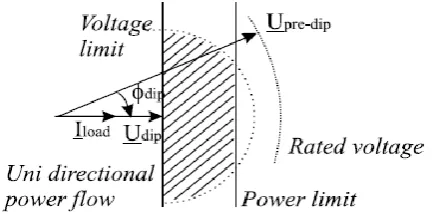
[image:4.595.331.551.113.220.2]All the limits should be taken into consideration in the control strategy. Fig. 1 illustrates a single-phase phasor diagram for one load case. The phasor of the pre-dip voltage is shown with a lagging load current and the voltage dip contains a negative phase jump with a reduced during-dip voltage. The voltage and power limits are indicated and the hatched region illustrates the region which the DVR can operate within. The pre-dip voltage cannot be maintained in the case illustrated in Fig. 1.
Fig. 1: A deep voltage dips with a phase jump. The hatched region indicates the region where the DVR can operate
Control strategy with symmetrical voltage dips Different control strategies have been evaluated in order to control the DVR. The most commonly used method is to put the DVR voltage in phase with the supply voltage, regardless of the actual phase angle of the load current. An undisturbed load voltage requires this method, but it may lead to a fast drain of the energy storage unit. Energy optimized control has been adapted to save energy and fully utilize the energy storage capacity.
Symmetrical voltage dip is ideally characterized by the dip duration, magnitude reduction and a phase jump. A control strategy for voltage dips with phase jump should be included in order to be able to compensate for this particular type of symmetrical voltage dip. The DVR can be controlled by a number ways to improve certain parameters. It is first assumed, that the DVR is only active during the voltage dip.
Voltage quality optimized control: The voltages are always compensated to the pre-dip level, disregarding that this may be an operating point with high voltage injection and energy depletion.
Voltage amplitude optimized control: The injected voltages are controlled in a way that minimizes the necessary injected voltages.
© 2016, IRJET | Impact Factor value: 4.45 | ISO 9001:2008 Certified Journal
| Page 442
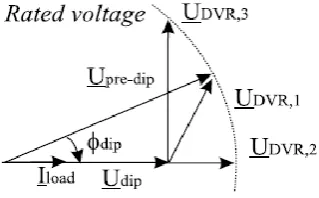
The three discussed control methods are illustrated inFig. 2.
Fig.2: Control strategies for a DVR compensating a voltage dip with a phase jump
The phase of the load voltages can be changed by the DVR, but with time the phase of the load currents will change until the same active and reactive power are absorbed by the load. The currents are equal for the supply, the DVR and the load and the amplitude of the current depends on the connected load. In a steady-state condition the load will absorb the same amount of power before and during the dip, if the voltage dip is fully compensated. The differences between the three methods are how much power, PDVRand voltage, UDVRthe DVR has to inject into the system. Two factors for evaluating the different methods are the voltage dip depth, Udipand the dip phase jump, φdip:
Fig. 3 illustrates the active and reactive power flow in the system also investigated. The control strategy depends on the type of load connected and the load response to a change in the phase of the impressed voltage. Some loads are very sensitive to a voltage phase shift and a phase shift should be avoided in the control. Other types of loads are more tolerant to phase shifts and the main criterion is to ensure the rated voltage on all three phases.
Fig.3: The flow of active and reactive power with a DVR inserted
Voltage quality optimized control:
Using the voltage quality optimization strategy the load voltages are always compensated to the pre-dip voltage amplitude and phase and the strategy gives undisturbed load voltages. In the case of a voltage dip without phase jump the method is equal to the voltage amplitude optimization. If a phase jump is present it can have a considerable impact on the power and voltage, which must be injected by the DVR.
A phase jump increases the amplitude of the voltage injection. The voltage quality optimized control is shown in Fig. 4 without phase jump (φdip = 0) for three
types of load (PFload = 0.5; 0.75; 1.0).
Fig.4: Voltage quality optimized control of the DVR for three different power factors. a) Power injected by the DVR as a function of the voltage dip and b) voltage injected as a function of the voltage dip.
[image:5.595.328.547.314.489.2] [image:5.595.40.248.621.720.2]© 2016, IRJET | Impact Factor value: 4.45 | ISO 9001:2008 Certified Journal
| Page 443
Voltage amplitude optimized control:Figure 5: Voltage quality optimization for three different power factors with φdip
= (-15 ◦). a) Power injected by the DVR as a function of the voltage dip and b) voltage injected by the DVR as a function of the voltage dip.
Voltage amplitude optimized control is a strategy, which gives a good utilization of the DVRs voltage rating during severe voltage dips with phase jump. The power from the DVR increases with the severity of the voltage dip and the power contribution from the supply drop proportional to the voltage dip.
Energy optimized control:
In the energy optimized control the DVR voltages are controlled according to a condition with low depletion of the energy storage. The only way to maximize the power absorbed from the supply is to decrease the angle between the load current and supply voltage. The power factor of the load determines how much the power from the supply can be increased. If the load angle was low before the voltage the power from the supply can only be increased slightly and the power has to come from the DVR to compensate for the voltage dip. Energy optimized control has of course less interest in DVR topologies, which uses the power from the supply instead of stored energy. The balance between active and reactive power is useful to evaluate the different strategies for a DVR.
It can be seen from Fig. 6b, that during a 0.5 voltage dip it is necessary with a (PFload = 1) to inject 0.5
pu-voltage, a (PFload = 0.75) to inject 0.71 pu-voltage and
a (PFload = 0.5) to inject 0.87 pu-voltage. The power
needed for this voltage dip is 0.5 p.u, 0.25 pu and 0 p.u respectively. The energy optimized control gains mostly interest with low power factor loads and it requires a
high voltage injection capability and loads, which are insensitive to phase shifts.
Fig.6: Energy optimized control with three different power factors. a) Power injected by the DVR as a function of the voltage dip and b) Voltage injected by the DVR as a function of the voltage dip
PROPOSED TOPOLOGY
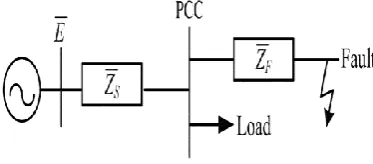
[image:6.595.37.266.133.287.2]A model of voltage sag at the point of common coupling (PCC) is illustrated in Fig. 1.
Fig.1: Single-phase model for voltage sag at the PCC
[image:6.595.343.530.415.497.2] [image:6.595.318.535.539.737.2]© 2016, IRJET | Impact Factor value: 4.45 | ISO 9001:2008 Certified Journal
| Page 444
The inter phase ac–ac converter topology, asshown in Fig.2, has a sag supporter in each phase consisting of two choppers connected to the other two phases independently, and it can account for phase-jump compensation
[image:7.595.315.540.184.707.2]Fig.3: AC chopper across phase- in the phase- sag supporter
Table 1: AC Chopper Parameters Parameters Values Rated voltage
and frequency
50V, 50Hz
Load 50Ω
Injection Transformer
1:1, 140V, 700VA
AC Chopper
Switching frequency fZ
5 kHz
Input
capacitance Cs
50 µF
Filter inductance Lf
0.25 mH
Filter
capacitance Cf
180 µF
To test the efficacy of the algorithm, two asymmetrical sags, and symmetrical sag are simulated using MATLAB, and the results are shown in Figs. 4–6. As discussed in the aforementioned sections, the magnitudes of the symmetrical components (Va1, Va2 , and Va0), sag-type indicator (Ty), characteristic voltage (Vch), reference voltage (Vref) in the affected phases, and the duty cycle of the choppers (d1 and d2) in the corresponding sag
supporters are estimated for three sag types.
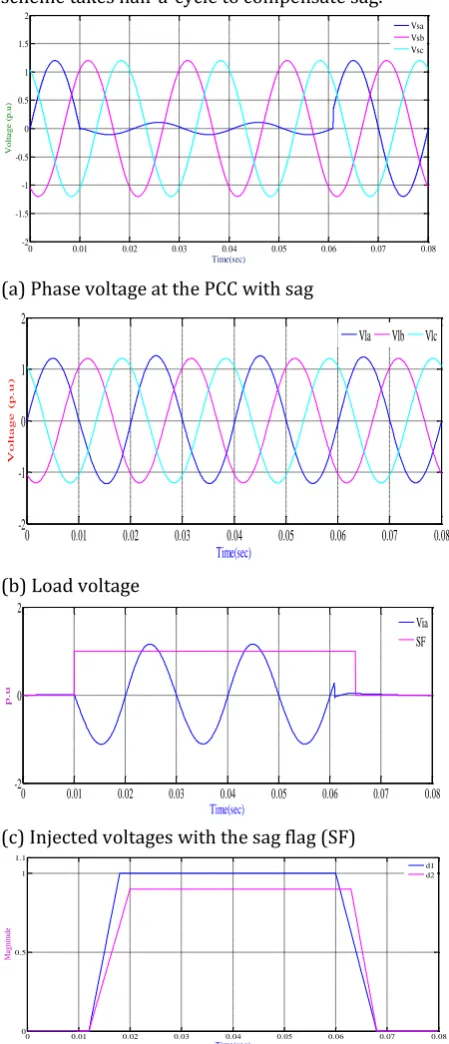
For single-phase sag as simulated in Fig.4 (a), the calculated Ty value and the presence of the zero
components (Va0) suggest that it is type Ba sag. Since phase-a is affected, the phasesag supporter is activated. Fig.4 (b) and Fig.4(c) shows compensated voltage, and injected voltage (via), which is accompanied by an SF.
The instant when the SF is high, the DVR is made operational. Here, the algorithm takes 1/8th of a power
cycle to detect and set the SF. The duty cycles d1 and d2
of the choppers across phase-b and phase-c, respectively, are shown in Fig. 4(d). It can be observed that the scheme takes half-a-cycle to compensate sag.
(a) Phase voltage at the PCC with sag
(b) Load voltage
(c) Injected voltages with the sag flag (SF)
(d) Duty cycle of the choppers in phase- sag supporter Fig.4: Compensation of a sag type Ba
Cb type sag with a characteristic voltage of 0.6 is considered. Since phases and are affected, both phase-c
0 0.01 0.02 0.03 0.04 0.05 0.06 0.07 0.08
-2 -1.5 -1 -0.5 0 0.5 1 1.5 2
Time(sec)
V
ol
ta
ge
(
p.
u)
Vsa Vsb Vsc
0 0.01 0.02 0.03 0.04 0.05 0.06 0.07 0.08
-2 -1 0 1 2
Time(sec)
V
ol
t
a
ge
(
p.
u)
Vla Vlb Vlc
0 0.01 0.02 0.03 0.04 0.05 0.06 0.07 0.08
-2 0 2
Time(sec)
p.
u
Via SF
0 0.01 0.02 0.03 0.04 0.05 0.06 0.07 0.08
0 0.5 1 1.1
Time(sec)
M
agni
tude
[image:7.595.37.247.188.360.2]© 2016, IRJET | Impact Factor value: 4.45 | ISO 9001:2008 Certified Journal
| Page 445
and a sag supporters are activated. From thecharacteristic voltage, the corresponding reference voltages are calculated from (11). Fig. 5(b) shows compensated voltages at the PCC, and it can be observed that the phase- voltage is compensated to the pre-sag condition, eliminating the 29 phase jump. Fig.5(c) shows injected voltages (vic and via) with SF, which is set in
1/4th of a power cycle for the case. Fig. 5(d) and Fig.5 (e)
shows the duty cycles of the choppers in sag supporters-c and a, respesupporters-ctively.
(a) Phase voltage at the PCC with sag
(b) Load voltage at the PCC.
(c) Injected voltages with the SF
(d) The duty cycle of voltages in phase-c Sag supporter.
(e) The duty cycle of choppers in phase-a sag supporter Fig.5: Compensation of a sag type Cb
Symmetrical sag exceeding the pre-sag compensation limit is considered in Fig.6 (a) with 50% sag magnitude and 600 phase jump. Here, the algorithm
switches to an in-phase compensation scheme, and the corresponding reference voltages are calculated. All sag supporters in three phases are activated. Fig.6 (b)–(d) shows the compensated voltages at the PCC, injected voltages, and the duty cycles of the choppers, respectively. Though sag duration of 2.5 cycles is compensated in the simulations from before; the compensation can be for a longer duration too. When the characteristic voltage at the PCC is within the compensation capability of the topology, the duration of compensation by the topology is limited only by the power available at the PCC.
(a) Phase voltage at the PCC with sag
0 0.01 0.02 0.03 0.04 0.05 0.06 0.07 0.08
-2 0 2
Time(sec)
V
ol
ta
ge
(
p.
u)
Vsa Vsb Vsc
0 0.01 0.02 0.03 0.04 0.05 0.06 0.07 0.08
-2 0 2
Time(sec)
V
ol
t
a
ge
(
p.
u)
Vla Vlb Vlc
0 0.01 0.02 0.03 0.04 0.05 0.06 0.07 0.08
-2 0 2
Time(sec)
p.
u
Via vic SF
0 0.01 0.02 0.03 0.04 0.05 0.06 0.07 0.08
0 0.5 1
Time(sec)
M
a
gni
t
ude
d1 d2
0 0.01 0.02 0.03 0.04 0.05 0.06 0.07 0.08
0 0.5 1 1.1
Time(sec)
M
a
gni
tude
d1 d2
0 0.01 0.02 0.03 0.04 0.05 0.06 0.07 0.08
-2 0 2
Time(sec)
V
ol
ta
ge
(
p.
u)
© 2016, IRJET | Impact Factor value: 4.45 | ISO 9001:2008 Certified Journal
| Page 446
(b) Load voltage at the PCC(c) Injected voltages with the SF
(d) The duty cycle of choppers in all sag supporters Fig.6: Compensation of a sag type A
CONCLUSION & FUTURE SCOPE CONCLUSION
In this thesis, a control scheme based on the characterization of voltage sag is proposed. It is tested on inter phase ac–ac converter topology and it is found that the scheme besides compensation gives insight on the limits on compensation imposed by various sag types. Therefore, it aids in the flexible compensation by switching between pre-sag and in-phase compensation. The scheme provides 100% compensation for type sag, and for all other types, compensation up to 50% sag magnitude with phase jumps ranging from 600 to 600 for
inter phase ac–ac topology. The algorithm takes; at most, half a cycle to compensate and it works in the presence of harmonics and unbalance, since the Fourier transform is employed to extract the fundamental component.
FUTURESCOPE
In the future, the proposed scheme can be possible to validate by real time testing using DSP.
REFERENCES
[1].R. S. Vedam and M. S. Sarma, Power Quality: VAR Compensation in Power Systems. Boca Raton, FL, USA: CRC, 2009.
[2].M. H. J. Bollen, Understanding Power Quality Problems. Piscataway, NJ, USA: IEEE, 2000.
[3].R. C. Dugan, M. F. McGranaghan, S. Santoso, and H.W. Beaty, Electrical Power Systems Quality. New York, USA: Mc Graw-Hill, 2004.
[4].J. G. Nielsen and F. Blaabjerg, “A detailed comparison of system topologies for dynamic voltage restorers,”
IEEE Trans. Ind. Appl., vol. 41, no. 5, pp. 1272–1280, Sep./Oct. 2005.
[5].G. Venkataramanan, B. K. Johnson, and A. Sundaram, “An AC-AC power converter for custom power applications,” IEEE Trans. Power Del., vol. 11, no. 3, pp. 1666–1671, Jul. 1996.
[6].S. M. Hietpas and M. Naden, “Automatic voltage regulator using an AC voltage-voltage converter,”
IEEE Trans. Ind. Appl., vol. 36, no. 1, pp. 33–38, Jan./Feb. 2000.
[7].E. C. Aeloíza, P. N. Enjeti, L. A. Morán, O. C. M. Hernandez, and S. Kim, “Analysis and design of a new voltage sag compensator for critical loads in electrical power distribution systems,” IEEE Trans.Ind. Appl., vol. 39, no. 4, pp. 1143–1150, Jul./Aug. 2003.
[8].E. Babaei, M. F. Kangarlu, and M. Sabahi, “Mitigation of voltage disturbances using dynamic voltage restorer based on direct converters,” IEEE Trans. Power Del., vol. 25, no. 4, pp. 2676–2683, Oct. 2010. [9].B. Wang and G. Venkataramanan, “Dynamic voltage
restorer utilizing a matrix converter and flywheel energy storage,” IEEE Trans. Ind. Appl., vol. 45, no. 1, pp. 222–231, Jan./Feb. 2009.
[10]. P. M. Garcia-Vite, F. M. David, and J.M. Ramirez, “Per-sequence vector-switching matrix converter
0 0.01 0.02 0.03 0.04 0.05 0.06 0.07 0.08
-2 0 2
Time(sec)
V
ol
t
a
ge
(
p.
u)
Vla Vlb Vlc
0 0.01 0.02 0.03 0.04 0.05 0.06 0.07 0.08
-2 0 2
Time(sec)
p.
u
Via vib vic SF
0 0.01 0.02 0.03 0.04 0.05 0.06 0.07 0.08
0 0.5 1 1.1
Time(sec)
M
a
gni
t
ude
© 2016, IRJET | Impact Factor value: 4.45 | ISO 9001:2008 Certified Journal
| Page 447
modules for voltage regulation,” IEEE Trans. Ind.Electron., vol. 60, no. 12, pp. 5411–5421, Dec. 2013.
AUTHORS:
1. V LEELA BHARATH REDDY was born in 1993. He completed her professional career of education in B.Tech (EEE) at Sri Krishnadevaraya engineering college in the year of 2014 and pursuing M.Tech from Sri Krishnadevaraya engineering
college, Gooty,
Anantapur(AP).He is interested in Electrical Power Engineering.
2. K.SWATHI has 4 years’ experience in teaching in graduate and post graduate level and she presently working as Assistant professor in department of EEE Sri Krishna devaraya Engineering College, Gooty, AP, India.
3.Mr. N. Narasimhulu has completed his professional career of education in B.Tech (EEE) from JNTU Hyderabad. He obtained M.Tech degree from JNTU, HYDERABAD.Now he is pursuing Ph.d from JNTU ANANTAPUR. At present working as an Associate Professor and Head of the EEE Department in Srikrishna Devaraya Engineering College, Gooty of Anantapuramu district (AP).
4.Dr.R.RAMACHANDRA has completed his professional career of education in B.Tech (MECHANICAL) from JNTU Hyderabad. He obtained M.Tech degree from JNTU, Hyderabad. He obtained Phd degree from JNTU, Hyderabad At present working as Principal in Srikrishna Devaraya Engineering College, Gooty of Anantapuramu