© 2017, IRJET | Impact Factor value: 5.181 | ISO 9001:2008 Certified Journal | Page 1630
Compressing the Dependent Elements of Multiset
Yogesh Shankar Landge
1, Prof. Dr.Girish K. Patnaik
21,
Student, Department of Computer Engineering, SSBT’s COET, Bambhori, Jalgaon (M.S.), India
2,
Prof. and Head, Department of Computer Engineering, SSBT’s COET, Bambhori, Jalgaon (M.S.), India
---***---Abstract -
A multiset is an unordered collection ofmathematical objects with repetitions allowed. Many authors showed that there is only one way to represent the multiset, i.e. the representation of multiset as sequences. But no one showed that the multiset can also be represented in multiplitive form. By performing operations like (union, intersection, sum and difference) on multisets having multiplitive form, the dependent elements of multiset are obtained. And can be compressed and decompressed in the similar manner as the independent elements of the multiset, because both the elements are related to each other. A Lossless compression and decompression algorithms for multisets; taking advantage of the multisets representation structure is described. The encoding technique that transforms the dependent elements of multiset into an order-invariant tree representation, and derive an arithmetic code that optimally compresses the tree. The proposed lossless compression algorithm achieves different arithmetic codes for dependent elements and independent elements of multiset and generating their lengths respectively on the basis on certain operations performed on multisets. With the help of the proposed system both the elements independents and dependents of multiset can be compressed and decompressed simultaneously.
Key Words: Lossless Data Compression, Dependent Elements of Multiset, Multiplicative Form, Union Operation, Intersection Operation, Sum Operation, Difference Operation…
1. INTRODUCTION:
The theory of sets is absolutely necessary to the world
of mathematics. But in set theory where repetitions of objects are not allowed it often become difficult to complex systems. If one considers those complex systems where repetitions of objects become certainly inevitable, the set theoretical concepts fails and thus one need more sophisticated tools to handle such situations. This leads to the initiation of multiset (M-set) theory as a generalization of set theory.A multiset is a set that each item in the set has a
multiplicity which specifies how many times the item repeats. The multisets are represented in different types of forms.an multiset containing one occurrence of p, two occurrences of q, and three occurrences of r is notationally written as [[p; q; q; r; r; r]] or [p; q; q; r; r; r] or [p; q; r]1;2;3 or [1.p; 2.q; 3.r] or [p.1; q.2; r.3], depending on one's taste and convenience.An information pressure calculation makes an interpretation of a data article to a compacted grouping of yield images, from which the first data can be recouped with a coordinating decompression calculation. Compressors (and their coordinating decompressors) are planned with the objective that the compacted yield is, by and large, less expensive to store or transmit than the first information.
For example if one wants to store a large data file, it may be preferable to first compress it to a smaller size to save the storage space. Compressed files are much more easily exchanged over the internet since they upload and download much faster. We require the capacity to reconstitute the first record from the compacted rendition whenever. Information pressure is a system for encoding decides that permits considerable decrease in the aggregate number of bits to store or transmit a document. The more data being managed, the more it expenses regarding stockpiling and transmission costs. To put it plainly, Data Compression is the procedure of encoding information to less bits than the first representation so it consumes less storage space and less transmission time while conveying more than a system. Data compression algorithms are classified in two ways i.e. lossy and lossless data compression algorithm. A compression algorithm is utilized to changeover information from a simple to-utilize arrangement to one advanced for smallness. In like manner, an uncompressing system gives back the data to its unique structure.
The motivation behind the present study is the knowledge of the representation of multisets in different forms and the certain operations performed on multisets. With the help of the two concepts, the new idea can be generated, i.e. the detailed knowledge could be obtained in the field of the dependent elements of multiset.
The contribution of the present study is to extend the concept of multiset theory proposed by Steinruecken [11]. The author does not give any method to generate a mutiset having the dependent elements. The main contribution of the present study is to how to obtain the dependent elements of multiset. After that, applying a lossless compression algorithm on the dependent elements of multiset to compress them into a tree based arithmetic codes and vice-versa.
© 2017, IRJET | Impact Factor value: 5.181 | ISO 9001:2008 Certified Journal | Page 1631
Discussion, and the conclusion implicating benefits ofproposed solution is described in Section 5.
2. LITERATURE SURVEY:
Singh and Isah, in [1], proposed a note on category of multisets (Mul).The authors overcome the problem where the consistency criterion for the existence of mono, epi, and iso-morphisms in Multiset is not considered. The authors provided the consistency criterion for the existence of mono, epi, and iso-morphisms by using mapping concept between multi-sets. The authors have given the criterion that objects of the same sort cannot be mapped to objects of different sorts. (i) f: X→ Y is a monomorphism in Multiset iff: X→ Y is one-to-one, sort-preserving. For example, f: [a, a, a] → [b, b, b] can be a monomorphism. (ii) f: X→ Y is an epimorphism in Mul iff: X→Y is onto, sort-preserving. For example, f: [a, a, a] → [b, b] can be an epimorphism. (iii) f: X→ Y is an isomorphism in Mul iff: X→ Y is a bijection, sort-preserving. The advantage of the proposed solution is that it makes easier to identify the type of morphism between multisets.
Ghilezan, in [2], proposed binary relations and algebras on multisets. Contrary to the notion of a set or a tuple, a multiset is an unordered collection of elements which do not need to be different. As multisets are already widely used in combinatorics and computer science. The author applied algebras on multiset theory. The author has considered generalizations of known results that hold for equivalence and order relations on sets and get several properties that are specific to multisets. Furthermore, the author has also exemplified the novelty that brings this concept by showing that multisets are suitable to represent partial orders. The advantage of the proposed concept is that it proves two algebras on multisets cannot be isomorphic even if their root algebras are isomorphic.
Isah and Tella, in [3], proposed the concept on categories of multiset (Mul) and topological spaces (Top).The authors have illustrated the concept of an isomorphism in categorical context and shows that a bimorphism is not necessarily an isomorphism in the categories multiset and topological spaces. Multisets (considered as objects) and multiset functions (considered as morphisms) together determine the category of multisets, denoted Mul. For example, f: [a, b, c] → [d, e, e], defined by f(a) = d, f(b) = e, f(c) = e, is an mset morphism which is a monomorphism and an epimorphism, and therefore a bimorphism, but not an isomorphism: since f(b) and f(c) are of the same sort but b and c are of different sorts. The multiset morphism f: [a, a, b] → [c, c, d], defined by f(a) = c, f(b) = d, f(a) = c, is an isomorphism. Moreover, the morphism g: [a, b] → [c, d], defined by g(a) = c, g(b) = d, is also an isomorphism. The advantage of the proposed concept is that both Mul and Top are not balanced thus; a bimorphism in Mul, Top is not necessarily an isomorphism. And, whereas Set, Abelian group, Ring and Group are balanced since every bimorphism is an isomorphism.
Girish and John, in [4], proposed the idea on multiset topologies. General topology is defined as a set of sets but multiset topology is defined as a set of multisets. The concept of topological structures and their generalizations is one of the most powerful notions in branches of science such as chemistry, physics and information systems. In most applications the topology is used to handle the qualitative information. In any information system, some situations may occur, where the respective counts of objects in the universe of discourse are not single. In such situations where dealing with collections of information in which duplicates are allowed. In such cases multisets play an important role in processing the information. The information system dealing with multisets is said to be an information multisystem. Thus, information multisystems are more compact when compared to the original information system. In fact, topological structures on multisets are generalized methods for measuring the similarity and dissimilarity between the objects in multisets as universes. The theoretical study of general topology on general sets in the context of multisets can be a very useful theory for analyzing an information multisystem. Most of the theoretical concepts of multisets are originated from combinatorics. Combinatorial topology is the branch of topology that deals with the properties of geometric figures by considering the figures as being composed of elementary geometric figures. The combinatorial method is used not only to construct complicated figures from simple ones but also to deduce the properties of the complicated from the simple. In combinatorial topology it is remarkable that the only machinery to make deductions is the elementary process of counting. In such situations, elements can occur more than once. The advantage of the proposed work is that the theory of M-topology may be useful for studying combinatorial topology with collections of elements with duplicates.
Tella and Daniel, in [5], proposed the concept of the symmetric groups under multiset perspective. Research on the multiset theory has not yet gained ground and is still in its infant stages. According to the authors, the research carried out so far shows a strong analogy in the behaviour of multisets and sets and it is possible to extend some of the main notions and results of sets to that of multisets for instance, the theoretical aspects of multisets By extending the notions of relations, functions, composition and partition have been explored. The advantage of the proposed concept is that it defines a symmetric multigroup and derives the analogous Cayleys theorem.
© 2017, IRJET | Impact Factor value: 5.181 | ISO 9001:2008 Certified Journal | Page 1632
elements. But the disadvantage of the proposed study isthat it does not address the concepts of Lagranges theorem, homomorphism of groups and symmetric groups in the context of multigroup theory.
Girish and John, in [7], proposed the concept of Rough Multisets and Information Multisystems. The most essential property of multisets is the multiplicity of the elements that allows distinguishing it from a set and considering it as a qualitatively new mathematical concept. In any information system, some situations may occur, where the respective counts of objects in the universe of discourse are not single. There are many situations where dealing with collections of information in which duplicates are significant. In such cases multisets play an important role in processing the information. The information system dealing with multisets is said to be an information multisystem. Thus, information multisystems are more compact when compared to the original information system. The authors have given a new dimension to Pawlaks rough set theory, replacing its universe by multisets. This is called a rough multiset and is a useful structure in modelling information multisystem. The processes involved in the intermediate stages of reactions in Chemical systems are a typical example of a situation which gives rise to multiset relations. Information multisystem is represented using rough multisets and is more convenient than ordinary rough sets. The authors have proposed the idea with Yagers theory of multisets. After presenting the theoretical study, the concepts mset relations, equivalence mset relations, partitions, and knowledge mset base have been established. Finally the concepts of rough multisets and related properties with the help of lower mset approximation and upper mset approximations have been introduced. The advantage of the proposed concept shows is that rough multisets are important frameworks for certain types of information multisystems.
Kuo, in [8], proposed the concept of Multiset Permutations in Lexicographic Order. The author proposed a simple and flexible method for generating multiset permutations in lexicographic order. Multiset permutation can be applied in combinations generation, since a combination of p items out of q items set is a special case of multiset permutations that contain q 1s and (q-p) 0s. For example, a combination of 5 items out of 10 items can be described as 1010011001 to stand the first item, the 4th item, the 5th item, 8th item and the last item are picked up. Obviously, this is a permutation of a multiset 5 0, 5 1. In other words, the advantage of the proposed technique is that the multiset permutations can be generated directly without any help of remapping. The new method is conceptually easy to understand and implement and is well-suited to a wide variety of permutation problems.
Singh et al., in [9], proposed the concept of Complementation in Multiset Theory. The paper delineates the problem related to difference and complementation in Multiset Theory. It is shown that none
of the existing approaches succeeds in resolving the attendant difficulties without assuming some contrived stipulations. In this paper, the authors have endeavoured to revisit the problem related to difference and complementation in multiset theory. It is shown that the attendant difficulties do remain unresolved unless some contrived stipulations are assumed. It has been demonstrated that the technique of introducing a cardinality bounded multiset space proves advantageous in many ways especially in Database systems. However, as investigated above none of the existing approaches succeeds if the goal is to augment the theory of multiset endowed with a Boolean algebraic structure without assuming some contrived situations. In fact, the obvious alternatives seem to be exhausted. However, some further adept explications cannot be ruled out.
Singh et al., in [10], focused on Some Applications of -Cuts in Fuzzy Multiset Theory. The authors briefly describe fuzzy set, multiset, fuzzy multiset, -cuts and related results. In particular, it is shown how -cuts turn out to be an intertwining thread between multiset and fuzzy multisets. It has been shown that either of the aforesaid representations allows us to extend various properties of crisp multisets and operations on crisp multisets to their fuzzy multiset counterparts. These extensions are cut worthy since in each representation, a given crisp property or operation is required to be valid for each crisp multiset involved in the representation.
Steinruecken, in [11], proposed the concept of compressing sets and multisets of sequences. The problem was that the information was being wasted for encoding multisets by simply storing its elements in some sequential order. The author has given the solution to the problem, by proposing a technique that transforms the multiset into an order-invariant tree representation, and derives an arithmetic code that optimally compresses the tree. The advantage of the technique is that the information is saved while encoding the multisets. And on the other hand, the disadvantage of the technique is that it does not compress the dependent elements of multisets.
© 2017, IRJET | Impact Factor value: 5.181 | ISO 9001:2008 Certified Journal | Page 1633
3. PROPOSED SOLUTION:
In tree based encoding and decoding, multisets can be encoded and decoded using various techniques. Tree based encoding needs to ensure that the compression should be lossless compression. The compression and decompression of independent multisets has been done with the help of encoding and vice-versa. But in the existing system, when the scenario is multisets having the dependent elements, there is no way to obtain the dependent elements of multiset and after that, compress and decompress like the independent elements of multiset to convert into arithmetic codes.
In the proposed system it is assure that encoding is done with lossless compression and it is done on dependent multisets. Different operations are performed on multisets in order to generate dependent multisets on which encoding is done. The Proposed system takes into considerations two things that are required to provide the solution to the problem.
I. The representation of the multisets as Multiplicative form instead of Sequences Form. and
II. The different types of operations performed on multisets of Multiplicative form.
There are certain types of operations like union, intersection, sum and difference can be applied on multisets, after performing the respective operations on multiset A and multiset B (assume), the resulting multiset (assume multiset c) is obtained.
a. If the union operation is performed on multiset A and multiset B, the resulting multiset C is obtained, where the multiset A and multiset B having the independent element while the multiset C contains the dependents elements. b. If the intersection operation is performed on
multiset A and multiset B, the resulting multiset C is obtained, where the multiset A and multiset B having the independent element while the multiset C contains the dependents elements. c. If the sum operation is performed on multiset A
and multiset B, the resulting multiset C is obtained, where the multiset A and multiset B having the independent element while the multiset C contains the dependents elements. d. If the difference operation is performed on
multiset A and multiset B, the resulting multiset C is obtained, where the multiset A and multiset B having the independent element while the multiset C contains the dependents elements.
The existing system only compresses and decompresses the independent elements of multiset (taking one multiset at a time) and generated the respective arithmetic codes for the multiset. It is known that there are two parts of multisets, one part is multiset having the independent elements and second part is multiset having the dependent element. To obtain the second part of multiset that is multiset having the dependent element, firstly the
multiset is represented in the multiplicative form. And secondly the certain operations like union, intersection, sum and difference are perform on multisets having the independent elements, so the resulting multiset is a multiset having the dependents element. This is the process to get the second part of multiset (multiset having the dependents element). Now, performing similar the lossless compression and decompression algorithms, on the dependent elements of multisets, the resulting arithmetics codes are generated based on operations performed. With the help of arithmetics codes, the difference between independent elements of multisets and dependent element of multiset can be made.
There are certain advantages using the proposed system:
I. At the same time both the part of multiset (independent and dependent) can be com-pressed and decomcom-pressed with the help of the proposed system.
II. It minimizes transmission time by simultaneously executing both the part of multisets.
3.1 Assumptions:
In the proposed system following assumptions are made.
The multisets are being taken in the form of alphabets (a, b, c, d and e).
a, b, c, d and e are the elements of multisets where Consider a=1 b=2 c=3 d=4 e=5.
1, 2, 3, 4, and 5 are the decimal value for the elements of multisets a, b, c, d, and e respectively.
3.2 Proposed System Architecture:
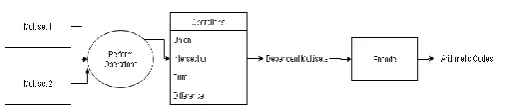
[image:4.595.308.561.572.627.2]Architecture is a system that unifies its components into a coherent and functional block. Figure 3.1 shows architecture of the proposed system.
Fig -3.1: Architecture of the Proposed System
© 2017, IRJET | Impact Factor value: 5.181 | ISO 9001:2008 Certified Journal | Page 1634
3.3 Design:
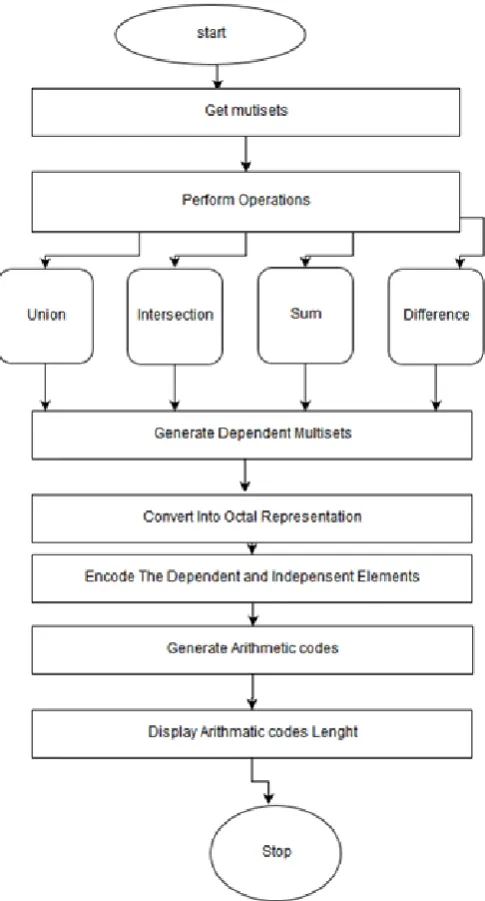
To generate both the dependent and independent elements of multisets, the modification in the past scheme can be done by performing the operations on multisets. To design the proposed system the above consideration is kept in mind that ensures the generation of both the elements and producing the arithmetic codes respectively.
Encoding Algorithm:
Require: Input (Multiset 1, Multiset 2), Assume (a=1, b=2, c=3, d=4, e=5).
1: Take Two Multisets as input.
2: Perform operations over multisets: Union, Intersection, Sum, and Difference.
3: Operatios Result over multisets: Dependent Multisets that contain total elements N, and length of string of elements L.
4: Encode N, L using Binomial Probability Distribution in tree form.
5: Let (t0) and t1 denote children of tree T, and n0 and n1 the children’s count.
6: Encode n using a binomial code, n=Binomial (n0+n1,
Ө
) 7: if (n0 >0) then8: Call encode node (t0) 9: end if
10: if (n1 >0) then 11: Call encode node (t1) 12: end if
Decoding Algorithm:
Require: Input(Arithmetic codes), Assume(a=1,b=2,c=3,d=4,e=5)
1: Decode N, using the same code over positive integers. 2: Return T, Decode node (N, L)
3: if (l >0) then
4: Decode n1 using binomial code 5: end if
6: if (n0 >0) then
7: t0 ← Decode node (n0, l-1) 8: end if
9: if (n1 >0) then
10: t0 ← Decode node (n1, l-1) 11: end if
[image:5.595.312.555.76.527.2]12: Return a new tree node with count n and children t0 and t1.
Fig -3.2: Flowchart of the Proposed System
4. RESULT AND DISCUSSION:
Result and discussion section is a primary part of research work. Evaluation of the proposed approach versus existing approach is carried out in the result and discussion section. Result section represents the experimental results of the proposed approach as well as the existing approach. Evaluation of the both the approaches are carried out in the discussion section on the basis of obtained results. In some cases various parameters i.e. performance metrics like tables are used to evaluate the system, in order to decide which one is the best.
4.1 Experimental Results:
© 2017, IRJET | Impact Factor value: 5.181 | ISO 9001:2008 Certified Journal | Page 1635
involvement of proposed lossless compression algorithmis proved better by carrying out experiments.
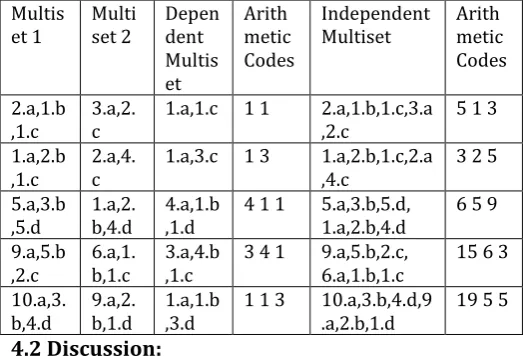
Results are carried out using java. In proposed system, arithmetic codes are generated both for dependent as well as independent elements of multiset at the same time instead of generating arithmetic code for only the independent elements of multiset. The results are taken by executing the algorithm with all combinations and average of 5 multisets are taken into consideration for each and every operation. Below Results show the arithmetic codes for dependent and independent multiset and the length respectively. All the evaluation is done on i3 processor with 4GB RAM and may vary as and when the hardware is changed.
Table -4.1: shows the comparison of arithmetic codes generated for the dependent multiset and independent multiset using union operation.
Multis
et 1 Multiset 2 Dependent Multis et
Arith metic Codes
Independent
Multiset Arithmetic Codes
2.a,1.b
,1.c 3.a,2.c 3.a,1.b,2.c 3 1 2 2.a,1.b,1.c,3.a,2.c 5 1 3 1.a,2.b
,1.c 2.a,4.c 2.a,2.b,4.c 2 2 4 1.a,2.b,1.c,2.a,4.c 3 2 5 5.a,3.b
,4.d 1.a,2.b,5.d 5.a,3.b,5.d 5 3 5 5.a,3.b,4.d, 1.a,2.b,5.d 6 5 9 6.a,5.b
,1.c 9.a,1.b,2.c 9.a,5.b,2.c 9 5 2 6.a,5.b,1.c, 9.a,1.b,2.c 15 6 3 10.a,2.
b,4.d 9.a,3.b,1.d 10.a,3.b,4.d 10 3 4 10.a,2.b,4.d,9.a,3.b,1.d 19 5 5
Table -4.2: shows the comparison of arithmetic codes generated for the dependent multiset and independent multiset using intersection operation.
Multis
et 1 Multiset 2 Dependent Multis et
Arith metic Codes
Independent
Multiset Arithmetic Codes
2.a,1.b
,1.c 3.a,2.c 2.a,1.c 2 1 2.a,1.b,1.c,3.a,2.c 5 1 3 1.a,2.b
,1.c 2.a,4.c 1.a,1.c 1 1 1.a,2.b,1.c,2.a,4.c 3 2 5 5.a,3.b
,4.d 1.a,2.b,5.d 1.a,2.b,4.d 1 2 4 5.a,3.b,4.d, 1.a,2.b,5.d 6 5 9 6.a,5.b
,1.c 9.a,1.b,2.c 6.a,1.b,1.c 6 1 1 6.a,5.b,1.c, 9.a,1.b,2.c 15 6 3 10.a,2.
b,4.d 9.a,3.b,1.d 9.a,2.b,1.d 9 2 1 10.a,2.b,4.d,9.a,3.b,1.d 19 5 5
Table -4.3: shows the comparison of arithmetic codes generated for the dependent multiset and independent multiset using sum operation.
Multis
et 1 Multiset 2 Dependent Multis et
Arith metic Codes
Independent
Multiset Arithmetic Codes
2.a,1.b
,1.c 3.a,2.c 5.a,1.b,3.c 5 1 3 2.a,1.b,1.c,3.a,2.c 5 1 3 1.a,2.b
,1.c 2.a,4.c 3.a,2.b,5.c 3 2 5 1.a,2.b,1.c,2.a,4.c 3 2 5 5.a,3.b
,4.d 1.a,2.b,5.d 6.a,5.b,9.d 6 5 9 5.a,3.b,4.d, 1.a,2.b,5.d 6 5 9 6.a,5.b
,1.c 9.a,1.b,2.c 15.a,6.b,3.c 15 6 3 6.a,5.b,1.c, 9.a,1.b,2.c 15 6 3 10.a,2.
b,4.d 9.a,3.b,1.d 19.a,5.b,5.d 19 5 5 10.a,2.b,4.d,9.a,3.b,1.d 19 5 5
Table -4.4: shows the comparison of arithmetic codes generated for the dependent multiset and independent multiset using difference operation.
Multis
et 1 Multiset 2 Dependent Multis et
Arith metic Codes
Independent
Multiset Arithmetic Codes
2.a,1.b
,1.c 3.a,2.c 1.a,1.c 1 1 2.a,1.b,1.c,3.a,2.c 5 1 3 1.a,2.b
,1.c 2.a,4.c 1.a,3.c 1 3 1.a,2.b,1.c,2.a,4.c 3 2 5 5.a,3.b
,5.d 1.a,2.b,4.d 4.a,1.b,1.d 4 1 1 5.a,3.b,5.d, 1.a,2.b,4.d 6 5 9 9.a,5.b
,2.c 6.a,1.b,1.c 3.a,4.b,1.c 3 4 1 9.a,5.b,2.c, 6.a,1.b,1.c 15 6 3 10.a,3.
b,4.d 9.a,2.b,1.d 1.a,1.b,3.d 1 1 3 10.a,3.b,4.d,9.a,2.b,1.d 19 5 5
4.2 Discussion:
The purpose of the discussion section is to state interpretations and opinions, explain the implications of findings in the experimental evaluation. Main function of discussion section is to answer the questions posed in the Introduction, explain how the results support the answers and, how the answers fit in with existing knowledge on the topic. The discussion section is important to know the detail advantage and need about proposed solution. [image:6.595.303.565.351.529.2]
© 2017, IRJET | Impact Factor value: 5.181 | ISO 9001:2008 Certified Journal | Page 1636
5. CONCLUSION AND FUTURE WORK:
The proposed system is developed to solve the problem of not compressing both the independent as well as the dependent elements of multisets simultaneously. To solve the problem, it is ensuresed that the multisets can also be represented in various forms. The multiplicative form is the one of them. The advantage of representing multiset in multiplicative form is that the dependent multiset can be obtained by performing operations on multisets having multiplicative form. After that the second part of multiset (multiset having dependent element can be compressed in the form of arithmetic codes and vice versa). The proposed system not only compresses the independent elements of multisets but also the dependent elements of multiset by performing operations on multisets.
In the future, it would be a point of research to compress and decompress the special type of Multiset i.e., Fuzzy Multiset into arithmetic codes.
REFERENCES
[1] D. Singh and A. I. Isah, "A note on category of multisets (Mul)," International Journal of Algebra, vol. 7, no. 2, pp. 73-78, 2013.
[2] S. G. and Jovanka Pantovi, “Binary relations and algebras on multisets," Publications De LInstitute Mathematique, vol. 9, no. 5, pp. 111-117, 2014.
[3] A. I. Isah and Y. Tella, “On categories of multisets (Mul) and topological spaces (top),"International Journal of Science and Technology, vol. 2, no. 6, pp. 442-445, 2013.
[
4] K. P. Girish and S. J. John, “On multiset topologies," Theory and Applications of Mathematics Computer Science, vol. 2, no. 1, pp. 37-52, 2012.[5] Y. Tella and S. Daniel, “Symmetric groups under multiset perspective," IOSR Journal of Mathematics, vol. 7, no. 5, pp. 47-52, 2013.
[6] Y.Tella and S. Daniel, “A study of group theory in the context of multiset theory, "International Journal of Science and Technology, vol. 2, no. 8, pp. 609-615, 2013.
[7] K. P. Girish and S. J. John, “Rough multisets and information multisystems," Hindawi Publishing Corporation Advances in Decision Science, vol. 5, no. 6, pp. 1-17, 2011.
[8] T. Kuo, “Multiset permutations in lexicographic order," International Journal of Emerging Technology and Advanced Engineering, vol. 4, no. 1, pp. 442-448, 2014.
[9] D. Singh, A. M. Ibrahim, and T. Yohana, “Complementation in multiset theory," International Mathematical Forum, vol. 6, no. 38, pp. 1877-1884, 2011.
[10] D. Singh, A. J. Alkali, and A. I. Isah, “Some applications of -cuts in fuzzy multiset theory," Journal of Emerging Trends in Computing and Information Sciences, vol. 5, no. 4, pp. 328-335, 2014.
[11] C. Steinruecken, “Compressing sets and multisets of sequences," Ieee Transactions on Information Theory, vol. 61, no. 3, pp. 1485-1490, 2015.
BIOGRAPHIES
Yogesh Shankar Landge is a
Student in Department of
Computer Engineering, SSBT’s COET, Bambhori, Jalgaon (M.S.), India.