Rescuing the physician-scientist workforce: the
time for action is now
Dianna M. Milewicz, … , Lawrence F. Brass, the National
Association of MD-PhD Programs Executive Committee
J Clin Invest.
2015;
125(10)
:3742-3747.
https://doi.org/10.1172/JCI84170
.
The 2014 NIH Physician-Scientist Workforce (PSW) Working Group report identified
distressing trends among the small proportion of physicians who consider research to be
their primary occupation. If unchecked, these trends will lead to a steep decline in the size of
the workforce. They include high rates of attrition among young investigators, failure to
maintain a robust and diverse pipeline, and a marked increase in the average age of
physician-scientists, as older investigators have chosen to continue working and too few
younger investigators have entered the workforce to replace them when they eventually
retire. While the policy debates continue, here we propose four actions that can be
implemented now. These include applying lessons from the MD-PhD training experience to
postgraduate training, shortening the time to independence by at least 5 years, achieving
greater diversity and numbers in training programs, and establishing Physician-Scientist
Career Development offices at medical centers and universities. Rather than waiting for the
federal government to solve our problems, we urge the academic community to address
these goals by partnering with the NIH and national clinical specialty and medical
organizations.
Perspective
Find the latest version:
In June 2014, the NIH Physician-Scientist Workforce (PSW) Work-ing Group completed a year of data collection and deliberation, and released a report about the status of the PSW (1). The report is a combination of good news and bad news. The good news is that, despite the decline in the NIH budget, the size of the PSW has remained relatively stable. The bad news is that the current demo-graphics, diversity, and career progression of this workforce raise concerns about the future. For a start, although apparently stable in size, the PSW is even smaller than many of us realized, and the apparent stability has hidden important demographic trends. In American Medical Association surveys of the nearly 1 million (and rising) MD physicians in the United States, only 14,000 (1.5%) consider research to be their primary focus (1). Even fewer have NIH grant support; only 8,200 physicians are principal investiga-tors on NIH grants, split evenly between MDs and MD-PhDs (1). The number of extramural NIH-funded physician-scientists with research program (R series) awards has been essentially constant for the past 20 years, while the number of nonphysician (PhD) NIH-funded investigators has increased by half over the same period, reaching 19,400 in 2012 (1). As a result, the percentage of NIH awardees who are physicians has fallen to 30%. Although public policies have encouraged an increase in the number of med-ical schools and medmed-ical students in the US, and medmed-ical school admission policies have placed value on undergraduate research, the percentage of physicians focused on research has fallen.
At the same time that the PSW has remained stable in size, data in the report show that the average age of the workforce is rising, as older investigators remain employed and younger investigators have not emerged in sufficient numbers. The average age at which a phy-sician-scientist received his or her first NIH R01 grant in 2011 was 44 years for MD-PhDs and 45 years for MDs: approximately 10 years older than in 1980 (2). R01-funded investigators (physicians and non-physicians) younger than 37 years have all but disappeared, and the time from graduating medical school to obtaining a first faculty posi-tion has increased to over 10 years for MD-PhDs and even longer for MDs without a PhD. Women and minorities are underrepresented, having opted not to enter or remain in the workforce. Thus, gathering places for physician-scientists look mostly like clubs for older white men. Without corrective action, the PSW appears headed for a popu-lation crash as older investigators retire. We recognize that younger physician-scientists have not entirely disappeared; they just take lon-ger to obtain faculty appointments and independent NIH grants. This situation creates an extended waiting period that we call the holding zone, which contributes to the disturbing demographics (Figure 1).
Enough talk, let’s do something
The NIH advisory group noted these trends and made recommen-dations that should be considered (1). Rather than repeating them here, we would like to join the discussion by adding the perspec-tive of four NIH-funded physician-scientists and educators who lead long-established MD-PhD training programs at our respec-tive institutions. The views are our own but also reflect those of the other members of the Executive Committee of the National Asso-ciation of MD-PhD Programs, an organization that each of us has The 2014 NIH Physician-Scientist Workforce (PSW) Working Group report identified distressing trends among the small
proportion of physicians who consider research to be their primary occupation. If unchecked, these trends will lead to a steep decline in the size of the workforce. They include high rates of attrition among young investigators, failure to maintain a robust and diverse pipeline, and a marked increase in the average age of physician-scientists, as older investigators have chosen to continue working and too few younger investigators have entered the workforce to replace them when they eventually retire. While the policy debates continue, here we propose four actions that can be implemented now. These include applying lessons from the MD-PhD training experience to postgraduate training, shortening the time to independence by at least 5 years, achieving greater diversity and numbers in training programs, and establishing Physician-Scientist Career Development offices at medical centers and universities. Rather than waiting for the federal government to solve our problems, we urge the academic community to address these goals by partnering with the NIH and national clinical specialty and medical organizations.
Rescuing the physician-scientist workforce:
the time for action is now
Dianna M. Milewicz,1 Robin G. Lorenz,2 Terence S. Dermody,3 Lawrence F. Brass,4
and the National Association of MD-PhD Programs Executive Committee5
1Department of Internal Medicine, University of Texas Health Science Center at Houston, Houston, Texas, USA. 2Department of Pathology, University of Alabama at Birmingham, Birmingham, Alabama, USA.
3Departments of Pediatrics and Pathology, Microbiology, and Immunology, Vanderbilt University School of Medicine, Nashville, Tennessee, USA. 4Departments of Medicine and Pharmacology,
University of Pennsylvania, Philadelphia, Pennsylvania, USA. 5The National Association of MD-PhD Programs Executive Committee is detailed in the Supplemental Acknowledgments.
duce full-time clinical experiences earlier in medical school. Such integration of medical and research training has been neglected in postgraduate education, which is typically segregated into long periods of clinical training divorced from research, especially lab-based research. As a result, future physician-scientists often spend years away from the research environment, making their reentry that much more difficult. A lesson from the MD-PhD program is that integration can and should be encouraged.
Share best practices and collect outcome data. The trend toward
integrated training in MD-PhD programs paralleled the emergence in the 1990s of an annual meeting of MD-PhD program directors and administrators. Leaders of MD-PhD programs from approxi-mately 75 medical schools currently meet annually to share best practices, exchange data and ideas, and help to develop new pro-gram leaders and administrators. Although propro-grams collect out-come data individually, these meetings have led to the collection of training metrics and outcomes for MD-PhD programs nationally, including data about whether graduates establish independent and productive research careers. These data led to the first broad-based analysis of MD-PhD program outcomes in 2008, which showed that approximately 80% of those who had completed all phases of train-ing were employed as either faculty members at medical schools, scientists at research institutes, or investigators in the biotech and pharmaceutical industries (3). A followup nationwide survey of the 10,500 MD-PhD program alumni to date is currently underway, with support from the American Association of Medical Colleges (AAMC). Based on our successful experience, we urge the forma-tion of a professional organizaforma-tion that promotes the sharing of best practices and collection of outcome data for research-focused resi-dency and fellowship programs as a key element to improving and shortening postgraduate physician-scientist training.
led. Our action plan focuses on four ideas that can be implemented now to sustain the PSW: (i) apply lessons from the MD-PhD train-ing experience to postgraduate traintrain-ing; (ii) shorten the time to independence by at least 5 years; (iii) achieve greater diversity and numbers in training programs; and (iv) better organize physician-scientist mentoring and oversight at all levels to reduce attrition. We note that much of this can be accomplished without new funds from the NIH, but we urge that the goals be addressed through a partnership between the NIH, national clinical and medical orga-nizations, and academic medical institutions.
Action item #1: Apply the lessons from the
MD-PhD training experience to postgraduate training
of physician-scientists
MD-PhD training programs started in the 1950s, with the first NIH Medical Scientist Training Program grants (MSTP grants) awarded in 1964. In the 50 years since, they have proven to be an effective approach for training physician-scientists. Our first action item is to apply lessons learned from MD-PhD training to postgraduate training of physician-scientists.
Integrate medical and research training. MD-PhD programs
were initially organized to include 2 years of preclinical course-work, followed by 3 or more years of graduate school, followed by 2 years of clinical training to complete medical school. Over the past 20 years, this approach — in which there is little cross-connection between medical and graduate training — has been gradually sup-planted by integrated strategies in which graduate studies begin sooner and clinical studies are often initiated prior to and continue during graduate school. Although the extent of integration var-ies widely, the shift in approach has taken advantage of medical education trends that allow greater curricular flexibility and
intro-Figure 1. The physician-scientist pipeline: long and leaky. The figure highlights a number of issues, including career attrition at every stage and the existence of a
[image:3.585.128.465.57.220.2]interval is not due solely to increased specialty board requirements, although these requirements may be a contributing factor. From our experience, the time to first faculty appointment has grown longer because of greater expectations on the part of department chairs. The net effect is a prolonged period during which well-trained phy-sicians in their 30s, a time when many are starting families, wait to begin independent careers. This holding zone is filled with uncer-tainties and increased potential for attrition. Ironically, we think that mentored NIH K awards may have the unintended conse-quence of contributing to the duration of the holding zone by requir-ing extensive postdoctoral research productivity, limitrequir-ing the ability to apply for other NIH grants, not providing sufficient resources for independent research, and often serving as a prerequisite for a fac-ulty appointment. Our second action item is to urge new training, funding, and hiring practices that will shorten the time from medi-cal school graduation to first faculty appointment by at least 5 years.
Establish and evaluate clinical training programs that better inte-grate research. We start with the perspective that it is undesirable to
remove future physician-scientists from the research setting to do 3 or more years of full-time clinical training and that doing so increas-es attrition. Currently approved rincreas-esearch rincreas-esidency programs are available in internal medicine, pediatrics, pathology, radiology, radiation oncology, and dermatology (4–10). There is a need for comprehensive evaluations of the outcomes of these programs in terms of physician-scientist training and careers. At present, the only available data show that the American Board of Internal Medi-cine Research Pathway does not adversely affect internal mediMedi-cine certification status, and that 63%–72% of graduates hold positions in academic medicine and continue to devote a substantial portion of their time to research (11, 12). There are no national standards for core curricula or for residency and fellowship research require-ments. A starting point for establishing these standards should be derived from institutions that have excellent physician-scientist training programs (PSTPs), including the University of California at Los Angeles STAR Program (13) and the Washington University PSTP (14). These programs have established that protected time for research, adequate mentoring, and a focus on career guidance and individual career development goals are critical for the retention of physician-scientist trainees in academic medicine and research.
In addition to this focus on well-established programs, innova-tive approaches should be explored to determine the optimal clinical and research training during residency and fellowship, since many future physician-scientists do not choose to complete their residen-cies within these established pathways (15). There have been several recent examples of unique strategies that have allowed for combined research and clinical experiences for physician-scientists training in the field of psychiatry (16–18). Although these unique pathways appear to work well in a single discipline, they have not been tested in other specialties that differ in their length and curricular require-ments. The NIH can help by funding pilot grants for innovative approaches to research-track residency and fellowship training.
Improve transition to independence awards: earlier grants better tai-lored for physician-scientists. Current mentored NIH career
develop-ment awards, including the K08 and K23, are often used to bridge for-mal research training to independent faculty positions. K awards have been successful in that 42% are eventually converted to R01 grants (1), but they have the unintended consequence of prolonging the
Acquire strong institutional support. MD-PhD programs are
expensive. Although NIH training and research grants support some of the costs, institutional investments are substantial in terms of funds, faculty time, and research infrastructure. These well-organized institutional efforts that enable modern MD-PhD training programs should also be applied to improve the quality of postgraduate physician-scientist training, reduce attrition, and shorten the time to independence. Suggestions about how to orga-nize these institutional efforts are provided in action item #4.
Action item #2: Shorten the time to an
independent research position by at least 5 years
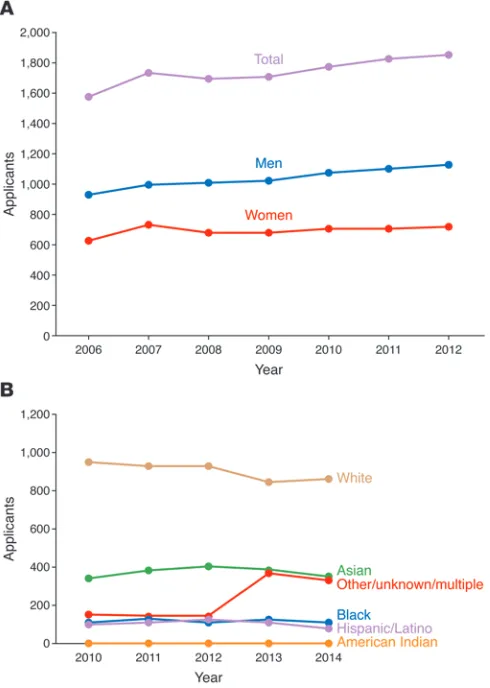
[image:4.585.38.283.57.401.2]The years following completion of formal postgraduate clinical training make up a critical time in the development of a physician-scientist. This interval is occupied primarily by additional research training and is often incorporated into a postdoctoral fellowship. This time used to be relatively short, with appointment to a fac-ulty position commonly occurring within a year or two of finishing a fellowship. A physician-scientist’s first faculty appointment now occurs at age 40 years or older, with the first independent NIH grant obtained at approximately 45 years. This extended training Figure 2. Women and underrepresented minorities are not entering the pipeline. (A) Although the number of graduates from MD-PhD programs has
risen over the past 10 years, women are less likely to apply to these programs than men (30). (B) The number of underrepresented minority applicants to
Finally, all K awards should be granted earlier, based on the candidate’s potential and the proposed mentoring relationship rather than substantial research productivity. K programs, includ-ing the proposed K99/R00 and K/Q/R awards, should be viewed as partnerships between the NIH and the candidate’s institution. Together, they should provide the investigator with sufficient funds to begin independent research and sufficient protected time to carry it out in a thoughtful manner.
Action item #3: Achieve greater diversity and
numbers in physician-scientist training programs
The PSW report shows that the physician scientist workforce is neither large nor diverse. Explanations for this are numerous and include limited advising about the career path, limited numbers of role models, readily apparent attitudes in academia about women and minorities, and unconscious biases. The NIH continues to play an active role in encouraging workforce diversity, using the carrot of institutional training awards to encourage recruitment. As our third action item, we propose new practices to achieve greater numbers and diversity in the physician-scientist pipeline.
Achieve greater numbers. Of the 8,200 physicians who are
prin-cipal investigators on NIH research awards, half are MD-PhDs and half are MDs without a PhD. The PSW advisory committee esti-mated that approximately 1,000 new physician-scientists need to enter the workforce each year to maintain steady-state. Currently, only half that number is graduating each year from MD-PhD pro-grams (20). Although many funded propro-grams exist to encourage medical students to pursue research, only limited data are avail-able about the outcomes of these programs. There also is a paucity of data available on graduates from medical school who become NIH-funded investigators after an extended period of postdoc-toral training, a pathway that used to be the most common route to a research career for physicians. Beyond the AAMC graduation questionnaire, there has been little organized effort to study the career paths of physician-scientists who were not enrolled in MD-PhD programs. The absence of these data makes it hard to know what influences individuals to pursue careers as physician-scien-tists and what sustains them going forward.
Although we endorse the PSW report’s recommendation to sus-tain MD-PhD training support, we note that the applicant pool for MD-PhD programs has barely increased in the past 5 years and cur-rently stands at only 1,800/year, one-third of whom enter a program (Figure 2A). What happens to applicants who are not admitted is not known — nor is it known how many were denied admission because of less than spectacular MCAT scores, a metric that bears little rela-tionship to success in research (21). We strongly support efforts to expand the pool of potential physician-scientist trainees through outreach efforts at all levels, greater engagement with undergradu-ate prehealth advisors, and an enhanced emphasis on characteristics that count. Additionally, new strategies to reach students prior to entering college should be developed to increase awareness of phy-sician-scientist careers before career goals are firmly established.
Achieve greater diversity. The PSW report noted that, among
physician-scientists applying for NIH grants, men outnumber women 3:1. Despite the current gender parity for both medical school and graduate school applicants, only 37% of MD-PhD pro-gram applicants are women, and that proportion is not increasing training interval and delaying independence if NIH K award study
sections require greater and greater years of experience and produc-tivity (e.g., preliminary data and manuscripts) before an award is made. Additionally, K awards have restrictive policies that may slow or limit the awardee’s ability to become an independent investigator. Specifically, K awardees cannot be principal investigators on addi-tional NIH grants until the final 2 years of the K award, nor can they serve as co-PIs on NIH grants, which makes it difficult for awardees to initiate collaborative studies or contribute to research teams.
Based on these concerns, we concur with the recommendation in the PSW report that a K99/R00 award should be established spe-cifically for physician-scientists. The duration of K99 support should begin during (not after) the fellowship and be no more than 2 years. The R00 period should be extended from 3 to 5 years, contingent on satisfactory progress and establishment of an independent position. An extended period of R01-level funding would provide time for phy-sician-scientists to recruit research teams, gather data, and publish findings, and it would make junior physician-scientists more attrac-tive hires for department chairs. We further propose that the K99/ R00 award should be renewable to an R01 grant (with such applica-tions, provided new investigator status) to enable physician-scientists to demonstrate continuity of funding. This mechanism would be very attractive for MD-PhDs who already have significant research train-ing and should be able to transition more rapidly to independence. R00 budgets should be boosted to levels of R01 grants, and along with institutional startup funds and protected time, the R00 should form the basis for independent research as a faculty member.
For MDs with little research exposure who may require a longer interval of mentored scientific training, the established K awards may be appropriate. For MDs with some research experi-ence, a new award mechanism that we call K/Q/R should be con-sidered. The initial K phase would provide support for 2 years of mentored research training after completion of clinical training, and the Q phase would provide an additional 2 years of mentored research training with an increased budget. If further training milestones are achieved, including appointment to an indepen-dent position, the R phase would provide 3 years of support. Thus, this award mechanism emphasizes uninterrupted career advance-ment of promising young investigators, rather than requiring them to apply for different grants, which may delay the launch of their career due to the often arduous review process.
Physician-scientist career development offices would be tasked with many aspects of career development training, includ-ing traininclud-ing in quantitative sciences, clinical trials, medical bioeth-ics, collaboration and research team participation, grant proposal preparation, oral and written presentations, finances, leadership, negotiation, conflict resolution, and many other topics. Trainees would be able to choose from these topics to develop highly indi-vidualized training and career development plans. This office would be responsible for collecting institutional data to track career outcomes, reasons for attrition, and institutional efforts to shorten the holding zone. Finally, the office would help create a welcoming and supportive environment for physician-scientists and facilitate a community for these individuals at each institution.
Pursue a national emphasis on postgraduate physician-scientist training. Bringing together program leaders from across the nation
to share ideas and best practices benefits everyone, and similar efforts should be developed for postgraduate physician-scientist training. It is likely that the establishment of a similar group for research residency and fellowship directors would immediately improve the quality of postgraduate physician-scientist training. Currently, oversight of physician-scientists in training is often the responsibility of residency program directors who, by necessity, tend to focus on clinical training requirements and the majority of residents who seek full-time clinical careers. Thus, this oversight is often insufficient and not appropriate for the mentoring needs of a developing physician-scientist. Additionally, many of these research residency and fellowship programs have only one or two trainees. Sharing effective training strategies across programs and providing opportunities for trainees to interact will likely enhance a sense of community for these future physician-scientists.
Conclusion
We propose four actions that can be taken now to sustain the PSW by attracting new members, reducing attrition, shortening the pipeline, and providing proper training and oversight. Since it is not always in the best interest of an institution or a depart-ment chair to promote research over clinical care for physician-scientist trainees and faculty members, national organizations such as the Academy of Medicine, the American Society for Clin-ical Investigation, AAMC, and the Association of American Phy-sicians should be involved to proactively address how most effec-tively to support physician-scientist training and careers. Absent such efforts, we foresee a steady decline in workforce numbers and biomedical research success as the remaining physician- scientists turn off the office lights for the last time.
Acknowledgments
We thank the many members of the MD-PhD training community for contributing to discussions about the PSW. See Supplemental Acknowledgments for the National Association of MD-PhD Pro-grams Executive Committee details.
About the authors
Dianna M. Milewicz, MD, PhD, is the President George H.W. Bush Chair of Cardiovascular Medicine and Director of the Divi-sion of Medical Genetics at University of Texas Health Science Center at Houston (UT Health). She directs the joint MD-PhD (Figure 2A). Therefore, the gender bias in NIH-funded
physician-scientists will continue if gender inequality in the MD-PhD train-ing pipeline is not addressed. Why fewer women than men apply to MD-PhD training programs is not known, but this discrepancy should be explored and corrected.
The PSW Working Group also found that three-quarters of the NIH-funded physician-scientists were white, and one-fifth were of Asian descent, but other ethnic and racial groups were underrepre-sented. Data about the racial and ethnic backgrounds of applicants for MD-PhD programs indicate that the pipeline for these underrep-resented groups is small and not improving (Figure 2B). Increasing the number of students from diverse backgrounds in MD-PhD pro-grams, and biomedical science in general, should be a top priority.
A number of undergraduate programs have been success-ful in recruiting increased numbers of underrepresented students into research, including the Meyerhoff Scholars Program at the University of Maryland-Baltimore County (22) and the Freshman Research Initiative, initiated at the University of Texas at Austin and now implemented at additional schools through Howard Hughes Medical Institute funding (23). These and other successful pro-grams should be implemented nationwide to improve and diversify the pipeline for the PSW. At the same time, factors that decrease the success of underrepresented minorities must be addressed, such as the recent report that African-American applicants are 10 percent less likely than whites to be awarded NIH research funding (24).
Action item #4: Mentoring and oversight of
physician-scientist trainees at all levels should
be centralized to reduce attrition
Harmonize physician-scientist training institutionally. As our final
1. NIH. Physician-scientist Workforce (PSW) Working Group Report. NIH Web site. http://acd.od.nih.gov/reports/PSW_Report_ ACD_06042014.pdf. Updated June 1, 2014. Accessed August 13, 2015.
2. NIH. Biomedical Research Workforce Working Group Report. NIH Web site. http://acd.od.nih. gov/biomedical_research_wgreport.pdf. Updated June 14, 2012. Accessed August 13, 2015. 3. Brass LF, Akabas MH, Burnley LD, Engman DM,
Wiley CA, Andersen OS. Are MD-PhD programs meeting their goals? An analysis of career choices made by graduates of 24 MD-PhD programs.
Acad Med. 2010;85(4):692–701.
4. American Board of Internal Medicine. Research
Pathway Policies & Requirements. ABIM Web
site. http://www.abim.org/certification/policies/ research-pathway-policies-requirements.aspx. Accessed August 13, 2015.
5. The American Board of Pediatrics. Integrated Research Pathway in Pediatrics. ABP Web site. https://www.abp.org/content/integrated-research-pathway-irp. Updated February 16, 2013. Accessed August 13, 2015.
6. The American Board of Pediatrics. Accelerated Research Pathway in Pediatrics. ABP Web site. https://www.abp.org/content/accelerated-research-pathway-arp. Updated January 14, 2015. Accessed August 13, 2015.
7. American Board of Pathology. The American Board Of Pathology Physician-Scientist Research Pathway. ABP Web site. http://www.abpath.org/ PHYSICIAN-SCIENTIST_RESEARCH_PATH-WAY1.pdf. Updated September 5, 2014. Accessed August 13, 2015.
8. The American Board of Radiology. Holman Research Pathway in Radiology. ABR Web site. http://www.theabr.org/ic-dr-holman-pathway. Accessed August 13, 2015.
9. The American Board of Radiology. Holman Research Pathway in Radiation Oncology. ABR Web site. http://www.theabr.org/ic-ro-holman-pathway. Accessed August 13, 2015.
10. The American Board of Dermatology. Require-ments For Eligibility To Take The Examination. ABD Web site.
http://www.abderm.org/resi-dency/residency.html. Accessed August 13, 2015. 11. Lipner RS, Lelieveld C, Holmboe ES.
Perfor-mance of physicians trained through the research pathway in internal medicine. Acad Med. 2012;87(11):1594–1599.
12. Todd RF 3rd, et al. Career outcomes of the gradu-ates of the American Board of Internal Medicine Research Pathway, 1995–2007. Acad Med. 2013;88(11):1747–1753.
13. UCLA STAR Program. UCLA Web site. http:// star.med.ucla.edu/. Accessed August 13, 2015. 14. Muslin AJ, Kornfeld S, Polonsky KS. The
phy-sician scientist training program in internal medicine at Washington University School of Medicine. Acad Med. 2009;84(4):468–471. 15. Paik JC, Howard G, Lorenz RG. Postgraduate
choices of graduates from medical scien-tist training programs, 2004–2008. JAMA. 2009;302(12):1271–1273.
16. Arbuckle MR, Gordon JA, Pincus HA, Oquendo MA. Bridging the gap: supporting translational research careers through an integrated research track within residency training. Acad Med. 2013;88(6):759–765.
17. Dzirasa K, Krishnan RR, Williams RS. Incubating the research independence of a medical scientist training program graduate: a case study. Acad
Med. 2015;90(2):176–179.
18. Tsai AC, Ordonez AE, Reus VI, Mathews CA. Eleven-year outcomes from an integrated resi-dency program to train research psychiatrists.
Acad Med. 2013;88(7):983–988.
19. Doris Duke Charitable Foundation. Fund to Retain Clinical Scientists. http://www.ddcf. org/Programs/Medical-Research/Goals-and- Strategies/Build-the-Clinical-Research-Career-Ladder/Fund-to-Retain-Clinical-Scientists/. Accessed August 13, 2015.
20. Association of American Medical Colleges. Enroll-ment, graduates, and MD-PhD Data. AAMC Web site. https://www.aamc.org/data/facts/enroll-mentgraduate/. Accessed August 13, 2015. 21. Bills JL, VanHouten J, Grundy MM, Chalkley R,
Dermody TS. Validity of the Medical College Admission Test for predicting MD-PhD student outcomes [published online ahead of print
May 8, 2015]. Adv Health Sci Educ Theory Pract. doi:10.1007/s10459-015-9609-x.
22. Maton KI, Pollard SA, McDougall Weise TV, Hrabowski FA. Meyerhoff Scholars Program: a strengths-based, institution-wide approach to increasing diversity in science, technology, engineering, and mathematics. Mt Sinai J Med. 2012;79(5):610–623.
23. The University of Texas at Austin. Freshman Research Initiative. UT Web site. https://cns. utexas.edu/fri. Accessed August 13, 2015. 24. Ginther DK, et al. Race, ethnicity, and NIH research
awards. Science. 2011;333(6045):1015–1019. 25. Ogdie A, et al. Barriers and facilitators of a career
as a physician scientist among rheumatologists in the United States [published online ahead of print February 23, 2015]. Arthritis Care Res
(Hobo-ken). doi:10.1002/acr.22569.
26. Tong CW, et al. Challenges facing early career academic cardiologists. J Am Coll Cardiol. 2014;63(21):2199–2208.
27. Brown AM, et al. Centralized oversight of physician-scientist faculty development at Vanderbilt: early outcomes. Acad Med. 2008;83(10):969–975.
28. Bruce ML, Bartels SJ, Lyness JM, Sirey JA, Sheline YI, Smith G. Promoting the transition to inde-pendent scientist: a national career development program. Acad Med. 2011;86(9):1179–1184. 29. Daye D, Patel CB, Ahn J, Nguyen FT.
Chal-lenges and opportunities for reinvigorating the physician-scientist pipeline. J Clin Invest. 2015;125(3):883–887.
30. Association of American Medical Colleges. FACTS: Applicants, Matriculants, Enrollment, Graduates, MD/PhD, and Residency Applicants Data. Table 32: MD-PhD Applicants, Acceptees, Matriculants, and Graduates of U.S. Medical Schools by Sex, 2001–2012. AAMC Web site. https://www.aamc. org/data/facts/. Accessed May 15, 2015. 31. Association of American Medical Colleges. Table
32 M.D.-Ph.D. Applicants to U.S. Medical Schools by Race/Ethnicity and State of Legal Residence, 2014. AAMC Web site. https://www.aamc.org/ download/321542/data/factstable32.pdf. Accessed May 15, 2015.
Program between UT Health and MD Anderson Cancer Center. Her research is directed toward understanding the genetic basis of vascular diseases, including thoracic aortic aneurysms, aortic dissections, and early-onset strokes.
Robin G. Lorenz, MD, PhD, is a professor of pathology who specializes in clinical pathology with a focus on clinical immu-nology and laboratory utilization. She is also the associate dean for physician-scientist development and oversees the UAB MSTP, the UAB Summer Medical Student Research Program (MSSRP), the Preparation for Graduate and Medical Education (PARAdiGM) Program, and the UAB Summer in Biomedical Sci-ences (SIBS) Undergraduate Research Program. Her research focuses on mucosal immunology and autoimmune diseases.
Terence S. Dermody, MD, is the Dorothy Overall Wells Profes-sor of Pediatrics and director of the MSTP and Division of Pediatric Infectious Diseases at Vanderbilt University School of Medicine.
He also is a professor of pathology, microbiology, and immunol-ogy at Vanderbilt and adjunct professor of biomedical sciences at Meharry Medical College. Dermody’s research focuses on viral pathogenesis, vaccine development, and medical education.
Lawrence Brass, MD, PhD, is a professor of medicine and pro-fessor of systems pharmacology and translational therapeutics at the University of Pennsylvania Perelman School of Medicine, where he studies mechanisms of thrombosis and hemostasis, and serves as associate dean for Combined Degree and Physician Scholars Programs, director of Penn’s MSTP, and director of the Hematology Research Training Program.