© 2017, IRJET | Impact Factor value: 5.181 | ISO 9001:2008 Certified Journal
| Page 2437
M.Aishwarya
, R.Nadhiya
, M.S.Nandhini
, R.Krishnaveni
123
Student, Dept Of Electronics And Communication Engineering, Panimalar Institute Of Technology, Tamilnadu,
India.
4
Assistant professor, Dept Of Electronics And Communication Engineering , Panimalar Institute Of Technology,
Tamilnadu, India.
---***---Abstract - Customizable software application are in trend
of the state of art technologies . This project work integrates a audio filter training algorithm into a windows platform music player and embeds into a single software application. A Matlab based audio filter will be developed to analyze the Histogram of the input music file and predict the nature of the input audio. The main categorization list will be Beat, melody & speech audio, it will enhance the user experience by matching the music database with their mind swings. A Music player GUI framework will be designed to adapt the conventional and proposed music player functionalities. With addition to that a Music Jockey plugin will be developed to play the music in a mixed mode format and noise filtering will also be done.
Key Words: GUI, ANN(Artificial neural network), back
propogation, DSP toolbox, DJ plugin, Noise filter.
1. INTRODUCTION:
Music players are a simple kind of stress busters,
Range of a music player cost from 2000-36000 rupees. Due to market demand and competitions various Audio enhancing methods & plugins are introduced day to day(Aero, Dolby atmos, Surround 3D etc...).The enhancement can be a hardware placement or a software processing algorithms like (Noise filters, Equalizers etc…).Various Audio processing algorithms are available to find and extract a particular audio frequency components, which later adopted as speech recognition engine. Enchancing user experience is the atmost goal for every software product. These enhancements has not been widely updated in music player the major update for music player is to enhance the audio player. There are many audio players but all these players can simply play the song and they may shuffle the songs .This project work attempts to create a intelligent music player using artificial neural network. To develop and analyze a DSP algorithm to find the beat nature and type of a audio content. To develop a Neural Network based
intelligent Music player which can categorize the playlist based on the beat levels of the Audio file . To develop a Music Jockey plugin to play the music file in a mixed mode with that noise filtering is also done to get a quality music.
2.BLOCK DIAGRAM:
Fig.2:Block diagram of intelligent music player
3.MODULE DESCRIPTION:
3.1.GUI FRAMEWORK DESIGN:
© 2017, IRJET | Impact Factor value: 5.181 | ISO 9001:2008 Certified Journal
| Page 2438
Fig:2.1 GUI frame
3.2.ARTIFICIAL NEURAL NETWORK:
Neural networks are a computational approach, which is based on a large collection of neural units, loosely modeling the way a biological brain solves problems with large clusters of biological neurons connected by axons.Neural networks typically consist of multiple layers or a cube design, and the signal path traverses from front to back .Back propogation is the use of forward stimulation to reset weights on the “front “ neural units and this is sometimes done in combination with training where the correct result is known.
Fig:3.2 Neural Training Architecture
3.2.1BACK PROPAGATION TRAINING EQUATION:
we use bjl for the bias of the jth neuron in the lth layer. And we use ajl for the activation of the jth neuron in the lth layer.
3.2.2.NEURAL TOOL BOX
MATLAB is associated with inbuilt Neural Training and prediction toolbox. It can be triggered by typing ‘nntool’ in the command window. ‘nntool’ toolbox compirised of more than 12 training functions like ‘Feed forward, ‘backpropogation’, ’trainlm’,’ min-max’ etc…It can be configured with “no of layers”, “type of training function”, “input and target data” functions.
Fig:3.2.2.nn toolbox inbuilt in MATLAB
2.3. AUDIO ANALYZER MODULE:
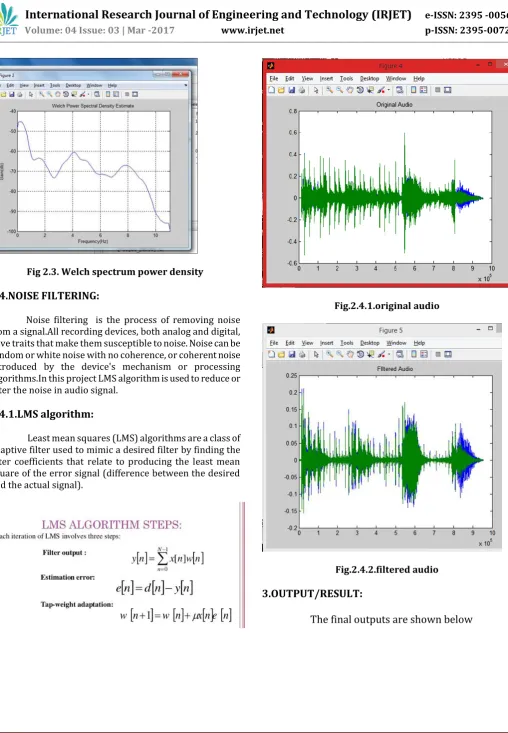
Welch spectrum power density analyzer is utilized to predict the power spectrum value in audio signal over frequency.power spectral density (PSD) this describes how power of a signal or time series is distributed over frequency. The average power P of a signal x(t) over all time is therefore given by the following time average .
© 2017, IRJET | Impact Factor value: 5.181 | ISO 9001:2008 Certified Journal
| Page 2439
Fig 2.3. Welch spectrum power density2.4.NOISE FILTERING:
Noise filtering is the process of removing noise from a signal.All recording devices, both analog and digital, have traits that make them susceptible to noise. Noise can be random or white noise with no coherence, or coherent noise introduced by the device's mechanism or processing algorithms.In this project LMS algorithm is used to reduce or filter the noise in audio signal.
2.4.1.LMS algorithm:
Least mean squares (LMS) algorithms are a class of adaptive filter used to mimic a desired filter by finding the filter coefficients that relate to producing the least mean square of the error signal (difference between the desired and the actual signal).
[image:3.595.296.566.62.328.2]
Fig.2.4.1.original audio
Fig.2.4.2.filtered audio
3.OUTPUT/RESULT:
[image:3.595.36.248.99.297.2]© 2017, IRJET | Impact Factor value: 5.181 | ISO 9001:2008 Certified Journal
| Page 2440
3.1.Initial Window
3.2.Added Playlist
3.3. Classifying Audio
3.4.
Classified melody
3.5.classified beats
© 2017, IRJET | Impact Factor value: 5.181 | ISO 9001:2008 Certified Journal
| Page 2441
is also done successfully.Thus an intelligent music
player which integrates audio classifier,DJ plugin and
noise filter is created to enhance the user experience.
REFERENCES:
[1] A. Krishna and T. V. Sreenivas, “Music instrument recognition: From isolated notes to solo phrases,” in Proc. IEEE Int. Conf. Acoust., Speech
Signal Process., 2004, vol. 4, pp. iv-265–iv-268.
[2] S. Essid, G. Richard, and B. David, “Musical instrument recognition on solo performances,” in Proc. 2004 12th Eur. Signal Process. Conf., 2004,pp. 1289–1292.
[3] T. Heittola, A. Klapuri, and T. Virtanen, “Musical instrument recognition in polyphonic audio using source-filter model for sound separation,” in
Proc. Int. Soc. Music Inf. Retrieval Conf., 2009, pp. 327–332. [4] T. Kitahara, M. Goto, K. Komatani, T. Ogata, and H. G. Okuno, “Instrument identification in polyphonic music: Feature weighting to minimize influence of sound overlaps,” EURASIP J. Appl. Signal Process., vol. 2007,
no. 1, pp. 155–155, 2007.
[5] Z. Duan, B. Pardo, and L. Daudet, “A novel cepstral representation for timbre modeling of sound sources in polyphonic mixtures,” in Proc. 2014
IEEE Int. Conf. Acoust., Speech Signal Process., 2014, pp. 7495–7499.
[6] M. Goto, H. Hashiguchi, T. Nishimura, and R. Oka, “RWC music database:
Music genre database and musical instrument sound database,” in Proc.
Int. Soc. Music Inf. Retrieval Conf., 2003, vol. 3, pp. 229–230. [7] Y. LeCun, Y. Bengio, and G. Hinton, “Deep learning,” Nature, vol. 521,
no. 7553, pp. 436–444, 2015.
[8] L. Deng and D. Yu, “Deep learning: Methods and applications,” Found.
Trends Signal Process., vol. 7, no. 3–4, pp. 197–387, 2014. [9] T. Mikolov, M. Karafiat, L. Burget, J. Cernock ´ y, and S. Khudanpur, “Re- `
current neural network based language model,” in Proc. Annu. Conf. Int.
Speech Commun. Assoc., 2010, vol. 2, pp. 1045–1048. [10] G. Mesnil, X. He, L. Deng, and Y. Bengio, “Investigation of recurrent-
neural-network architectures and learning methods for spoken language
technology in chennai (2013-2017).
R.Nadhiya is currently studying electronics and communication engineering at panimalar institute of technology in chennai (2013-2017).
M.S.Nandhini is currently studying electronics and communication engineering at panimalar institute of technology in chennai (2013-2017).