http://dx.doi.org/10.4236/ojbm.2016.42019
How to cite this paper: Yang, H. (2016) Comprehensive Evaluation of Online Peer-to-Peer Lending on the Province-Level
Comprehensive Evaluation of Online
Peer-to-Peer Lending on the Province-Level
Regions in China Based on Generalized
Principle Component Analysis
Hang YangInstitute of Industrial Economics, Jinan University, Guangzhou, China
Received 19 January 2016; accepted 29 March 2016; published 1 April 2016 Copyright © 2016 by author and Scientific Research Publishing Inc.
This work is licensed under the Creative Commons Attribution International License (CC BY).
http://creativecommons.org/licenses/by/4.0/
Abstract
This article is based on recent development of peer-to-peer lending industry in China. With the design of regional quality in mobile payment, this article constructs a multi-index evaluation sys-tem made by the current situation of economic and social foundation. By using principal compo-nent analysis, the article makes a comprehensive quantitative evaluation of quality and level of its development. Analysis results show that there are obvious gaps in the development of the P2P in-dustry of China, which indicates the trend that peer-to-peer lending, will spread from developed regions to developing regions. Coordination between indicators and evaluation results are basi-cally consistent with the evaluation results.
Keywords
Peer-to-Peer Lending, Industry Development Quality, Principal Component Analysis
1. Introduction
matching of funds and establish the relationship between the two sides of the loan through the effective informa-tion matching on the electronic commerce professional network platform. The borrowers issue interest and re-payment time, etc., the lenders make specific loan decision according to the information of the bidding. The two sides eventually achieve self-service lending through the free auction.
The penetration of Internet technology in the field of financial services is gradually deepening. Internet finan-cial services have emerged in the new form of payment and financing. At the same time, the traditional finanfinan-cial system has been gradually difficult to meet the huge financing needs from our various types of small and micro enterprises. P2P represents a development trend of the financial services industry in the future. It is based on the progress of information technology and Internet finance, and creates a new credit and security model. 2015 na-tional P2P net loan turnover reached 1180.6 billion yuan. This figure increased 258.62% compared to 2014, and the number of P2P platforms had also increased to 3844.
P2P net loan is not only able to provide additional market financing channels to tens of millions of small and medium-sized micro enterprise owners as a supplement to social credit loans, but also can effectively reduce transaction costs, improve the utilization efficiency of regional internal idle funds. At the same time, P2P net loan industry needs a higher level of user credit rating and certification in the demand for risk control and trans-action security. The development of P2P will have a positive effect on the construction of personal credit evalu-ation system through the credit rating and registrevalu-ation before trading and the monitoring and recording of trading behavior. P2P net loan eliminates the obstacles between the borrower and the lender, so that the loan process is more convenient and simple. Currently security mechanisms and supervision and management level of major P2P net loan platforms are more perfect, so that the flow of funds will be more in line with the specification through the third party depository system. Therefore, in the current vigorous development of various types of financial services, P2P net loan can improve investors idle funds utilization, optimize the allocation of funds, its interest on loans and the interest rate are more transparent, and it is easy to monitor. It also can curb the private usury. So it is a kind of financial innovation mechanism to meet the needs of the market, to achieve inclusive win-win.
In the P2P net loan related foreign literature, Herzenstein et al. (2008) found the influence factors of Internet lending behavior [1]. Davis & Gelpern (2010) and Paul (2013) studied the behavior of the lender in the online lending [2], and explored the way to supervise the network lending platform [3]. These researches are mainly based on the foreign capital market, and pay less attention to the emerging capital market. Domestic first P2P net loan platform appeared in 2007, P2P net loan industry has developed for 8 years, but the degree of im-provement of the data statistics is relatively low, so the academic community has less research about P2P net loan industry development level. Wang Huijuan and other (2014) consider that P2P network lending is a finan-cial innovation model which like the combination of Internet technology and private lending, credit is an impor-tant factor affecting the P2P network lending transactions [4]. Qian Jinye (2012) analyzed the current situation of the domestic P2P network lending industry, found P2P net loan is a new financing channel and a convenient financing facility, which is a necessary and effective supplement to the existing bank credit system. In view of this, this paper select the P2P net loan industry in China’s regional distribution as main point of view, to explore the P2P net loan industry the corresponding development process in each province, and through the cluster analysis to explain the future development of P2P net loan industry in various provinces and autonomous re-gions [5]. This paper helps to evaluate the future development trend of the provinces in the P2P net loan industry and provide targeted policy implications.
2. Research Technique
2.1. Principal Component Analysis Method and Index System
is the coefficient matrix.
Using principal component analysis method to evaluate the quality of P2P net loan industry is as follows: It then needs to collect and process the data, filtering it and normalizing it into a standard format, establish the correlation coefficient matrix of the variables. It extracted the factors whose characteristic value more than 1, then establish the correlation coefficient matrix R. The characteristic value and the variance contribution rate of the correlation matrix R are calculated; calculates the factor load score and sort, and makes the variance contri-bution rate of each factor as the weight, finally calculates the principal component comprehensive score of P2P net loan industry development of the province of the quality of the industry.
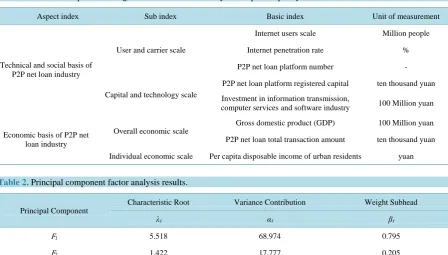
This paper uses the data indicators from statistical yearbook of all provinces and cities in 2014 and China In-ternet development statistics report which provided by CNNIC in 2014. A comprehensive index system (Table 1), which is composed of eight kinds of related basic evaluation points, is established.
P2P net loan industry development quality index is based on various types of data which can reflect the P2P net loan industry connotation and impact factor, all of the above indicators reflect the connotation and status of the P2P net loan industry in our country, the various aspects of the field are included in the quantitative evalua-tion system, so as to establish a feasible measure of P2P net loan industry in provinces and autonomous regions. The following analysis steps are completed using SPSS19.0 statistical analysis software. Standardized indexes shall be credited as NETI, RATE, PLAT, RECA, INVE, GDP, TRAD, INCO.
2.2. Data Analysis
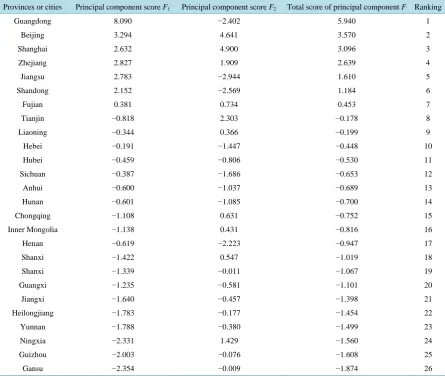
Data analysis results show that variance contribution rate of the principal component F1 and F2 reached 86.75%, contains the main information of the provinces P2P net loan industry. According to the principal component analysis method, the original data of 26 provinces and autonomous regions of China were analyzed, according to the output result analysis, the model can be used to extract two principal components: 5.518 > 1 and 1.422 > 1, cumulative variance contribution rate is 86.75% > 85%, this means that the two principal components can reflect the original information content of all 86.75% of the information (Table 2). Therefore, the two main compo-nents can be selected as the country’s 2014 P2P net loan industry development quality evaluation of comprehen-sive variables (Table 3).
[image:3.595.89.538.460.715.2]After the standardized treatment of the 8 indexes, the corresponding characteristic vector is the weight coeffi-cient. The function expression of the first principal component and the second principal component can be got.
Table 1. 2014 annual provincial regional P2P net loan industry development quality indicators.
Aspect index Sub index Basic index Unit of measurement
Technical and social basis of P2P net loan industry
User and carrier scale
Internet users scale Million people
Internet penetration rate %
P2P net loan platform number -
Capital and technology scale
P2P net loan platform registered capital ten thousand yuan
Investment in information transmission,
computer services and software industry 100 Million yuan
Economic basis of P2P net loan industry
Overall economic scale
Gross domestic product (GDP) 100 Million yuan
P2P net loan total transaction amount ten thousand yuan
Individual economic scale Per capita disposable income of urban residents yuan
Table 2. Principal component factor analysis results.
Principal Component
Characteristic Root Variance Contribution Weight Subhead
λi αi βi
F1 5.518 68.974 0.795
Table 3. Principal component factor analysis results.
Factor Load
NETI RATE PLAT RECA INVE GDP TRAD INCO
0.8110 0.9217 0.6996 0.9514 0.7893 0.7193 0.9155 0.7985 −0.4850 0.2136 0.6009 0.0035 −0.5683 0.5543 0.1258 −0.3664
1 0.3453 NETI 0.3924 RATE 0.2978 PLAT 0.4050 RECA 0.3360 INVE
0.3062 GDP 0.3897 TRAD 0.3399 INCO
F = × + × + × + × + ×
+ × + × + × (1)
2 0.4067 NETI 0.1791 RATE 0.5039 PLAT 0.0029 RECA 0.4766 INVE
0.4648 GDP 0.1055 TRAD 0.3072 INCO
F = − × + × + × + × − ×
+ × + × − × (2)
This paper puts the data into the expression, the expression is the sum of product score and contribution rate of each principal component: F = 79.51% × F1 + 20.49% × F2, Gets P2P net loan industry development quality principal component comprehensive score and ranking of all provinces and municipalities in 2014 (Table 4).
2.3. Results of Data Analysis
This paper compares the comprehensive score of P2P development quality level in all provinces (Figure 1). 2014 P2P net loan regional development quality ranking in the top 10 are Guangdong 1), Beijing 2), Shanghai 3), Zhejiang 4), Jiangsu 5), Shandong 6), Fujian 7), Tianjin 8), Liaoning 9), Hebei 10). All ten provinces and muni-cipalities in the East, the central and western provinces and cities in the rankings in a backward position. This shows that the early capital accumulation and stable customer groups of the P2P net loan industry are derived from the coastal developed areas, since then, it has been gradually formed the spreading trend in the inland provinces and cities. Guangdong, Beijing and Shanghai scored in the top three, occupy the leading growth pole of the P2P net loan industry technology innovation and scale development. Due to the gap between the eastern provinces and the central province in economic base, residents financing habits and technological level, the P2P net loan industry in central province still has a large development space. In 2014, Xinjiang, Qinghai, Tibet and other provinces in the region of the P2P net loan industry development has just started, develops lowly. From the perspective of the whole society, the basis of the market size of P2P net loan industry in various provinces and cities is always the size of the region’s economic activity and income and consumption levels, and show the trend of diffusion from east to west, the economically developed areas to less developed areas.
More specific explanation is that comprehensive score of development of P2P quality in eastern coastal prov-inces can be higher, not only because of the earlier development of P2P net loan industry, large amount of the trading platform for enterprises and the third party hosting services providers, strong capital, more complete in-formation infrastructure [6], but also because of updated financing habits of the people and micro enterprises in these region. The reason for the gap of the quality of P2P development between the western provinces and east-ern provinces lies in: The remote location and the smaller size of the economy are obstacles, technical level and management model of the financial and information industry which related to P2P net loan platforms needs to be improved, The financing needs of residents and small and micro enterprises in these region may be small. These factors are the upper limit for expanding the size of P2P net loan transaction market in the western provinces and cities. Backward regional P2P trading platform security management and control is one of the reasons for the slow development of P2P net loan industry in the western provinces as well.
Thus, provinces and cities in developed areas are the forefront of financial innovation, they rely on its huge economic and information advantages, occupy the leading position in the P2P net loan industry developing trends. However, the dynamic diffusion effect of Internet technology and the huge amount of local financing demand also provide power for other provinces in the development of P2P. Hainan, Qinghai and other western provinces also began to establish their new P2P trading platform in 2014, the future development can be ex-pected.
3. Conclusions and Policy Implications
Figure 1. Comprehensive evaluation of the quality of P2P development in all prov- inces in China in 2014.
Table 4. China’s P2P net loan industry development quality comprehensive score and ranking in 2014.
Provinces or cities Principal component score F1 Principal component score F2 Total score of principal component F Ranking
Guangdong 8.090 −2.402 5.940 1
Beijing 3.294 4.641 3.570 2
Shanghai 2.632 4.900 3.096 3
Zhejiang 2.827 1.909 2.639 4
Jiangsu 2.783 −2.944 1.610 5
Shandong 2.152 −2.569 1.184 6
Fujian 0.381 0.734 0.453 7
Tianjin −0.818 2.303 −0.178 8
Liaoning −0.344 0.366 −0.199 9
Hebei −0.191 −1.447 −0.448 10
Hubei −0.459 −0.806 −0.530 11
Sichuan −0.387 −1.686 −0.653 12
Anhui −0.600 −1.037 −0.689 13
Hunan −0.601 −1.085 −0.700 14
Chongqing −1.108 0.631 −0.752 15
Inner Mongolia −1.138 0.431 −0.816 16
Henan −0.619 −2.223 −0.947 17
Shanxi −1.422 0.547 −1.019 18
Shanxi −1.339 −0.011 −1.067 19
Guangxi −1.235 −0.581 −1.101 20
Jiangxi −1.640 −0.457 −1.398 21
Heilongjiang −1.783 −0.177 −1.454 22
Yunnan −1.788 −0.380 −1.499 23
Ningxia −2.331 1.429 −1.560 24
Guizhou −2.003 −0.076 −1.608 25
China. From the point of view of quantitative analysis, P2P net loan, as a new type of financial service, its de-veloping speed is not balanced in each area. In the current view, P2P net loan must go through a long process, and may become a common and convenient common financing channel in China. Due to the gap of the regional economic scale and the level of industry norms, P2P net loan transactions mostly occur in the eastern coastal provinces, most of the western provinces have still been in the stage of initial development of the market. Therefore, P2P net loan environment, such as the user network lending habits, facilities conditions, requires lo-cal government support and continuous cultivating of the regional trading platform.
Mainly the loss of contact, difficulties of withdrawals and stop of operation, this reflects the reality of the in-dustry reshuffle which is accelerating. Firstly, in the face of such problems, the provincial government should clear regulatory objects, improve the regulatory organization system in the field of P2P net loan industry. The government should not only promulgate P2P regulatory rules, include risk monitoring, technical support, service specification P2P, but also improve the future of the P2P net loan industry access threshold.
Secondly, Local government should strengthen the enforcement of laws and regulations on the illegal trading of P2P net loan in the region, protect the legitimate rights and interests of the participating subjects, and promote the development of industry standards. The local government should establish and improve laws and regulations of the network transaction, strictly control payment channels and regulate credit certification according to the virtual characteristics of net loan deal, based on the need of P2P net loan, to establish personal credit authentica-tion system and risk warning system, make public appearance of credit rating timely [7], establish and improve the protection mechanism of the rights and interests of the two parties in electronic trading, monitor abnormal network transactions, improve the anti money laundering monitoring mechanism and pay attention to network lending platform of public funds management [8].
Finally, market participants should share interests from the value chain of P2P net loan, establish cooperative relationship of Interest sharing and risk taking. In order to create an orderly and win-win P2P net loan transac-tion system, companies in the market should speed up technological progress and innovatransac-tion, give full play to the radiation and diffusion efficiency of P2P net loan, that will promote efforts to move towards the effective resolution of the pressing issues of development that will solving financing difficulties of all peoples.
References
[1] Herzenstein, M., Andrews, R.L., Dholakia, U.M. and Lyandres, E. (2008) The Democratization of Personal Consumer Loans? Determinants of Success in Online Peer-to-Peer Lending Communities. Bulletin of the University of Delaware, 15, 274-277.
[2] Davis, K.E. and Gelpern, A. (2010) Peer-to-Peer Financing for Development Regulating the Intermediaries. American University Washington College of Law, 11, 24-27.
[3] Paul, S. (2013) Square Pegs in a Round Hole: SEC Regulation of Online Peer-to-Peer Lending and the CFPB Alterna-tive. Yale Journal on Regulation, 30.
[4] Wang, H.J. and Liao, L. (2014) Chinese P2P Platform’s Credit Authentication Mechanism Research—Evidence from Renrendai. China Industrial Economics, 4, 136-147.
[5] Qian, J.Y. and Yang, F. (2012) The Development Status and Prospects of Chinese P2P Network Lending. Finance Fo-rum, 1, 46-51.
[6] Geng, H.Q., Chen, F., Zhan, C.W., Qiu, X.X. and Liu, L. (2009) Comprehensive Evaluation of Urbanization Level on the Province-Level Regions in China Based on Generalized Principle Component Analysis. Human Geography, 5, 47- 51.
[7] Wu, X.G. and Cao, Y. (2011) The Empirical Study on Pro-Cyclical Effect of the Listed Companies’ Default Rate. South China Finance, 4, 32-35.