http://dx.doi.org/10.4236/jamp.2014.24007
The Lagrangian Method for a Basic Bicycle
F. Talamucci
DIMAI, Dipartimento di Matematica e Informatica “Ulisse Dini”, Università degli Studi di Firenze, Firenze, Italy Email: [email protected]
Received 16 February 2014; revised 11 March 2014; accepted 18 March 2014
Copyright © 2014 by author and Scientific Research Publishing Inc.
This work is licensed under the Creative Commons Attribution International License (CC BY). http://creativecommons.org/licenses/by/4.0/
Abstract
The ground plan in order to disentangle the hard problem of modelling the motion of a bicycle is to start from a very simple model and to outline the proper mathematical scheme: for this reason the first step we perform lies in a planar rigid body (simulating the bicylcle frame) pivoting on a horizontal segment whose extremities, subjected to nonslip conditions, oversimplify the wheels. Even in this former case, which is the topic of lots of papers in literature, we find it worthwhile to pay close attention to the formulation of the mathematical model and to focus on writing the proper equations of motion and on the possible existence of conserved quantities. In addition to the first case, being essentially an inverted pendulum on a skate, we discuss a second model, where rude handlebars are added and two rigid bodies are joined. The geometrical method of Appell is used to formulate the dynamics and to deal with the nonholonomic constraints in a cor-rect way. At the same time the equations are explained in the context of the cardinal equations, whose use is habitual for this kind of problems. The paper aims to a threefold purpose: to formu-late the mathematical scheme in the most suitable way (by means of the pseudovelocities), to achieve results about stability, to examine the legitimacy of certain assumptions and the compati-bility of some conserved quantities claimed in part of the literature.
Keywords
Nonholomic Constraints; Lagrangian Equations; Pseudovelocities; Nonlinear Order Differential Equations; Stability
1. Introduction
1.1. The Equations of the Model
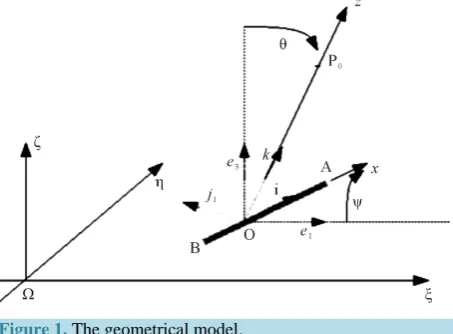
respect to a fixed horizontal direction. Let O be the projection of P0 on B−A and take a fixed reference frame
{
Ω, e e e1, 2, 3}
, e3 being the upward vertical, and a body reference frame{
0, , ,i j k}
such that ψ is the angle e i1 , θ is the angle ke3. The mutual disposal of the two frames is given by(
)
(
)
1 2
1 2 3
1 2 3
cos sin
cos sin cos sin
sin sin cos cos
ψ ψ
θ ψ ψ θ
θ ψ ψ θ
= +
= − + +
= − − + +
i e e
j e e e
k e e e
and sketched in Figure 1.
Set O− Ω =ξ0 1e +η0 2e : the geometrical restrictions A O− =a, B−O =b, P0−O =h lead us to con-
sider the four lagrangian coordinates
(
ξ η ψ θ0, 0, ,)
. Therefore(
)
(
)
0 0 sin sin 1 0 sin cos 2 cos 3
P − Ω = ξ +h θ ψ e + η −h θ ψ e +h θe . The angular velocity of the rigid body is
3
ω θ ψ= i+ e .
The Lagrangian function of the system writes
(
)
(
)
2 2 2 2 2
0
1 1
sin cos cos
2 2 i j k
T mP Iθ ψ I θ I θ mgh θ
= + = + + + −
(1)
where 2 2 2 2
(
2 2 2)
(
(
)
(
)
)
0 0 0 sin 2 sin 0cos 0sin cos 0sin 0cos
P =ξ +η +h ψ θ θ+ + h ψ θ ξ ψ η+ ψ +θ θ ξ ψ η− ψ and Ii, j
I and Ik are the moments of inertia with respect to the body reference frame
{
P i j k0, , ,}
, which is supposedto be principal.
The only kinetic constraint we are going to consider is B∧ =i 0, whose expression in the Lagrangian coordinates is
0sin 0cos 0.
bψ ξ+ ψ η− ψ = (2) The first kind Lagrangian equations of motion
(
)
0 0
d
sin , cos , , 0 , d
sin cos 0, b t
b
λ ψ ψ
ψ ξ ψ η ψ
∇ −∇ = −
+ − =
q q
(3)
where q=
(
ξ η ψ θ0, 0, ,)
are the lagrangian coordinates and λ is the unknown multiplier, will be suitablyhandled if one defines the pseudovelocities (see [1] for the concepts and the method we are pursuing)
(
)
(
)
0 0
0 0
cos sin ,
sin cos ,
U b
V b
W
ξ ψ η ψ
ξ ψ η ψ
θ
= +
= − +
=
(4)
[image:2.595.201.428.550.717.2]We point out the following relationships involving U, V and the real velocities:
(
1)
(
(
)
1)
, , 1 ,
B=bU Oi =b Ui+Vj A=b Ui+ +a Vj (5) where a=a b and j1=e3∧ = −i sinψe1+cosψe2 =cosθj−sinθk.
Together with the kinetic constraint, Equations (4) give the set of possible velocities in terms of
(
U V W, ,)
:( )
0 0
cos sin 0
sin cos 0
0 1 0
0 0 1
b b
U
b b
V
W
ψ ψ
ξ
ψ ψ
η ψ θ
Γ
−
= =
q q
(6)
It is known (see [1]) that linear kinetic constraints allow to refine the equations of motion (3) in a way similar to the holonomic case: as a matter of fact, the constraints identify a subspace in the tangent space of the lagran-gian coordinates, giving the virtual displacement of the system. The geometrical method consists of projecting the equations according to T d
dt
Γ ∇ − ∇ =
q q 0 where Γ is defined in (6). Joining to the kinetic constraint
(2) and the definition (4) we get, dividing by suitable constants,
(
)
(
)
(
)
(
)
(
)
2
2 2
2 2
0 0
sin 2 cos 0
sin 1 sin cos sin 2 cos sin 0
cos cos sin cos sin 0
cos sin , sin cos ,
k i
U hV V hVW
hU I I V hW UV hW IVW
hV I h W IV hUV gh b
W
b U V b U V V
θ θ
θ θ θ θ θ θ
θ θ θ θ θ
θ
ξ ψ ψ η ψ ψ ψ
+ − + =
+ + + − + + + =
− + + − − − =
=
= − = + =
(7)
where
(
2)
2 2, j k , i i
h=h b I = mh + −I I mb I =I mb (8) are dimensionless constants. Since the rigid body is practically plane and contained in the plane orthogonal to j, it is reasonable to assume Ij>Ik, Ii+Ik Ij, so that
2
> 0, i .
I I +h I (9) From here on we adopt (9).
The seven ODEs (7) contain the seven unknown quantities
(
U V W, , ,ξ η ψ θ0, 0, ,)
. With respect to the firstkind system (3) they have the advantage of no exhibiting multipliers and of reducing the kinetic variables of one unity.
It is not at all worthless to explain (7) in the context of the the cardinal equations of dynamics, seeing that many models in literature (some of them are [2]-[5]) rest on such equations: the first three equations in (7) are respectively
( )
(
)
( )
(
)
( )( )
0
3 0 0 0
0 e mP
B B mP
O O mP O
⋅ =
+ ∧ ⋅ =
+ ∧ ⋅ = ⋅
i
L e
L i M i
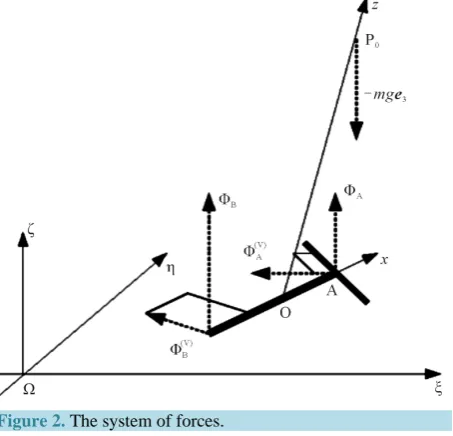
where L is the angular momentum and M( )e the resultant momentum of the external forces. Actually, since no friction is present, the constraint ΦA in A is along e3, while the constraints in B can be modelled as a force
B
Φ along e3 plus a horizontal force
( )v B
Φ perpendicular to B=A (see Figure 2), acting the constraint (2):
( ) ( )
3, 3, 1.
v v A =φAe A =φAe B =φB j
Φ Φ Φ (10) Hence no force exists along i (first equation) and ( )
( )
3 0e
B ⋅ =
M e (second equation), along e3 (and not k, as stated in [6]). Finally, third equation is simply due to the fact that the only external force with a non zero momentum along i is the weight force.
Figure 2. The system of forces.
motion is the total energy = − =T 0:
(
)
(
2 2 2 2)
(
)
(
)
( )
20
1
1 sin sin cos cos .
2 U + +Ik +I θ V +IW +hV U θ−W θ + gh b θ= mb (11) Actually, even if the system is nonholonomic, the first integral ≡ 0 can be achieved starting from
T d d
0
d d
U V
t t
W
= Γ ∇ − ∇ ⋅ = ∇ − ∇ ⋅
q q q q q and performing the usual calculations as in the holonomic
case, achieving at last =0.
In the same matter of integral invariants for the system, we find it not correct to claim, as in [7], that the ab-sence of ξ0, η0, ψ from entails three constant of motion, in order that four conserved quantities (includ- ing the total energy) can be obtained: as a matter of fact, the equations of the model are not d 0
dt∇ − ∇qL qL=
and cyclic variable does not mean conserved quantity. Besides that, even if is written in terms of U and
V , ψ is not a cyclical coordinate, being implicitily in such variables. For this reason we question the validity of d 0
dt ψ
∂ =
∂
(Equation (14) in [7]), which would imply an integral invariant.
With regards to the same subject, we emphasize that equation 0 d sin cos
dt U U hV θ hVW θ
∂
= = + +
∂
(Equa- tion (16) in [7]), giving rise to the conservation of U+hVsinθ, is not correct in our advice, since U does not refer to a lagrangian coordinate.
1.2. The Mathematical Problem
We perform now a brief analysis of (7). It is evident that the first four equations in (7) form the sub-system
( )
( )
(
)
( )
(
)
(
)
(
) (
)
2
, , , , ,
2 cos
1 sin 0 0
sin 2 cos
sin 1 sin cos 0
, .
0 cos 0 cos sin sin
0 0 0 1
k
F U V W
V V hW
h
UV W hW IV
h I I h
h I V IV hU gh b
W
θ θ
θ θ
θ θ
θ θ θ
θ θ θ θ
= =
−
+ + − − − +
= =
− + +
X X X
The last three equations in (7) give simply ξ0, η0, ψ once (12) has been solved.
Statement 1.1 System (7) admits locally one solution, for any set of data ξ0
( )
0 , η0( )
0 , ψ( )
0 , θ( )
0 ,( )
0U , V
( )
0 , W( )
0 .Proof. The assigned data provide q
( )
0 and q( )
0 , by means of (6). Furthermore(
2 2)
(
( )
)
2det=I 1+ +Ik Isin θ−h =I1− + + − +κ Ik 1 κ κ I Isin θ>0, (13) where we defined (see also (8) and (9))
2 1. h
I
κ = < (14) Therefore (12) can be solved in an appropriate time interval. Finally one obtains ξ0, η0 e ψ from the last three equations in (7) and the rest of the given data. □
Remark 1.1 If in (7) we let h=0, we are dealing with the simpler case of a bar on a horizontal plane with one point moving at each time along the direction of the bar: since I=0 equations reduce to
(
)
2
1 k
U V
I V UV =
+ = −
The energy conservation U2+ +
(
1 Ik)
V2≡20( )
mb2 gives the orbits on the phase plane(
U V,)
, namely each point of the U-axis and the semi-ellipses V = ± 0( )
mb2 −U2 2 1+Ik . Moreover lim( )
0t→+∞V t = ,
( )
( )
20
lim 2
t→+∞U t = ± mb , that is ψ
( )
t →constant, B→constant .
Again for h=0, the special case B≡P0, that concerns with one typical instance in nonholonomic con-straints (see for instance [1]), cannot be recovered from the system of Remark 1.2, but it requires the definition of the pseudovelocity U=ξ0 cosψ .
We are going now to investigate the stability of the system at θ=0.
For what concerns with the initial data, we can certainly assume with no loss in generality ξ0
( )
0 =0,( )
0 0 0
η = , ψ
( )
0 =0, hence q( )
0 =(
bU( )
0 ,bV( ) ( ) ( )
0 ,V 0 ,W 0)
. Let us first check whenever θ( )
t ≡0 is a solution of (7).Statement 1.2 θ
( )
t =0 is solution of (7) if and only if U is constant and V ≡0. Proof. Set θ=0 in (7), first three equations:(
)
2 1 k
U V
I V UV
V UV
=
+ = −
= −
which entails V =0, U =U
( )
0 . We incidentally notice that if Ik 1 then U, V consistent with θ≡0 are those we discussed in Remark 1.3.On the other hand, U constant and V ≡0 make us write (12), second and third equation, as
( )
( )
(
2(
)
)
cos 0 cos 0 , cos sin 0
W θ≡W θ IW − gh b θ θ= (15) (it is physically correct to assume −π 2 <θ
( )
0 <π 2), which implies θ( )
t ≡0. □Remark 1.2 The following statement also follows from the previous analysis: if the angle ψ is constant (that is B−A never changes direction), then U has to be constant and θ
( )
t has to be zero.Corollary 1.1 Assume θ
( )
0 =0, θ( )
0 =W( )
0 =0; then θ( )
t =0 is solution of (7) if and only if V( )
0 =0. Proof. If θ=0 is solution, then V must be zero at any time; on the other hand, the set of data U( )
0 =U0,( )
0 0V = , θ
( )
0 =0, W( )
0 =0 give univocally the solution θ( )
t =0, U t( )
=U0, V t( )
=0. □Our aim points now to discuss the stability of θ
( )
t =0. Thre physical problem requires U0> 0 (see (5)). Incidentally we notice that if(
U t V t W t( ) ( ) ( ) ( )
, , ,θ t)
is the solution of (7) starting from(
U V W0, 0, 0,θ0)
, then( )
( )
( )
( )
(
U t ,−V t ,−W t ,−θ t)
is the solution of the same equations corresponding to(
U0,−V0,−W0,−θ0)
.times:
( )
2( )
( )
0 0 0 0 0
1
0 , 0 , 0
1 1
k
k k
I
U V V U V W U V
I h I
κ κ
κ κ
−
= = − =
− + − +
(16)
that is, assuming for istance U0> 0, V0 > 0, U and W are initially increasing, V decreasing. Let us now show the following
Proposition 1.1 The equilibrium point X0=
(
U0, 0, 0, 0)
of (12) is unstable.Proof. We set (12) in normal form: calling G
( )
θ =det I , where det is computed in (13), it is easily found( )
(
)
( )
( )
(
)
(
)
( )
2
1
2
1 sin sin cos sin 0
sin 1 cos 0
1
cos sin cos 1 sin 1 0
0 0 0
k
k
I I h
h h
G h I I
G
κ κ θ θ κ θ θ
θ κ θ
θ κ θ θ κ θ κ θ
θ
−
− + + + − −
−
=
− − + +
so that F X
( )
=−1( ) ( )
θ X can be calculated (see (12) for ).We now compute the Jacobian matrix of F X
( )
at the equilibrium X0=(
U0, 0, 0, 0)
: calculations lead to( )
( )
(
)
(
)
( )
( )
0 0
0
0 0 0 0
0 1 0
1
0 0 1
0
0 0 0 0
k k
U g b
I U h I g bh
G
G
κ κ
κ κ
− −
=
+
X
J F X
where G
( )
0 = − +1 κ Ik >0. The eigenvalues σ are found by solving( )
(
)
(
)
(
3 2)
0 0
0 1 1 k 0, g .
G U I U
b h
κ
σ σ + −κ σ −γ + σ γ− = γ = (17) Since U0> 0, the polynomial ψ σ
( )
in brackets is such that ψ( )
0 < 0 and σlim→+∞ψ σ( )
= +∞, so that there exists one real and positive eigenvalue σ and standard results in this sense (see e.g. [8]) can be imple-mented. □The linear approximation X =J F XX
( )
0 X entails U =0 and( )
0(
1)
0 ,( )
0 k 0(
1 k)
g
G V U V h G W I U V I
h b
κ
κ γθ θ
= − − + = + +
(18)
which give the equation for θ:
( )
33 0(
)
(
(
)
0)
d
0 1 1 0
d k
G U I U
t
θ κ γ θ θ
θ
+ − − + + = (19) whose solution contains eσ1t,
1> 0
σ . As to V t
( )
, the linear approximation gives( )
( )
( )
( )
(
)
0( )
0
e d 0 e , 1 0
0 t
t
g
V t V U G
b G
αζ α
κ θ ζ ζ − α κ
= + = −
∫
which diverges the same.
An analytical investigation can be performed directly for system (7): choosing for istance, as it is natural,
( )
0 0ϑ = , W
( )
0 =0 and V0 ≠0, (16) shows that ϑ initially increases, so that P0 enters the quarter(
−V0 1j e, 3)
.Furthermore, setting Z=Vsinϑ, ψ ϑ
( )
= −1 κcos2θ+ +Ik I(
1−κ)
sin2θ>0 one writes (7) as( )
(
)
(
)
( )
(
)
(
)
2 1 2
2 1
1 cos , , ,
1
1 cos , ,
U hUZ F V W
Z hUZ F V W
κ ϑ ϑ
ψ θ
κ ϑ ϑ
ψ θ
= − +
= − − +
with appropriate F1, F2; on the other hand, using also
(
)
(
)
(
(
)
)
2 2 2 2
0 0
1 1
cos 1 , , , 1
2Ib W +gh θ− +G U V W θ = 2 U + +Ik V
which is (11) with the appropriate G, one should acquire information about the maintenance of U> 0 (A B−
does not change verse), of Z< 0 (the transverse velocity of O is opposite to the position of P0 with respect to the vertical direction) and of W> 0 (absence of inversion with respect to ϑ). Such as analysis will be not ex-panded, in order not to overload the Section.
Remark 1.3We have not imposed any constraint on the velocity of A yet: the velocity A can be calculated a posteriori by means of (5) and the angle β between i and A is such that
(
)
22 2
cos
1 U
U a V
β=
+ +
where a=a b.
Remark 1.4 It is sometimes assumed in literature (more or less expressly) to know U e V: in that case system (7) is obviously simpler, but such an assumption corresponds to impose the constraints ξ0cosψ η+ 0sinψ =U,
0sin 0cos V
ξ ψ η ψ
− + = , with given U and V. Hence
(
λucosψ λ− vsin ,ψ λusinψ λ+ vcos , 0, 0ψ)
must appear on the right-hand side of (3), with λu, λv unknown multipliers. As a whole, we get seven equations in the sev-en unknown quantities q, λ, λu and λv.1.3. Adding a Stabilizing Device
Following the approach in [6], we add an external force in order to modify the dynamics of the system and to infer the stability of the stationary solution.
We impose a force ( ) FA=FAj1 in A, where j1=e3∧i (horizontal versor perpendicular to B−A) and 1
1 e =Fe +Fe
F j j in P0; we expect fA = fA
(
U V W, , ,θ)
, the same for the other coefficients. Notice that a force along j1 in B would have no effects.Computing the Lagrangian components Fθ of the vector of forces in the tangent space and taking the pro-jection ΓTFθ (see (6)), one can check that the term to add to the right-hand side of (7), first three equations, is
(
)
(
( ))
( )
(
)
1 2
1 0 1
cos cos
A e e
e e
a b F b f F
mb
h F F
θ
θ
+ + +
− +
The conclusion of Statement 1.1 about existence and uniqueness is not altered, since the matrix A of (12) is still the same.
Let us investigate about the effect of stabilization by the external device in the case of the force in A only:
( )1 0 e e
F =F = (actually the overlap of Fe does not change the substance). Moreover, FA has to vanish at the equilibrium:
(
) (
)
2 A , , , , , 0, 0, 0 0. a b
F f U V W f U
mb θ
+ = =
(20) It can be easily seen that the characteristic polynomial (17) changes into
( )
(
)
(
)
2
3 2
0 0
1
0 0
0
0 1 1
0
k
a a
a
f f f f
G U U I
V h W h W
f f
U U
V h
κ κ
σ σ κ σ γ σ
θ
κ γ
θ
∂ ∂ ∂ ∂
− − + + − + + +
∂ ∂ ∂ ∂
∂ ∂
− − + =
∂ ∂
where the partial derivatives are calculated in X0=
(
U0, 0, 0, 0)
. The following Proposition sets a selection ofchoices for f.
Proposition 1.2 (o) If a0 > 0 then the system is unstable. 1) for a0 < 0:
a) if a1≥0 or a2≥0 then the system is unstable,
b) if a1< 0 and a2 < 0 and a a1 2<−G
( )
0 a0 [resp. a a1 2>−G( )
0 a0], then the system is unstable [resp.stable].
2) For a0=0:
c) if a1> 0 or a2 > 0, then the system is unstable,
d) if a1≤0 and a2≤0, then the (real or complex) eigenvalues different from zero have negative real part. Proof.
(o) Call p
( )
σ =G( )
0 σ3−a2σ2−a1σ−a0. If a0> 0, then p( )
0 < 0: since σlim→+∞p( )
σ = +∞, a real posi-tive eigenvalue certainly exists.1) a) If a0 < 0 then at least one real negative eigenvalue σ1 exists and p can be written as
( ) (
) ( )
(
)
( )
2
1 1 0 1
2 1 1 1 1 1 0 0 0 1
0 0, 0
0 , , .
p G b b
a G b a b b a b
σ σ σ σ σ σ
σ σ σ
= − + + = <
= − = − = (22)
If a2≥0, then b1< 0: since b0 > 0, the equation
( )
21 0
0 0
G σ +bσ+ =b has either two real positive solu-tions or two complex solusolu-tions with positive real part −b1 2. Likewise, if a1≥0, then it must be b1< 0 and we conclude in the same way.
b) It has to be checked the sign of b1: from (22) we see that b1 must solve
( )
2( )
0 21 2 1 1
2 1
0
0 G a .
b a b G a
a b
+ − =
+
The latter equation has a unique positive [resp. negative] solution b1 if and only if a a1 2>−G
( )
0 a0 [resp.( )
1 2 < 0 0
a a −G a ]. For b1 < 0 we conclude as before; on the other hand, if b1> 0 the real part of the (real or complex) solutions of 2
1 0 0
b b
σ + σ+ = is negative.
2) c) If a0=0 then p
( )
0 =0. The rest of the eigenvalues are the roots of( )
22 1
0 0
G σ −aσ− =a . If 1> 0
a then a real positive root exists, while if a2 > 0 then either a real positive eigenvalue exists or the real part of the complex roots is positive.
d) In that case the eigenvalues are 0 (twice) and the two roots of G
( )
0 σ2−a2σ− =a1 0, which are nonposi-tive if real or with nonposinonposi-tive real parts if complex. □The linear approximation X =J F XX
( )
0 X of (7) with the “new” F encompassing the external force fa is U=0 and( )
(
)
( )
(
)
0
0
1
0 1 ,
0 k 1 k
f f f
G V U V W h
V W h
f f f g
G W U I V W I
V W b
h
κ γ θ
θ
κ θ
θ
=∂ − − + ∂ + ∂ +
∂ ∂ ∂
∂ ∂ ∂
= + + + + +
∂ ∂ ∂
(23)
which generalizes (18). The partial derivatives are calculated at the equilibrium
(
U0, 0, 0, 0)
. The equation forθ replacing (19) is
( )
33 2 1 0d
0 0
d
G a a a
t
θ θ θ
θ
− − − =
(see (21) for the definition of a2, a1, a0). Hence the stable case 1), b) in Proposition 1.2 is asymptotic stabil- ity for θ. Case 2), d) concerns with G
( )
0 W−a W2 −a W1 =0 so that2
2 1
1,2
4 2
a a a
σ =− ± − (real or com- plex) and (assume ∆ =a2−4a1≠0)
( )
2 2(
(
)
2(
)
2)
0 2 0 1 0 0
1
ea t et e t
W t = − W −σ W ∆ + σW −W −∆
where W0 comes from (23), second equation. Obviously each specific case (coincident eigenvalues, a1 or a2 equal to zero, ...) can be examined deeper.
Remark 1.5 A simple guess for f is f =α1UV+α2W, with a and 1 a constant2 : in that case α <1 1 or
2 0
α ≥ gives instability. The stability region located by case 1), b) in the quarter
(
α1>1,α2<0)
is not empty:actually, a1< 0 and a2< 0 corresponds to the set 0<α1− < −1 κ
(
1+α2( )
hU0)
, possibly cut on the upperpart by the line α2= − +
(
1 Ik)
g(
bU0)
, if the latter value is lower than −U h0 . Such a set has a nonemptyin-tersection with a a1 2>−G
( )
0 a0: indeed, it is sufficient to take, for each fixed α1> 1, α2 large enough in module.Furthermore, the case 2), d) is simply −α2 >U h0 ∧ −α2 >γ
(
1+Ik)
h(
κU0)
.Inversely, the achieved conditions can be also read in terms of finding U0, for a given external force fa as in (20), in order to get stability. In particular, the case α =1 1 studied in [6] concerns with a counterbalance effect, so that the term UV in (7), second equation, vanishes.
Remark 1.6 The simplyfing assumption U 0 sometimes used in models makes sense only around the equi-librium position: far from X the linear approximation U constant would force the system to non reasonable 0 predictions. Besides that, the same assumption is not a consequence of the equations, as we pointed out in Re-mark 1.1.
2. A Two-Body Model
2.1. The Equations of MotionWe now consider a rigid device simulating the front wheel, adding to the body a rigid part (say the front wheel together with handlebars) hung in A and forming the angle β (front steering) between the direc-tion i and a direction fixed in the body frame :
1 1 3 1 2
cos sin , sin cos .
β = β + β = ∧ = − ψ + ψ
e i j j e i e e
For the sake of simplicity, we may imagine as a rigid bar laying on z=0, with no active force operating on it. We now consider the five lagrangian coordinates q=
(
ξ η ψ θ β0, 0, , ,)
. The angular velocity of ishence ω=
(
ψ β+ )
e3.The Lagrangian function of the whole system is 1= +T, where is the same as (1) and
( )
(
)
(
)
(
)
2
2
2 2 2 2
0 0 0 0
1 1
2 2
1 1
2 cos sin
2 2
T m A A
m a a I
ω σ ω
ξ η ψ ψ η ψ ξ ψ ψ β
= + ⋅
= + + + − + +
where β is a new lagrangian coordinate and m and I are respectively the mass of and the central inertial momentum of with respect to the direction e3. The equation of motion with respect to β is simply
(
)
0.I β +ψ = (24) Equation (24) gives
( )
(
( )
( )
)
( )
ˆ t 0 0 t ˆ 0
β = β +ψ +β
where β β ψˆ= + is the angle between e1 and .
Remark 2.1 If no further constraints are enjoined, the system is unstable the same: actually, changements in (7) are not essential: still keeping X =
(
U V W, , ,θ)
, X0=(
U0, 0, 0, 0)
is again an equilibrium point for the system µ( )
θ X =µ( )
X , where( )
2(
)
21 sin 0 0
sin 1 sin 1 cos 0 ,
0 cos 0
0 0 0 1
k
h
h I I a h
h I
µ
µ θ
θ θ µ θ
θ
θ
+
+ + + + −
= −
( )
(
)
(
)
(
)
(
)
(
)
(
)
(
) (
)
1 1 2 cos
1 1 sin 2 cos
cos sin sin
V a V hW
a UV W hW IV
V IV hU gh b
W µ
µ θ
µ θ θ
θ θ θ
+ + −
− + + − +
=
+ +
X
and (13), (17) are replaced respectively by
( )
(
(
(
)
)
( )
)
(
)
( )
( )
(
)
(
)
(
)
(
(
)
)
{
(
)
( )
(
)
( )
}
(
)
2 2
3 2
0 2
0
det 1 1 1 sin 1 0
0 1 1 1 1 1
1 0 1 0 0
1
k
k
k
I I I I a IG
G U a I a a
G a I a U G
a a
µ µ
µ
µ µ
θ κ κ µ κ θ µ θ
σ σ µ κ σ γ µ σ
γ µ κ
µ
= − + + − + + + + = >
+ + − + − + + + +
− + + − + + =
= +
which has in the same way one real positive solution.
We now add the kinetic constraint of no skidding of at A: A∧eβ =0 which gives
(
)
(
)
0sin 0cos a cos 0.
ξ β ψ+ −η β ψ+ − ψ β = (25) A possible way to face the problem is to neglect the mass m of the anterior part, so that the Lagrangian function is the same as (1). However, a complication is, in our point of view, the role of β, which does not ap-pear in , but only in the constraint (25).
This is a nontrivial point for the theory-building of the correct equations of motion: the way we are going to follow is not to neglect the mass m and consider 1 as the Lagrangian function. Even more, if we think of the problem as a “bicycle'” model, the front mass is not at all unsignificant for the overall frame.
We now consider the set of Lagrangian coordinates q=
(
ξ η ψ θ β0, 0, , ,)
: system (3) of the first kindLagran-gian equations is now replaced by the seven equations
(
)
(
(
)
(
)
)
(
)
(
)
1 1 1 2
0 0
0 0
d
sin , cos , , 0 sin , cos , cos , 0, 0
d
sin cos 0,
sin cos cos 0.
b a
t b
a
λ ψ ψ λ ψ β ψ β β
ψ ξ ψ η ψ
ξ β ψ η β ψ ψ β
∇ −∇ = − + + − + −
+ − =
+ − + − =
q q
(26)
where ξ0, η0, ψ , θ, β , λ1 and λ2 are the seven unknown quantities. Concening with the initial condi- tions for (26) we can choose, with no loss in generality:
( )
( )
( )
( )
( )
(
)
0 0 0, 0 0 0, 0 0, 0 0, 0 0 π 2, π 2 .
ξ = η = ψ = θ = β =β ∈ −
Let us change for the sake of convenience β into the variable
1 tg y
a
β =
+ (27)
so that
(
)
2 21
1 1
a y a y
β = +
+ +
. The velocities q are not independent, because of (2), (25): if on the one hand
( )
0 0θ =θ and β
( )
0 =β0 are arbitrary, on the other hand once ξ0( )
0 has been fixed the initial velocities( )
( ) ( )
( )
( ) ( )
0 0
0
0 0 0 ,
0 0 0
y
y b
η ξ
ψ ξ
= =
(
)
(
)
0 0 2 2 1 cos sin 1 . 1 1 U b W a Y y a yξ ψ η ψ
θ ψ = + = + = + + + (29)
Joining (29) with (2) and (25), the lagrangian velocities q are written in terms of the parameters (U,W,Y):
(
)
(
)
( )
( )
1 0 0cos sin 0 0
sin cos 0 0
0 0
0 1 0
0 b y U b y W y Y
y y y
y ψ ψ ξ ψ ψ η ψ θ ρ ρ Γ − + = −
where
( )
(
)
2 2 1 1 1 a y y aρ = + +
+ and, we recall, a=a b.
The equations of motion replacing (7) are now 1T 1 1 d
dt
Γ ∇ − ∇ =
q q 0, q=
(
ξ η ψ θ β0, 0, , ,)
together with(2), (25) and (29): straightforward computations lead to
(
) ( ) ( )
(
)
( )
(
)
(
)
( )(
)
2
2
d d d
2 sin cos sin 2 cos sin ,
d d d
d
cos cos 1 sin sin ,
d
, , 0,
cU y U Uy W Uy y UW
t t t
Uy W y U y g b
t
W y y Y Uy I Y
θ τ θ θ θ θ θ
θ θ θ θ
θ ρ + + − + = − − + = + + = = − =
(30)
(
)
(
)
0 b cos ysin U, 0 b sin ycos U, Uy
ξ = ψ − ψ η = ψ + ψ ψ= (31) where
(
)
( )
(
2(
)
2)
1 , , 1 sin k 1
c= +µ h =h κ=I h τ θ = +I θ+ +I µ +a h (32) and, as before, µ =m m, a=a b, h=h b, I =I mb2
, 2
k k
I =I mb .
Even in this case the equations of motion can be led back to the cardinal equations: indeed, calling the ri-gid part containing A, B and P0 (30), the second cardinal equation of the whole system using B for calculating the momenta and projecting along e3 writes
( )
( )
(
)
( )( )
0 3 3
e
B + ∧B mP + B + ∧B mA ⋅ = B ⋅
L L e M e (33) where M( )e is the momentum of the external forces of the whole system. Since the constraints are smooth, the force in A realizing the kinetic constraint (25) can be modelled as
( ) ( )
(
)
1 sin cos v v
A =φA − βi+ βj
Φ
so that (see also (10)) ( )
( )
3(
)
( )cose v
A
B ⋅ = a b+ φ β
M e . On the other hand, the first cardinal equation for the whole system along i is ( )sin 0 2.
v
A mP m A
φ β
= − = + Carring out all the computations, here omitted, one gets
exactly (33). The second equation in (30) is again ascribable to the momentum balance of the system along i, similarly to what discussed in Remark 1.1:
( )
( )
(
)
( )( )
0 sin .
e
P O + ∧O mP + O + ∧O m A ⋅ = O ⋅ =mgh θ
Finally, the fourth equation in (30), namely (24), is simply the second cardinal equation written only for and with respect to the point A, where all the momenta of the external forces vanish.
As we already remarked in Section 1, the overview of the system in the frame of the cardinal equations does not determine any conserved quantity: the only evident one is the energy conservation
(
)
( )
{
2 2 2 2}
(
)
(
)
( )
21
1 sin cos cos
2 +µ +hyτ θ U +IW +I Y +hUy U θ−W θ − gh b θ = mb 2.2. The Mathematical Problem
System (30), (31) consists of eight ODEs for the eight variables ξ0, η0, ψ , θ, y, U, W, Y. The five equations (30) form a sub-system for
(
U W, , , ,θ y Y)
together with the initial conditions( )
( )
( )
( )
( )
00 0 0 0 0
0 0 , 0 , 0 , 0 ,
1
tg
U b U W y y
a
β
ξ θ θ θ
= = = = = =
+
(34)
while the constant value Y is deduced from (24), (27) and (28)):
( ) ( )
0 0 0 0 0
0 1
0 .
Y U y y U y
y
β
ρ
= + = + (35)
Once (30) has been solved, (31) and (28) allow to solve ξ0, η0, ψ .
As in the case of Section 1, we incidentally remark that, if
(
U W, , ,θ y)
and Y as in (35) is solution of (30), then(
U,−W,− −θ, y)
, − = −Y β0−U0β0 is solution of the same system, as we expect.Statement 2.1 For any set of data (34), (35) system (30) admits one solution. Proof. System (30) can be concisely written as
( )
(
)
1 , 1 ,
, 0
y Y
Y
θ
=
=
X X
(36) with X =
(
U W, , ,θ y)
and( )
(
)
(
)
( )
(
( )
)
(
)
(
)
(
)
( )(
) (
)
( )(
)
1
1
2 sin cos 0 0
cos 0 0
,
0 0 1 0
0 0 0 1
sin sin 2 cos 1 sin
cos 1 sin sin
,
c y y y
y
y U y Y Uy yW W y U
U y y U y Y Uy g b
Y
W
y Y yU
θ τ θ θ
θ
ρ θ τ θ θ θ θ
θ θ ρ θ
ρ
+ + −
−
=
− + − − + +
+ + − +
=
−
X
the normal form being 1
( ) (
θ,y 1 ,Y)
1(
,Y)
−= =
X X F X with
(
)
(
)
(
( )
)
(
)
(
)
1 1
1 1
1
cos 0 0
cos 2 sin 0 0
1 ,
, 0 0 , 0
0 0 0 ,
y
y c y y
y
G y G y
G y
θ
θ θ τ θ
θ
θ θ
θ
−
+ +
=
and
(
)
(
( )
)
(
)
(
)
(
)
(
)
(
(
)
)
2 2
1 1
2
2 2 2 2 2
, det 2 sin cos
1
1 1 1 sin 1 k 1 sin 0.
G y c y y y
a y hy I y I y
θ θ τ θ θ
µ θ κ κ κ θ
κ
= = + + −
= + + + + + − + + + − >
( )
0 0θ = y
( )
0 =0, Y =0 is U ≡U0 and W, θ y identically zero. We notice that no other solutions such that the plane ABP0 is vertical are possible:Statement 2.2 If θ
( )
t ≡0, then U t( )
≡U0, y t( )
≡0, Y =0. Conversely, if θ( )
0 =0, W( )
0 =0 and( )
0U t ≡U , y t
( )
≡0, Y=0, then θ( )
t ≡0. Proof. Set θ≡0 in (30) and call c1=τ( )
0 c:(
)
( )(
)
( )(
)
(
)
( )(
)
2
1 1 1
1 ,
,
,
c y U c Uy y Y Uy c Uyy
yU U Uy y Y Uy U Uy y
y y Y Uy
ρ ρ ρ
+ = − − = −
− = + − = +
= −
The first two equations give
(
2) (
2)
0 1 1 1 1 0
U=U +c y +c y ; on the other hand, eliminating y from second and third equations yields
(
2)
( )
(
2)
( )
1 0 0 1 0 0
1 1 c y ρ y Uy U y 1 1 c y ρ y
− + = − +
, hence y≡ y0 and U≡U0. But y0 is consistent with the second equation only if y0=0 and the third equation leads to Y=0.
Conversely, if U =U0, y=0, Y=0 are replaced in (30), one gets W =
(
g b)
sinθ that, together with the initial conditions, gives θ≡0. □Still concerning with the initial data assignment, we notice that if β0=0 (which is a reasonable condition for t=0) we get from (35) Y =U y0 0: we wonder whether solutions such that Uy≡U y0 0 (meaning β≡0 and ψ ≡Y constant) are possible. From (30), fourth equation, one gets y≡y0, U≡U0. If y0=0 we clearly have β ≡0, ψ ≡0 and W =
(
g b)
sinθ for θ( )
t . If on the other hand y0≠0, by replacing U0 and y0 in the first two equations of (30) we achieve the first integrals(
)
( )
(
)
( )
( )
0 0 0 0
2 2
0 0 0 0
cos sin 2 sin 0 ,
2 2
cos 1 cos 0 0
W U y W U y
g
W U y W W U y W
b
θ θ θ
θ θ
− + = +
− − − = −
so that only θ θ≡ 0, W ≡0 can be a solution. Substituting in the first integrals we see that θ =0 0, y0=0, that is the stationary solution.
We are going to investigate the stability of the stationary solution.
Proposition 2.1 The equilibrium point X0=
(
U0, 0, 0, 0)
, Y=0 of (36) is unstable.Proof. The Jacobian matrix at the equilibrium is
( )
(
(
)
)
( )
(
(
)
)
(
(
)
)
(
)
(
)
0
2
0 0
1 ,
0
0
0 0 0 0 0
0 0 1 1
, , 0 0 1 0 0 0
0 0 0 1 1 1
0 0 0 0 0
Y
Y
g b aU a U a
J Y
U a a
= =
+ +
=
− + +
X X X F X
whose eigenvalues are 0, −U0
(
1+a)
, ± g b( )
. The linearized system(
)
(
)
(
)
(
)
0 0 00
1
1
0
U
g b aU y Y U a a y U y Y
Y
θ θ
=
− = + +
+ + =
=
gives
( )
01
0 0 0 0 0
0
, , 1 e ,
U t a Y
U U Y U y y t y
U
β −+
≡ = + = + −
( )
(
(
)
( )(
)
( ))
00 0 0 0 1 2
1
e e e
2
g b t g b t u t
t W b g W b g C C
θ = θ + + θ − − + + −
with u0 =U0
(
1+a)
,(
(
)
)
0
1 1 0 0
bu
C a Y aU y
g
= + + ,
(
0)
2 2
0 aYu C
u g b
− =
−
. □
We remark that, as bigger is =I h as longer is the time when the planar body ABP0 falls to the ground
(
θ=π 2)
.3. Discussing Some Specific Assumptions
It is evident that the stability of the system can be achieved by introducing an external force as in Paragraph 1.3: instead of replay such a theme, we prefer to discuss some assumptions recurring in literature which indeed sem-plify the mathematical problem.
First of all, let us see what happens if we let U≡U0, known constant. If β0=0 then Y =U y0 0 and the solution is y t
( )
≡y0 (that is β( )
t ≡β0) and ψ( )
t =ψ0t. The point(
ξ η0, 0)
draws the circle(
) (
2) (
2)
2(
2)
0 b 0 b y0 b y0 1 y0
ξ + + η − = + , y0=tgβ
(
1+a)
.On the other hand, if β0 ≠0, the angle β can be calculated by (30), fourth and fifth equations, regardless
of the rest of the system:
(
)
(
)
(
2)
(
)
0 0 0 0 0(
)
2
0
1
1, , 1 .
1 1
a y
Y u tg u U a
a y Y U y
β β
+
= = + = +
+ + −
(37)
By integrating one gets in terms of β:
( )
( )
(
)
( ( ) )(
)
2 2
0 0
0
0
2 2
2
2 0
2 2
0 0
1 2
2
2 0
2 0
1 1
e e if 0
1 e 1 if 0 t u Y u
Y t
u t
tg t tg
Y Y u tg t
u
tg Y
β β
β β
β β
β
β
+ −
−
+ = +
=/ −
= + − =
In any case, if (30) is accepted, the assumption U constant allows the immediate calculation of β, irrespec-tive of θ and ψ .
The same system (30) is worth considering together with the assumption, not uncommon in literature [2] [9]-[11], β θ∝ . Actually, assuming β αθ= , α constant, would lead to the invariant quantity αW+Uy=Y and, by integration, α θ θ
(
− 0)
= −Yt ψ . Hence also ψ is proportional to θ and (30), second equation, canbe written in terms of θ only:
(
)
(
)
(
)
2 1cos sin cos sin
tan a
W g b Y W
α θ θ α θ θ
αθ +
+ = + − +
On the other hand, also (30), first equation, turns out to be written in terms of θ, since
(
1+a y)
=tan( )
αθ and U=(
Y−αW)
y: it should be checked that two obtained equations show compatibility.Hence, in our mind the angle β also must be governed by the equations of motion which do not make room for an assumption such as β θ∝ .
Nevertheless, assume that the mass of is negligible, so that µ1 and 1= , as it is found in some models: in that case fourth and fifth equations in (30) have to be disregarded and β cannot longer be com-puted by means of (37). Following this point of view, the system is not closed, since β enters only the con-straint condition (25) and not in the Lagrangian function . This is the reason why an additional condition (say a constitutive law) is needed, as for instance β θ∝ .
References
[1] Gantmacher, F.R. (1975) Lectures in Analytical Mechanics, MIR.
[2] Astrom, K.J., Klein, R.E. and Lennartsson, A. (2005) Bicycle Dynamics and Control: Adapted Bicycles for Education and Research. Control Systems, IEEE, 25, 26-47. http://dx.doi.org/10.1109/MCS.2005.1499389
[3] Fajans, J. (2000) Steering in Bicycles and Motorcycles. American Journal of Physics, 7, 654-659.
[4] Schwab, A.L., Meijaard, J.P. and Kooijman, J.D.G. (2012) Lateral Dynamics of a Bicycle with a Passive Rider Model: Stability and Controllability. Vehicle System Dynamics, 50, 1209-1224.
http://dx.doi.org/10.1080/00423114.2011.610898
[5] Schwab, A.L., Meijaard, J.P. and Papadopoulos, J.M. (2005) Benchmark Results on the Linearized Equations of Mo-tion of an Uncontrolled Bicycle. KSME International Journal of Mechanical Science and Technology, 19, 292-304.
http://dx.doi.org/10.1007/BF02916147
[6] Ambrosi, D. and Bacciotti, A. (2009) Stabilization of the Inverted Pendulum on a Skate. Differential Equations and Dynamical Systems, 17, 201-215. http://dx.doi.org/10.1007/s12591-009-0016-8
[7] Ambrosi, D. and Bacciotti, A. (2007) The Bicycle Stability as a Control Problem. Politecnico di Torino, Rapporto in-terno n. 33.
[8] Braun, M. (1978) Differential Equations and Their Applications. Springer-Verlag, New York.
[9] Ambrosi, D., Bacciotti, A. and Ropolo, G. (2008) La matematica della bicicletta. La Matematica nella Società e nella Cultura I, Serie I, 477-492.
[10] Doria, A., Formentini, M. and Tognazzo, M. (2012) Experimental Analysis of Rider Motion in Weave Conditions.
Proceedings Experimental and Numerical Analysis of Rider Motion in Weave Conditions, Vehicle System Dynamics,
50, 1247-1260. http://dx.doi.org/10.1080/00423114.2011.621542
[11] Lowell, J. and McKell, H. D. (1982) The Stability of Bicycles. American Journal of Physics, 50, 1106-1112.