Munich Personal RePEc Archive
Do the right thing: But only if others do
so
Bicchieri, Cristina and Erte, Xiao
University of Pennsylvania
25 August 2007
Online at
https://mpra.ub.uni-muenchen.de/4609/
Do the Right Thing: But only if others do so
Cristina Bicchieri * Erte Xiao†‡
August 25, 2007
Abstract: Social norms play an important role in individual decision making. Bicchieri (2006) argues that two different expectations influence our choice to obey a norm: what we expect others to do (empirical expectations) and what we believe others think ought to be done (normative expectations). Little is known about the relative importance of these two types of expectation in individuals’ decisions, an issue that is particularly important when normative and empirical expectations are in conflict (e.g., high crime cities). In this paper, we report data from Dictator game experiments where we exogenously manipulate dictators’ expectations in the direction of either selfishness or fairness. When normative and empirical expectations are in conflict, we find that empirical expectations about other dictators’ choices significantly predict a dictator’s own choice. However, dictators’ expectations regarding what other dictators think should be done do not have a significant impact on their decisions. Our findings about the crucial influence of
empirical expectations are important for those who design institutions or policies aimed at discouraging undesirable behavior.
JEL classification: C91; C72
Acknowledgments: We wish to thank Jonathan Baron, Colin Camerer, Tim Cason, Jason Dana, Daniel Houser, Robert Kurzban, Giacomo Sillari, Jiji Zhang and participants in seminars at the University of California, Irvine, SABE 2007, CUNY and ESA Asia-Pacific Meeting Shanghai 2007 for many useful comments. We gratefully acknowledge the Goldstone Research Unit for funding that supported this research.
*
University of Pennsylvania, Department of Philosophy, 466 Logan Hall, 249, S. 36th Street, Philadelphia, PA 19104, 215.898.5820 (office), [email protected]
†
University of Pennsylvania, Philosophy, Politics and Economics Program and Wharton School, 313 Logan Hall, 249, S. 36th Street, Philadelphia, PA 19104, 215.746.3618 (office), [email protected]
‡
Leges sine moribus vanae
- Horace, Odes 3, 24
I. Introduction
People often follow social norms, such as norms of reciprocity or fairness, even when
obedience is not in their immediate self-interest and there is no obvious sanction looming
over the potential transgressor. Social norms are thus recognized as important
motivations behind individual decision making in several economic models (see, e.g.,
Elster, 1989; Rabin, 1993; Fehr and Schmidt, 1999; Bolton and Ockenfels, 2000;
Camerer, 2003). Empirical studies of norm conformity clearly show that focusing people
on an existing norm is an important step toward compliance (Cialdini et al. 1990).
Moreover, as argued by Bicchieri (2006), whether people obey a norm depends crucially
on two types of expectations: empirical and normative. That is, individuals have
preferences for conforming to social norms that are conditional on both types of
expectations being present. However, how different types of expectations affect norm
compliance, especially when they are in conflict, has gone largely unstudied. This paper
provides, to our knowledge, the first evidence regarding the relative influence of
empirical and normative expectations on individual decisions in situations involving
social norms.
The distinction between normative and empirical expectations is a long-standing one
in the sociology and philosophy literatures (Goffman, 1963; Paprzycka, K., 1999). By an
empirical expectation of conformity to a given norm we mean that one expects the norm
expectations can be grounded on past observations of conformity or its consequences, on
indirect knowledge or even on projection, as when we think our own behavior is
representative of what most other people would do in similar circumstances. Previous
research suggests that people tend to do what they believe others who are similar to them
would do in a similar situation (Cialdini, 1990)
Yet expecting others to follow a pro-social norm may not be a compelling reason to
conform. Because social norms usually prescribe behavior that may be in conflict with
narrow, self-interested motives, sometimes such expectations will encourage defection.
For example, the temptation to free-ride may be high when one expects a sufficient
number of others will contribute to a public good. In this case, the free rider is almost
justified in her choice to defect: the good will be provided anyway and she gains more
when she contributes less. Thus, as discussed elsewhere (Bicchieri, 2006), empirical
expectations of majority conformity is a necessary, but might not be a sufficient condition
for norm compliance. Normative expectations are the second, important ingredient in
leading people to follow a norm (Sugden, 1998 and 2004; Bicchieri, 2006)
A normative expectation is the belief that others expect one to conform to a given
norm1. This is not simply a second-degree empirical expectation; a normative
expectation involves the beliefs that others think one ought to conform to the norm in the appropriate circumstances, that one has an obligation to do so. For some individuals,
recognizing the legitimacy of others’ expectations, and thus their disapproval of norm
violation, is enough to induce a preference for conformity (Xiao and Houser, 2006).
1
Other individuals need further inducements such as the possibility of monetary sanctions
by those who expect (and want) their conformity (Fehr and Gächter, 2000).
When a norm is largely followed, one’s expectation regarding what people will do is
often in line with one’s expectation regarding what people think one ought to do. In this
case, normative and empirical expectations work in the same direction and motivate the
same behavior. For example, when most of your neighbors recycle, you form the
empirical expectation that people do recycle. At the same time, your normative
expectation is also that people think you should recycle. Thus, the presence of both
expectations makes it more likely that you will recycle.
On the other hand, when a norm is largely violated we may experience an
inconsistency between normative and empirical expectations. An example is corruption.
Even in the presence of laws and social norms condemning corruption, the widespread occurrence of bribery and kickbacks can induce people to form empirical expectations
that most people are corrupt, while simultaneously holding the normative expectation that
most people disapprove of corruption. In cases such as this, which expectation might
have a greater effect on public officers’ willingness to accept bribes? The answer to this
question is clearly crucial for policy and institution design. If the goal is to enforce
pro-social norms, the expectation to which we appeal can matter a great deal.
In the past decades, many experiments have shed light on the role of social norms in
influencing individuals’ decisions. For example, it was discovered that punishment and
emotions are two key factors in norm compliance (see, e.g., Fehr and Fischbacher,, 2004
for a good review). In particular, people often incur costs to punish norm violators and in
2002). Absent formal sanctions, negative emotions such as shame and guilt are also
effective enforcers of social norms (Keltner and Haidt, 1999; Elster, 1989, 1999; Rilling J,
et al., 2002). Punishment and emotions have also been closely linked to expectations
(Lewis, 1969; Sugden, 2000).2 Meanwhile, there is substantial experimental literature on
the importance of expectations and beliefs in directing decisions both when expectations
are payoff-related (Rapoport and Eshed-Levy, 1989; Rapoport and Suleiman, 1993;
Offerman et al., 1996; Croson, 2000; Charness and Dufwenberg, 2006) and
payoff-independent (Cason and Mui, 1998; Bardsley and Sausgruber, 2005; Krupka and Weber,
2006).3
In spite of the close connection between social norms and expectations (see also
Lewis, 1969; Bicchieri, 2006; Young, forthcoming), we are not aware of any previous
empirical study of the relative importance of empirical and normative expectations in
decisions about norm compliance. Here we present a version of the Dictator game in
which subjects’ empirical and normative expectations are exogenously and independently
manipulated in the direction of fairness or selfishness. We accomplish this by providing
subjects with different types of information in a way that allows us to elicit conflicting
normative and empirical expectations. In doing so, we obtain systematic evidence that
empirical expectations regarding other people’s behavior are the primary driving force
behind norm conformity. In contrast, normative expectations regarding what others think
2
For example, Sugden’s theory of normative expectations suggests that humans have a desire to conform to the expectations of others (normative expectations) and this desire arises from a fear of disapproval or resentment.
should be done can predict individuals’ decisions only when these expectations are
positively related to one’s empirical expectations.
II. Experiment design
Dictator games have been widely used to study fairness or beneficence motives. In the
standard Dictator game, two subjects are paired randomly, one as dictator (divider in the
instructions) and the other as receiver (counterpart in the instructions). The dictator
decides how much of $10 s/he wants to send to the receiver and the receiver earns that
amount. The amount sent can be interpreted as a measure of fairness, because there are
no other consequences associated with dictators’ decisions. Often people make different
decisions and also have different belief regarding what decisions ought to be made in
these games (Xiao and Houser, 2006). By providing our subjects with different types of
information about other subjects’ choices and beliefs, we exogenously manipulate
dictators’ expectations, and compare dictators’ decisions under different normative and
empirical expectations.
II.A. Expectation manipulation
To manipulate dictators’ expectations, we selectively drew data from some sessions of
Dictator games reported in Xiao and Houser (2006). We presented each dictator with a
message summarizing the majority of the dictators’ actual choices (i.e., empirical
information) or/ and the majority beliefs about what ought to be done (i.e., normative
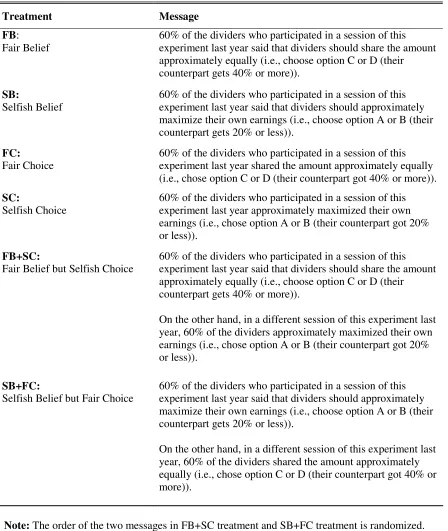
in Table 1. We refer to divisions that provide $5 or $4 to receivers as fair, and $2 or $1 as
selfish. For example, when we provided information about a majority of dictators making a fair choice (FC), we wanted to generate an empirical expectation of fairness in
our subjects. Conversely, when we conveyed information about the belief that one
“ought to” be fair (FB) on the part of a majority of dictators, we aimed at generating a
normative expectation of fairness in our subjects.
We considered six treatments in total: Fair Beliefs treatment (FB); Selfish Beliefs
treatment (SB); Fair Choices treatment (FC); Selfish Choices treatment (SC); Fair Beliefs
but Selfish Choices treatment (FB+SC) and Selfish Beliefs but Fair Choices treatment
(SB+FC). In the first four treatments we aimed at manipulating only one of the two types
of expectation, in the direction of either fairness or selfishness. In the last two treatments
our goal was to manipulate both empirical and normative expectations, but in opposite
directions.
In the FB (or FC) treatment, dictators are presented with data from a session where
the majority of dictators believed that a fair split should be chosen (or chose a fair split).
Thus, we hypothesize that our subjects’ normative (empirical) expectations will move
toward fairness, and therefore generate more fair offers. Similarly, in the SB (or SC)
treatment when subjects are informed that a majority of previous dictators believed that
only a small amount should be offered (or offered an unfair split), normative (empirical)
expectations will move toward selfishness, leading to an increase in selfish offers.
Inferences about the effects of these different expectations can be drawn by examining
dictators’ decisions when there is a conflict between normative and empirical
direction of fairness (selfishness) but the empirical expectation is that other dictators
behave selfishly (fairly).
Since we use data from Xiao and Houser (2006), our Dictator game is designed like
the game they devised. In particular, dictators can offer receivers any integer amount
from $1 to $9, excluding $7 and $3. In our experiment dictators receive information, so
one possible complication is that this information might lead to experimenter demand
effects (e.g., subjects might try to guess the experimenter’s intention and behave
accordingly). To mitigate this problem, we used a “double blind” procedure that ensures
subjects understand that neither other subjects nor the experimenter can connect a
dictator’s decision to a dictator’s identity (see the instructions in Appendix A for details).
In addition, the message containing the information follows a short note: In previous experiments, dividers have often wanted to know the views or decisions of other dividers. The information below is given to every divider in this experiment.4
II. B. Expectation elicitation
Immediately after each dictator made her decision, we gave her a survey to elicit her
expectations about the choices and presumed expectations of other participants in the
experiment. Dictators were rewarded based on the accuracy of the expectations they
reported. In particular, to elicit empirical expectations, dictators were asked how many
dictators they believed split the money approximately equally (i.e., gave the receiver $5
or $4), and were paid $1 if their answer matched the actual number of fair choices.
4
Normative expectations refer to a dictator’s beliefs regarding what others think one
ought to do. To elicit these expectations, subjects were asked, first, whether they thought
dictators should split the money approximately equally; and second, how many dictators
they believed answered “yes” to the first question. A dictator was paid $1 if her answer to
the second question matched the actual number of positive answers.
This paper focuses on the effect that information about dictators’ choices and/or
beliefs in previous experiments has on subjects’ normative and empirical expectations
about other dictators, and the behavioral consequences of such expectations. Dictators
are aware that messages are provided only to other dictators in the experiment. Still, it
might be possible that messages somehow influence dictators’ empirical expectations
regarding their receivers’ beliefs about what the dictator would or should do. This
“receiver expectation” effect might itself influence a dictator’s decision. To control for
this influence, in the survey we asked dictators what they thought their receivers believed
they would and should choose. A dictator was paid $1 if his/her answer matched the
receiver’s answer. Copies of the dictator and the receiver surveys are provided in
Appendix B.
II.C. Procedures
Subjects were recruited at the University of Pennsylvania through the “Experiments @
Penn” web-based recruitment system. Each subject was randomly assigned the role of
dictator or receiver. Dictators and receivers were separated and they could not see each
Each subject was randomly assigned a letter as his or her ID for the duration of the
experiment. A receiver and a dictator were paired if they held the same letter. All subjects
received an instruction sheet explaining the rules of the game. In addition to the
instructions, each dictator also received a separate sheet with one of the messages listed
in Table 1 and the short note mentioned in section II. A. A dictator’s decision card was
attached to the message sheet. The game started after every subject finished the
instructions.
Each subject played the game exactly once. Our procedures ensured it was clear to
dictators that no one, including the experimenters, knew their decisions. Dictators
indicated their chosen split on a decision sheet, wrote down their ID on the back of the
decision card and then put the card into a blank envelope. After all dictators had finished,
the experimenter collected all the envelopes and then gave each receiver his or her
dictator’s envelope according to the ID. At the end of the experiment, subjects’ earnings
were put in envelopes marked with ID letters. Each subject picked up her earnings
envelope privately. Each subject received a $5 show up bonus in addition to the money
earned in the game and the survey ($6 on average). Subjects were in the lab about 30
minutes.
III. Results
We obtained observations on 254 subjects: 21 pairs in the FB treatment; 19 pairs in the
SB treatment; 21 in FC treatment; 24 in SC treatment; 20 in FB+SC treatment and 22 in
expectations among treatments and reveals the relationship between mean expectations
and mean decisions. We then report an individual-level analysis connecting subjects’
expectations to their behaviors. Our results are convergent evidence that empirical
expectations about other dictators’ behaviors, but not normative expectations, are a key
force behind dictators’ choices.
III. A. Aggregate analysis of expectations and choices
III. A. 1 Dictator’s expectations by treatment
Every dictator (except one in the SC treatment) answered the question “How many
dividers in this room do you think split the money approximately equally (chose either C
or D)” (this is their empirical expectation of fair offers). From this we were able to
calculate the percentage of fair offers each dictator i in each treatment k expected
(EEik(fair offer)). We then obtained the overall mean percentage of fair offers expected
by dictators for each treatment (EEk(fair offer) ).
) (fair offer
EEk =
k n i k i n offer fair EE k
∑
=1 ) (; where nk is the total number of dictators in each
treatment k.5 Figure 1 plots this average by treatment.
Each dictator also reported her expectation regarding the number of dictators in the
experiment who believe that dictators should split the money approximately equally (this
elicits the normative expectation of fair offers). We calculatedNEik(fair offer), i.e., for
each treatment k, each dictator i’s normative expectation regarding the percentage of
dictators who believe fair offers should be made. Similarly to the calculation
ofEEk(fair offer), we calculated the average of NEik(fair offer)in each
treatment,NEk(fair offer). This average by treatment is also plotted in Figure 1.
First, as expected, EE(fair offer) and NE(fair offer) in FB and FC treatments are
significantly higher than those in SB and SC treatments (p<0.001 in all the four pairwise
Mann-Whitney tests). It is important to note that when only one message (either about
other dictators’ beliefs or choices) is presented, both empirical and normative
expectations are affected. For example, in the FC treatment where dictators were only
informed that the majority of dictators in another session made a fair offer, dictators
expected 64% of dictators to make fair offers and also expected 68% of dictators to
believe that fair offers ought to be made. In contrast, when dictators only knew that a
majority of dictators in a previous session made a selfish offer (i.e., gave $2 or $1) in the
SC treatment, dictators expected that only 37% of dictators would make a fair offer and
that just 41% of dictators believed fair offers ought to be made as well. Similar results
hold for the SB and FB treatments.
The fact that dictators change both empirical and normative expectations in the same
direction when only one message is presented makes clear that dictators’ decisions in the
SB, SC, FB and FC treatments cannot distinguish the relative behavioral importance of
empirical and normative expectations. However, this is not the case in the FB+SC and
SB+FC treatments.
For one, the change of normative expectations from the FB+SC treatment to the
SB+FC treatment goes in a different direction than the change we observe in empirical
in the SB+FC treatment are higher (43% and 48%, respectively); however, NE(fair offer)
are lower in the SB+FC treatment (57% and 52%, respectively). Second, NE(fair offer) in
the FB+SC treatment are significantly higher than EE(fair offer) (Wilcoxon
matched-pairs signed-ranks test, p=0.01). These results suggest that the manipulation in these two
treatments allows us to separate the effects of normative and empirical expectations on
choice. This is a crucial step in providing evidence about the relative importance of the
two expectations for predicting decisions. By examining which expectation is more
consistent with actual decisions, especially between the FB+SC and SB+FC treatments
we just discussed, we demonstrate next that empirical expectation seem to be a better
predictor of decisions than normative expectation.
III.A.2 Expectations and fair choices
Figure 2 plots the percentage of dictators who made fair offers in each treatment. First, as
expected, the percentage of fair offers is lower in the SB and SC treatments and much
higher in the FC and FB treatments. In particular, the percentage of fair offers in the SC
treatment is not significantly different from the percentage of fair offers in the SB
treatment (33% vs. 21%, Mann-Whitney test, p=0.38). However, in comparison to the SB
treatment, significantly more dictators make fair offers in the FB and FC treatments (48%
vs. 21%, Mann-Whitney one-tail test, p= 0.04; and 52% vs. 21%, Mann-Whitney one-tail
test, p=0.02; respectively). These results indicate that manipulating expectations about
other dividers’ choices or beliefs can have a significant effect on dictators’ own choices.
However, as we already noted, the dictators’ behavior in these four treatments cannot
To explore this issue, we now turn to the dictators’ behavior in the FB+SC and SB+FC
treatments, where they face inconsistent information about other players’ previous
choices and beliefs.
As shown in Figure 2, the percentage of fair offers in the SB+FC treatment is quite
close to what we observe in the FC treatment, and very different from the results of the
SB treatment. In particular, the percentage of fair offers in the SB+FC treatment is not
significantly lower than in the FC treatment (45% vs. 52%, Mann-Whitney one-tail test,
p=0.32) but is significantly higher than in the SB treatment (45% vs. 21%,
Mann-Whitney one-tail test, p=0.05). Meanwhile, the percentage of fair offers in the FB+SC
treatment is closer to what we observe in the SC rather than in the FB treatment (35% vs.
33% and 35% vs. 48% respectively), although neither of the two comparisons yields a
statistically significant difference. These comparisons provide preliminary evidence that
empirical expectations play a greater role than normative expectations in choosing to
make a fair offer.
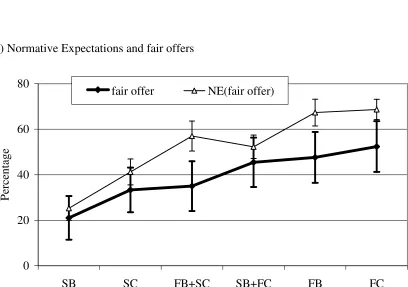
Figure 3 offers further evidence that empirical, but not normative, expectations
predict dictators’ decisions both in magnitude and direction. In particular, there are more
fair offers in the SB+FC than in the FB+SC treatment. This is consistent with the increase
in dictators’ empirical expectations of fair offers, but inconsistent with the decrease in
normative expectations of fair offers. In addition, while empirical expectations about the
percentage of fair choices are insignificantly different from the actual percentage of fair
offers in each treatment, normative expectations are significantly higher than the actual
It is possible that dictators’ expectations about receivers’ beliefs are affected by the
information they receive in each treatment, and if so this could also influence dictators’
decisions. We have some evidence about this possibility. In all sessions, at least 80% of
dictators expect receivers to believe that dividers should make a fair offer. The absence of
variation along this dimension among treatments suggests that this expectation has no
significant effect on dictators’ decisions6. Furthermore, for each treatment, we obtain data
on whether dictator i thinks her receiver would expect her to make a fair offer
(EEik(receiver'sEE)=1 if the dictator believes her receiver expects she will offer 40% or 50%; and equals zero otherwise). We calculated the proportion of dictators who believed
receivers expected fair offers (EEk(receiver'sEE)), and compared this to the actual
proportion of fair choices. As shown in Figure 4, it is clear that this expectation does not
predict dictators’ choices.
III.B. Individual level analysis of expectations and choices
The results derived by aggregating our data suggest that mean empirical expectations are
better predictors of mean decisions than mean normative expectations. Of course,
aggregate data do not give us much information about the effect of expectations on
decisions at the individual level. To investigate how the two types of expectations affect
subjects’ specific decisions we pursue next an analysis at the individual level.
6
Our approach is to run a probit regression. Our binary dependent variable is whether
dictator i made a fair offer. We assume the probit model’s error term is independent
across subjects in different sessions but allow it to be correlated among subjects within
the same session. With respect to our independent variables, we began by considering
both linear and non-linear terms connecting dictators’ expectations to their decisions. In
particular, our independent variables includedEEik(fair offer) , [EE (fair offer)
k
i ]
2
,
) (fair offer
NEik , [NEik(fair offer)]2 and EEik(receiver'sEE).7 However, in our analysis of this probit model we found that all of the non-linear expectations terms are
both economically and jointly statistically insignificant. Therefore, we report below the
results of a probit regression that includes the following independent variables:
) (fair offer
EEik ,NEik(fair offer)and EEik(receiver'sEE).
In our experiment expectations were exogenously manipulated. Nevertheless, it is in
principle possible that our regression analysis suffers from an endogeneity bias due to the
inclusion of elicited expectations as independent variables. In particular, if subjects’
declared expectations depend on their decisions, perhaps because they wish to defend
such decisions, then elicited expectations would be endogenous in our analysis. However,
we have no evidence supporting this possibility. Indeed, the dependence of reported
expectations on decisions is inconsistent with the fact that most dictators expect receivers
to believe that the division ought to be fair. In addition, there is substantial variation
between elicited expectations, even among dictators who make the same choice. Thus,
7
we are comfortable in proceeding under the standard assumption that our regression
analysis is appropriately specified8.
The results of our analysis are detailed in Table 2. The estimated coefficients of the
independent variables are listed in the second column. As it is difficult to interpret the
coefficients of a probit model, we also report the marginal effects in the fourth column,
which are evaluated at mean values for the independent variables. Just as in our aggregate
analysis above, we find that the dictators’ empirical expectations EEik(fairoffer)have a statistically significant and positive effect on the probability that a dictator will make a
fair offer. In particular, the marginal effect of EEik(fairoffer)is 0.019. For example, this implies that, ceteris paribus and evaluated at mean values for the independent variables,
the probability that a dictator makes a fair offer increases by about 10 percentage points if
her EEik(fair offer)increases from 45% to 50%.
In contrast to the substantial effect of empirical expectations, the coefficient of
normative expectations NEik(fair offer) is statistically insignificant, and its marginal
effect on the probability of fair choices is economically insignificant in magnitude.
In summary, our aggregate analysis and individual-level analysis together provide
compelling and convergent evidence that empirical expectations about other dictators’
behaviors, but not normative expectations, are a critical factor in dictators’ decisions.
IV. Discussion
This paper presents the first systematic study of the relative influence of empirical and
normative expectations on norm-abiding behavior. Our results provide evidence that
empirical expectations regarding other people’s behavior are a driving force behind
subjects’ decisions. Expectations regarding what other people think one ought to do can
predict decisions, but only to the extent that such expectations are in line with the choices
one believes others would actually make. When normative and empirical expectations
are inconsistent, our data suggest that individuals follow what they think others would do
in the same situation, even when they believe doing so would not be met with approval.
The importance of empirical expectations in decision-making has crucial implications
for the external validity of experimental results in dictator games. For example, why do
we see dictators give away money in experiments but lottery winners usually do not give
away some of their earnings to strangers? As argued in Houser (forthcoming) and
Bicchieri (2006), behaviors in naturally occurring and experimental environments are
reconciled if dictators and lottery winners make different decisions due to different
beliefs regarding what other people would do in their specific situation.
Our results have important implication for the policy makers whose goal is to
stipulate regulations to mitigate undesirable behavior, especially when violations are
widespread. Our findings suggest that, for a policy to be effective, it is not enough to
emphasize only the illegitimacy or the negative consequences of the undesirable behavior.
It is even more important to stress that many people do follow the relevant norms. This is
be quite important to sanction even small offenses such as graffiti. The reason is that
evidence that most society members follow norms will likely promote other members’
spontaneous norm compliance.
Our findings leave unexplained why people follow empirical instead of normative
expectations when these two are inconsistent. One possible reason is that, in naturally
occurring environments, punishment is often imposed on those whose behavior differs
from the majority. On the other hand, even when it is not formally approved, misconduct
might be only weakly punished – or perhaps not punished at all – when the behavior is
common. For example, in a society with high rates of corruption people are not likely to
expect corrupt acts to be punished, even in those cases where there exist laws explicitly
prohibiting corruption. To foster our understanding of how norms, expectations and
decisions interact, we are conducting further research on how punishment decisions
References
Bardsley, N., Sausgruber, R., 2005. Conformity and reciprocity in public good provision.
Journal of Economic Psychology, 26(5), 664-681.
Biccheiri, C. The Grammar of Society: the Nature and Dynamics of Social Norms, New
York: Cambridge University Press, 2006
Bolton, G.E., Ockenfels, A., 2000. ERC: A Theory of Equity, Reciprocity, and
Competition. American Economic Review, 90, 166-193.
Brandts, J., Fatás, E., 2001, Social information and social influence in an experimental
dilemma game. Working paper.
Camerer, C. Behavioral Game Theory: Experiments in Strategic Interaction. Princeton
University Press, Princeton, NJ, 2003.
Cason, T. N. , Mui, V., 1998, Social Influence in the Sequential Dictator Game, Journal
of Mathematical Psychology 42, pp. 248-265.
Charness, G., Dufwenberg, M. 2006. Promises and Partnership. Econometrica. 74(6),
1579-1601.
Cialdini, R.B., Kallgren, C. A., Reno R.R., 1990. A Focus Theory of Normative Conduct:
A Theoretical Refinement and Reevaluation of the Role of Norms in Human
Behavior. Advances in Experimental Social Psychology, 24, pp 201-234.
Croson, R.T.A., 2000. Thinking Like a Game Theorist: Factors Affecting the Frequency
of Equilibrium Play. Journal of Economic Behavior & Organization, Vol. 41, Issue 3,
March, 299-314.
Elster, J. 1989. Social Norms and Economic Theory. Journal of Economic Perspectives,
3(4), 99-117.
Fehr, E., Gächter,S. 2000. Cooperation and Punishment in Public Goods Experiments.
American Economic Review. 90 (4), 980-994.
Fehr, E., Urs F., 2004. Social norms and human cooperation Trends in Cognitive
Sciences, Volume 8, Issue 4 , 185-190.
Fehr, E., Urs F., Simon G., 2002. Strong Reciprocity, Human Cooperation, and the
Enforcement of Social Norms, Human Nature 13(1), 1-25.
Fehr, E. and Schmidt, K., 1999. A Theory of Fairness, Competition, and Cooperation.
Quarterly Journal of Economics, 114, 817-868.
Goffman, E. Stigma. Notes on the Management of Spoiled Identity, New York: Simon &
Schuster, 1963
Houser, D., forthcoming, Experiments and Econometrics. In The New Palgrave
Dictionary of Economics, Second Edition, Steven N. D. and Lawrence E. B. (eds).
London: Macmillan.
Keltner, D., Haidt J., 1999, Social Functions of Emotions at Four Levels of Analysis.
Cognition and Emotion, 13 (5), 505-521.
Krupka, E., Weber, R., 2006. The Focusing and Observational Effects of Social Norms.
Carnegie Mellon. Working paper
Lewis, D.K. Convention: A Philosophical Study. Cambridge, Mass.: Harvard University
Press. 1969.
Offerman, T., Sonnemans, J., Schram, A., 1996. Value orientations, expectations and
Paprzycka, K., 1999. Normative Expectations, Intentions and Beliefs. The Southern
Journal of Philosophy, 37-4, 629-652.
Rabin, Mathew. 1993. Incorporating Fairness into Game Theory and Economics.
American Economic Review. vol. 83, 1281-1302.
Rapoport, A., Eshed-Levy, D., 1989. Provision of step-level public goods: effects of
greed and fear of being gypped. Organizational Behavior and Human Decision
Processes 44, 325–344.
Rapoport, A., Suleiman, R., 1993. Incremental contribution in step-level public goods
games with asymmetric players. Organizational Behavior and Human Decision
Processes 55, 171–194.
Rilling J, Gutman D, Zeh T, Pagnoni G, Berns G, Kilts C., 2002. A neural basis for social
cooperation. Neuron 35, 395–405
Sugden, R., 1998. Normative expectations: the simultaneous evolution of institutions and
norms. In Ben-Ner, A. and Putterman, L. (eds), Economics, Value, and Organization.
Cambridge: Cambridge University Press.
Sugden, R. The Economics of Rights, Cooperation and Welfare, second edition,
Palgrave Macmillan, 2004, pp154-165.
Xiao, E., Houser, D. 2006. Emotion Expression and Fairness in Economic Exchange.
Working paper.
Young, P.H. forthcoming. Social Norms. In The New Palgrave Dictionary of Economics,
Table 1. Messages by treatment
Treatment Message
FB:
Fair Belief
60% of the dividers who participated in a session of this experiment last year said that dividers should share the amount approximately equally (i.e., choose option C or D (their counterpart gets 40% or more)).
SB:
Selfish Belief
60% of the dividers who participated in a session of this experiment last year said that dividers should approximately maximize their own earnings (i.e., choose option A or B (their counterpart gets 20% or less)).
FC:
Fair Choice
60% of the dividers who participated in a session of this experiment last year shared the amount approximately equally (i.e., chose option C or D (their counterpart got 40% or more)).
SC:
Selfish Choice
60% of the dividers who participated in a session of this experiment last year approximately maximized their own earnings (i.e., chose option A or B (their counterpart got 20% or less)).
FB+SC:
Fair Belief but Selfish Choice
60% of the dividers who participated in a session of this experiment last year said that dividers should share the amount approximately equally (i.e., choose option C or D (their counterpart gets 40% or more)).
On the other hand, in a different session of this experiment last year, 60% of the dividers approximately maximized their own earnings (i.e., chose option A or B (their counterpart got 20% or less)).
SB+FC:
Selfish Belief but Fair Choice
60% of the dividers who participated in a session of this experiment last year said that dividers should approximately maximize their own earnings (i.e., choose option A or B (their counterpart gets 20% or less)).
On the other hand, in a different session of this experiment last year, 60% of the dividers shared the amount approximately equally (i.e., chose option C or D (their counterpart got 40% or more)).
Note: The order of the two messages in FB+SC treatment and SB+FC treatment is randomized.
Table 2: Probit regression result of expectation effect
Dictator i ’s offer (=1, if gave $5 or $4; =0, o.w)
Coefficients P value Marginal Effects
Mean of the independent variable
) (fair offer
EEik 0.054
(0.012)
<0.001 0.019 (0.004)
45.337
) (fair offer
NEik 0.003
(0.007)
0.638 0.001
(0.002)
52.090
) ' (receiver sEE
EEik -0.394
(0.280)
0.160 -0.138
(0.095)
0.362
Constant -2.900
(0.564)
<0.001
Pseudo R2 0.430
Figure 1: Dictators’ normative and empirical expectations of the percentage of fair offers (i.e., offer $5 or $4 to the receivers)
0 20 40 60 80
SB SC FB+SC SB+FC FB FC
P
er
ce
n
ta
g
e
EE(fair offer) NE(fair offer)
Figure 2: Percentage of Dictators who made fair offers in each treatment
0 20 40 60 80
SB SC FB+SC SB+FC FB FC
P
er
ce
n
ta
g
[image:26.612.107.529.416.619.2]Figure 3: Expectations and fair offers
(A) Empirical Expectations and fair offers
0 20 40 60 80
SB SC FB+SC SB+FC FB FC
P
er
ce
nt
age
fair offer EE(fair offer)
(B) Normative Expectations and fair offers
0 20 40 60 80
SB SC FB+SC SB+FC FB FC
P
er
ce
nt
age
Figure 4: Dictators’ beliefs about Receivers’ expectation of fair offers (receiver’s EE) and Dictators’ percentage of fair offers
0 20 40 60 80
SB SC FB+SC SB+FC FB FC
P
er
ce
n
ta
g
e
Appendix A.
I. Divider Instructions
Thank you for coming! You've earned $5 for showing up on time. Whatever you earn in the rest of the session will be in addition to this $5. The instructions explain how you can make decisions. Please read these instructions carefully! There is no talking at any time during this experiment. If you have a question please raise your hand, and an experimenter will assist you.
You will be randomly and anonymously paired with another person in this room. You will never be informed of the identity of this person, either during or after the experiment. Similarly, your matched participant will never be informed about your identity. You are in the role of Divider and your matched participant will be referred to as your Counterpart. You and your Counterpart will participate only once in this decision problem. All the decisions will be anonymous.
This is how the experiment works.
Your task is to divide $10 between the two of you. How much money you end up with at the end of the experiment depends on the decisions you make.
Divider (You)
You will choose a Dividing Option (described in detail below). A Dividing Option determines how much of $10 will go to the Divider (you) and how much will go to your Counterpart.
Dividing Option
The possible divisions appear in the table below. You must choose only one of them.
Possible Dividing Options The option is
A Divider gets $9 and Counterpart gets $1
B Divider gets $8 and Counterpart gets $2
C Divider gets $6 and Counterpart gets $4
D Divider gets $5 and Counterpart gets $5
E Divider gets $4 and Counterpart gets $6
F Divider gets $2 and Counterpart gets $8
G Divider gets $1 and Counterpart gets $9
Experiment Procedure:
Step 1: Random and anonymous assignment of counterparts
Each of you has randomly chosen an envelope. In each envelope there is a tag marked with a letter. This letter is your ID for this experiment. Persons in this room who get tags marked with the same letter will be paired. Please do not show anyone your ID letter.
The Divider will be given a card where s/he can write down her/his decision. Below is a sample decision card:
After making the decision, the Divider will also write the letter ID on the back of the decision card, and then put it into his/her envelope.
Step 3: The Counterpart receives the Divider’s decision.
After every Divider has finished, the experimenter will give each Divider’s envelope to his/her Counterpart according to the ID on the card. The Counterpart will see the decision made by the divider and then put the decision card back into the envelope. After each Counterpart has finished an experimenter will collect all the envelopes.
Step 4: Receive cash payment privately
The experimenter will calculate the earnings of each Divider and each Counterpart. To keep everyone’s decision and earnings anonymous, the experimenter will put each participant’s earnings in an envelope marked with her/his ID letter. All Dividers’ envelopes will be placed on one desk, and all Counterparts’ envelopes will be placed on a different desk. Then, Dividers will be called one by one. When called, each Divider will pick up the envelope labeled with her/his letter ID. Then the Divider will exit the lab and drop all other supplies into the box outside the lab door. Every Counterpart will be paid in the same way after all the Dividers have been paid and have left the lab.
Divider and Counterpart will remain anonymously matched at all times during the experiment. Even the experimenter will not know your decisions.
End of Instructions
Please raise your hand to indicate that you are finished reading these instructions. Divider: (Dividing option)
I choose dividing option_______. That is,
II. Counterpart Instructions
Thank you for coming! You've earned $5 for showing up on time. Whatever you earn in the rest of the session will be in addition to this $5. The instructions explain how you can make decisions. Please read these instructions carefully! There is no talking at any time during this experiment. If you have a question please raise your hand, and an experimenter will assist you.
You will be randomly and anonymously paired with another person in this room. You will never be informed of the identity of this person, either during or after the experiment. Similarly, your matched participant will never be informed about your identity. Your matched participant is in the role of Divider and you will be referred to as Divider’s Counterpart. You and your Divider will participate only once in this decision problem. All the decisions will be anonymous.
This is how the experiment works.
The task is to divide $10 between the two of you. How much money you end up with at the end of the experiment depends on the decision your Divider makes.
Divider
The Divider will choose a Dividing Option (described in detail below). A Dividing Option determines how much of $10 will go to the Divider and how much will go to you.
Dividing Option
The possible divisions appear in the table below. The Divider must choose only one of them.
Possible Dividing Options The option is
A Divider gets $9 and Counterpart gets $1
B Divider gets $8 and Counterpart gets $2
C Divider gets $6 and Counterpart gets $4
D Divider gets $5 and Counterpart gets $5
E Divider gets $4 and Counterpart gets $6
F Divider gets $2 and Counterpart gets $8
G Divider gets $1 and Counterpart gets $9
Experiment Procedure:
Step 1: Random and anonymous assignment of counterparts
Each of you has randomly chosen an envelope. In each envelope there is a tag marked with a letter. This letter is your ID for this experiment. Persons in this room who get tags marked with the same letter will be paired. Please do not show anyone your ID letter.
Step 2: Divider chooses the option
After making the decision, the Divider will also write the letter ID on the back of the decision card, and then put it into his/her envelope.
Step 3: The Counterpart receives the Divider’s decision.
After every Divider has finished, the experimenter will give each Divider’s envelope to his/her Counterpart according to the ID on the card. The Counterpart will see the decision made by the divider and then put the decision card back into the envelope. After each Counterpart has finished an experimenter will collect all the envelopes.
Step 4: Receive cash payment privately
The experimenter will calculate the earnings of each Divider and each Counterpart. To keep everyone’s decision and earnings anonymous, the experimenter will put each participant’s earnings in an envelope marked with her/his ID letter. All Dividers’ envelopes will be placed on one desk, and all Counterparts’ envelopes will be placed on a different desk. Then, Dividers will be called one by one. When called, each Divider will pick up the envelope labeled with her/his letter ID. Then the Divider will exit the lab and drop all other supplies into the box outside the lab door. Every Counterpart will be paid in the same way after all the Dividers have been paid and have left the lab.
Divider and Counterpart will remain anonymously matched at all times during the experiment. Even the experimenter will not know your decisions.
End of Instructions
Please raise your hand to indicate that you are finished reading these instructions. Divider: (Dividing option)
I choose dividing option_______. That is,
Appendix B.
I. Divider survey
Please write down your ID________ Gender_______ (Divider)
Please answer the following questions. You can earn extra money depending on your answers.
Please Note: To answer some of the questions below you need to know that there are ….. dividers in this room.
a) How did you make your decision? (Write on the back of the paper if you need more space)
b) How many dividers in this room do you think split the money approximately equally (chose either
C or D)?
(If your answer is the same as the actual number, you will earn an additional $1)
c) How many dividers in this room do you think approximately maximized their payoff (choose A or
B)?
(If your answer is the same as the actual number, you will earn an additional $1)
d) Do you think that dividers should split the money approximately equally (choose C or D)?
e) Do you think that dividers should approximately maximize their payoff (choose A or B)?
f) How many dividers in this room do you think answered “Yes” to question d)?
(If your answer is the same as the actual number, you will receive an additional $1).
g) How many dividers in this room do you think answered “Yes” to question e)?
(If your answer is the same as the actual number, you will receive an additional $1).
h) Which option do you think your counterpart believed you WOULD choose?
(If your answer is the same as what your counterpart wrote on his/her survey before he/she knew your final
decision, you will earn an additional $1).
i.) Which option do you think your counterpart believed you SHOULD choose?
(If your answer is the same as what your counterpart wrote on his/her survey before he/she knew your final
II. Receiver survey9
Please write down your ID________ Gender_________ (Counterpart)
Please answer the following question. You can earn extra money depending on your answer.
a) Which option do you think your divider WOULD choose? Why?
(If your answer matches your divider’s actual decision, you will earn an additional $2).
b) Which option do you think your divider SHOULD choose? Why?
c) Suppose that 60% of the dividers who participated in a session of this experiment last year said that dividers should share the amount approximately equally (i.e., choose option C or D (their counterpart gets 40% or more)). If your divider knew this, which option do you think your divider WOULD choose? Why?
9