Published Online January 2014 in SciRes
Exploring Second Life as a Learning Environment for
Computer Programming
Atul Sajjanhar
1, Julie Faulkner
2 1Deakin University, Burwood, Australia
2Monash University, Clayton, Australia
Em
Received August 27th, 2013; revised September 27th, 2013; accepted October 4th, 2013
Copyright © 2013 Atul Sajjanhar, Julie Faulkner. This is an open access article distributed under the Creative Commons Attribution License, which permits unrestricted use, distribution, and reproduction in any medium, provided the original work is properly cited. In accordance of the Creative Commons Attribution License all Copyrights © 2013 are reserved for SCIRP and the owner of the intellectual property Atul Sajjanhar, Julie Faulkner. All Copyright © 2013 are guarded by law and by SCIRP as a guardian.
Computer programming can be challenging for beginners because of the need to understand abstract pro- gramming concepts. In this paper, we study the use of the Second Life (SL) virtual world for learning computer programming concepts. We conduct an empirical study for learning computer programming in SL by addressing affordances of SL for experiential problem-based learning pedagogies. We present pre- liminary findings, the promises and the limitations of Second Life as an environment for learning com- puter programming.
Keywords: Problem Based Learning; Computer Programming; Experiential Learning; Second Life
Introduction
Failure to grasp computer programming skills can lead to de- motivation of computer science students (Jenkins, 2001). Some students who struggle with programming may drop out of the course while others might choose a career path which does not involve programming (Miliszewska & Tan, 2007; Stamouli et al., 2004).
Learning computer programming requires a hierarchy of skills (Sloane & Linn, 1988). Skills required for computer pro- gramming are broadly divided into high level skills and low level skills. High level computer programming skills are: ana- lytical skills for problem analysis and developing a conceptual solution (Esteves et al., 2009). Low level computer program- ming skills are used to generate syntactically correct computer programs, i.e. articulate conceptual solutions in a programming language. The focus of this paper is on high level computer programming skills. High level skills require a comprehension of abstract programming concepts which tend to be difficult to grasp, because they lack real life analogies (Dunican, 2002).
Environments, such as ALICE (Dann, Cooper, & Pausch, 2000), JELIOT (Ben-Bassat Levy et al., 2003), BlueJ (Kölling, Quig, Patterson, & Rosenberg, 2003) and RAPTOR (Carlisle, Wilson, Humphries, & Hadfield, 2005) have been used to teach introductory computer programming. In these environments, blocks of code are dragged and dropped into a canvas to create visual representations of a computer program. Isolating the pro- grammer from intricacies of programming syntax means that these environments do not have a steep learning curve which is conducive for student engagement. These environments are suitable for teaching high level computer programming skills. However, the drawback of these environments is that they do not inherently support collaboration.
Guzdial et al. (1996) and Menchaca et al. (2005) suggest that collaboration is an effective approach for computer program- ming. According to Casamayor et al. (2009), collaboration is significant, because it stimulates learning, promotes feelings of belonging to a team, encourages creativity, eases communica- tion and increases achieved personal satisfaction. Collaborative environments can offer important support to students in their activities for computer programming. According to Newman (1989), collaboration in problem solving not only provides an appropriate activity but also promotes reflection, a mechanism that enhances the learning process. Reflection encourages the act of articulating and ordering thoughts, organizing them in a coherent form to provide fresh insights into practices and moti- vations. Britzman (2003) argues the importance of “second thoughts”, running through and over ideas in multiple and re- petitive ways in order to draw more from the ideas and consider how something could be done differently.
There are several vendors which provide Multi-User Virtual Environment (MUVE) or virtual world environment for teach- ing/learning. Virtual worlds provide a collaborative learning environment which affords a contextual embodied experience and has the potential to offer student engagement aligned with real-world experiences (Sajjanhar, 2012). Second Life
Linden Lab which was founded in 1999. Another vendor of 3D
virtual world is Active Worlds
Virtual Worlds Research, 2009): it is used in medical and health education (Boulos, Hetherington, & Wheeler, 2007); it is used for teaching languages, including Arabic (Kern, 2009) and Chinese (Henderson et al., 2010); it is also used for researchers to collaborate (Novak, 2010).
The aim of this paper is to investigate the potential of SL as an enabling environment to acquire the disparate skills re- quired for computer programming. The research question ad- dressed is: To what extent does SL facilitate understanding of computer programming concepts? We conduct an empirical study in which academics and students provide relevant feed- back about SL; data from the study are used to draw inferences about SL in the context of a programming learning environment. The rest of the paper is organized as follows: Section 2 de- scribes the proposed approach including pedagogies of interest; evaluation is documented in Section 3. Conclusions are given in Section 4.
Proposed Approach
SL has a proprietary scripting language, namely, Linden Scripting Language (LSL); it is used to control the behavior and interactivity of virtual entities. LSL can be used to manifest concepts in the virtual world. Hence, LSL can be used to ac- quire higher level computer programming skills such as prob- lem analysis and conceptualization. SL provides a means for educators to use various pedagogies suitable to teach computer programming, namely, problem-based learning and experiential learning. In this section, we address these pedagogies in the context of SL as a learning environment for computer pro- gramming.
Experiential Learning
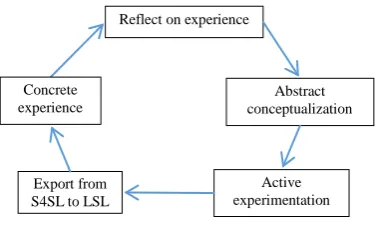
Experiential learning is proposed by Kolb (1984). According to Wrzesien et al. (2010), the aim of experiential learning the- ory is to engage learners in direct experience. Experiential learning as defined by Kolb (1984) consists of a cycle of the following stages: concrete experience, reflect on experience, abstract conceptualization and an active experience.
Girvan et al. (2013) have mapped stages of experiential learning to the stages in creating programmable artefacts in SL. LSL is the native programming tool in SL but has a steep learn- ing curve for a novice. Barriers to engagement are lowered by providing a low-floor tool i.e. a tool which does not require a steep learning curve. Scratch for Second Life (S4SL) was de- signed by Rosenbaum (2008) as a low-floor and high-ceiling (powerfully expressive) programming tool for SL. It is a visual environment which employs the drag-and-drop approach to create blocks of script outside SL; the code from S4SL is pasted into an object in SL to add behavior and interactivity to other- wise static objects. Although Girvan et al (2013) use SLurtle for creating artefacts, the mapping is identical when S4SL is used as the programming tool as shown in Figure 1.
According to Girvan et al. (2013), the experiential learning cycle of Figure 1 provides learners with concrete experience which they can observe and reflect upon. The learners can re- assess the code by comparing the visualization at the concrete experience stage with the original plan.
Problem Based Learning
This paper is inspired by experiential learning theory and
Reflect on experience
Export from S4SL to LSL
[image:2.595.329.517.84.202.2]Abstract conceptualization Active experimentation Concrete experience Figure 1.
Stages of experiential learning and stages to create pro-grammable artefacts in SL. Adapted from Girvan et al. (2013).
PBL. Torp and Sage (2002) highlight the similarity between these pedagogies by defining PBL as focused, experiential learning organized around the investigation and resolution of messy, real-world problems.
PBL was first introduced in medical education over 30 years ago; however, it has since been used in a wide range of disci- plines (Savery, 2006). Problem based learning (PBL) is consid- ered effective for programming courses (Hwang et. al., 2008). Savery (2006) summarized the characteristics of PBL and notes that the key to success is the selection of ill-structured problems and a teacher who guides the learning process. PBL is de- scribed as facilitated problem-solving by Hmelo-Silver (2004). In PBL, problems once articulated by the teacher act as cata- lysts that initiate the learning process (Duch, 2001). Effective problems engage students and motivate them to gain a deeper understanding (Duch, 2001) by allocating more responsibility to the students (Esteves, Fonseca, Morgado, & Martins, 2009).
PBL in computer programming is afforded in SL by virtual objects. A programming tool in SL is used to define the behav- ior of these objects; learners analyze the behavior of these ob- jects. Problems are formulated around computer programming; students are tasked to replicate or enhance the behavior of vir- tual objects by using a programming tool in SL. Visualization plays an important role in confirming the successful solution to a problem; the highly visual feedback allows the students to relate the program to the behavior of the object (Esteves, Fon- seca, Morgado, & Martins, 2010). If the behavior of an object is not as expected then the student has an opportunity to reflect and revisit the problem.
Evaluation
In order to address the research question, SL is evaluated as a learning environment for computer programming concepts. The instrument is described in Section 3.1. Experimental Setup is described in Section 3.2. Data collection and data analysis is addressed in Section 3.3.
Instrument
which generate behaviors. The relationship between belief, attitude, intent, and behavior is adapted by TAM.
The premise of TAM are: first, users tend to use technology if they believe that it will help them perform better; second, potential users who believe in the usefulness of the technology may still reject it if they find that it is not easy to use (Chen, Chiu, & Wu, 2010). Based on these premise, Davis (1989) pro- posed two constructs, namely, perceived usefulness (PU) and perceived ease-of-use (PEOU) as indicators of intent to use a technology i.e. technology acceptance (TA); he used an ex- periment with email and graphics to validate TAM. Constructs proposed in TAM have been further validated in a number of studies, for example, Matheison (1991), Adams, Nelson and Todd (1992), and Chau (1996). TAM constructs are comprised of items listed below for PU and PEOU.
PU and PEOU (Table 1) are adapted to evaluate SL/S4SL as a learning environment for computer programming concepts; the adapted items are shown in the Data Analysis section (Sec- tion 3.3). Job Performance item in PU is regarded irrelevant; hence, it is removed from the questionnaire.
Cronbach’s α is used as a measure of internal consistency re-
liability of the items in PU and PEOU. High values of alpha are used as evidence that the items have an underlying correlation. Cronbach’s alpha is computed as below.
(
1)
N c N c α υ ⋅ =+ − ⋅ (1)
Here N is equal to the number of items, c is the average inter-item covariance among the items and υ equals the av-
erage variance. Cronbach’s α of 0.8 is considered high en-
ough in most social science experiments (Carmines & Zeller, 1979).
Experimental Setup
Faculty members and students at a large Australian univer- sity were invited to participate in an empirical study about the use of SL as a learning environment for computer programming. The potential participant did not need prior experience of SL, although some programming knowledge was required. Student participants were given a $30 Kmart ™ voucher as incentive to participate.
Robins et al. (2003) proposed a three-pronged comprehen- sive approach to teach/learn programming, addressing knowl- edge required to design, generate and evaluate programs. Here, we focus on reinforcing programming concepts rather than comprehensive programming. Therefore, the proposed experi- ments do not require students to generate programs. The focus is removed from programming language syntax and directed towards evaluating programs i.e. reviewing programs and giv- ing comments (Lister & Leaney, 2003). The empirical study implicitly addresses knowledge of program design.
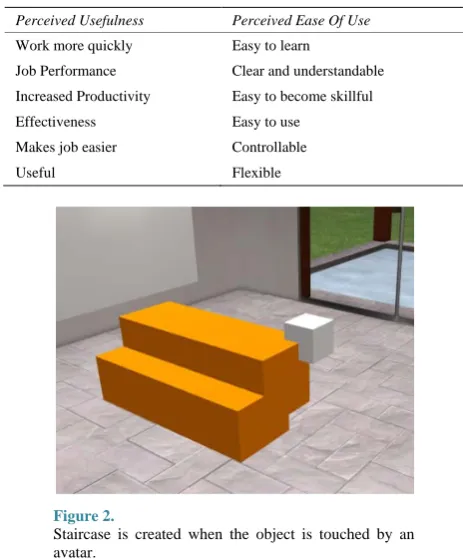
The staircase example of Rosenbaum (2008) is used to de- velop experiments for the empirical study. Rosenbaum (2008) uses S4SL to create LSL; the script is embedded in an object in SL. When the object is touched by an avatar, it creates a stair- case. The final resting position of the object is at the end of the staircase. Visualization of the staircase example of Rosenbaum (2008) is shown in Figure 2.
Experiments to address programming concepts of variables, iterations and conditional statements are described below. Vis
Table 1. TAM constructs.
Perceived Usefulness Perceived Ease Of Use
Work more quickly Easy to learn
Job Performance Clear and understandable
Increased Productivity Easy to become skillful
Effectiveness Easy to use
Makes job easier Controllable
[image:3.595.306.538.106.386.2]Useful Flexible
Figure 2.
Staircase is created when the object is touched by an avatar.
ualization is used to confirm that the correct solution is achie- ved for each problem and multiple attempts may be required to obtain the correct solution.
Variables
Variables are used for temporary storage of data. A variable is demonstrated by defining a scenario in which after comple-tion of the staircase, the virtual object returns to the posicomple-tion it had at the start. The psuedocode for implementing this scenario is the following:
variable (namely, variable_location) is used to record the position of the object
create a pair of stairs
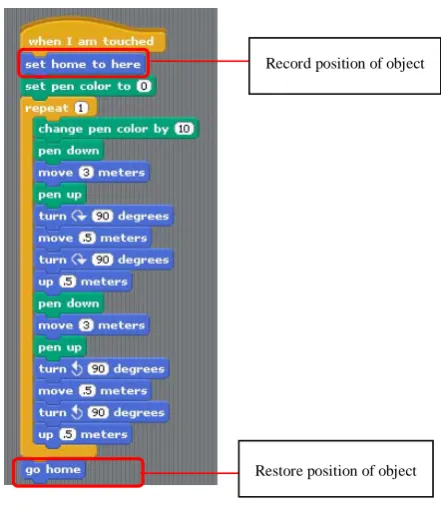
object is returned to position specified by variable_location Two blocks of code highlighted in Figure 3demonstrate the use of variables. set home to here assigns the current coordi-nates of the object to a variable; go home will return the object to the location stored in the variable. LSL generated from Fig-ure 3 is embedded in an object in SL. When the object is touched by an avatar, the script responds by creating a staircase; after creating the staircase the object returns to its initial posi-tion as shown in Figure 4.
Iteration Statement
An iteration statement is used in computer programming to implement an iterative task. The psuedocode for iteration statement is:
for variable = initialvalue to finalvalue statement 1
...
Record position of object
[image:4.595.61.282.84.342.2]Restore position of object
Figure 3.
[image:4.595.311.537.86.381.2]Restore position of object after staircase is created.
Figure 4.
Visualization of the experiment.
In the staircase example of Rosenbaum (2008), when an ob- ject is touched, it creates a single pair of stairs (Figure 2). In this section, multiple pairs of stairs are created. The psuedocode for implementing this scenario is the following:
for variable = initialvalue to finalvalue create single pair of stairs
end
The number of pairs of stairs will depend on initialvalue and finalvalue in the psuedocode above. The scenario is imple- mented in S4SL by using repeat as shown in Figure 5. The number of stairs is controlled by the counter supplied to the repeat statement.
LSL generated from Figure 5 is embedded in an object in SL. When the object is touched by an avatar the script responds by creating a staircase. Visualization of the experiment is shown in
Figures 6and 7.
Conditional Statement
[image:4.595.91.257.366.520.2]A conditional statement is executed when a predefined con-
Figure 5.
[image:4.595.333.516.392.543.2]Create a staircase using an iteration statement.
Figure 6.
Visualization of the experiment.
Figure 7.
Visualization of the experiment.
[image:4.595.334.514.576.713.2]dition holds good. The psuedocode for conditional statement is: if (condition exists) then (execute statements)
Hence, an expression is evaluated to decide if a pre-defined condition holds good; if the condition holds good, a set of statements is executed otherwise the set of statements is ig- nored.
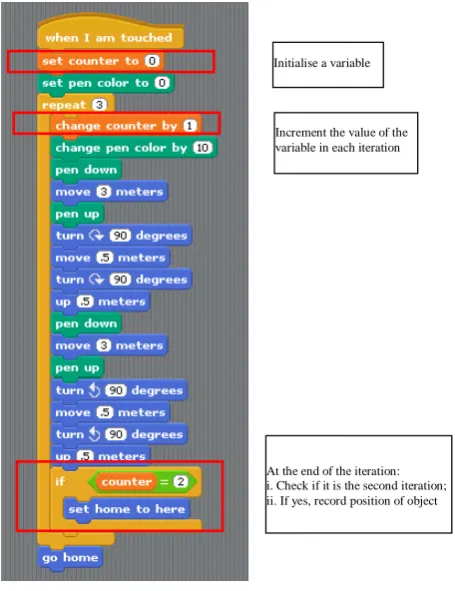
We consider a scenario which is an enhancement of the prob- lems in Sections 3.2.1 and 3.2.2. In this scenario, when a virtual object is touched, it creates a staircase similar to Section 3.2.2; however, after completion of the staircase, the virtual object returns to the position it had at the end of the second iteration. The psuedocode for implementing this scenario is the follow- ing:
1. variable_counter is initialized to 0 2. for variable_loop = 1 to finalvalue 3.. variable_counter is incremented 4. create single pair of stairs 5. if (variable_counter equals 2) then (remember the current position) 6. end
7. object returns to the position which was stored in line 5 LSL generated from Figure 8is embedded in an object in SL. When the object is touched by an avatar, the script responds by creating a staircase. After the staircase is created, object returns to the position it held at the end of the second iteration.
To assess SL in the context of the research question, tasks were implemented in-world based on the experiments described in Section 3.2. The tasks are included in the Appendix. Partici- pants were required to complete these tasks in-world. It was possible to observe the actions of the participant’s avatar in- world and also provide in-world assistance. Participants docu- mented their experience by completing a questionnaire. The questionnaire comprised four parts: Part 1 obtained background of the participant regarding their programming experience; Parts 2 and 3 had Likert-scale questions which were adopted with adaptation from the TAM questionnaire; Part 4 was used for qualitative data collection and comprised open-ended ques- tions about the participant’s experience.
Data Collection and Analysis
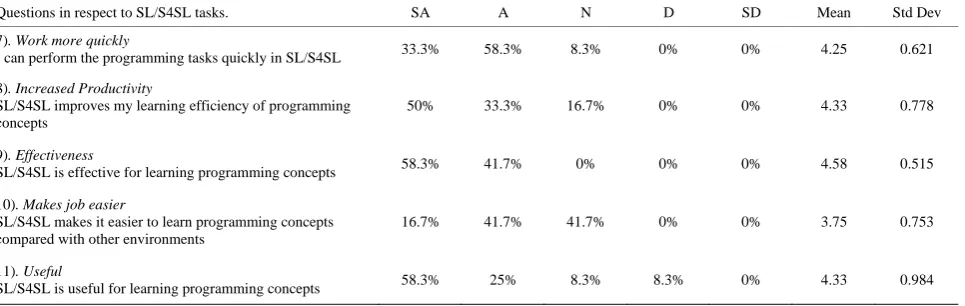
A total of 12 people participated in this study. They were all post-graduate students with 75% males and 25% females. Data from completed questionnaires is analyzed to derive conclu-sions about SL as a learning environment for computer pro-gramming concepts. Results from the Likert-scale questions in the questionnaire are summarized in Tables 2and 3.
Cronbach’s α of 0.868 is obtained for the 11 Likert-scale
questions. Some feedback from open-ended questions in the questionnaire is given below.
Q: Did you find the tasks interesting?
i. The activities are interesting and very useful for beginners who want to clear the concepts of programming.
ii. I have been doing programming for two months and I am amazed to see what we can do with programming.
iii. It is easy to learn programming by visualization. iv. It is more interesting than just write down or read code. v. It is user friendly for beginner to learn programming Q: Do you expect the virtual presence of the teacher to be helpful for completing activities in this environment?
i. At the time of the activity, I had doubts and the virtual presence of the teacher clarified my doubts.
At the end of the iteration: i. Check if it is the second iteration; ii. If yes, record position of object
[image:5.595.309.537.85.381.2]Increment the value of the variable in each iteration Initialise a variable
Figure 8.
Record the position of the object at the end of the second iteration; return the object to this location after all stairs are created.
ii. I do favor the concept of a teacher because sometimes you need help when you are stuck and programming needs some help in one way or the other
iii. Virtual presence of the teacher is helpful as teacher can always guide or give the solution if any doubt or problem is there.
iv. It is really good to have virtual presence of someone who can guide.
v. Virtual presence of teacher could help me to improve my skills because I am not nervous when I encounter the virtual presence of the teacher.
vi. Yes, I think it is helpful. When I have questions, I can chat with the virtual presence of the teacher.
Q: Do you expect the virtual presence of the peers to be helpful for completing activities in this environment?
i. It is really interesting to learn with peers in this environ-ment.
ii. Virtual presence of peers may distract the learner from his/her task.
iii. Yes, SL provides a good social community. Peers could learn programming and share what they learn.
Q: Any other comments
i. It can explain more programming concepts visually and we can learn fast. It is interesting to learn here.
ii. SL is good platform for understanding programming con- cepts as well as for entertainment.
iii. It is really useful to understand programming fundamen- tals but implementing or understanding the logic is all up to the learners
Table 2.
Perceived ease of use.
Questions in respect to SL/S4SL tasks. SA A N D SD Mean Std Dev
1). Easy to learn
SL/S4SL provides an easy to learn approach for programming concepts
41.7% 41.7% 16.7% 0% 0% 4.25 0.754
2). Clear and understandable
SL/S4SL tasks makes the programming concepts clear and understandable
50% 41.7% 8.3% 0% 0% 4.33 0.888
3). Easy to become skillful
It is easy to become skillful in programming tasks in SL/S4SL 16.7% 50% 25% 8.3% 0% 3.75 0.866
4). Easy to use
SL/S4SL is an easy to use environment for attempting programming tasks
25% 33.3% 41.7% 0% 0% 3.83 0.834
5). Controllable
SL/S4SL is a controllable environment for attempting programming tasks
25% 58.3% 16.7% 0% 0% 4.08 0.668
6). Flexible
SL/S4SL provides a flexible environment for learning programming concepts
41.7% 58.3% 0% 0% 0% 4.42 0.515
SA: Strongly Agree; A: Agree; N: Neither Agree or Disagree; D: Disagree; SD: Strongly Disagree.
Table 3.
Perceived usefulness.
Questions in respect to SL/S4SL tasks. SA A N D SD Mean Std Dev
7). Work more quickly
I can perform the programming tasks quickly in SL/S4SL 33.3% 58.3% 8.3% 0% 0% 4.25 0.621
8). Increased Productivity
SL/S4SL improves my learning efficiency of programming concepts
50% 33.3% 16.7% 0% 0% 4.33 0.778
9). Effectiveness
SL/S4SL is effective for learning programming concepts 58.3% 41.7% 0% 0% 0% 4.58 0.515
10). Makes job easier
SL/S4SL makes it easier to learn programming concepts compared with other environments
16.7% 41.7% 41.7% 0% 0% 3.75 0.753
11). Useful
SL/S4SL is useful for learning programming concepts 58.3% 25% 8.3% 8.3% 0% 4.33 0.984
SA: Strongly Agree; A: Agree; N: Neither Agree or Disagree; D: Disagree; SD: Strongly Disagree.
interested in SL.
v. I think this is good for students who pay attention to de- tails otherwise they are not able to identify the difference be- tween objects.
Conclusions and Future Work
The research question addressed in this paper is the extent to which SL facilitates an understanding of computer program- ming concepts. An empirical study, based on problem-based learning and experiential learning approaches was conducted. Participants completed a questionnaire comprising Likert-scale questions and open-ended questions. Responses to Likert-scale questions (adopted from TAM questionnaire) paint a positive picture of SL with regard to PEOU and PU in the context of the
research question. Cronbach’s α of 0.868 is obtained for the
Likert-scale questions; it indicates a high level of internal con- sistency reliability of the items in PEOU and PU. Responses to open-ended questions show that participants responded posi- tively to the experiments; however, few participants got dis- tracted by the inherent characteristics of virtual worlds, e.g.,
in-world social interactions; in-world entertainment is also a likely distraction.
In the future, it is proposed that constructivist learning be incorporated to enhance the learning experience. In construc- tivist approach, learners build on their existing knowledge by applying prior knowledge to solve real-world problems (Had- jerrouit, 2008). This approach to learning focuses on the proc- ess of creating and sharing artefacts which are personally mea-ningful (Girvan, Tangney, & Savage, 2013). Girvan & Savage (2010) have argued the alignment between affordances of SL and constructivist pedagogies. SL tools which afford the con-struction of persistent objects use features of this pedagogy (Girvan, Tangney, & Savage, 2013). In line with improved pedagogical approaches in computer programming, preliminary data suggest that SL provides a constructivist environment for building skills and knowledge.
Acknowledgement
[image:6.595.59.542.344.497.2]tion Technology, Deakin University, Australia.
REFERENCES
Adams, D. A., Nelson, R. R., & Todd, P. A. (1992). Perceived useful-ness, ease of use and usage of information technology: A replication.
MIS Quarterly, 16, 227-247.
Ben-Bassat Levy, R., Ben-Ari, M., & Uronen, P. A. (2003). The Jeliot 2000 program animation system. Computers & Education, 40, 1-15.
Boulos, M. N. K., Hetherington, L. & Wheeler, S. (2007). Second Life: an overview of the potential of 3-D virtual worlds in medical and health education, Health Information & Libraries Journal, 24, 233-
Britzman, D. (2003). Practice makes practice: A critical study of learn-ing to teach. New York State University: New York Press.
Carlisle, M. C., Wilson, T. A., Humphries, J. W., & Hadfield, S. M. (2005). RAPTOR: A visual programming environment for teaching algorithmic problem solving. ACM SIGCSE Bulletin, 37, 176-180.
Carmines, E. G., & Zeller, R. A. (1979). Reliability and validity as-sessment. Sage University Paper 17. Beverly Hills: Sage Publica-tions.
Casamayor, A., Amandi, A., & Campo, M. (2009). Intelligent assis-tance for teachers in collaborative e-learning environments. Com-puters & Education, 53, 1147-1154.
Chau, P. Y. K. (1996). An empirical assessment of a modified technol-ogy acceptance model. Journal of Management Information Systems, 13, 185-204.
Chen, M.-P., Chiu, C.-H., & Wu C.-C. (2010). Instructional simulations for teaching high school computer science concepts: A technology acceptance perspective. IEEE International Conference on Digital Game and Intelligent Toy Enhanced Learning, 216-218.
Dalgarno, B., Lee, M. J. W., Carlson, L, Gregory, S., & Tynan, B. (2010). 3D immersive virtual worlds in higher education: An Aus-tralian and New Zealand scoping study. Ascilite Sydney, 269-280. Dann, W., Cooper, S., & Pausch, R. (2000). Making the connection:
programming with animated small world. ACM SIGCSE Bulletin, 32,
41-
Davis, F. D. (1989). Perceived usefulness, perceived ease of use, and user acceptance of information technology, MIS Quarterly, 13, 319-
Dickey, M. D. (2003). Teaching in 3D: Pedagogical affordances and constraints of 3D virtual worlds for synchronous distance learning.
Distance education, 24, 105-121.
Duch, B. J. (2001). Models for problem-based instruction in under-graduate courses. The Power of Problem-Based Learning, 39-46. Esteves, M., Fonseca, B., Morgado, L., & Martins, P. (2009). Using
second life for problem based learning in computer science pro-gramming. Journal of Virtual Worlds Research, 2, 3-25.
Fishbein, M., & Ajzen, I. (1975). Belief, attitude, intention, and beha-vior: An introduction to theory and research. Reading, MA: Addi-son-Wesley.
Guzdial, M., Kolodner, J. L., Hmelo, C., Narayanan, H., Carlson, D., Rappin, N., Hübscher, R., Turns, J., & Newstetter, W. (1996). Com-puter support for learning through complex problem-solving. Com-munications of the ACM, 39, 43-45.
Girvan, C., & Savage, T. (2010). Identifying an appropriate pedagogy for virtual worlds: A communal constructivism case study. Com-puters & Education.
Girvan, C., Tangney, B., & Savage, T. (2013). SLurtles: Supporting constructionist learning in Second Life. Computers & Education, 61,
115-13
Hadjerrouit, S. (2008). Towards a blended learning model for teaching
and learning computer programming: A Case Study. Informatics in Education, 7, 181-210.
Henderson, L., Grant, S., Henderson, M., & Huang, H. (2010). Univer- sity students’ cognitive engagement while learning in a Virtual World.
Australian Computers in Education Conference, 6-9 April, Mel- bourne.
Hwang, W.-Y., Wang, C., Hwang, G.-J., Huang, Y.-M., & Huang, S. (2008). A web-based programming learning environment to support cognitive development. Interacting with Computers, 20, 524-534.
Jenkins, T. (2001). The motivation of students of programming. Pro- ceedings of ITiCSE 2001: The 6th Annual Conference on Innovation and Technology in Computer Science Education (pp. 53-56). New York: ACM.
Journal of Virtual Worlds Research (2009). Pedagogy, education and innovation in Virtual Worlds.
Kolb, D. A. (1984). Experiential learning: Experience as the source of learning and development. Upper Saddle River, NJ: Prentice-Hall. Kölling, M., Quig, B., Patterson, A., & Rosenberg, J. (2003). The BlueJ
system and its pedagogy. Computer Science Education, 13, 249-268.
Kern, N. (2009). Starting a Second Life.
Lister, R., & Leaney, J. (2003). First year programming: Let all the flowers bloom. Proceedings of the Fifth Australasian Conference on Computing Education (pp. 221-230). Adelaide.
Mathieson, K. (1991). Predicting use intentions: Comparing the tech-nology acceptance model with the theory of planned behaviour. In-formation Systems Research, 2, 173-191.
Menchaca, R., Balladares, L., Quintero, R., & Carreto, C. (2005). Software engineering, HCI techniques and Java technologies joined to develop web-based 3D-collaborative virtual environments. Pro-ceedings of the 2005 Latin American conference on Human-compu- ter interaction (pp. 40-51). New York, NY: ACM Press.
Miliszewska, I., & Tan, G. (2007). Befriending computer programming: a proposed approach to teaching introductory programming. Journal of Issues in Informing Science & Information Technology, 4, 277- 289.
Newman, D., Griffin, P., & Cole, M. (1989). The construction zone: Working for cognitive change in school. New York: Cambridge Uni- versity Press.
Novak, T. P. (2010). eLab city: A platform for academic research on virtual worlds. Journal of Virtual Worlds Research, 3.
Record voice chat and sounds. (2012).
Robins, A., et al. (2003). Learning and teaching programming: A re-view and discussion. Computer Science Education. 13, 137-172.
Rosenbaum, E. (2008). Scratch for second life. Proceedings of the In- ternational Conference of the Learning Sciences-ICLS, Utrecht, The Netherlands: ICLS., 144-152.
Sajjanhar, A. (2012). Virtual worlds for student engagement. Creative Education, 3, 796-801.
Savery, J. R. (2006). Overview of problem-based learning: Definitions and distinctions. Interdisciplinary Journal of Problem-based Learning,
1, 9-20.
Second life bot. (2012). http://wiki.secondlife.com/wiki/Bot.
Sloane, K., & Linn, M. C. (1988). Instructional conditions in Pascal programming classes. In R. Mayer (Ed.), Teaching and learning com- puter programming: Multiple research perspectives (pp. 207-235).
Hillsdale: Lawrence Erlbaum Associates.
Stamouli, I., Doyle, E., & Huggard, M. (2004). Establishing structured support for programming students. 34th Annual Conference on Fron-
tiers in Education, 2, F2G - 5-9.
Warburton, W. (2009). Second Life in higher education: Assessing the potential for and the barriers to deploying virtual worlds in learning and teaching. British Journal of Educational Technology, 40, 414-426.
Wrzesien, M., & Raya, M. A. (2010). Learning in serious virtual worlds: Evaluation of learning effectiveness and appeal to students in the E- Junior project. Computers & Education, 55, 178-187.
Appendix—Experiment 1
S4SL code in objects Task 1-Object A and Task 1-Object B is shown below.
Use objects Task 1-Object A and Task 1-Object B from the Second Life Inventory to visualize the two pieces of code and answer the questions below.
1. Identify the difference in the code.
____________________________________________________________________________ ____________________________________________________________________________
2. How is the difference reflected in the visualization?
____________________________________________________________________________ ____________________________________________________________________________
Appendix—Experiment 2
S4SL code in objects Task 2-Object A and Task 2-Object B is shown below.
Use objects Task 2-Object A and Task 2-Object B from the Second Life Inventory to visualize the two pieces of code and answer the questions below.
1. Identify the difference in the code.
____________________________________________________________________________ ____________________________________________________________________________
2. How is the difference reflected in the visualization?
____________________________________________________________________________ ____________________________________________________________________________
Appendix—Experiment 3
S4SL code in objects Task 3-Object A and Task 3-Object B is shown below.
Use objects Task 3-Object A and Task 3-Object B from the Second Life Inventory to visualize the two pieces of code and answer the questions below.
1. Identify the difference in the code.
____________________________________________________________________________ ____________________________________________________________________________
2. How is the difference reflected in the visualization?