Munich Personal RePEc Archive
Alcohol Consumption and Sickness
Absence: Evidence from Panel Data
Johansson, Edvard and Böckerman, Petri and Uutela, Antti
Labour Institute for Economic Research
19 December 2007
Online at
https://mpra.ub.uni-muenchen.de/6398/
Keskusteluaiheita – Discussion papers
No. 1112
Edvard Johansson* – Petri Böckerman** – Antti Uutela***
ALCOHOL CONSUMPTION AND
SICKNESS ABSENCE:
EVIDENCE FROM PANEL DATA
*
Corresponding author. The Research Institute of the Finnish Economy.Address: Lönnrotinkatu 4B, FIN-00120 Helsinki, FINLAND.
Phone: +358-9-609900. Fax: +358-9-601753. E-mail: [email protected]
**
Labour Institute for Economic Research. E-mail: [email protected]***
National Public Health Institute. E-mail: [email protected]ISSN 0781-6847 10.12.2007
ETLA
ELINKEINOELÄMÄN TUTKIMUSLAITOS
THE RESEARCH INSTITUTE OF THE FINNISH ECONOMY Lönnrotinkatu 4 B 00120 Helsinki Finland Tel. 358-9-609 900JOHANSSON, Edvard – BÖCKERMAN, Petri – UUTELA, Antti, ALCOHOL CONSUMPTION AND SICKNESS ABSENCE: EVIDENCE FROM PANEL DATA. Helsinki: ETLA, Elinkeino-elämän Tutkimuslaitos, The Research Institute of the Finnish Economy, 2007, 10 p. (Keskustelu-aiheita, Discussion Papers, ISSN 0781-6847; No. 1112).
ABSTRACT:
Objective: This paper examines the relationship between alcohol consumption and sickness
absence.
Methods: We use regional panel data from Finland over the period 1993-2005. The data on
indi-viduals’ health that we are using originates from Health Behaviour and Health among the Finnish Population conducted by the National Public Health Institute. To control for the effect of economic conditions on the prevalence of sickness absence, we aggregate Health Behaviour and Health among the Finnish Population to the regional level. Then we link the data, using information on individuals’ residence, to the regional statistics produced by Statistics Finland. Panel data allows us to control for unobserved determinants of lifestyle behaviours associated with the region and sur-vey year.
Results: The results show that alcohol consumption is associated with sickness absence, and
par-ticularly so for men. Therefore, the earlier aggregate time-series evidence from Sweden is largely confirmed in a regional panel data setting.
Conclusion: It is important to take into account the effects of alcohol consumption on sickness
absence when considering the appropriate level of taxation of wines and spirits in Nordic countries.
JEL: I10
Keywords: Alcohol consumption; sickness absence
JOHANSSON, Edvard – BÖCKERMAN, Petri – UUTELA, Antti, ALCOHOL CONSUMPTION AND SICKNESS ABSENCE: EVIDENCE FROM PANEL DATA. Helsinki: ETLA, Elinkeino-elämän Tutkimuslaitos, The Research Institute of the Finnish Economy, 2007, 10 s. (Keskustelu-aiheita, Discussion Papers, ISSN 0781-6847; No. 1112).
TIIVISTELMÄ: Tutkimuksessa tarkastellaan alkoholin kulutuksen ja sairauspoissaolotodennäköi-syyden välistä yhteyttä Suomen maakunnissa vuosina 1993-2005. Käyttämämme data on Kansan-terveyslaitoksen Suomalaisen aikuisväestön terveyskäyttäytymisen -aineisto, josta muodostetaan alueellinen paneeliaineisto. Tulokset osoittavat, että alkoholin kulutus korreloi positiivisesti sairaus-poissaolotodennäköisyyden kanssa, ja erityisesti miesten osalta.
JEL: I10
1. Introduction
Sickness absence constitutes a substantial loss of actual working time. Therefore, it is not
surprising that there are a growing number of studies that have analysed the factors that have
an influence on the prevalence of sickness absences (e.g. [1]). Health behaviour has a
bear-ing on sickness absence, based on the evidence. In particular, there is a strand of literature
that has put forward an argument according to which heavy drinkers have substantially
higher rates of sickness absence (e.g. [2-3]). It has been an open question whether the
rela-tionship between alcohol consumption and sickness absence prevails at more moderate levels
of alcohol use. In an important recent contribution, Norström [4] argues by using aggregate
time-series evidence from Sweden over the period 1935-2002 that overall per capita alcohol
consumption is strongly associated with sickness absence. Alcohol consumption turns out to
be an essential determinant of sickness absence in Sweden even when taking into account the
effects of unemployment and real wages. This is a rather provocative claim.
Norström [4] admits that the time-series evidence is rarely conclusive, because it is
possi-ble that there is some third factor (shifts in preferences over time, among others) that has
an influence on both per capita alcohol consumption and sickness absence. For this reason,
the time-series association between the variables of interest can be spurious. However, the
issue can be tackled by using regional panel data, where both time-series and
cross-sectional variation is present. In this paper, we estimate fixed-effects models that exploit
within-region changes in alcohol consumption. In particular, the use of regional panel data
allows us to control for unobserved determinants of lifestyle behaviours associated with the
region and survey year. Our approach is similar to the one adopted by Ruhm [5] to
2
This paper uses regional panel data from Finland over the period 1993-2005. The Finnish
case is interesting, because there have been an increase in the number of sickness absence
since the end of the great depression of the early 1990s. At the same time, there has been
an increase in alcohol consumption. It is interesting to see whether these two are
con-nected. Furthermore, the issue is highly policy-relevant, because taxation has a lot of
influ-ence on the overall price level of wines and spirits in all Nordic countries and real prices
have substantial influence on the consumption of alcohol beverages (e.g. [6]).
2. Materials and methods
2.1. Data
The data on individuals’ health that we are using originates from Health Behaviour and
Health among the Finnish Population conducted by the National Public Health Institute.
This repeated cross-sectional data resembles data from the surveys done for the US
Behav-ioral Risk Factor Surveillance System. The Finnish surveys on health and health behaviour
started in 1978. They have been repeated annually, using samples of 5 000 randomly
se-lected 15-64-year-old permanently resident citizens. Hence, the survey constitutes a
repre-sentative sample of Finns. The sample frame excludes non-citizens, about 4% of the
popu-lation. The survey was carried out as a postal questionnaire. On average, 73% of those
tar-geted responded. The core questions have remained the same over the years. The survey
contains detailed self-reported information on health and health behaviour. The
aggrega-tion of the survey to the regional level is arguably able to diminish the amount of
3
For this paper, the most important fact is that the survey contains information about
sick-ness absence. This information is available over the period 1993-2005. Sicksick-ness absences
are self-reported, but there is no particular reason to believe that employees would give
systematically biased answers to this particular question, because their identity is not
re-vealed to their employers. The most important advantage of information recorded in the
survey is that it also contains information on short sickness absences that are not recorded
by the Social Insurance Institution (KELA), which pays out sickness benefits to the
af-fected employees. The reason for this is that short sickness absences do not entitle
employ-ees to payment of sickness benefits, but they obtain normal pay from the employers. This
is essential, because most of the sickness absences are presumably short. Furthermore,
relevant socioeconomic background variables such as gender and education, important for
sickness absence, are reported in the survey.
To control for the effect of economic conditions on the prevalence of sickness absence, we
aggregate Health Behaviour and Health among the Finnish Population to the regional level.
Then we link the data, using information on individuals’ residence, to the regional statistics
produced by Statistics Finland. Individuals’ residence is aggregated to eighteen provinces
that correspond to the so-called NUTS3 regions stipulated by the European Union. In this
paper, economic conditions are measured by the regional unemployment rate. We include
the gender-specific regional unemployment rates among the explanatory variables to all
models, because the earlier evidence from Nordic countries shows that unemployment is
an important determinant of sickness absences (e.g. [1, 7]).
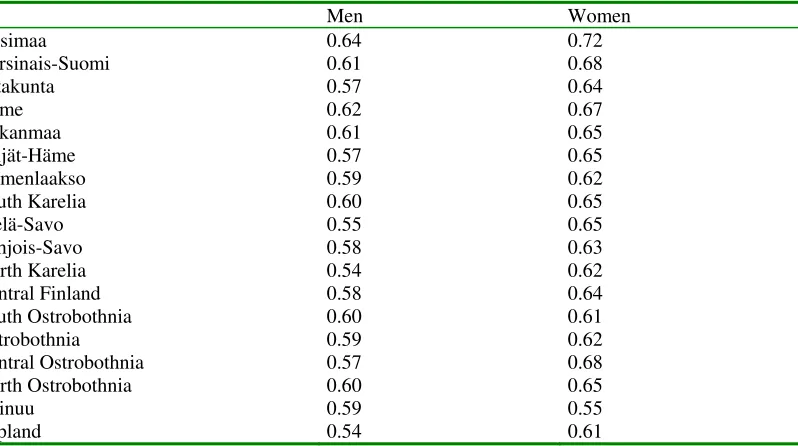
The variables that we are using are described in Table 1. Descriptive statistics show that
Finnish women are more likely to report a positive number of sickness absences. (Tables
4
have higher sickness absence rates. There has also been a slight upward trend in sickness
absence, both for men and women (Table 2). Furthermore, sickness absences are more
common in the province of Uusimaa that constitutes the region around the Helsinki
metro-politan area (Table 3), where unemployment is lower compared to Eastern and Northern
Finland. Arguably, the regional variation is useful when identifying the effect of alcohol
consumption on sickness absence.
2.2. Methods
The models that we estimate have the following general structure:
jt t jt jt j
jt X D
Y =α +β + +λ +ε
where Y is the outcome (the share of individuals that have reported at least one sickness
absence day) for thoseliving in province j in year t. X is a vector of aggregated
individual-level characteristics for provinces, D represents the variable of interest, which is the
aver-age number of alcohol units consumed per week per person (1 unit = 4 cl of alcohol) in the
province, α and λ represent unobserved determinants of lifestyle behaviours associated
with the region and survey year, and ε is an error term. Furthermore, in addition to the
variables shown above, the gender-specific regional unemployment rate is included to all
models, as noted earlier. In these fixed-effects model, the effect of alcohol consumption on
sickness absences is identified by intra-region variations, relative to the corresponding
changes in other regions. This helps us to avoid identifying spurious relations. In additional
specifications, we also include individual-level controls (the years of education, age, age
5
We report all estimation results separately for men and women, because of biological,
so-cial norm and occupational structure differences between men and women. If we would
pool observations both for men and for women in the estimation of the models, we would
impose the restriction that the determination process of sickness absences is exactly the
same between men and women. Consequently, by estimating the models separately for
men and women, we allow that the same independent variables have different coefficients
for men and women.
4. Results
We discover evidence according to which sickness absences are less common in the
re-gions of higher unemployment, which is in line with the observations from other Nordic
countries (e.g. [1, 7]). The most interesting finding that stems from the estimations is that
sickness absence is positively related to alcohol consumption for both men (Table 4) and
women (Table 5) in a panel data setting. However, it is important to note that we do not
find statistically significant positive effect when we include regional dummies, but not year
dummies to the models. Having said that we prefer the results obtained from the models in
which we have taken the existence of time trends into account, because there have been
overall fluctuations in sickness absence over the period 1993-2005, as shown earlier in
Ta-ble 2. Moreover, the estimation results are statistically weaker when we include both
re-gional and year dummies to the models (Tables 4-5). Standard errors for the estimates
in-crease, but the point estimate for alcohol consumption remains reasonably similar
espe-cially for men. In this respect, it is important to keep in mind that all models include the
6
including both regional and year dummies along with the gender-specific regional
unem-ployment rates to the models arguably leaves too little variation in the data in order to
iden-tify the relationship that would be statistically significant. To examine robustness of our
baseline findings, we have estimated the models by including individual-level
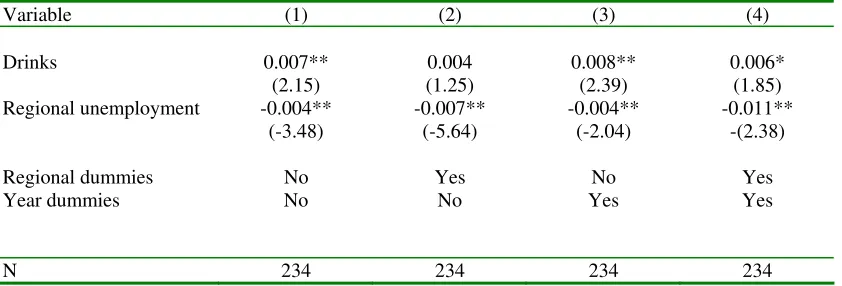
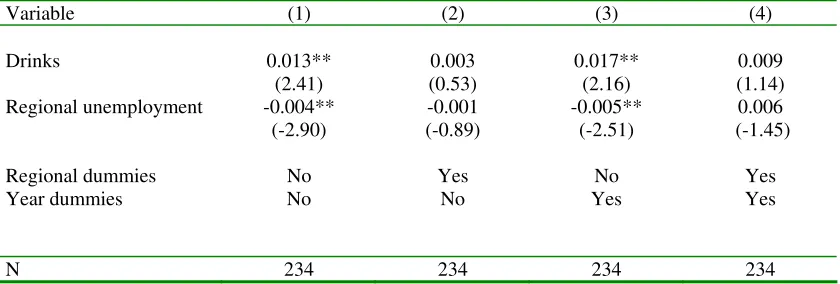
characteris-tics to the models (Tables 6-7). All in all, the conclusions remain the same. The main
dif-ference to the earlier models is that when we include individual-level control variables to
the models, we obtain somewhat stronger evidence for the relationship between alcohol
consumption and sickness absences for men in the model in which we include both
re-gional and year dummies. The opposite prevails for women, however.
5. Conclusions
This paper examines the relationship between alcohol consumption and sickness absence.
We use regional panel data from Finland over the period 1993-2005. Panel data allows us
to control for unobserved determinants of lifestyle behaviours associated with the region
and survey year. The results show that alcohol consumption is associated with sickness
ab-sence, and particularly so for men. Therefore, aggregate time-series evidence from Sweden
provided by Norström [4] is largely confirmed in a regional panel data setting. This
obser-vation carries a clear lesson that has been overlooked in recent policy discussions. Namely,
it is important to take into account the effects of alcohol consumption on sickness absence
7
References
[1] Holmlund, B. Sickness absence: An introduction. Swedish Economic Policy Review
2004;11:3-8.
[2] Persson J, Magnusson P. Sickness absenteeism and mortality in patients with excessive
drinking in somatic out-patient care. Scandinavian Journal of Primary Health Care
1989;7:211-217.
[3] Holder DH, Blose JO. A comparison of occupational and nonoccupational disability
payments and work absences for alcoholics and nonalcoholics. Journal of Occupational
Medicine 1991;33:453-457.
[4] Norström T. Per capita alcohol consumption and sickness absence. Addiction
2006;110:1421-1427.
[5] Ruhm C. Are recessions good for your health? Quarterly Journal of Economics
2000;115:617-650.
[6] Leppänen K, Sullström R, Suoniemi I. The consumption of alcohol in fourteen
Euro-pean countries. A comparative econometric analysis. Helsinki: Stakes; 2001.
[7] Askildsen JE, Bratberg E, Nilsen ØA. Unemployment, labour force composition and
8
Table 1. Definition of the variables.
Variable Definition/explanation
Sickness absences Share of individuals in a region with at least one sickness
absence day in a year
Drinks Number of alcohol units consumed per week (1 unit = 4 cl
of alcohol)
Regional unemployment Gender-specific regional unemployment rate
Age Age in years
Age squared Age in years squared
[image:11.595.57.467.279.444.2]Education The years of education
Table 2. Share of individuals with at least one sickness absence day by gender and year.
Men Women
1993 0.548 0.603
1994 0.563 0.652
1995 0.543 0.608
1996 0.599 0.640
1997 0.580 0.647
1998 0.591 0.630
1999 0.606 0.638
2000 0.590 0.644
2001 0.602 0.653
2002 0.607 0.637
2003 0.594 0.666
2004 0.598 0.641
2005 0.615 0.668
Source: Authors’ calculations from Health Behaviour and Health among the Finnish Population.
Table 3. Share of individuals with at least one sickness absence day by gender and region.
Men Women
Uusimaa 0.64 0.72
Varsinais-Suomi 0.61 0.68
Satakunta 0.57 0.64
Häme 0.62 0.67
Pirkanmaa 0.61 0.65
Päijät-Häme 0.57 0.65
Kymenlaakso 0.59 0.62
South Karelia 0.60 0.65
Etelä-Savo 0.55 0.65
Pohjois-Savo 0.58 0.63
North Karelia 0.54 0.62
Central Finland 0.58 0.64
South Ostrobothnia 0.60 0.61
Ostrobothnia 0.59 0.62
Central Ostrobothnia 0.57 0.68
North Ostrobothnia 0.60 0.65
Kainuu 0.59 0.55
Lapland 0.54 0.61
[image:11.595.67.466.513.736.2]9
Table 4. Estimated effect of alcohol consumption on the share of individuals with at least one sickness absence day, men.
Variable (1) (2) (3) (4)
Drinks 0.006** 0.003 0.006** 0.004
(2.01) (0.90) (2.14) (1.23)
Regional unemployment -0.004** -0.004*** -0.004** -0.009**
(-4.14) (-4.73) (-2.53) (-2.01)
Regional dummies No Yes No Yes
Year dummies No No Yes Yes
N 234 234 234 234
[image:12.595.96.518.374.507.2]Note: Robust t statistics in parentheses. * significant at 10%; ** significant at 5%; *** significant at 1%.
Table 5. Estimated effect of alcohol consumption on the share of individuals with at least one sickness absence day, women.
Variable (1) (2) (3) (4)
Drinks 0.016** 0.005 0.019** 0.010*
(2.31) (0.85) (2.27) (1.53)
Regional unemployment -0.005** -0.003** -0.006** 0.008*
(-3.58) (-2.54) (-2.42) (1.59)
Regional dummies No Yes No Yes
Year dummies No No Yes Yes
N 234 234 234 234
Note: Robust t statistics in parentheses. * significant at 10%; ** significant at 5%; *** significant at 1%.
Table 6. Estimated effect of alcohol consumption on the share of individuals with at least one sickness absence day, men.
Variable (1) (2) (3) (4)
Drinks 0.007** 0.004 0.008** 0.006*
(2.15) (1.25) (2.39) (1.85)
Regional unemployment -0.004** -0.007** -0.004** -0.011**
(-3.48) (-5.64) (-2.04) -(2.38)
Regional dummies No Yes No Yes
Year dummies No No Yes Yes
N 234 234 234 234
[image:12.595.96.517.591.734.2]10
Table 7. Estimated effect of alcohol consumption on the share of individuals with at least one sickness absence day, women.
Variable (1) (2) (3) (4)
Drinks 0.013** 0.003 0.017** 0.009
(2.41) (0.53) (2.16) (1.14)
Regional unemployment -0.004** -0.001 -0.005** 0.006
(-2.90) (-0.89) (-2.51) (-1.45)
Regional dummies No Yes No Yes
Year dummies No No Yes Yes
N 234 234 234 234
E L I N K E I N O E L Ä M Ä N T U T K I M U S L A I T O S (ETLA)
THE RESEARCH INSTITUTE OF THE FINNISH ECONOMY LÖNNROTINKATU 4 B, FIN-00120 HELSINKI
____________________________________________________________________________ Puh./Tel. (09) 609 900 Telefax (09) 601753 Int. 358-9-609 900 Int. 358-9-601 753
http://www.etla.fi
KESKUSTELUAIHEITA - DISCUSSION PAPERS ISSN 0781-6847 Julkaisut ovat saatavissa elektronisessa muodossa internet-osoitteessa: http://www.etla.fi/finnish/research/publications/searchengine
No 1080 JYRKI ALI-YRKKÖ – MIKA PAJARINEN – PETRI ROUVINEN – PEKKA YLÄ-ANTTILA, Family Businesses and Globalization in Finland. 03.04.2007. 35 p.
No 1081 JYRKI ALI-YRKKÖ, Ulkomaalaisomistuksen vaikutus yritysten kasvuun. 29.03.2007. 24 s. No 1082 MIKKO KETOKIVI – JYRKI ALI-YRKKÖ, Determinants of Manufacturing-R&D
Co-location. 30.03.2007. 28 p.
No 1083 VILLE KAITILA, Suomen ulkomaankaupan erikoistuminen – keiden kanssa kilpailemme? 05.04.2007. 25 s.
No 1084 MIKKO MÄKINEN, CEO Compensation, Firm Size and Firm Performance: Evidence from Finnish Panel Data. 30.03.2007. 38 p.
No 1085 MIKKO MÄKINEN, Do Stock Option Schemes Affect Firm Technical Inefficiency? Evidence from Finland. 30.03.2007. 26 p.
No 1086 CHRISTOPHER PALMBERG, Modes, Challenges and Outcomes of Nanotechnology Transfer – A Comparative Analysis of University and Company Researchers. 05.04.2007. 33 p.
No 1087 VILLE KAITILA, Free Trade between the EU and Russia: Sectoral Effects and Impact on Northwest Russia. 05.04.2007. 23 p.
No 1088 PAAVO SUNI, Oil Prices and The Russian Economy: Some Simulation Studies with NiGEM. 16.04.2007. 15 p.
No 1089 JUKKA LASSILA – NIKU MÄÄTTÄNEN – TARMO VALKONEN, Vapaaehtoinen elä-kesäästäminen tulevaisuudessa. 16.04.2007. 38 s.
No 1090 VILLE KAITILA, Teollisuusmaiden suhteellinen etu ja sen panosintensiivisyys. 25.04.2007. 31 s.
No 1091 HELI KOSKI, Private-collective Software Business Models: Coordination and Commercializa-tion via Licensing. 26.04.2007. 24 p.
No 1092 PEKKA ILMAKUNNAS – MIKA MALIRANTA, Aging, Labor Turnover and Firm Perform-ance. 02.05.2007. 40 p.
No 1093 SAMI NAPARI, Gender Differences in Early-Career Wage Growth. 03.05.2007. 40 p.
No 1095 OLAVI RANTALA, Kasvihuonekaasupäästöjen ennakointi ja EU:n päästörajoituspolitiikan vaikutusten arviointi. 07.05.2007. 22 s.
No 1096 JANNE HUOVARI – JUKKA JALAVA, Kansainvälinen ja vertaileva näkökulma Suomen tuottavuuskehitykseen. 12.06.2007. 36 s.
No 1097 JARLE MØEN, Should Finland Introduce an R&D Tax Credit? Reflections Based on Experi-ence with Norwegian R&D Policy. 12.06.2007. 14 p.
No 1098 RITA ASPLUND – OUSSAMA BEN-ABDELKARIM – ALI SKALLI, An Equity Perspective on Access to, Enrolment in and Finance of Tertiary Education. 09.08.2007. 48 p.
No 1099 TERTTU LUUKKONEN, Understanding the Strategies of Venture Capital investors in Helping their Portfolio Firms to Become International. 17.08.2007. 24 p.
No 1100 SARIANNA M. LUNDAN, The Home Country Effects of Internationalisation. 21.08.2007. 43 p. No 1101 TUOMO NIKULAINEN, Identifying Nanotechnological Linkages in the Finnish Economy. An
Explorative Study. 25.09.2007. 31 p.
No 1102 HELI KOSKI, Do Technology Diffusion Theories Explain the OSS Business Model Adoption Patterns? 29.10.2007. 26 p.
No 1103 JUKKA JALAVA – PIRKKO AULIN-AHMAVAARA – AKU ALANEN, Intangible Capital in the Finnish Business Sector, 1975-2005. 29.10.2007. 25 p.
No 1104 BÖCKERMAN, Petri – JOHANSSON, Edvard – HELAKORPI, Satu – UUTELA, Antti, Eco-nomic Inequality and Health: Looking Beyond Aggregate Indicators. 05.11.2007. 21 p.
No 1105 MIKA MALIRANTA – RITA ASPLUND, Training and Hiring Strategies to Improve Firm Per-formance. 08.11.2007. 45 p.
No 1106 ESTEBAN FERNÁNDEZ VÁZQUEZ – BART LOS, A Maximum Entropy Approach to the Identification of Productive Technology Spillovers. 08.11.2007. 21 p.
No 1107 SAMI NAPARI, Is There a Motherhood Wage Penalty in The Finnish Private Sector? 20.11.2007. 46 p.
No 1108 ANTTI LÖNNQVIST, Intellectual Capital and Productivity: Identification and Measurement of the Relationship at Company-Level. 20.11.2007. 20 p.
No 1109 MIKA MALIRANTA – PETRI ROUVINEN, Aineettomat investoinnit Suomen yrityksissä vuonna 2004: kokeilu yritysaineistoilla. 20.11.2007. 16 s.
No 1110 ANNU KOTIRANTA – ANNE KOVALAINEN – PETRI ROUVINEN, Naisjohtoiset yritykset muita kannattavampia? 20.11.2007. 23 s.
No 1111 MIKA MALIRANTA – SATU NURMI – HANNA VIRTANEN, It Takes Three to Tango in Employment: Matching Vocational Education Organisations, Students and Companies in La-bour Markets. 07.12.2007. 35 p.
No 1112 EDVARD JOHANSSON – PETRI BÖCKERMAN – ANTTI UUTELA, Alcohol Consumption and Sickness Absence: Evidence from Panel Data. 10.12.2007. 10 p.