‘TECHNOLOGY TRANSFER’ THROUGH HIGH TECHNOLOGY CORRIDORS: A STUDY OF MULTI-AGENCY PARTNERSHIP LEARNING
HELEN BROWN
February 2005
This thesis is submitted in partial fulfilment o f the requirements for the
degree o f Doctor o f Philosophy
Department o f Educational Research
ProQuest Number: 11003562
All rights reserved
INFORMATION TO ALL USERS
The qu ality of this repro d u ctio n is d e p e n d e n t upon the q u ality of the copy subm itted.
In the unlikely e v e n t that the a u th o r did not send a c o m p le te m anuscript and there are missing pages, these will be note d . Also, if m aterial had to be rem oved,
a n o te will in d ica te the deletion.
uest
ProQuest 11003562
Published by ProQuest LLC(2018). C op yrig ht of the Dissertation is held by the Author.
All rights reserved.
This work is protected against unauthorized copying under Title 17, United States C o d e M icroform Edition © ProQuest LLC.
ProQuest LLC.
789 East Eisenhower Parkway P.O. Box 1346
This thesis was completed as part o f the Doctoral Programme in
Educational Research
Declaration
This thesis results entirely from my own work and has not been offered
previously for any other degree or diploma
Vs
Ab s t r a c t...6
Ac k n o w l e d g e m e n t s...9
Gl o s s a r y...10
Lis to f Fi g u r e s... 15
1. INTRODUCTION...16
1.1 Si t u a t i n g Co n t e x t...16
1.2 Th e o r e t i c a l Pe r s p e c t i v e: t h e Co n c e p t u a l Fr a m e w o r k...2 2 1.3 Re s e a r c h Aim sa n d Qu e s t i o n s...2 5 1.4 St r u c t u r e o ft h e Th e s i s... 28
2. POLICY ENACTMENT BY PARTNERSHIPS: THEORIES AND ISSUES... 32
2.1 Si t u a t i n g Th e o r ie so f Po l ic y Ch a n g ea n d Im p l e m e n t a t i o n... 32
2 .2 Th e Th e o r i s a t i o no f Kn o w l e d g ea n d Kn o w l e d g e Tr a n s f e r in Po l i c y 3 6 2 .3 A Di s c o u r s e o n Kn o w l e d g ef r o m So c i o-Cu l t u r a l Th e o r y...38
2 .4 In n o v a t i o n a s Co l l a b o r a t i o n a n d Ex p a n s i v e Le a r n i n g... 4 2 2 .5 Me t h o d so f Vi s u a l i s i n g In t e r a c t i o n s Be t w e e n Ac t i v i t y Sy s t e m s...5 0 2 .6 Ov e r v i e w...53
3. A NATURAL HISTORY OF MY RESEARCH METHODOLOGY... 55
3.1 My Me t h o d o l o g i c a l Jo u r n e y... 55
3 .2 My Re s e a r c h De s i g n... 61
3 .3 My Me t h o d o f Da t a Pr e s e n t a t i o n... 7 0 3 .4 Di s c u s s i o n o f Et h ic a la n d Po l it ic a l Is s u e s...71
3 .5 Ov e r v i e w...75
4. RECONSTRUCTING SUBJECT PERSPECTIVES IN THE HTCS... 77
4.1 INTRODUCTION...7 7 4 .2 Su b j e c t Po s i t i o n i n ga n d Id e n t i t y w it h int h e Po l i c y Pr o c e s s... 7 7 4.2.1 Sub-Regional Priorities...83
4.2.2 Practical Experience o f Technology Transfer versus Policy Borrowing...86
4.2.3 Subject Positioning at the Policy Implementation Level...90
4 .3 So m e Co n s e q u e n c e so f Co m p e t i n g Ob j e c t s o f Ac t i v i t y... 91
4 .4 Th e Im p l e m e n t a t io n Ga p... 9 6 4 .5 Ov e r v i e w...9 8 5. HORIZONTAL EXPANSION OF THE OBJECT OF ACTIVITY...100
5.1 In t r o d u c t i o n...100
5 .2 Th e Ro l eo f Bo u n d a r y Ob j e c t sin In n o v a t i o n... 100
5.3.1 Vignette 1: Collaborative Projects to Develop Electronic Tools...108
5.3.2 Vignette 2: Collaborative Research Project...110
5.3.3 Vignette 3: Rapid Prototyping Project...113
5.3.4 Vignette 4: Collaborative Visualisation Software Project...117
5 .4 Ov e r v i e w...121
6 . V E R T I C A L E X P A N S I O N O F T H E O B J E C T O F A C T I V I T Y ... 12 3 6.1 In t r o d u c t i o n... 123
6 .2 Co n n e c t i n g Le v e l s a n d Ac t iv it y Sy s t e m so f Un e q u a l Ag e n c y... 124
6 .3 In c r e a s i n g t h e Ag e n c y o f Bo u n d a r y Me d i a t o r s... 128
6.3.1 Vignette 5: Novus Project...131
6.3.2 Vignette 6: Consultancy Project...134
6 .4 Co n s c r i p t i o n De v i c e sa n d Em o t i o n a l Co m m i t m e n tt o t h e Ob j e c t 135 6.4.1 Vignette 7: Collaboration Between Physicians and Automotive Designers... 137
6.4.2 Vignette 8: Collaboration Between Defence Industry and Physicians...138
6.4.3 Vignette 9: Aligning Boundary Mediators in the MED1LINK Project...141
6 .5 Ov e r v i e w... 145
7 A T H E M A T I C D E P I C T I O N O F D I L E M M A S I N H T C A C T I V I T Y ...1 4 7 7.1 INTRODUCTION... 147
7 .2 Te n s i o n s Be t w e e n Le v e l s: Es p o u s e d a n d Ac t u a l Au t o n o m y...147
7.3 Th e Vi c t o r y Na r r a t i v ea n d Re f l e c t i v e Ev a l u a t i o n...151
7 .4 Th e Ro l e so f An i m a t e u ra n d Au d i t o r...159
7 .5 Su s t a i n i n g Co h e r e n t De v e l o p m e n t w it h Sh o r t Te r m Pr o j e c t s... 165
7 .6 Ov e r v i e w...172
8 . A P O L I C Y O V E R V I E W : M U L T I - A G E N C Y L E A R N I N G ... 17 4 8.1 Ke y Fi n d i n g s...174
R e se a r c h Q u e s tio n 1 ... 174
R e se a r c h Q u e s tio n 2 ...175
R e se a r c h Q u e s tio n 3 ...176
R e se a r c h Q u e s tio n 4 ...177
8 .2 Ov e r v i e w...179
9 . A T H E O R E T I C A L O V E R V I E W ... 1 8 0 9.1 Ke y Fi n d i n g s... 180
R e se a r c h Q u e s tio n 5 ... 180
R e se a r c h Q u e s tio n 6 ...182
R ese a r c h Q u e s tio n 7 ...185
R e se a r c h Q u e s tio n 8 ...187
9 .2 Ov e r v i e w... 196
10. REFLECTIONS ON THE RESEARCH PROCESS...197
10.1 Ri s k sa n d Li m it a t io n so ft h e Re s e a r c h... 197
10.2 Fu t u r e De v e l o p m e n to f Ex p a n s i v e Le a r n i n g Th e o r y...200
10.3 Re l e v a n c e o f In s i g h t sf r o m m y Re s e a r c h...202
11. APPENDICES... 212
11. 1 RESEARCH INSTRUMENTS...2 1 2 Semi Structured Interview Schedules...212
11.2 Da t a An a l y s i s To o l s...217
11.3 Co d e so f Pr a c t i c e...218
‘TECHNOLOGY TRANSFER’ THROUGH HIGH TECHNOLOGY CORRIDORS: A STUDY OF MULTI-AGENCY PARTNERSHIP LEARNING
Abstract
The research explores the implementation o f a ‘technology transfer’ policy in High Technology Corridors (HTCs), which responded to a critical incident in the West Midlands. The policy was a direct result o f the crisis at the Rover Automotive Plant in 1999, when it was threatened by possible closure with the potential loss o f 27,000 jobs. This was a catalyst for the region to change from dependence on traditional
manufacturing by developing a regional ‘knowledge econom y’.
HTC policy was based on the premise that change would happen by bringing together communities o f business ‘users’ and research ‘developers’ with no prior history of working together. My research challenges current theories and tacit assumptions about how complex business and university multi-agency partnerships ‘work in practice’.
Expansive learning theory is an evocative heuristic device that has been used in recent studies o f innovation in complex organisations. It is applied in this study of multi agency learning because it frames the relationships between individual and collective subject perspectives. Human relationships are mediated by tools, social rules and divisions o f labour orientated towards an object o f activity and collaborative outcomes.
were not fully considered. My research reconstructed HTC as meta-activity systems, or networks in which sub activity systems collide and interact in two dimensions.
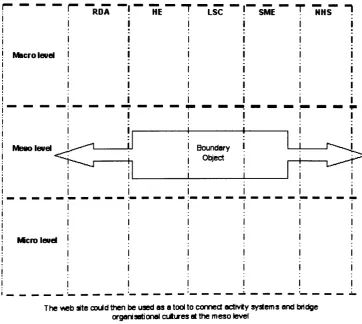
Collaboration between experts involves crossing horizontal boundaries between activity systems. Special tools called boundary objects can link communities with no previous experience o f working together. They act as bridges across the horizontal boundaries between activity systems, separating different cultural practices. They enable people operating at the same level to learn from one another by expanding the ‘object o f their activity’ towards collaborative activities. In the HTCs, boundary objects such as web sites, act as tools or bridges across cultures to mediate between individuals and groups from different ‘communities’ or activity systems.
However there is a gap in theory because collaboration does not adequately describe learning between levels. The vertical communication between activity systems is impeded by boundaries defined by political power and agency. Vertical boundaries between activity systems separate three levels o f HTC policy enactment and these resist movement between levels. These boundaries restrict the upward flow o f communication from the operational to strategic levels so feedback from the micro HTC project level cannot percolate to the more powerful upper levels.
To overcome barriers special people act as boundary mediators or human bridges spanning the vertical boundaries between levels. Yet mediation and the capacity to travel freely between levels is successful only if the individual acting as a boundary mediator is recognised as a member o f the strategic macro level o f HTC policy
Acknowledgements
Thanks are due to all the people who were willing to be interviewed and contribute information, opinions and insights to this study. Comments in this study about the role o f key actors and agencies are intended to illuminate the difficulties involved in enacting a complex and ambitious policy. The overwhelming impression was of people doing their very best to work together in challenging contexts to achieve, within a very short time, a huge change.
I am grateful to my Supervisor, Professor Murray Saunders for his unfailing enthusiasm and advice.
Glossary
AfA. Agenda for Action, a regional policy document for economic development.
Agency. The term is used in two ways, in the context o f this study ‘agency’ means the capacity to act, but can also refer to a type o f institution or organisation such as the Regional Development Agency.
ANT. Actor Network Theory was developed to explain how technologies have agency and can interact with humans to achieve their effect.
AWM. Advantage West Midlands (The Regional Development Agency).
Boundary Object. A tool to link two or more activity systems, often bridging a cultural divide between different communities o f practice.
Co-configuration. Expansive learning theory uses this term synonymously to mean co-construction o f the object o f activity by multiple activity systems.
Conscription Device. Enrols people into an emotional commitment to a community o f practice or activity system.
Collaboration. The term used in expansive learning theory to denote organisational learning.
Consensus. Agreement by voluntary basis without financial or other forms o f coercion.
COPT. Communities o f Practice Theory belongs to the family o f socio-cultural theory and describes human action within its social context. It describes the induction o f a new member, such as an apprentice, into a community o f practice as ‘legitimate peripheral participation’. The theory has been widely used in understanding small group interactions in the workplace. (Chapter Two)
Developmental Transfer. Describes expansive learning by large organisations or institutions.
Division of Labour. Describes how work is divided up according to tasks and roles.
DTI. Department o f Trade and Industry in UK Government.
ERDF. European Regional Development Fund is usually linked to capital projects and expenditure on infrastructure such as land and buildings.
ESF. European Social Fund provides revenue to address training needs to meet skills gaps in socially or economically disadvantaged communities. It was part o f the Rover Task Force funding package and imposed complex eligibility rules.
Expansive Learning. This describes an outcome when several activity systems share an emotional commitment and motivation towards a shared goal.
FRESA. Regional policy document called the Framework for Regional Employment and Skills Action.
HTC. High Technology Corridors are geographically pre-determined sites o f
interaction between sources o f research and commercial exploitation, that aim to drive a sub-regional Knowledge Economy as described in the West Midlands Regional Innovation Strategy.
Knowledge Economy. The term used to describe a broad family o f policies linking economic growth to a skilled workforce and their intellectual resources for wealth creation. The term ‘Knowledge Society’ also appears in policy documents but it is associated with a focus on social networks and has a less instrumental emphasis.
Knowledge Transfer. Describes the application o f research or new technology in a new commercial context.
Mediation. A key concept in expansive learning originating in activity theory that proposed that artefacts can mediate between a subject and object.
Object. The object encapsulates the motivation and trajectory o f activity and its orientation towards achieving a shared goal.
Outcomes. In expansive learning theory, outcomes are the results o f the interaction of six elements o f activity within an activity system.
Practices. These are routine sets o f actions and interactions that can be observed in behaviour and are associated with tacit knowledge.
Polycontextuality. A term denoting horizontal learning, often used when experts contribute complementary skills to a demanding problem.
RTF. Rover Task Force was set up in 1999 as a macro level regional forum for public and private sector organisations to work together to address the Rover Automotive Crisis.
Rules. Refer to the explicit and tacit rules or norms that structure social relations in an activity system.
Situated Practice. Within the larger family o f socio-cultural theory it emphasises the situating context o f human actions.
Socio-Cultural Theory. A category o f social theory that has shifted the focus o f discussions o f 'knowledge management' away from issues o f information and technology towards those o f human capabilities. Within this family some theories focus on the dynamics o f everyday life and the relationships between people and institutions {situatedpractice) whilst other theories emphasise the influence o f institutions, rules and norms {theories o f social structure). Activity theory is an example o f a socio-cultural theory that includes elements o f both within its conceptual framework (see Chapter Two).
Subject. A term used in activity theory and used somewhat ambiguously in expansive learning theory to refer to the individual, or small group, or collective body in an activity system.
Third Mission. The third task o f Universities (in which first and second missions are research and teaching) addresses interaction with industry, commerce and the wider community.
Tools. Tools act as cultural and historical mediating artefacts in an activity system (such as language).
Vertical Learning. Refers to learning between activity systems o f varying agency, and limited by dynamics o f politics and power. Vertical relationships between activity systems are uneven and hierarchical. These relationships are different in character to the horizontal relationships between activity systems, which are at the same level.
Zone of Proximal Development (ZPD). A Vygotskian concept describing the optimal distance between an old and a new concept that offer the best opportunity for a child to learn1, (see Collective ZPD)
List of Figures
Figure 1: Locating HTC Policy Enactment on the Implementation Staircase...35
Figure 2: The Structure o f an Activity System...45
Figure 3: Depicting Structure and Contradictions Between Activity Systems...51
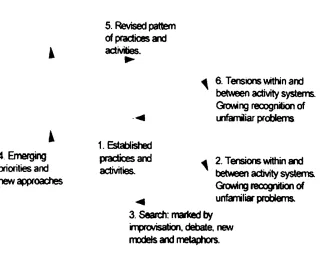
Figure 4: Dynamic Tensions in Activity...52
Figure 5: Mapping Relationships within the Macro Level HTC...64
Figure 6: Mapping Elements o f Activity at the Meso Level...65
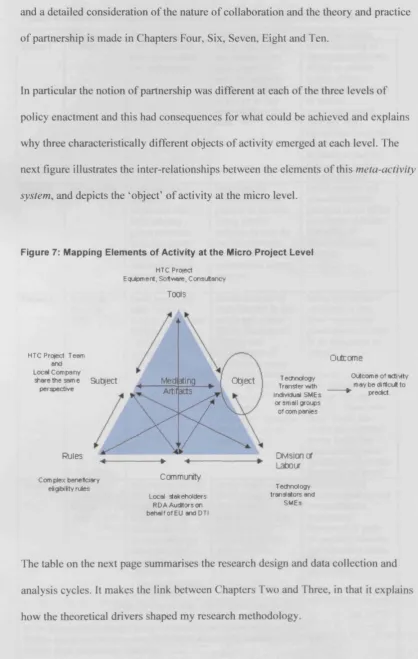
Figure 1: Mapping Elements o f Activity at the Micro Project Level...67
Figure 8: Research Design including the Data Collection and Analysis Plan...68
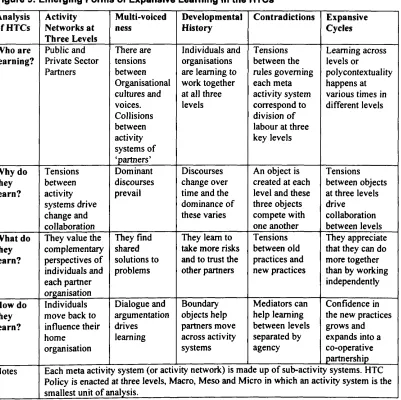
Figure 9: Emerging Forms o f Expansive Learning in the HTCs...69
Figure 10: A Depiction o f Agency at Three Levels in the Enactment o f HTC Policy...92
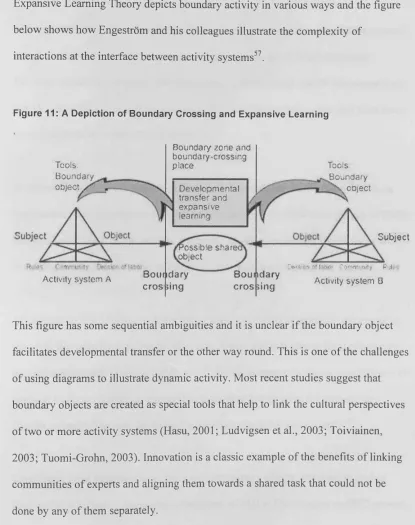
Figure 11: A Depiction o f Boundary Crossing and Expansive Learning...104
Figure 12: The Creation o f Electronic Tools as Boundary Objects...110
Figure 13: Collaborative Research into Sub-Regional Skills Gaps in IC T...112
Figure 14: Transformation o f a Boundary Object by its Use...119
Figure 15: Constraints on Expansive Learning Between Levels...125
Figure 16: A Depiction o f the Vertical Levels Bridged by Boundary Mediators...127
Figure 17: How NOVUS Projects Links Users and Developers...132
Figure 18: The Power o f a Boundary Object When Used by Boundary Mediators...143
Figure 19: Guidelines on Clustering 2004... 155
1. Introduction
1.1
Situating Context
The rationale for this research is my interest and professional involvement in regional policy development. The ‘High Technology Corridor’ (HTC) policy is an example of an attempt to enhance the impact o f Higher Education Institutions on the economic regeneration o f an English Region. The policy describes a mechanism for Universities to contribute to the so called ‘knowledge econom y’. From the perspective o f
Universities, this belongs to a type o f activity known as the ‘third m ission’2, described variously as ‘knowledge transfer’ or ‘technology transfer’. High Technology
Corridors are geographically pre-determined sites o f interaction between sources o f research and commercial exploitation, that aim to drive a sub-regional Knowledge Economy as described in the West Midlands Regional Innovation Strategy.
In my professional role these issues are o f significant interest and recent experience led me to question theories o f policy development, which describe a smooth and rational process. In practice, policy development and implementation is often a turbulent and conflictual process. (This is discussed in detail in Chapter Two). In many ways the implementation staircase model describes the process more
realistically (Reynolds & Saunders, 1987). The implementation staircase articulates a problem that is often ignored, namely the dissociation o f discourse from practice. It recognises stages in the process o f negotiation between practitioners and policy makers. It describes the possibility o f movement upwards and downwards in the
hierarchy o f decision makers at strategic and operational levels. In the
implementation staircase model the interests o f different social groups are clearly recognised despite variations in ‘apparent status and pow er’ and the policy outcome is subject to many diverse influences. This inquiry will explore gaps between theory and practice in policy development and implementation.
The High Technology Corridor policy was the direct result o f the imminent loss o f 7,000 jobs at the Rover Factory in Birmingham and 20,000 more in the automotive supply chain in 19993. This galvanised the West Midlands to reconsider its reliance on automotive production. When BMW took control o f the Rover plant at Longbridge in Birmingham, the company immediately decided to cut jobs in the production line and to impose new quality procedures on the automotive supply chain. As a result, the Department o f Trade and Industry (DTI) and the Regional Development Agency (RDA) commissioned the Rover Task Force (RFT) to devise a solution to the problem. The RTF was a formal mechanism for aligning the interests o f regional stakeholders from the public and private sector, some o f whom were working together for the first time. The idea for HTC policy was first described in a report to the
Secretary o f State, which influenced the decision to provide DTI funding to the West Midlands (SQW, 2001). The consultants who wrote the report proposed the creation o f three HTCs to respond to characteristically different problems and potential partnerships in their sub-regional contexts.
The concept o f ‘HTCs’ assumes that providers o f research, including both universities and private research institutes, can transfer new technologies to local companies. The
assumption is that this will enable the economic regeneration o f the region by stimulating diversification, and exploitation o f new technologies by local companies.
The policy identified three corridors because they corresponded to geographically defined areas each with a concentration o f companies that were dependent on the automotive industry and at immediate risk due to the ‘Rover Crisis’. The other key factor was the proximity o f a research capacity to stimulate and support the
diversification o f these companies. The policy assumed that the research capacity o f local Universities would attract new high technology companies to locate in the HTCs and that this would also attract inward investment. The research examines specific tacit assumptions about the way in which complex business and university
partnerships work in practice. The implementation o f the HTCs policy is investigated through three case studies with cross cutting themes and which describe the structural mechanisms that shaped the enactment o f the policy.
Globalisation and rapid technological change persuaded Governments to adopt policies that improved national competitiveness. Competitiveness in the new ‘knowledge econom y’ is dependent upon innovation and a skilled workforce. The human capabilities o f nations are therefore seen as a crucial resource for
competitiveness. Consequently ‘knowledge’ is treated in policy documents as if it were a national resource. European policy is driven by the need to compete with the knowledge economy o f the United States o f America (USA). It urges closer
technology transfer. It even specifies mechanisms for achieving this, such as spin-out companies and consultants from academia working for industry.
Europe needs excellence in its universities, to optimise the processes, which underpin the knowledge society and meet the target, set out by the European Council in Lisbon, o f becoming the most competitive and dynamic knowledge-based economy in the world, capable o f sustainable economic growth with more and better jobs and greater social cohesion (EU, 2003).
In Britain DTI documents speak o f a new focus on skills and innovation and of increased regional control o f the resources allocated to higher education. The policy documents make the assumption that discretionary funding o f Universities by RDAs will benefit regional innovation. The DTI have been strongly influenced by the work o f Professors Michael Porter and Christian Ketels o f Harvard University. Their work has underpinned the UK Government’s response to the challenge o f innovation.
We fin d that the competitiveness agenda facing UK leaders in Government and business reflects the challenges o f moving from a location competing on relatively low costs o f doing business to a location competing on unique value and innovation. This transition requires investments in different elements o f the business environment, upgrading o f company strategies, and the creation and strengthening o f new types o f institutions (DTI, 2003d).
dynamics o f politics and power are played out. The UK Government commissioned a review o f the effectiveness o f ‘third mission’ activities and evaluated the impact o f the first round o f discretionary funding known as the Higher Education Innovation Fund (HEIF1). It recognised that Universities are playing an increasingly important role in regional economic development, and RDAs are taking an active role in ‘building bridges between business and universities across the regions’ (Lambert, 2003). The Lambert Review shows that Universities are working together with local and regional agencies to develop regional science-based clusters. It recommends that the DTI should shift the pattern o f regional support away from job creation schemes and towards more value-added programmes, including collaborative research and development (R&D) projects with Universities (Lambert, 2003).
However, the review noted some significant contradictions in policy that would frustrate the policy intentions o f a second tranche o f ‘third m ission’ funding known as HEIF2. The Lambert Review noted that a great deal o f effective ‘technology transfer’ was carried out at a regional level by the post 1992 (ex-polytechnic) Universities. At the same time as encouraging this in HEIF2 the Government introduced a policy to concentrate research funding in a few research-intensive Universities. This reduced the capacity o f the broad spectrum o f Universities to engage in applied research and conduct the type o f activities encouraged in the Higher Education Innovation Fund policies.
The Review accepts that public funding should be concentrated on world-class research. But the increased selectivity o f funding will create a tension within
business but which does not rank as world-class will get little support from the
dual support system and may fin d it increasingly difficult to sustain themselves (Lambert, 2003).
The distinctions between the different types o f Universities and their capacity to attract funding, has been reflected in the differential funding and status o f the three HTCs. Lambert expressed the tension between two opposing aspirations for regional technology transfer as follows:
In addition, proximity matters when it comes to business-university collaboration. SMEs, in particular, find it difficult to work with research departments on the other side o f the country. I f resources are increasingly concentrated on a small number o f world-class research departments, there is likely to be a negative impact on the level o f business-university collaboration in the UK (Lambert, 2003).
For example one local University was under pressure from the RDA to focus on the local rather than their global role, which made it difficult for the University to balance the tension between the various demands. However since allocating a huge sum to one particular institution, the question o f ‘value for m oney’ is an issue some three years later. The opportunity cost o f dispersing their resources more evenly across the region’s Universities is a current concern for the regional policy makers.
an example, is globally advising the automotive supply chain around the world. But what we're trying to do through our partnership is to get them to link more closely with local businesses so that the local economy develops4.
The University managed to successfully address both global and local economic development issues. To reduce the University’s exposure to risk and to ensure a clear distinction, it set up separate structures and strategic business units to deal with the regional and local issues.
Playing on the strengths o f the organisation within the global marketplace o f higher education requires a particular strategy that seems incompatible with a sense o f social responsibility to the local community. This illustrates the conflicting demands upon Universities and also exemplifies the ‘organisational response’ o f the University to this dilemma.
1.2
Theoretical Perspective: the Conceptual Framework
Expansive learning theory has gained currency in postmodern studies o f organisations. It has been used as a framework to understand how agencies connect in an organic way and in most cases research has focused on innovation within large complex organisations. Several well-referenced and recent studies have used activity theory to inform their understanding o f innovation and organisational change in which
Many o f these studies have been conducted in structured and facilitated environments in which researchers have intervened to influence the dynamics and trajectory o f change5 (Engestrom, 1999; Engestrom, 2001, 2004; Engestrom et al., 1999; Hasu, 2001; Miettinen & Hasu, 2004; Toiviainen, 2003; Tuomi-Grohn & Engestrom, 2003).
This study o f HTCs takes place in a naturalistic setting in which ‘expansive learning’ is used to problematise the issues and provide a focus for data collection and analysis. The distinctions between naturalistic and structured research contexts are discussed in Chapters Two and Nine. Expansive learning theory is used as a heuristic tool to study practices in the HTC steering groups and in HTC projects, which can be described as concrete work packages.
O f particular interest to me is the capacity o f ‘expansive learning theory’ to provide a coherent and consistent account o f the emergence o f collaborative practices in the HTCs. In this sense the theory is also treated as an object o f study. It is used to frame the tensions and dilemmas arising within and between activity systems. The ontology o f the inquiry assumes that prior understanding and assumptions shape reality for individuals and the stakeholder groups to which they belong. This orientation is consistent with finding out how a High Technology Corridor is ‘experienced’ by individuals representing major stakeholder groups. Social constructivism is often termed ‘critical realism' or 'fallible realism' and the inquiry adopts this approach. It aims to ‘account for events rather than simply document their sequence.. .and to provide a causal description o f the forces at work’ (Miles and Huberman 1994: 4).
The research addresses the ontological, epistemological, and methodological problems o f ‘seeing organisations’ by adopting the notion o f practice as the trajectory o f
organisational learning. The concept o f practice enables organisations, such as complex multi-agency partnerships, to be perceived in terms o f relationships between concrete practices. Practices can be defined as ‘sets o f acts and interactions’ involving language and objects (Giddens, 1993; Saunders, 1995; Yanow, 2000).
Social theories can be seen as sensitising frameworks for empirical research in the social sciences. In this sense they can open out ‘ways o f seeing and analysing social phenomena’, and at the same time mould and change our self-understanding
(Reckwitz, 2002, p.257). Practice theory regards agents as carriers o f bodily routines of behaviour, mental routines o f understanding and knowing embedded in the use o f objects. Carrying out a practice very often means using particular things in a certain way.
'A specific social practice contains specific forms o f knowledge' it is more complex than 'knowing that'. It embraces ways o f understanding, knowing ways o f wanting and o f feeling that are linked to each other within a practice (Reckwitz, 2002, p. 253).
A practice is a routinized type o f behaviour, which consists o f several elements, interconnected to one another, including know-how, states o f emotion and
relationships between individuals and communities mediated by artefacts, social processes and structures.
Innovation involves changing and breaking familiar structures and habitual routines. In expansive learning theory, innovation occurs when traditional ways o f doing things prove to be inadequate to the challenges o f new situations. This results in tensions that drive the development o f new practices. The subsequent tensions between the old and new ways o f doing things then drive further change and innovation.
The HTCs can be considered as an experiment in social engineering aimed at economic regeneration through innovation. Each HTC is conceptualised as an
‘activity network’ or meta-activity system composed o f sub-activity systems in which new practices evolve and are in tension with old practices.
My research reconstructs the developmental history o f HTCs as the practices adopted by actors. It contributes to the debate on technology transfer by focusing attention on mechanisms, which connect the ‘perspectives’ o f individuals and organisations and expand the object o f activity towards a new and shared perspective.
1.3
Research Aims and Questions
-Research Question 1
What was the context fo r the introduction and implementation o f the HTC policy? (Chapters One, Two and Four)
Research Question 2
What technology transfer practices were evident prior to the enactment o f HTC policy? (Chapter Four)
Research Question 3
What knowledge transfer practices were evident amongst key stakeholders? (Chapters Four and Five)
Research Question 4
How influential were policy enacters at each level o f the implementation o f HTC policy? (Chapters Six and Seven)
The theoretical aim is to use expansive learning theory as a conceptual framework for the analysis o f collaboration across different organisations and between levels in the implementation o f the HTC policy 6. Four research questions address the theoretical aim:
Research Question 5
What were the different ‘objects ’ at different implementation levels at regional (macro), sub regional (meso) and local (micro) levels? (Chapter Six)
Research Question 6
How do boundary objects connect activity systems? (Chapters Two and Five)
Research Question 7
Are boundary objects equally effective across cultures and between levels distinguished by agency? (Chapters Five and Six)
Research Question 8
What are the benefits and limitations o f using expansive learning theory to analyse the development o f multi agency learning? (Chapter Nine)
One final research question links the overarching and theoretical aims together: Research Question 9
What insights from expansive learning theory andfrom the analysis o f collaboration in the HTCs can be applied to similar policy initiatives7? (Chapters Five, Six, Seven Eight, Nine and Ten)
This set o f research questions links the theoretical ideas with the data collection and analysis and shaped the development o f questionnaires used in the fieldwork and desk based research and is discussed in the methodology section in Chapter Three.
1.4
Structure of the Thesis
The thesis is written as ten chapters. The first chapter is an introduction to the research problem situated in the local and national policy context.
Chapter Two outlines the theoretical underpinning o f the research. The logic for prefacing the research methodology with theory is to show how the theoretical considerations suggested a way o f eliciting the data. It frames a rationale for my methodology, which is described in Chapter Three. My second chapter discusses the international policy context for the ‘knowledge econom y’ and the assumptions made in global and local policy. There is a tacit assumption that knowledge and ‘technology transfer’ is a logistical problem, to be resolved by unblocking the flow o f knowledge from Universities to industry. By contrast socio-cultural theory emphasises the process o f knowledge creation and the significance o f consequent changes in the dynamics o f human relationships. Following this line o f argument leads towards a conception o f innovation as collaboration and organisational learning. Consequently, the third chapter outlines my research design and methodology, linking this to the heuristic framework o f expansive learning theory.
Chapter Four draws on the empirical data to reconstruct subject perspectives in relation to changing conceptions o f the ‘object o f activity’. Variation in perspectives show how key individuals and organisations in the HTC partnership were influenced by various competing ‘objects o f activity’ that emerged during the policy
Chapter Five draws on the empirical data to reconstruct collaborative practices in HTC projects. I focus on the capacity o f boundary objects to act as tools to mediate learning across different activity systems. I present the data as vignettes that sketch the different ways that material artefacts and ‘conceptual models’ act as boundary objects. Vignettes describe how boundary objects are instrumental in collaboration and act as a bridge between the distinctive perspectives o f the users and developers of new technologies in HTC projects8.
The sixth chapter recreates the object o f activity at three levels in the implementation o f HTC policy and reconstructs a vertical hierarchy o f linked activity systems. Activity at macro, meso and micro implementation levels is considered in terms o f characteristically different relationships o f power and politics. Examples from the empirical data illustrate contradictory sets o f rules operating at different levels of policy enactment, which confounded the espoused policy aim to bring the public and private sector closer together. As in Chapter Five, I present the data in vignettes to illustrate the developmental history o f collaboration between activity systems. Two vignettes depict miniature expansive cycles, which seemed to contribute to fuller expansive cycles in healthcare. The collaboration between activity systems in healthcare was unusual because it connected activity systems in two dimensions. In combination, boundary mediators and boundary objects mediated across boundaries separating horizontally and vertically arrayed activity systems.
Chapter Seven draws on key insights from the data analysis to encapsulate how particular incidents and practices were ‘experienced’ by different individuals and
groups. A thematic discussion o f dilemmas and unresolved tensions in HTC activity highlights some implementation problems.
The eighth chapter provides a policy overview o f the findings in relation to the context in which the HTC policy was enacted. It discusses characteristic differences in the perspectives o f the so-called partner organisations in relation to their horizontal and vertical organisational positioning in the enactment o f policy.
Chapter Nine discusses the findings in terms o f the theoretical questions. The heuristic capacity o f expansive learning theory is critiqued with reference to the inherent ambiguities in the emotional and motivational regulation o f collaboration. Some specific issues associated with the terminology o f expansive learning are discussed alongside the overall benefits and limitations o f using expansive learning theory as an analytical framework and includes a discussion o f some practical difficulties
associated with using activity theoretical tools in naturalistic settings.
The tenth and concluding chapter reflects on the risks and limitations o f the research process. It suggests directions for future research including consideration o f the effects o f globally networked work environments. My research reflects on the current gaps in expansive learning theory, which make it difficult to differentiate the quality o f collaborative practices. I discuss circumstances that inspire individuals and
organisations with a shared passion and commitment and the potentially positive role o f configuration devices. My findings suggest that used in combination boundary mediators and boundary objects optimise the potential for multi agency learning.
problematic in the HTCs. In identifying effective strategies and potential hazards I hope that all the people who contributed to this research, by sharing their experiences, may help similar policy initiatives to be implemented more smoothly and with less anxiety.
2. Policy Enactment by Partnerships: Theories and
Issues
This chapter describes the theoretical assumptions that influenced the development of knowledge economy policies. The chapter examines how the HTC policy was
grounded and suggests that policy formation was influenced by a rather weak theory o f change. It highlights contradictions and inconsistencies in the policy assumptions, which resulted in a loose assemblage of theoretical concepts rather than an integrated and coherent approach to policy implementation.
I describe alternative perspectives on knowledge and innovation from socio-cultural theories. The chapter concludes with a discussion o f expansive learning theory and how this shaped my research methodology, which is explained in Chapter Three.
2.1
Situating Theories of Policy Change and Implementation
Theories represent the stories that people tell about how problems arise and how they can be solved. Stories can arise from stereotypes, myths or research knowledge and they are potent forces in policy discussion. Policies that seem to violate the
assumptions o f prevailing stories (dominant discourses) will receive little support (Weiss, 1995). Policy change is likely to be most successful when informed by robust theory and evidence. However the regional policy makers may not have fully
The regional HTC policy text sets out an ambitious programme o f cultural change. The successful enactment o f HTC policy depends on developing the ability o f individuals and communities to learn and change. It relies upon the effective
communication o f ‘what seems to work’ and the acquisition o f ‘new practices’ in the adoption o f new technologies. It involves complex cultural change, which involves much more than simply aligning public and private sector agencies to support the process.
Change happens at local levels during the implementation process. HTC policy is not unusual in embracing a vast range o f sites o f action and discourse. It is normal for policy to pass through many long and elaborate implementation chains (Halpin & Troyna, 1994). Haphazard approaches to change are likely to be frustrating, partly because they do not prepare innovators for the experience o f the implementation gap (Trowler, Saunders, & Knight, 2002). Implementation can be described as 'what really happens in practice' (Fullan, 1993). The process o f change is inherently volatile and dynamic because as each change is introduced it brings about further unpredictable changes.
et al., 2002). Ambitious and significant changes, such as those envisaged in HTC policy take much longer to embed than anticipated.
Although policies are attempts to create a new reality, a policy vision is often distinctly different from its effect and there is a risk in being too rigid in prescribing for change (Fullan, 1993; Ozga, 1999 , p.94-5). The process o f policy evolution and practical change is analogous to the notion o f sense making. The implementation process needs to allow flexibility for aspects o f the policy to be rejected or modified by experience. When the impact o f a new practice is understood it is important to be able to adjust the practice based on an evaluation o f its actual effect compared with the desired effect. This flexibility allows ‘practitioners’ to contribute to a shared process o f sense making and helps to ensure that the innovation is sustained and assimilated.
To avoid organisational ‘blind spots’, a pilot project can help to test out the actual effect o f a policy before a full-scale launch. Making sense o f change involves placing individual elements o f the change into frameworks, and understanding their
implication and potential impact. People can pursue mutual understanding and
potential patterns in the likely outcomes o f change, which involves making sense o f an uncertain situation that initially makes no sense at all.
Change involves loss, anxiety and struggle (Fullan, 1993 p 30).
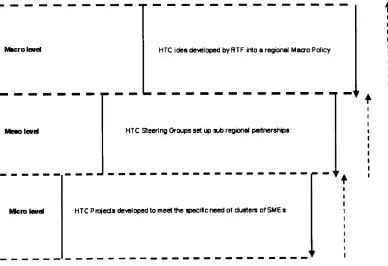
unequal power relationships (Reynolds & Saunders, 1987 p 213). The Implementation Staircase model suggests that policy enactment is capricious and is affected by people and factors at various positions and levels in the process. It models how policy is ‘transformed’, as the policy is enacted by local practitioners. It focuses upon the subtle and often invisible ways policy ‘changes’ to make it ‘workable’ in a specific local context. It shows how feedback and reflection on practice affects the development and the trajectory o f the policy as it takes account o f various levels including those above and below the key agents. Initially I adapted the implementation staircase model to depict three predominant levels o f HTC policy enactment as shown in the figure below (Reynolds & Saunders, 1987).
Figure 1: Locating HTC Policy Enactment on the Implementation Staircase
M icro level HTC idea developed by RTF into a regional Macro Policy
---
-r -▼
Meao level HTC Steering Groups set up sub regional partnerships
Mcro level HTC P rejects developed to meet the specif c need of clusters of SME s
▼
[image:36.465.36.424.373.639.2]A similar understanding o f the adaptation o f policy as it passes down and up the implementation staircase is adopted in an analytical concept called policy refraction. It depicts the way policy is re-conceptualised and adapted at different levels and sites and acknowledges the key role played by practitioners in policy development (Higham, Sharp, & Yeomans, 2002 p 10). This flexibility and openness to policy adaptation by people closest to the ultimate beneficiaries o f policy is important.
From another sociological perspective, the concepts o f bridging and provisional stability offer a similar analysis o f responses to change. The rapidity o f change means that those involved in complex change need to respond creatively in order to survive during periods o f change because they are associated with ‘chronic’ anxieties. The concept o f provisional stability refers to circumstances and tools that create a
temporary degree o f stability. It offers a temporary solution to changing practices and reduces angst by helping to crystallise a new way o f doing something, which is
necessary in order to move from potentially destructive instability to a new framework for action (Bonamy, Charlier , & Saunders, 2001; Fullan, 1993). The quest to
transform traditional manufacturing economies into ‘knowledge economies’ has become an international policy imperative. The financial risk o f failing to develop ambitious policies contributes to a tendency to take urgent policy action without fully considering the nature o f knowledge itself.
2.2
The Theorisation of Knowledge and Knowledge Transfer in
Policy
consumable goods. There is also an assumption that knowledge is a stable and material entity. The discourse o f knowledge management combines this notion with the idea that knowledge can be controlled. It locates knowledge in the senior managers in an organisation so that ‘knowledge’ is treated as a strategic resource. The notion of ‘intellectual property’ further reifies knowledge on the assumption that knowledge has a monetary value and can be traded. This misrepresents knowledge as if it is
something independent o f the ‘knowledge creating interactions’ between people (Hellstrom, 2004, p.643).
The project management model takes this idea one step further and aligns relationships between actors, groups, tasks and responsibilities and assumes that contextual and tacit knowledge can be made explicit. These assumptions shaped the HTC policy discourse. However the so-called transfer o f research between
Universities and other stakeholders is a complex process. The potential o f scientific and technological discoveries requires a vibrant innovation system. The premise o f ‘knowledge economy policies’ is that research in science and technology must be connected with developments in market demand and social needs (Goddard & Chatterton, 1999).
Many policy documents use the term innovation interchangeably with the term technology transfer and assume that the diffusion o f innovation can occur by mechanisms such as the licensing o f University intellectual property and spin off companies without distortion (EU, 2003). Recent European funding policies have encouraged Universities to take a leading role in working directly with local companies to enhance skills and deploy new technologies in commercial processes.
European structural funding encourages many universities to participate in ERDF and ESFprojects aimed at enhancing local skills or assisting local SMEs to develop in capability or technological sophistication (Goddard & Chatterton, 1999, p. 36).
The HTC policy discourse regards research and knowledge transfer as a simple linear model. However in practice this is more like a spectrum where a number o f
simultaneous flows occur between groups o f stakeholders and Universities.
2.3
A Discourse on Knowledge from Socio-Cultural Theory
Discourses are partial and positioned, and social differences are manifest in the diversity o f discourse within particular social practices. Evaluating discourses means setting them against shifting understandings o f what material possibilities there are in the practical domain concerned- discourses are not evaluated against 'absolute truth' but in terms of'epistemic gain ’ (Fairclough, 1999, p. 74).
Postmodernism9 recognises the importance o f ‘local’ discourses. Different discourses are associated with specific perspectives or mindsets which reflect the ‘positioning and interests’ o f the organisation or community to whom an individual owes
allegiance. Foucault stressed that local discourses are affected by global and national discourses and so policy documents can be used to enrol and govern individuals and groups10 (Foucault, 1972).
Foucault proposes that discourse is not to be treated as a mere 'document' o f the metal qualities 'behind it', but as a sequence o f external events in which symbolic structures (formative rules) are manifested (Reckwitz, 2002, p. 248).
In this sense the HTC policy can be considered in terms o f the social relations it can draw people into, and the individuals and organisations that stand to gain or lose. The social constructivist discourse in sociology represents knowledge as a process.
Within Sociology, there has been much recent interest in theories o f practice, and consequently organisational routines are o f significant interest.
From a socio-cultural perspective, situated practice theories focus on the dynamics o f everyday life and the choreography o f relationships between peoples and agencies.
Taking a different approach, theories o f social structure focus on institutions, rules and norms. Their interest lies in analysis o f social systems, discourses and history, and in the most extreme cases they deny that individuals are ‘knowledgeable’ and have agency in the sense o f the power to act independently o f social structures and group norms.
Cultural theories, including practice theory seek explanations for action, in symbolic structures o f meaning and language, discourses and conceptual tools and technologies. Although practice theory is an example o f cultural theory, not all cultural theories are practice theories. Models o f practice draw on the ideas o f Wittgenstein, Giddens, Latour, Foucault and Bourdieu among others and are interested in the 'everyday' and 'life world' (Reckwitz, 2002, p. 244).
W eick’s theory o f ‘sense making’ shares a phenomenological focus and speaks o f social activity as grounded in ‘physically situated routines’. The process o f ‘sense making’ happens when 'people make retrospective sense o f the situations in which they find themselves and it is this process that shapes organisational structure and behaviour (Weick, 1995)11. In Giddens' structuration theory, and Lave’s situated learning theory organisational routines are emergent and enacted (Giddens, 1993; Lave, 1993; Weick, 1995). Giddens introduced the notion o f the ‘trajectory o f the s e lf in which people reflexively reconstruct their self-narratives, to create coherent
relationships between the various sequential and disjointed influences on their lives, suggests that individual identity is an emergent self-image. Self-identity is crafted and emergent, and mediated by changing cultural factors o f various social groups to which
the individual belongs (Giddens, 1993). The problem o f distinguishing between individual and collective identity is discussed more fully in Chapters Four, Six, Seven and Nine in relation to the empirical data, and the emphasis in expansive learning theory on the depiction o f tensions in activity systems between the individual and their social context.
Cultural and Historical Activity Theory on which expansive learning theory is based has been used in studies o f organisational change to emphasise the interplay between individual and collective action. Organisational culture can be seen in terms o f processes created by individuals and groups whose activity and motivations are shifting and ambiguous. Within expansive learning theory it is possible for both individuals and organisations to learn and this is consistent with the view that knowledge is constructed by a complex interaction between individuals and communities.
even though ‘organisational routines12’ can be carriers o f tacit knowledge, it is not easy to transplant routines or ‘know how’ from one work environment to another (Giddens, 1993).
Socio-cultural theory has shifted the focus o f discussions o f 'knowledge management' away from issues o f information and technology towards those o f human capabilities (Wenger, 1998, 2000). During the last century organisations have moved from a focus on mass production towards mass innovation. Continuous processes o f innovation and mass customisation are moving closer to experimentation (Ludvigsen et al., 2003). However, much o f the knowledge o f innovation is difficult to articulate because it is locally generated ‘professional knowledge’ and tends to be not only local but also tacit (Colville, Waterman, & Weick, 1999).
Expansive learning theory proposes a conceptual framework for knowledge creation that embraces both the concerns o f situated practice and social structure orientations. When activity systems learn from one another, expansive learning theory describes the process as collaboration. In this sense ‘knowledge’ can be treated as a shared social construction by organisations working together.
2.4
Innovation as Collaboration and Expansive Learning
one location to another. The term co-configuration is used to describe the shared co construction o f new practices (Tuomi-Grohn & Engestrom, 2003). Expansive learning theory has been used to conceptualise the ways in which experts can work together by applying complementary expertise to a new problem that they could not have tackled independently. Recent studies have depicted this as interactions between equally important but distinctive activity systems. It is described as a process o f horizontal learning in which good communication is essential to the negotiation o f expanded
practices. (Hasu, 2001; Kerosuo & Engestrom, 2003; Ludvigsen et al., 2003; Toiviainen, 2003; Tuomi-Grohn, 2003).
Within the last three years ‘complex organisations’ have been the subject o f study by researchers associated with the Change Laboratory at the University o f Helsinki (Collins, Shukla, & Redmiles, 2004; Engestrom, 2004; Hasu, 2001; Ludvigsen et al., 2003; Miettinen & Hasu, 2004; Toiviainen, 2003). Researchers traced and visualised disturbances and breakdowns in everyday work practices in order to reformulate or expand work practices.
These studies were conducted in professionally facilitated environments in which the researchers made deliberate attempts to develop collective work practices.
very detailed data driven analysis o f the discursive processes, practical actions and mediating artefacts that are employed in the step-by-step production o f an innovative solution or idea (Engestrom, 1999, p.377).
In developing expansive learning theory Engestrom applied Cultural and Historical Activity Theory to new contexts some distance from the original focus o f Russian psychologists on concept development in children. During the 1920s and 1930s Vygotsky’s pioneering work in activity theory was concerned with individual learning and development. Activity theory was influenced by insights o f Marx and Hegel that tools could shape the progress o f cultural evolution, and could help to create more advanced ways o f doing things13. In the concept o f practical consciousness Marx makes an important connection between action and thinking o f relevance to innovation.
a division o f labour between thinking and working risks creating a social production o f knowledge that grossly misrepresents reality (Hellstrom, 2004, p. 641)
At the heart o f activity theory is an interest in the capacity o f tools to mediate in the relationship between the ‘ideal’ and the ‘concrete’. In other words ‘what is imagined’ can be realised with the help o f a tool. Leont’ev designed a triangular diagram to show how a tool mediated the relationship between the subject and object o f activity14. Later, V ygosky’s work in the field o f education, focused on the use o f language as a mediating tool in human activity. Engestrom adopted and changed the model and arrayed collective elements within an activity system in which the mediating artefact
13 An idea conveyed in the political philosophy o f G.W .F Hegel and K. Marx.
could be a physical object, a mental model or symbol system, such as language. Engestrom moved beyond the original focus on individual learning and mediation of human consciousness to re-orientate Cultural and Historical Activity Theory (CHAT) towards studies o f organisational learning.
Activities are social practices oriented towards objects, motivated by a human need (Fichtner, 1999, p. 380).
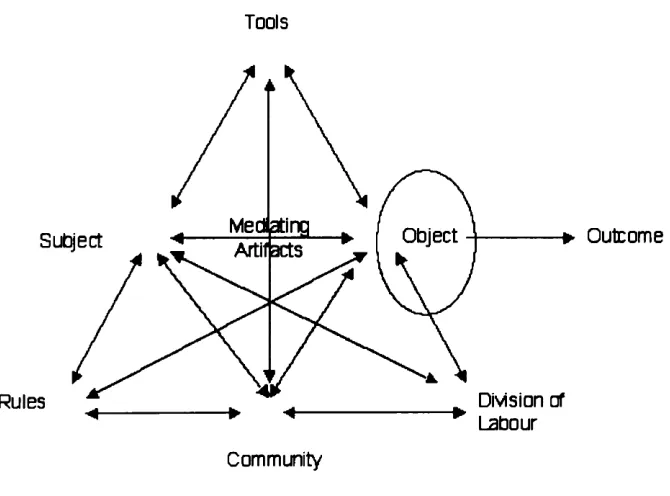
[image:46.465.36.371.405.653.2]The figure below depicts the structure o f an activity system and situates individual action within a social context. It shows how tools such as concepts and technologies mediate the interaction between the individual and the emerging object. At the same time, a division o f labour mediates the interaction between the community and the emergent object o f activity leading to an eventual outcom e15.
Figure 2: The Structure of an Activity System
Tools
M edating
O bject Subject
Artifacts
Division of Labour Rules
Community
could be a physical object, a mental model or symbol system, such as language. Engestrom moved beyond the original focus on individual learning and mediation o f human consciousness to re-orientate Cultural and Historical Activity Theory (CHAT) towards studies o f organisational learning.
Activities are social practices oriented towards objects, motivated by a human need (Fichtner, 1999, p. 380).
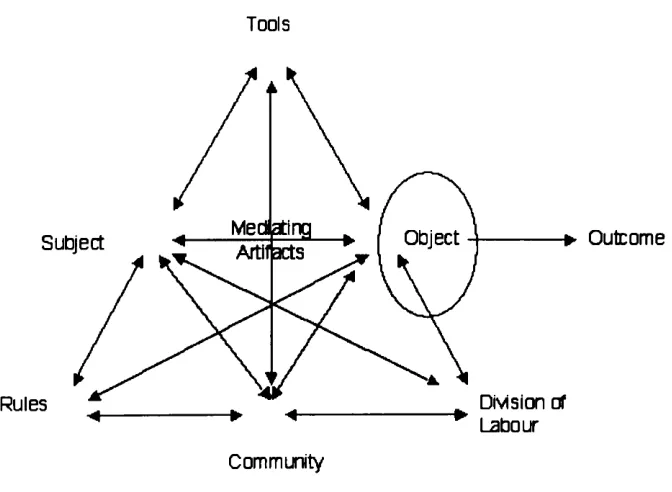
[image:47.465.35.371.404.650.2]The figure below depicts the structure o f an activity system and situates individual action within a social context. It shows how tools such as concepts and technologies mediate the interaction between the individual and the emerging object. At the same time, a division o f labour mediates the interaction between the community and the emergent object o f activity leading to an eventual outcom e15.
Figure 2: The Structure of an Activity System
Tools
M edating
O bject * O utcom e Subject
Artil acts
Division of Labour Rules
Community
Expansive learning theory encapsulates the idea that as a result o f people working and thinking together, organisations have the capacity to change. Organisations have a developmental trajectory in so much as future activities are created by past activities. It suggests that conflict is creative because new and better ideas push the
developmental trajectory towards a more comprehensive understanding. Crossing the boundaries between the surrounding worlds or activity systems brings various subjects and objects into creative tension and the tension between old and new practices drives the innovation process (Hellstrom, 2004, p.639-640).
Innovation is not just the conception o f a new idea, nor the invention o f a new device, nor the development o f a new market. The process is all those things acting together in an integratedfashion (Hellstrom, 2004, p. 634).
Innovation involves both mental and physical activity; it concerns a problem and its solution and involves the creation o f something new. The notion o f innovation as a creative and conflictual process is influenced by a theory o f dialectical action introduced by Hegel. Innovation from the point o f view o f Hegel's dialectics implies that progress does not happen in a smooth and orderly way (Hellstrom, 2004, p.639- 640). A new idea is created in opposition to existing ideas and practices, in which conflict and power struggles play a central role. This contrasts with notions o f
A result o f the reification o f innovation and the emphasis on innovation management rather than innovation dynamics product developers become ‘cogs ’ in the machinery o f the innovation system (Hellstrom, 2004, 643).
As a result, relations and selves become more ‘thing like’ and the social relations of innovation more manipulative (Hellstrom, 2004, p.643). In descriptions o f activity systems the ‘subject’ sometimes refers to an individual acting as a representative o f a small group and sometimes the term ‘subject’ denotes a collective body. It is this contradiction that expansive learning embraces and I discuss ‘subject perspectives’ in detail in Chapter Four.
From the perspective o f expansive learning theory innovation involves meaningful social action. It is radically different from knowledge management approaches, which reify innovation as if it is a disembodied thing that stands apart from people.
Expansive learning theory stresses that people have agency and can actively shape their future activities. In other words, people create organisations and not the other way around.
An activity system is by definition a multi-voiced formation. An expansive cycle is a re-orchestration o f those voices, o f different viewpoints and approaches o f the various participants (Davydov, 1999, p35)
An interesting observation about the sustainability o f change relates to its perceived value for those involved. As suggested in the previous section, complex change requires people working insightfully on the solutions and committing themselves to concentrated action together (Fullan, 1993 p 34). This suggests that clarity o f
communication and shared purpose is vital for success, and arguments and debate are healthy as encapsulated by Davydov.
The sense o f a person's action lies not in the action itself but in its relation to other members o f the group (Davydov, 1999, p. 73).
When applying the theory o f expansive learning to the organisational learning and to innovation in the workplace, Engestrom uses the term developmental transfer to describe the collaboration between diverse groups o f people at work (Engestrom, 2000, 2001, 2003). At Engestrom’s web site at the Centre for Activity Theory and Development Work Research16 a major section is devoted to Workplace Learning and Developmental Transfer. It recognises the difficulty o f developing ‘conceptual tools’ to understand organisational dialogue, multiple perspectives, and networks
(Engestrom, 2000, 2001). The concept o f an activity network evolved to describe the complicated relationships between multiple activity systems, in which the smallest unit o f analysis is an activity system. Innovation is described as ‘collaborative
interaction in which activity systems learn something from each other’. The term
developmental transfer distinguishes ‘organisational learning in the workplace’ from
other forms o f expansive learning (Tuomi-Grohn, 2003, p.226).
Engestrom appropriated and adapted Vygosky’s notion o f the ‘Zone o f Proximal Development’ (ZPD), which was originally used to explain how children acquire a new concept. The ZPD is the ideal space in which a child can learn and represents the optimal distance between the old and new concept. If the gap between the old and new concept is too wide it is difficult for the child to learn. Engestrom adapted this insight to develop the concept o f a Collective Zone o f Proximal Development to explain the optimal distance between routine activity and new forms o f societal activity.
Organisations can learn new ways o f doing things when the gap between old and new practice is not too large.
The study o f an activity system becomes a collective, multi-voiced construction o f its past, present and future zones ofproximal development. (Davydov, 1999, plO)
2.5
Methods of Visualising Interactions Between Activity Systems
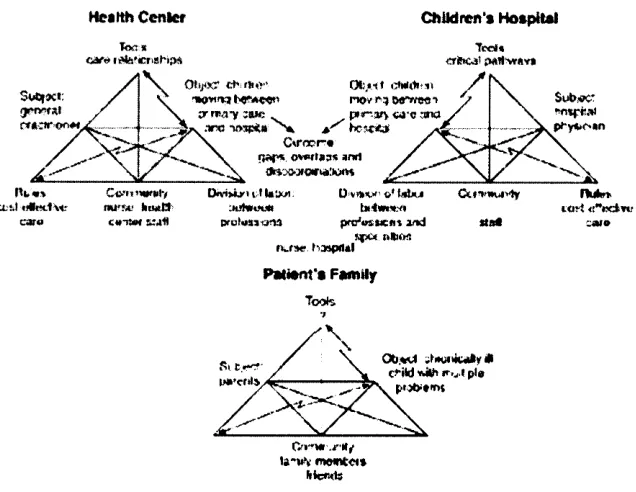
Depicting both the structure and dynamics o f activity systems presents a continuing challenge for activity theorists. Engestrom’s most persuasive illustration o f the interplay o f multiple activity systems describes the development o f a new policy to improve the care o f chronically ill children.
Expansive change occurs when a policy is developed to bring together all those responsible for the child’s welfare in a holistic way to improve the treatment by understanding the motivations o f the parents and the responses o f the medical professions to specific symptoms and events in the child medical history. If the new practices and the old practices are not too different they will fall within the Collective Zone o f Proximal Development and the proposed change is likely to be adopted. The new patient care agreement represents an improvement in care for the child and the family and a more coherent approach from the medical care team with less wasteful cross referrals.
However, it could be argued that the complex interaction o f activity systems is not evident to scrutiny because what remains is simply the change in practice. In other words the policy itself remains, whilst the description o f activity systems afford a complicated way o f explaining how the change happened.
Figure 3: Depicting Structure and Contradictions Between Activity Systems
Health Center Children's Hospital
T o e * foot*
erfctca! jMit'vmv* Otyxr »*<>•'
St*e»x«: JW fJI rtt-tronH
Ciy ii’WHty nU'tA; heuta
CMtUH
n»a-y zm:
me ~iortpi.* \
rtevr? oa^wsei pi*~.vy «ac ane
*r hc**rtaf Orocr-* 0WH5* anrt dttXXJWWWtfMH $ut>^ pfytKStn iu*> <X!.I eaw DwHaj'U;! li»ui autwooM Dro!«MS<r*a
O v»'C>' O* lj*bu Ctn'1H4>1y nufcrr 1»1»b m t a r i t i V l w pfc'«ssc«i Md *tsS zsuo
SpCl ttfefrt h3SfMUl
Patient's Family Tools
Ob.«o( ^wu>iMSye cSM v& i r . j . l pie
p>}0 *T>(
O v ta .r * f
ta-w\ memtot Mwb
Depictions o f interactions between three or more activity systems soon become impenetrable and I found it impossible to use this diagrammatic format to depict the vast array o f complex interactions in the HTCs. It is difficult to illustrate the structure o f relationships within and between activity systems at the same time as conveying a sense o f a dynamic process.
[image:53.465.44.362.111.357.2]