Current state on internet growth and usage
in Saudi Arabia and its ability to support
ecommerce development
Alshehri, H and Meziane, F
10.18178/joams.5.2.127132
Title
Current state on internet growth and usage in Saudi Arabia and its ability
to support ecommerce development
Authors
Alshehri, H and Meziane, F
Type
Article
URL
This version is available at: http://usir.salford.ac.uk/43785/
Published Date
2017
USIR is a digital collection of the research output of the University of Salford. Where copyright
permits, full text material held in the repository is made freely available online and can be read,
downloaded and copied for noncommercial private study or research purposes. Please check the
manuscript for any further copyright restrictions.
Current State of Internet Growth and Usage in
Saudi Arabia and Its Ability to Support
E-Commerce Development
Haya Alshehri
University of Salford / School of Computing, Science and Engineering
Salford, M5 4WT, UK
Email:
[email protected]
Farid Meziane
University of Salford / School of Computing, Science and Engineering
Salford, M5 4WT, UK
Email:
[email protected]
Abstract-It is widely recognized that the Internet has been rapidly growing and massively used in recent years. Previous studies have revealed that this is true for Internet users across the world. Likewise it is reported, lack of ICT infrastructures and is one of the main reason behind lack of spread of E-Commerce. The study attempted to understand the state of Internet growth and activities usage and its ability to support E-Commerce development .Little attention has been paid to testing particular questions in this study which proper investigation can help in understanding the prospects of the development and adoption of E-Commerce. The current study will attempt to confirm on whether similar growth and usage of the Internet is also happening in Saudi Arabia and whether this will help in establishing a platform of E-Commerce development. Quantitative data was gathered from 606 Saudis living in various parts of Saudi Arabia. Four questions related to the use of the Internet in Saudi Arabia are tested. The outcome shows that the findings are similar to those of other countries. In addition, individuals’ readiness to use the Internet as their main shopping medium is approved by more than half of the sample used.
Keywords: Internet Usage, E-Commerce, Saudi
Arabia, Quantitative Research.
I. INTODUCTION
The Internet is one of the most significant innovations that influenced lifestyles. Business, education, healthcare, and environment have all gained from the development of the Internet when they changed to online usage and transactions.
1
1Haya Alshehri
The fast progress of the Internet has offered a novel host of chances in addition to threats [1]. To take advantage of the benefits of using the Internet, it is important that individuals, governments and companies understand the threats and benefits of going online. Trust in these new technologies will be paramount to their acceptance, adoption and success. In addition to trust, developing countries face more technical challenges such as the cost of telephone tariff and Internet, technical support and hardware [2]. The Arab work is facing similar challenges that slow the development of the Internet and related applications [3]. It has been noted that the increasing access to Internet demonstrates the country’s readiness for E-Commerce, and indeed this will require the support of the governments and businesses [4]. It was tested that the development of Internet environments influences Saudi customers to engage in E-Commerce and buy online [5]. Therefore, the purpose of this study is to examine the current state of Internet relative growth and usage in Saudi Arabia as the foundation of a research to develop a framework for the adoption and development of E-Commerce; The Internet being the backbone for the implementation of B2C E-Commerce.
Although, the results reported in this paper are based on a questionnaire survey of 606 Saudi citizens living across Saudi Arabia, the main issues that were tested are the following four questions:
‘Where do you access the Internet?’
‘Which medium do you use to access the Internet?’
How often do you access the Internet?’
‘When you access the Internet, how many
‘Are you ready to use the Internet as your main shopping medium?’
The remaining paper is organized as follows. In section 2 we provide a background review for this study in the form of a literature review, in section 3 the research methodology is described. The finding and analysis of the study are presented in section 4. Finally the study conclusions are given in section 5.
II. LITERRATUREREVIEW
A. Background
Prior to the late 90s, access to the Internet in Saudi Arabia was limited [6]. Furthermore, according to TIAC [7], the technical difficulties associated with the use of Arabic on the Internet (and on computers more generally), tended to restrict Internet use to only those who could work in English. Using Communication and Internet Technologies (ICT), the total number of Internet users had increased to 6.4 million, representing about 26% of Saudi citizens by the end of 2008, compared with only 200,000 in 2000 [8]. However, Saudi Arabia has the highest percentage of mobile phone users in the world, with 95% of individuals having a mobile phone. As a result, mobile Internet penetration has grown to 54% with 70% mobile Internet usage rates [9]. In 2014, the total IT expenses are predicted to reach US$ 5.7 billion; with each person’s expenses reaching US$ 200. These figures represent a 13% rise in two years, and account for over 50% of overall ICT investments throughout the Gulf Co-operation Council (GCC) countries [9].
However, currently Saudi Arabia, like the rest of the Middle East, and indeed the Arab World, has very little global market share of the income generated by E-Commerce. In this respect, it is the USA and Europe which are the biggest beneficiaries, sharing around 79% of the income generated worldwide, while the smallest share representing about 3% is occupied by Africa and the Middle East [10]. Worries about security, cultural and political focuses are the key issues that slow down the implementation of Internet transactions in the Arab World [3, 11].
B. Internet and E-Commerce
The Internet is one of the significant actors in the implementation of many new innovations such as E- Business, E-Commerce, E-Marketing and M-Commerce. It is the main way of offering online services. Businesses that seek to use the Internet in the marketplace in the developing world might be facing vital difficulties, more than those in the developed countries. One of the significant effects of the Internet on business is E-Commerce [12]. E- Commerce is seen as a revolution in the business world as it added new features to the whole process of trade guarantying smart, more rapid services in
related segments of information [13]. E-Commerce offers services that enable customers to purchase, sell, and pay via the World Wide Web (WWW). Customers are allowed to buy from markets around the world without seeing the goods or trying the services. To implement E-Commerce, it is important that companies adopt the new technologies like the Internet. Lack of telecommunication infrastructures is often cited as the main reason behind the limitation of the Internet in developing countries [2]. One of the key threats that face the spread of E-Commerce is the lack of Internet access [2]. This is true in the Arab world [3]. E-Commerce requires an appropriate and a full development plan to fulfil its potential and the availability of an adequate ICT infrastructure is essential for the implementation of such a plan [14]. A large number of Arab countries need to fully embrace and develop the Internet to get its full benefits and advantages [3]. The situation is similar in many developing countries where ICT infrastructures are not well developed, hence slowing the development of E-Commerce [15]. B2C E-Commerce deals with customers buying goods from businesses. It has been known that B2C in developed countries has a high level of growth [15]. Different changes of shopper’s behaviour by ICT infrastructure growth, it was found that the main influences of the development of E-Commerce are the rising value of ‘Internet users, online spending and adoption of new technologies’ [14]. These results can be similar to implement E-Commerce in developing countries like Saudi Arabia.
it is being shown that about 39% of adult Internet users purchase goods and makes payments for services online via E-Commerce facilities [16]. Table 1 shows the Internet growth and population in Saudi Arabia [17].
TABLE 1: INTERNET GROWTH AND POPULATION STATISTICS’ IN SAUDI
ARABIA
N
Internet in Saudi Arabia
Year Users Population
% Usag e Sour
ce 1 2000 200,000 21,624,422 0.9 % ITU
2 2003
1,500,00
0 21,771,609
6.9 % ITU
3 2005
2,540,00
0 23,595,634
10.8 % C+I+ A
4 2007
4,700,00
0 24,069,943
19.5 % ITU
6 2009
7,761,80
0 28,686,633
27.1 % ITU
7 2010
9,800,00
0 25,731,776
38.1 % ITU
8 2012
13,000,0
00 26,534,504
49.0% IWS
III. RESEARCHMETHODOLOGY This study conducted a survey method to examine Saudis attitudes towards the Internet usage activities in Saudi Arabia. This method is one of the methods that give primary data. It is information that is collected directly by the researcher through working in the field. What is important about primary data is that it can throw new light on a topic and add to existing published knowledge, or even help to create a new stream of literature. This method enabled to achieve an experiential investigation of phenomenon in its real life environment of a big young population where they have the ability to use the Internet. In this section of the research, a pilot study was conducted by questionnaires and it was validated. The questionnaire was designed in English and then translated into the Arabic Language. The data was collected over a period of 12 weeks in Saudi Arabia, A drop and collect technique was used. Descriptive analysis of frequency and percentages were performed via the SPSS software. The results reported in this paper are part of a larger study which is trying to improve the understanding of the
advantages of the Internet in Saudi Arabia for the development of a framework for the development of E-Commerce.
IV. FINDINGSANDANALYSIS
A. Sample Demographic Information
[image:4.595.66.289.178.482.2]Saudi citizens’ gender information is given in Table 2. Out of the 606 respondents, 213 are males; representing (35.1%) of the sample and 393 females (64.9%).
TABLE2: GENDER DISTRIBUTON
N Gender
Items Frequency Percent
1 Males 213 35.1
2 Females 393 64.9
3 Total 606 100.0
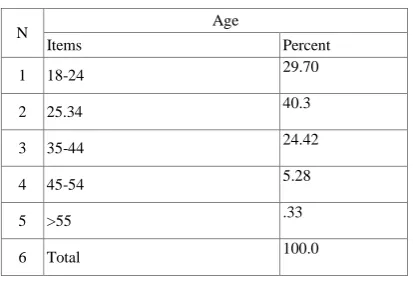
Table 3 shows the age distribution of the sample. The age group from 25-34 years old was the largest with 244 respondents (40.3%). The second largest group is the 18-24 group (29.70%) and the third is the 35-44 group (24.42%), the age group greater than 55 years old was the smallest, containing only two respondents (3%).
[image:4.595.317.524.445.587.2]
TABLE 3: AGE DSTRIBUTION
N Age
Items Percent
1 18-24 29.70
2 25.34 40.3
3 35-44 24.42
4 45-54 5.28
5 >55 .33
6 Total 100.0
Table 4 summarizes the level of instruction of the participants. The nearly half of the respondents are educated, it can be observed that people holding a Bachelor degree were the highest with a frequency of 301 (49.7%). Second level is under diploma (22.11%), third level is diploma (16.01%), the higher level of education is (10.23%) and the smallest is other (1.98%).
TABLE 4: LEVEL OF INSTRUCTION OF PARTICIPANTS
N Instruction
Items Percent
N Instruction
Items Percent
2 Diploma 16.01
3 Bachelor 49.67
4 Master and PhD 10.23
6 Other 1.98
7 Total 100
[image:5.595.74.281.71.188.2]Table 5 summarizes the occupation distribution of the participants. The largest group is employed (60.23%). The second is students (26.57%), and the other rest around between 4 and 5 %.
TABLE 5: OCCUPATION
N Occupation
Items Percent
1 Students 26.57
2 Employee 60.23
3 Retired 2.81
4 Housewife and Husband 4.29
6 Other 4.95
7 Total 100
Table 6 shows the respondents came from all over the five regions in Saudi Arabia, but representation from the middle region was highest, reaching 46.4%. This was followed by the north with 19.64% of the research population, then the south being represented by 13.2%, the west with 12.21%, and finally the east with only 8.91%.
TABLE 6: REGIONS DISTRIBUTION
N Region
Items Percent
1 Middle 46.04
2 East 8.91
3 West 12.21
4 North 19.64
5 South 13.20
6 Total 100.0
Table 7 shows the responses to the question “When did you start using the Internet?” The results show
that approximately one quarter (24.9%) of the sample began to use the Internet between 1998 and 2001. However, the highest group (31.2%) began to use the Internet immediately after that period, between 2002 and 2005, and this was followed by another group representing 29% of the sample that began Internet use between 2006 and 2009. A further 14.9% of the sample did not start using the Internet until 2010. These figures indicate that the Internet has been established in Saudi Arabia since 1998 and that its popularity grew relatively quickly.
TABLE 7: WHEN DID YOU START USING THE INTERNET?
N Start date of using the Internet
Items Frequency Percent
1 1998-2001 151 24.9
2 2002-2005 189 31.2
3 2006-2009 176 29.0
4 2010-Now 90 14.9
5 Total 606 100.0
Regarding the pattern of Internet usage, Table 8 shows that 61.9% of participants used the Internet at home, and 23.6% accessed it from home and work. Only 3.5% of respondents used the services of an Internet café. These percentages may well reveal that the population prefers to conduct personal online research through the use of home-based Wi-Fi, which offer them greater privacy.
TABLE 8: WHERE DO YOU ACCESS THE INTERNET?
N Access the Internet
Items Frequency Percent
1 Home 375 61.9
2 Work 21 3.5
3 Internet café 8 1.3
4 Other 17 2.8
5 Home and work 143 23.6
6 Home and Internet café 4 .7
7 Home, work and Internet café 30 5.0
8 Home, work, Internet café and other
8 1.3
9 Total 606 100.0
[image:5.595.71.282.290.431.2]the younger population to access the Internet in different ways.
TABLE 9: WHICH MEDIUM DO YOU USE TO ACCESS THE INTERNET?
N Medium use to access the Internet
Items Frequency Percent
1 PC 150 24.8
2 Tablet 28 4.6
3 Smart phone 93 15.3
4 All 181 29.9
5 PC and smart phone 118 19.5
6 Tablet and smart phone 32 5.3
7 PC and Tablet 4 .7
8 Total 606 100.0
[image:6.595.69.285.113.296.2]
Table 10 shows that the majority of respondents (68%) access the Internet more than once a day but it is not known what they do during this time (i.e. play games, communication, social media, work, online shopping). Only 4.1% indicated that they access the Internet as little as once or twice a month.
TABLE 10: HOW OFTEN DO YOU ACCESS THE INTERNET?
N Often access the Internet
Items Frequency Percent
1 Once or twice a month 25 4.1
2 Three to four times a week 78 12.9
3 Once everyday 86 14.2
4 More than once a day 417 68.8
5 Total 606 100.0
[image:6.595.317.523.219.323.2]Table 11 shows that in terms of the amount of time spent using the Internet each week, the category which attracted the highest proportion of respondents was that of more than 1 hour and less than 55 hours (showing 37.3%), whereas only 13.2% used the Internet for over 20 hours a week.
TABLE 11: HOW MANY HOURS A WEEK DO YOU USE THE INTERNET?
N Hours of using the Internet per a week Items Frequency Percent
1 Less than 1 hour 68 11.2
2 More than 1 hour and less than 5 hours
226 37.3
3 More than 5 hours and less than 10 hours
132 21.8
4 More than 10 hours and less 20 hours
100 16.5
5 Over 20 hours 80 13.2
N Hours of using the Internet per a week Items Frequency Percent
6 Total 606 100.0
In respect of their readiness to use the Internet as their main shopping medium, a small majority of respondents (52.5%) believed that they were ready, whilst 47.5% considered that they were not. These responses are shown in Table 12.
TABLE 12: ARE YOU READY TO USE THE INTERNET AS YOUR MAIN SHOPPING MEDIUM?
N Main shopping medium
Items Frequency Percent
1 Yes 318 52.5
2 No 288 47.5
3 Total 606 100.0
V. DISCUSSION
The literature has outlined that Internet is the backbone of the development of E-Commerce. When populations engage in Internet usage, they have a better understanding of the issues and threats associated with it. A better education will make turn them into confident users that may then pave the way of E-Commerce adoption and engagement. This study has confirmed what other studies have shown in terms of Internet Usage growth in other countries to Saudi Arabia. There is a growth in Internet usage although this is slow and late compared to other countries. Indeed, the study has shown that 44% of the population has started using the Internet after 2006. A time when most people in the developed world are fully using the internet and E-Commerce well developed. This section of the population that started using the Internet late, may not be fully ready to engage in E-Commerce and may still be hesitant at providing for examples their personal details or payments details. Nevertheless, it is very encouraging to see that although the sample covered large parts of Saudi Arabia, 100% of the sample participants are Internet users.
[image:6.595.76.291.422.546.2] [image:6.595.77.292.649.771.2]of the Saudi Adult population is engaged in E-Commerce and make online payments.
The study has also shown that there is a moderate usage of Internet by Saudis with over 50% of the population uses the Internet between one to ten hours. Nearly 70% of the population using the Internet more than once a day.
VI. CONCLUSION
This research contributes to the knowledge of Internet activities usage in Saudi Arabia and to have a better understanding of the Saudi society behavior towards the Internet. Furthermore, to the direct question on whether the sample population is ready to use the Internet as their main shopping medium, over half of the population answered yes. However, as many studies have shown, acceptance by the populations alone may not be sufficient for the development of E-Commerce. Legislations and the support from the governments and financial institutions are also needed for the full implementation of E-Commerce.
The support of the government in Saudi Arabia [4] and the results obtained from this study confirms the readiness of Saudi Arabia to embrace E-Commerce. However, we agree that this study alone may not provide all the answers to the readiness of the Saudi society for the adoption of E-Commerce. Indeed, the work reported in this paper is only a part of a larger study conducted by the authors.
To confirm the early results of this study, the following investigations are also being conducted:
Perception of the sample on the use and usefulness of E-Commerce looking at both the technological, cultural and societal variables.
Similar study is also conducted for Saudis living abroad, in this case the UK [5]. This study investigate whether the environment influence the change in the habits and attitudes towards E-Commerce.
A comparative study between the two samples is analyzed.
Finally, a qualitative study about the perception of companies and organization of E-Commerce is conducted.
The results of these studies is used to develop a framework for the development and implementation of E-Commerce in Saudi Arabia.
REFERENCES
[1] M. Tan and T. S. Teo, “Factors influencing the
adoption of Internet banking,” Journal of the Association
for Information System , vol. 1 issue 1, Article 5. 2000.
[2] S. Hawk, “A comparison of B2C e-commerce in
developing countries,” Electronic Commerce Research,
vol. 4, no. 3, 181-199, 2004.
[3] A.M. Aladwani, “Key Internet Characteristics and
E-Commerce Issues in Arab Countries,” Information
Technology & People, vol. 16 no. 1, pp. 9-20, 2003.
[4] S. M. Sait, K. M. Al-Tawil, and S.A. Hussain, “E-commerce in Saudi Arabia: adoption and perspectives” AJIS, vol. 12, no. 1, pp. 54-74, 2004.
[5] H. Alshehri, and F. Meziane, “An Investigation into
Saudi Online Shoppers' Behaviour Abroad,”
In Developments in eSystems Engineering (DeSE), Sixth International Conference, Abu Dhabi, 2013, pp. 323-327. IEEE.
[6] Electronic Frontiers, (2002). Internet Censorship: Law and policy around the world. Australia. [Online] https://www.efa.org.au/Issues/Censor/cens3.html#sau, last accessed in 13-07-2014.
[7] TIAC (The Internet in the Arab Countries). (2009). Development and growth of the Internet. [Online] http://www.al-bab.com/media/internet.htm, last accessed in 14 July 2014.
[8] CITC (Communications and Information Technology Commission). (2007). Internet Usage Study in the Kingdom of Saudi Arabia Communication and Information Technology Commission, Riyadh.
[9] SOCG (Sacha Orloff Consulting Group). (2012). E-Commerce in Saudi Arabia: Driving the evolution, adaption and growth of e-commerce in the retail
industry,[online] http://sacha-orloff-group.com, last
accessed in 12 March 2014.
[10] R. AlGhamdi, S. Drew, and W. Al-Ghaith, “Factors influencing EC adoption by retailers in Saudi Arabia: a
qualitative analysis” The Electronic Journal on
Information Systems in Developing Countries, vol. 47, no. 7, pp.1-23, 2011a.
[11] W. Alrawabdeh, D. Zeglat, and A. Alzawahreh,
“TheImportance of Trust and Security Issues in
E-Commerce Adoption in the Arab World,” European
Journal of Economics, Finance and Administrative Sciences, vol. 52, ISSN, 1450-2275, pp. 72-78, 2012. [12] N. Kamalabadi, A. Bayat, P. Ahmadi and A. Ebrahimi, “Identifying and Prioritization of Challenges and Barriers of EC Implementation in Iran,” World Applied Sciences Journal, vol. 5, no. 5, pp. 590-597, 2008.
[13] S. A. A. Rajon, Abdullah-Al-Nahid and A. S. M. Arif, “A Generic Framework for Implementing Electronic Commerce in Developing Countries,” IJCIT, 2078-5828, vol. 01, no. 02, pp. 42-53, 2011.
[14] M. Jehangir, P.D.D. Dominic, Naseebullah, and A. Khan, “Towards Digital Economy: The Development of
ICT and E-Commerce in Malaysia”, Modern Applied
Science, Vol. 5, No. 2. Pp. 171-178, 2011.
[15] R. AlGhamdi, S. Drew, O. AlFaraj, “Issues Influencing Saudi Customers’ Decisions to Purchase from Online Retailers in the KSA: A Qualitative
Analysis,” European Journal of Scientific Research,
vol.55, no 4, pp.580-593, 2011b.
[16] IMRG (International Commissioned by Visa Middle East). (2011). Gulf Cooperation Council B2C Overview. London,. [Online] http://www.imrg.org, last accessed in 12 May 2015.
[17] IWS (Internet World State). (2012). Internet usage, broadband and telecommunications reports.
Haya Alshehri is a PhD students in the school of computing, Science and Engineering at the university of Salford, UK. She was born in Saudi Arabia in 1974. She got king Abdullah scholarship program for studying a PhD in information system with specialism in E-Commerce and hold a MBA from King Abdulaziz University, Saudi Arabia. Her principal research interest lies in the field of E-Commerce researching the impact of different environment on customer activities on E-Commerce. She got award for scientific excellence of Saudi Arabia Cultural Bureau in Britain and Ireland four times for every academic year during her PhD.
Farid Meziane (PhD) is a
professor of computer science at the University of Salford, UK and holds a PhD in Computer Science from the same university. He is currently the director of the Informatics Research Centre at the University of Salford. His research interests include Data and knowledge Engineering, Natural Language Processing and E-Commerce. He is serving in the research committee of over 20 conferences and is the co-chair of the international conference on application of Natural Language to Information Systems (NLDB).