• No results found

Devising ridiculusmus’ total football: A schematic reading of performance process

N/A
N/A
Protected

Academic year: 2020

Share "Devising ridiculusmus’ total football: A schematic reading of performance process"

Copied!
24
0
0

Loading.... (view fulltext now)

Full text

(1)

D evi si n g r i di c ul u s m u s’ t o t a l

foo t b all: A s c h e m a t i c r e a d i n g of

p e r f o r m a n c e p r o c e s s .

Tal b o t , RJ

h t t p :// dx. d oi.o r g / 1 0 . 1 0 8 0 / 1 4 6 8 2 7 6 1 . 2 0 1 3 . 8 7 7 6 6 2

T i t l e

D evi si n g r i di c ul u s m u s’ t o t al foo t b all: A s c h e m a t i c r e a d i n g

of p e r f o r m a n c e p r o c e s s .

A u t h o r s

Tal b o t, RJ

Typ e

Ar ticl e

U RL

T hi s v e r si o n is a v ail a bl e a t :

h t t p :// u sir. s alfo r d . a c . u k /i d/ e p ri n t/ 2 9 4 9 2 /

P u b l i s h e d D a t e

2 0 1 4

U S IR is a d i gi t al c oll e c ti o n of t h e r e s e a r c h o u t p u t of t h e U n iv e r si ty of S alfo r d .

W h e r e c o p y ri g h t p e r m i t s , f ull t e x t m a t e r i al h el d i n t h e r e p o si t o r y is m a d e

f r e ely a v ail a bl e o nli n e a n d c a n b e r e a d , d o w nl o a d e d a n d c o pi e d fo r n o

n-c o m m e r n-ci al p r iv a t e s t u d y o r r e s e a r n-c h p u r p o s e s . Pl e a s e n-c h e n-c k t h e m a n u s n-c ri p t

fo r a n y f u r t h e r c o p y ri g h t r e s t r i c ti o n s .

(2)

Devising Ridiculusmus’ Total Football: a schematic reading of performance process

Dr Richard Talbot, University of Salford, School of Arts & Media

Contact: University of Salford, Peru Street, Salford, M3. [email protected]

Abstract

This article critically reflects on a series of drawings created during the devising process for Ridiculumus’ Total Football (2012). Ridiculusmus' production, a narrative of a non-sporty bureaucrat tasked with harnessing the enthusiasm of football fans in the interests of national cohesion, examines the impossibility of thorough incorporation of a national body within the Olympic mo(ve)ment.

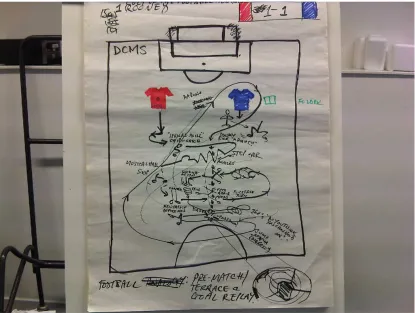
Based on an existing convention among football commentators for contextualizing and narrating team play, a series of photographs of sketches-in-process discussed here capture the marks of live notation as an urgent activity during devising. As such the reader has access to a snapshot from Ridiculusmus’ rehearsal methods and process. The paper analyses the notation devices employed in the sketches arguing that the approximate qualities of sketched notation, and its failed totality, capture the tone of comedy in this work about masculine hubris. While the sketches attempt to keep pace with the spontaneity of tactics devised by performers, the paper argues that performance systems and dance notation that have paid attention to architecture and spatial arrangement as a score do not generally notate intention or strategy. The paper presents the idea that the sketches document a multiplicity of tactics, and footballing metaphor in process.

The notation can be understood both as documentation of movement and a contribution to a theatrical and scenographic discourse that is concerned with more than a simple ‘blocking.’ The paper discusses the origins of ‘self-blocking’ in this production, its relation to a priori

analysis of character and to unpredictable elements of game-playing in a piece about football.

The paper discusses the way in which Ridiculumus tackle the inherent rigidity of the British class system through a metaphorical critique of the ‘4 4 2’ team formation in football. With its wasteful habit of long ball passes, the formation has proven vulnerable against continental versatility, just as a bureaucratic class that resists meritocracy will not withstand more imaginative social structures elsewhere in the world.

Finally, the article, which includes original photographs and diagrams, suggests that similar crude schema indicate a potential for digital software to expand on the score/ing function of dance notation and may be appropriate for devising in contemporary theatre.

(358 words)

Keywords: Comedy; Devising; Documentation; Football; Performance; Physical Theatre; Olympics; Ridiculusmus.

1. Introduction: notation and dramaturgy.

(3)

Cultural Olympiad and London Olympics.3

In his reading of a Renaissance dance manual, André Lepecki noted an ‘inextricable alliance’ between writing and dance; such writing serves as an archive, an idealization of movement and a manual of imperatives to dance, he notes. (Lepecki, 2005) The series of drawings that trace a stage in the development of Total Football are sketchy but nevertheless it could be said that they serve a similar archival purpose to the dance manual: they exist as a historical document of a process, and have been used as a set of guidelines for future performance. It could also be claimed that they are an idealized version or adaptation of the devised

performance, transformed into a series of frames that throw into question the division of scenes in the written script. The alliance between notation and movement, Lepecki observes, expresses an ontological plaint in dance against the fact that the body is subject to the passage of time and that choreography must suffer the ‘structural impermanence of the body’ (121). The notation devices employed in the sketches attempt to keep pace with the

spontaneity of the devising performers who, of course, escape thorough translation into drawings. Nevertheless, the approximate qualities of sketched notation, and its failed totality if you like, arguably capture the tone of comedy in this work about masculine hubris.

The sketches were documented in photographs and are presented here in that form. The drawings have not been transferred to line diagrams as a ‘clean’ subsequent re-drawing of the sketches as such schema would perhaps reinforce the idealizing imperatives that Lepecki addresses and seeks to overturn. Rather, the photograph captures the marks of live notation as an urgent activity during devising and as such the reader has access to a snapshot from the devising process. In what follows, I discuss some of the sketches and track some of the main themes and performance techniques in the production.

At this particular stage of devising, the performers, Jon Haynes and David Woods, were trying to establish and fix key movement sequences. The purpose of fixing at this point was to establish a strong foundation and paradigm for future work by the ensemble (including performers, sound and lighting designers). The schema needed to be suggestive as the Lighting Designer, Mischa Twitchin, was considering designing an illuminated floor pattern based on the principles in the sketches. It records the devising as dramaturgical process, that is, it traces the positions of actors in relation to dialogue and it also visualizes the

dramaturgical synthesis of football dynamics and character interaction ‘in the field’. The company’s discussions around the sketches suggest, then, that the notation can be understood both as documentation of movement and a contribution to a theatrical and scenographic discourse.

2. Marking out a pitch: the temporal-spatial grid of performance.

The rehearsal room for Total Football was a plain office space at the National Theatre of Scotland’s base in Glasgow.4 This room was subsequently reproduced as the set for the production. A flip chart left in the corner of the room as a prop for Woods’ character Nigel Burton quickly became a board on which to document movement within each scenario. I was standing and drawing on the flip chart on the edge of the performance space, and the board was visible to the actors; so a notation system was devised as the drawings responded to the nascent performance. A large degree of spontaneity can be seen in variations such as the weight of the lines, and the ad hoc orientation, style and scale of symbols. By developing a notation language, however elementary, we were able to explore and discuss more than a simple record of ‘blocking’5, for it seems that the schema expressed both performance tactics and a movement score.

(4)
[image:4.595.89.508.68.636.2]
(5)
[image:5.595.124.510.92.360.2]

Figure 2: Football Association Law 1: The Field of Play

(6)
[image:6.595.91.506.70.307.2]

Figure 3: TheTotal Football Set

(7)
[image:7.595.91.506.71.384.2]

Figure 4: Sketch 1 - Dance Sequence (Total Football p1, Image 224. All images

©

Ridiculusmus, 2010)

David Woods devised the opening dance sequence prior to November 2010. The sequence was shifted a year later, during touring performances, to the middle of the play because of a concern with the play’s momentum and dramatic arc. Woods worked with choreographer Luke George. Later Haynes added in manager-persona moves performed in the background. The sequence was based on footballing manoeuvres including the ‘rabona’, the step over, the Cruyff turn, goal celebrations, donkey kicks and dummies.7 Phrases were augmented

alongside an existing sound track, developing a sense of increasing momentum and suspense through repetition, contrasting intensity and fluidity. Staccato rhythms of travel across the space and more lyrical phrases also invoke the balletic of a footballer. The sequence includes a moment in which Woods lifts Haynes horizontally above his head like a plank, while Haynes remains deadpan and unmoved by the sudden re-orientation. The dance culminates with a sweeping kick to an imaginary ball.

A football match proceeds following a series of set pieces governed by a relatively narrow set of rules. The frequency and rhythm of passes of the ball can be very short or unusually extended depending on the pace, competitive intensity, communication and organizational integrity within the team. Thus the movement of play augments and intensifies until a goal is scored and it is in this combination of momentum, skill and team play that a certain beauty is said to emerge.8

Ridiculusmus’ use of balletic footballing physicality has been recognized by reviewers of Total Football who have not missed the opportunity to explore the analogy, placing themselves in role as commentators: ‘[T]here’s a less than clinical finish, this slice of the absurd has a real lightness of touch.’ (Evening Standard) or, ‘[t]heir finishing is sometimes a bit rough and their timing a bit hectic, but overall this is an entertaining match with some nice curling shots.’9 (Financial Times)

(8)

as a tangled floor pattern, a series of shapes traced by Woods’ feet. This is a cartoonish, messy representation of the performer’s bodily inscription in the blank office space. It takes time to decipher and it is not very beautiful.

The relationship between internal and external affective spatialization has been one of the concerns of modernist performance systems. Rudolf Laban’s meticulous notation is a detailed representation of weight, time and space. He imagines the stage space in terms of a 3-D grid framework around the performer that can be used to describe movement dynamics and pathways and to introduce affective correspondence between the two, for example in ‘Effort Actions’. Tina Landau and Ann Bogart’s postmodern dance-derived Viewpoints system visualizes a floor grid across which affective intensity is explored using, amongst other elements, contrasting iterations of performer shape, level, and speed but also an imaginary topography. (Bogart, 2006) But performance systems that pay attention to architecture and spatial arrangement in this way do not in themselves notate intention or strategy. Their relation to an extant script, context and narrative are implied forming part of the post-devising analysis. The challenge for the sketches was to find a way of documenting this multiplicity of tactics, metaphor, pattern and dialogue between performers concurrently.

3. The tactics of shifting position.

Metaphorical phrases such a ‘keep[ing] the ball in the air’ are recognised in performance improvisation and are fundamental to the ‘give and take’, ‘call and response’, or ‘accept and change’ principles taught in elementary movement training. Physical Theatre practitioners have turned to the rules of game-playing to find a shared language and regulatory ‘scaffold’ to support character objectives (Barker, 1977/2010). Game-playing can work as a means of liberating the actor from interpreting a character’s psychological intention. Haynes and Woods were not playing a meta-theatrical game, but rather found their game in the deployment of tactics such as character slippage, shifts in spatial arrangement, status positioning, emotional resistance, and a firm trust of impulse.10 In Glasgow, associate artist Louise Bush asked Haynes and Woods to consider an analysis of character based on a forensic reading of evidence about character objectives that can be found in the script. This contextualizing work imposed a new discipline around tactics. Bush has worked with Mike Alfreds, a founding member of Shared Experience Theatre Company, who as a director encourages performers who are liberated from tight ‘blocking’ to ‘self-block’ (2007:261-4) Alfreds rehearses actors to develop a skill of ‘self-block[ing]’ in which ‘points of concentration’, on the stage spatial dynamics, for instance, are derived from an a priori analysis of information about the

character. This enables actors to move creatively and ‘naturally’ balancing of knowledge and impulse.

In her blog site Drama Queens Review Elaine Aston cites Sarah Kane's theory about the correspondence between performance ensemble and sporting teamwork, to make the point that ‘[Ridiculusmus] shows are all about teamwork.’11 Aston observes in Total Football ‘the demands that the duo place on themselves to deliver a highly technical and physical

performance’ and she offers 'absurdly fast-paced multiple shifts in character, time and place’ as examples of their key tactics.

(9)
[image:9.595.91.505.70.387.2]

Figure 5: Sketch 15 - Substitution. (Total Football pp34-39. Image 258)

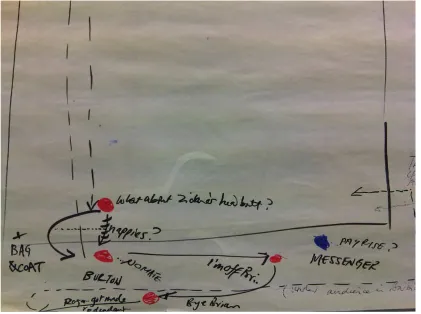
One of the most detailed sketches, Figure 5, involves an attempt to indicate a shift in character from Nigel Burton to Roger Jeffreys with a diamond placed around the usual red circle. A new name on a football shirt would have worked more clearly, perhaps. The character shift is also located with a letter: (a) Brian and Nigel; (b) Brian and Roger. The dotted line indicates a move without speaking and a bold line, a move while speaking. Reverse direction of movement is indicated by an ‘R’.

BRIAN: You don’t sound like a scouser

NIGEL: well you don’t sound like where you’re from

BRIAN: Rugby?

NIGEL becomes Roger

ROGER: Rugby? We don’t want to get messed up

with that - sport for hooligans–unlike football ..

sport for gentlemen – played by hooligans– that’s

what we need to crack -

ROGER: Are you married Brian?

BRIAN: Yes. No children yet.

ROGER: Oh good

(10)

ROGER: And you went to school in Rugby?

BRIAN: How do you know?

ROGER: Oh, it’s important to know who’s working

for you.

12

4. The scheme of Total Football

The play is an institutional critique of the British civil service and of recent British citizenship tests as well as a satire of male relationships, most often expressed through sporting activities and particularly rigidity in the British footballing imagination. Central to Ridiculusmus' production is the narrative of a non-sporty bureaucrat, Brian Messenger, working in the UK Department of Culture Media and Sport who is tasked with harnessing the enthusiasm of football fans in the interests of national cohesion, the emblem of which is to be a British Football Team.

ROGER: So who have we got?

BRIAN:

Well, him, him and him.

With each person a non-blinding spot comes onto

them in the auditorium

ROGER: And who are they?

BRIAN:

Sorry, and her.

ROGER: They are all white folk?

BRIAN:

Yes, yes, yes, yes.

ROGER: And you represent Britain, ok?

BRIAN:

Yes, they represent Britain.

ROGER: Ok – so try and get a heads up on what

you think are the greatest cultural

sporting, cultural sporting, historical

sporting, historical cultural sporting

moments in British history – could you

do that by next week?

The implication here is that in the interests of national success and of survival as civil servants, ‘outfield’ social engineers in the DCMS need to study the language and culture of sport and to cultivate national integrity and cohesion, just at the moment when national identities, bureaucratic efficiency and their own personal virility are waning.

(11)

They really were an amazing side. You only had to give them an idea; they added skills, movement and combinations all the time. They'd get into threes and fours without really knowing they were doing it. They were playing habit football after a time, and habit football was star football. They could find each other by instinct. They'd have a rhythm; go from the left side of the field to the right side of the field but make progress of thirty or forty yards as well. Keeping the ball all the time.' i.e. possession football (Winner, 2006:12)

Following totaalvoetbal all players must be comfortable and skilled in all positions in order to achieve the full potential of the team. In the performance the game is to keep possession of power, and Sir Roger Jeffreys does this by switching between an ambivalent attitude so as to veil his actual intention, and bombastic demands in order to get Messenger to take on his task. Messenger will need to understand football in order to fulfill this task, but the sport is alien to him. Messenger is required to be adaptable and to work alongside Jeffreys’

[image:11.595.91.507.399.714.2]

unpredictability. In fact, they both lose their jobs because their ambitions cannot ultimately be tied to the project of a national team. Ridiculumus tackle the inherent rigidity of the British class system through this metaphorical critique of the ‘4 4 2’ team formation. With its wasteful habit of long ball passes, the formation has proven vulnerable against continental versatility, just as a bureaucratic class that resists meritocracy will not withstand more imaginative social structures elsewhere in the world. Messenger’s objective is a matter of personal not national legacy: to improve his reproductive chances in an entirely different game, with his wife.

Figure 6: Sketch 6 - The Task. (Total Football pp6-9. Image 232)

(12)

motion around Messenger offers an indication of the dizzying effect on Messenger and of Jeffrey's manipulation.

ROGER: What do you know about firstly the

Olympics and secondly the sport of

football?

BRIAN:

Well um, I know the basics about the

Olympics, but I’m not a football fan, I

should tell you that.

ROGER: Yes. And what do you know, what’s your

idea of, or knowledge of football in the

Olympics?

BRIAN:

Well very little really. Does it usually

happen?

ROGER:

Okay, so …

BRIAN:

Is there, has there been football in the

Olympics before? Before now?

ROGER: Yes there has and I think what we’ll do

is, I’ll get you to go and do some

preliminary enquiries, um, gen yourself

up, gen yourself up on the wider area,

and get a sort of heads up on where this

is sitting

TIME JUMP

Capturing the Passion

ROGER: Okay? So what position are we in ?

BRIAN:

I’ve realized that there’s no point trying

to make myself passionate about

football because I’m never going to be.

So what I have to do is I have to forget

all that about trying to make myself

passionate about football because I’m

never going to be. (

Pause

) Did you get

that?

ROGER: Oh for Christ’s sake, Brian. We’ve got Sir

Alex Ferguson

coming in, and you’re

saying you can’t get passionate about a

sport that is the key to us capturing the

nation spirit

BRIAN:

I can’t –

(13)

BRIAN:

Oh, it

is

ok?

ROGER: And I need you now to say ‘that’s ok but

I

will

understand how

other

people

can

become passionate about it.’ Can you

say that please?

Pause

BRIAN:

No.

Interestingly it is Nigel Burton who is able to weave round this awkward clash between

Messenger and Jeffreys. Burton symbolizes the informal cash-in-hand entrepreneurialism that side-steps the class values of the bureaucracy. As Woods says

[image:13.595.91.506.359.671.2]

Nigel runs metaphorical rings around the tiered rigidity of Roger and Brian and Miguel as the representative of the zero hours cash in hand underclass hints of a fluidity to come - he is the free player - the true number ten - the Maradona, the Messi.14

Figure 7: Sketch 9 - Sir Alex (Total Football pp15-xx. Image 241)

(14)

ROGER (to A):

The um Scottish football

association, the Welsh FA and

Football Northern Ireland have

come to an agreement with

FIFA and they’re not going to

allow their players to be part of

the team. But they’re

negotiating a deal for only

English players to represent

Britain.

SIR ALEX:

Well then it’s not Britain, is it?

ROGER:

Well no it...they don’t want to

compromise their...(

stands up

with a brainwave

) I think it’s

actually rather a good outcome,

it’s not the outcome we

officially wanted but –

SIR ALEX:

We can’t call it Team GB then,

can we?

ROGER:

Well, we’re going to have to. It

is Team GB.

SIR ALEX:

It’s English. English team. (

he

throws the football boot at

Roger, who ducks. The boot hits

the wall and Roger picks it up

)

ROGER:

There won’t be any Scottish,

Welsh or Irish players - How do

you feel about that?

SIR ALEX:

I don’t feel right about it.

ROGER:

So who do you think we should

have in the squad?

SIR ALEX:

Not good at all.

ROGER:

.. under twenty-three and

English. Who are we going to

have? Anyone you want. Any

English player you want.

Bearing in mind now this is in

two years’ time. (Pause) Three

years’ time. (Pause) Three

years from now, so –

SIR ALEX:

(

boiling with rage

) I canna

remember their names.

(15)

good as it used to be. That’s

another reason I was thinking

maybe I should get out now.

5. Transcribing movement and dialogue

[image:15.595.92.507.329.639.2]

In Figure 7 the symbols used for editing are drawn on the line to indicate fast movement or reverse direction. Where phrases are written over lines and dots of movement, or objects such as the chair, the viewer reads the location from which the actor speaks. The text is located to indicate the way in which the text floats in space, or remains with the audience even though the actor and the piece moves on. In this way, as in Figure 6 (Image 232) above, the characters are visualized in the abstract. Where the phrase is broken up we get an impression of the way text accompanies bodies across the space. It is broken but linked with a string of dots just as a thought is extended, while a trajectory of movement is changed. A broken line also indicates a character in ‘minor’ (moving and not speaking) while another character is moving in 'major'. In other words, the broken line can indicate a preparatory or subordinate move. This is particularly the case in a scene exploring the notoriously elusive offside rule, Figure 8.

Figure 8: Sketch 12 - Some Numbers (Total Football p26-29, Image 249)

ROGER:

Well what I’ve always wanted to know,

Brian, is what this bloody offside rule is

all about. Can you explain it to me?

(16)

which means they’re off the side, isn’t

it? Something like that. (

He

demonstrates by jumping over the side

line stage left. He giggles. A deathly

pause

)

ROGER:

This isn’t a joke, you know. We’re all on

the line here. My career is hanging on

this, and yours.

BRIAN:

On the offside rule?

[image:16.595.90.511.313.627.2]

There is an additional phrase at the bottom of some sketches. Here it is used to indicate an analogy with a dramatic moment from a football match, not limited to play, but to the whole culture of buying, training, and promoting a team. For example: 'The new Star-Signing has to prove himself'; 'Half-time trying to keep warm'; ‘Sudden Death Penalty’, and suchlike. This operates like the title of a cartoon, to illustrate and inform the sketch. They also refer to notional scene-breaks in the draft script that are never seen by the audience.

Figure 9: Sketch 16 - Last Days of the DCMS (Total Football pp40-43. Image 260)

In Figure 9 (Image 260) the actions extends beyond the field of play and almost escapes the notation as action ‘falls’ off the stage/pitch. At this point in rehearsals some text was intended to be spoken from within the audience.

NIGEL:

[…] Bye, Brian.

(17)

whatsit without me.

NIGEL:

Are you being racialist? You think I’m a

piccaninni? It’s good to have met you

mate. Good to have worked with you

BRIAN:

What am I gonna do? I’ve got to ring

somebody – who? Who’s left?

NIGEL:

Good luck mate. No hard feelings. Did

you hear Roger Jeffreys got made

redundant?

Nigel becomes Miggy and appears with a furniture

removalists trolley and start taking away boxes to

the dump

BRIAN:

Fucking football. Shoulder feint.

(

Laughs

) Nutmegs. I’ve been

[image:17.595.95.508.355.668.2]

nutmegged.

Figure 10: Sketch 13:Nigel’s Breakfast (Total Football pp30-xx. Image 253) 6. Props, detail and complexity

(18)
[image:18.595.90.506.197.511.2]

operate like a storyboard sequence might do for a video-maker. If the notation becomes more descriptive its documentary role is greater. When the sketch or schema is more sparse and suggestive its dramaturgical role is clearer, as it functions like stage directions in a script. In stage directions one tends to hear the voice of the writer as a surrogate director, indicating not only what happens but also how it may happen on stage.

Figure 11: Sketch 8 - Core British Values. (Total Football pp11-12. Image 239)

ROGER:

What are the other five core British

values Brian?

BRIAN:

Well tolerance, decency, patience and

stiff upper lip.

ROGER:

That’s four isn’t it?

BRIAN:

Those are the ... the basic values.

ROGER:

How do they relate to the cardinal

virtues?

(19)

ROGER:

I’m not sure, but prudence ... courage,

and ... what did you say your four

were? Stiff upper lip –

[image:19.595.92.507.250.566.2]

When movement by one actor becomes very complex in one area of the stage the coloured circular symbol is no longer sufficient. In Figure 11 (Image 238/9) a sequence with a closely linked set of short moves are indicated by a stickman player in 9 poses, 6 of them numbered, the remaining 3 being variations on some of the numbered moves. These operate like close-up frames, and were a quick aide-memoir for the actor. Where the close close-up is insufficient, such as the drawing of a face, a signifier is needed: ‘lips’. Just as the detail of the sequence exceeds the scale of notation, the function of the sequence exceeds the dramatic conceit, becoming a meta-narrative, and meta-theatrical parody of theatre warm-ups. The stickman is a parodic approximation and so is the sequence, as Jeffreys is not an athlete or performer, rather, he is ‘just going through the moves’.

Figure 12: Sketch 12 - Beckham. (Total Football pp25-26. Image 247) 7. Notation and meta-theatre

In Figure 12 (Image 247) the sequence notates a play within a play, or a sequence as meta-sequence as Nigel Burton demonstrates David Beckham's infamous foul against Diego Simeone in the England-Argentina game in the 1998 World Cup. This incident was by popular accounts in retaliation for a foul by Simeone that had gone un-noticed by match officials. This moment in Total Football then is a vortex for the strength of popular nationalist feeling about the historical relationship between Argentina and England (see for instance the list of quotes about Beckham listed by the Daily Mail on his retirement, 16 May 201315). Beckham was sent off, reducing England’s chances of progressing to the semi-final. The demonstrative

emotional, Catholic family man, Miguel, in the play is Algerian but assumed to be Argentinian due to this history of the Southern foreign threat, and is the target of prejudice from

(20)
[image:20.595.91.510.180.415.2]

both by his nickname and by the test set by the UK Border Agency. A re-enactment of the foul is an excuse for Burton to kick Messenger, but also to reduce him to the order of a foreigner, through an act of repetition and re-enactment, in short, strategic theatrics. The notation draws the movement of Burton as he directs Messenger from within the scene. Messenger is disorientated again so Burton has to ask him to move, saying ‘backwards towards me’ a phrasing which only confuses Messenger further, and highlights the problem of the re-enactment's new co-ordinates in this new ‘pitch’, the DCMS office space (and, at a further remove, in the wider frame of the production, their repetition in a theatre space).

Figure 13: Burton (on the floor) fouls Messenger asBeckham’ fouls ‘Simeone’

BRIAN:

Do you want me to be Simioni

(sic)

?

NIGEL:

Yeah go on

BRIAN:

or I should be Beckham?

Nigel gets on floor

BRIAN:

Who are you?

NIGEL:

Simioni’s just walking back having

fouled me

BRIAN:

Who are you?

NIGEL:

I’m Beckham

BRIAN

(

walks across front of stage SL to SR

)

I’m like this? Walking back?

NIGEL:

Walk this way

(

illustrates with his hand

)

(21)

just clarifies what he’s meant to do

)

Walk towards you?

NIGEL:

Yeah

BRIAN:

(

clarifying further

) Walk away?

NIGEL:

Backwards towards me

B walks backwards to N

NIGEL:

Closer, closer, Miroslav Klose

N Kicks him, B falls in agony

NIGEL:

Yeah, you got it, yeah. And make a big

thing out of it.

(

Performance script, 2013

)

Underscoring the Physical Theatre credentials of the piece, the Herald newspaper sent their Dance Critic, Mary Brennan, who reported on a ‘fast-paced, wickedly astute comedy of mind games’ (Herald Scotland, 21 Mar 2013); while Joyce McMillan observed that ‘in just over an hour of hard-won physical theatre, this strange, courageous show lets us see exactly why [the characters are lost to themselves and almost suicidal]’(Scotsman, Mar 2013) 16

Befitting this theme of hubris the play ends with the collapse of the DCMS office and with a diminished physicality. Jeffrey’s project and Messenger’s hopes for a family are over and the pair are left in a desolate and gloomy space. They are fishing: a static sport. We can hear the sound of a busy road. The physical vigor of the piece has gone and the pair appear to be sharing a depressive post-match analysis. Such an obscure space can no longer be documented on the football diagram although Messenger’s vague gesture, reaching out to Jeffreys with his fishing rod, is perhaps the beginning of a new and beautiful game.

8. Future uses of sketchy notation

(22)
[image:22.595.90.426.70.323.2]

Figure 14: Football ManagerVideo Game Screenshot (TVG Media Ltd, 2012)

Bibliography

Alfreds, M (2007) Different Every Night: Freeing the Actor. London: Nick Hern Books. Barker, C (2010) Theatre Games: a new handbook for drama training. London: Methuen Drama.

Bogart, A & Landau, T (2006) The Viewpoints Book: A Practical Guide to Viewpoints and Composition. New York: Theatre Communications Group Inc.

Lecoq, J (2009) The Moving Body (Le Corps Poetique): Teaching Creative Theatre London: Methuen

Woods, D. & Haynes, J. (2012) Total Football. (London: Oberon Books)

Woods, D. & Haynes, J. Total Football. (Unpublished rehearsal scripts, 21 Nov 2010 & May 2013)

Winner, D (2001) Brilliant Orange: The Neurotic Genius of Dutch Football. London: Bloomsbury Publishing.

Fraser, S. From the Argentina red card to Goldenballs! The quotes which sum up the career of England legend Beckham Daily Mail Online http://www.dailymail.co.uk/sport/football/article-2325587/David-Beckham-The-quotes-sum-career-England-legend.html 16 May 2013

[Accessed 20 Aug 2013]

Hitchens, H. Evening Standard, 20th May 2011. http://www.ridiculusmus.com/shows/on-tour/total-football/ [Accessed 3 Aug 2013]

(23)

http://www.ridiculusmus.com/shows/on-tour/total-football/ [Accessed 3 Aug 2013]

Lepecki, A. ‘Exhausting Dance: Themes for a Politics of Movement in Live’ 121-127 In

Heathfield, A (2005) Live: Art & Performance London: Tate; see also (2005) Exhausting Dance: Performance and the Politics of Movement. London: Routledge.

Ridiculusmus. Company Website. www.ridiculusmus.com [Accessed 21 Aug 2013]

The Field of Play. The Football Association. 2012. http://www.thefa.com/football-rules-governance/laws/football-11-11/law-1---the-field-of-play.aspx. [Accessed 21 Aug 2013]

TVG Media Ltd. Football Manager Software.

http://www.totalvideogames.com/img/uploaded/www.totalvideogames.com_69194_Football_ Manager_2010-PCScreenshots17679Match_Analysis2A.jpg. [Accessed 21 Aug 2013]

Williams, R. ‘Pitch Invasion’ in The Guardian, 22 Sep 2006.

1Ridiculusmus is a performance company established over 20 years ago. Initially a loose

ensemble, now the productions are predominantly performed by David Woods and Jon Haynes. However, in keeping with the company's recent pattern of collective collaboration, occasional input was invited or accepted from a range of practitioners both on a formal basis and via ad hoc or spontaneous encounters. Having worked with the company on previous productions (The Exhibitionists (2002), How To Be Funny (2007) and Goodbye Princess (2009-10)) I was invited to a period of rehearsal and development in Glasgow at the National Theatre of Scotland, along with a freelance director and performer, Louise Bush. Other creative collaborators throughout the devising process (which spanned 2 years) include: Paul Bonglorno, Helen Chadwick, Paul Goddard, Rupert Jones, Renee Palmer, and Fiona Roake

2 Total Football was co-commissioned by the Barbican in association with Belfast Festival at

Queens, the National Theatre of Wales & the National Theatre of Scotland. The production premiered in May 2011, touring to festivals and venues across the UK from the Latitude Festival to Warwick Arts Centre to Cheshire Rural Touring, and most recently Stephen Joseph Theatre, Scarborough. Full touring details and critical responses can be found on the company’s website: http://www.ridiculusmus.com/shows/on-tour/total-football [Accessed 20 August 2013]

3The London Olympics was unquestionably a sporting success in terms of the medal tables,

and is popularly reported (in the BBC and by the government) as a success for British identity abroad. This is an achievement when one considers widespread cynicism about the games in the run up to the Games. The media and the London Organising Committee of the Olympic Games (LOCOG) seem to have achieved precisely the kind of effect that Ridiculusmus’ characters are straining to pull off. Nevertheless in the aftermath of the games the question of legacy has received critical attention and the actual impact may have been overstated (ref media investigation into legacy). The play continues to have satirical force as audiences recognise that this degree of success was achieved with an acknowledged amount of gamesmanship around the promotion and coverage of the games.

4Some movement sequences had already been determined by Haynes and Woods before

this development phase. For instance, the idea that Nigel Burton would present advertise a public seminar on A Celebration of Britain and that he would be joined by a character seated in the audience. The second page of the flip chart advertised the time of the performance so that Burton inadvertently appeared to be offering a more incisive and critical seminar: A Celebration of Britain Today .

(24)

than just contemporary or contemporary-ist – you

know its more than that its history its historirical …

So did you want to talk about?

5The term ‘Blocking’ is used variously in different systems of rehearsal from nineteenth

century musical theatre to versions of Naturalism in order to discuss the position of actors and the impact on the stage picture, its consequences for audience sightlines and so on.

Traditionally, the Stage Manager’s book is a record of the blocking location of actors and props.

6Aston, E & XX, G. Drama Queens Review http://dramaqueensreview.com/2012/11/16/total-football-ridiculusmus-touring/ [Accessed 8 August 2013]

7The ‘rabona’ involves kicking with the ‘wrong’ leg wrapping it around a rigid correct leg while

the Cruyff turn is named after the inventor of totaalvoebal.

8The relationship between performance and football can be seen in a documentary about

Zidane that takes movement as an aesthetic criterion. Zidane: A 21st Century Portrait (2006), made by the video artists Douglas Gordon and Philippe Parreno, fixes 17 camera lenses on a sole player, Zidane, and follows a balletic performance as he plays in the Spanish league for Madrid in 2005.

9Hitchens, H. Evening Standard, 20th May 2011; Hemming, S. Financial Times Review 20

May 2011.

10A detailed investigation of these methods is discussed in Woods unpublished PhD [Title] 11Aston, cited above.

12From the rehearsal script, November 2010. Other script citations are from the 2013

performance script unless indicated.

13Totalvoetbal was invented by Dutch football manager Rinu Smichels in partnership with

celebrated Captain Johan Cruyff for use by Ajax, an association football squad in the early 1970s. The strategy was expressed particularly through the innovation and speed in passing, demonstrated by Ajax Captain Johan Cruyff. Between 1971 and 1972 Ajax made effective use of this technique, at one point winning 46 games without defeat. (See Winner, 2001)

14David Woods private email 27 August 13 15See for instance Daily Mail 6 May 2013

16Scotsman Online March 2013

[http://www.scotsman.com/what-s-on/theatre-comedy-dance/theatre-reviews-april-in-paris-driving-manuel-1-2848209 [Accessed 3 August 2013]

Figure

Figure 1: Barclays Premier League Team of the Day (Observer Sport, 25 Aug 2013 p.4)
Figure 2: Football Association Law 1: The Field of Play
Figure 3: The Total Football Set
Figure 4: Sketch 1© - Dance Sequence (Total Football p1, Image 224. All images Ridiculusmus, 2010)
+7

References

Related documents

This study aims to describe the housing conditions and health status of a sample of people assisted by Caritas Barcelona (Spain) and living in inadequate housing and/or struggling

innovation in payment systems, in particular the infrastructure used to operate payment systems, in the interests of service-users 3.. to ensure that payment systems

Figure 2 indicates the representative chromatographic peaks of FFAs in the sediment samples in both seasons while the free fatty acid levels of the river sediments

Considering only women who received abortion care from public facility where there is shortage contraception supplies in study conducted in two of the region and failing to

It was decided that with the presence of such significant red flag signs that she should undergo advanced imaging, in this case an MRI, that revealed an underlying malignancy, which

Table 1 Effect of different growth regulators for callus formation of Hemidesmus indicus. 3.3

In order to test the stability of reconstituted suspensions, the samples were kept at three controlled temperatures, namely room, refrigerated and elevated (40ºC)

Field experiments were conducted at Ebonyi State University Research Farm during 2009 and 2010 farming seasons to evaluate the effect of intercropping maize with