a s s o ci a tio n r u l e s
R a m e z a ni, R, S a r a e e , M H a n d N e m a t b a k h s h , MA
T i t l e
M RAR : m i ni n g m u l ti-r e l a ti o n a s s o ci a ti o n r u l e s
A u t h o r s
R a m e z a n i, R, S a r a e e , M H a n d N e m a t b a k h s h , MA
Typ e
Ar ticl e
U RL
T hi s v e r si o n is a v ail a bl e a t :
h t t p :// u sir. s alfo r d . a c . u k /i d/ e p ri n t/ 4 2 5 0 4 /
P u b l i s h e d D a t e
2 0 1 4
U S IR is a d i gi t al c oll e c ti o n of t h e r e s e a r c h o u t p u t of t h e U n iv e r si ty of S alfo r d .
W h e r e c o p y ri g h t p e r m i t s , f ull t e x t m a t e r i al h el d i n t h e r e p o si t o r y is m a d e
f r e ely a v ail a bl e o nli n e a n d c a n b e r e a d , d o w nl o a d e d a n d c o pi e d fo r n o
n-c o m m e r n-ci al p r iv a t e s t u d y o r r e s e a r n-c h p u r p o s e s . Pl e a s e n-c h e n-c k t h e m a n u s n-c ri p t
fo r a n y f u r t h e r c o p y ri g h t r e s t r i c ti o n s .
Journal of Computing and Security
April 2014, Volume 1, Number 2 (pp. 133–158)
http://www.jcomsec.org
MRAR: Mining Multi-Relation Association Rules
Reza Ramezani
a,∗
Mohamad Saraee
aMohammad Ali Nematbakhsh
baElectrical & Computer Engineering, Isfahan University of Technology, Iran. bDepartment of Computer Engineering, University of Isfahan, Iran.
A R T I C L E I N F O.
Article history:
Received:23 December 2013
Revised:28 April 2014
Accepted:08 June 2014
Published Online:13 September 2014
Keywords:
Data Mining, Knowledge Discovery, Association Rules, Multi-Relation Association Rules, MRAR, Copulative Entity, Endpoint Entity, ItemChain
A B S T R A C T
In this paper, we introduce a new class of association rules (ARs) named “Multi-Relation Association Rules” which in contrast to primitive ARs (that are usually extracted from multi-relational databases), each rule item consists of one entity and several relations. These relations indicate indirect relationship between entities. Consider the following Multi-Relation Association Rule where the first item consists of three relationslive in,nearbyandhumid: “Those who live in a place which is near by a city with humid climate type and also are younger than 20 → their health condition is good”. A new algorithm called
MRAR is proposed to extract such rules from directed graphs with labeled edges which are constructed from RDBMSs or semantic web data. Also, the question“how to convert RDBMS data or semantic web data to a directed graph with labeled edges?” is answered. In order to evaluate the proposed algorithm, some experiments are performed on a sample dataset and also a real-world drug semantic web dataset. Obtained results confirm the ability of the proposed algorithm in mining Multi-Relation Association Rules.
c
2014 JComSec. All rights reserved.
1
Introduction
In KDD process, the problem of finding frequent pat-terns and association rules (ARs) has been studied in different settings. The association rules mining (ARM) problem has gained considerable interest among the researchers as one of the most important data mining components due to its usage in everyday life. One of the ARM goals is to find frequent patterns from exist-ing data. These patterns show what items occur more frequently with each other. Employing these patterns, the desired ARs would be generated. Each AR shows
∗ Corresponding author.
Email addresses:[email protected](R. Ramezani),
[email protected](M. Saraee),
[email protected](M.A. Nematbakhsh) ISSN: 2322-4460 c2014 JComSec. All rights reserved.
that if some items or events occur together, some other specific items or events will also occur with a certain probability which is known as confidence.
Each AR has one antecedent part and one conse-quent part where each part consists of one or more items. Current ARM algorithms generate primitive ARs consisting of only one entity and at most, one relation. For example the following rules are primitive rules:
• Apple,Tomato→Cucumber,{C = 0.78} • Buy(Apple),Buy(Tomato)→
Buy(Cucumber),{C = 0.78} • AgeYoungerThan(20),MaritalState(Single),
FatherSalaryMoreThan(2000$)→
GraduateInYears(4),{C = 0.78}
In these rules,italicwords are relations andbold
words and numbers are entities. The first and the sec-ond rules indicate that“Those who buy apple and buy tomato→they also buy cucumber, with probability of 78%”. The last rule indicates that: “Those who are younger than 20 and are bachelor and also their fa-thers’ salary is more than 2000$→they are graduated in 4 years, with probability of 78%”. There are 3 items in the antecedent part of this rule and there is only one in the consequent part with each item having only one relation. In this example,AgeYoungerThan(20) is an item andAgeYoungerThan,MaritalState, Father-SalaryMoreThanandGraduateInYears are relations of the entities “20”, “Bachelor”, “2000$” and “4” respectively.
In this paper, a novel algorithm is proposed to ex-tractMulti-Relation Association Rules from RDBMS and semantic web data. These rules are a new class of ARs with more than one relation in each item of each rule. These new rules allow discovering indirect relationships among entities. For example, consider the following rule:
• LiveIn(NearTo(ClimateType(Humid))),
AgeLessThan(20)→HealthCondition(Good), {C = 0.78}
This rule indicates that “Those who live in a place which is near to a city with humid climate type and also are younger than 20→they have a good health condition, with probability of 78%”. There are 3 rela-tions in the first item of the antecedent part of this rule. Details aboutMulti-Relation Association Rules
are addressed later in Section2.3.
To the best of our knowledge, this is the first paper that introduces this new class of ARs and proposes a new algorithm to solve the problem. The proposed algorithm receives a directed graph with labeled edges as input data (these labels differ to edge’s weight) and recursively traverses the graph to extract Multi-Relation Association Rules. The input graph is a spe-cial graph that the source vertices indicate entities, the destination vertices indicate other entities or
val-ues of an attribute of the source entity (source vertex), and each edge indicates a relation between two enti-ties or an attribute of the source entity. Any dataset convertible to this graph can be employed by the algo-rithm. Such data structure also makes it possible to extract ARs from heterogeneous data. Heterogeneous data, are those data that their entities (with same type or different types) can take different attributes. The input dataset could be heterogeneous semantic web data or existing data in relational databases that in both cases, data should be converted to a directed graph with labeled edges. In this paper these types of datasets and also how they are converted to directed graphs with labeled edges are discussed.
To clarify the task of converting RDBMS and seman-tic web data to a suitable directed graph with labeled edges and also the problem of miningMulti-Relation Association Rules, a simple and overt example will be shown. Finally, to evaluate the proposed algorithm behavior and also to prove its ability in mining Multi-Relation Association Rules, several experiments have been done on a real-world drugs dataset. The obtained results show the usefulness of the proposed algorithm and its ability in miningMulti-Relation Association Rules from datasets convertible to directed graphs with labeled edges.
The rest of the paper is organized as follows. Sec-tion 2briefly describes the concepts of association rules, semantic web andMulti-Relation Association Rules. Section3introduces a number of related work. Section 4 investigates two different kinds of input dataset, RDBMS and semantic web data, and shows how to convert them to a directed graph with labeled edges. Section 5 contains the general methodology and foundations of the proposed method addition to the related concepts and data structures. Section??
presents the proposed algorithms pseudo code in detail. Section7shows an example to clarify the proposed algorithm and the employed data structures concepts. Section8gives the experimental evaluations and de-scribes the obtained results and finally the Section9 concludes the paper and offers some future work.
2
Basic Concepts
This section briefly describesAssociation Rules, Se-mantic Web and Multi-Relation Association Rules
concepts which are related to our work.
2.1 Association Rules
co-occurred items, such as sold products, prescript biomedical drugs and etc. The problem of mining as-sociation rules was first introduced in 1993 [15]. Let us denote each item with Ii, thusI ={I1, I2, , Im} is set of all items which sometimes called the item base. Each transactionTiis a subset ofIand based on transactions we define database as collection of trans-actions denoted byD={T1, T2, , Tn}. Based on this definition each transaction contains only items and there is only one relation among items (e.g. bought together) and thus this relation is not shown in the transaction. Each itemset (S) is a non-empty subset ofIand an association rule (R) is a rule in the form of X → Y which both X and Y are itemsets and the relation among items is implicit. This rule means that if in a transaction the itemset X occurs, with certain probability the itemsetY will appears in the same transaction too. We call this probability as con-fidence and callX as rule antecedent andY as rule consequent.
• Support of an Item Set
The absolute support of the itemsetSis the number of transactions in D that contain S. Likewise, the relative support ofS is the fraction (or percentage) of the transactions inDwhich containS.
More formally, let S be an item set and U the collection of all transactions in D that contain all items inS. Then
Supabs(S) =|U|
Suprel(S) = (|U|/|D|)∗100%
For brevity we callSuprel(S) asSup(S).
• Confidence of an Association Rule
The confidence of an association ruleR=X →Y
is the support of the set of all items that appear in the rule divided by the support of the antecedent of the rule. That is,
Conf(R) = (Sup({X∪Y})/Sup(X))∗100%
Rules are reported as association rules if their confi-dence reaches or exceeds a given lower limit (minimum confidence, to be specified by a user).
• Support of an Association Rule
As mentioned in [15,16], the support of the rule is the (absolute or relative) number of cases in which the rule is correct. For example in the association rule
R: A, B→C, the support ofRis equal to support of{A, B, C}.
• Frequent Itemsets
Itemsets with greater support than a certain thresh-old, so-called minimum support are frequent itemsets. The goal of frequent itemset mining is to find all fre-quent itemsets.
• Maximal Itemsets
A frequent itemset is called maximal if no superset is frequent, that is, has a support exceeding the minimum support.
• Items structure
In this paper, if there is only one relation between items (such asbought together) each item is equal to an entity (such as beard, cheese and etc.), otherwise if there are different relations among items, each item not only is equal to an entity but also it is equal to an entity and one relation. Figure1shows two kinds of
Item Structure.
Entity Entity Relation
Item Structure
There is one type of relation There are multi types of relations
Item Structure
Figure 1. Item Structure
2.2 Semantic Web
Semantic web data is one of the employed data sources in this papers. Hence in this part some concepts of semantic web are described briefly.
The Semantic Web (or Web of Data), sometimes called the third generation of the Web, emerges in distinction to the traditional web of documents. The goal of the Semantic Web is to standardize web page formats so that the data becomes machine readable. This data is described by ontologies. A well-known definition by T.R.Gruber in 1995 is ”An ontology is an explicit specification of a conceptualization” [21]. The main purpose of the semantic web is to be machine readable so this feature needs to make entities mean-ingful and also describe entities by standard methods.
In order to describe entities, some means of entity representation and entity storing are needed. There are several methods for representing and storing semantic web data. The first method is RDF1 which is based on XML structure. XML is a powerful standard and also is flexible for transmitting structured data. In fact, the RDF documents are descriptions of semantic web data so this data becomes machine readable. Each RDF statement is a triple and each triple consists of three parts:subject,predicateandobject. Subjects and predicates are resources that are identified by URI.
Objects can be resources and shown by URI or can be constant values (literals) and represented as strings. In each triple, one relation or typed link exists between either two resources or between one resource and one literal. A similar concept to the URL is the IRI, which has been introduced to represent non-Latin text items in order to internationalize DBPedia [22].
RDFS is an extension of RDF which allows to define entities over classes, subclasses and properties. Hence it is possible to apply some inference rules on these RDFS structure entities.
Due to RDF and RDFS limitations the OWL2 has
been introduced which has more powers of deduction. OWL, which is based on DAML3 and OIL [23], is
the most well-known language that applies descrip-tion logic to the semantic web data. The first version of this language has three versions,OWL Lite,OWL DLandOWL Full, which differ in expressive ability and deductive power. This language also allows tran-sitive, symmetric, functional and cardinality relations between entities.
These three OWL flavors (Lite/DL/Full) are a bit old-fashioned. New profiles have been designed as OWL2 [24]. OWL 2 profiles are defined by placing restrictions on the structure of OWL 2 ontologies. Syn-tactic restrictions can be specified by modifying the grammar of the functional-style syntax and possibly giving additional global restrictions. OWL 2 has three subsets (EL, QL and RL).OWL 2 ELis particularly useful in applications employing ontologies that con-tain very large numbers of properties and/or classes and has polynomial time reasoning complexity with respect to the size of the ontology.OWL 2 QLis aimed at applications that use very large volumes of instance data, and where query answering is the most impor-tant reasoning task. This profile is designed to enable easier access and query to data stored in databases.
OWL 2 RLis aimed at applications that require scal-able reasoning without sacrificing too much expres-sive power. It is designed to accommodate OWL 2 applications that can trade the full expressivity of the language for efficiency, as well as RDF(S) applications that need some added expressivity.
As with traditional databases, which in order to re-trieve information, need an endpoint language (SQL), semantic web datasets need such a language too. For this purpose, the SPARQL4 [25, 26] language has
been introduced which is able to extract information and knowledge from semantic web datasets. DBPedia [27] is an example of a semantic web dataset. SPARQL
2 Ontology Web Language 3 http://www.daml.org/
4 http:// www.w3.org/TR/rdf-sparql-query/
can be used to express queries across diverse data sources, whether the data is stored natively as RDF or viewed as RDF via middleware. SPARQL has ca-pabilities for querying required and optional graph patterns along with their conjunctions and disjunc-tions. SPARQL also supports extensible queries based on RDF graphs. The results of SPARQL queries can be presented as result sets or RDF graphs.
In addition to RDF, semantic web data can be stored in different kinds of dataset formats, such as Turtle, Jason, NTriples, and etc. Regardless to dataset format, it is possible to extract data from datasets with different format and ontologies by SPARQL com-mands and convert the extracted data to a directed graph with labeled edges which is the standard input dataset of the proposed algorithm.
2.3 Multi-Relation Association Rules
As mentioned in Section 2.1, antecedent part and consequent part of ARs are constructed of itemset. Each itemset consists of one or more items. In the simplest form, each item contains only one entity and has no relation (in fact relations are implicit). These simple items are extracted from those datasets that has only one type relation among entities and thus this relation does not being put in items. For example consider a market basket analyze problem that there is only “buy together” relation among items. These data are usually stored in a table of relational databases. The following rule is a primitive AR that has been extracted from a supermarket data and has only one “buy together” relation that this relation is not shown
in the rule.
Bread,Cheese→Cucumber,{C = 0.78}
This rule indicates:“Those customers who buy Bread and Cheese, may also buy Cucumber with probability 78%”. In order to extractMulti-Relation Association Rules, this kind of data are not usable, since more than one type relation among items is required.
Humid
Tehran
Shiraz
Yazd
Kerman
Hasan
Reza
Good
IUT Ali
Ahmad
Saraee
Nematbakhsh
Mr A
Mr B
Project A
Project B
MIT
Live in
Live in Nearby
Nearby
Study in
Live in Supervised By
Supervised By Cooperator
Cooperator Work On
Work On
Pa
tr
onag
e
Kn
ow
s
Kn
ow
s
Live in
Kn
ow
s
Patronage
Isfahan
[image:6.595.111.491.81.264.2]Knows
Figure 2. An example of a directed graph with labeled edges
• AgeYoungerThan(20),MaritalState(Bachelor),
FatherSalaryMoreThan(2000$)→
GraduateInYears(4) ,{C = 0.78}
In the scientific societies, those rules that are ex-tracted from multiple tables (multiple relation in rela-tional databases) are referred to as “Multi Relational Association Rules” [28–31] and means “those rules that are extracted from multiple tables (multiple rela-tions)” not “those rules that have several relations in their items”.
Here we define “Multi-Relation Association Rules”
as “those rules that have more than one relation in at least one of their items”. For example in the following rule, there are three relations in the first item and means “those who live in a place which is near to a city with humid climate type and also are younger than 20, they have a good health condition, with probability of 78%”:
• LiveIn(NearTo (ClimateType(Humid))),
AgeLessThan(20)→HealthCondition(Good)
In this paper a new algorithm namedMRARhas been proposed to extractMulti-Relation Association Rulesfrom directed graphs with labeled edges. This graph is constructed from various data sources, such as RDBMS or semantic web data. In order to extract these rules, regardless to the type of input dataset, the input data should be converted to a directed graph with labeled edges in a way that source vertices in-dicate entities, destination vertices inin-dicate other en-tities or values of an attribute of the source entity (source vertex), and edges indicate relations between two entities or indicate an attribute of the source en-tity.
In order to clarify the problem, consider the pre-sented graph in Figure2.
Table1shows the meaning of Figure2entities.
Now we define“primitive rules” as those rules that have at most one relation in each item. By traversing and mining the graph presented in Figure2, these primitive rules would be extracted:
(1) Those whoLive in Isfahan →Study in IUT
too{Ali, Ahmad}
(2) Those whoStudy in IUT→areSupervised By
Saraeetoo{Ali, Ahmad}
In these primitive rules, each item has only one relation. Such asLive inandStudy in. In these rules,
italicwords indicate relations andboldwords indicate entities.
Consider the followingMulti-Relation Association Rules that have been extracted from the graph pre-sented in Figure2:
(3) Those who theirHealth Condition isGood→
theyLive In a placeNear by a city which its
Climate TypeisHumid{Hasan and Reza} (4) Those whoStudy inIUT→they areSupervised
Bya person who isCooperatorwith another per-son whoWorks ona project which itsPatronage
isMITUniversity.{Reza, Ali and Ahmad} (5) Those whoLive inIsfahan→they are
Super-vised By a person who isCooperator with an-other person whoWorks ona project which its
PatronageisMITUniversity.{Ali and Ahmad}
In these rules, there is more than one relation in at least one item.
And also if we add (Hasan Knows Ali) and (Reza
Knows Ahmad) to the graph presented in Figure2, the following rules would be generated too.
Table 1. Meaning of graph example entities
Entity Meaning
Tehran, Shiraz, Isfahan, Yazd, Kerman City
Reza, Nematbakhsh, Saraee, Hasan, Ali, Ahmad Person
IUT, MIT University
they Know people who are Supervised By a person who isCooperator with another person whoWorks ona project which itsPatronage is
MITUniversity.{Hasan and Reza}
(7) Those whoLive In a placeNearby a city which itsClimate TypeisHumid→theyKnow peo-ple who areSupervised By a person who is Co-operator with another person whoWorks on a project which itsPatronage isMITUniversity. {Hasan and Reza}
As rules #3 to #7 show, in at least one item, there is more than one relation. Also the rule #3 can be rewritten in this form:
• HealthCondition(Good)→
LiveIn(Near(ClimateType(Humid)))
In a similar way, the rule #7 can be rewritten in the below form:
• LiveIn(Near(ClimateType(Humid)))→
Know(SupervisedBy(Cooperator(
WorksOn(Patronage(MIT))))
3
Related Work
In the past years many machine-learning algorithms have been applied to traditional datasets successfully in order to discover useful and previously unknown knowledge and patterns. Although these machine learning algorithms are useful, in contrast to our pro-posed algorithm they are not able to extract ARs with multiple relations.
The ARM problem as first introduced in [15,32] has goal to find frequent itemsets and to generate primitive and simple ARs. Nowadays there are many ARM algorithms which can work with traditional datasets [33–35]. These algorithms are classified into two main categories: Apriori based [16,36] and FP-Tree based [18–20]. FP-Tree based approaches extract ARs from graph structured data by using frequent sub-graph and frequent sub-tree techniques [18,37]. The logic behind these algorithms is based on identifying repeated sub graphs in the entire graph. Although this is an interesting approach but it is not appropriate for our work, because these algorithms do not consider relations among entities and also in our proposed
scheme, each entity is not replicated in the entire graph more than once.
ARM problem has different settings. The most related work to our problem are categorized into three groups: multi-level ARM methods, several rela-tional database based methods and semantic web data based methods. Among these three settings, multi-level ARM is the most similar problem to the problem of MiningMulti-Relation Association Rules.
The problem of mining multi-level association rules was first introduced in [38]. Many studies on ARM find rules at single concept level. Mining association rules at multiple concept levels may lead to the dis-covery of more specific and concrete knowledge from data and often carry more specific and concrete in-formation than primitive ARs. Mining multi-level as-sociation rules uses concept hierarchies, also called taxonomies and defined as relations of type ’is-a’ be-tween objects, to extract rules whose items belong to different levels of abstraction. There are applications which need to find associations at multiple concept levels. For example, besides finding “80% of customers that purchasemilk, may also purchasebread”, it also could be informative to show that “75% of people buy
wheat breadif they buy2% milk”or even “75% of peo-ple buyDairyland 2% milk if they buyWonder wheat bread”. To discover multi-level association rules, one needs to provide data at multiple levels of abstraction, and also provide efficient methods for multiple-level rule mining. Figure3shows an example of items tax-onomy [38]. Hierarchy levels can be conceptual and attribute based or can be time/place based [39].
…
…
…
…
…
food
milk
2% chocolate white
Old Mills Wonder
[image:8.595.149.457.78.254.2]wheat bread
Figure 3. A taxonomy for the relevant data items [38]
at multiple concept level to extract level-crossing asso-ciation rules. This items hierarchy can also be used to extract multi-level association rules from previously generated primitive association rules [45].
Multi-level association rules are different to Multi-Relation Association Rules in the sense that in multi-level association rules, in rules’ items, there is only one relation but there are more than one entities that are derived from data hierarchy. Thus, the proposed algorithms for mining multi-level association rules are not applicable to miningMulti-Relation Association Rules.
Studies for AR discovery in Multi-Relational Data Mining [15, 46] are rooted in the field of Inductive Logic Programming (ILP) [47]. In ILP both relational data and relational patterns are expressed in first-order logic and the logical notions of generality first-order and of the downward/upward refinement operator on the space of patterns are used to define both the search space and the search strategy. WMRAR [28] and its variants [29] are the most popular approaches that use ILP to extract ARs. However, with larger search spaces and more complex evaluation of a single candidate pattern, these approaches are inherently computation-wise and thus efficient methods such as [48] could be used.
There are many other works on mining ARs from relational databases that are not rely on ILP. Some works use SQL commands to extract ARs [49]. In these work instead of frequent itemsets, frequent queries are used where a query support is the number of tu-ples that it returns [50]. Other works use other algo-rithms or use extended SQL to extract ARs [51,52]. Some improvements on query based ARM techniques have been proposed in [53,54]. In fact all these work hoard data from multiple relations (tables) by differ-ent queries and based on the relations among queries,
launch to discover ARs with at most one relation in each item. For example, the following rules are ex-tracted from a multi-relational database [28] (likes,
has andprefersare database tables):
• likes(KID, piglet), likes(KID, ice-cream) →
likes(KID, dolphin)
• likes(KID, A),has(KID, B)→prefers(KID, A,B) In many ARM researches, the researchers work on data with tabular structure. In [36,55,56] a number of methods have been introduced that receive data in graph structure and extract ARs from these data. Unfortunately, these works are not suitable for our problem since they find only maximal frequent item-sets instead of all frequent itemitem-sets and also, like other ARM algorithms, do not consider relations among en-tities and generate ARs with at most one relation in each item.
A transaction in a database typically consists of transaction identifier, customer identifier, transaction date (or transaction time), and the items purchased to-gether in the transaction. In semantic web data there is no exact definition of transactions and traditional ARM algorithms are not able to extract ARs from semantic web data directly. In [57], an algorithm has been introduced to extract association rules from se-mantic web data through mining patterns following an extended SPARQL syntax provided by the end user. In fact, this work converts semantic web data into traditional transactions and then employs traditional algorithms to extract primitive and simple ARs.
transaction items. Six different combinations of these values along with their usage are shown in Table2 [58]. For example, grouping triples by predicates and using objects for generating transactions has usage in clustering. This approach has two drawbacks. First, it extracts primitive and simple ARs notMulti-Relation Association Rules, and also it eliminates one part of triples parts and does not consider it in mining process.
Table 2. Combinations of triple parts [58]
Row Context Target Use Case
1 Subject Predicate Schema discovery
2 Subject Object Basket analysis
3 Predicate Subject Clustering
4 Predicate Object Range discovery
5 Object Subject Topical clustering
6 Object Predicate Schema matching
Linked Data is an effort to implement semantic web data. There are a number of methods to extract ARs from linked data [59,60]. The first one is based on transactions and extracts primitive ARs in a way that the items of the generated rules do not have any relation. The second one considers the input data as a directed graph with labeled edges and regardless to transactions concept, extracts primitive ARs in a way that the items of the generated rules consist of one entity and one relation.
All of the above work have a common feature: the generated rules do not have several relations in their items. To the best of our knowledge, this paper is the first work that introduce the problem of Multi-Relation Association Rulesand proposes an algorithm to solve it.
4
Data Sources
The proposed algorithm receives the required data as a directed graph with labeled edges like the presented graph in Figure2, in a way that vertices identify enti-ties or values and edges identify a relation between cor-responding vertices. It then extracts frequent itemsets by traversing the input graph recursively. The input dataset can be in different structures, such as rela-tional databases or heterogeneous semantic web data, which should be converted to the mentioned graph.
In this section, we will show how relational databases and semantic web data are converted to the required format of the proposed algorithm which is a directed graph with labeled edges. Next sections
present the proposed algorithms and related data structures.
4.1 Relational Databases
Relational database refers to those databases that data are distributed over several tables (schemes) and there are some relations among them.
We define a new concept named“Copulative Entity”
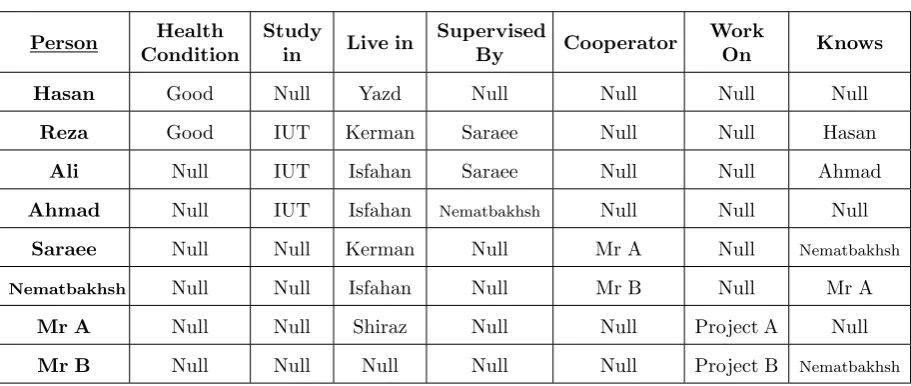
which refers to those entities which have edges in the input graph from some entities and also have edges to some other entities. In order to extractMulti-Relation Association Rules, the existence of such copulative entities is essential. In relational databases, copulative entities are those entities that are stored in a table and have primary key (independent entities) and also their key is used in other tables as foreign key of other entities. In our approach, each table describes at most one type of copulative entity (e.g. Persons) and the name of fields construct edges between the copulative entity and the value of the field. For example, in Table4 there are some information about“Kerman”and also in Table3“Kerman”is the value of attribute
Live in of entity “Reza”. In fact, “Kerman”is a primary key in Table4and a foreign key in Table3 and hence it is a copulative entity. As another example, in Table3which describes persons,“Nematbakhsh”
is a copulative entity, because it has a primary key and also its key is the foreign key of attributeKnows
of entity“Saraee”at the same table.
In the proposed algorithm, the existence of copula-tive entities is crucial. Because they act as median ver-tices (connector) between adjacent edges (relations) in the input graph and if they do not exist, mining
Multi-Relation Association Rules is impossible.
The process of converting a relational database to a directed graph with labeled edges is as simple as follows: first, for each copulative entity, a vertex is constructed. Afterwards, for each attribute of each copulative entity, an edge is made out from the corre-sponding vertex. Finally, the value of attribute con-structs the target vertex of the edge and the name of the attribute constructs the label of the edge. If the value of the attribute is a copulative entity (foreign key), the edge is connected to the vertex correspond-ing to that copulative entity.
Table 3. Example of persons
Person Health Condition
Study
in Live in
Supervised
By Cooperator
Work
On Knows
Hasan Good Null Yazd Null Null Null Null
Reza Good IUT Kerman Saraee Null Null Hasan
Ali Null IUT Isfahan Saraee Null Null Ahmad
Ahmad Null IUT Isfahan Nematbakhsh Null Null Null
Saraee Null Null Kerman Null Mr A Null Nematbakhsh
Nematbakhsh Null Null Isfahan Null Mr B Null Mr A
Mr A Null Null Shiraz Null Null Project A Null
Mr B Null Null Null Null Null Project B Nematbakhsh
Table 4. Example of cities
City Climate Type Near
Yazd Null Tehran
Kerman Null Shiraz
Tehran Humid Null
Shiraz Humid Null
Table 5. Example of projects
Project Patronage
Project A MIT
Project B MIT
Project B IUT
4.2 Semantic Web Data
As mentioned earlier in Section2.2, each instance of semantic web data would has asubject-predicate-object
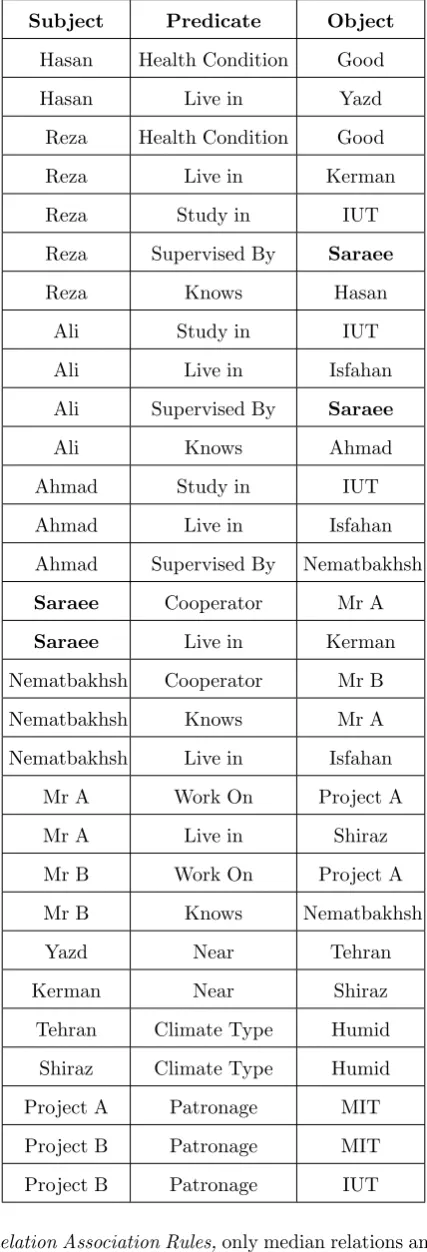
format. These data are stored in files with different syntaxes. Regardless to the syntax of semantic web data, they can be extracted by SPARQL commands and be shown in simplesubject-predicate-objectformat. Suppose the semantic web data of Table6which are in triple format.
In semantic web data, copulative entities are those entities that are laid in both subject and object parts, hence in this paper only those semantic web data are suitable to be used that some entities are appear in subjects of some triples and also in objects of some other triples too. For example, in the data presented in Table6“Saraee”is a copulative entity, because it is located in both subject and object parts.
The conversion of semantic web data to an appro-priate directed graph with labeled edges is very simple and straightforward. The subject and object parts of triples construct graph vertices and predicates con-struct graph edges to connect corresponding subject to corresponding object. The result of converting seman-tic web data presented in Table6to a directed graph with labeled edges, has been depicted in Figure2.
5
Methodology, Concepts and Data
Structures
In this section, the proposed methodology for solving the problem of mining Multi-Relation Association Rulesalong with related concepts and data structures are discussed in detail.
5.1 Problem Description
In this section, some details and concepts related to theMulti-Relation Association Rules are presented.
As rules #3 to #7 in Section2.3show, in Multi-Relation Association Rules onlymedian relations
andendpoint entities are shown andmedian en-tities are not shown.
For example, consider rule #3 which indicates
“Those who theirHealth Condition isGood→they
Live In a placeNear by a city which itsClimate Type
is Humid {Hasan and Reza}”. Figure 4 is a sub-graph of Figure2and also is the data source of rule #3. In Figure4,HumidandGoodareendpoint enti-ties;LiveIn,Near,ClimateTypeandHealthCondition
aremedian relations;Yazd,Tehran,Shirazand
Multi-Table 6. Example of semantic web data in triple format
Subject Predicate Object
Hasan Health Condition Good
Hasan Live in Yazd
Reza Health Condition Good
Reza Live in Kerman
Reza Study in IUT
Reza Supervised By Saraee
Reza Knows Hasan
Ali Study in IUT
Ali Live in Isfahan
Ali Supervised By Saraee
Ali Knows Ahmad
Ahmad Study in IUT
Ahmad Live in Isfahan
Ahmad Supervised By Nematbakhsh
Saraee Cooperator Mr A
Saraee Live in Kerman
Nematbakhsh Cooperator Mr B
Nematbakhsh Knows Mr A
Nematbakhsh Live in Isfahan
Mr A Work On Project A
Mr A Live in Shiraz
Mr B Work On Project A
Mr B Knows Nematbakhsh
Yazd Near Tehran
Kerman Near Shiraz
Tehran Climate Type Humid
Shiraz Climate Type Humid
Project A Patronage MIT
Project B Patronage MIT
Project B Patronage IUT
Relation Association Rules,only median relations and endpoint entities are shown and median entities are not shown. Hence in rule #3, entitiesYazd,Kerman,
TehranandShirazare not shown, because they are median entities and only endpoint entitiesHumid
andGoodalong with median relationsLiveIn,Near,
ClimateType andHealthCondition are shown.
• Rule #3:HealthCondition(Good)→
LiveIn(Near(ClimateType(Humid)))
In the proposed algorithms, endpoint entities differ to conventional sink entities. In each iteration of the main algorithm, endpoint entities change and are become the entities where the process of extracting
ItemChains is started from. As it will be stated later, the algorithm GenerateItemChains for each vertex is called only once. By calling GenerateItemChain
on a vertex, that vertex becomes an endpoint entity (vertex). For example, in graph Figure2even if an edge is made out from the entityHumidto the entity
IUT; by calling algorithm GenerateItemChain on entityHumid, this entity still remains as an endpoint entity even though it has a relation to another entity.
EachItemChain is a set of entities that are con-nected to an endpoint entity with common relations. Details of data structures will be discussed later.
5.2 Working Process
The proposed algorithm is in fact an extended version of Apriori algorithm which extractsMulti-Relation Association Rules from directed graphs with labeled edges. As mentioned earlier, in the proposed problem, there are different relations among entities that must be considered in the mining process. Also the input data are heterogeneous and there are no exact defini-tions of transacdefini-tions and hence the Apriori algorithm must be changed so that it does not need transactions and would also generate rules with several relations from heterogeneous data. For this purpose, the pro-posed algorithm regardless of the concept of transac-tions and by considering relatransac-tions among entities, after generatingItemChains generates2-Large ItemChains
and feeds them to the extended Apriori algorithm to generateLarger ItemChains. Finally,Multi-Relation Association Rulesare generated fromL-Large Item-Chains (L≥ 2).
Figure5shows the workflow of the mining Multi-Relation Association Rules process.
5.3 ItemChains
[image:11.595.64.278.99.726.2]Humid
Tehran
Shiraz
Yazd
Kerman
Hasan
Reza
Good
Live in
Live in Near
[image:12.595.100.501.82.146.2]Near
Figure 4. A sub-graph of the graph Figure 2
Graph*
Relational Database
Semantic Web Dataset
Other Data Sources
Deleting
Unfrequent Entities Converting To Numerical ID
Generating 2-Large
ItemsChains Generating L-Large ItemsChains (L ≥ 3)
Generating Multi-Relation Association Rules Data
Discretization
Multi-Relation Association Rules
Preprocess
Process
[image:12.595.90.512.202.344.2]MinSup, MinConf, MinLevel, Max Level
Figure 5. The Workflow of Mining Multi-Relation Association Rules
the endpoint entityHumidthrough relationsLiveIn,
NearandClimateType. EachItemChainincludes a list of connected entities (LOE), a list of median relations (LOR), an endpoint entity and the support value of the ItemChain. In fact, the concept ItemChain is equivalent to the concept Itemset in Apriori algorithm.
Figure6shows the structure ofItemChain. Consider rule #3 in Section 2.3 whose data source has been depicted in Figure4. The consequent part of this rule is anItemChain:
• “Those whoLiveIn a placeNear by a city which itsClimate TypeisHumid”{Hasan and Reza}
ThisItemChaincontains these parts:
• ChainID: a numerical ID for identifying Item-Chain. This number starts incrementally from 1. • List of Entities (LOE): a set of entities which are connected to the endpoint entity with com-mon relations (LOR). In the above example,
HasanandRezaare laid in this part.
• List of Relations (LOR): a set of relations which connect several entities (LOE) to the end-point entity. In above example,Live in,Nearand
Climate Typeare laid in this part.
• Endpoint Entity: identifies an endpoint entity which several entities (LOE) are indirectly con-nected to it through common relations (LOR). In above exampleHumidis an endpoint entity.
• Support: the frequency rate ofItemChain. That is what percent of entities are connected to the endpoint entity via LOR. This value is equivalent to the number of LOE part’s entities divided by the number of entire graph entities. In above example,Support= 2
19.
5.4 2-Large ItemChain
The second step of miningMulti-Relation Association Rules is to generate2-Large ItemChains from the extracted ItemChains. Two ItemChains that their LOE parts have many common entities are combined to generate a2-ItemChain. A2-ItemChain is large when the intersection count of LOE parts of its two
ItemChains is equal to or greater than the predefined minimum support value (MinSup) that means these twoItemChains are co-occurred abundantly.
In order to generate2-Large ItemChains, the pro-posed algorithm compares all extractedItemChains
Endpoint Entity List Of Relations (LOR)
[image:13.595.158.443.140.191.2]List Of Entities (LOE) Support ChainID
Figure 6. ItemChain Structure
Intersection Count Support ChainID ChainID … ChainID
List of ChainIDs (LOC)
Figure 7. Large ItemChaitn Structure
5.5 Larger ItemChains
Apriori algorithm generates a (L+1)-candidate itemset by combining two L-large itemsets that their L-1 first items are equal and then makes a candidate itemset with length L+1 [16]. A candidate itemset is large when its occurrence is equal to or greater thanMinSup
value.
In our approach, each L-Large ItemChain has L
ChainIDsin itsLOC part (see Figure7). In order to generate(L+1)-Large ItemChains, the proposed al-gorithm employs those twoL-Large ItemChains that their L-1 firstChainIDs of LOC parts are equal. For example suppose{1, 2}and{1, 3}are LOC parts of two2-Large ItemChains. Combining{1, 2}and{1, 3} results{1, 2, 3}as LOC part of a new3-ItemChains. If
ItemChains withChainID1, 2 and 3 have many com-mon entities in their LOE part, these threeItemChains
construct a new3-Large ItemChains. Also suppose{1, 2, 3}and{1, 2, 5}are LOC parts of two3-Large Item-Chains. Combining{1, 2, 3}and{1, 2, 5}results{1, 2, 3, 5}as LOC part of a new4-ItemChains. Similarly ifItemChainswithChainID1, 2, 3 and 5 have many common entities in their LOE part, these four Item-Chainsmake a new4-Large ItemChains. Inter bracket numbers indicateChainIDs in LOC part. Generating
larger ItemChains is continued until generating new
candidate ItemChains is not possible.
The image of an L-Large ItemChain (L ≥ 2) is depicted in Figure7
EachLarge ItemChainhas three parts:
• List of ChainIDs (LOC): ChainIDs of Item-Chainsthat have many common entities. • Intersection Count: the intersection count
of LOE parts of those ItemChains that their
ChainIDsare laid in theLOC part.
• Support: the frequency rate of thisLarge Item-Chainwhich is accounted by this formula:
Support= Intersection Count of LOE P arts
Entire Graph Entities Count
5.6 Association Rules
Finally the proposed algorithm generates Multi-Relation Association Rules by employing Large ItemChains. Each generated rule includes several
ItemChainand eachItemChain contains one or more relations in LOR part. The algorithm generates rules with only oneItemChain in the consequent part. The logic behind this work is that usually the number of generated rules is enormous, thus with only one item in the consequent part, this number would be reduced. Additionally when complex rules are gener-ated (rules with several items in the consequent part) it is hard to use them in the real world applications. Finally generated rules with confidence equal to or greater than predefined confidence value (MinConf) are marked asMulti-Relation Association Rules.
Multi-Relation Association Rulesare generated by usingLarge ItemChains in a way that oneChainID
of LOC part makes consequent part and the rest
ChainIDs make antecedent part of the rule. For each
Large ItemChain this process is repeated until each
ChainID is laid in the consequent part once.
Figure8shows the structure of a Multi-Relation Association Rule.
EachMulti-Relation Association Ruleconsists of these fields:
(1) Antecedent: list ofItemChains as antecedent (2) Consequent: anItemChainas consequent (3) RuleConfidence value
(4) RuleSupport value
Ruleconfidenceis equal to the intersection count of existing entities in the LOE parts of allItemChains
in the whole rule divided by the intersection count of existing entities in the LOE parts of allItemChains
Confidence ChainID
ChainID ChainID … ChainID
Antecedent Consequent
[image:14.595.110.491.102.162.2], , Support
Figure 8. Structure of a Multi-Relation Association Rule
Endpoint Entity (Vertex)
Relation (Edge) Relation (Edge)
… …
Inpu
t En
tit
ies
(V
er
tice
s)
Rel
at
ions (E
dg
es)
[image:14.595.112.478.213.378.2]List of Incoming Entities (Vertices) List of Incoming Entities (Vertices)
Figure 9. EntityInfo Structure
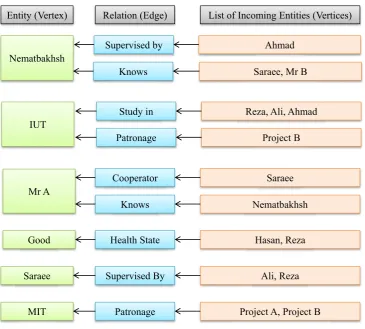
5.7 EntityInfo Data Structure
The simplest and the fastest way to retain the input graph (which is a directed graph with labeled edges) in main memory is to use cube (3D array) as data structure, in a way that the first dimension stores source vertices, the second dimension stores destina-tion vertices and the third dimension stores reladestina-tion between two vertices. Each entry value is 0 or 1. If the value of the(i,j,k)thentry is equal 1, that is there is a relation of typek from theith vertex to thejth
vertex. Although cube structure is too fast and easy to use, to retain such cube, a large memory space is required. The solution of this problem is to uselinked list as data structure. To store information about each entity (including relations and other entities that are connected to the entity), there is anEntityInfo struc-ture with these attributes:
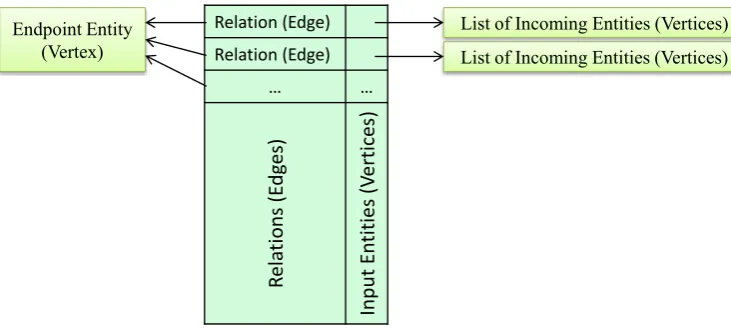
(1) EndpointEntity (Vertex): identifies an entity which is a vertex of graph.
(2) ALinked List that its entries have two parts: (a) Relations (Edges): identifies relations (edges) that are entered to the EndpointEn-tity.
(b) Input Entities (Vertices): pointer to a list of entities (vertices) which refer to the
EndpointEntity through corresponding re-lation (edge).
The image ofEntityInfo structure is depicted in Figure9.
By this data structure policy, in fact data are grouped based on destination vertices (endpoint enti-ties), because for each vertex of graph, the algorithm defines anEntityInfo instance and then specifies that based on each edge (relation), what other vertices (entities) refer to this vertex (endpoint entity). This grouping reason is to make the mining process faster, based on the proposed algorithm. Finally there is a linked list namedList EntityInfo that its entries refer only toLarge EntityInfo instances. AnEntityInfois large when the number of entities connected to it di-vided by the number of vertices in the input graph is more thanMinSup value.
5.8 MinLevel and MaxLevel
As mentioned earlier, the proposed algorithm is able to generateItemChainswith several relations in LOR part. To determine the number of relations, the algo-rithm receives the minimum and the maximum num-ber of relations in LOR part as input parameters. These parameters are namedMinLevel andMaxLevel
6
Algorithms
In this section, the proposed algorithms pseudo codes are described in detail. The name of the main pro-posed algorithm isMRAR(Multi-Relation Associ-ation Rules). The MRAR algorithm (Algorithm 1) calls three other sub-algorithms and its workflow is as follows: First, after constructing largeEntityInfo
instances, theGenerateItemChains algorithm (Al-gorithm2) is called to traverse the input graph re-cursively and generate all possibleItemChains. After-wards theGenerate2LargeItemChains algorithm (Algorithm 3) is invoked to generate 2-Large Item-Chains and feed them to theMRAR algorithm. Then the MRAR algorithm generatesLarger ItemChains
in a repetitive process. Finally theGenerateRules
algorithm (Algorithm4) is called to generate Multi-Relation Association Rules based on the generated
Large ItemChains. These algorithms are as follow:
6.1 Algorithm 1: MRAR
Algorithm MRAR is the main algorithm that after invoking GenerateItemChains and Gener-ate2LargeItemChains, generates Large ItemChains
and finally invokesGenerateRules to generate Multi-Relation Association Rules. The pseudo code of this algorithm is depicted in Algorithm1.
MRAR algorithm receives a dataset convertible to a directed graph with labeled edges, along with min-imum support and minmin-imum confidence values and minimum and maximum number of relations in Item-Chainsas input parameters. The pre-process step is done in lines 20 and 21. In pre-process, the input data are converted to appropriate graph andLarge EntityInfoinstances are constructed from the graph. AnEntityInfo is large when the number of entities connected to it divided by the number of vertices in the input graph is more than MinSup value. After pre-process, allItemChains are generated by Gener-ateItemChainsalgorithm. This algorithm starts its process from a vertex and an incoming edge of that vertex and discovers all entities that with common edges are directly or indirectly connected to that ver-tex. This vertex is calledEndpointEntity. This process is done in lines 22 to 26. After generating all Item-Chains, all2-Large ItemChains are generated by in-vokingGenerate2LargeItemChainsalgorithm in line 27. Then the loop between lines 29 to 45 gener-ates allLarge ItemChainsand this generation is con-tinued until generatingLarger ItemChains is impos-sible. In each run of this loop, allLarge ItemChains
withLChainIDsinLOC part are assessed and new candidateItemChainswithL+1 ChainIDsinLOC
part are generated. Each loop’s run (lines 32-36), uses previous loop’s run results which is stored inLLICs.
Lines 32 and 33 state that allLarge ItemChains with
LChainIDsinLOC part have to be compared two by two and this comparison is done in line 33. If twoLarge ItemChainswithLChainIDs inLOC part are com-binable (theirL-1firstChainIDsare equal), they are combined withCombineAndSortfunction generat-ing new candidateItemChainswithL+1 ChainIDsin
LOC part. After generating all candidateItemChains
withL+1 ChainIDsinLOC, in lines 38 to 43 allLarge ItemChainsare selected from candidateItemChains
collection and then added to theLarge ItemChains
collection (LLICs). Finally, line 44 adds generated
Large ItemChains withL+1 ChainIDsinLOC part to the collection of allLarge ItemChains(AllLICs). After generating all possibleLarge ItemChains, Multi-Relation Association Rulesare generated by invoking
GenerateRulesalgorithm in line 46.
6.2 Algorithm 2: GenerateItemChains
AlgorithmGenerateItemChains traverses the input graph recursively and generatesItemChains. This al-gorithm receives a vertex as endpoint entity and one of its incoming edges and then finds entities connected to the endpoint entity directly or indirectly with com-mon relations. If the number of relations from the en-tities to the endpoint entity is betweenMinLevel and
MaxLevel, the algorithm adds generatedItemChain
to theList ItemChains. This algorithm is depicted in Algorithm2.
GenerateItemChains generates ItemChains with the number of relations between MinLevel and
MaxLevel. This algorithm is invoked byMRAR algo-rithm and starts its process from a vertex of graph and one of its incoming relations. Parameter End-pointEntity indicates start vertex and parameter
Relations Parameter indicates one or more edges be-tween vertices in parameterEntities Parameter and theEndpointEntity. In line 16, all vertices that are connected to theEndpointEntity through relations in
Relations Parameter are extracted. In lines 17 and 19, it is determined if the current level is between valid levels and also the support value of connected vertices is equal to or greater thanMinSup value. If so, a newItemChainis generated in line 21. Lines 24 to 29 re-traverse the input graph to generate more
ItemChains. Line 24 assesses if the number of cur-rent relations (Level) is less than maximum possible relations (MaxLevel). If so, all incoming edges of the connected vertices are extracted in line 25 and unified byUnionIncomingEdgesOf function and thenGenerateItemChains algorithm is re-called by adding all of the extracted edges to the current rela-tions set. All generatedItemChains are retained in
Algorithm 1MRAR: Mining Multi-Relation Association Rules
1: functionMRAR(DS, MinSup, MinConf, MinLevel, MaxLevel) 2: Inputs
3: DS a dataset convertible to a directed graph with labeled edges
4: MinSup Minimum support value
5: MinConf Minimum confidence value
6: MinLevel,MaxLevel Minimum and maximum number of relations in each ItemChain
7: EndInputs
8: Outputs
9: AllLICs[] List of Large ItemChains
10: Rules[] Multi-Relation Association Rules
11: EndOutputs
12: Variables
13: LLICs[] List of Large ItemChains
14: Candidates[] Lists that maintain ChainIDs Set
15: CIS Set of ChainIDs
16: LIC1,LIC2 Large ItemChain
17: List EntityInfo[] List of large EntityInfo instances 18: List ItemChains[] Global list of ItemChains 19: EndVariables
20: convert input data to a directed graph with labeled edges
21: construct Large EntityInfo instances from the input graph and add to List EntityInfo
22: for all(EntityInfoinList EntityInfo)do
23: for all(Relation inEntityInfo.Relations)do
24: GenerateItemChains(EntityInfo.EndpointEntity,Relation,EntityInfo.EndpointEntity, 1)
addsItemChains toList ItemChains
25: end for
26: end for
27: LLICs =AllLICs =Generate2LargeItemChains(List ItemChains)
28: L = 1
29: repeat 30: L = L + 1
31: Candidates = null
32: for all(LIC1, LIC2 inLLICs)do
33: if (LIC1.LOC[1..L-1] = LIC2.LOC[1..L-1]) then
34: Candidates.Add(CombineAndSort(LIC1.LOC[1..L],LIC2.LOC[L]))
35: end if
36: end for
37: LLICs =null
38: for all(CIS inCandidates) do
39: Calculate IntersectionCount and Support of CIS
40: if (Support(CIS)≥ MinSup ANDall subsets of CIS areLarge)then
41: LLICs =LLICs ∪CIS
42: end if
43: end for
44: AllLICs=AllLICs∪LLICs 45: until (Candidates.Lenght=0) 46: Rules =GenerateRules(AllLICs) 47: returnAllLIC,Rules
Algorithm 2GenerateItemChains: generating ItemChains
1: functionGenerateItemChains(EndpointEntity, Relations Parameter[], Entities Parameter[], Level) 2: Inputs
3: EndpointEntity A vertex of graph which the algorithm starts search from it 4: Relations Parameter[] Common relations between several vertices and theEndpointEntity
5: Entities Parameter[] Vertices connected toEndpointEntitythroughRelations Parameter
6: Level Number of relations inItemChain, initially it is 1
7: EndInputs
8: Outputs
9: List ItemChains[] List of all ItemChains
10: EndOutputs
11: Variables
12: Entities Var[] List of entities
13: Relations Var[] List of relations
14: Support Support value of an ItemChain
15: EndVariables
16: Entities Var = List of vertices that are connected ToEndpointEntity throughRelations Parameter 17: if (Level ≥MinLevel ANDLevel ≤ MaxLevel)then
18: Support=Entities Var.Count÷Graph.NumberOfVertices 19: if (Support ≥ MinSup)then
20: ChainID =ChainID + 1
21: List ItemChains.Add(new ItemChain(ChainID,Entities Var,Relations Parameter, EndpointEn-tity,Support))
22: end if
23: end if
24: if (Level <MaxLevel)then
25: Relations Var=UnionIncomingEdgesOf(Entities Var)
26: for all(Relation inRelations Var)do
27: GenerateItemChains(EndpointEntity,Relations Parameter ∪Relation,Entities Var,Level + 1)
28: end for
29: end if 30: end function
Algorithm 3Generate2LargeItemChains: generating 2-Large ItemChains
1: functionGenerate2LargeItemChains(List ItemChains[])
2: Inputs
3: List ItemChains[] List of all ItemChains
4: EndInputs
5: Outputs
6: LLICs[] List of all Large ItemChains with two ChainIDs in LOC part
7: EndOutputs
8: Variables
9: IC1,IC2 ItemChain
10: LOE[] List of Entities
11: EndVariables
12: for all(IC1, IC2 inList ItemChains)do 13: LOE =Intersect(IC1.LOE,IC2.LOE)
14: Support=LOE.Length÷Graph.NumberOfVertices 15: if (Support≥MinSup)then
16: LLICs.Add(new LargeItemChain({IC1.ChainID∪IC2.ChainID},LOE.Length,Support))
17: end if
18: end for
19: returnLLICs
Algorithm 4GenerateRules: generating ARs by using Large ItemChains
1: functionGenerateRules(List LargeItemChains[]) 2: Inputs
3: List LargeItemChains[] List of all Large ItemChains 4: EndInputs
5: Outputs
6: Rules[] List of Multi-Relation Association Rules
7: EndOutputs
8: Variables
9: LIC Large ItemChain
10: Antecedent[] ItemChains that appear in the rule antecedent part
11: Consequent An ItemChain that appears in the rule consequent
12: EndVariables
13: for all(LIC inList LargeItemChains) do
14: for all(ChainID inLIC.ListofChainIDs)do
15: Consequent =ChainID
16: Antecedent =LIC.ListOfChainIDs –Consequent 17: Confidence=LIC.Support÷Support(Antecedent) 18: if (Confidence ≥MinConf)then
19: Rules.Add(new Rule(Antecedent,Consequent,Confidence,LIC.Support))
20: end if
21: end for
22: end for
23: returnRules
24: end function
6.3 Algorithm 3: Generate2LargeItemChains
AlgorithmGenerate2LargeItemChains traverses the
List ItemChains (allItemChains) and generates all possibleLarge ItemChainswith twoChainIDsin the
LOC part. These 2-Large ItemChains are then em-ployed by the MRAR algorithm to generateLarger ItemChains. This algorithm is depicted in Algorithm3.
This algorithm receives allItemChainsas the input parameter and then generates all possible 2-Large ItemChains. In line 12, allItemChains are traversed two by two. In line 13, an intersection is made from entities (LOE) of twoItemChains. This intersection returns the common entities of twoItemChains. If the number of common entities divided by the number of all entities is equal to or greater thanMinSupvalue, these twoItemChains generate a2-Large ItemChains. This algorithm is finished when allItemChains are compared to each other. After generating all2-Large ItemChains, theMRARalgorithm generatesL-Large ItemChains (L≥ 3) to be used for generating Multi-Relation Association Rules.
6.4 Algorithm 4: GenerateRules
AlgorithmGenerateRulesreceives allL-Large Item-Chains (L≥ 2) and generates candidate rules with only oneItemChainin the consequence part. If the con-fidence of a candidate rule is equal to or greater than
MinConf value, it is identified as a Multi-Relation
Association Rule. This algorithm is depicted in Algo-rithm4.
This algorithm receivesL-Large ItemChains (L≥ 2) as input parameter. In line 13, theLarge ItemChains
are selected one by one. In line 14, allChainIDsof the selectedLarge ItemChain are traversed. Lines 15 and 16 construct the antecedent and the consequent parts of a new candidate rule based on the selectedLarge ItemChain andChainID, and then line 17 calculates the confidence of this new candidate rule. Line 18 assesses the rule’s confidence. If the confidence value is equal to or greater thanMinConf value, then this candidate rule is strong and it is added to the strong rules collection in line 19. Notice that the algorithm puts only oneItem in the consequent part in line 15. Finally, all the generated strong rules are returned as
Multi-Relation Association Rules.
7
Example
Let us make an example to show how the proposed algorithms work and how the related data structures are filled by corresponding values during the mining process. In this example, the graph depicted in Figure2 is employed as data source.
7.1 Data Structure
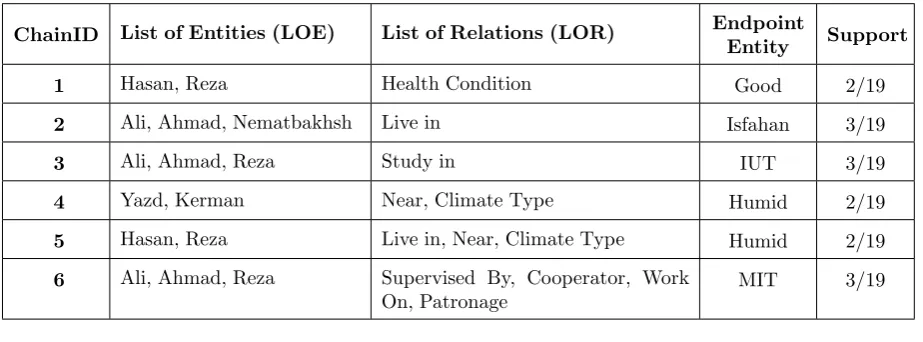
Table 7. Some generated ItemChains after traversing EntityInfo instances
ChainID List of Entities (LOE) List of Relations (LOR) Endpoint
Entity Support
1 Hasan, Reza Health Condition Good 2/19
2 Ali, Ahmad, Nematbakhsh Live in Isfahan 3/19
3 Ali, Ahmad, Reza Study in IUT 3/19
4 Yazd, Kerman Near, Climate Type Humid 2/19
5 Hasan, Reza Live in, Near, Climate Type Humid 2/19
6 Ali, Ahmad, Reza Supervised By, Cooperator, Work On, Patronage
MIT 3/19
• MinSup = 0.1
• MinConf = 0.7
• MinLevel = 1
• MaxLevel = 4
Before any computation on the input data, they should be discretized and infrequent entities should be eliminated. In this section, appropriate images of the used data structures are depicted.
After reading the contents of the input data source and converting them to a suitable graph, data struc-tures are filled by this policy: First, the software de-fines an EntityInfo instance for each vertex. After-wards, it groups the vertices connected to the vertex by the edges (relations). In other words, it indicates that based on each incoming edges of the vertex, what other vertices are connected to the vertex.
Figure10shows theEntityInfodata structure state after reading the content of the graph depicted in Figure2. In order to reduce the display space, some entities such as Hasan, Yazd, Kerman, Isfahan,
Ahmadand etc. have been eliminated from theEntity (Vertex)part of Figure10.
Other data structures are filled with corresponding data when the algorithm starts the mining process.
7.2 Algorithms
When theEntityInfoinstances are filled with the input data, theMRARalgorithm traverses them in a way that for eachEntityInfoinstance and for each relation of the instance,GenerateItemChains algorithm is invoked. This algorithm generatesItemChains with relations count betweenMinLevel toMaxLevel.
Table 7 shows some ItemChains that have been extracted from the graph presented in Figure2(some
ItemChainsare not shown).
After generatingItemChains,2-Large ItemChains
are generated byGenerate2LargeItemChains al-gorithm. This algorithm compares allItemChainstwo by two and calculates theirList of Entities (LOE)s
intersection count. Based on this count, the algorithm decides whether these twoItemChaincan make a 2-Large ItemChain or not. If so, theirChainIDs along with their intersection count and support value is added to theLarge ItemChains collection to generate
Larger ItemChains in next step.
For example, consider Table 7. If the algorithm comparesItemChainswithChainID1 and 2, since the intersection count of their entities ({Hasan, Reza}, {Ali, Ahmad, Nematbakhsh}) is zero, they are not identified as a2-Large ItemChain. ButItemChains
with ChainID 1 and 5, would generate a 2-Large ItemChain because the intersection count for their entities ({Hasan, Reza},{Hasan, Reza}) divided by the number of all entities is equal toMinSup value (their intersection result is{Hasan, Reza}and the
support value is 2/19 which is equal toMinSup).
Table8shows the2-Large ItemChainsthat can be extracted from Table7.
In order to generate3-Large ItemChains,MRAR
algorithm combines two by two those2-Large Item-Chainsthat the firstChainIDof theirList of ChainIDs (LOC)part are equal. If the number of common enti-ties of the combinedItemChainsis equal to or greater thanMinSup value and all subsets of the combined
ChainsIDsare large too, the combination is identified as a 3-Large ItemChains. In Table 8, the combina-tion of{2, 3}and{2, 6}, would generate a3-Large ItemChain, because the result of intersecting their en-tities parts (LOE) is{Ali, Ahmad}and its support is 2/19 that is equal toMinSupvalue.{2, 3, 6} con-stitute theLOC part of this new3-Large ItemChain. Consider that all subsets of{2, 3, 6}are large too.

![Figure 3. A taxonomy for the relevant data items [38]](https://thumb-us.123doks.com/thumbv2/123dok_us/8712242.882222/8.595.149.457.78.254/figure-taxonomy-relevant-data-items.webp)