International Journal of Emerging Technology and Advanced Engineering
Website: www.ijetae.com (ISSN 2250-2459, ISO 9001:2008 Certified Journal, Volume 6, Issue 10, October 2016)
228
Mixed-Mode Biquadratic Filter Using Only Two DVCC and
Grounded Passive Components
Chen-Nong Lee
Department of Computer and Communication Engineering, Taipei City University of Science and Technology, Taipei, Taiwan, R. O. C.
Abstract— This paper presents a new mixed-mode
(including voltage, current, transadmittance, and
transimpedance modes) biquad filter using only two differential voltage current conveyors (DVCCs), two grounded capacitors and three grounded resistors, which are the least number of active components and the minimum number of grounded passive components necessary for realizing current-mode (with high output impedance) and transimpedance modes all five universal filtering responses (lowpass, highpass, bandpass, notch, and allpass), in addition to high input impedance voltage-mode and fully cascadable transadmittance-mode highpass and bandpass filtering responses without changing the filter topology. This represents the attractive feature from chip area and power consumption point of view. Moreover, the proposed biquadratic filter still enjoys many advantages like having no need of components matching conditions, in addition to using only grounded passive components, no need of extra inverting or non-inverting amplifiers for special input signals, and low active and passive sensitivities. H-Spice simulation results confirm the theory.
Keywords—Active filters, differential voltage current conveyors (DVCCs), mixed-mode, biquadratic filter.
I. INTRODUCTION
Over the last decade, many voltage and/or current-mode current-conveyor-based biquadratic filters have been reported. In some applications, however, we may intend to connect the voltage-mode (VM) circuits with the current-mode (VM) circuits. Thus, the transimpedance-current-mode (TIM, i.e. input as current and output as voltage) and transadmittance-mode (TAM, i.e. input as voltage and output as current) may play a very important role in the special filtering applications where we need to connect a CM circuit with a VM circuit and vice versa. Therefore, the mixed-mode (including VM, CM, TAM, and TIM) circuits are worthy of researches and presented for the use of any filtering requirement which is compatible with modern microelectronic systems applications, such as controls and voice and data communications, where consideration of size and weight make the use of inductors prohibitive.
International Journal of Emerging Technology and Advanced Engineering
Website: www.ijetae.com (ISSN 2250-2459, ISO 9001:2008 Certified Journal, Volume 6, Issue 10, October 2016)
229
Only two mixed-mode (including VM, CM, TIM, and TAM) universal (not only multifunction) biquadratic filters which use only two current conveyors have been presented [35, 36]. In 2016, the very recently reported mixed-mode universal biquadratic filters using only two current conveyors and several passive elements can realize all five universal filtering functions in all four possible modes [35, 36]. The mixed-mode circuit, reported in [36], with no need of matching conditions, uses two fully differential current conveyor (FDCCII) as active elements. Another mixed-mode circuit, reported in [35], with versatile input/output functions and independent tunability, uses one FDCCII and one DDCC as active elements. However, the FDCCII has more complex implementation configuration than the DVCC. In 2013, a new current-mode and transresistance-mode (i.e. transimpedance-transresistance-mode) universal biquad filter was proposed [26]. Although the biquad filter [26] uses only two multiple-output CCIIs (MOCCIIs) in addition to two grounded capacitors and three grounded resistors, it can not be operated in VM and TAM. In 2013, the reported mixed-mode [28] biquad using only two voltage differencing transconductance amplifiers (VDTAs) and two grounded capacitors can realize all five universal filtering functions, but the biquad in [28] has not included CM and TIM. In 2014, the recently reported mixed-mode [29] biquads using three operational transconductance amplifiers (OTAs) and two grounded capacitors can realize all five universal filtering functions, but the biquad filter in [29] needs to use three active elements. Moreover, the biquad filter [29] only can be operated in TAM. In 2015, the new mixed-mode (including VM, CM, TAM, and TIM) biquadratic filter using only two second-generation current conveyors as active elements has been presented [32]. Although the biquad [32] is not universal filter for all four possible modes, it uses only two current conveyors with simple implementation configuration. This represents the attractive feature from chip area and power consumption point of view. However, the circuit in [32] needs to use floating resistors in filter structure.
Therefore, this leads to prospective research work: investigating and developing a mixed-mode (including VM, CM, TAM, and TIM) biquadratic filter structure using two current conveyors (with simple implementation configuration) and only grounded passive components.
In this paper, the proposed circuit using only two DVCC, two grounded capacitors, and three grounded resistors (all passive components grounded), which can be operated in all four possible modes (i.e. VM, CM, TAM, and TIM) and can realize CM and TIM all five universal filtering responses (lowpass, highpass, bandpass, notch, and allpass) in addition to VM and TAM highpass, bandpass filtering responses without changing the filter topology. The DVCC has simpler implementation configuration than some complex current conveyors, such as, FDCCII, differential difference current conveyor transconductance amplifier (DDCCTA), differential voltage current conveyor transconductance amplifier (DVCCTA), current controlled current conveyor transconductance amplifiers (CCCCTA), etc. For example, the use of a FDCCII can be divided into two separate DDCCs. Similarly, a DDCCTA (DVCCTA, CCCCTA) also can be produced by cascading a DDCC (DVCC, CCCII) with an OTA. Moreover, the proposed circuit still achieves many important advantages which are (i) using only two grounded capacitors at the Z terminals of the DVCCs (attractive for monolithic IC implementation and absorbing shunt parasitic capacitance), (ii) using two grounded resistors at the X terminals of the DVCCs (suitable for the variations of filter parameters and having no capacitors bringing extra poles degrading high-frequency performance), (iii) high output impedance for CM and TAM, (iv) high input impedance for VM and TAM, (v) no need of component matching conditions, (vi) no need of inverting-type input signals or double-type input signals for the use of special input signals, and (vii) low active and passive sensitivities.
II. PROPOSED CIRCUIT
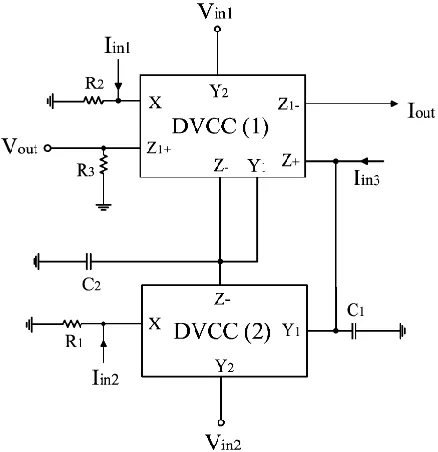
Figure 1 shows the proposed mixed-mode biquadratic filter structure using only two DVCCs, two grounded capacitors (attractive for integrated circuit implementation) and three grounded resistors (suitable for the adjustment of filter parameters) where Iin1, Iin2, Iin3 are the filter input
currents and Vin1, Vin2 are the filter input voltages whose
setting determine the filter functions as shown later, Iout and
Vout are the filter current output and voltage output,
respectively. Using standard notation, the port relations of a DVCC can be characterized by IY1 = IY2 = 0, VX = VY1 − VY2
International Journal of Emerging Technology and Advanced Engineering
Website: www.ijetae.com (ISSN 2250-2459, ISO 9001:2008 Certified Journal, Volume 6, Issue 10, October 2016)
230
The multiple current outputs of DVCC(1) can be simply reconstructed using current mirrors. Moreover, all voltage inputs have very high input impedance and the current output has very high output impedance. We notice that two grounded capacitors connected to the Z terminals of two DVCCs are attractive for absorbing shunt parasitic capacitance. Moreover, two grounded resistors connected to the X terminals of two DVCCs are suitable for absorbing series parasitic resistances (Rx) of two DVCCs as a part of
the main resistance. Because the X terminal of DVCCs has a series parasitic resistance (Rx), when the X terminal of
[image:3.612.59.278.327.553.2]DVCCs is connected to a capacitor, it leads to an improper transfer functions which do not exhibit good performance at high frequency [18]. Therefore, the proposed biquadratic filter has the advantage: no capacitors bringing extra poles degrading high-frequency performance.
Figure 1. Proposed mixed-mode biquadratic filter structure.
Routine circuit analysis for Figure 1 yields the following transfer functions:
) (
) ( ) (
3 2 1 2
s D G
s N s N G
Vout (1)
and
) (
) ( )
( 2
1 2
s D
s N s N G
Iout (2)
in which
2 1 1 1 2 1 2
1(s) s CCVin sCGVin
N (3)
3 2 1 2 2 1 1 2 1 2
2(s) s CC Iin sCG Iin GG Iin
N (4)
2 1 2 1 2 1 2
)
(s s CC sCG GG
D (5)
From Eqs. (1) - (5), the mixed-mode biquad filter transfer functions are obtained according to input voltage or current conditions as follows.
Part I: If Vin1 = Vin2 = 0, the following CM all five universal
filtering responses can be obtained from Iout as below.
(i) Non-inverting highpass: Iin1 = Iin, and all the other
input currents are zero.
(ii) Non-inverting lowpass: Iin3 = Iin, and all the other
input currents are zero.
(iii) Inverting bandpass: Iin2 = Iin, and all the other input
currents are zero.
(iv)Non-inverting notch: Iin1 = Iin3 = Iin, and the other
input current is zero.
(v) Non-inverting all-pass: Iin1 = Iin2 = Iin3 = Iin.
Part II: If Vin1 = Vin2 = 0, the following TIM all five
universal filtering responses can be obtained from Vout as
below.
(i) Inverting highpass: Iin1 = Iin, and all the other input
currents are zero.
(ii) Inverting lowpass: Iin3 = Iin, and all the other input
currents are zero.
(iii) Non-inverting bandpass: Iin2 = Iin, and all the other
input currents are zero.
(iv)Inverting notch: Iin1 = Iin3 = Iin, and the other input
current is zero.
(v) Inverting all-pass: Iin1 = Iin2 = Iin3 = Iin.
Part III: If Iin1 = Iin2 = Iin3 = 0, the following VM inverting
highpass and non-inverting bandpass filtering responses can be obtained from Vout as below.
(i) Inverting highpass: Vin1 = Vin, and the other input
voltage is zero.
(ii) Non-inverting bandpass: Vin2 = Vin, and the other input
voltage is zero.
Part IV: If Iin1 = Iin2 = Iin3 = 0, the following TAM
non-inverting highpass and non-inverting bandpass filtering responses can be obtained from Iout as below.
(i) Non-inverting highpass: Vin1 = Vin, and the other input
voltage is zero.
(ii) Inverting bandpass: Vin2 = Vin, and the other input
International Journal of Emerging Technology and Advanced Engineering
Website: www.ijetae.com (ISSN 2250-2459, ISO 9001:2008 Certified Journal, Volume 6, Issue 10, October 2016)
231
Note that there are no critical component-matching conditions or cancellation constraints in the design. Moreover, the structure does not need inverting-type input current signals or double-type amplifier and also does not need to change the network topology. Inspection of Eq. (5) shows that, in all cases the parameters ω0, ω0/Q, and Q are
given by 2 1 2 1 0 C C G G
(6)
2 2 0 C G Q (7) 2 1 1 2 G C G C
Q (8)
From Eqs. (6) and (7), the parameters ω0 and ω0/Q are
orthogonally adjustable through the resistor R2 and then the
resistor R1 in that order. From Eqs. (6) and (8), the
parameters ω0 and Q are interactive. However,
non-interactive filter parameter control can be obtained as follows: for the fix-valued capacitors, ω0 can be tuned
arbitrarily without disturbing Q by simultaneously changing G1 and G2 and keeping the ratio G1/G2 constant.
The parameter Q also can be adjusted without disturbing ω0
by simultaneously changing G2 and G1 and keeping the
product G1G2 constant.
III. NONIDEAL ANALYSIS
Taking the tracking errors of the DVCC into account, the relationship of the terminal voltages and currents can be written as: IY = 0, VX = β1(s)VY1 − β2(s)VY2, IZ± = ±α(s)IX,
where α(s) and β1(s), β2(s) represent the frequency transfer
functions of the internal current and voltage followers of the DVCC. They can be approximated by the first order lowpass functions [37, 38]. For frequencies much less than the corner frequencies of the DVCC, the α(s), β1(s), and
β2(s) are real quantities of magnitudes slightly less than one
[37, 38]. Assuming the circuit works at frequencies much less than the corner frequencies of α(s), β1(s), and β2(s)
namely, α(s) = α = 1-εi (εi << 1) denotes the current
tracking error of the DVCC and β1(s) = β1 = 1-εv1 (εv1 <<
1), β2(s) = β2 = 1-εv2 (εv2 << 1) denote the voltage tracking
error of the DVCC. Taking into account the non-idealities of the DVCC(1) and DVCC(2), we obtain the non-idealities as below: X Z X Z X Z X Z Y Y X Y I I I I I I I I V V V I 3 ) 1 ( 1 2 ) 1 ( 1 ) 1 ( 1 0 ) 1 ( 2 2 ) 1 ( 1 1 ) 1 ( , , , , , 0
for DVCC(1) (9)
X Z
Y Y
X
Y V V V I I
I 0, (2)1 1(2)2 2, (2)0
for DVCC(2) (10)
The non-ideal denominator of the mixed-mode transfer functions becomes: 1 ) 2 ( 1 ) 1 ( 0 ) 1 ( 0 ) 2 ( 2 1 1 ) 1 ( 2 ) 1 ( 2 1 2 1 2 )
(s s CC sCG GG
D
(11) The ω0 and Q of the non-ideal mixed-mode biquad are:
2 1 2 1 1 ) 1 ( 1 ) 2 ( 0 ) 1 ( 0 ) 2 ( 0 C C G G
(12)
1 2 1 ) 1 ( 2 1 1 ) 2 ( 0 ) 2 ( 0 ) 1 ( 2 ) 1 ( 1 C G C G Q
(13)
The active and passive sensitivities of ω0 and Q are:
2
1
0 1 ) 1 ( 1 ) 2 ( 0 ) 1 ( 0 ) 2 ( 0 2 1 0 21, , , , ,
S
S
S
G G C C2
1
1 ) 1 ( 1 ) 2 ( 0 ) 2 ( 0 ) 1 ( 2 1 12, , , ,
Q Q QG C Q
G
C
S
S
S
S
1
2 ) 1 (
QS
,
00
2 ) 2 ( 2 ) 1 ( 3 ) 1 ( 2 ) 1 ( 1 ) 1 ( , , , ,
S
0
2 ) 2 ( 2 ) 1 ( 3 ) 1 ( 1 ) 1 ( , , ,
QS
(14)
From Eq. (14), the proposed mixed-mode biquad filter has low active and passive sensitivities (not larger than unity in absolute value).
IV. H-SPICE SIMULATIONS
International Journal of Emerging Technology and Advanced Engineering
Website: www.ijetae.com (ISSN 2250-2459, ISO 9001:2008 Certified Journal, Volume 6, Issue 10, October 2016)
232
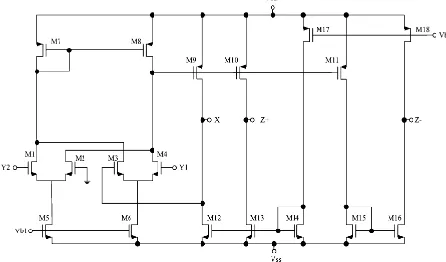
To verify the theoretical analysis of the proposed biquadratic filter, the H-SPICE simulations, using the TSMC 0.25μm process with the parameters of level 49 for the proposed mixed-mode circuit of Fig. 1, were performed with the component values: (i) C1 = C2 = 4pF and R1 = R2 =
R3 = 10kΩ, for the CM and TIM five universal filtering
responses, leading to a center frequency of f0 = 3.9789MHz
and quality factor of Q = 1, (ii) C1 = C2 = 4pF and R1 = R2
= R3 = 12kΩ, for the VM and TAM filtering responses,
leading to a center frequency of f0 = 3.3157MHz and
quality factor of Q = 1. Their supply voltages are VDD =-
Vss = 1.25V, Vb = 0.49V, and Vb1 = -0.41V. Fig. 3
presents the simulated CM and normalized TIM (with the normalized transimpedances magnitude = 20 log |Vout /
10000 Iin| dB due to R3 =10 kΩ) lowpass and highpass
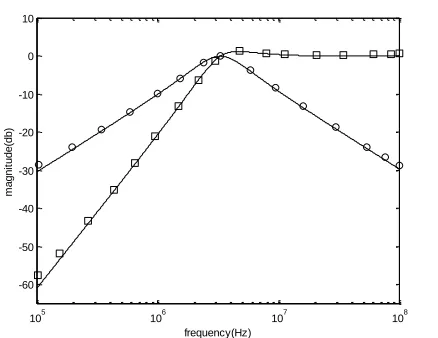
amplitude-frequency responses of the proposed mixed-mode biquadratic filter. Fig. 4 presents the simulated CM and normalized TIM (with the normalized transimpedances magnitude) bandpass and notch amplitude-frequency responses of the proposed mixed-mode biquadratic filter. Fig. 5 presents the simulated CM and normalized TIM (with the normalized transimpedances magnitude) allpass phase and amplitude-frequency responses of the proposed mixed-mode biquadratic filter. Fig. 6 presents the simulated VM and normalized TAM (with the normalized transadmittance magnitude = 20 log |12000Iout / Vin| dB due
to R3 =12 kΩ) bandpass and highpass amplitude-frequency
[image:5.612.333.559.144.305.2]responses of the proposed mixed-mode biquadratic filter. As can be seen, there is a close agreement between theory and simulation.
Figure 2. CMOS implementation of the DVCC.
105 106 107 108
-60 -50 -40 -30 -20 -10 0 10
frequency(Hz)
m
a
g
n
it
u
d
e
(d
b
)
Figure 3. CM and normalized TIM amplitude-frequency responses with highpass and lowpass signals of the proposed biquadratic filter (
□, simulated highpass; Δ, simulated lowpass; and ____,theoretical
curve ).
105 106 107 108
-60 -50 -40 -30 -20 -10 0 10
frequency(Hz)
m
a
g
n
it
u
d
e
(d
b
)
Figure 4. CM and normalized TIM amplitude-frequency responses with notch and bandpass signals of the proposed biquadratic filter
(○, simulated notch; □, simulated bandpass; and ____, theoretical
[image:5.612.332.541.351.519.2] [image:5.612.56.279.492.623.2]International Journal of Emerging Technology and Advanced Engineering
Website: www.ijetae.com (ISSN 2250-2459, ISO 9001:2008 Certified Journal, Volume 6, Issue 10, October 2016)
233
104 105 106 107
-400 -350 -300 -250 -200 -150 -100 -50 0 50 100
frequency(Hz)
p
h
a
s
e
(d
e
g
re
e
)
m
a
g
n
it
u
d
e
(d
b
)
10
5
0
-5
-10
-15
-20
-25
-30
-35
[image:6.612.62.282.144.307.2]-40
Figure 5. Phase-frequency and amplitude-frequency responses with CM and normalized TIM allpass signals of the proposed biquadratic
filter (○, simulated phase; □, simulated amplitude; and ——,
theoretical curve).
105 106 107 108
-60 -50 -40 -30 -20 -10 0 10
frequency(Hz)
m
a
g
n
it
u
d
e
(d
b
)
Figure 6. VM and normalized TAM amplitude-frequency responses with highpass and bandpass signals of the proposed biquadratic filter
(□, simulated highpass; ○, simulated bandpass; and ____, theoretical
curve ).
V. CONCLUSIONS
Only using two DVCCs (with simple implementation configuration), three grounded resistors, and two grounded capacitors (all passive components grounded), to design a mixed-mode biquadratic filter is presented in this paper, which can be operated in all four possible modes (i.e. VM, CM, TAM, and TIM) and can realize CM and TIM all five universal filtering responses (lowpass, highpass, bandpass, notch, and allpass) in addition to VM and TAM highpass, bandpass filtering responses without changing the filter topology.
Moreover, the proposed mixed-mode circuit still enjoys many main advantages: no component-value constraints, no inverting or non-inverting amplifiers for special input signals, no capacitors bringing extra poles degrading high-frequency performance, high input impedance VM, fully cascadable TAM, high output impedance CM, and low active and passive sensitivities. H-Spice simulations with TSMC 0.25μm process confirm the theoretical predictions.
Acknowledgements
The author would like to thank the Ministry of Science and Technology of Taiwan, R. O. C. The Ministry of Science and Technology, Taiwan, R. O. C. supported this work under grant number MOST 104-2221-E-149-001-.
REFERENCES
[1] M. T. Abuelma‘atti, A. Bentrcia, and S. M. Al-Shahrani, ―A novel mixed-mode current-conveyor-based filter,‖ Int. J. Electron., Vol. 91, No. 3, pp. 191-197, 2004.
[2] M. T. Abuelma‘atti and A. Bentrcia, ―A novel mixed-mode CCII-based filter‖, Active and Passive Electronic Components, Vol. 27, pp.197-205, 2004.
[3] V. K. Singh, A. K. Singh, D. R. Bhaskar, and R. Senani, ―Novel mixed-mode universal biquad configuration‖, IEICE Electron. Express, Vol. 2, No. 22, pp. 548-553, 2005.
[4] M. T. Abuelma‘atti and A. Bentrcia, ―A novel mixed-mode OTA-C universal filter,‖ Int. J. Electron., Vol. 92, No. 7, pp. 375-383, 2005. [5] N. A. Shah, and M. A. Malik, ―Multifunction mixed-mode filter
using FTFNs,‖ Analog Integrated Circuits and Signal Processing, Vol. 47, No. 3, pp. 339-343, 2006.
[6] C. M. Chang, C. N. Lee, C. L. Hou, J. W. Horng, and C. K. Tu, ―High-order DDCC-based general mixed-mode universal filter‖, IEE Proceedings Circuits, Devices and Systems, Vol. 153, No. 5, pp. 511-516, 2006.
[7] N. Pandey, S. K. Paul, A. Bhattacharyya, and S. B. Jain, ―A new mixed mode biquad using reduced number of active and passive elements‖, IEICE Electron. Express, Vol. 3, No. 6, pp. 115-121, 2006.
[8] C. N. Lee, C. M. Chang, C. L. Hou, and J. W. Horng, ―Cascadable multiple-mode universal biquad using fully grounded passive components‖, International Journal of Electrical Engineering, Vol. 14, No. 2, pp. 141-146, 2007.
[9] C. N. Lee, C. M. Chang, C. L. Hou, and J. W. Horng, ―Multiple-mode universal biquad filter using two DDCCs‖, International Journal of Electrical Engineering, Vol. 14, No. 4, pp. 291-298, 2007. [10] N. Pandey, S. K. Paul, A. Bhattacharyya, and S. B. Jain, ―Insensitive mixed mode biquad using reduced number of active and passive components‖, J. of Active and Passive Electronic Devices, Vol. 2, pp. 117-125, 2007.
[11] S. Minaei and M. A. Ibrahim, ―A mixed-mode KHN-biquad using DVCC and grounded passive elements suitable for direct cascading‖, International Journal of Circuit Theory and Applications, Vol. 37, No. 7, pp. 793-810, 2009.
[image:6.612.63.282.358.527.2]International Journal of Emerging Technology and Advanced Engineering
Website: www.ijetae.com (ISSN 2250-2459, ISO 9001:2008 Certified Journal, Volume 6, Issue 10, October 2016)
234
[13] C. N. Lee and C. M. Chang, ―Single FDCCII-based mixed-mode biquad filter with eight outputs‖ AEU-International Journal of Electronics and Communications, Vol. 63, No. 9, pp. 736-742, 2009. [14] L. Zhijun, ―Mixed-mode universal filter using MCCCII ‖ AEU-International Journal of Electronics and Communications, Vol. 63, No. 12, pp. 1072-1075, 2009.
[15] H. P. Chen, Y. Z. Liao, W. T. Lee, ―Tunable mixed-mode OTA-C universal filter‖ Analog Integr. Circuits Signal Process., Vol. 58, No. 2, pp. 135-141, 2009.
[16] N. A. Shah. and M. F. Rather, ―Electronically tunable
current-mode/mixed-mode/voltage-mode multifunction active-only
Biquads‖ J. of Active and Passive Electronic Devices, Vol. 4, No. 3, pp. 223-235, 2009.
[17] C. N. Lee, ―Multiple-mode OTA-C universal biquad filters‖, Circuits Systems and Signal Processing , Vol. 29, No. 2, pp. 263-274, 2010. [18] J. W. Horng, ―Current-mode and transimpedance-mode universal
biquadratic filter using multiple outputs CCIIs‖, Indian Journal of Engineering & Materials Sciences, Vol. 17(June), pp. 169-174, 2010.
[19] E. Yuce, ―Fully integrable mixed-mode universal biquad with specific application of the CFOA‖, AEU-International Journal of Electronics and Communications, Vol. 64, No. 4, pp. 304-309, 2010. [20] J. W. Horng, ―High-order current-mode and transimpedance-mode universal filters with multiple-inputs and two-outputs using MOCCIIs‖, Radioengineering, Vol. 18, No. 4, pp. 537–543, 2009. [21] E. Yuce and S. Tokat, ―Design and stability analysis of mixed-mode
filters containing only grounded capacitors‖, Journal of Circuits, Systems, and Computers, Vol. 19, No. 6, pp. 1345-1363, 2010. [22] C. N. Lee, ―Fully cascadable mixed-mode universal filter biquad
using DDCCs and grounded passive Components‖, Journal of Circuits Systems and Computers, Vol. 20, No. 4, pp. 607-620, 2011. [23] S. Maheshwari, S. V. Singh, and D. S. Chauhan, ―Electronically tunable low-voltage mixed-mode universal biquad filter‖, IET Circuits Devices & Systems, Vol. 5, No. 3, pp.148-158, 2011. [24] W. B. Liao and J. C. Gu, ―SIMO type universal mixed-mode
biquadratic filter‖, Indian Journal of Engineering & Materials Sciences, Vol. 18(December), pp. 443-448, 2011.
[25] C. N. Lee, ―High-order multiple-mode and transadmittance-mode OTA-C universal filters‖, Journal of Circuits Systems and Computers, Vol. 21, No. 5, pp. 1250048 (21 pages), 2012.
[26] C. N. Lee, ―Versatile universal current-mode and transresistance-mode biquadratic filter using two MOCCIIs and grounded passive components‖, Journal of Circuits Systems and Computers, Vol. 22, No. 1, pp. 1250077 (18 pages), 2013.
[27] N. Pandey and S. K. Paul, ―Mixed mode universal filter‖, Journal of Circuits Systems and Computers, Vol. 22, No. 1, pp. 1250064 (10 pages), 2013.
[28] Yeşil, A., Kaçar, F.: ‗Electronically tunable resistorless mixed mode biquad filters‘, Radioengineering, Vol. 22, No. 4, pp. 1016–1025, 2013.
[29] C. N. Lee, ―Versatile transadmittance-mode OTA-C universal biquad filter using minimum components with independently electronic tunability‖, Journal of Circuits Systems and Computers, Vol. 23, No. 7, 1450102 (18 pages), 2014.
[30] C. N. Lee, ―High-order CCII-based mixed-mode universal filter‖, International Journal of Emerging Technology and Advanced Engineering, Vol. 4, No. 8, pp. 32–38, 2014.
[31] K. Ghosh and B. N. Ray, ―CCII-based Nth-order mixed mode elliptic filter with grounded R and C ‖, Journal of Circuits Systems and Computers, Vol. 24, No. 3, 1550035 (17 pages), 2015.
[32] C. N. Lee, ―MISO type mixed-mode biquad filter using basic active elements‖, International Journal of Emerging Technology and Advanced Engineering, Vol. 5, No. 11, pp. 309–315, 2015. [33] D. Singh and N. Afzal, ―Fully digitally programmable generalized
mixed mode universal filter configuration‖, Circuits Systems and Signal Processing , Vol. 35, No. 5, pp. 1457-1480, 2016.
[34] D. Singh and N. Afzal, ―Digitally programmable mixed mode universal filter using followers-a minimal realization,‖ Analog Integrated Circuits and Signal Processing, Vol. 86, No. 2, pp. 289-298, 2016.
[35] C. N. Lee, ―Independently tunable mixed-mode universal biquad filter with versatile input/output functions‖ AEU-International Journal of Electronics and Communications, Vol. 70, No. 8, pp. 1006-1019, 2016.
[36] C. N. Lee, ―Mixed-mode universal biquadratic filter with no need of matching conditions‖, Journal of Circuits Systems and Computers, Vol. 25, No. 9, 1650106 (24 pages), 2016.
[37] A. Fabre, O. Saaid, and H. Barthelemy, ―On the frequency limitations of the circuits based on second generation current conveyors‖, Analog Integrated Circuits and Signal Processing Vol. 7, pp. 113-129, 1995.
[38] J. W. Horng, C. L. Hou, C. M. Chang, W. Y. Chung, and H. Y. Wei, ―Voltage-mode universal biquadratic filters with one input and five outputs using MOCCIIs‖, Computers and Electrical Engineering, Vol. 31, pp. 190-202, 2005.