Development of a soundscape simulator
tool
Bruce, NS, Davies, WJ and Adams, MD
Title Development of a soundscape simulator tool Authors Bruce, NS, Davies, WJ and Adams, MD
Type Conference or Workshop Item
URL This version is available at: http://usir.salford.ac.uk/2467/ Published Date 2009
USIR is a digital collection of the research output of the University of Salford. Where copyright permits, full text material held in the repository is made freely available online and can be read, downloaded and copied for noncommercial private study or research purposes. Please check the manuscript for any further copyright restrictions.
Development of a soundscape simulator tool
Neil S. Bruce
Acoustics Research Centre University of Salford
Greater Manchester, M5 4WT, UK Email. [email protected]
William J. Davies Mags D. Adams University of Salford
Greater Manchester, M5 4WT, UK
ABSTRACT
This paper discusses the development of an interactive soundscape simulator, enabling users to manipulate a series of parameters to investigate if there is group correlation between factors such as source selection, positioning and level. The basis of the simulator stems from fieldwork and recordings carried out in London and Manchester. Through the use of an enhanced version of soundwalking, respondents are led on a walk around an urban space focusing on the soundscape, whilst answering questions in a semi-structured interview. The data collected is then used to inform the ecological validity of the simulator. The laboratory based tests use simulations based on spaces recorded in a series of urban locations, as well as an ‘idealised’ soundscape simulation, featuring data from all recorded locations. The sound sources used are based on user highlighted selections from all locations, based on preferences extracted from soundwalk field data. Preliminary results show the simulator is effective in obtaining numerical data based on subjective choices as well as, effective qualitative data which provides an insight into the reasoning behind the respondents choices. This work forms part of the Positive Soundscape Project.
1. INTRODUCTION
The concept of ‘soundscape’ research is currently gaining importance within the acoustic community[1][2] and has resulted in a number of high profile projects, such as the Positive Soundscape Project. With the current focus on interdisciplinary collaboration in soundscape research[2][3], the development of new research methodologies to integrate qualitative and quantitative methods are required[3][4] . Recently, there has been a move away from traditional acoustic methods and measurements with regard to environmental sound issues and a focus on a more holistic approach to the sound environment[3], as popularised by Schafer. Existing soundscape studies have investigated subjective response to soundscapes using a number of techniques, including interview, rating scales and questionnaires in the field[8] and by the playback of field recordings in the laboratory[6].
principle method under demonstration in this paper. The aim of this research is to try and understand what constitutes the soundscape 'expectation', in particular the expectation of soundscape in urban spaces. The simulator is part of a combined qualitative and quantitative methodology which aims to determine the effects of expectation on the perception of the soundscape by a respondent. The simulator provides a tool by which the correlation between the designed parameters of a soundscape by individual or group can be studied and linked to real world experience and expectation. Dubois has investigated the individual and group experience of soundscapes based on representation shared in language and knowledge[7][8][9]. Through their work, they suggest a need for “accurate and reliable tools for measuring subjective experience of sounds before measuring physical parameters”[7]. Their work has provided a detail of semantic categories from questionnaire and interview methodologies, which are used as the basis of the simulator. This work hopes to provide a tool by which subjective experience can be measured effectively and correlate this experience to physical acoustical parameters.
Currently, there has been little work on investigating methodologies where respondents may design and control aspects of the soundscape. The development of a soundscape simulator aims to address these issues, as well as to create a tool from which field data can be used to test and design scenarios in a laboratory. Tracing the development of commercial tools and their availability has not been possible. An additional purpose for the development of this tool is to allow planners, architects and urban designers to test designs before developing them.
2. BACKGROUND
‘Soundscapes’ is a term attributed to R.Murray Schafer, in his well-cited work “The Tuning of the World”[3], to depict the acoustic environment. The issues surrounding interdisciplinary collaboration are highlighted by Schafer, who recognised that it is crucial for many branches of the sciences and the arts to come together and try and answer the question of soundscape design and appreciation. “The true acoustic designer must thoroughly understand the environment he is tackling; he must have training in acoustics, psychology, sociology, music and a great deal more besides, as the occasion demands.”[4] Schafer’s concepts are now being addressed by the acoustics community as a way to overcome problems surrounding current noise legislation. Raimbault and Dubois state that ‘most city regulations are insufficient’[8] focusing on noise levels and ‘neglecting human experiences’ of noise. They argue that ‘sound quality cannot be determined by a simple measurement (such as LAeq)’[8]. Southworth states that assessment of a
sound environment depends on the information content of the sound and the context in which it is perceived[12]. It is in getting a better understanding of information content and context, as well as acoustical data which is the problem to be addressed. Dubois’ work leads to the hypothesis that the soundscape accounts for the relationship between ‘individual experience and subjectivity with a physical and social-cultural context'.'[7]
soundwalking[13][15], provide a basis for the sound sources and locations used in the simulator, this data also informs the field recording process.
The simulator uses as a basis two semantic categories these are Background sounds and Event sounds[14]. These categories are very similar to those used a film soundtrack, ambient or background tracks and FX and Foley sounds[10][11]. These also relate to sound marks, sound events, sound objects and soundscape, suggested by Schafer[4]. The ambient track is a general track which is a baseline soundscape for a space, as such for an urban square would contain as few external/individual sounds as possible, the benefit of this method is to create an acoustic signature for a space. With a base line, additional event sounds can be added and removed to the base. There are some limitations with this method and these are discussed later. By utilising these two categories, the simulator provides a method by which the breaking down soundscape components for a given location and manipulating ambient v event elements and seeing the effect this has on preference and expectation. The use of the term location in this document refers to St Ann’s Square, Manchester.
3.SOUNDSCAPE SIMULATOR EXPERIMENTAL METHOD
There are two phases which make up the process flow in this methodology. The first phase involves collecting primarily qualitative from soundwalking and interviews, in the field. Although there is also collection of quantitative acoustic data including LAeq taking place at the same time. Analysis of the interview data highlights sound sources which need to be recorded for use in the simulator. At this point field recordings take place. Field recording also involves the recording of sound level measurements, these measurements allow the calibration on the simulator during the second phase
Using data collected from soundwalk interviews conducted in Manchester and London in 2008 and 2009, it was possible to extract the primary soundscape components for locations under test. Respondents’ answers were used to inform which sound sources would be included for manipulate them to measure the effect this has on preference and expectation. Numeric correlates such as level and frequency content can also be compared to see if these have any impact on the perception of the space.
The soundscape simulator presents the user with the ability to manipulate the soundscape via a panel of controls. They are able to change level and other acoustic parameters, as well as add and remove different sound sources. By utilising the soundscape simulator for a ‘location’ , it is possible to see if there is correlation between the parameters of a group and their expectation. The simulator allows research into the question of if it is possible to manipulate a ‘location’s’ preference by removing/adding characteristics of the audio spectrum, and different types of sounds.
A. Equipment
Behinger FCB-2000 controller for repondent manipuation Matlab for decoding the b-format ambisonic files. Playback takes place in either the Semi-anechoic chamber or listening room facilities at the University of Salford. Ambisonic recordings were made using the Soundfield microphone and Edirol R4 . Interviews were recorded using Zoom H2 hand-held recorder.
PHASE 1 - SOUNDWALKING AND FIELD RECORDING
The Schaferian notion of soundwalking is based on going on a silent walk, the timing of which can vary[4], during which time the individual must walk in silence observing the soundscape. The soundwalking method has been explored and trailed on a number of pilot and test studies[13][15]. Results showed that moving from a traditional Schaferian model, based on walking in silence for an hour or more and then having a discussion at the end was found to be less effective than a method involving regular stops where respondents were interviewed. The enhanced method involves stopping the group or individual after 10 to 15 minutes and then facilitating a discussion or interview. This enabled the individual to become more engaged with the process and refocus on the listening task presented, rather than walking for an hour unsure exactly what they were supposed to be doing.[15]
Field recording
Field recordings for the simulator involved recording specific sounds highlighted from soundwalk data, as well recording ambient background recordings with the minimal of activity to provide a base line.. The mono recordings were made as close as possible to the sound source to try as far as possible to isolate the sound from the background. Recordings were made in the locations visited in the soundwalks, the recordings were made not only through out the day to get the best ambience, but throughout the year to get a wide variety of sources.
Configuration of simulator
An Ambisonic reproduction system is used for the reproduction of soundscape field recordings made with the Soundfield ST-250 microphone, using a ‘pantophonic’ or horizontal ambisonic. This reproduction system allows the listener to experience the spaciousness, clarity and localization features of the recorded material. Two off the shelf computer based digital audio workstation (DAW) packages have been used for the simulator, these are Sonar 6.0 from Cakewalk for PC and Logic Studio for the Apple Mac, the purpose to allow the system to be used by other researchers on different platforms. The simulator requires a number of features which are standard in both these packages. These features are: playback of multiple channels of audio, the configuration of multiple speakers and the acceptance, recording and playback of midi automation parameters. All of these features are available in both packages, and therefore switching between them does not cause any issue, the configuration is performed in a similar manner in each. Another benefit is the implementation of a plug-in architecture.
A Behinger BCR-2000 Midi controller is used to manipulate the chosen parameters in the DAW. Midi (Musical Instrument Digital Interface) is an music technology industry-standard protocol defined in 1982[20]. This protocol enables a wide variety of musical instruments and computers to communicate and synchronise with one another. In particular for the soundscape simulator, it allow the DAW and controller to exchange midi event messages. These messages allow the control of almost any parameter on the DAW. In the case of the simulator, these parameters are volume, surround panning, sound selection (mute and solo), filter cut off and reverberation. The parameters are set by using the 'midi learn' or 'remote control' feature in the DAW, this process involves selecting the parameter on screen which needs to be controlled and right clicking to select the 'remote control' window. Clicking the 'Learn' button and then turning one of the controls on the controller surface, a midi message is sent to the DAW and a controller (CC number) ID is assigned to the parameter. Once the controller is assigned to a parameter, parameter data can be recorded as automation tracks within the DAW.
Experiment 1 - Sound Source Selection
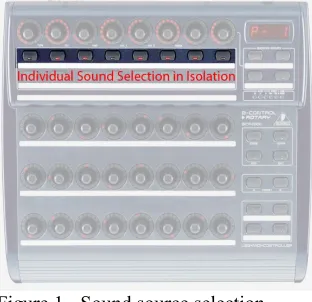
The first simulator experiment uses sound sources highlighted and recorded in the location being tested, each sound source can be listened to in context with the background ambient soundscape or isolation of the ambient soundscape. The respondent is able to select or deselect the sound source using the buttons on the controller highlighted (Figure 1). The following sound sources were used for St. Ann’s Square : Big Issue Seller call, Cleaning Machine, Bell from nearby Clock town, Feet, Loading rubbish, Passing car, Traffic light warning signal, Bird song (Pigeon – Sparrow – Wagtail mixed together) and acoustic Music (Pachabel’s Canon), The choice of the these sounds arrived from data extracted from respondents comments made during the soundwalking process, as sounds that were heard in the real location. Whilst some sources were not explicitly referred to by name but by a higher semantic descriptor, e.g. music or bird song, these sources were recorded in the location relevant to what was described.
[image:6.612.228.384.448.599.2]After listening to each of the individual sound sources, the respondent is asked if they wish to include or exclude the sound source from their soundscape simulation. The following questions are also presented at this point. 1)Why did you choose to include/exclude this sound? and 2)Would you expect this sound to be present in this location? There is a possibility the respondent will not know the actual location of the simulation, but will be given an outline of the location, e.g. Green square in London, with buildings on each side. These questions relate to the work undertaken on expectation, but this method can apply to any subjective data which is being studied.
Experiment 2 – Source Level Adjustment
Once the source sounds have been selected the respondent is asked to adjust the level of each sound source in relation to the 'ambient' track and to a level which they think is acceptable. There are two separate parts to this experiment, the first part includes only those sources selected in Experiment 1. These sound sources form the basis of sounds to be included in an ‘accepted’ soundscape. The second part includes all sound sources used in Experiment 1. In this experiment, the use of all sound sources is an attempt to investigate levels which respondents set for sources which may not ‘accepted’ in a space, but are actually present. The experimental methodology described below will be the same for both parts described above.
Firstly, the respondent is asked to adjust the overall global level of the ambient track using the controller. The initial global level presented to the respondent is calibrated to the dB(A) level recorded at the time the ambient recording was made. The calibration method will be applied to all sound sources. The calibration not only enable an investigation into the levels that respondents find acceptable for the ambience and each of the individual sound sources, but also the relation between levels acceptable for each of the sources. The respondent is able to adjust the overall global levels at any point during the experiment should they wish to. This data is recorded as automation data within the DAW and is analysed at the end of the experiment. This method allows for an accurate simulation of background to foreground sound level relationships, where the respondent may initially set a background level in isolation but wish to adjust these once additional sounds sources are added to the soundscape.
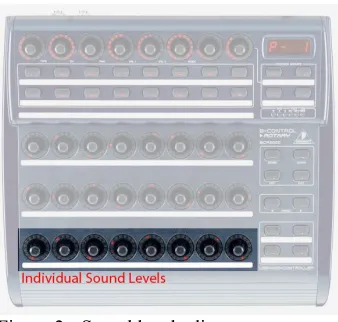
Secondly, the respondent listens to all the sound sources and adjusts the levels for the individual sources (as shown in Figure 2 - Individual sound source level selection). The material is looped as many times as it is necessary for the respondent to be satisfied with their levels.
Experiment 3 – Source Positioning
[image:7.612.222.391.70.231.2]This experiment investigates source positioning within the horizontal plane1. The respondent is asked to position each sound source in a 360° horizontal plane. As the sources are mono sources, the control parameters which are being manipulated are 'angle'(angular position from 0 to 360) and 'focus' (distance position from central point). These parameters are controllable for each sound source
Experiment 4 – Spaciousness
This experiment aims to examine the importance of perceived spaciousness on the soundscape. This method uses a convolution reverberation plug-in with a suitable impulse response for the simulated locations. The effect will be initially used in a simplified way to control, wet/dry mix of the signal and the amount of early reflections.
Experiment 5 – Low frequency cut-off
The aim of this experiment is to investigate the correlation between respondents acceptance of a soundscape and the removal of low frequencies from the soundscape.
RESULTS
Tests of the simulator during a pilot study showed that respondents felt that the ability to control and 'play' with the soundscape was hugely beneficial and enjoyable. Respondents presented with specific instructions on usage of the simulator felt that the ability to manipulate and play with the sounds, rather than follow the set instructions of processing one sound at at time, produced better results and was an educational experience. This method was useful in communicating the concept of soundscapes to respondents, in a fun and hands-on way.
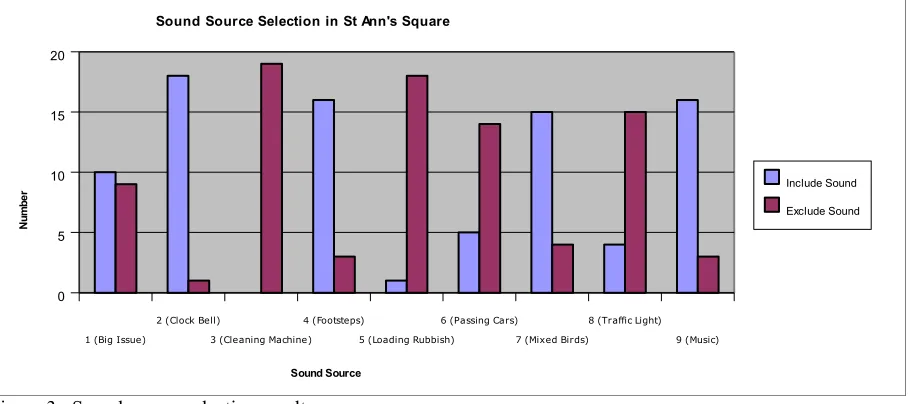
[image:8.612.78.533.329.531.2]Initial testing of the first experiment, produced the following results for inclusion and exclusion of sound sources. The response data was analysed and an average of source sources selected was collated. The answers to the second question on expectation were coded and analysed separately. With the exception of the street cleaner machine, which had 100% rejection rate, there is a general consensus for the major of sound sources, although the Big Issue seller was equally divided between the sample set, as can be seen in Figure 3 The questionnaire taken at the same time provided an insight into the subjective reasons behind the respondents choices. These answers begin to provide some understanding of why some features of the soundscape are tolerated in an urban square. For example, the presence of the Big Issue seller divided opinion, these ranged from a positive inclusion as it 'adds human elements' or a negative inclusion as it felt like 'harassment, is unwanted'. These subjective reasons are not related to the acoustic nature of the source, but a more social expectation, aligning with the ideas presented by Dubois[8]. This process allows provides a richness to the objective data and requires further investigation. This
Figure 3 : Sound source selection results
1 (Big Issue)
2 (Clock Bell)
3 (Cleaning Machine) 4 (Footsteps)
5 (Loading Rubbish) 6 (Passing Cars)
7 (Mixed Birds)
8 (Traffic Light) 9 (Music)
0 5 10 15 20
Sound Source Selection in St Ann's Square
Include Sound
Exclude Sound
Sound Source
N
um
be
method not only allows the researcher to look reasoning behind the design of the soundscape, but also numerical acoustical data and the influences this may have over choice and acceptence. At this point as the tests are still on going it is difficult to fully
Analysing the data has shown that the simulator can be used to obtain not only numerical data on subjective choices, but effective qualitative data which provides an insight into the reasoning behind the respondents choice. As experimentation is still in process at the time of writing, more detailed will presented at the time of the conference.
DISCUSSION AND LIMITATIONS
There are a number of limitations which need to be considered when discussing the future design of the simulator. It is obvious that there are not an infinite number of sources available for the user to choose from, although through soundwalking, the sounds actually being heard can be recorded and used in the simulator, although in a design process a much wider of city centre sounds would be required. The flexibility of a DAW to allow unlimited tracks (more than 999) [16], and the ability to add multiple controller, gives access to more sources than may actually be controllable by a respondent. The grouping of sources into to semantic groups, would be a way of tackling this[7], alternatively these groups could then be analysed on their own.
An issue with the source recordings, is fundamentally that a sound can not be recorded in total isolation of the background. This means that even with close recording, a sound will have some element of background present, the task of the recordist is to minimise this. There is also difficult in creating realistic outdoor reverberation for use in the convolution reverberation experiment, one method is to create an impulse response in the location, but logistically this has been difficult to achieve. Finally, the soundwalks interviews have highlighted that being immersed in the location is crucial in perception and the listening environment recreated in the laboratory is lacking in the multi-sensory real world perception it would seem affects the perception of the soundscape.
Further tests will use simulations based on Soho Square in London as well as an ‘idealised’ soundscape simulation. The ‘idealised’ soundscape simulation will use the same methodology as the ‘real’ simulations, but will use more sounds sources (sixteen instead of 8 in the first instance). By introducing a visual element, either as a video or photograph, the question of does a different soundscape produce a different meaning or expectation could be asked.
CONCLUSION
ACKNOWLEDGEMENTS
This work is carried through an EPSRC studentship funding (EP/E011624/1) as part of the Positive Soundscapes Project.
REFERENCES
[1] Schulte-Fortkamp, B. (2007). Soundscape : An approach to rely on human perception and expertise in the post-modern community noise era. Acoustics Today: 7-14.
[2] Davies, W. J., Adams, M., Bruce, N. S., Cain, R., Carlyle, A., Cusack, P., Hume, K. I., Jennings, P. J., & Plack, C. J. (2007, 2-7 September). The Positive Soundscape Project. Paper presented at the 19th International Conference on Acoustics, Madrid.
[3] Kull, R. C. (2006). "Natural and Urban Soundscapes : The Need for a Multi-Disciplinary Approach." Acta Acustica United with Acustica 92: 898-902.
[4] Schafer, R. M. The tuning of the world. (Alfred a. Knopf, Inc. New York, 1977)
[5] Schulte-Fortkamp, B. & Lercher, R, P. (2003) The Importance of Soundscape Research for the assessment of noise annoyance at the level of the community. TecniAcustica. Bilbao.
[6] Catherine Gustavino & Dubois, D. (2005) Ecological Validity of Soundscape Reproduction. Acta Acustica United with Acustica, 91, 333-341.
[7] Dubios D and Guastavino C (2006). In Search of soundscape indicators : Physical descriptions of semantic categories, Internoise 2006, Hawaii,
[8] Dubois D and Raimbault M, Urban Soundscapes : Experiences and knowledge, Cities The International Journal of Urban Policy and Planning Vol 22, No 5 p340
[9] Dubios et al, A cognitive approach to soundscape, Acta Acustica United with Acustica, Vol 92, 2006 p870 [10] Purcell, J. (2007). Dialogue Editing for motion pictures: (Focal Press, 2007)
[11] Yewdall, D.L,. Practical art of motion picture sound (2nd Edition). (Focal Press, 2003)
[12] Southworth, M. (1969). The sonic environment of cities. Environment and Behavior, 1(1), 49-70.
[13] Adams, M and Bruce, N (2008)– Soundwalking as methodology for understanding soundscape, IOA summer conference, Reading,.
[14] Guastavino, C. and D. Dubois (2006). From Language and Concepts to Acoustics : How do people cognitively process soundscapes? Internoise. Honolulu, Hawaii, USA.
[15] Bruce, N - Semio-acoustics, Soundscape, Meaning and Values, Lancaster Sociology Summer Conference,2008
[16] http://www.cakewalk.com/products/sonar/ Accessed April 2009
[17] http://www.steinberg.net/en/company/steinberg_technology/virtual_studio_technology.html ,Accessed April 2009
[18] http://msdn.microsoft.com/en-gb/directx/default.aspx Accessed April 2009 [19]
http://developer.apple.com/documentation/MusicAudio/Conceptual/AudioUnitProgrammingGuide/Introduction/ Introduction.html Accessed April 2009