The two pillars of design theory: Method
of analysis and rhetoric
Koskela, LJ and Ballard, G
Title
The two pillars of design theory: Method of analysis and rhetoric
Authors
Koskela, LJ and Ballard, G
Type
Conference or Workshop Item
URL
This version is available at: http://usir.salford.ac.uk/29455/
Published Date
2013
USIR is a digital collection of the research output of the University of Salford. Where copyright
permits, full text material held in the repository is made freely available online and can be read,
downloaded and copied for noncommercial private study or research purposes. Please check the
manuscript for any further copyright restrictions.
ICED13/498 1
INTERNATIONAL CONFERENCE ON ENGINEERING DESIGN, ICED13 19-22 AUGUST 2013, SUNGKYUNKWAN UNIVERSITY, SEOUL, KOREA
THE TWO PILLARS OF DESIGN THEORY: METHOD
OF ANALYSIS AND RHETORIC
Lauri Jaakko KOSKELA (1), Glenn BALLARD (2)
1: University of Salford, United Kingdom; 2: University of California Berkeley, United States of America
ABSTRACT
Since the 1960’s, there have been many initiatives for promoting theoretical understanding on design. However, in spite of definite progress, there are several puzzles and anomalies in the current theoretical landscape of design. We present an interpretation of the evolution of design theorizing that throws new light on these puzzles and anomalies. We contend that in the modern time, there have been two hidden inspirational sources for design theorizing, namely the method of analysis and rhetoric. As they concern different situations, their prescriptions in many ways differ. However, without explicit recourse to the sources, these mutually incompatible prescriptions, along with associated concepts and terms, have been mixed up in a confusing way. It is proposed that these two influences to design theory and practice have to be disentangled, to be able to act like two pillars supporting the phenomenon of designing. We hypothesize that actual design assignments require the mobilization of ideas and support from both pillars.
Keywords: design theory, design method, design process, method of analysis, rhetoric
Contact:
Prof. Lauri Jaakko Koskela University of Salford
School of the Built Environment Salford
M5 4WT United Kingdom
1 INTRODUCTION
Since the 1960’s, there have been many initiatives for promoting theoretical understanding of design. However, in spite of definite progress, there are several puzzles and anomalies in the current theoretical landscape of design that may hint of fundamental problems. One problem is related to esthetical qualities in design; they are not embraced by theories of engineering design. Another problem is provided by the central terms used: especially analysis and synthesis have several different definitions inside design science, and some of these are diametrically opposed to the use of these terms in other fields. A third problem is related to the scope of the phenomenon of design, especially whether the initial exploration of the design problem belongs to the field or not. A fourth problem concerns creativity, which has been very difficult to tackle in theorizing (Editorial board of IJDCI 2013): “…the design creativity and innovation discipline is very challenging; it attempts to explore a new field beyond the existing disciplines rather than bridge a gap between them.” Fifthly, there is the issue of historical discontinuity in design theorizing. Although art and architecture from Antiquity and the Middle Ages are much admired, the associated underlying theoretical notions were not taken as a starting point for design theorizing in the 1960’s. Here, we see a stark difference, say, to physics, where there has been a continuity of theoretical work at least since Aristotle.
In this paper, we present an interpretation of the evolution of design theorizing that throws new light on these puzzles and anomalies. We contend that in the modern time, there have been two hidden inspirational sources for design theorizing, namely rhetoric and the method of analysis. These two sources were explicit and influential for design in Antiquity and still in the Middle Ages. As they concern different situations, their prescriptions in many ways differ. However, without explicit recourse to the sources, these different prescriptions, along with associated concepts and terms, have been mixed up in a confusing way.
The paper is structured as follows. Next, the origins of design theorizing, namely the method of geometrical analysis and rhetoric, are discussed, along with their historical and current influences on design theory. Then the central differences between these origins are examined. After that, the puzzles and anomalies of design theory that become clarified through an explicit juxtaposition of rhetoric and the method of analysis are discussed. The paper ends with conclusions.
2 ORIGINS OF DESIGN THEORIZING
2.1 Method of analysis
In his Nicomachean Ethics, Aristotle suggests that when a person is deliberating towards an end, he reasons as he would when analyzing a geometrical construction. Granted that designing is a kind of ‘deliberating towards an end’, it can be inferred that Aristotle made an important theoretical statement, namely that design equals to, or at least is like certain types of reasoning, as exhibited in geometric analysis. This understanding of design (and making) as closely related to analysis and synthesis was known still in late Antiquity. Although this understanding was lost, and actually also the precise contents of analysis and synthesis were largely forgotten, the conception of design as logical reasoning has persisted as an undercurrent throughout history, to be the common assumption in current (engineering) design theories.
It is worth mentioning that the method of analysis has also otherwise had a major historical significance in providing starting points to Aristotle’s philosophy, to Descartes’ analytical geometry (leading to analysis in the sense of calculus), to Newton’s method of science as well as to Kant’s distinction between analytical and synthetical judgments (Hintikka & Remes 1974).
2.1.1 Core ideas of the method of analysis
3
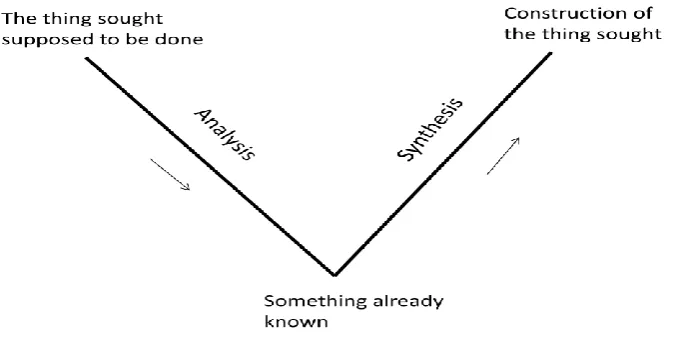
[image:4.595.130.468.147.319.2]This concise account, summarized in Figure 1, somewhat conceals the sophistication and richness of the method of analysis as it was actually practiced by Greek geometers. Through an interpretation of the account given by the Greek geometer Pappus, seven features of the method of analysis can be identified, concerning the types of analysis, its stages, its start and end points, the types of reasoning involved, the relation of the two directions of reasoning, the strategy of reasoning and the targeted outcomes (Koskela & al., forthcoming).
Figure 1. Simplified outline of the method of analysis.
2.1.2 Historical influences on design
In late Antiquity, Galen (1997) was able to explain the designing and making of sun dials through analysis and synthesis. He explained that the concept of time measurement using the sun, in terms of geometric lines, is found through analysis and synthesis. He divided the design and making into three stages, each of which was to be carried out through analysis and synthesis. Furthermore, for the demonstration of the correctness of the sundial, he presented three different methods (this relates to synthesis as proof). Galen’s account shows that Aristotle’s suggestion on the method of analysis as the method of designing and making was well understood and applied several centuries after his time.
2.1.3 Connections between the method of analysis and engineering design
Although not much direct influence can be shown to have occurred, many design theories and methods developed during the last 50 years largely embody or expand the seven features of the method of analysis (Koskela & al. forthcoming), as outlined in Table 1. Due to space restrictions in this presentation, it is not possible to go into details, which can be found in the mentioned source.
Table 1. The features of the method of analysis and their counterparts in current design theories and methods (Koskela & al. forthcoming). The term “counterpart” refers to methods or theories which, based on similarity or analogue, can be argued to embody or expand a certain feature of the method of analysis.
Features of geometric analysis Embodied in current methods Expanded in current methods
Two types of analysis Problem oriented and solution oriented approaches
Synthesis-analysis models
Two stages of analysis Distinction between conceptual design and embodiment/detail design
Morphological analysis; parameter analysis
Difference between start and end point
Future perfect approach C-K theory
Three types of reasoning
Regression Quality Function Deployment Decomposition Product Breakdown Structure Transformation TRIZ
Unity of the two directions Vee model
Strategy of reasoning Axiomatic design
[image:4.595.65.537.585.755.2]2.2 Rhetoric
Rhetoric emerged as an art of persuasion through speech, first, in early Antiquity, in relation to defendants’ speeches in courts of law, being then generalized to other types of speeches. From early on, there has also been a tendency to expand the scope of rhetoric to cover other types of expression, especially writing, painting, music, sculpture and architecture. Rhetoric evolved into a mature art in the heyday of the ancient Greek civilization, was further developed and applied during the period of the Roman Empire, and survived through the Renaissance up to the early modern period. During Enlightenment, rhetoric was redefined and reduced to a narrow body of knowledge on presentation. In the last fifty years or so, there have been initiatives to revive rhetoric as an influential science, notably by Perelman (1982).
For discussing the application of rhetoric to design, it is necessary to outline the process of creating a persuasive speech, as prescribed by the classical rhetorical literature (for example, Cicero 2006).
2.2.1 Core ideas of classical rhetoric
The intended persuasion was to be achieved through three different means: rational argumentation (logos), moral argumentation (ethos) and influencing the feelings of the audience (pathos). According to Cicero, rational argumentation had to be the explicit contents of a speech, other forms of influencing having to be implicit, like blood in the vessels: critically important but not visible. The preparation of a speech is divided into five stages – for clarity and avoiding the later connotations of the corresponding English terms, the original Latin names are used: inventio, dispositio, elocutio, memoria, actio. Inventio (invention) concerns finding and discovering the topics of a speech. Three main considerations play a role. First, what is the nature of the case; what has happened, was it legal, etc. Second, what is the nature of the audience; which are its knowledge and opinions. Thirdly, based on the two former, the rhetor decides on his intentions regarding persuasion. For finding suitable topics in view of these considerations, the rhetorical manuals provided guidelines on topos, places from which ingredients of speech can be found.
Dispositio (arrangement) is about organizing the topics into a speech. Different rules were given, related to the relative importance of each topic, the nature of the case, and others. Also the contextual factors, case, audience and intention, play a role here.
Elocutio (style) refers to different rhetorical methods and devices by means of which the topics were to be delivered. These ranged from well defined patterns of argumentation (as treated, for example, by Aristotle), to different types of humoristic elements (as presented, for example, by Cicero).
Memoria (memory) as a stage is related to the fact that in Antiquity, speeches were mostly delivered from memory. The mnemonic technique of connecting topics to places, say, of a building well known to the rhetor was commonly proposed.
Actio (delivery) refers to the use of gestures, face expression, voice and similar during the delivery of the speech.
Although these stages seem to form a logically advancing sequence, the frequently presented requirement for flexibility (Frost 2005) suggests that moving back and forth between stages was not shunned.
2.2.2 Historical influences on arts and design
The discipline of rhetoric has had deep influences on arts and design during its history (Vickers 1988). By way of illustration of this, the cases of Vasari and Repin are examined.
In his book on the lives of great painters, sculptors and architects, originally published in 1550, Vasari (1998) defines the criteria through which paintings should be evaluated as follows:
1. Disegno, good design 2. Natura, imitation of nature 3. Grazia, grace
4. Decoro, artistic decorum
5. Maniera, style of an individual painter or group of artists
5
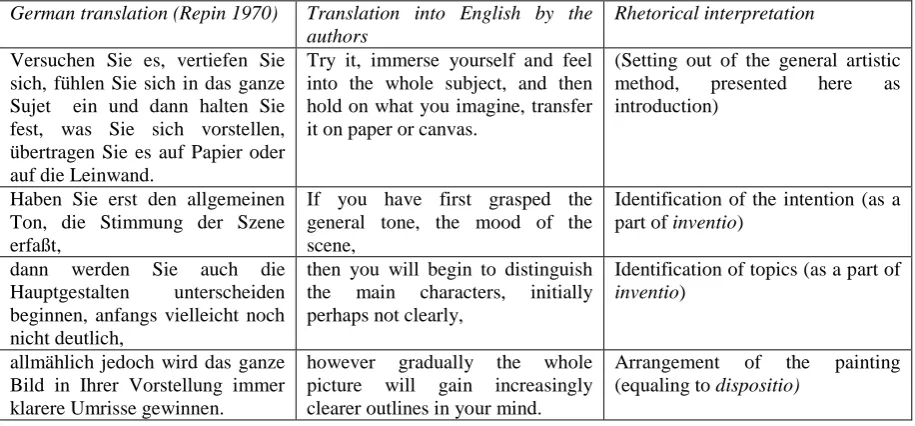
[image:6.595.71.529.155.368.2]The Ukrainian Ilya Repin is well known as one of the foremost painters in the pre-revolutionary Russia. In his autobiography (Repin 1970), he recollects how one of his painting teachers gave him guidelines on how to compose a painting from imagination (Table 2). He describes how this brief guideline enthralled him and created a moment of change for his view on composition. Although influences of rhetoric are not explicitly mentioned by Repin, they can be clearly distinguished.
Table 2. Ilya Repin’s teacher’s guidelines on the method of painting (Repin 1970) and their rhetorical interpretation.
German translation (Repin 1970) Translation into English by the authors
Rhetorical interpretation
Versuchen Sie es, vertiefen Sie sich, fühlen Sie sich in das ganze Sujet ein und dann halten Sie fest, was Sie sich vorstellen, übertragen Sie es auf Papier oder auf die Leinwand.
Try it, immerse yourself and feel into the whole subject, and then hold on what you imagine, transfer it on paper or canvas.
(Setting out of the general artistic method, presented here as introduction)
Haben Sie erst den allgemeinen Ton, die Stimmung der Szene erfaßt,
If you have first grasped the general tone, the mood of the scene,
Identification of the intention (as a part of inventio)
dann werden Sie auch die Hauptgestalten unterscheiden beginnen, anfangs vielleicht noch nicht deutlich,
then you will begin to distinguish the main characters, initially perhaps not clearly,
Identification of topics (as a part of
inventio)
allmählich jedoch wird das ganze Bild in Ihrer Vorstellung immer klarere Umrisse gewinnen.
however gradually the whole picture will gain increasingly clearer outlines in your mind.
Arrangement of the painting (equaling to dispositio)
2.2.3 Connections between rhetoric and engineering design
The literature does not recognize any relation between rhetoric and engineering design. However, this can be challenged. In one of the first comprehensive treatments of engineering design, Asimow (1962) suggests a process model consisting of analysis, synthesis, evaluation and decision. From these, analysis and synthesis arguably have their counterparts in the classical rhetorical prescriptions.
According to Asimow, analysis (of the problem situation) leads to a statement of the problem: “The statement makes clear what goals are to be achieved, what difficulties must be overcome, what resources are available, what constraints will circumscribe any acceptable solution, and finally, what criterion should be used to judge the goodness of a possible solution”. From the point of view of rhetoric, this is similar to the analysis of the case and determination of the intention, parts of inventio, as treated above.
Asimow then moves to synthesis, explained as follows: “With the problem statement before us we can begin the search for solutions. A solution is a synthesis of component elements which [...] accomplishes the prescribed goals. What are and whence come the component elements? For the most parts they are stored in our memory; we add to the store as our experience widens and our ability to see and hear the potentially useful sharpens. What enables us to draw from the warehouse of our experience just the right set of elements, and to put them into just right combination so that they have a sense of fitting the situation, we do not know, since no definite formula exists.” The concept of synthesis is further explained as follows: “Synthesis refers to the fitting together of parts or separate concepts to produce an integrated whole.” From a rhetorical viewpoint, Asimow’s synthesis seems to consist of finding of topics (subsolutions), part of inventio, and their composition into a solution, more or less equalling dispositio.
Table 3. Correspondence of Asimow’s (1962) analysis and synthesis and inventio and dispositio in rhetoric.
Asimow’s concepts Rhetorical concepts
Analysis Investigation of the particulars of the case and identification of the intention; parts of inventio
Synthesis: Finding the component elements of a solution
Finding the topics; part of inventio
Synthesis: Fitting together of component elements into solutions
Dispositio
3 HOW ARE THE METHOD OF ANALYSIS AND RHETORIC DIFFERENT AS INSPIRATIONAL SOURCES FOR DESIGN THEORY?
These two inspirational sources for design theory and practice, the method of analysis and rhetoric, differ in significant aspects and thus provide different lenses to see design. In the following, these differences are outlined.
3.1 Starting point of design
In geometry, the question is about universals; self-contained problems which are not dependent on time or place. Thus, in analytical understanding, design starts from a given problem, from what is required. This view is shared in traditional project management, where the starting point is in a given task (Koskela & Howell 2002). Also many design theories, such as the Function-Behavior-Structure theory of Gero (1990), resonate with this idea.
In rhetorical understanding, design is about particulars. Thus exploration of the particular case is required at the outset of design – this equates to invention in classical rhetoric. Actually, this was called “analysis” in the seminal writings of design (Asimow 1962), but this view has been downplayed later, along with the switch of the meaning of “analysis” to refer to the deduction of behavior from structure. Also it is implied that our understanding of a particular case is never complete, and requirements are liable to change. This has been emphasized in recent design theorizing (Dorst 2006).
3.2 Output or outcome as target?
In geometrical problems, the solution consists of a figure produced. In analytical understanding of design, the target of designing is to produce the design of an artifact, i.e. material output, that fulfills the functions required. The artefact is described through its form and materials. This resonates with much of theorizing on engineering design.
However, it is usually expected that artefacts to be used by human beings display esthetical qualities, besides their functionalities for use. Engineering design theories focusing on logical reasoning have not covered esthetical effects.
In turn, in rhetorical understanding, the target is on the outcome, persuasion, through the speech (or more generally: material artefact) to be designed. This brings the audience into the domain of design. But also the esthetical issues are about influencing the audience. Indeed, the achievement of esthetical effects, not only in speech but also in art, through paintings, sculptures and music (Vickers 1988), was the original key area of rhetoric.
3.3 Reasoning
In analytical understanding of design, the main line of reasoning is logical: moving along the means-ends three through inferences backwards or forwards, intertwined with decomposition/composition. These ideas are present also in many current design theories.
7
3.4 Creativity
In analytical understanding of design, creativity comes into play in the inferences backward towards something known and doable. Creativity may be focused on creating a new chain of means towards a known end point, or discovering a new end point. However, the inclusion of creativity into current design theories and models, beyond just naming it, has been considerably challenging, as mentioned above.
In rhetorical understanding of design, creativity comes strongly into the play especially in two instances: invention (and discovery) of topics, and arrangement of topics into a whole (creative composition). Ancient rhetoric contained a theory and method of discovery, namely the approach of topoi (places or seats) (Williams & Enos 2002) (actually, in pinpointing ways to find new solutions, the method of TRIZ (Cavallucci 2002) has affinity to that ancient approach). Later on, Vico elevates ingenium, the creative ability to a central place in his understanding of rhetoric (Vico 1965).
3.5 Relation between parts and whole
In analytically influenced design, the relationship between part and whole in the product is conceived to be unproblematic: a whole can be decomposed into parts and again composed back, as regarding a geometrical figure. This is reflected in the method of product breakdown structure.
Rhetorically oriented design contends that many design tasks include a stage where several partial solutions have to be integrated into a whole and where the functionality or aesthetics heavily depend on this arrangement into a whole, besides the quality of mentioned partial solutions. Although useful rules may be found, only rarely can the arrangement into a whole1 be practically designed through a chain of reasoning, rather the method of abduction is needed (Roozenburg 2002). In classical rhetoric, arrangement has been one of the key themes. Indeed, rhetorical rules regarding arrangement have had a major influence in architecture, from Vitruvius onwards (Frith 2004).
3.6 Evaluation
In analytical design, evaluation comes in the form of verification and validation that form part and parcel of design, similarly to proof of the correctness of the solution being an integral part of geometric analysis. This is reflected in the Vee model (Forsberg & al. 2005).
In rhetorical design, it is judgment that corresponds to evaluation. However, the role of judgement is multi-faceted in rhetoric. It is the audience’s task to make a judgment based on the speech, which in turn is based on the judgment of the rhetor on the matter in question (Pollock 2001).
In design terms, the judgment of the audience is of course related to the outcome of design (influencing or persuading), discussed above; this is not a part of the design process but its target. All the principles and methods of rhetoric are usable here.
In turn, the judgment of the rhetor equates to the reasoning, assessments, etc. of the designer during the design process. However, design is rarely an activity that is embodied within one individual. Rather, outputs of design have to be presented to the client, to the producer and to other designers. Each designer needs to persuade others that his output is the best possible in the situation. Asimow (1962) aptly states this:
But important solutions pass beyond our personal sphere. They must be communicated. Communication is often a perilous adventure, beset with semantic pitfalls and strewn with the pages of misunderstood proposals and solutions, discarded and dead, but it must be essayed; for there is no other way in a design project, except for occasional alternatives, to implement the solution.
Of course, this is the setting that is at the heart of rhetoric. Recently, related insights have ranged from a return to the rhetorical understanding of planning (Throgmorton 1996) to examination of communication in design (Eckert & al. 2005).
3.7 Conclusion
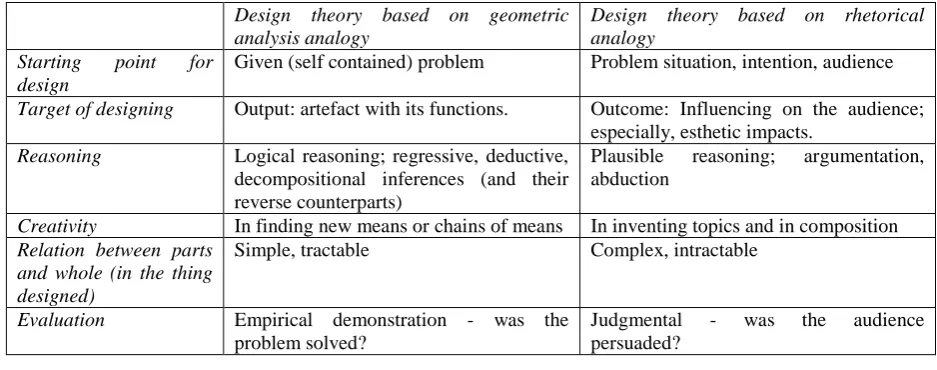
The method of analysis and rhetoric seem to act like two pillars supporting the phenomenon of designing (Table 4). We hypothesize that actual design assignments require the mobilization of ideas and support from both pillars.
1 In engineering design, this creative composition, arrangement into a whole, has traditionally (but confusingly as
Table 4. Juxtaposition of rhetorical analogy and analytical analogy in design. Design theory based on geometric
analysis analogy
Design theory based on rhetorical analogy
Starting point for design
Given (self contained) problem Problem situation, intention, audience
Target of designing Output: artefact with its functions. Outcome: Influencing on the audience; especially, esthetic impacts.
Reasoning Logical reasoning; regressive, deductive, decompositional inferences (and their reverse counterparts)
Plausible reasoning; argumentation, abduction
Creativity In finding new means or chains of means In inventing topics and in composition
Relation between parts and whole (in the thing designed)
Simple, tractable Complex, intractable
Evaluation Empirical demonstration - was the problem solved?
Judgmental - was the audience persuaded?
4 WHAT GETS CLARIFIED?
It is contended that the examination presented can both solve and explain the puzzles and anomalies of design, mentioned at the outset, and also show the way forward.
4.1 Scope of the phenomenon of design
The method of analysis and rhetoric define the design phenomenon differently. Thus, for example, the initial exploration of the design problem is only covered in rhetorically inspired design theories and methods, as that stage is not needed in analytically inspired design. It is prudent to have the generic concept of design embrace the phenomena covered by both pillars.
4.2 Terminology
The terms of analysis and synthesis are the case in point. In the method of analysis, analysis is the creative stage and synthesis the rational. It seems that an understanding deriving from rhetoric has been adopted to these terms in engineering design, implying that synthesis (in Latin compositio) is the creative stage while the meaning of analysis has drifted from problem clarification to evaluation. That the original meaning of these terms in geometry has been diluted and forgotten has of course facilitated these developments where new meanings have been attached to these prestigious terms. It is opportune to clarify the meaning of these terms when used in a design context.
4.3 Functionalities and esthetics
The method of analysis, which has mostly, although implicitly, provided the basis for engineering design, is incapable of handling esthetic impacts, as the question is about influencing the audience, a concept missing from that method. Although some ideas have been borrowed from rhetoric into engineering design, there has not been any comprehensive understanding of the rhetorical approach. This has prevented the inclusion of esthetical factors in theorizing on engineering design. This situation invites for a new fusion of design theories inspired, respectively, by rhetoric and the method of analysis.
4.4 Creativity in design
9
4.5 Suitable starting point for design theorizing
Theorizing on design started afresh in the 1960’s, without efforts to understand the antecedents in the field. This has meant that both historical pillars of design theorizing, rhetoric and the method of analysis, have remained out of sight. Arguably, this has slowed down theoretical progress. It is suggested that both rhetoric and the method of analysis have to be made explicit for securing future theoretical progress.
5 CONCLUSION
Both rhetoric and the method of analysis have been extremely generative throughout history, having inspired and been applied to numerous new contexts – design included. However, the current movement towards a design science, initiated in the 1960’s, has failed to embrace these historical roots of the discipline. This omission is puzzling given that current design theories and methods are already to a considerable extent, but latently, based either on rhetoric or the method of analysis, as has been shown here.
It is argued that these two pillars have to be made explicit, for making sense of the current theoretical landscape and for providing, through their integration, a new, effective platform for design theorizing. In doing so, we connect back to the Aristotelian roots of philosophy and science, and acknowledge that both main forms of reasoning as discussed by Aristotle, analytical and dialectical (Perelman 1982), have their proper place in design.
ACKNOWLEDGMENT
The authors are grateful to Dr. Esa Kuismanen for his suggestion to analyze a particular passage in Repin’s autobiography from a rhetorical viewpoint.
REFERENCES
Asimow, M. (1962) Introduction to design. Englewood Cliffs: Prentice-Hall.
Buchanan, R. (1985) Declaration by design: Rhetoric, argument, and demonstration in design practice. Design Issues, 4-22.
Buchanan, R. (2001) Design and the new rhetoric: Productive arts in the philosophy of culture. Philosophy and Rhetoric, 34(3), 183-206.
Buchanan, R. (2001) Design research and the new learning. Design issues, 17(4), 3-23.
Cavallucci, D. (2002) TRIZ, the Altshullerian approach to solving innovative problems. In: Chakrabarti, A. (ed,) (2002). Engineering design synthesis: understanding, approaches and tools. Springer Verlag.
Cicero, M.T. (2006) Puhujasta. [De Oratore] Translated into Finnish by Aulikki Vuolle. Gaudeamus, Helsinki.
Dorst, K. (2006) Design problems and design paradoxes. Design issues, 22(3), 4-17.
Eckert, C., Maier, A., & McMahon, C. (2005). Communication in design. In: Clarkson, J., & Eckert, C. (Eds.). (2005). Design process improvement: a review of current practice. Springer.
Editorial board of IJDCI (2013) Perspectives on design creativity and innovation research, International Journal of Design Creativity and Innovation, 1:1, 1-42
Forsberg K, Mooz H, Cotterman, H (2005) Visualizing Project Management. Third ed. Wiley, Hoboken.
Frith, S. (2004) A Primitive exchange: on rhetoric and architectural symbol. Architectural Research Quarterly, 8(1), 39-45.
Frost, M (2005) Introduction to Classical Legal Rhetoric: A Lost Heritage. Ashgate, Aldershot. Galen (1997) The Affections and Errors of the Soul. In: Selected Works. Singer, P.N. (transl.) Oxford University Press, pp 120-149
Gero, J. S. (1990) Design prototypes: a knowledge representation schema for design. AI magazine, 11(4), 26.
Hintikka J & Remes, U. (1974) The Method of Analysis. Boston Studies in the Philosophy of Science. Volume XXV. D. Reidel Publishing Company, Dordrecht.
Kaufer, D. S., & Butler, B. S. (1996) Rhetoric and the Arts of Design. Lawrence Erlbaum.
Koskela, L. J. & Howell, G. (2002). The underlying theory of project management is obsolete. In Proceedings of the PMI Research Conference (pp. 293-302). PMI.
Koskela, L., Codinhoto, R., Tzortzopoulos, P., Kagioglou, M. (Forthcoming) The Aristotelian proto-theory of design. In: An Anthology of Theories and Models of Design, A. Chakrabarti and L. Blessing (editors), Springer, London. (In press).
McKeon R (1971) The uses of rhetoric in a technological age: Architectonic productive arts. - The prospect of rhetoric - Prentice‐Hall Englewood Cliffs, NJ
McQuillan, J. (1999) Beyond Logistics: Architectural Creativity as Techne and Rhetoric in the European Tradition. Subject, issue 1.
Perelman, C. (1982) The realm of rhetoric, trans. William Kluback. Notre Dame: University of Notre Dame Press.
Pollock, M.A. (2001) Judgment. In: Encyclopedia of Rhetoric. Ed. By Thomas O Sloane. Oxford University Press.
Repin, I. (1970) Fernes und Nahes. Berlin, Henschelverlag.
Roozenburg, N. F. M. (2002) Defining Synthesis: on the senses and the logic of design synthesis. In: Chakrabarti, A. (ed,) (2002). Engineering design synthesis: understanding, approaches and tools. Springer Verlag.
Suhr, J. (1999) The choosing by advantages decision making system. Praeger Pub Text.
Throgmorton, J. A. (1996) Planning as persuasive storytelling: The rhetorical construction of Chicago's electric future. University of Chicago Press.
Vasari, G. (1998) The lives of the artists. Oxford University Press, USA. Vickers, B. (1988) In defence of rhetoric. Oxford: Clarendon Press.
Vico, G. (1965) On the Study Methods of our Time. Translated, with an Introduction and Notes by E. Gianturco. The Bobbs-Merrill Company, Indianapolis.
Walden, D. (2012) “Frozen Music”: The Synthesis of Music and Mechanical Theory in Vitruvius’ De Architectura. Suniukisis Talk Final Draft.