182
Chapter 25
Tensile Strength Analysis of Concrete-Cellulose Composite from Coconut Coir
Edwin Azwar1, Darmansyah1, Chitra Mutiara Usman1
1Chemical Engineering Departement, Engineering Faculty, Lampung University Bandar Lampung 35145, Indonesiaa[email protected]
Abstract. Composites of the planned concrete grade K-275 mixed with cellulose powder were made to look the effect of density, tensile strength, and compressive strength of the composite material by adding the cellulose powder. Powdered cellulose obtained from the coconut coir insulation by solvent replacement method and affixed to the concrete with variation 0%; 0.25%; 0.5%; 0.75% and 1% of the concrete total weight. This research aims to produce a lighter material that has resembles or even exceed power than previous materials. The best conditions from this research analysis occur in 0,5% cellulose powder addition that is formed lower density
material with 2.8208 Mpa of tensile strength and 17.8344 MPa compressive strength, rise respectively
33, 33% and 16.66% compared to the tensile strength and compressive strength of concrete without cellulose powder addition.
Keywords: composites, concrete, cellulose, density, tensile strength, compressive strength.
I.
Introduction
Concrete is needed as one of the main ingredients in infrastructure development. We need at least four main building blocks, namely coarse aggregate, fine aggregate, water and cement and other materials can also be added as an additive (Claudio at al, 2007). Concrete has resistance to press very well, but not so with strength against the pull. Tensile strength of concrete only reach 10% to 15% of the value of compressive strength (Prayuda, 2012). These properties cause easily appear small cracks in the concrete that could lead to collapse when given additional concrete loads (Sudarmoko, 1990). Repair concrete properties can be done with the addition of natural fibers (coconut coir) Eniarti M., (2010) but not all of the content in natural fiber has good effect. Lignin has a bad influence on the strength of the fiber(Siswadi et al,2007, Klemmat al. 1998), this research will minimaze lignin content and enlarge cellulose content in fiber by cellulose insulation with solvent replacement method. The presence of OH groups in cellulose and hemicellulose cause polar nature. Ion exchange mechanism occurs between -OH group bonded in surface with the kation in logam. In this case the - OH group will bind to positive metal ions in the cement content, Si2+ , with this following mechanism.
M2+ is a metal ion, OH is a hydroxyl group and Y is a -OH group attached matrix. The interaction between -OH
with metal ions is also possible through the formation mechanism of complex coordination because oxygen atom (O) in the -OH group has a free electron pair, while the metal ions have empty d orbitals. The lone pair will occupy a vacant orbital which is owned by a metal ion, thus forming a compound or complex ion (Sukarta, 2008).
183
significant effect on tensile strength of concrete by varying the ratio cellulose-hemicellulose of the total concrete weight to obtain concrete with the most excellent tensile strength.II.
Experiments
2.1. Materials
[image:2.595.184.427.269.418.2]Coconut husk which will be used as raw materials derived from Desa negeri Agung, Kecamatan Marga Tiga, Lampung Timur. The materials used for coconut coir isolation are Ethanol, Toluene, Aqua DM, NaOH,, NaOCl solution (commercial bleach) 0.5%, sulfuric acid (H2SO4). Materials used in the concrete manufacturing is accordance with SK SNI DT 91-000802007 for the quality of concrete K-275 (24 MPa), those are cement, coarse aggregate, fine aggregate, and water.
Table 1. Procedures of Measuring Concrete Unit Price
2.2. Cellulose Insulation
This isolation using a solvent replacement. 1200 grams Coconut coir chopped in order to facilitate the isolation process, and then collected in a container containing the solvent ethanol-toluene volume ratio of 1: 2 for 4 hours. The mixture is heated to a temperature of 600C to evaporate the solvent. The extract rinsed with hot aqua DM (800C) until free from ethanol and toluene and other minerals. Then the sample is immersed in hot NaOH 2M (90 ° C) for 1 hour to remove the lignin content. Heat soaking process with NaOH is repeated for 1 hour until the filtrate does not precipitate when sulfuric acid is added (H2SO4) and the product produced in the form of a yellowish brown powder. Furthermore, the product is immersed in a solution of 0.5% NaOCl containing 1 gram of NaOH for 15 minutes to form a white product. The products produced at this stage is washed with 70% ethanol and aqua DM to get this neutral pH and remove any remaining NaOCl. The product is dried with a vacuum oven at 600 C for 3 hours. Cellulose-hemicellulose isolated from waste coconut coir ready weighed and mixed into the concrete.
2.3. Manufacture of composites
Concrete mixed with cellulose-hemicellulose then called specimen was planned to have compressive strength
f’c = 24 MPa, created with the following steps: Mortar materials was prepared for manufacturing 10
184
The concrete was feasible if maximum of descent printout Abrams cone was 2 cm. To make 1 specimen, the mixture is loaded into a cylindrical mold and then weighed to determine the weight. For the first variant specimen, as much as 0.25% of the net weight of the initial mixture is reduced, then replaced by cellulose- hemicellulose extracted. Mortar is poured back into the container, affixed cellulose-hemicellulose, cellulose- hemicellulose stirred untill dispersed evenly, then put back into the mold cylinder. Specimens with this composition was made 2 pieces for tensile strength and compressive strength test purposes. Then the same thing is repeated for manufacture variants specimens with 0.5%, 0.75% and 1% cellulose-hemicellulose of the concrete weight. Also made two specimens without cellulose-hemicellulose added (normal concrete) for comparison. Specimens are compacted with tamper and vibrators. Digesters allowed to harden for 24 hours. The mold is removed, the specimen soaked in either water or in a wet sacks for 28 days until they are ready to be tested.III.
Results and Discussions
3.1. Cellulose Insulation
[image:3.595.189.418.330.500.2]Cellulose obtained from experiment are physically creamy yet completely white, as shown in Figure 4.1 because the whitening agent/bleaching (NaOCl) that used are in low concentration. If using high concentration NaOCl, the main chains of cellulose would lead to degradation, so that the properties of the material decreases. The powders data analysis result presented in Table 2.
Fig 2. Coconut coir after treatment (left); Coconut coir before treatment (right)
Table 2. Coconut Coir Content Before and After Treatment
[image:3.595.173.449.545.625.2]185
3.1. Manufacture of composites [image:4.595.190.418.151.351.2]Specimens are 10 pieces solid cylinder with 30cm height and 15cm diameter, which each of the ten-cylinder density will be measured. Then 5 cylinders are to be tested its compressive strength, and 5 other cylinders will be tested its tensile strength. That cylinders are concrete-cellulose composites added with treatmented 0%, 0,25%, 0,5%, 0,5%, and 1% coconut coir of cylinder weight, they are 0gram; 30,88gram; 61,77gram; 92,65gram; and 123,54gram. Cylinders as specimens shown in figure 4.
Fig 4. Specimen cylinders
Figure 4. shows that specimen cylinders looks like normal concrete cylinder.
3.2. Density Analysis
Density is defined as mass per unit volume of material. Density test done to determine the density of each cylinder. In accordance with the long-term goals to be achieved, would like to obtain material that is lighter but has the same strength and quality even exceed the pre-existing material. The density of a material can be determined by
the formula ρ = m / v, where m is the mass of the cylinder and v is the volume of a cylinder. Here is the
[image:4.595.170.439.505.654.2]measurement data:
Table 3. Cylinder measurement data
SA 0 (a) shows the cylinder with 0% coconut coir addition into specimen that to be used as a test object in the compressive strength test or also called normal concrete. SA 0 (b) shows the cylinder with t 0% coconut coir addition that to be used as a test object in the compressive strength test. SA Code 0.25 (a) and (b) shows the cylinder with 0,25% addition and so on. The mass of the cylinder is obtained from the measurement results
using10 gram precision scales with like shown in Figure 6. Volume calculated using the formulaπr2t because
186
De
ns
ity
(k
g/
m
3)
[image:5.595.207.402.85.300.2]But if the test object is an irregular in shape object , the volume calculation can be done by using increasing fluid in a measuring cup (Sudarmoko, 1990).
Fig 5. Measuring the specimen weight
Densities of specimen with 1%, 0,75%, 0,5% and 0,25% addition are 2212,135 kg/m3, 2229,5837 kg/m3, 2285,229 kg/m3, and 2326,349 kg/m3. And specimen density without addition is s 2354,3612 kg/m3.
2400 2350 2300 2250 2200 2150 2100
Density Vs %Cellulose
0 0,25 0,5 0,75 1
Cellulose adding (%)
Fig 6. Corelation between cylincer density and percentage of the cellulose filler
Shown in fig 6. the more addition of coconut coir into the concrete, the lighter concrete mass we get, indicated with it density that is getting smaller. It is caused, some of concrete mixture replaced by coconut coir that has lower density than it mixture.
3.3. Tensile Strength
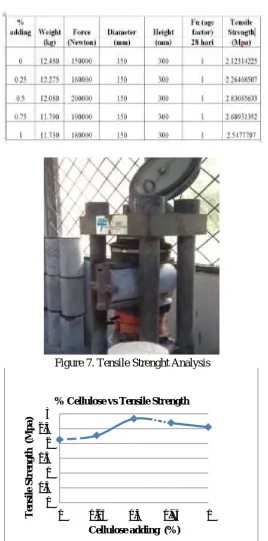
[image:5.595.181.425.359.490.2]187
T
en
sile
S
tr
en
g
th
(M
p
a
)
[image:6.595.172.441.61.604.2]Table 4. Tensile Strength Analysis Data Result
Figure 7. Tensile Strenght Analysis
% Cellulose vs Tensile Strength
3 2,5 2 1,5 1 0,5 0
0 0,25 0,5 0,75 1
Cellulose adding (%)
Fig. 8. The effect of Coconut coir powder substitution for Concrete Tensile Strength
188
C
o
m
p
re
ss
iv
e
S
tr
en
g
th
(M
P
a
)
3.4. Compressive Strength Analysis
[image:7.595.180.424.141.446.2]Concrete-cellulose composites compressive strength test conducted to determine the effect of cellulose powder addition to concrete compressive strength. Has been tested and observated a pieces normal concrete without cellulose powder addition and 4 pieces concrete with cellulose powder addition with variation of 0.25%; 0.5%; 0.75%; and 1% of the total weight of the concrete, the results are shown in the Figure below.
Table 5. Compressive Strength Analysis Data Result
% Cellulose Adding Vs Compressive Strength
20 15 10 5 0
0 0,25 0,5 0,75 1
Cellulose adding (%)
Fig 9. The effect of Coconut coir powder substitution for Concrete Tensile Strength
In the figure above shown that the maximum compressive strength value obtained in 0,5% coconut coir powder substitution, 17.8344 MPa with density value of 2291.83 kg / m3 , still lighter than normal concrete, while the addition of coconut fiber cellulose powder into the concrete more than 0.5% , it will decrease the compressive strength of concrete to below the compressive strength of normal concrete (Siswad, Alfeara 2007).
IV.
Conclusions
[image:7.595.177.432.143.282.2]189
References
[1]. Civil Departement, Research and Development .2007. SNI DT -91-0008-2007 Teh Calculation Step of Concrete Works.
[2]. Claudio, H.S.D.M., Vinicius, G.C., Mario, R.S., 2007, Production and Properties of a Medium
Density Wood-Cement Boards Produced With Oriented Strands and Silica Fume, Clencla y tecnología 9(2): 105-115.
[3]. Eniarti. 2010. The Effect of Using Coconut Fiber as Supplementary Materials to Increasin g
Mechanical Properties of Normal Concrete. Mataram. Spectrum Civil Engineering University of Mataram.
[4]. Iwanah. 2009. Timber Waste Effect to Concrete Mechanic character. Medan. North Sumatera University.
[5]. Klemm et al. 1998. Comprehensive cellulose chemistry. Volume 1, Fundamentals and Analytical Methods. Jerman: Weinhelm.
[6]. Saifuddin, I Muhammad, dkk. 2013. The Efeect of Wood flour to Concrete Strength.. Riau. Civil Engineering. University Pasir Pengaraian
[7]. Saputra, Ahmad DS. 2013. Concrete Mtertial Laboratory Bandar Lampung. Civil Engineering. Engineering Faculty. University of Lampung.
[8]. Schwartz, M.M. 1984. Composite Material Handbook. Singapur. Mc Graw Hill.
[9]. Siswadi, Alfeatra Rapa. 2007. Teh Effect of Wood Flour to The Concrete Strength.Yogyakarta. Atma Jaya University.
[10]. Soehendro, B., 1999, Te Effect of Fibre Use Partialy to the Block Bond Concreete Behaviour (Full Scale Model Tes), Seminar of Material.
[11]. Sudarmoko, 1990, Concrete Fibre, New Concrete Composite. Yogyakarta. University of Gajah Mada.
[12]. Sukarta, I Nyoman. 2008. Adsorption Cr3+ Wood Flour. The Study to Develope alternate Material. Bandung. ITB Repository.
[13]. Sunario, Jakson. 2008. The Efeect of Natural Fibre Addition to Concrete Strength. Medan. Repository USU.
[14]. Syafiisab, Asma. 2010. Effect of Concrete Composite Rice Huusk and Cococnut Husk. Bending Panel. Surakarta. Universitas Negeri Surakarta.