A Web Services Framework for Mobile Payment
Services
David McKitterick
A dissertation submitted to the University of Dublin, in partial
fulfilment of the requirements for the degree of Master of Science
in Computer Science
Declaration
I declare that the work described in this dissertation is, except where
otherwise stated, entirely my own work and has not been submitted as an
exercise for a degree at this or any other university.
________________________
David McKitterick
Permission to lend and/or copy
I agree that Trinity College Library may lend or copy this dissertation upon
request.
________________________
David McKitterick
Acknowledgements
I would like to thank my supervisor, Jim Dowling, for his enthusiasm and guidance throughout the course of this project. I would also like to thank the members of the PerSL project, in the Distributed Systems Research Group, for their assistance with the development of the real mobile network payment system.
Abstract
Next generation mobile services are readily emerging into the mainstream services market and this growth is dependent on mobile technologies and their support
infrastructure. 2.5G and 3G mobile technologies presently are beginning to be adopted as a platform for the deployment of communication, business and leisure mobile services. Mobile payment services are one of many necessary support services, which will enable improved development of next generation services. In addition to this necessity for support services, the growth of m-commerce relies vitally on effective payment solutions, provided by mobile payment services.
This dissertation describes a solution for a generic framework for mobile payment services. The issue of diverse, enclosed payment solutions is addressed by presenting an open, extensible and interoperable framework for deploying payment services to the mobile services domain. This framework is based on the distributed architecture offered by Web Services. A Web Services solution provides integration over existing Internet protocols to current mobile payment infrastructures. The framework uses a combination of object oriented design patterns and web based structuring and description styles to allow mobile payment services to be deployed to meet both content provider and mobile user needs.
Table of Contents
1. INTRODUCTION ... 1
1.1 DISSERTATION ROADMAP... 3
2. MOBILE TECHNOLOGIES ... 4
2.1 MOBILE NETWORK TECHNOLOGIES... 4
2.1.1 GSM... 5
2.1.2 HSCSD... 7
2.1.3 GPRS ... 7
2.1.4 EDGE ... 9
2.1.4 3G ... 10
2.1.5 UMTS... 10
2.1.6 CDMA... 10
2.2 MOBILE COMMUNICATION SERVICES... 11
2.2.1 SMS... 11
2.2.2 WAP... 12
2.2.3 I-Mode ... 13
2.2.4 USSD ... 13
2.2.5 Cell Broadcast ... 13
2.2.6 SIM Toolkit ... 14
2.2.7 Web Clipping ... 14
2.2.8 MExE ... 15
2.2.9 Network Protocols ... 15
2.3 MOBILE PLATFORMS... 16
2.3.1 Mobile Operating Systems... 16
2.3.2 Mobile Programming Platforms... 17
2.4 SUMMARY... 18
3. MOBILE PAYMENT ... 19
3.1 MOBILE PAYMENT PRINCIPLES... 19
3.1.1 Actors within a Mobile Payment System... 20
3.1.2 Characterising Mobile Payment... 22
3.1.3 Payment Scenarios ... 23
3.1.4 Generic Operations in Mobile Payment ... 26
3.2 MOBILE PAYMENT:MOBILE OPERATOR PAYMENT... 29
3.2.1 Network Operator Payment Systems ... 29
3.2.2 Mobile Payment Standards... 30
3.2.3 Vendor Billing Solutions... 31
3.3 MOBILE PAYMENT:OUT-OF-BAND PAYMENT... 32
3.3.1 Financial Institutions... 32
3.3.2 Reverse-Charge/Billed SMS ... 33
3.3.3 Vodafone m-pay... 33
3.3.4 MobiPay ... 33
3.3.5 Iti Achat ... 34
3.3.6 PayBox... 35
3.4 MOBILE PAYMENT:PROXIMITY... 36
3.4.1 Smartcards... 36
3.4.2 EMV... 37
3.4.3 Mobile Wallet - Micropayments ... 37
3.4.4 Mobile Wallet - Wireless Technologies ... 38
4. FRAMEWORK DESIGN ... 40
4.1 WEB SERVICES... 40
4.1.1 XML ... 41
4.1.2 SOAP ... 41
4.1.3 WSDL... 42
4.1.4 UDDI ... 43
4.2 AWEB SERVICES FRAMEWORK... 44
4.2.1 Abstract Factory Design Pattern... 44
4.2.2 WSDL Interface as a Stateless Façade ... 45
4.2.3 Registration Web Service... 45
4.2.4 Charging Web Service ... 47
4.2.5 Client and Session Identification ... 49
4.3 DESIGNING WITH WSDL... 51
4.3.1 Abstract Complex Types ... 51
4.3.2 Polymorphism and Extensibility ... 53
4.4 SUMMARY... 54
5. IMPLEMENTATION OF MOBILE PAYMENT SYSTEMS... 55
5.1 IMPLEMENTATION ENVIRONMENT AND TOOLS... 55
5.1.1 Programming Language... 56
5.1.2 Apache Axis ... 56
5.1.3 Apache Tomcat Web Server... 57
5.1.4 J2ME Wireless Toolkit... 57
5.1.5 Kannel SMS Gateway ... 57
5.2 FRAMEWORK IMPLEMENTATION... 59
5.2.1 Operator Billing Payment Method ... 59
5.2.2 Credit Card Payment Method... 59
5.2.3 Reverse SMS Payment Method ... 60
5.2.4 Development of the Web Services Framework ... 60
5.3 REAL MOBILE NETWORK PAYMENT SYSTEM... 62
5.3.1 Mobile Client – HTML and WML Browser ... 62
5.3.2 Content Provider – Java Servlet Application ... 63
5.3.3 Payment Service Provider – Asynchronous Authorisation ... 64
5.4 SIMULATED MOBILE PAYMENT SYSTEM... 66
5.4.1 Mobile Client - J2ME Application... 66
5.4.2 Content Provider – TCP Socket Server ... 67
5.4.3 Payment Service Provider – Synchronous Authorisation ... 68
5.5 SUMMARY... 68
6. EVALUATION ... 69
6.1 DESIGN AND IMPLEMENTATION... 69
6.1.1 Network Failure and Latency ... 69
6.1.2 Security ... 70
6.1.3 Extensibility ... 71
6.2 FUTURE WORK... 72
6.3 SUMMARY... 72
7. CONCLUSION ... 73
BIBLIOGRAPHY ... 75
APPENDIX A – REGISTRATION SEQUENCE DIAGRAMS... 77
APPENDIX B – CHARGING SEQUENCE DIAGRAMS... 79
Table of Figures
Figure 1: Relationships between all parties in a Mobile Payment System with participation from a Trusted
Third Party ... 20
Figure 2: Relationships between all parties in a Mobile Payment System excluding participation from a Trusted Third Party ... 21
Figure 3: Payment System for Content Download ... 23
Figure 4: Payment System for Point of Sale... 25
Figure 5: Payment System for Content on Device ... 25
Figure 6: Generic Operations in a Mobile Payment System... 26
Figure 7: Mobile Payment System with a Web Services Framework ... 44
Figure 8: WSDL Design View of the Registration Web Service ... 46
Figure 9: Component Architecture for the Web Services Framework ... 46
Figure 10: WSDL Design View of the Charging Web Service ... 47
Figure 11: WSDL Complex Type for the Session Id... 50
Figure 12 : WSDL Complex Type Definitions... 52
Figure 13: WSDL Simple Type Definitions ... 52
Figure 14: WSDL Complex Type Definitions using Polymorphism... 53
Figure 15: Topology of the Real Mobile Network Payment System... 62
Chapter 1
Introduction
The demand for next generation mobile services is increasing as more mobile services are becoming available to the mainstream services market. Additional growth in this area is dependent on the technological and infrastructural support available. 2.5G and 3G mobile technologies presently are beginning to be adopted as a platform for the deployment of communication, business and leisure mobile services. With the
technology gradually becoming available, the development and deployment of mobile services is increasingly an attractive market for Internet service providers, content
providers and M-Commerce solution providers. For greater acceptance of these services, quality and performance must be ensured through the integration of mobile support services.
mobile payment services, but as yet no common standard has been adopted for mobile payment services.
This dissertation outlines the background research into mobile technologies and the mobile payment domain, which was a necessary investigation for the compilation of the requirements for a generic, open solution for mobile payment services. A technical overview of existing mobile network technologies and mobile communication services is followed by a description of the generic features of a mobile payment system, including some mobile payment principles and various types of mobile payment.
Following the investigation into the mobile payment domain, a proposed solution for deploying mobile payment services was realised. This solution is based on an open, extensible, interoperable framework for the implementation of various categories of mobile payment services. The distributed architecture of Web Services was selected to provide the extensibility and interoperability requirements of this framework. This Web Services solution allows integration over existing Internet protocols to current mobile payment infrastructures.
This dissertation describes the implementation of the proposed Web Services framework for three different payment approaches, to represent the diverse payment techniques in the mobile payment domain. The realisation of the framework implementations is illustrated through the development of two payment systems. These systems attempt to establish the comprehensive relationship between the main actors in a mobile payment system. The first payment system demonstrates the integration of the Web Services framework into a real mobile network system, using a SMS gateway and Web servers. The second payment system demonstrates a simulated version of the first system, but with a more complex mobile client implementation, with the use of J2ME technology.
1.1 Dissertation
Roadmap
Chapter two provides a technical outline of some of the existing mobile network technologies and mobile communication services. Also, various mobile platforms are described for operating systems and programming environments.
Chapter three introduces the mobile payment domain, discussing the various principles within a mobile payment system, such as the actors involved, characterisation of mobile payment, the generic operations for mobile payment and a selection of possible payment scenarios. Mobile payment is then discussed under three areas, providing examples of current systems and infrastructures association with these areas.
The framework design methodology is presented in chapter four. This chapter outlines the extensibility and flexibility aspects of designing a framework with WSDL interfaces.
Chapter five describes the implementation of the Web Services framework for three different payment methods, and the integration of these implementations in the development of two mobile payment systems.
Chapter 2
Mobile Technologies
This chapter describes various mobile network technologies, where some are currently in existence on global mobile networks, while the other technologies are gradually
becoming adopted by mobile operators. A technical description is outlined for some of the communication services for these network technologies. The chapter concludes with a description of current mobile platforms available for mobile operating systems and application environments.
2.1 Mobile Network Technologies
• 1G: Advance Mobile Phone System (AMPS) in North America, Total Access Communication System (TACS) in UK, Nippon Telegraph & Telephone (NTT) in Japan, Code Division Multiple Access One (CDMAONE).
• 2G: Global System for Mobile Communication (GSM), Code Division Multiple Access 2000 (CDMA2000), High Speed Circuit Switched Data Technology (HSCSD).
• 2.5G: General Packet Radio System (GPRS), Enhanced Data Rate for GSM Evolution (EDGE).
• 3G: Universal Mobile Telephone Standard (UMTS)
2.1.1 GSM
Global System for Mobile Communication [1] is a second generation standard for mobile communication, developed by the European Telecommunications Standards Institute (ETSI) and now currently owned by the Third Generation Partnership Project (3GPP). Operating in the 900 MHz and the 1800 MHz frequency band [2], GSM is the most widespread mobile standard currently in use across Europe and the Asia-Pacific region. Recently it is believed that GSM technology is in use by more than one in ten of the world’s population [18] and it is estimated that at the end of 2002 there were 787 million GSM subscribers across the 190 countries of the world. By late 2003 or early 2004, it is forecast that the global GSM market will reach the one billion subscriber mark.
GSM was designed using digital techniques, unlike with previous analog cellular systems like AMPS in the US and TACS in the United Kingdom. The techniques [1] used are a combination of Time Division Multiple Access (TDMA) and Frequency Division
FDMA [19] divides the radio frequency into several frequency carriers of 200 Hz, while TDMA enables 8 voice channels in each 200 Hz carrier by dividing each one in time.
GSM Services [19]:
• Teleservices: telecommunication services can be divided into bearer services, teleservices, and supplementary services. The most basic teleservice supported by GSM is telephony.
• Data Services:
o Internet Services: GSM users can send and receive data, at rates up to 9.6K bps, to users on POTS (Plain Old Telephone Service), ISDN, Packet Switched Public Data Networks, and Circuit Switched Public Data
Networks.
o SMS (Short Messaging Service): unique to GSM technology, SMS is a bidirectional service for short alphanumeric (up to 160 bytes) messages. (will be discussed later in more detail)
o Facsimile: Sending and receiving of fax messages, using a GSM phone and a laptop computer.
o Secure Corporate LAN Access: secure access to e-mails, faxes, and file transfer via an encrypted link to a corporate LAN.
• Supplementary Services: [1] Such services include call forwarding, call barring, caller identification, call waiting and multiparty conversation. These services can be controlled via service applications using a GSM network API, such as those specified by the Parlay Group, allowing application developers to access GSM network capabilities.
to charging of on-line duration and reconnection is necessary for each browsing session, as opposed to with GPRS (General Packet Radio Service), in which charging is based on the data received or viewed and all time connectivity is available.
2.1.2 HSCSD
High Speed Circuit Switched Data [1, 19] is a circuit switched protocol based on GSM, providing an enhancement of data services. HSCSD enables higher rates by using
multiple channels as apposed to single voice channel with GSM. Transmissions rates can be up 57.6 Kbps by using 4 radio channels simultaneously. Typically, HSCSD [1] was directed at mobile PCs rather than smart phones, where a PCMCIA card is used with transmission speeds of 42.3 Kbps downstream and 28.8 Kbps upstream. HSCSD was intended as a temporary substitute for GPRS, to improve the transmission rates of existing mobile data applications.
2.1.3 GPRS
General Packet Radio Service [2] is packet switched wireless protocol providing non-voice value added services that allows information to be sent and received across a mobile telephone network. It is described as a 2.5G technology which supplements Circuit Switched technology such as GSM. Data transmissions speeds of 9.6 kbps to a theoretical maximum speed of up to 171.2 kbps are achievable with GPRS using all eight timeslots at the same time. In addition to higher data rates, GPRS provides users with all time connectivity while only charged for the data viewed or received with a minimal on-line charge. GPRS is an evolutionary step towards 3G technologies, such as EDGE (Enhanced Data GSM Environment) and UMTS (Universal Mobile Telephone Service).
provide the IP infrastructure needed for packet based services. The SGSN (Serving GPRS Support Node) and GGSN (Gateway GPRS Support node) are the mobile network
equivalents of routers and gateways. Other main additions are the upgrading with new software to existing cellular infrastructure.
GPRS [19] only uses its radio resources when users are actually sending or receiving data, therefore the available radio resource can be concurrently shared between several mobile data users, rather than dedicating a radio channel to a single user for a fixed period of time. This efficient use of scarce radio resources means that large numbers of GPRS users can potentially share the same bandwidth and be served from a single cell. GPRS [1] uses the same radio channel as voice calls, a channel that is 200 kHz wide and which carries a raw digital radio stream of 271 kbps. For voice calls this channel is divided into 8 separate data streams, each carrying about 34 kbps. After protocol and error correction overhead, 13 kbps is left for each voice connection or about 14 kbps for data. Packet-switched data can use several channels where as circuit-switched data uses one voice channel. GPRS can combine up to 8 of these channels, and with 14 kbps of data throughput each, the delivered bandwidth can be up to 100 Kbps. Most economical phones will be ones that are limited to 56 kbps, as not all eight voice channels have to be used. A mobile station can request the amount of bandwidth it desires at the time it establishes a data session.
GPRS applications includes Intranet and Internet access, E-Mail, Fax, and Unified messaging, using a single mailbox for all messages, including voice mail, faxes, e-mail, short message service (SMS), and pager messages.
Limitations of GPRS [1, 19]:
• Achieving the theoretical maximum GPRS data transmission speed of 172.2 kbps would require a single user taking over all eight timeslots which is unlikely that a network operator will allow all timeslots to be used by a single GPRS user. The bandwidth available to a GPRS user will therefore be severely limited.
• Suboptimal Modulation -GPRS employs a modulation technique called Gaussian minimum-shift keying (GMSK) while the EGDE uses a new modulation
technique to allow a much higher bit rate across an air interface, called eight-phase-shift keying (8PSK) modulation. This type of modulation is used for 3G systems, so upgrading to 3G technology seems inevitable for a network operator. • Transit Delays -GPRS sends data packets through different channels to reach a
destination, therefore data corruption or data loss may occur. Data integrity and retransmission capabilities are used to avoid this, but the result is that potential delays can occur.
• No Store and Forward -Unlike SMS technology, GPRS doesn’t provide a store and forward mechanism for data transmission, therefore SMS may be need to enable sending and receiving of short messages.
2.1.4 EDGE
2.1.4 3G
3rd Generation [2] is the generic term for the next big step in mobile technology development. The formal standard for 3G is the IMT-2000 (International Mobile Telecommunications 2000). There are three optional modes as part of the 3G standard. W-CDMA (Wireless Code Division Multiple Access) is for Europe and for the Asian GSM countries, CDMA (Code Division Multiple Access) is for North America, and then TDD/CDMA (Time Division Duplex/CDMA) for China.
2.1.5 UMTS
Universal Mobile Telephone System [1] is designed to provide for 3G mobile data services. Realistic expectations suggest a maximum capacity in metropolitan areas of 384 Kbps, at least in the early years of its deployment. The same transmission rate can be achieved much earlier with EDGE. This third generation mobile phone system is already available in Japan [2]. The system enables the transmission of video, data and voice communication at a high speed and low cost.
2.1.6 CDMA
2.2 Mobile Communication Services
2.2.1 SMS
Short Messaging Service [1] was created as a part of the GSM Phase 1 standard to send and receive short text messages, of 70-160 alphanumeric characters in length, to and from mobile phones. The number of characters which can be sent is dependent on the
language in use, with language support limited to the European Languages, Chinese and Arabic. This service is widely popular in Europe and Asia while in the US it is
practically non-existent. SMS requires digital wireless interface standard (GSM) which is slowly being adopted in the US. In the US the ‘mobile-party-pays’ pricing model is commonly used, so mobile users pay for incoming as well as outgoing calls. Similarly this is the case with text messaging, so paying for messages received will not help the adoption of SMS in the US.
SMS is a smart service, as it can store messages when to the target mobile device is switched off and forwards the messages when the unit is again in use. SMS applications are voicemail/fax notifications, delivery of replacement ring-tones, operator logos and group graphics, unified messaging, personal communication (text messaging), and
information services. Basically, any information that fits into a short text message can be delivered by SMS.
2.2.2 WAP
Wireless Application Protocol [1] is a technology which provides a mechanism for displaying internet information on a mobile phone or any wireless device. This is done by translating internet information in to a format which can be displayed within the constraints of a mobile device. WAP is an open standard, developed by the WAP Forum, which has over 500 members. Its founder members include the major wireless vendors of Nokia, Ericsson and Motorola, plus the US software company, Phone.com (formerly Unwired Planet).
To obtain Internet access on a mobile device, the device should be WAP-enabled and the web site information should be described in WML (Wireless Markup Language) format. WML is the mobile equivalent to HTML for web pages. A WAP gateway is also
necessary between the client mobile device and the WML host server, to translate the WAP request. The response from the host server is translated into a WAP response by the WAP gateway, which can be displayed on the mobile device. An application environment, called WAE (WAP Application Environment), is defined by the WAP standard to enabling the development of advanced services and applications. These include micro-browsers, scripting facilities, e-mail, www-to-mobile messaging, and mobile to telefax access.
2.2.3 I-Mode
I-mode (I standing for information) [1] is a wireless technology developed by a Japanese company called NTT DoCoMo, which enables uses to access Internet services via their cellular phones. I-Mode can be used to exchange e-mail with computers, personal digital assistants (PDAs) and other I-Mode cellular phones. I-Mode has already dominated the Japanese market and is being considered a success story in the world of M-Commerce.
I-Mode's underlying technology is uncomplicated, which makes it easy for content providers to create new I-Mode services and easy for customers to find and use them. The service is based on the Asian cellular standard PDC and uses Compact HTML
(cHTML) markup language [3]. cHTML [2] is basically a scaled down version of HTML. It is relatively easy and it takes little time to rewrite HTML into cHTML. I-Mode’s transmission speed is just 9.6kbps, but fast enough for its services. DoCoMo operates a packet-switched network, which means that customers pay not for time elapsed but for the packets of data they download. Packet switching also means that I-Mode is always on, so customers don't have to log into the service or wait for a connection, but have immediate access to services, similarly with GPRS.
2.2.4 USSD
Unstructured Supplementary Services Data [1] is a mechanism of transmitting information via a GSM network. Similar to SMS, but it is only basically a store and forward service. USSD offers a real-time connection during a session. It is said that USSD will grow with the further market penetration of WAP. Its main uses will be for mobile financial services, shopping and payment.
2.2.5 Cell Broadcast
broadcast is similar to SMS, but it is a one-to-many service rather than a one-to-one or one-to-few. It is a mass distribution media mainly for news and generic information. Usually, cell broadcast services are distributed to the consumer on a no cost basis. The network operator charges the content provider for sending the messages and the content provider will try to make money on follow-up services, such as advertising.
2.2.6 SIM Toolkit
SIM (Subscriber Identity Module) Toolkit [4] is an ETSI/SMG standard for value added services and e-commerce using GSM phones to perform the transactions. SIM Toolkit programmed into the special GSM SIM card enables the SIM card, using the GSM handset, to build up an interactive exchange between a network application and the end user and access or control access to the network. Therefore, it provides the SIM card with a proactive role in the handset. This means that the SIM initiates commands independently of the handset and the network. SIM Toolkit [1] is targeted at phones that do not yet fall into the smart phone category. Although SIM Toolkit was being heavily pushed by the smartcard industry, it will be an interim technology and will not be able to survive once GPRS terminals take over the market, since WAP is be the GPRS-supported protocol.
2.2.7 Web Clipping
The Web Clipping [1] service for 3Com’s Palm handheld device has been very
2.2.8 MExE
The Mobile Station Application Execution Environment [1] is the incorporation of a Java virtual machine into the mobile phone, allowing full application programming. The protocol is integrating location services, sophisticated intelligent customer menus and a variety of interfaces, such as voice recognition. MExE will incorporate WAP, but also provides additional services exceeding the WAP functionality.
2.2.9 Network Protocols
Infrared data association (IrDA) [5] is a protocol stack which represents the physical characteristics of infrared communication. This wireless communication mechanism enables establishment of connections between devices, which must be in line of sight of each other.
Bluetooth [5] has become the predominant standard for lower power and short-range radio link to exchange information, enabling wireless connectivity between devices and peripherals. It had been adopted by many mobile phone manufacturers, and introduced as an addition communication feature on most new phones.
Hypertext transfer protocol (HTTP) is a text-based protocol for content transfer over the internet. This protocol is used to access web content via a web browser on a mobile device.
2.3 Mobile
Platforms
2.3.1 Mobile Operating Systems
Symbian [5] was formed from Psion Software, by Nokia, Motorola, Psion (UK PDA
manufacturer) and Ericsson in June 1998. In 1999 Matsushita (Panasonic) and in April 2002 Siemens joined the Symbian group. It was based on Psion’s earlier software, EPOC operating system. It was a modular 32-bit multitasking operating system especially designed for two types of mobile devices: smart phones and communicators. After EPOC release 5, the operating system was renamed ‘Symbian OS’. Symbian is a joint venture between leading phone manufacturers formed to develop a common operating system suitable for mobile communication devices. The operating system is quite simple: Symbian develops and licenses Symbian OS containing the base (microkernel and device drivers), middleware (system servers, such as the window server), a large set of
communication protocols, and a test user interface for the application engines of the operating system.
The Series 60 Platform [5] (Smartphone Platform), designed for Symbian OS, supports mobile browsing, multimedia messaging service (MMS) and content downloading, as well many personal information management and telephony applications. The Series 60 Platform 1.0 provides communication technologies needed in smartphones such as e-mail, WAP 1.2.1 stack, SyncML, MMS, Bluetooth and GPRS.
Microsoft has developed a lighter version of its Windows operating system, called Windows CE that has been created especially for small palm-size, hand-held PCs and
3COM is the smallest player for mobile terminal operating systems, but it is the global market leader in the PDA market (72% according to IDC in 1998) with the Palm Pilot product and its proprietary Palm OS [1]. The operating system is regarded to be inferior to its competitors’, but the Palm is much simpler to use in both software and hardware terms. 3COM has spun-off its Palm division (Palm Inc.) in 2000. The Palm OS has a particular wide acceptance in the US.
Wysdom has recently developed a mobile network operating system called Wysdom MAP-OS [10]. It is the mobile industry's first complete service delivery platform
designed exclusively to meet the challenges mobile operators face in delivering feature and margin-rich mobile data services to their consumer and enterprise customers, according to Wysdom.
2.3.2 Mobile Programming Platforms
Java 2 Micro Edition (J2ME) [5] provides an environment to develop applications for mobile devices. Due to the limited resources for memory and execution on a mobile device, J2ME was designed to limit the usage of these resources, more than other Java 2 editions.
J2ME defines two device configurations, the Connected Device Configuration (CDC) and the Connected Limited Device Configuration (CLDC). CDC is designed for high-end devices, such as set-top boxes and communicators, with numerous UI capabilities, high bandwidth and available memory of about 2-4 Mbytes. Alternatively, CLDC is designed for low-end devices, such as mobile phones and personal organisers, with simple UI capabilities, low bandwidth and limited available memory about 128Kbytes.
APIs for this category of device. The CLDC is extended by the Mobile Information Device Profile (MIDP).
MIDP defines the characteristics for a mobile device on top of the CLDC, providing support for user interface, networking and persistent storage. The latest version, MIDP 2.0, provides support for TCP/IP socket connections between different mobile devices and also server applications. There is also support for SSL to provide network level security for the communication of sensitive information, which is especially important in payment systems.
2.4 Summary
Chapter 3
Mobile Payment
This chapter outlines the main concepts of the mobile payment domain relating to potential mobile payment systems. The principle attributes of mobile payment describe actors, characterisation of payment, possible scenarios and operations involved. Dividing mobile payment into three areas, operator payment, out-of-band payment and proximity payment, further describes the diverse areas in mobile payment, as explained in following sections with current examples of existing payment systems.
3.1 Mobile Payment Principles
3.1.1 Actors within a Mobile Payment System
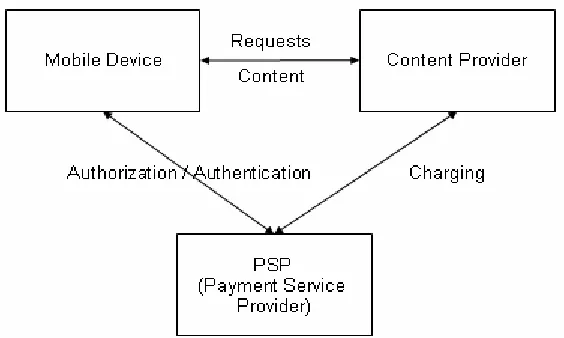
[image:28.612.157.453.235.409.2]The mobile payment value chain has various roles which need to be managed [18]. Such roles may be the provision of a service or content, consumer authentication, payment authorization and payment settlement. In a general sense these roles can be assigned to four actors in the payment system; the consumer, the content provider/merchant, the payment service provider (PSP) and the trust third party (TTP), as shown in figure 1.
Figure 1: Relationships between all parties in a Mobile Payment System with participation from a Trusted Third Party
The consumer is the person owning the mobile device and is willing to use it to pay for a service or the supply of content. In this report the consumer is referred to as the mobile user. The content may be either physical goods or downloadable digital content and the service may be either a physical or digital service. The role of the mobile user may involve registering with the PSP, initializing the mobile purchase, authorizing the payment and accessing/acquiring the purchased service/content.
this report this actor is always referred to as the content provider, as the service is usually the provision of digital content.
The payment service provider is the party responsible for the payment process. They control the payment between the mobile user and the content provider. A consumer may register with the PSP to avoid repetition of keying payment details into the mobile device, such as credit card details, every time a purchase is initiated. A PSP could be a network operator, a financial institution, a credit card company or an independent payment vendor.
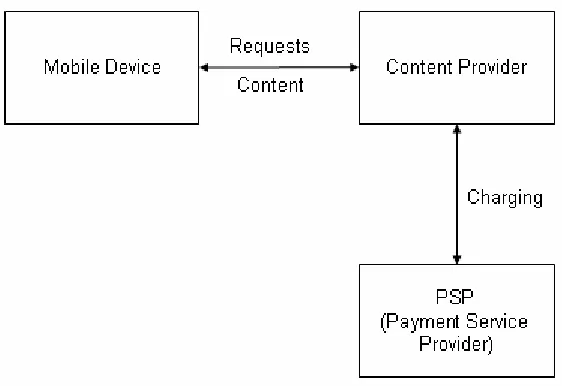
[image:29.612.165.447.473.642.2]The trusted third party is a company used to perform the authentication of transaction parties and the authorization of the payment settlement. This actor could be a network operator, a financial institution or a credit card company. Therefore, their main role is authentication and authorization of payment requests. A network operator or bank could merge roles and act at the same time as the PSP, the TTP, and the content provider. In this dissertation there is no further reference to a TTP, and it is to be assumed that the PSP is responsible for all its roles, as it may be in many cases. Therefore only three actors exist in the mobile payment system as shown in figure 2.
3.1.2 Characterising Mobile Payment
Mobile payment may be characterized into various categories, such as transaction type, settlement type, content type, and content value. An outline of some of the possible payment characteristics regarding these types is presented below.
• Transaction Type:
o Pay Per View – the mobile user pays for each view, or increment, of the desired content. For example downloadable MP3 files or video clips.
o Pay Per Event – the mobile user pays for an event. This event may be the use of a service for a particular time interval or value.
o Pay Per Unit – the mobile user pays for each unit of content provided by the content provider. Units can be based on volume or duration of
content, such as per byte or per minute. The amount of units used for each session will be billed to the consumer. Such examples of this type could be used in downloadable games or streaming video content.
o Flat Rate – the mobile user pays a recurring periodic amount to access the content on an unlimited basis during the period. For example unlimited access to online newspaper articles.
• Settlement Type:
o Pre-paid – mobile users pay in advance of obtaining the content with pre-paid accounts which are deducted after each payment session.
o Post-paid – mobile users receive and use the content before they paid for it. The consumer is billed after the access to the content is obtained, for example on a phone bill.
• Content Type:
o Digital services – e.g. video streaming services
o Physical goods and services - e.g. pay-parking
o Voting - e.g. TV voting polls
o Ticketing – e.g. booking plane tickets
• Content Value:
o Micropayments – describes same purchases usually less the 10 Euro, for example pay parking and ring tones.
o Macropayments – usually large purchases over 10 Euro, for example purchasing plane tickets.
3.1.3 Payment Scenarios
[image:31.612.165.446.417.610.2]Content Download
Figure 3: Payment System for Content Download
Metered content may be a streaming service, such as a video, a radio channel or an on-demand game service. The payment of the transaction is dependent on a metered quantity of the provided service, such as the duration of the service, the data volume delivered, or type of gaming sessions (e.g. different levels).
Event content may involve the full download of digital content, in which the consumer pays a predefined price per item downloaded. The transaction is dependent on a
successful download, as the content is worth the purchase price only when it is complete downloaded. This pricing mode may also cover recurring charge agreements or
subscriptions, e.g. to a monthly online magazine subscription.
The content may also be purchased via a PC internet connection, where the mobile device will be used to authorize the payment transaction and authenticate the content recipient as the mobile user.
Once a service request is made by the mobile user to the content provider, then the content provider will initiate a charging session with the PSP. The PSP will seek authorization from and authentication of the mobile user to complete the payment transaction, using either a post-paid or prepaid method.
Point of Sale
Figure 4: Payment System for Point of Sale
Also vending machine scenarios apply here. A mobile user can pay for goods and services at a machine, such as buying public transport tickets or paying for parking. Identification of the mobile user may also involve using a wireless link such as Bluetooth or Infra Red, and may be in addition with the use of a sms pin request for authentication. Point of sale applications could be developed using the MIDP 2.0 profile for J2ME, as support is provided for Bluetooth and SSL (Secure Socket Layer).
Content on Device
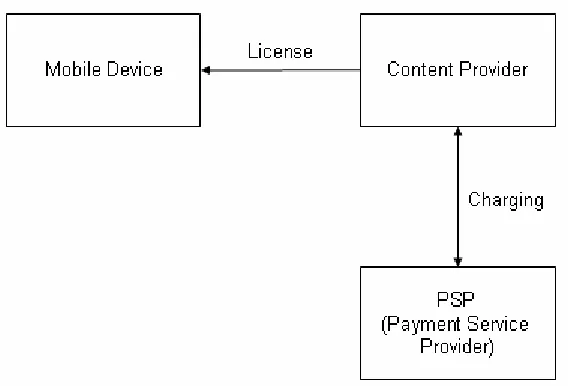
[image:33.612.164.448.482.675.2]In this payment scenario, as shown in figure 5, the content may already exist on the mobile device, in which the use of this content may involve obtaining a digit license. The license may be based on usage, duration or number of users. Such content using this scenario will be an on-demand gaming service. In this scenario, the license is a form of content which payment is required to obtain it.
3.1.4 Generic Operations in Mobile Payment
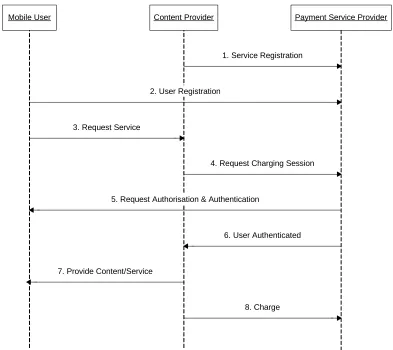
Within a mobile payment system, there exist certain interactions between the parties involved, which are necessary during a payment session. The sequence diagram in figure 6 outlines some generic operations between each party. These operations may vary depending on the payment scenario.
Mobile User Content Provider Payment Service Provider
1. Service Registration
2. User Registration
3. Request Service
4. Request Charging Session
5. Request Authorisation & Authentication
6. User Authenticated
7. Provide Content/Service
[image:34.612.109.502.332.682.2]8. Charge
• Service Registration - The content provider needs to register with the payment
service provider, to make their service available to mobile users via the payment system. Service details, such as payment characterisation for the service, and also the financial information for receipt of payment after use of the service.
Following registration, the content provider will receive a service identification number, for identification in further operations with the payment service provider.
• User Registration - The mobile user needs to register with payment service
provider before they can avail of services offered by a registered content provider. The user will submit details of how they wish to pay for the services and they may be able to personalise the payment to suit their needs. Also the user may be requested to submit a personal identification number (PIN), which will be used during the user authentication process. A user identification number will be returned to the user following the completion of registration. This id will uniquely identify the user during each payment transaction.
• Request Service - Once the mobile user has registered with the payment service
provider, they are able to request the use a services provider by a registered content provider.
• Request Charging Session - On receiving the service request, the content
provider will initiate a charging session request with the payment service provider. Both the user’s id and the service’s id will be sent to the payment service provider to uniquely create a charging session, which will be represented by a unique session identification number.
• Request Authorisation and Authentication - Before a charging session can be
user, usually in the form of a payment contract. This contract will state the terms and conditions of the payment agreement between the mobile user and the content provider. The mobile must reply to the payment service provider with
confirmation of acceptance of the terms in the contract, before the charging session process can continue. The mobile user will also be requested to authenticate with the payment service provider. This will usually be done by submitting their PIN from the mobile device being used. Authorisation and authentication may be performed within the one request and the authorisation confirmation may include the authentication PIN.
• User Authenticated - The payment service provider will notify the content
provider whether the mobile user has been authenticated successfully. If authorisation and authentication requests return a positive result, then the charging session will be initiated. The payment service provider will issue a unique session id to the content provider, signalling the start of a charging session.
• Provide Content or Service - The content provider will now provide the
requested content or service to the user.
• Charge - Depending on the payment scheme related to the requested service, the
content provider will request a charge operation to the payment service provider at the end of the service or at different intervals during the service. On receipt of the charge request, the payment service provider will settle the payment
3.2 Mobile Payment: Mobile Operator Payment
Network Operators are well suited to deliver payment services for mobile content due to their expertise in the area of billing. This type of payment is sometimes referred to as “in-band” [6], where the content and the payment channel are the same, e.g. a chargeable WAP service over GPRS. Mobile users will either be offered subscription or per usage payment models, with the amount of payment usually being small, i.e. micropayments. Applications that could be covered by in-band transactions included video streaming of sports highlights or video messaging.
An example of In-Band payment: Bob is on holiday, and uses his smartphone to take a photo, adds audio comment, and sends it via MMS (Multimedia Messaging Service) to Tom. He is charged 1 Euro to his prepaid account. This would use MMS and 2.5G technologies, involving a mediation system integrated with real-time stored value micropayment system.
3.2.1 Network Operator Payment Systems
Mediation systems provide the systems to manage the charging models and integrate with various payment methods, such as billing systems and prepay systems [6]. Operators are generally not interested in providing a standalone payment application because charging and payment are at the centre of their wireless data systems and form part of the network operator’s infrastructure.
their systems to support data services billing. The second option is usually the better option to maintain trust and security confidence with the mobile users.
3.2.2 Mobile Payment Standards
In mid 2003, Orange, Telefonica Moviles, Deutsche Telekom, unit T-Mobile
International and Vodafone formed the Mobile Payment Services Association to foster development of an open, commonly branded system designed to work across all mobile networks [8]. A second group, PayCircle, recently released its reference implementation for the first version of its payment service specification.
PayCircle1 [9, 11] was formed early 2002 by Internet and telecom network technology vendors CSG Systems, Hewlett Packard, LogicaCMG, Lucent Technologies, Oracle, Siemens and Sun Microsystems to develop uniform application programming interfaces (APIs) for payment systems based on Internet languages. The companies realize they have more to gain by contributing to a standard than by competing with proprietary offerings. With a proprietary-segmented market, mobile commerce activity would be a fraction of what it can be with standardised APIs.
The OSA/Parlay standard [12] is a merged standard derived from OSA and Parlay. OSA (Open Service Access) is developed by the 3GPP organization and Parlay is developed by the Parlay Industry Consortium. The objective of OSA and Parlay was to simplify application development for fixed and mobile networks and open up to a larger development community than what traditionally existed for telecom networks. Via standardized OSA/Parlay interfaces, the Application Server interconnects with the mobile operator’s network to use functionality in the network. For charging the application server interfaces the billing system via a charging gateway.
1
The alternatives to OSA/Parlay are solutions based on vendor proprietary interfaces between the application server and the billing systems. The disadvantage with
proprietary solutions is the scalability, i.e. proprietary solutions are more expensive to maintain since each new application server needs to implement the proprietary interface.
3.2.3 Vendor Billing Solutions
The current vendors for providing mobile billing solutions for GPRS and 3G services are Amdocs, Cerillion Technologies, Convergys, EHPT, Geneva Technology, Kenan
3.3 Mobile Payment: Out-of-Band Payment
Out of band payment [6] refers to the fact that the content and payment channels are separate, e.g. a credit card holder may use their mobile device to authenticate and pay for a service they consume on the fixed line Internet or interactive TV. This type of payment usually involves a system controlled by a financial institution, maybe in partnership with a mobile operator. In order to make the wireless device suitable for authenticating
payments, financial institutions are especially interested in wireless PKI, shared secret (or symmetrical key) schemes, or merging with their chip card programs via dual slot or dual chip devices.
An example of Out-of-Band payment: A SMS notifies Anna that music concert tickets have just gone on sale. From an Internet Café she browses to the ticket vendor site, books her tickets and pays with her Visa card. The payment authentication request appears on her mobile phone via SMS, and she authenticates using a personal PIN, digitally signing the order. A receipt is sent to her phone. Here wallet server technology with SMS and PKI support and an acquiring gateway is needed.
3.3.1 Financial Institutions
Banks are already seeing the opportunity for using mobile phones as a personal secure payment terminal [6]. Different payment schemes exist where a bank will deduct payment from a mobile user’s account to pay for a service or virtual product. The payments involved here are usually of higher value than micropayments. Various
At the moment, there are schemes where the security is based on the mobile user being in possession of a registered mobile device and authentication is obtained via a PIN. The mobile user is required to register their mobile phone with the payment service provider, allowing the payment transaction to be authenticated using a variety of technologies. Such examples of these systems are offered by Paybox and MobiPay (will be described later on).
3.3.2 Reverse-Charge/Billed SMS
Reverse-billed premium rate SMS services deliver content to mobile phones for a charge [14]. Customers typically subscribe to a service and are then charged a premium for the messages they receive. The payment model enables consumers to use SMS text
messaging to anonymously pay for access to digital entertainment and content. Reverse SMS billing means that the owner of the recipient phone rather than the message sender is charged for the cost of the SMS message received. There are various vendors offering reverse-charge SMS services to content providers, providing an alternative payment option not connected to mobile network operators’ infrastructure.
3.3.3 Vodafone m-pay
Vodafone m-pay allows you to bill users directly on their mobile phone bill. There is no need to send them an SMS each time you wish to bill a user. Instead, users are billed when they enter their username and password details on the web or WAP site where they are buying content from.
3.3.4 MobiPay
include Vodafone but not O2). MobiPay’s payment system [7] can work in several ways. In a traditional merchant environment, the customer either tells the sales assistant their mobile phone number or (in larger retailers) allows the sales assistant to scan their phone using a special barcode reader. The POS (Point of Sale) terminal sends the phone
number, a description of the goods and the payment amount to MobiPay.
MobiPay makes an Unstructured Supplementary Services Data (USSD) call [8] to the customer’s mobile phone and sends the “invoice” and amount. The customer authorizes the transaction by punching in their PIN code. All of this takes a few seconds.
The service costs the customers nothing and the charge to merchants (apart from the special POS interface if they choose to have one) is “comparable” to credit cards. The system currently offers two payment options to customers:
• A pre–paid network wallet (separate from the operators’ pre–paid wallet) that can be loaded manually or automatically.
• A post–pay (against a bank account) option.
There is an alternative for handsets incapable of placing USSD calls, where the customer calls MobiPay on receipt of a payment instruction and confirms the payment by a voice call.
3.3.5 Iti Achat
3.3.6 PayBox
PayBox [2] was established EKS, Oracle, Compaq, Lufthansa Service and Deutsche Bank, where Deutsche Bank has the largest share in the company and deals with the client databases, clearing and settlement. This system allows for the debiting of bank accounts to pay for services via a PayBox voice message requesting payment
3.4 Mobile Payment: Proximity
A payment system with good potential for mobile commerce is proximity transactions, such as using a mobile device to pay at a point of sale, vending machine, ticket machine, tolls, parking, etc. By using wireless technologies, such as Bluetooth and 802.11, mobile devices can be transformed into sophisticated payment devices that can process both micro and macro payments [6].
A proximity payment example: Bob is the photo and imaging shop. He transfers his holiday photos from his digital camera to the store computer over a Bluetooth link. The payment request is sent to his mobile phone, also over a Bluetooth link, where he accepts it, and his credit card information is returned to the store point of sale device. The technologies that could be used here are Bluetooth, or some other wireless technology, and a payment J2ME application, based on MIDP 2.0, running on the mobile phone and the point of sale device.
3.4.1 Smartcards
Smartcards, i.e. chip cards with a small microprocessor such as GeldKarte, Proton or Mondex, can have credit/debit functionality as well as digital signature or electronic wallet functionality [1]. The SIM cards used within the GSM phone are smartcards as well. Their size and compatibility with the magnetic stripe card theoretically makes the smartcard an ideal carrier for personal information, such as secret keys, passwords, customization profiles and medical emergency information. Although many smartcards have been delivered to customers for other reasons, such as ATM cards, and not as a debit card for direct payments, there is ongoing speculation about the success of smartcards as a mobile wallet.
push for interoperable smartcard solutions based on Java across many hardware and software platforms, but they do not seem to be overly committed to make it work. Visa, for example, has also developed a proprietary solution, called Open-Platform that it is pushing independently into the market.
3.4.2 EMV
In a relatively short time almost all European consumers, and many others around the world, may have a bank–issued smart electronic payment card [8]. These cards will be based on EMV: the Europay-MasterCard–Visa standard. Most schemes for moving existing ‘dumb’ credit, debit and charge cards over to smartcards have declared EMV compliance to be one of their goals. Even France, where smart payment cards have been in use for many years, has decided to switch from proprietary standards to EMV.
The current plan is for all European payments cards to be replaced by smart cards by 2005. This mass issuing of EMV cards is relevant to mobile commerce. A smart credit card can be used with a two–slot mobile phone to pay for a theatre ticket, for example, quickly and conveniently. Since the banks are issuing the cards anyway, many of them will choose to issue cards that have both EMV and mobile wallet applications on them.
3.4.3 Mobile Wallet - Micropayments
The use of the mobile phone as a payment device for impulse purchases at unattended POS may become very significant [8]. The Sonera Coke machine demonstrates how such a system might work and there are already other suppliers working to develop
The use of the handset as a payment device is spreading. Scandinavians pay for their car parking using their phones in several cities. In Ireland in 2003, O2 and Vodafone are involved with a public parking scheme run by Dublin City Council where drivers can pay for parking using their mobile phones [7]. Hundreds of thousands of French pre-paid users top up their accounts by slotting their bank card into their phones and Japanese consumers buy from vending machines by dialling the machines.
3.4.4 Mobile Wallet - Wireless Technologies
Due to the increasing emergence of m-commerce, mobile applications could become an important and widely adopted tool for use in financial transactions. However, at present, one of the outstanding problems is that certain resources limit mobile devices, most notably memory and communication facilities, battery power and security.
Improvements in wireless networks in terms of protocols, standards, infrastructure and user acceptance, have been significant in the last few years. Two of the widely adopted wireless technologies, Bluetooth and IEEE 802.11, are seen as the future communication solution for mobile payment mediums. Both standards have their inherent benefits and drawbacks, but neither has proven more suitable than the other for an application in the mobile payment domain.
Although Bluetooth can co-exist with IEEE 802.11 [16], they interfere with one another in close proximity. In the context of a mobile payment, trade offs exist with the two standards providing different properties that suit this payment environment in contrasting ways.
to a SIM card, possibly using the Dual-SIM technique, where two SIM cards exist in a mobile phone. Also PKI certificates can be pre-installed to memory on to smart phones for creating secure connections with an authenticated server application.
3.5 Summary
This chapter outlined the generic characteristics of the mobile payment domain. As explained under the three different areas, mobile payment is growing, but great diversity exists among mobile payment services.
Chapter 4
Framework Design
This chapter describes the distributed software design techniques employed in this dissertation project. Web Services standards are the main architectural components used in the design of this framework for mobile payment services. These standards provide a façade interface to any framework implementation of a payment system. This integration of Web Services technologies and framework design patterns explores the co-existence of object oriented programming techniques with web based structuring and communication.
4.1 Web
Services
Web Services [21] are self-contained, self-describing XML based software components. They provide architecture for distributed loosely coupled services that can be published, located and invoked remotely over Internet protocols, by service clients written in a different language.
distributed architectures such as CORBA and Java RMI. This interoperable architecture uses existing internet protocols, such as HTTP and IP.
The main components of the Web Services architecture are the open standards; XML, SOAP, WSDL and UDDI.
4.1.1 XML
The Extensible Markup Language is the foundation on which Web Services are built by describing all aspects of Web Services. XML defines a standard way to structure
information for describing, storing and exchanging data via Web Services. This standard was developed for applications that require functionality beyond the current Hypertext Markup Language (HTML).
XML enables a structured communication of data between Web Services components. There are no predefined semantics, so the definition of data must be agreed in advance between communicating parties. One of the main advantages of XML is its feature of independently extensible documents, which may be extended without negatively affecting applications dependent on the XML document.
4.1.2 SOAP
Simple Object Access Protocol specifies a simple format for communicating XML encoded messages in the Web Services architecture. SOAP messages are carried over standard Internet protocols such as HTTP, SMTP and MIME. All SOAP messages are encoded in XML and each message is a XML document.
envelope contains the header and body, and is the unit of communication. The header is used to extend the SOAP message with additional features and functionality, such as security, transactions, and other quality of service attributes associated with the message. The body contains the payload of the message, i.e. the application-defined XML data being exchanged in the SOAP message.
4.1.3 WSDL
Web Services Description Language defines a standard way to describe and publish the formats and protocols of a Web Service. A WSDL file describes how a service is located and bound to by clients. WSDL is written in XML and each WSDL file is a XML
document.
In a Web Service interaction the WSDL file is produced and published by the service side and the WSDL file is used to obtain the necessary information about a service by the client side. Both parties need copies of the same WSDL file for the interaction to work.
The main components defined by WSDL Schema are as follows: • Types: a container for data type definitions.
• Message: an abstract definition of the data being communicated.
• Operation: an abstract definition of the operation for a message supported by the service.
• Port Type: an abstract set of operations mapped to one or more endpoints. • Binding: a concrete protocol and data format for a particular port type. • Port: an endpoint definition defined as a communication of a binding and a
network address.
4.1.4 UDDI
Universal Description, Discovery and Integration specification defines the
4.2 A Web Services Framework
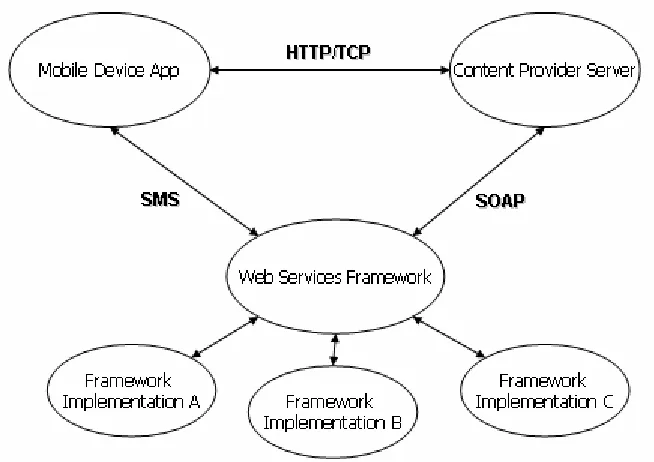
A Web Services framework introduces extensibility and interoperability to the generic mobile payment system. As shown in figure 7, the framework is situated in the position of the payment service provider, which is integrated with various framework
[image:52.612.143.470.256.487.2]implementations for different payment methods. This section describes the design patterns and WSDL interfaces implemented in the Web Services framework.
Figure 7: Mobile Payment System with a Web Services Framework
4.2.1 Abstract Factory Design Pattern
This design pattern consists of a parent component, the abstract factory, which declares an interface for operations that create abstract product objects. These abstract products declare an interface for a type of product object. The implementation of this design releases a concrete factory which implements the operations of the abstract factory to create the concrete product objects. The concrete products define a product object to be created by the corresponding concrete factory. This product object implements the abstract product interface. Client objects will only use interfaces declared by abstract factory and abstract product classes.
4.2.2 WSDL Interface as a Stateless Façade
The characteristics of a web service are specified by the WSDL file which is published for the service; therefore the WSDL interface defines the web service. A best practice for designing Web Services is to use a stateless session façade pattern. The reason for a session façade pattern is to hide a complex subsystem by creating a coarse-grained façade to provide client access to the subsystem. Therefore the façade does no new work it just is a point for access to existing subsystem functionality.
All Web Services are generally stateless, due to no definition for a stateful connection in WSDL and the transport protocol HTTP does not retain state. It is possible to force state into a Web Service using information held in a HTTP 1.0 session or in a singleton, but it is best that services remain stateless for better scalability performance.
4.2.3 Registration Web Service
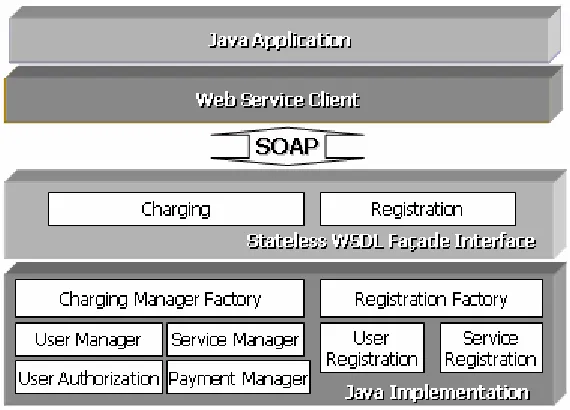
The design of the Web Service framework consists mainly of two WSDL interfaces, the registration and charging interface. These interfaces specify all the operations performed by the framework, the data type information to be transacted, and the location and
Figure 8: WSDL Design View of the Registration Web Service
The first WSDL interface defines the characteristics for a Registration Web Service (see figure 8 for design view). This service is designed for client registration with the
[image:54.612.162.447.403.608.2]payment service provider, which covers mobile user and content provider registration. The registration process involves sending client information as parameters in predefined data type objects to the Web Service. These parameters will be extracted and stored in a database for further reference. On receipt of this data the service will return a unique, client identification, data type object. This client id will be used by the client in future correspondence with the payment service provider.
Figure 9: Component Architecture for the Web Services Framework
user registration and service registration. They respectively process the registration information for the mobile user and the content provider. Examples of different concrete user objects the abstract factory can create include users that register for operator billing payment, credit card payment and reverse SMS payment.
4.2.4 Charging Web Service
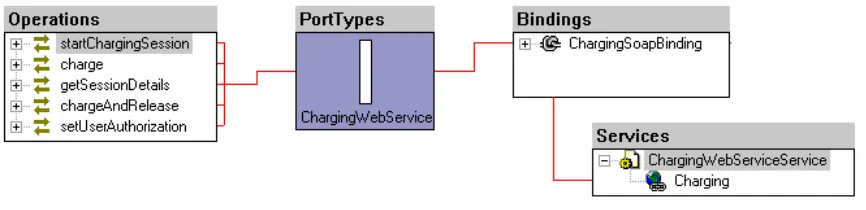
[image:55.612.90.523.393.498.2]The second WSDL interface defines the characteristics for a Charging Web Service (see figure 10 for design view). This service is designed for creating a payment transaction period, called a charging session, for the use of a content service by the mobile user. The main function of this Web Service is to transact an agreed amount from an authenticated mobile user to the content provider supplying the service used. The processes involved should be secure, atomic and transparent to the payment clients, i.e. the mobile user and the content provider.
Figure 10: WSDL Design View of the Charging Web Service
Before a charging session can be started, various operations must be done to ensure that all parties agreed to the terms of the session and are aware of the consequences of the session transactions. A charging session is requested by a registered content provider after a registered mobile user requests to use a content service. At the onset of this session request a contract is produced using the service and user details, taking from the registration information. The contract outlines the payment agreement between all parties, specifying the amount to be paid for a unit value of a service during a certain interval. The contract is presented to each party, which must digitally authorise it to make the charging session valid.
To ensure that the mobile user is the same person from whom the payment will be deducted from, the user must authenticate themselves with the framework. To limit the number of messages to the user and the tasks which the user must perform, the
framework will send the contract to the user for authorisation and then the user will be requested to authenticate themselves by replying with a PIN to the framework. For authentication to be complete the PIN should match the PIN entered by the user during registration. Once authorisation and authentication are complete then the charging session may become active.
Similarly to registration, the charging part of the framework is designed using the abstract factory design pattern methodology. The charging manager interface is a façade abstract factory interface for the framework implementation, which creates three abstract products called managers. Each of these manager interfaces effectively manages a proportion of the Charging Web Service from a perspective of one of the parties involved.
interface to the communication medium for transmission of the session contract and the receiving of the authorisation confirmation and authentication attempt. As discussed later in the next chapter, SMS technology is used to communicate the requests and responses.
The main function of the service manager interface is the creation of a charging session contract. The manager extracts relevant information from the user and service
registration stored data to construct the payment agreement between the parties involved. All major aspects of the contract are specified by the content provider during the service registration process and some addition options may be chosen by the mobile user, e.g. the settlement type for the payment transaction. The contract is defined by the charging WSDL interface as a complex data type, which may be extended to fit any kind of service and payment scenario. This methodology will be explained further in the next section.
Finally, the payment manager interface controls the process of settling payment transactions. This would involve integration with existing mobile payment
infrastructures. This interface uses the session contract details to determine the attributes of a payment transaction and following this, the transaction is completed and a payment receipt data type is returned to the clients. Once a charging session is no longer required, a charge and release operation is performed to charge any remaining amounts and
followed by releasing the charging session. All session details are now obsolete and the session id will be invalid, therefore this information will be removed from the payment service persistent storage.
4.2.5 Client and Session Identification
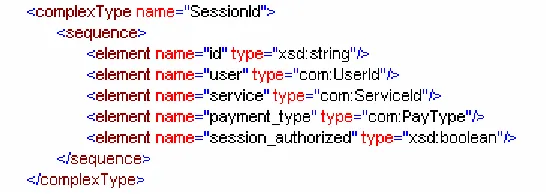
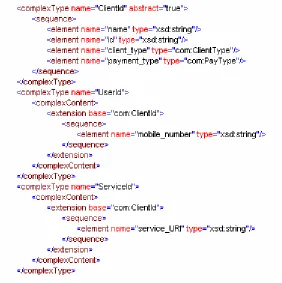
To uniquely identify a client of the mobile payment web service, a XML type is designed with extensible elements to detail the unique characteristics of a client. Such
transactions and is obtain by the client upon completion of registration with the payment service provider.
Figure 11: WSDL Complex Type for the Session Id