ScholarWorks @ Georgia State University
ScholarWorks @ Georgia State University
Art and Design Theses Ernest G. Welch School of Art and Design
Spring 5-10-2014
White Trash Cherub
White Trash Cherub
Ashley Maxwell
Follow this and additional works at: https://scholarworks.gsu.edu/art_design_theses
Recommended Citation Recommended Citation
Maxwell, Ashley, "White Trash Cherub." Thesis, Georgia State University, 2014. https://scholarworks.gsu.edu/art_design_theses/144
This Thesis is brought to you for free and open access by the Ernest G. Welch School of Art and Design at ScholarWorks @ Georgia State University. It has been accepted for inclusion in Art and Design Theses by an authorized administrator of ScholarWorks @ Georgia State University. For more information, please contact
by
ASHLEY MAXWELL
Under the Direction of Christina West
ABSTRACT
White Trash Cherub is a romanticized exploration of my autobiographical memory spanning a three-year period of my early childhood whenI grew up in a poor, uneducated, and abusive environment. This current work serves as a transitional passage between some of those memories and the metamorphosed perspective I now carry as an adult while simultaneously reflecting on the beauty of being human even though an individual’s circumstances may not be so.
WHITE TRASH CHERUB
by
ASHLEY MAXWELL
A Thesis Submitted in Partial Fulfillment of the Requirements for the Degree of
Master of Fine Arts
in the College of Arts and Sciences
Georgia State University
Copyright by Ashley Nicole Maxwell
WHITE TRASH CHERUB
by
ASHLEY MAXWELL
Committee Chair: Christina West
Committee: Maria Gindhart
Ruth Stanford
Electronic Version Approved:
Office of Graduate Studies
College of Arts and Sciences
Georgia State University
DEDICATION
I would like to dedicate this to Benjamin Tabor.
ACKNOWLEDGEMENTS
I would like to thank my thesis committee: Christina West, Ruth Stanford, and Maria
Gindhard for their supervision, presence and time. A special thank you to, Christina West for
three years of editing, opportunities, crate building, mold making and simply having faith in me.
I would also like to acknowledge my family for all the love and support they have always given
and never doubting me. To, Ben Tabor who is a constant middle path, keeping me at
equilibrium. Thank you Sarah Justice and Kelly Stevenson for being amazing friends, clam jam
forever! A special thank you to, Mark Errol for being my studio husband, and spending three
years in close proximity without having to have a throw down in “the dungeon.” Thank you,
Laura Martin for being a great friend, roommate, and travel partner. Lastly, I would like to thank
the faculty and staff of GSU Art and Design for offering their students countless opportunities
TABLE OF CONTENTS
ACKNOWLEDGEMENTS ... v
PREFACE ... 1
THESIS STATEMENT ... 3
INTRODUCTION TO AUTOBIOGRAPHICAL MEMORY ... 4
Trigger Objects ... 5
Autobiography and Narrative ... 6
SETTING THE STAGE ... 7
INTRODUCTION TO PEOPLE AND LOCATION ... 8
A LITTLE MORE BACKGROUND INFORMATION ... 10
N-‐WORD LOVER, THE STORY ... 12
INFLUENCES ... 13
Romantic Art ... 13
William-‐Adolphe Bouguereau, My Romantic Inspiration ... 14
Rococo Influence ... 19
Clodion, My Rococo Inspiration ... 20
N-‐WORD LOVER, THE SCULPTURE ... 21
CONCLUSION ... 27
REFERENCES ... 30
“Childhood- a temporary state- becomes an emblem for our anxieties about the passing
of time, the destruction of historical formations, of conversely, a vehicle for our hopes for the
future. The innocent child is caught somewhere over the rainbow-between nostalgia and utopian
optimism, between the past and the future.” Chris Jenks, Childhood1
PREFACE
Coming to Atlanta was secretly a scary thing for me. A big portion of my childhood was
spent in a small town about an hour west of here and that Podunk town held many unpleasant
memories; to me it represented everything I never wanted to be. I still have a lot of family there
and it isn’t family I’ve never met. No, it’s family that I’ve been close to my entire life—family
that consists of a great grandmother, some of my favorite cousins, an uncle, two sisters, a brother
and my only niece. I was terrified that I would be expected to visit and therefore be flooded with
old memories- ones I would rather not remember- and be faced with all that discomfort that
surfaces when nostalgia grabs hold of the reins and sends you on a roller-coaster ride. And if
anything about me is tried and true, it is my defense mechanism. If any manic person or
situation hints at tipping my scale off balance, I quickly become emotionally detached. If I went
to that small town, it meant I’d have to acknowledge dysfunction and years of abuse and that
most definitely were scale tippers! So naturally I became distant and made my excuses for not
visiting good ole’ Cedartown, Georgia. I will say that in almost three years, the only time I’ve
ever been back to Cedartown was on my terms and it wasn’t to visit family, but to gather
inspirational materials for this very thesis. With that being said, I must back track to set the stage
for this body of work titled, White Trash Cherub.
It is hard for me to recall exactly why I decided to come to graduate school. I
know it probably had something to do with getting a degree that allowed me to teach and, of
course, to be able to create work, experiment and to find a voice. What I now realize as it comes
to an end, is this journey has allowed me to find my true voice, not just any voice. Through
experimentation and critique I’ve been pushed to be true to myself and embrace what I’m
naturally inclined to want to create—to work backwards in order to understand why and then
have insight and the ability to work from concept all the way through to fabrication.
It is an understatement to say that I have met an array of very interesting people
here in Atlanta and I can say that all of them, in one way or another, have directly influenced this
newest body of work. But Sarah in particular has truly made me step outside my comfort zone
by encouraging me to examine my self as a source for inspiration, no mater how uncomfortable
and gritty it may be. To examine it, deal with it, create from it and move on. Over many bowls
of cheese dip and pitchers of margaritas my dear friends, Sarah, Kelly and myself have spent
countless hours pondering life, art, and sharing personal histories that makeup who we are today.
Through constant conversations I’ve learned how to be open with the past and not just store it in
the back of my memory and avoid it. I’ve realized that it is a part of me and that I don’t have to
do everything in my power to put miles between my current self and my child self. Instead, it
can be harnessed as a creative influence in my artistic practice. I’ve always felt that people end
up where they need to be for whatever serendipitous reasons and it is clear to me now why it was
important for me to come to Atlanta, for I have come full circle and it has never felt so right and
THESIS STATEMENT
The way people remember their childhood experiences varies from person to person.
How we subconsciously group together certain memories from a period of time gives insight to
the awareness of oneself during that era of our life and provides information about who you
were, are, and can be in the future.
Using clay, found objects, and common construction materials such as concrete, plaster,
and foam as a vehicle, I explore my childhood through specific autobiographical memories. My
sculptures serve as transitional passages between specific memories and the metamorphosed
perspective I now carry as an adult. I have recently started revisiting locations associated with
specific childhood memories. From these places, I use landmarks and trigger objects associated
with the memory as a way to inform and conjure imaginative landscapes. The landscapes are
purposely rendered in a dreamy way to disguise the harshness of my youth. By exploring these
autobiographical memories I am able to reflect on who I was and how those circumstances have
helped define who I am today.
My figures are sculpted at an intimate scale, with stylized bodies that reference the
classical tradition of figuration. This stylization supports with the way I romanticize the actions
and characters within my memories, creating picturesque scenes that, in the end, are a
combination of the authentic and fantastical. With titles such as, Dumpster Beat Down and
N-Word Lover paired with the show title, White Trash Cherub, I create an intentional juxtaposition
between the given titles and what is actually physically presented to the viewer. It is my
intention to challenge viewers, to make them question how they perceive and choose to handle
allows the audience to experience a feeling of comfort and reflect on the beauty of being human,
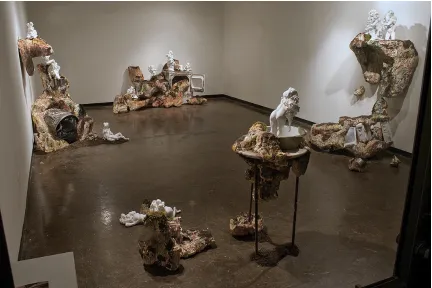
[image:13.612.109.541.127.415.2]while recognizing that an individual’s circumstances may not always be so.
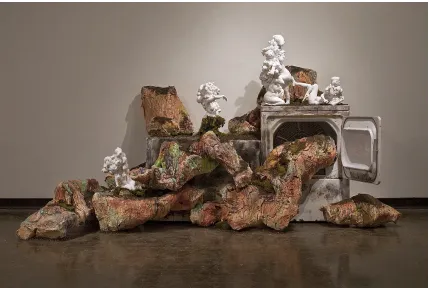
Figure 1. Ashley Maxwell. Gallery shot of White Trash Cherub.
INTRODUCTION TO AUTOBIOGRAPHICAL MEMORY
The term autobiographical memory is an umbrella concept that overarches the roots of
my work. The exact definition of autobiographical memory is broad and is extensive in its
breakdown once one starts examining the many psychological levels associated with the term. In
short, autobiographical memory is defined as, “A memory system consisting of episodes
recollected from an individual's life, based on a combination of episodic (personal experiences
and specific objects, people and events experienced at a particular time and place)and semantic
(general knowledge and facts about the world) memory.”2 In a nutshell, autobiographical
2 H. L Williams, M. A Conway, and G. Cohen, Autobiographical Memory, Memory in the Real World (Hove, UK:
memory relates to things we remember during the course of our lifetime and can be broken down
into what is known as the autobiographical knowledge base, which contains knowledge of the
self and provides information of what the self is, was, and what we can be. So ultimately, a
person’s sense of who she is stems from the memories she has of her life. Autobiographical
memory and how it functions is the backbone of my thesis and the pages that follow attest to
some semblance of the term in connection to the physical work.
Trigger Objects
Trigger objects are objects from a person’s past that when seen, cause one to remember
the memory associated with the object or the general time frame when the object was important.3
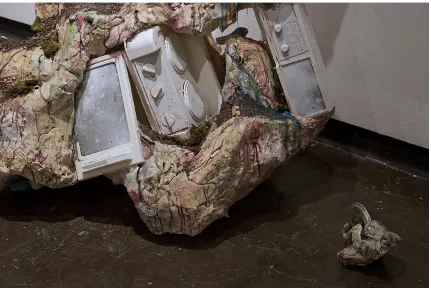
Trigger objects embedded within the landscapes for this body of work are either actual objects
from my childhood or objects that are similar to the ones I had during that time. The use of
objects within my sculptures is a way for me to link the past with the present representation of
the memory. It is also employed as a way to bring viewers back from the realm of fantasy and to
make them question the relationship between the surreal and the familiar object. An important
trigger object within the show was actual dirt collected from the trailer park, the location where
the memories that inspired the White Trash Cherub work originally occurred. That specific dirt
not only bridges the gap between fantasy and reality, but also allows me to physically represent
the location of these events in the work. It is a way for me to materialize Maplewood, the trailer
park in a gallery setting.
3 Sarah Steinvorth, Suzan Corkin, Eric Halgren, “Ecphory of Autobiographical Memories: An fMRI Study of Recent
Figure 2. Ashley Maxwell. Example of trigger object. Childs play kitchen and real pots embedded in landscape. Detail of Blood Sisters.
Autobiography and Narrative
Autobiographical narrative tells the story of an experience that took place in the author’s
life. It usually focuses on the details associated with the experience, but it also lets the author
express his or her thoughts and feelings about what happened.4 Through my research I found
that there are a plethora of autobiographical text narrations of childhood experiences that, more
often than not, depict traumatic childhoods that are characterized by abuse, poverty,
discrimination and struggles with identity. My sculptural works are just another viewpoint,
another voice and representation to add to this ever-growing genre. White Trash Cherub allowed
me to explore my child self and share with others a portion of what makes me who I am.
4 Holt, Rinehart and Winston, “Autobiographical Narrative,” Model Bank, Retrieved December 20 2013,
With this work, I’m depicting the climax moment of a particular autobiographical
narrative. I’m not telling my story from beginning to end; rather I’m choosing to represent a
particular facet of my childhood during the age range of 6 to 8. I have narrowed it down to
represent specific characters and memories that give insight to the fonder times of my childhood,
while also shedding light on the underlying circumstances of a more traumatic upbringing that
stemmed from abuse and poverty.
SETTING THE STAGE
My mother up and left my birth father somewhere around the time I was four. I
remember this age because I have a memory of racing my father around the interior courtyard of
the apartments where we lived in Jacksonville, Florida. After the race, I leaned against the front
door jamb, expressing disdain about having to go to kindergarten soon, and vowing that I was
never ever going to school. The next memory I can recall is cloudy, but I can remember helping
my mother put shoes on my baby brother, James. That scene fades into being on a big
Greyhound bus, and is foggy up to the point of sitting in a McDonalds with my mother and
James. James was in a highchair and my mother was feeding him when she saw a Ford Bronco
leaving the parking lot. I remember seeing it too; it was getting ready to pull out when my
mother yelled for me to stay with James. Now I’m not sure if it is happenstance or if it was
planned, but my pawpaw and mawmaw were the ones in the Bronco and I can only assume that
this memory of quickly placing shoes on my brother and getting into that Bronco is of us leaving
my birth father and returning to extended family in Georgia. This memory is important because
it marks the turning point in my life and the effects of it are what ultimately led to events that are
Now my mother, Mitzi, was raised by a single divorced mom who wasn’t
financially well off but wasn’t trashy either. My mother and those with whom she associated
herself, on the other hand, were. When she married my stepdad, Sam, all logic in her brain must
have been completely gone. Mitzi fell into the sad category of bad decisions resulting from low
self-confidence. She lacked self worth and no doubt was codependent. Mitzi wasn’t a bad
person-she didn’t drink or do drugs. She wasn’t very educated, but the woman was a hard
worker and was easy to get along with and everyone always loved her. She just didn’t have a
back bone when it came to Sam and really, in retrospect, it’s hard to blame her; he tried to kill
her, James and myself many times, threatened it more often than not and always accompanied
the threats with beatings and torturous acts if he ever feared she was going to leave. I guess
sometimes it’s just easier to stay than go.
It is important to reveal this because it sets the stage. It gives a small fraction of
insight to the backstory and conditions I was exposed to as a child and is important to the thesis
work on a personal level. What I’m presenting as the first installment of this work isn’t the
retelling of the physical abuse and inner workings of a disastrous family unit, but rather, I’m
presenting the fonder memories I have of my two girlfriends and myself and some of the
shenanigans we got into during this particular span of time—a time that I often refer to as my
white trash days.
INTRODUCTION TO PEOPLE AND LOCATION
Cedartown, Georgia. The setting is Maplewood, a trailer park that is plopped down on
the edge of town. Also known as home for roughly three years during a pivotal turning point of
my life. It had to have been the first few days of moving to the trailer park when I remember my
but she had given me a bunch of pots and pans that she was throwing out so that I could go play
house. Somewhere along the way I found an old rotting rope just lying around so I added it to
the arsenal and a plan came to fruition. I can recall reciting my plan with quite some sass to the
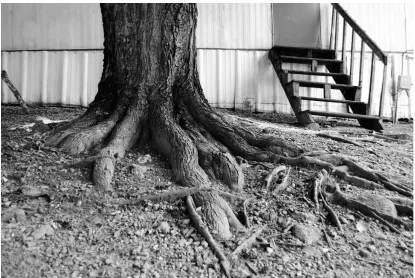
lady; I was going to tie all these pots together in an intricate trap around the root system of the
only tree in her little sliver of a backyard. The woman then properly warned me about two
trouble- making rug rats who stole, fought, bullied and ran wild in the trailer park and who
would, no doubt, steal my pans. I specifically remember stating with confidence that those girls
weren’t going to get past my knots and trickery and with a Crayon- scribbled note of warning. I
was 100 percent convinced that those loose cannons were absolutely NOT going to steal my
pots. Well, you can bet those girls sure enough stole all my pots and didn’t even leave me the
rope as some sort of warped atonement for their actions. This was my first introduction to “the
[image:18.612.99.514.401.679.2]sisters” Nicole and Christina Bullington who were to be my future best friends.
Now I don’t know when the three of us became best friends, but somewhere along the
line it happened. Nicole was my age, and Christina was a grade or two ahead of us, but the three
of us ran wild—barefoot troublemakers whose parents were never around or cared to teach us
any better. “If you can’t beat them, join them” so the old saying goes.
A LITTLE MORE BACKGROUND INFORMATION
I was no older than six when I was fully in charge of James, Samantha, and my new baby
sister, Amanda. I can remember school days when I relied on my biological clock to get James
and myself up, dressed, and to the bus stop for school, and summer days when I babysat all day.
I made ten bucks a week during the summer and I would save my money up so that I could buy a
few new school clothes and school supplies at the local Family Dollar. I didn’t mind buying my
own supplies because it would mean that I got to pick what I wanted and didn’t have to go with
the cheapest option. Honestly, it was a good lesson in saving. Nonetheless, I always felt like a
mini-mother, charged with feeding, cleaning and getting my siblings to bed without any adult
supervision. When it came to cooking, I would have to pull the kitchen chair to the stove. I
remember patting out hamburgers and cooking them in Crisco. I even knew not to put the grease
down the sink and would save it in a can for future use. I have no idea how I didn’t burn the
trailer park down. Looking back, there was definitely a duality to my childhood. I was a
domesticated child, taking on the role of a grown woman on one hand and completely innocent
and inexperienced in the lessons and boundaries of life on the other.
If I were to reflect on all my memories during my “white trash days” in search of
what I would consider the epitome of my loss of childhood innocence, it would be what
transpired the first time I figured out my stepdad stored his porn above the washer and dryer in
really sets the tone for what life was like through my eyes during the time when it should have
been untainted.
Nicole, Christina, and I used to scale up the front of the appliances and share all
the interesting positions we found in the magazines. To this day I can still remember some of the
sex scenes depicted in the photographs. And honestly, it didn’t stop at the three of us huddled
around magazines in the bathroom. We would invite the other kids from the trailer park over, sit
them in the living room and bring out the collection of VHS tapes, plopping them into the VCR
and taking turns fast forwarding to our favorite parts. Eventually we were rotating to the other
kids’ trailers to see what their parents’ porn stashes had to offer. We played strip spin the bottle
and I even remember getting busted by my second grade teacher, Ms. Adkins, for passing a note
to a friend that was informing her that Christina had supposedly had sex in a closet with a boy!
To say we were highly sexualized at an early age is an understatement. And it is
important for this work that I depict traces of that sexuality throughout the entire show. These
traces sometimes appear as poses of fully developed women reenacting the actions of children,
or sometimes in the pairing of these fully developed women with toys that I possessed as a child.
As I stated previously, the washer and dryer is a symbolic representation and anchoring symbol
for sexual presence during my youth.
The washer and dryer physically make an appearance as the focal point in my
show, serving as the foundation for the scene of N-word Lover. No matter how fast we were
forced to grow up, we were still so innocent and oblivious to the social workings of the world.
We hadn’t been taught much about what was right or wrong, so, often as kids do, we acted
without any consideration of what our words meant and how hurtful or negative they were, or
adult concepts and unknown histories, but through the eyes of inexperienced juveniles naïve to
the rest of the world.
The following story falls into the category of autobiographical memory that is
known as an analogous event. Analogous events are something that happened in the past that
dictates future behaviors.5 I can say without a doubt that this had an outcome that set the tone
for a life long lesson and quickly put in perspective that there was a whole lot out in the big ole
world I didn’t understand, but just because I couldn’t comprehend it didn’t mean I could go
around loose tongued. I want to note before going further that for this thesis paper I’ve chosen to
dissect one sculpture and the story that accompanies it. All other pieces from White Trash
Cherub have a similar infrastructure as N-Word Lover, though their specific stories will not be
discussed here.
N-WORD LOVER, THE STORY
Just beyond the boarder of the trailer park, distinguished by a slope peppered with pines,
sat an old rugged house surrounded by old beat up cars, trucks and layers of mud. The couple
that resided in that little house was an interracial couple- a black older man and a white older
woman. Now, in the first grade I had little boyfriend named Jamie and he was black, so when
Nicole, Christina and I stood on the back steps of my parents trailer and screamed over and over
to the couple below, “N-word lover” (insert the actual word) at the top of our lungs, it is a
testament to the fact we didn’t, or at least I didn’t, understand the significance of the word. Nor
did we understand the consequences of using it. That man definitely made it a mission to see to
it that even if I was clueless, I would remember it was a word I never wanted to breathe again. It
was commendable on his part, but was a hard lesson to learn on mine.
5 Explorable.com, “Autobiographical Memory,” Explorable.com. Retrieved December 21 2013,
He waited until my parents were home and I can still remember the sinking
feeling in my stomach when I saw him pull up in his truck and step into our yard and proceed to
inform my step dad of what Nicole, Christina, and I had done earlier in the day. I also remember
him insisting I get my butt tore up for it. Since Sam never needed a reason to give a beating in
the first place, he most certainly obliged. He took his leather belt off right then and there and
didn’t just whip me, he beat the b’jesus out of me, metal buckle end first! I can only imagine
how bad the man must have felt because the only reason Sam stopped when he did was because
the man insisted that he do so.
This is the defining moment in my life that made me aware of how hurtful words
could be and I believe this is also the time I became aware that there was a difference between
“your mama is so fat” jokes and derogatory name calling. Referring to someone by a racial slur
wasn’t a joke or a laughing matter and it had serious repercussions; all my bruises were proof of
that. This memory was important for me to reference as part of this show because it
demonstrates a pivotal moment in my life that aided in defining my character and helped develop
an understanding, appreciation, and tolerance of others who were different than me.
INFLUENCES
Romantic Art
The vast majority of my work is influenced by the notion of Romantic Art. Throughout
the centuries, the understanding of the word ‘Romantic’ has continuously grown to signify more
than just the idea of romantic love and my interest in Romantic Art goes beyond chivalrous acts
often solely associated with the word. Researching the period extensively allowed me to
understand the mindset of these artists and characteristics associated with the movement and why
Initially the term ‘Romantic’ was equated with the old tales of chivalry, but as
early as the mid 1600’s it was being associated with aspects of the imagination.6 The
significance of ‘Romantic’ continued grow and around 1710, “ tales of imagination and
sensibility and the scenes and landscapes described in them were being taken more seriously, and
the term ‘Romantic’, applied to them, and came to signify ‘imaginative’, ‘interesting’, ‘exotic’,
‘unusual’ or beautiful’.” Romanticism, as an artistic movement, was birthed out of the
politically turbulent background of the French Revolution, Napoleonic Wars, and the American
Revolution, when times were filled with war, strife, and all around uncertainty.7 Romantics
attempted to rediscover a past Utopia in juxtaposition to these ugly times. Today, a simple
search to define Romanticism describes it as an emphasis on the imagination and emotions and
the use of autobiographical material with an appreciation of external nature and interest in the
remote.8
With White Trash Cherub I aim to explore and depict my memories from the
same perspective as the romantics that came before me. I see a parallel between my work and
the work of the Romantic era that had an opposition to grit and countered it with imagined peace,
beauty, and the picturesque as a means of escaping the real world. I admire their decision to take
on a more optimistic view of the life around them than choosing to paint their work as the
darkness that it was.
William-Adolphe Bouguereau, My Romantic Inspiration
William-Adolphe Bouguereau was a French painter during the Nineteenth century.
Bouguereau is known for his mythological themes and idealized world that mostly captured
bathers, nymphs and shepherdesses. The vast majority of his paintings had a large emphasis on
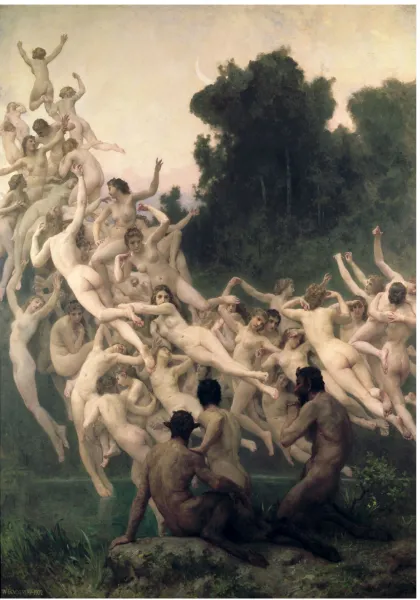
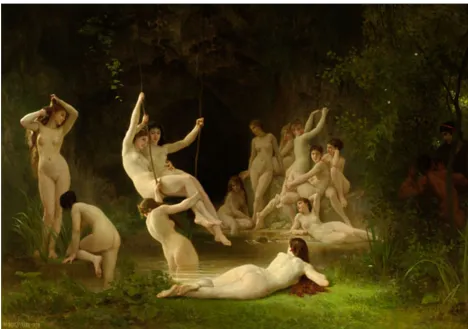
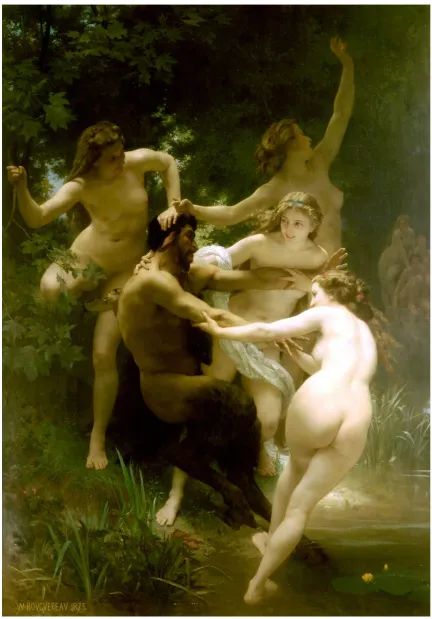
the female figure.9 Three paintings that I intensely draw inspiration from are: The Nymphaeum
(1878), The Oreads (1902), and Nymphs and Satyr (1873).
When it comes to inspiration for my work, I’m interested in the elegant poses and
groupings of the figures more than the mythology that Bouguereau captures in his depictions. In
The Nymphaeum and The Oreads, the nymphs are depicted as passive and beautifully posed,
mostly lackadaisical, unaware and frozen in some sort of flowing slow motion, and stretched-out
positions. There is something alluring and almost musical about the scenes. They are in action
but not necessarily taking on an active role. I feel as if Bouguereau’s figures create a dialogue
amongst themselves, though there are with no words spoken. I like to compare it to the way
musical scores create emotionally charged dialogue but words have no place amongst them.
What I admire about Nymphs and Satyr is the active role of attaining a goal. The Nymphs have
caught a peeping Satyr and intend to dunk him in the waters in which they bathe. There is
pushing, pulling, bending and running captured within this painting and I am constantly striving,
little by little, to incorporate similar active roles for my ladies. When rendering the female nude,
I use the sensual positioning and robust softness found in Bouguereau’s style.
Rococo Influence
Much of my inspiration is also derived from the Rococo sculptures of the 1700’s.
Ultimately what I enjoy about the Rococo style is its elegance and beauty.
When discussing the role of Rococo and the significance of the stylistic sculptures of that
period and how it transfers to my work, I best like the description by Gauvin Bailey, “Adopting
the dramatics, gesture and illusionistic perspective of the stage, they seek to engage and employ
the human passions, from the mystical and ecstatic to the violent and erotic. They also favor
the area beyond.”10 The idea of capturing a dramatic single moment like a snapshot is something
that I’m constantly considering.
Clodion, My Rococo Inspiration
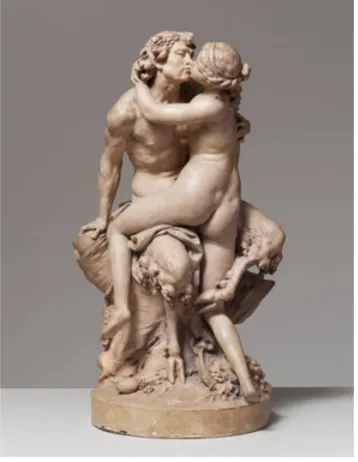
My favorite and most influential sculptor from the Rococo period is Claude Michel,
known simply as, Clodion. Clodion is best known for his small Rococo styled terracotta
sculptures of nymphs and satyrs. His work is amazingly rendered in the round and I am in awe
of his ability to capture movement through the medium of clay. In fact, there is one pose that
I’ve used as direct reference to his sculptures. It can be found in N-word Lover and will be
discussed in the next section.
Figure 7. Clodion, Female Satyr with Putti
N-WORD LOVER, THE SCULPTURE
By borrowing visuals and ideas from the above pool, intertwining them with
romanticized sculptures in a contemporary way. This can be seen with the introduction of the
washer and dryer set as I felt it was appropriate to use the washer and dryer as the understructure
for the romanticized portrayal of N-Word Lover due to its symbolic representation of the
instability of my childhood, its link to sex and “adult things,” and how my view of the world was
through a distorted filter. N-word Lover is the first example of me having real world awareness
of sexual preferences; sex and fetishes no longer just lived in the magazines and on TV screens,
they were a part of actuality. I reference this further by embedding clippings from early 90s porn
magazines as the foundation of the landscapes that are slowing overgrowing my trigger objects.
It is important to mention that in the sculpture I decided to omit any male
presence. It was not only an aesthetic decision, but also a conceptual choice. I didn’t want to
open a conversation about male and female hierarchies or have too much deliberation of the male
presence, as I felt it could potentially lean that way, given the ratio between the two sexes.
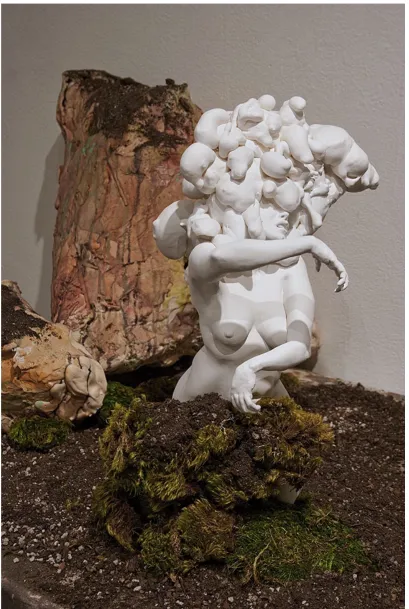
Instead, I chose to represent them as ghost characters. The females that require interaction with
men are seemingly interacting with the air. This can be seen in the representation of the white
woman who was the lover of the black man. I have her straddling a rock form that resembles a
lap with spread legs. In fact, this pose is based on one seen in Clodion’s, Satyr and Nymph, in
I’m drawn to the pose of this female because it isn’t your typical frontal view of a
figure. Instead it is of her backside and its softness, with her elegant, sweeping motion
projecting love or sexual attraction towards a lover. For this reason, I chose to borrow her pose
for the white woman. I wanted to express the relationship between the interracial couple in a
way that allowed the viewer to associate her pose with something I would consider to be loving
or sexual. The figure that represents myself is the woman on her back in a braced position as she
twists and kicks upwards. I wanted to represent the actual beating that took place as a result of
my actions. In this composition, Nicole and Christina’s positions recreate the act of yelling
downward towards the white woman’s character, similar to the actual relationship of my trailer
to her house. I have one character on her knee while the other character rests her foot on the
supporting leg of the crouched woman. This is symbolic for the way we enabled each other and
encouraged one another to do bad things. It’s important to note that I do not think it is necessary
that the viewer be privy to the exactness of my memory or to even know that it is a recollection.
It is my wish that viewers employ their own interpretations or simply admire it for being
Figure 10. Ashley Maxwell. Detail of N-Word Lover.
[image:35.612.112.541.400.688.2]CONCLUSION
White Trash Cherub represents a romanticized depiction of defining and difficult
formative years. The elaborate and embellished landscapes I have created present a
whimsical interpretation of a youth spent growing up too fast. Barefoot and muddy
troublemakers are transformed into flirtatious female figures while beat up cars and
double-wides become brightly colored fantastical terrains.
Romanticizing my autobiographical narrative allows my work to become a more
accessible vehicle for the discussion of tormenting memories. Although this body of
work has its own specific personal meanings, the presentation of these imaginative
compositions may allow the viewer to evaluate his or her own memories through an
escapist lens. White Trash Cherub additionally represents the culmination of my time in
Atlanta. It reflects the relationships created, the research completed, and the knowledge
accumulated over my three years in the city. The combination of those three ingredients
REFERENCES
Bailey, Gauvin Alexander. Baroque & Rococo. London: Phaidon Press Inc., 2012.
Douglas, Kate. Contesting Childhood. New Brunswick: Rutgers University Press, 2010.
Explorable.com. “Autobiographical Memory.” Explorable.com. 12/21/2013. http://explorable.com/autobiographical-memory
Holt, Rinehart and Winston. “Autobiographical Narrative.” Model Bank, 12/20/2013. http://go.hrw.com/eolang/modbank/mguide/mg11-1.htm.
Lister, Raymond. British Romantic Painting. Cambridge: Cambridge University Press, 1989. Wissman. Fronia E. Bouguereau, Rohnert Park: Pomegranate Artbooks, 1996.
Steinvorth, Sarah. Corkin, Suzan. Halgren,Eric. “Ecphory of Autobiographical Memories: An fMRI Study of Recent and Remote Memory Retrieval.” NeuroImage Elsevier. Retrieved January 1 2014.
http://web.mit.edu/bnl/pdf/Steinvorth,%20in%20press.pdf.