ScholarWorks @ Georgia State University
ScholarWorks @ Georgia State University
Anthropology Theses Department of Anthropology
Fall 12-17-2014
Examining The Social Networks Of Internationally Married
Examining The Social Networks Of Internationally Married
Couples And Divorced Individuals: Are Relationships Autonomous
Couples And Divorced Individuals: Are Relationships Autonomous
Entities?
Entities?
Kimberly Johnson-Diouf
Follow this and additional works at: https://scholarworks.gsu.edu/anthro_theses
Recommended Citation Recommended Citation
Johnson-Diouf, Kimberly, "Examining The Social Networks Of Internationally Married Couples And Divorced Individuals: Are Relationships Autonomous Entities?." Thesis, Georgia State University, 2014. https://scholarworks.gsu.edu/anthro_theses/89
AND DIVORCED INDIVIDUALS: ARE RELATIONSHIPS AUTONOMOUS ENTITIES?
by
KIMBERLY JOHNSON-DIOUF
Under the Direction of Jennifer Patico PhD
ABSTRACT
Research on international relationships is plentiful but research on the roles of social
contacts in international relationships has not been forthcoming. Additionally, recent research on
companionate marriages suggests that couples who have relationships that mimic companionate
marriages have weak ties to their community. This research uses participant narratives to
understand the social network of internationally married couples and divorced individuals in an
effort to understand the roles that social contacts may play in international marriages. The
research findings challenge pre-existing arguments about the companionate model of marriage
and suggest that simplistic marriage models are inadequate frameworks used to understand
INDEX WORDS: International marriage, International divorce, Companionate marriage,
AND DIVORCED INDIVIDUALS: ARE RELATIONSHIPS AUTONOMOUS ENTITIES?
by
KIMBERLY JOHNSON-DIOUF
A Thesis Submitted in Partial Fulfillment of the Requirements for the Degree of
Master of Arts
in the College of Arts and Sciences
Georgia State University
Copyright by
AND DIVORCED INDIVIDUAL: ARE RELATIONSHIPS AUTONOMOUS ENTITIES?
by
KIMBERLY JOHNSON-DIOUF
Committee Chair: Jennifer Patico
Committee: Kathryn Kozaitis
Cassandra White
Electronic Version Approved:
Office of Graduate Studies
College of Arts and Sciences
Georgia State University
DEDICATION
I give honor to God for giving me the opportunity to be an educated woman of color- an
opportunity which did not fully present itself to my mother and grandmothers. I dedicate this
work to my late father who passed away only months before I received my bachelor’s degree. He
was the most intelligent man (and the funniest man) I ever knew. He pushed me to be educated,
saying that people can strip you of money, clothes, and material possessions but no one can take
your education away. He would be very proud of his “little fat girl”.
This work is also dedicated to my mother who always encouraged me to press on in the
face of adversity. For days at a time you cooked, cleaned, and somehow managed all four of my
children just so I could focus on my studies. Your hard work will never go unnoticed.
To my husband, Bassirou Diouf, I would like to say thank you. Thank you for being a
loving husband and a hands-on father. You have worked very hard to support our family; your
dedication to our family is undeniable. Thank you for allowing me to cry, complain, and get
angry all because of my studies. Most importantly, thank you for holding my hand through it all.
To my sons, Mioka Mokontou and Mamadou Diouf, and to my daughters, Fatima Diouf
and Farrah Diouf, in a world that refuses to acknowledge God, make Him known through your
words and actions. I encourage you to be leaders of your generation and to take advantage of
every viable opportunity. Do not let your ethnicity, gender, or environment stand in the way of
your goals. Surpass your parents in your piety and your faith. Finally, I pass on to you what my
father told me: remember that people can strip you of money, clothes and material possessions
ACKNOWLEDGEMENTS
Thank you to all of the participants who made this research possible. Many of you
willingly invited me into your homes and even to your jobs to complete interviews (sometimes
staying past 10pm!). We laughed, we joked, and I even cried with a few of you. Some of you
even cooked for me and/or allowed me access to family photo albums. It is all appreciated. I
thank you all for your flexibility, your candor, and your transparency.
I owe many, many thanks to Dr. Jennifer Patico. You were the perfect advisor. You
allowed me to be creative yet you were always honest about what was feasible. You were
nothing but helpful and I could not have succeeded without you. Your concern for me went
beyond the university; many times you inquired about my health and my family. I thank you for
making me feel like a valuable individual, not just another student needing your help. I look
forward to calling you friend rather than professor in the years to come.
Thank you to Dr. Kozaitis and Dr. White for the guidance you graciously provided to me
while I was in the department. To all of the professors in the anthropology department, thank you
for fostering my educational growth for the years that I was at Georgia State University. Many of
you even contributed to Dr. White’s efforts to send me bereavement flowers after the death of
my father, which is above and beyond the call of duty. Thank you all very much.
Thank you to Gale Brock, data dissemination specialist for the Census Bureau of Atlanta,
for patiently helping me to navigate through the complicated U.S. Census data for my research
purposes.
Finally, thank you to my sisters in Christ, Velma Burks and Desiree Warren, for all you
TABLE OF CONTENTS
ACKNOWLEDGEMENTS ... v
LIST OF TABLES ... viii
1 Chapter 1-Introduction ... 1
1.1 Project Goals ... 2
1.2 Pilot Ethnography ... 3
1.3 Methodology ... 5
1.3.1 Recruitment ... 5
1.3.2 Data Collection ... 9
1.4 Literature Review ... 12
2 Chapter 2- Introducing International Marriage and Divorce: Love and Agency .. ... 22
2.1 Marriage ... 22
2.2 Divorce... 25
2.3 Agency ... 27
3 Chapter 3 – The Social Network... 33
3.1 Prioritizing Companionate Marriages and Extended Family ... 33
3.2 Then comes baby: The Status of Grandparents after Children ... 36
3.3 Friends: The Family We Choose ... 39
4.1 Identity ... 44
4.2 Economics ... 48
4.3 Religion ... 50
5 Chapter 5- Conclusion ... 54
5.1 Research Limitations ... 55
5.2 Shifts in Marriage... 57
5.3 The Future of International Marriage ... 58
LIST OF TABLES
1 Chapter 1-Introduction
“…They thought his dad was my husband…and his
dad has long dreads (dreadlocks) down his back and I’m
like, ‘Do you think I would marry some 50 year old man?’”
-Sarah (North American)
Sarah sat diagonal from me at her kitchen table watching for my reaction to what she felt
was an insult. Sarah was telling me about the time her father-in-law had come down to Georgia
from the Northeast a few years ago. He happened to be pushing one of his grandchildren in a
stroller when he was mistaken by Sarah’s associate to be Sarah’s husband, Michael. At the time,
Sarah was in her 30’s and her father-in-law was in his 50’s. We had shared many laughs during
our interview and in that particular moment I laughed at how animated she was as she told the
story. She slapped her hand against the wooden table and leaned forward for emphasis while
suggesting that her husband simply could not be 15 to 20 years her senior, with dreadlocks
nonetheless. I debated telling her that my own husband, Dean (Senegalese), was 16 years my
senior, but I feared that she may become embarrassed and limited in what she told me.
What ultimately interested me about Sarah’s story and other stories like hers and
Michael’s was how their nuclear family interacted with people outside of their core family unit
and what kinds of exchanges took place. A great example of these exchanges in Sarah’s life was
her father-in-law helping her with the children in her husband’s absence. Chapter 2 will show
how many non-native partners tended to have heavy involvement with their spouse’s relatives
and other social contacts. Similarly in my own international marriage, our social network
children almost twice a month and sometimes we had a mutual friend who mediated when Dean
and I had a major disagreement. These interactions run counter to Paul Amato’s (2009) notion
that marriages modeled after the companionate and individualistic models of marriage - those
which are presumed to be normative in the United States and much of the world today - have
nuclear families that operate relatively independent of social contacts. This research focuses on
the relationships among internationally married couples (and divorcés from international
marriages) and the people in their social networks.
1.1 Project Goals
This research speaks to two primary issues. First, it examines the nature of the link
between internationally married couples and their social networks, as described by participants in
the study. Additionally, international marriages are said to have more problems than
intranational marriages and often end in divorce (Amato 2009:78-81). This research does not
provide new information on the divorce rates of internationally married couples but rather seeks
to understand the motives behind the divorces that do occur and the roles that social contacts
played in the marriages before and after divorce.
Another goal is to conduct this research using a qualitative approach. Qualitative
ethnographies of international marriages are limited. Ethnographies that address social networks
of internationally married couples and divorcés and are assumed to be even more infrequent and
possibly non-existent. Interviews were conducted to gather narratives concerning social contacts
as told by the participants. Participant narratives were a critical aspect of the research process
because some studies published concerning international marriages are conducted by sociologists
and demographers whose analyses often rely on quantitative research, such as census surveys,
1970). While the quantitative research of sociologists and demographers make necessary
contributions to social scientific knowledge, participant narratives are more useful in a
qualitative study that aims to illuminate the cultural trends underlying marriage stories .
Quantitative research cannot provide information about the meaning that people find in being
married or divorced. Likewise, quantitative research cannot address the reasons that people in
intercultural marriages may face adversity, how the adversity they face as individuals is unique,
how they navigate the issues they face, or who helps them navigate their issues.
1.2 Pilot Ethnography
Pilot ethnography was conducted on the topic of international marriage to gain a general
knowledge about marriage as a basis for further research. In particular, this pilot research
allowed me to gain specific knowledge about the growing phenomenon of international marriage
according to the people experiencing these marriages. Much of the literature suggested that
international marriages are becoming very common but most often end in divorce (Amato
2009:84-85). My goal was to understand how these marriages might be different from
same-nation marriages in terms of relationship dynamics and most importantly what would make these
marriages more prone to divorce than same-nation marriages. I asked questions about
decision-making, communication, hybrid cultural practices (blending cultures), financial planning,
reactions to disapproval, and support during marital hardships.
What I found was that the decision-making about issues such as child-rearing was shared
among the couples but in most cases the final decision was left to the husband. There were
communication challenges between the spouses which most couples attributed to the language
barrier between them. Spouses typically blended traditions from each of their background to
expertise. Most couples had not experienced direct disapproval of their international relationship
by others in their social networks. Finally, when hard times arose, most couples turned to family
members or close friends for support and/or advice.
It did not occur to me until the pilot research was completed that in each conversation
with the pilot research participants, people constantly made references to people outside of their
marriage. For example, some of the couples started dating because a friend urged them to or
introduced them with the intent of them becoming a couple. In some cases, there were people
that the couples could talk to if they were having troubles or disagreements in the marriage.
Chapter 2 will show that support and/or advice from outside of the marriages complicates the
isolated and independent vision of the modern companionate marriage that many contemporary
social scientists assume to be normative in the U.S. and elsewhere in the world. There was also
mention of key people that had to approve of the relationship before a partner decided to marry
their spouse. Thus, the connections that these marriages had to broader social networks became
the basis of my thesis research.
There were several limitations in the pilot ethnography. The most important of these
limitations was the sample size of the participants in the pilot ethnography. The pilot sample
consisted of five couples (ten people). Though the consensus is that you can technically do a
qualitative study with a sample size of one, when conducting ethnography to see what could be
affecting a trend, the more participants included increases the possibility that similar patterns will
emerge in the result. Another limitation of the pilot study was that four of the five couples were
recruited through contacts at my church. As a result, the people that contacted me who were
willing to be interviewed tended to be more religiously inclined than the one couple that was
not foresee. For example, on more than one occasion, reasoning for life events or occurrences
were summed up to fate handed down by God. God and fate were not topics that I wanted to
focus on initially, but Chapter 3 will show how people can be influenced by their lifestyles and
their sense of self among other things. Finally, time was also a factor of limitation in the pilot
study. The research was conducted from start to finish in less than two months. This time frame
did not allow for more participants, nor was I able to add more depth to the ethnographic data by
conducting additional subsequent interviews with the same participants.
Despite the limitations, my pilot ethnography enlightened me that social network contacts
are important to international marriages, but it left some critical questions unanswered. What
cultural trends are at work? How are social contacts important? And to what extent do social
contacts shape the decision making process of individual in international marriages, if at all? I
also felt that it would be important to know what role social contacts play in marriages that are
now dissolved. I set out to answer those questions in this ethnography.
1.3 Methodology
1.3.1 Recruitment
For the purposes of this research, 21 total participants were recruited, which included
married couples and divorced individuals. I had initially anticipated that approximately 25
participants – 7 married couples and 11 divorced individuals – would participate in this research.
However the final number of participants was 21, which included 8 married couples and 5
divorcés. Recruitment was done primarily through word of mouth. I used every opportunity
possible to tell people about my research at my university, church, and in my circle of contacts. I
hoped that whomever I was speaking to would be interested or would know someone who may
research; instead I used the flyers by giving them to participants so they could pass it on at will
to others who may have fit the participation requirements. I changed tactics because my IRB
approval had already taken enough of my research time. When I finally received the approval for
this research, time was running out and I thought the flyers were more useful if I handed them to
people myself instead of taping them to a wall.
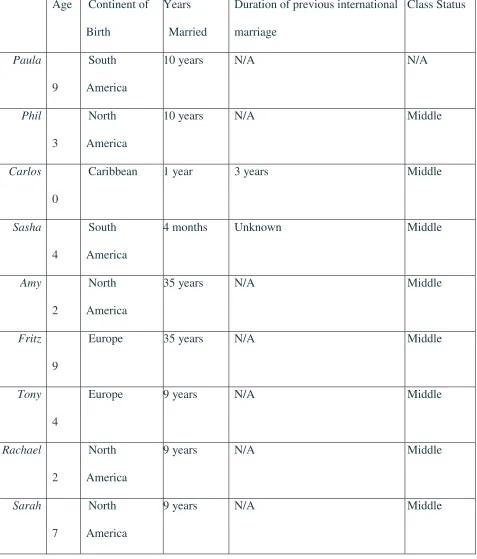
The table below contains demographic information. In the table, continent of birth is used
instead of country of birth for the foreign born participants. This was done to protect the
confidential identity of the participants because some of the participants attend the same local
church. Additionally, continent of birth was used throughout the table for all participants for the
purposes of uniformity. However, when their narratives are told in later chapters, I use USA to
identify the participants born and raised in the USA. Due to the nature of this research as one that
is conducted in Atlanta, G.A., U.S.A about international marriages, it is to be expected that some
of the participants would be born and raised in the United States. The class statuses represented
in the table are the participants’ self-identified class status. Some participants chose not to reveal
Table 1 Participant Demographic Information
Age Continent of
Birth
Years
Married
Duration of previous international
marriage Class Status Paula 9 South America
10 years N/A N/A
Phil
3
North
America
10 years N/A Middle
Carlos
0
Caribbean 1 year 3 years Middle
Sasha
4
South
America
4 months Unknown Middle
Amy
2
North
America
35 years N/A Middle
Fritz
9
Europe 35 years N/A Middle
Tony
4
Europe 9 years N/A Middle
Rachael
2
North
America
9 years N/A Middle
Sarah
7
North
America
Michael
0
North
America
10 years N/A N/A
Joy
9
Southeast Asia 8 years N/A N/A
Travis
2
North America 8 years N/A Middle
David
6
North America 25 years N/A Middle
Joanna
7
Europe 26 years 3 years
Lower-Middle
Samuel
7
North America N/A 20 years Middle
Sheila
8
North America N/A 12 years N/A
Marla
6
North America 11 years N/A N/A
Reid
0
South America 11 years N/A N/A
I contacted two participants from my pilot research in an attempt to recruit them to
participate in this research study. I did not contact the other participants from my pilot research
because I wanted the participants in this project to represent diversity specifically in Atlanta,
and one additional couple moved out of the state between the end of the pilot research and the
start of this current study. Of the two participants that I did attempt to contact, one couple was
unresponsive to my phone call and voice message. Consequently, that couple was not pursued
further. The other couple was asked in person if they were interested in taking part in this
research and they were happy to participate a second time. I made it abundantly clear to all
participants that neither involvement in this research nor the forwarding of my personal contact
information was mandatory.
1.3.2 Data Collection
The recruits that consented to participate in this thesis research project were interviewed
a minimum of one time. There were two follow-up interviews conducted and several casual
conversations about marriage in general before and after some of the original interviews.
Information from interviews and casual conversations were what allowed me to understand
marital, post-marital and extramarital social dynamics. Information gathered from informal
interviews generally supported the narrative already detailed in the formal interview.
Internationally married couples were interviewed separately and confidentially for the initial
interviews. Participants that were divorcés of international marriages were interviewed
individually without the presence of the estranged spouse.
Interviews allow anthropologists to ask in-depth questions and allow an interviewer to
ask unplanned follow-up questions. Additionally, anthropologists are often able to let the
participant guide the conversation by using semi-structured interview questions rather than
structured questions. Doing so allows the researcher to ask the questions they think are important
but also allow the participant to discuss the issues they think are an important contribution to the
series of in-depth questions, but what the participants actually shared was completely under their
control. The longest interview was 1 hour and 45 minutes while the shortest was 25 minutes. On
average, each interview lasted approximately one hour.
Due to the nature of the study as one that aims to focus specifically about social contacts,
which includes the touchy subjects of parents and in-laws, it is always possible that some
information could be withheld during interviews to spare feelings. I felt the risk of this would
have increased if I were only interviewing the couples together. It was to be expected that when
interviewing couples together, I would be given the general impression that everything was
excellent in their marriage and that they adored everyone their spouse introduced to them.
Therefore, I decided that discussions with individual partners may be more revealing of their true
feelings about social contacts during interviews. I also recognized that individuals would likely
feel more comfortable sharing information with the knowledge that they have complete
confidentiality, even from their spouse. Thus, all initial interviews were conducted separately for
couples.
I also had the opportunity to conduct multiple but brief observations and participant
observations of interactions between the married couples and between one or both partners with
contacts in their close social network. Observation and participant observation were used to
gather background and/or contextual information. Participant observation entails the same
process as observation but the researcher may take a more hands-on approach instead of just
observing. I observed many interactions in the field between the couples and I generally just
watched and took note of things. However, there were other times that I became a participant
a hand to change the baby for Sarah’s mother and I helped to organize the diaper bag and other
baby items by making them easier to carry.
As a supplement to interviewing and observation I wrote field notes during interactions
and interviews with participants. Field notes allowed me to pay special attention to minute
details such as body language, excitement, and hesitations during the interview. Field notes were
also useful to document the setting of the interview. For example, when an interview was taking
place in a participant’s home I was likely to see pictures on the walls that may clue me into who
was important in the his/her life.
Finally, there were two things that I intentionally avoided doing in this research study.
First, I did not compare the relationships of intranationally married couples and internationally
married couples. No comparison was made because there is not a group with which international
marriage or any relationship discussed in this research can adequately be compared. Each
relationship, international relationships included, are unique in their complexities. When
comparisons are made with relationships that are dissimilar, the comparisons can cast the
relationships as polar opposites. It is important to say that all marriages have their different
issues and that such comparisons would have complicated this study rather than advanced it. I
acknowledge that some challenges may be shared by international and intranational couples;
however, the intent of the research is not to compare the two types of marriages.
Second, I was very intentional in not asking about topics of immigration such as
citizenship statuses, visa statuses, and/or anything else related to immigration during interviews.
The purpose in not discussing immigration was simple: this research was/is not directly related to
issues of immigration and I wanted everyone who participated to be comfortable talking to me
immigration were not mentioned by the participants because some participants indeed had a lot
to say about immigration politics. I did not ask about statuses nor did I dwell on the subject.
However, it later became important to use a narrative from someone with non-legal status to
show how parts of the self are constructed in relation to companionate marriage and society. The
use of the narrative concealed as much identifying information about the participant as possible.
1.4 Literature Review
This research asks: What are the functions of social contacts in the marriages of
internationally married couples? What were the functions of social contacts in international
marriages that are now dissolved? What other factors may have influenced international
marriages that are currently dissolved? Finally, what factors may influence the course of current
international marriages? To frame the significance of these questions, background information is
necessary about the general trends of marriages, divorces, and international relationships.
Early works from some social scientists suggested that the process of spousal selection
took place according to the characteristics and qualities of a potential mate (Buss and Barnes
1986) and that we frequently choose someone very similar to us for various reasons (Bizman
1987, Buss 1985). Buss (1985) made a logical geographical reference that people who share the
same local space (e.g. neighborhood, grocery stores and other areas of the city) select marital
partners from that same locality. Cottrell (1973) posited that intercultural marriages were usually
a direct result of a lifestyle that allowed for international travel. According to Cottrell,
international travel leads to an appreciation of people of unfamiliar national cultures.
The concept of globalization remains important and its applications are a key theoretical
principle in this research. However, technology has changed the way we communicate since
“cultures” as entities distinct from one another experientially and in geographical space, it is
impossible to sustain this vision in an era when ideologies and concepts such as Feng Shui or
The American Dream are communicated between people through the use of technology, namely
media technologies and travel technologies. The movement of ideas and material culture inform
our everyday lives and may even inspire someone to relocate across the globe (see Appadurai
1996). To put this in conversation with Cottrell and Buss, we no longer have to travel to
experience different national cultures. And while experiencing a culture and appreciating a
culture are two completely different things, I am of the opinion that as people of different
nationalities cohabitate in the same geographical area, the continual experiencing of different
cultures may lead to an appreciation of said national cultures. Regardless, as a byproduct of the
movement of people and cultures, international marriages have become prevalent (Chen et al
2013, Zahedi 2010, Silva et al 2012).
Social scientists have talked about marriages in a number of ways but most recently
studies of marriages have focused on three types of marriages: traditional, companionate, and
individualistic marriages. Traditional, companionate, and individualistic models of marriage can
be described as a sliding scale of involvement in relation to social contacts. In the traditional
marriage, which includes (formally and non-formally) arranged marriages, kinship reinforces the
bond of the spouses and social contacts are heavily embedded in the marital union (Amato
2009:77). The focus of this ethnography is companionate marriage. Companionate marriages are
characterized as love-based unions in which, as its name suggests, the primary purpose is
companionship, friendship, and teamwork with love at its core (Giddens 1992: 43,155, Amato
2009:78-79). In companionate marriages, couples work together to benefit the family as a whole
benefit each spouse individually for the marriage to continue. Couples in individualistic marriage
disconnect from social networks and value the privacy of their marriages (Amato 2009:79).
While Amato presents these models as separate entities, he also recognizes that modern
marriages and the marriages of the past may be composites of all three types of marriage models
(2009:80). Companionate marriage has been discussed in many ways by scholars but the
intersections that are most important to this study are companionate marriage and romantic love,
companionate marriage and divorce, companionate marriage and religion (particularly
Christianity), and finally, companionate marriage and the social network.
Scholars have discussed companionate marriage and romantic love as separate and
intersecting. Giddens (1992) suggests that romantic love entails an unspoken, subconscious
meeting of two "broken" souls (Giddens 1992:45). When two souls meet and the romantic
relationship forms the "flawed individual is made whole" (Giddens 1992:45). This is a direct
comment about self-identity whereby one partner discovers a part of themselves was "missing"
only after "finding" themselves in someone else. Giddens also suggests that the modern self is
reflexive, taking its cues of who it is and what it is from resources such as media and therapy
sessions (Giddens 1992:30). A romantic relationship is understood as an additional means
through which an individual defines his or her identity and constructs a life narrative.
Jennifer S. Hirsch and Holly Wardlow, the editors of Modern Loves: The Anthropology
of Romantic Courtship and Companionate Marriage, argue that intimacy and pleasure are
becoming a vital and expected component of the modern companionate relationship and the
modern self (2006:2). This expectation of intimacy is a force of the modern West whereby
people, cultures, and countries are pushed into the categories of traditional or modern (2006:14).
part by different forms of media, which (continually) commodify the concept of love and makes
the acts of love increasingly social (2006: 8-14).
Chan (2006) has emphasized the social and economic aspect of companionate marriage
through the illustration of jewelry gifts in China in the 1960s-1970s. Chan argues that love is
“codified” by means of men giving gifts to women (Chan 2006:47). Additionally, in the act of
giving bigger, better, more expensive gifts, love is nurtured through consumption (Chan
2006:47). Chan argues that jewelry consumption is a reflection of a man’s wealth while women
as the receivers of the jewelry are obligated to wear it at social functions (2006:48). At social
functions jewelry serves a dual purpose: it signals how loved she is and it displays her husband
wealth through which she and the gifts of jewelry are objectified (Chan 2006:48).
This research only examines two of several marriage models; however, all marriage
models are theoretical. The shift from a traditional model to a companionate model of marriage
in particular has theoretical implications that the nuclear family functions separately from the
people outside of the nuclear family. In addition, the shift implies that gendered performances
are toward equality. The undertone of such is that people in marriages operating similar to the
companionate model are progressive and forward-thinking. This research in particular is in direct
contrast to some theories about these models. Not only does this research indicate that the
nuclear family does not always function independently from outsiders but also that whether one
is considered progressive and forward-thinking is measured by their own cultural and individual
standards. Traditional models of marriages did include heavier kin involvement but
companionate marriage does not prevent or inhibit kin involvement. My research serves as a
Wardlow (2006), in particular, has discussed the influence of Christianity on the
companionate marriage. Christianity for women in Papua New Guinea meant a chance to
perform love the modern way, using verses from the bible to elevate their positions in the family
(63). In Rebhun’s (2006: 111) research in Brazil, Christian Bible verses were referred to as the
epitome of what love is. Rebhun also notes that the older generation usually married a cousin
that they didn’t know very well but their family was acquainted with while the younger
generation married someone they became close with outside of the family and chose to marry for
themselves (113). Because of the change in what relationships are permissible, the young and the
old insist that the opposite generation married strangers (113). Constable (2003: 122, 129) notes
that for some Western (American, European, and Australian) men seeking an Asian (Filipino or
Chinese) wife, the initial attraction to the women was because they were traditional in the
Christian sense. To the men this meant that the women were less modern, opposed to divorce,
and were likely virgins or not promiscuous (122, 125).
Family is undoubtedly important in most people’s lives and it is reasonable to assume
that family members have an involvement, or stake, in intercultural marriages. In the modern
companionate marriage individualism and separation from kin is assumed, but it continues to be
theoretical - that is, an ideal model that is not necessarily played out on the ground- as this
research will show. Social scientists have found that the family unit creates a culture that may
endorse unified family values (Huijnk et al. 2008; Kalmijn 1998). This may ultimately be a
factor in spousal selection, but families are not always advocating for intermarriage. Some
scholars found that families may be more relaxed and accepting of whomever a relative chooses
as a spouse. This may occur for various reasons one of which may be because the family trusts
to marriages and friends often act as confidants (Julien et al. 1994). Some authors base their
argument on the functions of friends and family that together influence international marriages
(Felmlee 2001; Julien et al.1994). Reiter et al. distinguishes “close friends and first degree
relatives” (2009: 2) implying that the degree of closeness signifies level of influence the person
could have on a marriage. This implication requires further qualitative research, which is a
method that is frequently overlooked by scientists outside of anthropology. Furthermore, authors
such Felmlee (2001) have touched on the fact that contacts can provide support in various ways
including provision of material aid and in giving advice, but this topic has not been discussed by
social scientists in depth as it relates to international marriage. It is important to further
investigate and understand the functions of family members, friends and other social contacts in
ways that extend beyond neutral or antagonistic positions.
While some have tried to determine the relationship quality of international marriage
(Tadinac et al. 2012, Holmann-Marriott and Amato 2008), other authors have tried to explain the
complex manifestations of international marriages (Remennick 2009, Inman et al. 2011).
Literature on international marriages by social psychologists has clinical implications whereby
they determine the likelihood that international couples will require marital counseling and the
likelihood that internationally married couples will divorce (Heller and Wood 2000, Shi and
Scharff 2008, Inman et al 2011). Much of the literature by sociologists have implications for the
family unit as a whole, implications for the children of the union, or implications for fertility
(Amato 2004, Amato 2009, Remennick 2009, Lichter and Brown 2009, Fu 2008). Many authors
have used international marriage as a platform to discuss indicators of assimilation and
acculturation/integration (e.g., Tadinac et al. 2012, Silva et al. 2012, Sandel and Liang 2010,
More useful to this study is the research whereby social scientists have linked social
network contacts with marital satisfaction. Julien et al. (1994) use the support model and the
interference model to examine the roles that confidants play in marriages. They suggest that a
confidant’s roles in others’ marriages may be connected to their own relationship status. For
example, if the contact is unhappily married, he or she may adversely affect the marriage/s of
friends. Additionally, Lee et al. (2012) posit that as parents age and their adult children begin to
provide them with support, the spouse that is providing the most support to their parent/s can
begin to feel marital dissatisfaction. Lee et al. reject contingency theory which claims that needs
motivate intergenerational interactions. Instead, they found that intergenerational interactions are
simply a part of life. Other social scientists that have connected social contacts with international
marriages include Tadinac et al 2012, Taylor et al. 2012, Reiter et al. 2009, and Julien et al.
2000, among others; however, most of these studies are quantitative rather than qualitative. This
research will expand on the roles that parents and other social contacts play in international
marriages.
International marriage has not been specifically addressed in detail by many
anthropologists. Two notable exceptions are Nicole Constable (2010) and Dan Rodriguez Garcia
(2006). Nicole Constable has examined international marriage through the phenomenon of the
“mail-order bride.” In a recent book she examines what it means to be an Asian woman
(focusing specifically on Chinese and Filipina women) married to a Western man (focusing
specifically on American, European, and Australian men) in the “mail-order” context. The
societal aspects of these marriages include the approvals and objections of family and friends but
also of society in general through the media. One of the main contributions of Constable’s book
play in international marriages. Constable examined the role of politics by conveying the
struggles of some participants in obtaining visas and defending their marriages against the
protective “big brother” U.S. government. Constable also shed light on economics, love and
most importantly social networks. Social networks in Constable’s research included family and
friends of participants but also people who became friends via social media and support groups
geared toward those who were spouses and future spouses of someone living abroad.
Constable’s research is important to my research for two major reasons. Getting married
in the United States and abroad is sometimes as easy as filling out paperwork and showing
documentation of who you are. However, Constable informs readers of some of the obstacles
before obtaining visas that some couples have to endure before they can actually live together as
a married couple. Scholars agree that internationally married couples are likely to experience
relationship difficulties due to persons outside of the relationship (e.g. Silva et al. 2012).
Essentially Constable showed that couples may experience negativity from family and friends
and resistance at the government level even before experiencing opposition from social contacts.
Constable’s research is also important because it presents the participants as people who turn to
others outside of their family and friends who understand their marital situation. These newfound
friends are then included in their social networks and, considering that some of the people
participating have already been through the visa process, the newfound friends’ opinions may be
highly influential in a couple’s decisions.
In Constable’s research much of the data was gathered from the internet via chat room
and email. While she conducted some in-person interviews, the virtual approach was useful to
her research because she was able to access a large population of people with similar interests.
in-person interviews because it is rarely possible to gather the contextual data that could be
observed in a face to face interview such as hesitations, excitement, and frowns. Furthermore, I
wanted to see and hear unfiltered reactions to the questions I asked in interviews whereas the
internet allows for a time lapse wherein participants are able to plan their answers to questions
and can potentially carefully construct their answers before they respond instead of responding
candidly.
Garcia (2006) has done anthropological research on intercultural marriages in Catalonia,
Spain between Spanish and West African couples. His research examines how political processes
may hinder intercultural unions from forming and how accommodation presents itself in the
marriages that have formed. One major contribution Garcia makes to discussions of international
marriage is that clashes, Garcia maintains, are not usually clashes between cultures but rather are
conflicts due to economic factors and/or personal factors such as practicing different religions in
the household. While I did not find evidence of religious clashes and only found one example of
economic conflict, Garcia's essential argument that people clash, not cultures, led me to
investigate the ways in which national culture, economics, and personal choice are
interconnected in some cases. It is reasonable to consider that some personal choice may be a
reflection of one's national culture. Another consideration is that one’s national culture could
lead others to ascribe an assumed social position which in turn could affect his/her financial
condition. Many of the participants in this study were unemployed. Some female participants
defined themselves as homemakers or housewives while the one man did not define himself in
proximity to his home, though that is where he spent a lot of his time. Chapter 3 of this study will
briefly discuss the economic dynamics of the intercultural relationships in this ethnography and
When I combined the theories of the literature, I expected to find that social network
contacts would have an influence in the lives of participants which could ultimately affect the
marriages of the couples. However, as Constable demonstrated through her research, kin
relationships were not always the most important relationship to an individual as sometimes
fictive kin was formed to substitute for kin that was located far in distance. According to Hirsch
and Giddens, I could expect intimacy and love to be a critical part of the marriages, but Garcia
also inspired me to think critically about the interconnectedness of multiple challenges that could
present themselves in the marriages.
2 Chapter 2- Introducing International Marriage and Divorce: Love and Agency
This chapter will explore notions of romantic love and companionate marriage in order to
examine how people form – or dissolve – marital relationships. This chapter will show how
international relationships come together, how they fall apart, and how these developments
reflect the agency and decision-making of individual partners. Though it is a cliché, love at first
sight holds true for some participants in this study, but for others it took months and even years
for love to develop. Contrarily, divorced individuals felt differently about the romantic love they
experienced in their previous international marital unions after the marriage was over. For each
participant, agency was used to make choices that benefitted them, however, for some
participants, agency was utilized against the wishes of others.
2.1 Marriage
The most basic definition of romantic love is a relationship based on mutual affection and
attraction. Romantic love is most closely associated with the companionate and individualistic
models of marriage (Amato 2009). The difference between these two models of marriage is that
companionate marriages are characterized as love unions between the spouses. The
companionate marriage union emphasizes the success of the family unit (ibid.). Individualistic
models of marriage are also characterized as love unions and suggests a focus and a drive which
benefits an individual more than their spouse and the family unit (ibid.). In this research, I have
opted for the use of the term companionate marriage over individualistic marriage simply
because all but one of the participants in this research were adults with a child or children. While
I cannot say they thought of their marriage primarily as the base of a family unit, I perceived the
actions and decisions of the participants in this study to be foundational to the family as a unit
instead of as an individual person. If I had interviewed couples or divorced individuals without
children, I would have examined their decisions with equivalent scrutiny to understand if
decisions were made to benefit themselves or their family.
Romantic love and companionate marriage are undoubtedly separable, though in Western
culture the rhetoric seems to put forward that these two separate ideas are one grand idea and that
the meaning of each is the same. The best way to differentiate between romantic love and
companionate marriage is to understand that romantic love does not particularly suggest a
marital relationship, though it can include a marital union. Romantic love is also based on
affection and sexual attraction (Giddens 1992:62). While affection could suggest a continuity of
affection throughout the relationship, it more often than not means affection during some parts of
the relationship or affection until a certain event happens which had an adverse effect on the
couple. Companionate marriage as described above puts forward that the reason couples married
was because they loved each other and they intended to work together as a team to successfully
advance the family unit.
The intersection of these principles manifested themselves in very different ways in
marriages and divorces. For married couples, people expressed the intersection of romantic love
and companionate marriage in present tense and described them as ongoing and long-lasting.
Romantic love and companionate marriage were expressed through phrases such as having found
“the one”, “my soul mate”, “my best friend and love of my life”, or by statements such as “my
husband is my best friend.” This was especially true for people who had only been married one
time and were still married. What tends to be missing from the romantic "soul mate" narrative is
Paula and Phil were married for around 12 years at the time of our interview. They met
while Phil was in South America for a job. They were introduced by friends who set them up on
a blind dinner date. Phil knew from the first time he met his wife that they would be married.
Paula, contrarily, thought that after their first blind date she would never see Phil anymore. Then,
they began communicating via phone and email. This communication continued even after Phil
had come back home to the United States. While Phil was stateside, Paula’s friend that
introduced them began saying “This man will be the father of your children.” Paula was baffled
about why she would say such a thing but Paula also admits that her friend “started a little spark”
inside of her. She began seriously considering the possibility of actually marrying Phil and
having children with him. He eventually went to South America again and as the saying goes
“the rest is history.” By the time Phil asked for Paula’s hand in marriage they were both in love.
Amy and Fritz met in Europe when Amy went there for college. She went back and forth
from Europe to the U.S. for 7 years before they actually began a true relationship. During those 7
years they began hanging with the same crowd and as Amy described it, they “fell in love
gradually over the course of 7 years.” According to Fritz, he loved her long before they got
married. They wrote letters which would take one week to arrive from Europe or the U.S while
Amy was away from him. Then he visited her in the U.S for three weeks which he described as a
turning point in their relationship. He recalled arriving from Europe with friends and being
picked up from the bus station by Amy. When he arrived at her home he met her late father, with
whom he became great friends. The meeting of her father seemed to seal the deal for Fritz
because he and Amy’s father got along extremely well. Despite the variations in how they fell in
In these partial stories of how Phil and Paula and Amy and Fritz fell in love and got
married, there are two things that are noteworthy. First, in both stories there was one spouse, the
husband, who said he loved his mate instantly and there was the wife who said it took a little
longer for her. This clarifies romantic love as a love that can involve instant attraction and affect
but also that sometimes one cannot be certain if their spouse is “the one” until the relationship
stands the test of time. When these couples were sure that they loved each other they entered into
a companionate marriage because of the love they had for each other.
Second, people outside of their friendship paved the way for a serious relationship. It is
evident in the story of Paula and Phil, but seemingly unclear in the story of Amy and Fritz. For
clarity, you would have to know that Fritz’s parents faced a war in Europe that left them “putting
back they pieces for the rest of their lives.” They were in a sense emotionally unavailable for
their children who were born close to the war period. The friend and father (if you will) that Fritz
found in Amy’s father meant very much to him. It was a relationship that encouraged his love for
Amy and also a relationship that he would not have wanted to lose if he had not married Amy.
2.2 Divorce
People who had been divorced had a very different outlook on love and marriage. Many
of the divorcés described their previous international marriages as a union in which by entering
into it, they had made a mistake or had been tricked. Sheila (U.S.A), divorced from a West
African man, and Samuel (U.S.A), divorced from a Caribbean woman, both described a time in
their previous marriages when they were in denial. Carlos (Caribbean) described his previous
marriage to a European woman as very troubled with an abrupt ending. Sasha (South American)
was reluctant to marry her first husband (U.S.A) from the start. Joanna (European) described her
Carlos and his ex-wife lived in Europe during the time of their marriage. He described his
marriage as “good but it was not the right foundation for a marriage.” Their relationship
consisted of traveling and partying all the time. They had no children and no real responsibilities
so their lives were essentially about fun. Carlos attributed their lack of responsibility and party
lifestyle to both of them being young and in their twenties. His ex-wife exhibited unpleasant
behaviors early on in their marriage that he was willing to work through such as jealousy,
immaturity, and other things. The breaking point of their marriage came when his ex-wife
cheated on him. They tried to work on the relationship a few times after they broke up, but
Carlos said, “At that point, it was me. I couldn’t trust her.” He filed for divorce quickly without
even telling his friends and family.
Joanna’s case is a little different from some of the other divorce stories in the sense that
she was the cheater and she left her husband in Europe and moved to the U.S. Joanna described
the beginning of their relationship as rocky. They “were addicted to each other” according to
Joanna, which kept them from dissolving the relationship early on. Her ex-husband used heroin
and other drugs and she was essentially left to clean up his messes and trash drug paraphernalia
such as needles. Her ex-husband was not only using drugs but making them as well, drawing
upon his scientific educational background. Joanna experienced heavy criticism from his mother
who bought Joanna revealing lingerie and insisted that Joanna was not having enough sex with
her husband. Eventually Joanna began to see other people while still married to her ex. As time
went on, her husband finally “got himself together”, but by that time Joanna was ready for a
change of scenery. She moved to the U.S. for better economic opportunities thinking that her
then husband would follow her; meanwhile he maintained that she would not last two weeks in
working in a restaurant. It was in that restaurant where she met her current husband, David, who
was working there as well. They began a relationship but neither her ex-husband nor Joanna ever
filed for divorce. When Joanna and David wanted to get married, it was David who filed the
divorce paperwork, not Joanna.
Carlos and Joanna’s stories are very different; however, both stories allude to the fact that
people outside of the marriage can also contribute to divorce. Whether a marriage dissolved
because of their direct actions or not, each participant in this research had choices to make during
the course of their marriage that determined its course. The next section will explore the concept
of agency in greater detail.
2.3 Agency
The goal of this section is to explore how agency was employed by many of the
participants in this research to make ordinary decisions and to make life-changing decisions. In
this chapter agency is defined as using one’s own freedom of choice to make determinations
about one’s life. Agency includes the ability to frame your own experience (Palriwala and
Uberoi 2008:12) and the choice to engage in creative, innovative, and potentially risky behaviors
to achieve intended goals (Williams 2010:48). A key theme in this section is that many
participants made choices that opposed their social contacts' desires for them. For some
participants in this study, mostly divorcés, some choices occasionally prove to be risks not worth
taking and choices were often made in light of other options that may have benefited them in
some manner. For other participants, usually married people, agentive decisions did not carry
critical consequences but sometimes went against what the people in a spouse’s social network
wanted. The act of making the correct choices was undoubtedly a social act though it did not
The role of agency is most clearly exemplified in most of the narratives of divorcés
whose international marriages had ended. Five divorcees were interviewed for this research, each
of whom say that it was their initiative that brought the marriage to an end. Four of the five
participants whose international marriages ended in divorce involved infidelity either by the
participant or the spouse. Two of those participants said that the marriage ended specifically
because of the issue of infidelity, two ended their marriages due to abuse, and one relocated to
the U.S. leaving her husband in another country alone.
The initial display of agency in all of these divorces was the choice of when to stay in a
marriage and work through problems and when to take action to dissolve the marriage. This may
not be as evident as the other displays that followed but it is an important choice nonetheless.
Contrary to theories which suggest that most romantic marriages (those comparable to the
companionate and individualistic models of marriage) end when one spouse becomes unhappy
(Amato 2009: 79), it is important to note that the decision to leave for all divorcees occurred
because of chronic problems with their marriages. It was not the case that the first thing that
made them unhappy made them leave their spouse (see also Sailor 2013).
Before the divorces occurred, one of two things usually happened: either small issues that
the couple had been trying to work through continued to build up until one or both of the spouses
realized that the relationship would not improve OR the couple was dealing with the small
marital issues and something major occurred that made one spouse decide to dissolve the
marriage. The major events which ultimately led one spouse to seek a divorce are what I call
deal-breakers. The deal-breaker defines an imaginary line that was crossed and led a spouse to
seek refuge from the relationship through means of a divorce.
Samuel was married to his Caribbean ex-wife for over a decade. He described their
marriage as troubled even from the beginning. Their families did not get along with each other
and he frequently dealt with racism from some of her family members. In the home, his ex-wife
was verbally abusive and threw fits of rage often. What bothered him the most was the persona
she would display in front of other people as if they were the perfect couple and family while
behind closed doors she was a completely different person. Samuel put up with all of these
things until his ex-wife was unfaithful to him. Her infidelity was the deal-breaker that not only
led him to divorce her but also meant that he had to face all the people who believed her public
persona of the perfect wife.
Sasha (South American)
Sasha hesitantly married her ex-husband a few years ago. Her ex-husband was an
emotional and angry alcoholic who stayed outside the home for long hours on most nights. Sasha
frequently endured his temper tantrums which included breaking things and hitting walls. Sasha
frequently locked herself in her room to avoid him. She often suspected that her ex-husband was
not alone when he stayed out into the early hours of the morning and she sometimes saw
provocative text messages that corroborated her suspicions. The deal-breaker for their marriage
occurred when Sasha, a new mother at the time, was pushed by her ex-husband while holding her
infant child. Sasha describes their divorce as the best thing she ever did.
In the marriages and divorces of Samuel and Sasha there were social ramifications which
came with the territory of both their marital statuses. Samuel became unhappily married over the
years. Some of his friends and family rejoiced when he divorced his ex-wife and they became
close once again. However, Samuel actually found himself distanced from others who believed
single parent to children who were already currently in counseling. Samuel’s story is a great
example of the entwined nature of social contacts and marital relationships. His divorce was not
simply the end of his marriage with his ex-wife. The divorce meant that relationships between
Samuel and his family and some friends could be pieced back together. The divorce also meant
that other friends would begin to distance themselves from him and take sides with his ex-wife.
Finally, the divorce forced Samuel to form a new identity as a single father to newly distressed
children.
Sasha’s story plays out very differently. All of Sasha’s family is in her home country in
South America. When she met her ex-husband, close friends encouraged her to get married and
stay married because her ex-husband was older than her and more financially stable, even though
experiencing violence in her marriage was not an ideal situation. In addition to having more
financial stability, being married to an American meant that Sasha could also begin the
citizenship process and stay in the U.S. permanently. However, before Sasha could make
progress toward citizenship the marriage deteriorated very rapidly. The members of Sasha’s
church, from whom she sought advice concerning her tumultuous marriage, discouraged Sasha
from divorcing her husband. Yet, on the day she was pushed by her ex-husband, Sasha decided
to cut her losses and flee from her volatile spouse. Socially, Sasha may have disappointed some
friends and church members, but she decided that the safety of her baby and her personal
well-being mattered more than her marriage and what people outside the marriage thought. Sasha’s
use of agency, freedom of choice, is also very clear in her narrative. She made choices
independent of her social contacts which were aimed toward the safety of herself and her baby
Agency presents itself fairly differently in the lives of internationally married couples.
The cost of agentive decisions which conflicted with the preferences of their social contacts for
married couples did not carry the same consequences as the divorcees from international
marriages. Two examples of agency are used here: one case involves just the husband and wife
and the other case involves a wife conflicting with the will of a social contact.
Joy and Travis (USA & Southeast Asia)
Joy’s relationship with Travis began as a roller coaster. They met as teenagers and began
communicating via international phone calls. They had good days and plenty of bad days to go
along with the good. They would frequently make each other angry and break up with each other
only to get back together later. When Joy and Travis came together years later, the arguments
were fewer but they, like most couples, still had their ups and downs. Joy used to talk to her
mother when she and Travis were upset with each other, but many times she would be more
upset after talking to her mother who insisted that Joy leave the U.S. and return home. Rather
than return home because her relationship was not perfect in the moment, Joy chose to stay with
her husband and get through the tough times. Consequently, Joy also chose not to share as much
information about the ups and downs of her marriage with her mother anymore. They still talk
regularly but their conversations focus on topics other than Joy’s marriage.
Marla and Reid (USA & South America)
For Marla and Reid, buying the home they currently live in was previously a great source
of tension in their married life. Marla and Reid rented a wonderful townhouse (one that Marla
absolutely adored) with their two small children. Then, one day Reid announced that they were
going to buy a house. Marla, caught off guard, protested because it was a big task to undertake
as a process, while Reid saw buying a home as something you just did. However, Reid was
persistent and they soon bought a house and moved into it. While Marla was not pleased at first
about the suddenness of the decision to buy a home, she recognized the benefits of having a
permanent home as opposed to renting. Reid employed his individual agency in deciding to buy
a house and uprooting his family from their townhouse to transition into a permanent home. In
both cases one spouse made a decision about their own lives that also affected their partner.
Married couples and divorced individuals used their agency to make decisions about their
lives. Some participants made choices that did not coincide with the advice and/or pressures
from the people in their social networks, which may include their spouse. Married and divorced
individuals navigated through problems by choosing the outlet that benefitted them the most.
When international marriages end in divorce, it occurred due to a gradual decline in the
relationship or a deal-breaker such as infidelity or abuse. The next section will examine how
3 Chapter 3 – The Social Network
The intent of this chapter is to show in greater detail how relationships outside of
marriages may affect the family. The marital union is usually developed as a means of starting a
partnership whereby each partner is (contractually) obligated to each other, but the partnership is
sometimes in competition with extended family members. When children were born into the
nuclear family, relationships between spouses and their parents and/or spouses and their in-laws
were sometimes strained for the well-being and preservation of the nuclear family. Yet, while the
participants pushed their parents away to focus on their own families, the participants also
became very close with friends who had similar family units. This chapter will detail spousal
relationships with extended family members and friends. It will also show how the birth of
children may change relationships with social contacts for the parents and may also change the
international marriage as well.
3.1 Prioritizing Companionate Marriages and Extended Family
The social network in this chapter refers to the people with whom individuals have
extended interactions on a regular basis. This tends to include immediate family, extended
family, and friends. The parent-adult child relationship, the parent-child relationship, the spousal
relationship: these are all relationships that have taken time to build. Individuals may encounter
many people every day, however the difference between those casual encounters and the social
network is intentionality and the formation of a relationship beyond cordialities. Intended
intimacy simply means that someone intended to and desired to encounter someone else. The
formation of a relationship beyond cordialities means that conversations will penetrate surface
room for narratives which include co-workers in the social network because in most cases the
people you work with are picked for you. To give a hypothetical situation: because you see the
same people in the workplace every day, you may begin to talk more comfortably with that
person by sharing personal matters. It is at that time that a relationship beyond cordials begins to
occur. If you begin to look forward to seeing and talking with that person at work and outside of
work, then intended intimacy is there as well.
Hypothetically, when spouses join together it is a marriage of two families instead of two
individuals. This is not always true when one person is not a native of the country in which they
married. In cases where one spouse’s family is abroad, substitutes for family members are
usually found. This is especially the case for mothers but it also holds true for other family
members. A close friend may be affectionately referred to as a brother or sister. Similarly, an
older neighbor whom one sees often may be referred to as uncle or aunt. These substitutes are
not true replacements for actual family members but chosen family may indicate affectionate
relationships which may signify that a person that can be relied on or has similar attributes as the
actual relative they are affectionately named after.
With a few exceptions, participants in this study who were born and raised in the USA
had parents living in the USA. Contrarily, participants born and raised abroad usually still had
parents that still lived outside of the USA. Examples of exceptions include Samuel whose mother
and his ex-wife’s parents both lived in the USA and Amy who had parents living in the USA, but
Amy and Fritz spent most of their time living abroad. Those who did not have family in the US
either adopted (or attempted to adopt) their spouse’s family as their own, like Joanna, or adopted