http://dx.doi.org/10.4236/health.2013.58A3008
Evaluating a school based childhood obesity
intervention for posture and comfort
Mark Benden, Adam Pickens, Eva Shipp, Jase Perry, Drew Schneider
Texas A & M Health Science Center, College Station, USA; [email protected]
Received 20 May 2013; revised 21 June 2013; accepted 19 July 2013
Copyright © 2013 Mark Benden et al. This is an open access article distributed under the Creative Commons Attribution License, which permits unrestricted use, distribution, and reproduction in any medium, provided the original work is properly cited.
ABSTRACT
Background: Research shows that students who are more active throughout the day have fewer reports of body part discomfort and greater en- ergy expenditure needed to combat childhood obesity. Many factors may contribute to the overall health of the child, including the pos- tures that are required to complete assigned tasks at their school workstations. Decreasing sedentary behaviors in children through the use of standing desks at school has been shown to increase calorie expenditure and may be a viable approach to the energy imbalance typical of modern children. The objective of this research was to quantify and analyze sub-optimal pos- tures and self-reported discomfort of students during the use of traditional seated and stand- biased desks to determine whether any unin- tended consequences of the intervention were present. Methods: A postural analysis based on the Portable Ergonomic Observation (PEO) method was used to assess the posture of 42 elementary school students as they worked at their assigned workstation (either standing or seated). Two classrooms contained stand-bi- ased workstations (15 students) and two class- rooms had traditional seated workstations (27 students). Each student was assessed three times at 10 minutes, for a total of 30 minutes of observations each. The percent of time spent in preferred versus non-preferred postures was then computed. Student body part discomfort surveys were used to assess the discomfort of students between the two groups. The relation- ship between type of workstation and percent time in non-preferred postures and body dis- comfort was examined using Wilcoxon rank- sum tests and Fisher’s exact tests, respectively. The significance level was p ≤ 0.05 for all of the
two-sided tests. Results: No significant differ- ence was found between the two groups and time spent in non-preferred postures and body discomfort, children using stand-biased work- stations reported less discomfort overall. Stand- biased desks presented no additional ergo- nomic issues, while providing increased caloric expenditure. Conclusions: A study containing a larger sample and older children that includes postural observation throughout the school day is needed for future research.
Keywords: Childhood Obesity; Elementary Health; Ergonomics; Stand-Biased; Posture
1. INTRODUCTION
Obesity is an increasing threat to children in economi- cally developed countries. The obesity epidemic can cause a plethora of health problems in children, including: hyperinsulinemia, glucose intolerance, an increased risk of Type II diabetes, hypertension, and sleep apnea [1]. Overweight or obese children may also suffer from social and psychological issues due to teasing and poor body image, and these issues can carry into adulthood [1,2]. Childhood obesity is doubly dangerous because of the long lasting social and psychological issues and health problems that persist and often worsen during adulthood [2].
Children utilize workstations in different ways and it is known that a person’s posture plays an integral role in overall body comfort. A significant amount of research has been devoted to the study of office ergonomics for adults, but little has been done to study the effects of the school environment. In essence, the school classroom environment is the “work” environment for children [6].
Children assume different postures at workstations than adults. However, it is difficult to assess how posture may negatively affect a child in the future, because they continually change as they grow and develop. There is evidence that the onset of lower back pain in childhood is a risk factor for lower back pain as an adult [7-10]. Research has also shown that static sitting with poor posture is common and modifications may be necessary to prevent future back pain [11].
A study by Damkot, et al. indicates that bending for- ward movements of the spine increase the risk of lower back pain [12]. Other studies illustrate that energy ex- penditure increases as much as 25% when people are standing, as opposed to sitting [13,14]. A pilot study from research at the Texas A & M Health Science Cen- ter’s School of Rural Public Health confirms that stand- ing, rather than sitting, increases energy expenditure [15]. Elementary school children spend a majority of their day at a school workstation. These seated workstations pro- vide children with little opportunity to move and expend calories. As childhood obesity levels continue to rise at alarming rates, interventions, including stand-biased workstations, need to be adopted in order to facilitate increased caloric expenditure throughout the school day [16].
Pilot studies show that children standing at stand-bi- ased workstations have greater energy expenditure com- pared to their sitting counterparts [15]. Although the ef- fects of excessive sitting in children is not known, re- search shows that prolonged sitting in adults can have dire consequences and may lead to a shorter lifespan [17, 18]. These same studies state that humans have evolved to become bipedal and ambulatory over the course of millions of years and are not meant to sit all day [17-19]. Other research strongly suggests that sitting habits differ greatly in traditional seated schools and institutions where movement is encouraged through environmental intervention [20].
The purpose of this study was to identify how children in a second grade elementary school use their worksta- tions and how their workstations impact posture and ove- rall comfort.
2. METHODS
2.1. SubjectsA total of 42-second grade students, 22 males and 20
females, were recruited from four randomly selected classrooms at College Hills Elementary School in Col- lege Station, TX. Approval for the study was gained through TAMU-IRB and the College Station Independent School District (CSISD). Consent forms were sent out to parents for approval to enroll their children in the study.
The study consisted of two standing treatment class- rooms (Classrooms A and B) and two seated control classrooms (Classrooms C and D). Classrooms A, B, C, and D each had 12, 14, 18, and 16 total students, respec- tively and 5, 10, 16, and 11 participants, respectively. The number of participants was limited by the number of consent forms returned as well as the assent of the par- ticipants. Study participant age ranged from 7 - 9 years, with 53% of the participants being age 7. Only 2 partici- pants (~5%) were 9 years old.
2.2. Instruments
The study compared traditional seated workstations and stand-biased workstations. The traditional seated workstations were Scholar Craft Products, Model 2200 FBBK Series, manufactured in Birmingham, AL. These desks had limited adjustability, but the school never made adjustments. Facilities personnel set all worksta- tions at the same height (60 cm) during the initial instal- lation. The chairs for the seated workstations were the 9000 Classic Series, manufactured by Virco, of Torrance, CA.
The stand-biased workstations were manufactured by Artco-Bell Inc. in Temple, TX and were part of the Ar- chetype Series. The workstations featured a footrest and stool, allowing the students to sit when desired. All stand-biased workstations were adjusted to each student at, or slightly below, the standing elbow height, prior to beginning the study to assure proper use and fit of the equipment.
A body part discomfort survey developed by the re- search team was distributed to assess self-reported levels of discomfort caused by the workstations. The research team used an age appropriate, body part discomfort sur- vey as part of a first year pilot study [15,24].
A postural analysis technique, based on the PEO, was developed for this study. The analysis method was built from previous pilot studies, at the Texas A & M HSC- SRPH, along with previous ergonomic research to incor- porate body position and degrees of movement [11,20-23].
3. PROCEDURE
Body part discomfort surveys were distributed to all students 12 days prior to postural analysis to assess any self-reported discomfort caused by their workstations. The teachers explained that the discomfort they reported was solely caused by the workstations and not other fac- tors, such as playground accidents or illnesses.
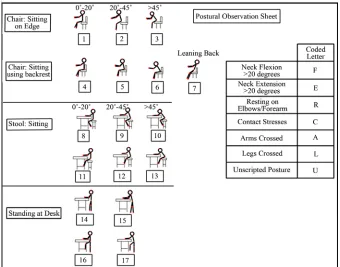
Using the SRPH-developed postural observation tech- nique, student postures were observed. The research team recorded student postures in both the control and treatment groups. They first positioned themselves to look at the sagittal plane of an individual participant. The researcher then started a stopwatch and used the Postural Observation Sheet (Figure 1) to identify the posture that most closely resembled the position of the child. A pos- tural observation was noted on the Postural Data Collec- tion Sheet after each minute, for 10 minutes. This was done three times for each student, for a total of 30 min- utes of observation for each participant. After the re- searcher had performed a 10-minute postural analysis on all of the students in one class, the researcher moved to the next class and performed the same 10-minute analy- sis on those students.
Data were also recorded with respect to if the student’s neck was in flexion or extension and whether or not they were resting their elbows/forearms on the workstation. It was also noted in the “Comments” section if there were any noticeable contact stresses from the furniture, whether the student’s arms and legs were crossed, and
any unscripted postures not intended for the workstation. Unscripted postures, for the purpose of this study, were any postures assumed by participants, which would not be considered appropriate for the design of the work- station. Common unscripted postures included students leaning back in chairs on two legs, sitting on their legs while in their chair or stool, sitting sideways, etc.
It should be noted that only postures observed at the start of each minute were recorded. It was observed that postures did change throughout the minute, but marking the posture at the start of each minute ensured consis- tency throughout the study. If a student was absent from their workstation at the beginning of a minute in their observation session, the researcher marked an “X” and treated it as a missing data point for analysis. Similarly, if the student moved during a minute of data collection, the researcher noted it in the “Comments” section of the Data Collection sheet, but the movement did not influ- ence statistical analysis. The researcher collected be- tween 20 and 30 units of observation within the 30 min- ute time period. Only three students did not have be- tween 20 to 30 units of observation time.
4. DATA ANALYSIS
Analysis for this study addressed two primary null hypotheses.
[image:3.595.128.468.449.716.2] The discomfort level of the children using the stand- biased workstations is equal to the children at seated workstations.
The proportion of time spent in non-preferred pos-
tures, for students using stand-biased workstations, is equal to the students in seated workstations.
The independent variable was the workstation type (stand-biased and seated). Dependent variables included self-reported discomfort level from the Student Body Part Discomfort Survey and observed percent time in non-preferred postures.
Descriptive statistics were used to describe all vari- ables of interest. Categorical variables were described using proportions, while continuous variables were de- scribed using ranges, means, and standard deviations. The significance level for all statistical tests used to ex- amine the two main objectives was p < 0.05. All statisti- cal tests were two-sided.
Self-reported discomfort levels were quantified for each major body part region and ranged from 1-5. This was then condensed to a range from 1-3 during analysis based on the distribution of the data. The three categories for discomfort were considered good, neutral, and poor from 1-3, respectively. The relationship between the type of workstation and self-reported body part discomfort were quantified using the chi-square test and Fisher’s exact test due to the occurrence of a small number of endorsements for some of the categories of discomfort.
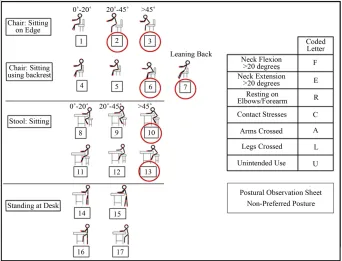
Preferred and non-preferred postures were determined by the research team, which consisted of two ergono- mists, one of who is a Certified Professional Ergonomist, and the other, has a research history in biomechanics. Circles in Figure 2 identify these postures. The propor-
tion of time spent in various postures was calculated as the minutes spent in a particular posture divided by the total minutes observed at the workstation.
The distribution of the posture data was observed. There was evidence that the data were not normally dis- tributed. Consequently, a Wilcoxon rank sum test was used to examine the relationship between type of work- station and percent time in non-preferred postures.
Potential confounders for this study included gender, height, weight, and teacher. The relationship between these potential confounders and type of workstation was assessed using the same two-sided tests and significance level (p < 0.05) as the main set of analyses.
5. RESULTS
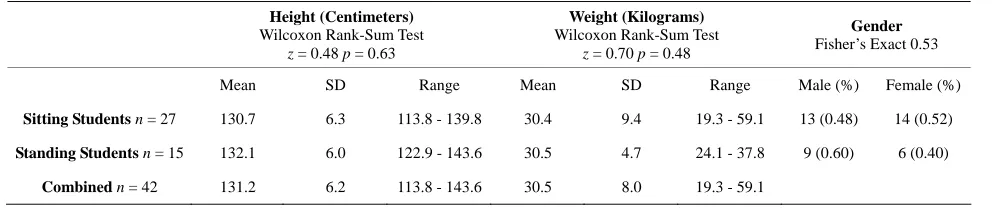
[image:4.595.127.469.458.719.2]Participants ranged from 7 - 9 years of age. The dis- tribution of height and weight were similar in both the control and treatment classrooms. One student had miss- ing values for their height, weight, and age. This indi- vidual was still included in the study, since data were collected for posture and body part discomfort. The dis- tribution of height and weight for the sitting and standing students can be seen in Table 1. There was no significant difference between the seated and standing groups with respect to the key confounders of interest. Although “teacher” could also be a potential confounder, this vari- able was highly correlated with workstation type. Con- sequently, the potential confounding effect of teacher could not be evaluated. On average, students stood 12.3% of the time with a range of 0% to 27%, while
Table 1. Descriptive statistics for sitting and standing students.
Height (Centimeters) Wilcoxon Rank-Sum Test
z = 0.48 p = 0.63
Weight (Kilograms) Wilcoxon Rank-Sum Test
z = 0.70 p = 0.48
Gender Fisher’s Exact 0.53
Mean SD Range Mean SD Range Male (%) Female (%)
Sitting Studentsn = 27 130.7 6.3 113.8 - 139.8 30.4 9.4 19.3 - 59.1 13 (0.48) 14 (0.52)
Standing Studentsn = 15 132.1 6.0 122.9 - 143.6 30.5 4.7 24.1 - 37.8 9 (0.60) 6 (0.40)
Combinedn = 42 131.2 6.2 113.8 - 143.6 30.5 8.0 19.3 - 59.1
working on an assignment at their workstation. There were outliers who stood almost 40% and more than 50%, respectively.
Overall, the body part discomfort surveys found that students in the standing classrooms reported greater comfort for their neck, arms, and legs, while the sitting classes reported greater comfort for the lower back, wrists and hands, and ankles and feet. The sitting class- rooms also reported greater discomfort in all areas of the body than the standing students, as seen in the combined data in Figure 3. A larger proportion of the standing stu- dents reported a neutral comfort level for all body parts, except the arms.
Analysis of the body position/posture data indicated greater neck flexion and extension in the treatment group. However there were only 15, out of 42 participants that illustrated any extension greater than 20 degrees. All par- ticipants exhibited flexion of the neck, greater than 20 degrees at some point during their observation period. This was likely due to data being collected only when students were working on handwritten assignments.
A greater proportion of the standing students portrayed more time in preferred postures and less time in non- preferred postures. Using a Wilcoxon rank-sum test, the two treatment groups were compared with respect to the percent time observed in non-preferred postures. There was no statistically significant difference (p > 0.05) based on this test.
6. DISCUSION
The purpose of this pilot study was to identify the discomfort level of children using stand-biased worksta- tions compared to that of children at seated workstations. Researchers also sought to identify non-preferred pos- tures for students using stand-biased workstations com- pared to students at seated workstations. The data ana- lyzed in this study found no statistically significant dif- ference between the stand-biased and seated worksta- tions (p > 0.05) with respect to either time spent in non- preferred postures or body discomfort. There were, how- ever, many interesting observations that are informative for future research studies.
Research findings showed that approximately 75% of
Combined Discomfort Data
0 10 20 30 40 50 60 70 80
1 (Good) 2 (Neutral) 3 (Poor)
P
er
ce
nt
R
esp
on
se
Comfort Level
[image:5.595.308.539.139.336.2]Standing Sitting
Figure 3. Discomfort data.
students in seated workstations could not touch the floor with their feet when seated. This illustrates the impor- tance of workstation design for elementary schools, as the anthropometry of students between grade levels can vary substantially. The school in this study used the same size 41 cm high seat for kindergarten through fourth grade. This eliminates all but the tallest fourth graders from being able to sit properly in the seats. The stand- biased workstations proved to be more effective in fitting each individual student due to the flexibility of standing and the large adjustment ranges of the stool and work- station.
One of the greatest advantages of this study over pre- vious pilot studies was interacting with the teachers and allowing them to communicate with students about the Body Part Discomfort Survey. The teachers illustrated the importance of reporting accurate discomfort with respect to the workstations.
7. LIMITATIONS
a rural setting.
Prior to beginning the study, it was apparent that there was a potential for a teacher effect. Teachers had their own, unique teaching style that made it difficult to assess the role that posture played throughout the school day. Some teachers chose to lecture while the students were at their workstations. Other teachers had their students par- ticipated from the floor, or from other areas within the classroom, limiting their time at their workstations. This is why it was decided to collect data when students were working by themselves at their workstations. The poten- tial exists for significantly more time at the workstation in higher grades, as many teachers place students on the floor to teach in second-grade classrooms.
Another factor that may have influenced how partici- pants used their workstations was the presence of the researcher. Although students were never told when they were going to be observed, the presence of the researcher may have altered student behavior and the classroom dynamic.
8. CONCLUSION
As a pilot study, several lessons were learned for fu- ture researches. While there was no statistically signify- cant difference in either posture or discomfort, standing students reported an overall lower discomfort than their seated peers. The teaching style of the classrooms, which is more variable in early grades, contributed to an overall minimization of time at the workstations. Future studies should include older student populations, where worksta- tions are the primary site for lecture and individual work among the students.
9. IMPLICATIONS FOR OBESITY
The results of this study and the intervention of a stand-biased workstation in classrooms have the poten- tial to profoundly impact the health of students by pro- moting more movement throughout the school day. Stu- dents will burn more calories, which may have a positive impact on their weight. Additionally, the stand-biased desk has the potential to reduce long-term musculoskele- tal disorders of the low back due to improper seated pos- tures. The intervention of a stand-biased desk could im- prove the health of children as they mature into adults and enter the workforce.
Previous studies show the more immediate benefits to these types of interventions. Students who are more ac- tive report better grades and attention while in class [20,25]. Additionally, the calorie expenditure goals noted in the recent article of Wang, et al. needed to achieve Healthy People Goals by 2020 are similar to those re- ported in interventions of stand biased desks in elemen- tary students. Additionally, overweight and obese stu-
dents have a greater benefit in total calorie expenditure as both a total and a percentage increase [22-26].
There are a number of obstacles in implementing a standing workstation. School budget cuts are becoming more prevalent, and many districts have a difficult time replacing traditional seated workstation with stand-bi- ased workstations because of cost. The transition to stand biased desks needs to be slow and progressive, starting with new schools, or converting only a few classrooms at a time in existing schools, as seen in this study. Schools may decide that other interventions may be more appro- priate and feasible for their students. However, when new schools are being built and new equipment is being purchased, it is important to keep in mind what products would encourage healthy movement of the children.
REFERENCES
[1] Lobstein, T., Baur, L. and Uauy, R. (2004) Obesity in children and young people: A crisis in public health. Obe-sity reviews, 5, 4. doi:10.1111/j.1467-789X.2004.00133.x
[2] Dean, H. and Flett, B. (2002) Natural history of type 2 diabetes diagnosed in childhood: Long term follow-up in young adult years. Diabetes, 51, A24-A25.
[3] Manley, A. (1997) Physical activity and health: A report of the surgeon general. Department of Health and Human Services, Washington, September 15, 1997.
[4] Ewing, R. (2005) Building environment to promote heal- th. Journal of Epidemiology & Community Health, 7, 536-537. doi:10.1136/jech.2004.032367
[5] Sirard, J., Laska, M., Patnode, C., Farbakhsh, K., Lytle, L. (2010) Adolescent physical activity and screen time: As-sociations with the physical home environment. The In-ternational Journal of Behavioral Nutrition and Physical Activity, 7, 82. doi:10.1186/1479-5868-7-82
[6] Gouvali, M.K. and Boudolos, K. (2006) Match between school furniture dimensions and children’s anthropometry.
Applied Ergonomics, 37, 765-773.
doi:10.1016/j.apergo.2005.11.009
[7] Harreby, M., Neergaard, K., Hesselsoe, G. and Kjer, J. (1995) Are radiologic changes in the thoracic and lumbar spine of adolescents risk-factors for low-back pain in adults: A 25-year prospective cohort study of 140 school- children. Spine, 20, 2298-2302.
doi:10.1097/00007632-199511000-00007
[8] Nygaard, B., Jessen, T., Larsen, E., Storr-Paulsen, A., Lindahl, A., Fisker, I., et al. (1999) Risk factors for low back pain in a cohort of 1389 Danish school children: An epidemiologic study. European Spine Journal, 8, 444-450.
doi:10.1007/s005860050203
[9] Adams, M., Mannion, A. and Dolan, P. (1999) Personal risk factors for first-time low back pain. Spine, 24, 2497- 2505. doi:10.1097/00007632-199912010-00012
early disc degeneration. Spine, 24, 1316-1321.
doi:10.1097/00007632-199907010-00008
[11] Geldof, E., De Clerq, D., De Bourdeaudhuij, I. and Car- don, G. (2007) Classroom postures of 8-12-year-old chil- dren. Ergonomics, 50, 1571-1581.
doi:10.1080/00140130701587251
[12] Damkot, D.K., Pope, M.H., Lord, J. and Frymoyer, J.W. (1984) The relationship between work history, work en- vironment, and low-back pain in men. Spine, 9, 395-399.
doi:10.1097/00007632-198405000-00012
[13] Levine, J., Schleusner, S. and Jensen, M. (2000) Energy expenditure of nonexercise activity. The American Jour- nal of Clinical Nutrition, 72, 1451-1454.
[14] Beers, E.A., Roemmich, J.N., Epstein, L.H. and Horvath, P.J. (2008) Increasing passive energy expenditure during clerical work. European Journal of Applied Physiology,
103, 353-360. doi:10.1007/s00421-008-0713-y
[15] Mancuso, A.R. (2010) The ability of the Sensewear arm-band to assess a change in energy expenditure in children while sitting and standing [Master of Science of Public Health]. School of Rural Public Health of the Texas A & M University System Health Science Center.
[16] Benden, M.E., Wendel, M.L., Jeffrey, C.E., Zhao, H., Morales, M.L. (2012) Within-subjects analysis of the ef-fects of a stand-biased classroom intervention on energy expenditure. Journal of Exercise Physiology, 15, 9-19. [17] Franks P. (2010) Diabetes family history: A metabolic
storm you should not sit out. Diabetes, 59, 2732-2734.
doi:10.2337/db10-0768
[18] Katzmarzyk, P. (2010) Physical activity, sedentary be-havior, and health: Paradigm paralysis or paradigm shift?
Diabetes, 59, 2717-2725.doi:10.2337/db10-0822
[19] Levine, J. (2010) Health-chair reform: Your chair: Com-fortable but deadly. Diabetes, 11, 2715-2716.
doi:10.2337/db10-1042
[20] Cardon, G., De Clerq, D., De Bourdeaudhuij, I. and Brei-thecker, D. (2004) Sitting habits in elementary school-children: A traditional versus a “moving school”. Patient Education and Counseling, 54, 133-142.
doi:10.1016/S0738-3991(03)00215-5
[21] Fransson-Hall, C., Gloria, R., Kilbom, A., Winkel, J., Karlqvist, L. and Wiktorin, C. (1995) A portable ergono- mic observation method (PEO) for computerized on-line recording of postures and manual handling. Applied Er-gonomics, 26, 93. doi:10.1016/0003-6870(95)00003-U
[22] Murphy, S., Buckle, P., Stubbs, D. (2002) The use of the portable ergonomic observation method (PEO) to monitor the sitting posture of school children in the classroom.
Applied Ergonomics, 33, 365-370.
doi:10.1016/S0003-6870(02)00003-0
[23] Benden, M., Blake, J., Wendel, M., Huber, J. (2011) The impact of stand-biased desks in classrooms on calorie expenditure in children. American Journal of Public Health, 101, 1433-1436. doi:10.2105/AJPH.2010.300072
[24] Wingrat, J. and Exner, C. (2005) The impact of school furniture on fourth grade children’s on-task and sitting behavior in the classroom: A pilot study. Work, 25, 263- 272.
[25] Koskelo, R., Vuorikari, K., Hanninen, O. (2007) Sitting and standing postures are corrected by adjustable furni- ture with lowered muscle tension in high-school students.
Ergonomics, 50, 1643-1656.
doi:10.1080/00140130701587236
[26] Wang, Y.C., Orleans, C.T. and Gortmaker, S.L. (2012) Reaching the healthy people goals for reducing childhood obesity: Closing the energy gap. American Journal of Preventive Medicine, 42, 437-444.