From competitive advantage to dynamic
capabilities: Small and Medium-sized
Multinationals in Asia
Tattara, Giuseppe
University of venice
2012
From competitive advantage to dynamic capabilities: Small and Medium-sized
Multinationals in Asia1
Giuseppe Tattara, University of Venice, dept. economics. [email protected]
Abstract
Italian firms have recently engaged in direct investment abroad through the establishment of production facilities in China and India. Using data gathered from interviews conducted in those countries in 2009 with 16 Italian predominantly small and medium-sized firms, this article explores: the motivations behind Italian parent companies’ decisions to create subsidiaries in Asia; relations between the newly established production facilities and their local suppliers and markets; any subsequent organizational adaptations; and the cultural and administrative difficulties the enterprises have encountered. The article provides a novel perspective on how predominantly small and medium-sized manufacturing firms achieve cost and differentiation advantages by leveraging their dynamic capabilities.
JEL: F23, F14, L25
Key words: Strategic management of multinational firms, Value chains, Capability-based strategies.
1. Introduction.
This article examines the prospects and problems faced by Italian firms that recently
established production facilities in China and India through direct investment. Over 4
months, in spring 2009, we visited 16 factories in China and India – most of them of small
and medium size (controlled by Italian parent companies) - , and discussed with their
general managers the reasons underlying the decision to produce abroad; the direction,
extent and nature of adaptation (in respect of strategies, structures, resources, and more)
to foreign market conditions; and the character of the management of new networks that
were created, in relation to the parent companies, to foreign suppliers, and to the sales
market2.
1
I would like to thank the participants in the seminar of the School of Economics at the University of Reading where the paper was discussed. Special thanks are due to Marina della Giusta, Carlo Gianelle, Andrea Ginzburg, Faith Hatani, David Lane, and Frank Pyke for their careful reading and valuable comments. Partial funding was provided by Osservatorio economico provinciale, Treviso.
2 Hatani (2009; 2010). These are the main questions faced today by international business, according to the
The article begins, in Section 2, with an outline of the research methodology used in the
study. The following Section 3 discusses the role of country specific circumstances in
explaining the development of the cross border organisation of Italian firms, comparing the
strategies of internationalization towards Asia with that towards Central and Eastern Europe.
Section 4 presents firm level case studies and discusses how firms have adapted their
specific advantages to the particular circumstances of foreign markets. Firms are grouped
into 3 clusters according to the motives that induced the Italian parent companies to create
subsidiaries in China or India. Each group is discussed in a sub-section (4.1, 4.2, 4.3).
Section 5 summarizes the previous discussion and considers the shift made by several firms
in moving from “competitive advantage” to “sustainable advantage” through the creation of
dynamic capabilities (Teece et al. 1994;1997). The subsequent Section 6 reports on binding
institutional constraints faced by subsidiaries and the necessary adaptation of managerial
strategies. The following section 7 concludes.
2. Research Methodology The investigation of the experiences of Italian firms investing
abroad employed a multiple case study approach. Through qualitative research we were able
to achieve a comprehensive understanding of how events unfolded and the context in which
this occurred. Firms were selected according to their size and sector, and their readiness to
grant permission to visit their foreign plants and carry out detailed interviews with the
managers. Not all firms that were asked agreed to our request. Reasons for refusal mainly
related to difficulties connected to subsidiary re-organization.
We interviewed 16 firms in China or India, all of which have Italian parent companies in part
or in whole. In fact, 13 of the subsidiaries in Asia were 100% controlled by a parent
company in Italy; the remaining 3 had participation by Chinese firms. Some of the
subsidiaries had the same parent company (the Carraro Group) which meant that the total
number of parent companies was 12. Of these, 10 had additional subsidiary plants in other
countries. Also, 10 of the parent companies were located in Veneto, a region in the North
East of Italy, and it was to the Asian subsidiaries of these companies that our interviews
were initially directed. Interviews with the subsidiaries of 2 more Italian parent firms were
added during the process. All but 3 interviewed subsidiaries in Asia were small or medium
sized3. 9 of them belonged to medium-sized groups4 with well-known brands. 7 belonged to
3
large groups. Of these, 5 (B,C,D,O,Q: See Table 1) belonged to a single important
mechanical engineering group (Carraro), 1 (H) to a technical textiles group (Filmanmande),
and 1 (P) to a cotton textiles group (Monti). The biggest group employs worldwide more
than 4,000 employees, while the second and third biggest have around 1000.
The majority of the head offices of the interviewed firms (B,C,D,E,L,N,O,Q: See Table 1) are
located in the “mechanical district” of Padua in the Veneto region, Italy; 2 (R,M) are located
close to that district’s borders; 2 (H,P) belong to the textiles-garments sector and are
located in Treviso, Veneto region; and 2 (A,G) belong to the “furniture district” of Treviso; of
the remaining 2, 1 (F) is located in the Republic of San Marino, and the other (I) in Brescia,
northern Italy.
All the firms retained their headquarters in Italy (or San Marino) and all but one retained in
Italy their most important manufacturing units. The large majority of parent firms already
had international expertise and were following a strategy of continuous geographic
expansion. All firms were challenged by their entrance into markets that presented entirely
new environments.
A "case" is defined as a visit to an industrial plant accompanied by an in-depth interview
with a senior manager. Interviews were transcribed, and then analysed. The use of open
interviews allowed a respondent driven agenda to emerge, permitting the Italian managers
interviewed to concentrate on what they considered to be the important aspects of their
Asian operations, thereby avoiding certain biases associated with more structured interview
approaches. One of the most powerful sources of evidence is when in a case study approach
interviewees use their own words to "tell the story." We have followed this method to bring
the reader into the world of the participants, who provide in depth insights into the rationale
for events and the rich contexts in which they occur (Mintzberg, 1979; Van Maanen, 1988;
Yin, 2003).
Semi-structured interviews were conducted both in Asia (16 interviews) and in Italy (4
interviews) in two waves between October 2008 and June 2009. All interviewed persons held
a leading top management position. Each interview lasted at least two hours, in many cases
half a day, and in all cases included a tour of the factory, both in Italy and in Asia. All but 2
interviews were conducted in Italian; the other 2 were conducted in English. The interviews
focused on company background and marketing policy, motivations for the entry into the
Of course, none of the small and medium-sized businesses we interviewed had a completely independent management and nor were they independently owned. We are well aware that a firm’s behaviour is influenced by how it may be linked to a group to which it belongs, and/or by the sector in which the group operates.
4
Asian market, the position of the firm in the value chain, and relations with and policies
towards customers, consumers and local suppliers.
Information was complemented by interviews in China with two Italian government agencies
that have the role of supporting Italian firms in Asia (The Italian Chamber of Commerce and
the Italian Trade Institute), and by follow-up contacts with people we interviewed, and by
reviews of press releases and company material.
Sectors
Cases span several sectors i.e. mechanical engineering, textiles and garments, and
furniture; and involve firms of varying dimensions, with the consequence that the research
has highlighted a spectrum of adaptation efforts by enterprises driven to Asia for different
purposes.
10 out of the 16 firms interviewed belonged to the mechanical engineering sector. Of
these 10, 5 belonged to the Carraro group, which is a leader in the production of axles,
transmissions, and final and slew drives for agricultural and construction equipment. We
interviewed the directors of two factories in the drive system division of the Group in China
(Quingdao:B) and in India (Pune:C); the directors of 2 plants in the gear division in India
(Pune:Q) and in China (Suhzou:O); and also in the research division the director of the
design centre in Pune (D).
Also in the mechanical engineering sector, we interviewed the directors of subsidiaries that
produced agricultural machinery (Maschio: N), hydraulic fittings (Genarl Fittings: I),
radiators (Irsap: M), pressure washers (Hydroeast: L), welding machines (Ritmo: E), and
amusement rides (Zamperla: R). They all produce their own brand products and have well
defined niches in their respective international markets.
The remaining 5 of the interviewed firms belonged to the “traditional manufacturing” sectors
of textiles and furniture. These included: a cotton factory in India (Monti: P); a producer
of high performance yarns in the sub-sector of technical textiles (Filmanmade: H); and 3
furniture firms (Colombini: A; Faram: G; DalianMato: F).
For 9 firms (B,C,D,H,L,N,O,P,Q) the interviews at the foreign plants were supplemented
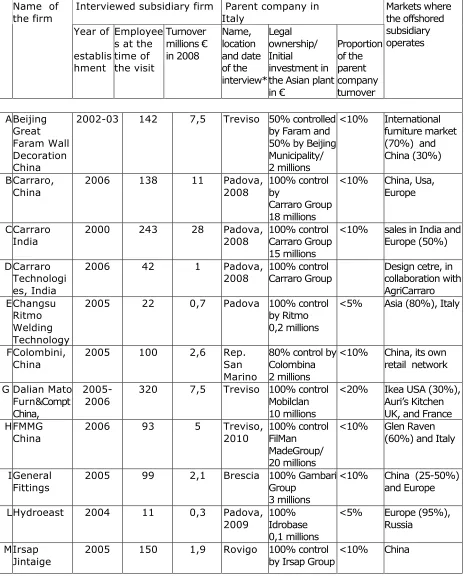
with interviews in their parent firms in Italy. Table 1 summarizes the main characteristics of
the interviewed firms.
All the firms employed technology that was modern for their sectors, and used, whenever
necessary, European components in order to ensure product quality. In fact, the proportion
of components used that are imported varies a lot, according to the particular strategy
pursued by each firm. However, sometimes the use of low cost of labour is reflected by the
presence of low levels of automation. For example, activities such as stock control,
warehouse usage, and quality control are often manually executed; in contrast, the
corresponding operations in Italy would have been organized with a higher level of
automation. 2 firms (L, J) made extensive use of machinery transferred to China from Italian
parent companies, which was later updated with more automated technology.
3. Off-shoring and Production Internationalization.
Italian firms initiated significant internationalization strategies in the mid-nineties and today
the off-shoring of a part of production is an important feature of that country’s
manufacturing system, in particular in the North Eastern regions of Italy (Schiattarella,
2001; Tattara, 2011). Until the late eighties Italian firms operating in the international
market were mainly concerned with expanding their exports, and increasing their share of
markets in the richest countries, selling in Europe products manufactured at home, in Italy.
Since the mid-nineties, however, many firms began transferring a significant part of their
manufacturing activity across borders to other countries, which also provided flourishing
sales markets.
It became profitable to develop outside Italy a part of production with the onset of
circumstances that reduced transaction costs involved in operating abroad. At the macro
level (Kedia, Mukherjee, 2009), the establishment of a fixed exchange rate in the late
nineties, and the subsequent appreciation of the Euro, induced Italian export firms to
abandon a strategy of making their products more competitive through currency
devaluation. Currency devaluation had been a strategy that Italian firms had practised after
the defeat, in the early seventies, of the Bretton-Woods regime of fixed exchange rates, and
which had promoted exports, with alternating movements, for 25 years. In the nineties, with
the defeat of the Soviet empire, new territories in Central and Eastern Europe, close to two
of the most important countries of industrial Europe, Germany and Italy, opened up to
foreign investment. Countries with stable social and political structures, educated
populations, low labour costs, and fiscal regimes very favourable to foreign investments
Until the mid-1990s, for Italian firms the role of developing Asian economies as places for
investment remained negligible. However, as emerging countries, particularly in Asia,
removed restrictions, and implemented policies to attract foreign direct investment inflows,
a new interest developed. Producing in China and India, and other Asian countries, became
to be seen as attractive because of the low cost of resources and because firms producing
locally can easily adapt and quickly benefit from a growing consumer demand due to the
rapid growth of incomes and populations (Agarwal, 1980; Kaplinsky, Farooki, 2010).
Nonetheless, few Italian firms have yet in 2011 established production activities in these
countries. Indeed, many are reluctant to launch new businesses so far away, and in fact
many firms that did so have gone bankrupt5
. Managerial decisions about internationalization
must take into account the nature of the environment in which enterprises operate: obvious
advantages may be balanced by costs that relate to cultural, administrative, geographical
and economic (CAGE) distance (Ghemawat, 2007).
For our sample, all the parent firms but 3 have other factories abroad and for them the
move to Asia can be considered a step in a process of incremental acquisition of knowledge
of foreign markets6. By the mid-nineties firms in Veneto districts were faced by increased
competition and felt that the advantages linked to their traditional local assets were rapidly
fading away and their claimed superiority over non district firms was being questioned
(Iuzzolino, Micucci, 2007; Iuzzolino, Menon, 2010; Callegari, Callegaro, Tattara, 2010). In
order to meet the competition district firms now had to use a wider range of suppliers and to
internationalize parts of production that were once outsourced locally.
The majority of the parent firms have plants in Central and Eastern Europe: in Poland, in
Russia and in Slovenia, and especially in Romania. Today, in the most developed area of
Romania there are difficulties in labour recruitment because of a massive emigration of
Romanians. Because of the constant appreciation of the Euro in relation to the Dollar the
relative cost of labour in Eastern and Central Europe has risen considerably, and this factor
together with a lowering of transport costs to places elsewhere in the world means we are
now seeing a transfer of production from Europe to North Africa and to Asia. In most recent
years, China, and to a lesser degree, India, have offered European investors not only a
5
According to anecdotal evidence provided to us by the director of the Italian Foreign trade institute, and by the secretary of the Italian Chamber of Commerce in Beijing, the story of Italian foreign investments in China is not encouraging.
6 The acquisition of information in “psychically distant” markets - different in culture, language, levels of education
reservoir of cheap labour but also enormous and profitable consumer markets7. Available
data on direct investments confirm a relative stagnation of flows moving from Italy to
Central and East European (CEE) countries (+16% between 2002 and 2009 measured by
the number of employees), while direct investments directed towards Asia have rapidly
increased (+35%).
Internationalization derives from the ability to adapt firm specific advantages to the
circumstances of foreign markets. Such adaptation takes multiple forms, including
engagement in commodity flows, subcontracting, direct investments, commercial and
technological agreements, licences and other arrangements formal and informal (Rugman,
Verbeke 2005; De Propris, Menghinello, Sugden, 2008).
Data is currently available in a systematic way for trade flows and direct investments.
Italy’s imports from some CEE countries mainly relate to the clothing and footwear
subcontracting trade. This is particularly the case for Romania, from where 61% of imported
goods to Italy in 2009 were so related. For Romania, imports from that country into Italy are
an end stage of a process which firstly saw the export of semi-manufactured goods and raw
materials from Italian based firms to firms in Romania, owned either by local or Italian
entrepreneurs; then the Romanian firms used the imported materials to manufacture and
subsequently re-export to Italy finished products or advanced level parts, which are then
distributed (Crestanello, Tattara, 2010).
Levels of imports to Italy of textiles, clothing and footwear from Romania were close to
imports from China in value until 2006. Subsequently, China took the lead, but products
imported from China have been mainly produced utilizing a model of full package
outsourcing by Italian brands. Under this model, articles are manufactured by large local
firms capable of processing high volumes at low prices; and raw materials and accessories
are acquired directly in the Asian market, where it is possible to find quality and variety.
There is not an equal flow of exports from Italy to China for these commodities. In contrast,
Romanian imports from, and exports to, Italy are of similar values because Italian exports to
that country provide the basic materials for producing future imports under sourcing
agreements.
In clothing and footwear, due to the importance of subcontracting, commodity flows
between Italy and CEE countries are basically reciprocal. Internationalization is
accomplished by large inflows and outflows of commodities across a country’s borders in a
7 The cost of labour in China and India is a fraction of that in Italy, and is definitively lower than in Central and
sequence of transactions that are, in most cases, internal to the firm (Tattara, 2005).
In the mechanical engineering industry a different situation exists. In this industry, control
of proprietary knowledge of key aspects of industrial technology is important. Consequently,
usually, when a firm from one country establishes a subsidiary in an emerging country in
order to have access to cheaper resources, hierarchical relations between the parent
company and the subsidiary are maintained, and only gradually is the subsidiary allowed to
acquire autonomy in respect of either local sourcing or the sales market8.
Italian foreign direct investments are overall bigger in CEE countries than in Asia, but those
investments in European countries are mainly in “traditional sectors”, while in Asia the
mechanical engineering industry is important (figure 1) and has been gaining ground rapidly
in recent years. The rate of increase in the number of Italian foreign direct investments in
CEE countries from 2002 to 2009 is nil in traditional sectors and positive in mechanical
engineering industries (+5%), while both sectors have grown at significant rates in Asia
(respectively 18% and 54%).
<FIGURE 1>
4. The Case Studies: Different Strategies of Subsidiaries in Asia.
Our case studies are summarized in Section 2-table 1. To better understand how a firm
develops a competitive advantage, value chain theory divides up the business system into a
series of “primary” activities. These are then conceived as being underpinned by “support”
activities, providing various inputs or infrastructures that allow the primary activities to
occur on an ongoing basis (Porter, 1985). “It is only at the level of discrete activities that
the competitive advantage can be truly understood” (Porter, 1986, p. 13). Primary activities
include procurement, inbound logistics, operations, outbound logistics, marketing and sales,
and services9.
The organisation of the value chain is conceived as being characterised by semi-autonomous
units which can vary their activities independently of one another. Typically a firm must
locate downstream activities such as marketing close to the buyer in the countries in which
it operates while upstream activities can, at least conceptually, be decoupled from where the
buyer is located (Porter, 1986, p.16). There are two driving forces which may decouple the
8
See, for example, Gereffi, Humphrey and Sturgeon (2005, 85 ff.)
9 This classification is tailored to our interviews and differs slightly from the classic Porter’s classification (see Porter,
links in an existing chain10, namely: the search for low cost resources, and, secondly, the
desire to achieve a better product differentiation. This reflects the fact that there are
thought to be two alternative kinds of competitive advantage that a firm can possess: one
based on low relative cost and another on product differentiation (Porter, 1986, p. 25;
Wathne, Heide, 2004).
Interviewed Italian firms moving to China and India came from different perspectives and
each subsidiary employed different strategies according to: the motivations parent
companies had for establishing them; the power relation between subsidiaries and their
parent companies; and the strategies the subsidiaries were able to implement and pursue.
For the purposes of this article, the subsidiaries have been grouped into 3 clusters. These
include a first cluster where subsidiaries had a low level of independence thanks to a high
power asymmetry with parent companies, and where the firms were initially established
abroad in order to reduce production costs. In a second group, firms have been clustered
which have been pulled into foreign markets by the internationalisation activities of larger
network partners, and where the ability to compete abroad was a function of the
technological embeddedness of the subsidiary. A third cluster includes subsidiaries for which
the motivation to set them up included a significant consideration of accessing markets.
These firms have a more autonomous management, and sell in the foreign market with their
own brand products engineered in Italy and adapted to local market needs.
4.1. Cluster 1. At First Seeking Cost Advantages but then Sales in Asian Markets.
This cluster groups firms that initially went to Asia in order for the parent company to exploit
differences in absolute costs of labour and components (Li et al., 2008; Swan, Allred,
2009)11, and more advantageous fiscal regimes. This strategy was pursued by 6 firms
(E,I,N,L,P), but then for 3 of them, to varying degrees, there was an evolution. The firms
making cotton textiles (P), welding machines (E) and fittings (I), once they had settled in
Asia, searched for their own production and sale niches on that market, engendering a
10
Rugman and Verbeke (2004) assume a “normative” hypothetical balanced expansion over time whereby the firm specific advantages derived from sourcing locally grow at a similar rate to those derived from Asian market penetration. Our case studies show that this is not a desirable neither a profitable expansion path. Firms decouple procurement from distribution and sales market penetration.
11
The factory making agricultural machinery in China (N), at Quingdao, is part of this group. It is a small factory located in rented premises, and produces small agricultural machines (rotary tillers), and also a basic gear box for its parent company. At the time of our visit the cost of labour in the factory was 4% of the total cost and components accounted for 70%, mainly outsourced. In Italy, the cost of labour was 35% of the total for the same gearbox in the same period. The management in China faced no quality problems as these machines are unsophisticated and the components required have large tolerances. The profitability derived from producing in China was explained in the following terms: cost of production for the gear box was 90€ in China and 130€ in Italy.
change in management strategy that was not planned in advance, but proved necessary to
their survival.
Cotton Textiles Producer
The cotton textiles producer (P) is an important firm producing high quality fabrics, mainly
for shirt making. It has suffered from an adverse market for classic garments in Europe, and
by competition from low cost producers, and chose to transfer almost the whole of its
production to its new plant in India, and to two plants it owns in the Czech Republic, which
were previously producing for it as subcontractors. Only design, the manufacture of textile
samples and a very limited segment of the production process have been retained in Italy.
At the end of the nineties, the Italian plant had almost 1000 employees and produced 20
million metres of textiles. By the time of the interview, production was split between the
Indian plant which was producing 7-8 million metres a year, but which had a capacity double
that, the two Czech Republic plants (producing 1-2 million metres a year), and the Italian
plant (producing only 250 thousand metres a year) (Campagnol and Tattara, 2008).
The firm was attracted to India by the good quality cotton yarn available, and by the low
cost of labour. The cost of labour for its Indian plant was about 100€ a month per blue
collar. The factory had a complex administrative department that took charge of the large
initial investment and which also marketed the product in India where, at the time of the
interview, almost half of the production of the Indian plant was sold. The plant was vertically
integrated, including in its activities the manufacture of raw yarns and cotton fabrics. From
the parent company in Italy came design and dies; although dies were sometimes also
purchased in India where they were manufactured under European licence. Machines used in
manufacture were almost all Italian or German, most of them brought from the parent
Italian plant or from the company’s Czech Republic plants, and have been imported duty
exempted under special provision.
The cost structure for producing 1 metre of cotton fabric “I dogi” in the India plant is
detailed in table 2. This fabric was sent to Italy to be sanforized and distributed from the
Italian headquarters12.
<TABLE 2>
The extent of the cost reduction achieved by the Group by producing in India in comparison
12 The reference is to cloth sold in Europe, and the Group took advantage of a recent plant built in Treviso, Veneto,
with an equivalent production in Italy was significant. As one of the owners in Italy told us:
“It is no longer possible to meet international competition with cotton textiles produced in
Italy. All factories are closing down. The high cost of labour, the high cost of energy and the
appreciation of the Euro have put us out of the market.Our main competitor produces in the
Czech Republic and in 2009 it set up a new plant in Egypt. Now the cost of labour in the
Czech Republic has rapidly increased and the country has lost its attractiveness.”
The unit cost of production of high quality cotton fabric in India was around 2,38 € per
metre (table 2), 1/3 of the cost in Italy. The sale price varied between 6 and 8 € per metre
and consequently after 2005 the Group began again to make profits, although the capacity
of the Indian plant was still underutilized.
A few years after having established a main plant in India, the Group incrementally added
further operations there. Familiarity with the country and the size of the market induced ther
textile factory to enter the shirt making business, an activity that was never directly
undertaken in Italy but which, at the time of the visit, absorbed more than 1/3 of the total
production of the plant in India. In order to enter the new business, in 2005 the Group
established Laguna Clothing, a 50:50 Joint Venture between the Group and Aquarelle of
Mauritius, a shirt maker working for the most famous European and USA brands, with the
aim of providing high end shirts. Initially, shirts were manufactured in a single plant in
Bangalore with a capacity of 5,000 shirts per day, but recently (2010) a new plant was
added bringing the total capacity to 15,000 shirts per day, using the fabrics produced by the
Indian plant as well as those of others. The Group had never made shirts before; it
“exapted”13 the traditional home country organization of production to the new environment,
and added the shirt making phase downstream of weaving in order to increase revenue and
profits. By 2009, the shirt factory in Bangalore was responsible for about 40% of total Indian
textile production, a percentage likely to increase when the new planned factory comes on
stream.
Fittings Producer
Access to cheap labour was an important country factor condition determining the
off-shoring decision by other firms of this cluster. The fittings producer (I), belongs to a group
based in Brescia, Italy, which is a leader in the fittings sector for plumbing and heating. It
13 We refer to this choice as “exaptation”, a term imported from biology since the change has implied a new
has plants in Italy, Mexico, and Romania and in 2005 it opened a plant in China (Nancjing)
in order to reduce production costs. At the beginning of 2007, production for the Italian
parent company started. The production manager told us:
“It was contract manufacturing for the most simple fittings, that are no longer produced in
Italy. However, high quality forged brass rods made to standard CW617 – the standard
required by the American and European markets for fittings - are not locally available. So
brass rods were purchased in Italy by the parent company and then sent to China. From the
brass rods fittings were made through a die cast process and then sent back to the Italian
company for distribution. On the whole, the process provided only a marginal contribution to
Group turnover, and production was not very profitable both because in China the cost of
labour is relatively high in respect to other South Asian countries and also the brass rods
sent from Italy were made more expensive by the time and cost of transport”
In die cast manufacturing, the cost of labour in the Chinese plant was 30% of the
manufacturing cost; the remaining part was accounted for by plant amortization and
depreciation, metal losses, and energy (which in Nancjing costs 50% less than in Italy).
The Chinese plant was less automated than the Italian plant, especially in respect of the
movement of components, and taking everything into account the overall cost reduction
was limited to 25% of the cost of the same product manufactured in Italy, and so not worth
the initial investment, which was substantial (table1).
At the end of 2007 a new management decided that the Chinese plant needed to change its
function, and to move from contract manufacturing for its parent company to producing
brass components for the Chinese market. At the time of the interview 25% of total
production was sold in China. It was a complex move because the Chinese market did not
demand sanitary metal fittings for private houses where fittings are mainly low quality
plastic ones, and the new manager has been gearing production towards the automotive and
shipbuilding industries. At the time of the interview, General Fittings China supplied a wide
range of standard products as well as articles tailor-made to specific customer demands.
This change in functionality reduced brass imports because in China Western accreditations
were not required; the Chinese factory used brass purchased in the local market and
competed successfully with local producers.
The firm producing welding machines (Ritmo, E) shared part of this story of learning and
adapting. The Group produces welding machines for any size of plastic pipes and entered
China to reduce manufacturing costs. The building was rented and the initial investment was
kept to a minimum. The Group had production plants in Italy and Bulgaria and the
production made by the plant in China was marginal to the Group turnover. Ritmo entered
China because two important customers required a lower price and the initial purpose of the
investment was to assemble and sell in Asia machines for which the parts were produced in
Italy.
To off-shore the assembly line turned out to be not the correct strategy. The importing of
components was burdened by duties that varied between 5 and 15% of the imported value
(no drawback was allowed because the machines were sold in the local market) and, at the
beginning, the imported components accounted for 70% of the final value: the selling price
was still too high for the Chinese market14. The turnover for the first couple of years was
very small, a few hundred thousand Euros. In 2008 the strategy changed. A new manager
created a new brand (NewRitmoAsia), and launched a line tailored to the East Asian market
with its own brand (mainly China and Indonesia). The aim was to manufacture locally almost
the entire product, whilst maintaining good quality and reducing drastically imports from
Italy which by the time of the interview were reduced almost to nothing; an hydraulic
cylinder was still imported because it was not available to the same quality or, at least, it
was available but not by firms that supply the short buckles that were required by the
Chinese plant.
At the time of the interview, savings on Chinese components varied between 30% and 50%,
but, against this, at the beginning returned items had peaks as high as 80%. For example,
nickel and zinc Chinese plating firms very seldom produced to Western standards, and some
metal components were roughly finished and were not acceptable to the firm. A strict
monitoring process was introduced and the percentage of returned items was lowered to
less than 30%, but this was still too much.
Both the welding machines manufacturer (E) and the fittings producer (I), at first offshored
in order to reduce their costs of production but such a strategy did not lead to market
success and both consciously demonstrated timely responsiveness and rapid and flexible
product innovation, along with the management capability to effectively coordinate and
redeploy internal and external competences in order to sell directly on the foreign market.
The manager of the fittings producer (I) searched for a new functionality, which was to
make automobile components, which the company did not make before. The manager of
14
welding machines (E) sought local subcontractors for almost all components that were
previously imported from Italy, delivering a considerable cost reduction, and repositioned
the product by launching a new series. This move implied a process of selection of suppliers,
a standardization of production, the ensuring of quality control, and the development of
relations of trust; only a few strategic components were still imported. This was a difficult
process for a small firm like the welding machine firm, as the market for components both in
China and India was not well developed and reliable components were often produced by
companies supplying big orders for large international firms, but not the limited amounts
demanded by small sized customers (Buckley, 2004; Lemoine, Ünal-Kesenci, 2002). The
local supply market for components and parts that can be sourced by a small firm was
composed of backward local firms who lacked testing equipment and whose product quality
was often inconsistent (Humphrey, 2008; Kaplinsky, Farooki, 2010). They were not capable
of implementing the correct procedures, did not know the proper vocabulary, and technology
was seldom trustworthy.
High-pressure Washer Manufacturer
The problem of the quality of Chinese components has been tackled and solved successfully
by the subsidiary company in China of an Italian parent company that produces
high-pressure washers and cleaning machines for professional cleaning. Hydroeast (L) went to
China to buy at low cost components for its washers and send them back to Italy to be
assembled, or send them as spare parts to the various markets where the Group sold its
products (including USA, Europe and Russia). The Chinese market for high-pressure washers
was still in its infancy and the volume of production sold in China was modest. At the time of
the interview the percentage of components the factory in China was returning to its local
suppliers was less than 2%. The manager of the Group told us:
“We have in China about a hundred suppliers, of which 30 are stable suppliers and each of
which I know in person. To these I grant constant orders, so that they can organize their
warehouse and respond to our orders just in time.Every new component needs a long
preparation. On average, from receiving the order to the consignment takes one month
because our suppliers are small local mechanical engineering firms and communication is
difficult. The production manager of our subsidiary is in daily contact with our suppliers. If
machines that we don’t consider reliable we test every single component. Any new order is
split into two suppliers that compete one with another and enter a selection process.
We have chosen small size suppliers because we purchase small bucks and for this reason
we have localized our plant in a district of small firms [Ningbo south of Shanghai]. At the
end of the year our suppliers are evaluated and the best suppliers (according to aspects
such as quality and timely delivery) are awarded the Hydroeast certified supplier status. We
organise an award ceremony at which all our suppliers are invited and they take part
enthusiastically with all their families. We have created in China the relations of trust that
we had, and still have, in Veneto with our suppliers”15.
4.2. Cluster 2. Following Large Network Partners.
This cluster groups firms that produce for third parties under subcontracting agreements and
have been pushed to Asia by their clients. Retaining key clients was the main motivation.
Holding onto these clients meant opening subsidiaries in Asia in order to reduce production
costs, and to maintain an efficient and timely service for their customers. It included the
members of the Carraro Group (B,C,D,O,Q), the technical textiles firm (H), and a
manufacturer of furniture components (G).
The Mechanical Engineering Manufacturers
The main customers of the Carraro Group, a big international brand in agricultural
machinery and construction equipment, sell machinery directly in Asia, and have pressed the
Italian parent company to open production units in Asia to shorten the time to market of the
product and to maintain quality at a low unit cost. The Group has invested abroad in
response to the demands of their main customers, and value chain leaders, which
subsequent to deciding to move to Asia encouraged their suppliers to follow suit and
off-shore their production. 3 of these firms made big initial investments, around 10-20 millions
€ (B,C,Q). The other two (D,O) have a comparably lean structure as they occupy rented
premises. In fact, the Group’s main customers base their reputation on an efficient repair
capability, and so required the Group to supply components as quickly as possible. Labour
15 Hatani shows that, in the case of Toyota, and possibly of other large international firms, suppliers in a well
cost was much less important.
Among the main customers of the Carraro Group in India (C) and China (B) are producers of
tractors and construction machines. In India, the subsidiary opened in 1999, under pressure
from Case New Holland; it produced for Case, Caterpillar, John Deere and others and axles
for lorries too; a limited quota, 5-10% of production, was supplied to the Indian firms
Larsen&Toubro and Mahindra (for its tractors). India is the largest world market for tractors,
but only recently have producers started producing 4 wheel drive vehicles, whose axles are
a speciality of the Group. In this sector, interest in the Asian market has grown in recent
years. For example, Caterpillar has moved a significant part of its business to Asia, and in
2008 this market was responsible for 20% of its turnover (compared with 12% in 2006). To
reinforce its presence on the Asian market it has recently purchased the Korean firm
Jinsung, which produces undercarriage components.
The establishment of the two subsidiaries in Asia was a part of the trend to follow major
customers to Asia, although the managers of the two plants kept a fairly diversified
customer portfolio. As well as producing for similar customers to its sister Indian factory,
the Quingdao16 plant in China also made steel gears for Kone, the Finnish multinational that
produces lifts, escalators, and loading bays, and which in 2005 purchased significant
enterprises in Asia (Giant Elevators in China and Fuji Lift&Escalator in Malaysia).
To sell on the Asian market proved difficult and a significant part of the Indian production,
and a small part of the Chinese production, were sent back to Europe. For example, both in
India and China, the subsidiaries built drivers for eolic turbines required in Germany by a
partner of the same Group. The global recession of the last two years drastically reduced
orders from international corporations and the Group managers were targeting the more
flourishing Chinese and Indian markets. The attempt to sell domestically was delegated by
the manager of the China plant to a Chinese dealer Guangzhou Match and prospects were
favourable. The latest information from the Group headquarters, in 2010, tells us that the
value of turnover due to sales in the Chinese market had reached 27% of total turnover of
the Quingdao plant; at the time of our visit, in 2009, the proportion was as low as 2%. The
increase was particularly due to the drive production. China is now both a prime production
location and a key market17.
One characteristic that distinguished the 2 Carraro factories, in India and China, is that the
second was able to find on the domestic market high-level subcontractors supplying gears of
16
On Quingdao, Kim, Zhang (2008)
17
high quality that in India were not easy to find. Consequently, the factories in India and
China had different structures. In India the factory was vertically integrated with the nearby
plant Turbo Gear that belonged to the same Group, and had its own steel hardening process,
and sold 50% of its steel gear production to Carraro India. In the case of the Chinese
Carraro factory, in contrast, steel gears were purchased from third parties, the customer
taking advantage of the opportunity to source from large firms that worked for the army;
only a few special parts, such as gaskets, were imported from Italy18.
The industrial cost in China of the main product, axles, was at the time of our interview,
30% less than for similar products manufactured in Europe, and 15% higher than for those
made in India.
Technical Textiles Producer
The textile producer (H) produces high-range quality yarns using the most advanced cotton
spinning technologies available on the market. The yarns are used for the production of
special fabrics for clothing, furnishings, and sophisticated industrial applications such as
filtration and protective wear. The Group is the leader in Europe in this field.
The managing director of the Group told us:
“When our main customer decided to offshore one of its textile units to China we understood
that we would not be able to continue to supply it from Europe with our yarns, because the
cost would be too high. We signed a three-year manufacturing agreement with it that
covered the start-up of our new plant, and we chose a new location in China together with
our customer, next to his plant”
Production costs include electric energy (which in Italy is twice that in China), depreciation
and amortization of machines, and, least significantly, the cost of labour. Production is
highly automated so that per capita productivity is almost the same in different countries19
.
At the time of the interview the parent company was seeking to utilize the full capacity of its
Chinese subsidiary by outsourcing orders from Italy.The purchase guaranteed by the main
18
The subsidiary gear manufacturing plant in Suzhou (O) was established to supply small metal sinterized gears to international producers of electric and gardening tools who have moved to China a part of their production (such as Bosch, Black&Decker, and Stihl). 57% of its production is sold to international firms operating in China, 27% to firms operating in North America and the remaining part to companies in Europe. The decision to off-shore this production was completely independent from the decision to off-shore the Group subsidiary in Quingdao (B).
19 In fact, during the world crisis employment in the Chinese plant declined by 1/3 and then at the first sign of
customer amounted to 40% of the plant’s production, but only 13% of its optimal capacity.
To successfully place the remaining part on the Chinese market is a difficult task. The
manager of the textile plant explained the problem:
“We had two customers in Europe, buying yarns for their industrial filters, one German and
one Scottish, both of which off-shored to China and once we also moved there we felt sure
we would be able to continue to sell to them. It has not been so. Both have left us and have
chosen new Chinese producers that sell to them at a price that is 1/3 of our price. Filters
sold in China are of very low quality and our price is not competitive but they are preferred
because of the absence of strict regulatory standards in the domestic market.20
Not so for our yarns sold in Turkey where the quality of our yarn is appreciated and we are
able to sell to Turkish firms even though our product is more expensive than competitors’
prices. The reason is that Turkish firms sell mainly to European countries where the
observation of regulatory standards is compulsory.”
Furniture Components Firm
The furniture components firm (G) in China started in 2007. The factory was located in the
export industrial zone of Dalian, to the north East of Beijing, and produced solid wood
kitchen doors. Raw materials included imported water varnish, dried wood imported from
the United States (oak), Russia and Estonia (ash and birch), and wood panels bought
directly in China21. The firm exported doors to large kitchen producers, including British
and American manufacturers, among these firms belonging to the Ikea Group. For this
producer also off-shoring has been in response to pressure from its main customers which
required door panel production at a price the parent company was not able to produce in
Italy.
At the time of the visit purchasing agreements were arranged by the Italian headquarters
and the Chinese plant acted in fact as an off-shored producing unit of the Italian parent
company. In China the cost of labour was around 5% of the total cost of production; raw
materials and metal components accounted for 70% and varnishes for 15%. The remaining
10% or so was down to general expenditures. Local suppliers provided all the packaging
20 Standards are likely to be of reduced significance for China according to Kaplinski, Farookil, 2010a; Kaplinski et
al. 2011; Humphrey, Schmitz, 2008. We have evidence that the lack of regulatory standards in this market prevents Italian firms from selling some products to China. For example the technical textile firm sells regularly in North America, but is not able to sell on the Chinese market because a lack of adequate regulatory standards makes its products too expensive for the domestic market. This is a situation shared by the fittings producer which die casts two kinds of brass bars, with different specifications and prices for the two markets.
21
materials. The main customer was Ikea USA; it would not have purchased the more
expensive kitchen doors produced by the parent company in Italy and demanded a product
at a lower price, a demand that the Italian plant was not able to meet.
In all of the firms in cluster 2 the cost of labour is not a significant part of industrial costs.
For all it amounts roughly to 5% of total costs or less.
4.3. Cluster 3. Exploiting Asian Market Opportunities to the Forefront.
This cluster groups a set of medium-sized firms that sell on the final market with their own
brands (A,F,M,R). These firms had important brand positions in Europe and were established
in Asia to both gain access to a large sales market and to reduce costs of production. Direct
sales from Italy to China, or to the broader international market, were inhibited by the high
cost of the Italian product, by import duties and by the distance. These firms were fairly
independent from their parent companies, and market directly their own production under
their companies’ brand names.
Manufacturer of Office Furniture
Firm (A) is a world leader in the design and manufacture of office furniture and partitions,
and is characterised by its use of leading edge technology, and its products by functionality,
ergonomics, durability and environmental friendliness. The parent Group has four production
plants in Italy and this one in China. The typical customer is an architecture studio and the
Group takes part in different competitions at the international level. The Chinese subsidiary
was created following the visit to Italy of a delegation from Beijing municipality looking for
foreign investments. Beijing Building Materials Group, a holding of the municipality, has
minority control.
At the time of the interview, 75-90% of raw materials were purchased on the Chinese
market, exact amounts depending on what is being produced, and 25-10% came from Italy.
In China, the company had a network of suppliers while a strategic supplier (working on
aluminium bars) worked on the factory premises, in close contact with the contractor’s
technicians. The Chinese subsidiary sold its output on both the international and Chinese
markets (around 50%). The main advantage of producing in China was the ability to be able
to respond quickly to consumer demand. The frenetic pace of construction occurring in
Raw materials and semi-finished products acquired in the host country represented about
30% of total turnover; the cost of labour 14% of total turnover (the unit cost varied
between 150€ and 170€ per month); and the final industrial cost was 50-60% of the Italian
cost for a comparable item.
Producer of Fairground Rides
The next firm (R) is a big producer, and world leader, of rides for the amusement industry
and in the design of the layout of amusement parks. In China, the Group realized a quarter
of its total turnover. The Group has other production plants in Russia, Slovakia, and the
Philippines. With the appreciation of the Euro the increase in production costs made it
difficult for the Group to continue to sell from Europe to China and the parent company
decided to offshore production to reduce costs. Initially, a plant was set up in the Philippines
because it was seen as offering a “Western” milieu and an avoidance of linguistic problems,
but it did not prove the right choice for selling to China where Philippino exports were
subject to duties. The Group then moved directly to China where it opened a factory in
Suzhou, close to Shanghai. The products were often single rides, or produced in very short
series (7-8 rides). They were reworks of designs produced in Italy and were assembled
using parts and components made by Chinese subcontractors (80% of industrial cost).
Producer of Children’s Bedroom Furniture
The firm (F) is an Italian family enterprise and is the leading manufacturer in Italy in the
production of children’s bedrooms and bedroom furniture. Its products are distributed in
Italy, Europe, North America, the Far East and Africa. The creative driving force of the
company is its centre in Italy dedicated to innovation and design quality.22 The Group
entered China with a precise market oriented attitude, intending to establish a strong
position in the niche market for children’s bedrooms. At the time of the interview the
Chinese firm produced only children’s furniture in melamine (MDF) and sold 80% of the
product of the Chinese plant on the local market. The panels and various accessories were
bought in China, the design was made by a Group design team in Italy, and special
accessories were bought in Italy (e.g. Ferrari23
metal drawer guides). The firm in China had a
22 The Group entered the Chinese market in 2005 in a joint partnership with a local firm, although at the time of the
interview the Group was intending to purchase the share of its partner.
23 As the manager told us: “I could buy them here, but the brand Ferrari deeply impresses the Chinese customers,
unit cost, for the same product, 30% less than the cost of its Italian parent company. The
lower cost was due both to savings on labour and on components, particularly metal and
glass parts. The sale price was higher that that of competitive products by 7-8%, but the
difference reflected a recognised quality premium.
Producer of Radiators
The radiator producer (M) is an Italian-Chinese partnership, the Chinese partner being
Golden Tiger Radiators of Beijing. Following the purchase, the Group brought to China its
own machines, made products to its design (mainly tubular radiators), and started selling on
the domestic market; this absorbed the entire production. A project to also sell to Russia
was underway at the time of our interview.
5. From Competitive Advantage to Dynamic Capabilities.
The case studies have revealed that an adequate understanding of the evolution of the
organisation of value chains requires an awareness of the effects of the particular strategies
pursued at various points in the chain. That is to say, value chains are not just structured in
a simple linear fashion according to the behaviour of perceived chain leaders. Rather, our
analysis indicates that value chain structure and organisation has a dynamic character, and
that even small and medium-sized subsidiaries that are not themselves chain leaders can
contribute to that dynamism.
Of interest here is that some of the subsidiaries we interviewed themselves developed new
capabilities – dynamic capabilities (Teece, Pisano, Shuen, 1994) – , integrating, building,
and reconfiguring internal and external competences in the face of a changing environment
and an evolving competition. Through utilising their core competencies the subsidiaries
were able to continuously create and upgrade their asset bases (Teece, Pisano, Shuen,
1997, p. 516; Tallman, Fladmoe-Lindquist, 2002, p.117-18), and build sustainable
competitive advantages.
The development of dynamic capability is influenced, firstly, by the key role of strategic
management and its ability to appropriately adapt, integrate, and re-configure internal and
external organizational skills, resources, and functional competences; and, secondly, by an
ability to adapt to shifting environments. At the time of our interviews, the fall in
international demand was indeed providing a shifting environment, pushing subsidiaries to
that Asian countries do not lack skilled technicians capable of design innovations, and
neither do they lack sophisticated consumers.
From our case studies, it is clear that some subsidiaries were able to develop their dynamic
capabilities by: leveraging access to skilled labour, engaging in new forms of production
organisation, developing a capacity for product differentiation, and participating in new
marketing, distribution and sales activities. Below, the importance of these activities are
discussed, both for the subsidiaries which engaged in them to improve their dynamic
capabilities, and more generally.
Leveraging Access to Skilled Labour
The Indian subsidiary (D) of the Carraro Group - unique among the interviewed firms-, was
able to leverage the science educated segment of the Indian labour market that has rapidly
grown in recent years, to set up a research team of engineers dedicated to tractor design
and directed by a local manager. The firm took advantage of high levels of competencies by
Indian engineers to carry out a capability building process, which has contributed key
competences to the parent company. The subsidiary was created in 2006 with a staff of 45
engineers who work, under local management, closely with the Group’s Italy based design
department to design small tractors that big brands subcontract to it. Integration has been
made possible by the advanced standardization and codification reached in design of
mechanical components and by a common software that allow the two firms to interact in
real time. The cost of an engineer in India is half of the cost of a newly employed engineer
in Italy, so the difference is not as big as the difference in blue collar wages, but flexibility
and versatility of high level engineers is greater in India than in Italy, and the number of
employees of the Indian subsidiary is due to increase in the near future. The plant of the
mechanical engineering Group in China (B), in the same vein, has signed an agreement with
a polytechnic that supplies good engineers.
Developing New Forms of Production Organisation: Moving from Vertical Integration to
Subcontracting, or Vice Versa.
Subcontracting can be more efficient than direct production because it offers the potential
for lower sunk costs and/or for enhanced flexibility. However, such benefits may be offset
by other, possibly higher, costs. When assets required to produce a good are specific, they
supplier to engage in opportunistic behaviour. Also, it may be necessary to rigorously test
quality. Furthermore, the outsourcer is vulnerable to disruptions in supply (Endervick,
1989, p. 54). Also, outsourcing often leads to high costs of coordination, maybe because of
physical distance, or maybe because of difficulties in communicating with suppliers (Meyer et
al., 2011, p. 245).
In Italy, mechanical engineering producers make substantial use of subcontracting but in an
emerging economy context there may be a preference for vertical integration. Let us
consider, for example, the subsidiaries (B and C) of the Carraro Group. In the past, this
Group outsourced in Italy, especially in the neighbourhood of its main plant, and encouraged
some of its employees to set up their own firms, leasing them some of its own machines.
Even today, the Italian plant assembles components that are produced in the nearby district.
In the case of the Group’s India plant (C), however, all the manufacturing process takes
place inside the firm. Selling on the international market requires the adoption of well
defined standards and the vertical integration of operations guarantees for a buyer that a
product has been made in accordance with particular desired characteristics. In the Group’s
Chinese plant (B) some phases, such as hardening (an asset specific component24), are
carried out externally and the firm has a sophisticated department to test incoming
components, a function that in Italy does not exist as components are certified by the
suppliers themselves.
The integration of new suppliers into the value chain increases coordination challenges as
reliable producers in India and China are seldom available given the limited quantity
demanded by the small and medium-sized subsidiaries we have interviewed. External
sourcing requires the existence of a group of competent and reliable suppliers and so in
these countries there is a need for small local producers to improve their performances25.
Both in China and in India this creates a gap between capabilities required for the domestic
market and those required by international customers, which raises the degree of
monitoring and control required by buyers. Suppliers and customers cannot be easily linked
and de-linked and subcontracting locally may require firms to develop relationships of trust
(see, for example, I,L,and R) and to run their own technical test departments (B).
Small foreign firms that want to buy components locally need to engage in a process similar
to that which led to the formation of Italian industrial districts. Many difficulties would prove
24 When asset specificity increases, the hazard of opportunism, as well as the bilateral dependency of the firms
involved in the transaction, increases (with higher transaction costs), and subcontracting is less likely. Subcontracting transactions involved by firms I,L,R involve low asset specificity - although the firms’ products have high specificity (i.e. all three firms have well defined brands) - , have low transaction costs, and are more easily managed through market governance (Zott, Amit, 2006).
25 in developing countries suppliers are expected to meet requirements that frequently do not apply to their
more tractable if large Italian firms were present in Asia, as this size of firm can help to
create a network of local reliable producers. This is what happened in Italian districts in the
sixties when relatively large firms outsourced a part of their production and created a
market for parts and components that was at the origin of production fragmentation,
capability building, and specialization that are the cornerstones of the industrial districts26.
Basic assemblers do not need large direct investments. Some of them work in rented
premises (E,L,R assemble manually simple components) and sunk costs are very low in
comparison with costs sustained by vertically integrated producers. Complete labour
flexibility (due to low wages and very limited labour protection) is available to even vertically
integrated plants; this makes the ability to exploit flexibility through local networks of
producers less relevant than in Italy.
Engaging in Product Differentiation and Greater Product Sophistication: A Way of Achieving Competitive Advantage.
Three subsidiaries (E,I,P) directly addressed the issues of redesigning and re-engineering
their products, Two subsidiaries (E and I) began with simple production facilities carrying
out basic production for their parent companies but their initial projects of assembling in
Asia Italian components proved faulty. Both firms reshaped their product offers and
production processes – the welding machines producer (E) outsourced locally previously
imported components – in order to sell locally, launched its own brand targeted to the Asian
market (NewRitmoAsia), and contributed to re-defining the core competencies of their
parent companies. The fitting producer (I) addressed an entirely new market sector, the
automotive, the textile cotton producer (P) added a shirt making activity to its traditional
operations and repositioned itself on the international market, in the process internalizing an
activity with high value added; a process it never did before, neither at home or abroad.
Participating in New Distribution, Marketing and Sales Activities.
According to Porter (1986, p.27), an important determinant of a country’s attractiveness as
a platform for industry is the character of domestic demand. The proportion of sales made in
the Asian region is an important indicator of the success of an Asian venture, and as such it
plays the role of a critical performance parameter. For the factory in India (C) belonging to
the Carraro Group, the products it sends back to Europe account for a much larger
26