Technology (IJRASET)
Embedding in QR Codes for Information
Hiding
Using Raspberry-PI
P.V.Vinod Kumar1, K.Dhanunjaya2 M.Tech
Department of Electronics and communication Engineering Audisankara College of Engineering & Technology, Gudur, (Autonomous)
Abstract: The QR Codes are often detected by digital camera that is connected to ARM small controller through USB device and also the image is processed by exploitation image process technique. Image process is any style of signal process that the input is a picture, like a photograph or video frame; the output of image process could also be either a picture or a collection of characteristics or parameters associated with the image. during this project we have a tendency to don\'t seem to be solely recognizing QR code however conjointly generating color image from the QR code. the most advantage of this project is to acknowledge the QR Code from the digital camera and generates color image. The controller can show the results on show unit in addition as we will store the QR code and color image into pen drive.
Index Terms- QR codes, UVC camera, Raspberry Pi board.
I. INTRODUCTION
QUICK response (QR) codes have apace emerged as a wide used inventory following and identification technique in transport, producing, and retail industries. Their quality is thanks to the proliferation of sensible phones, capable of decipherment and accessing on line resources in addition as its high storage capability and speed of decipherment. QR codes ar utilized in a spread of applications, like accessing websites, transfer personal card info, post info to social networks, initiate phone calls, reproduce videos or open text documents. This skillfulness makes them a valuable tool in any trade that seeks to have interaction mobile users from written materials. Not amazingly QR codes are wide adopted within the selling and packaging trade due to the advantage they supply in following the performance of packaging campaigns.
An important downside of QR codes is its impact on the aesthetics of packaging styles. The sq. shapes and restricted color tolerance severely impairs their integration into bill board styles or written materials. This challenge has generated nice interest for algorithms capable of embedding QR codes into pictures while not loosing decipherment strength. There are many efforts to enhance the looks of such embeddings which might be classified in 2 classes, ways that modify the physical property or color of image pixels and ways that replace QR modules.
II. HARDWARE IMPLEMENTATION
A. Raspberry pi
The Raspberry Pi is a credit-card-sized single-board computer developed in the UK by the Raspberry Pi Foundation with the intention of promoting the teaching of basic computer science in schools.
Technology (IJRASET)
The Raspberry Pi is manufactured in two board configurations through licensed manufacturing deals with Newark element14 (Premier Farnell), RS Components and Ego man. These companies sell the Raspberry Pi online.Ego man produces a version for distribution solely in China and Taiwan, which can be distinguished from other Pis by their red coloring and lack of FCC/CE marks. The hardware is the same across all manufacturers. The Raspberry Pi has a Broadcom BCM2835 system on a chip (SoC), which includes an ARM1176JZF-S 700 MHz processor, Video Core IV GPU, and was originally shipped with 256 megabytes of RAM, later upgraded to 512 MB. It does not include a built-in hard disk or solid-state drive, but uses an SD card for booting and persistent storage.
Fig.2: Board features
The Foundation provides Debian and Arch Linux ARM distributions for download. Tools are available for Python as the main programming language, with support for BBC BASIC (via the RISC OS image or the Brandy Basic clone for Linux), C, Java and Perl.
B. UVC Camera Driver
Fig2. UVC Driver Camera
A UVC (or Universal Video Class) driver is a USB-category driver. A driver enables a device, such as your webcam, to communicate with your computer’s operating system. And USB (or Universal Serial Bus) is a common type of connection that allows for high-speed data transfer. Most current operating systems support UVC. Although UVC is a relatively new format, it is quickly becoming common.
C. TFT display unit
Technology (IJRASET)
viewed head-on. If you view a TFT-LCD from the side, it can be difficult to see.
III. SOFTWARE REQUIREMENTS
A. Linux Operating System
The Linux open source operating system, or Linux OS, is a freely distributable, cross-platform operating system based on Unix that can be installed on PCs, laptops, net books, mobile and tablet devices, video game consoles, servers, supercomputers and more.
B. Qt for embedded Linux
Qt for Embedded Linux is a C++ framework for GUI and application development for embedded devices. It runs on a variety of processors, usually with Embedded Linux. Qt for Embedded Linux provides the standard Qt API for embedded devices with a lightweight window system.
C. OPEN CV
Open CV is an open source computer vision library originally developed by Intel. It is free for commercial and research use under a BSD (Berkeley Software Distribution) license. The library is cross-platform, and runs on Linux, Windows and Mac OS X. It focuses mainly towards real-time image processing, as such, if it finds Intel's Integrated Performance Primitives on the system, it will use these commercial optimized routines to accelerate itself.
IV. PROPOSED SYSTEM
Fig4. Block diagram
In proposed method we can overcome the drawback present in existing system. Our embedded project recognizes both QR code and bar codes. The QR Codes can be detected by webcam which is connected to ARM micro controller through USB device and the image is processed by using image processing technique. Image processing is any form of signal processing for which the input is an image, such as a photograph or video frame; the output of image processing may be either an image or a set of characteristics or parameters related to the image. In this project we are not only recognizing QR code but also generating color
Technology (IJRASET)
image from the QR code. The main advantage of this project is to recognize the QR Code from the webcam and generates color image. The controller will display the results on display unit as well as we can store the QR code and color image into pen drive.
[image:5.612.171.464.516.696.2]
V. RESULTS
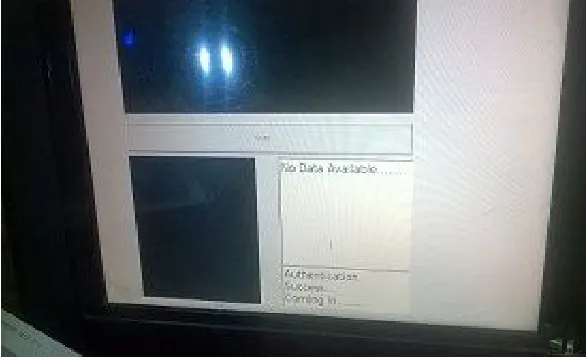
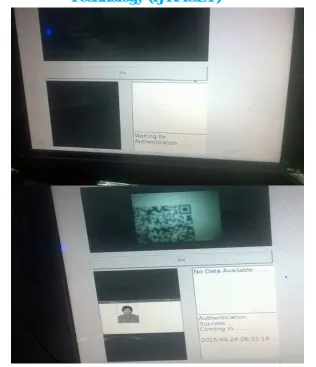
Fig . Kit connections and coding on screen.
Technology (IJRASET)
FIG. Final Output on the Screen.
VI. CONCLUSION
The project “KINDILING AND PERCEPTION OF QR IMAGES USING RASPBERRY-PI ” has been successfully designed and tested. It has been developed by integrating features of all the hardware components and software used. Presence of every module has been reasoned out and placed carefully thus contributing to the best working of the unit. Secondly, using highly advanced Raspberry pi board and with the help of growing technology the project has been successfully implemented.
REFERENCES
[1]Information Technology—Automatic Identification and Data Capture Techniques—Bar Code Symbology QR Code, Int. Org. Standardization, Geneva, Switzerland, ISO/IEC 18004, 2006.
[2] M. Hara, M. Watabe, T. Nojiri, T. Nagaya, and Y. Uchiyama, “Optically readable two-dimensional code and method and apparatus using the same,” U.S. Patent 5 726 435, Mar. 10, 1998.
[3] T. J. Soon, and Q. R. Code. Synthesis Journal, 2008, section 3 [Online]. Available: http://www.itsc.org.sg/pdf/synthesis08/Three_QR_ Code.pdf
[4] R. Cox. (2012, Apr.). Qart Codes [Online]. Available: http://research.swtch.com/qart
[5] Visualead company, Herzelia, Israel. (2013, Jan.). Free Visual QR Code Generator [Online]. Available: http://www.visualead.com/
[6] S. Ono, K. Morinaga, and S. Nakayama, “Two-dimensional barcode decoration based on real-coded genetic algorithm,” in Proc. IEEE CEC, Jun. 2008, pp. 1068–1073.
[7] D. Samretwit and T. Wakahara, “Measurement of reading characteristics of multiplexed image in QR code,” in Proc. 3rd Int. Conf. Intell. Netw. and Collaborative Syst., 2011, pp. 552–557.
Technology (IJRASET)
http://www.google.com/patents/US7950589
[10] M. Hagiwara. (2013). Qrjam [Online]. Available: http://qrjam.jp/
[11] K. Fujita, M. Kuribayashi, and M. Morii, “Expansion of image displayable area in design QR code and its applications,” in Proc. Forum Inform. Technol. Papers, 2011, vol. 10, no. 4, pp. 517–520.
[12] Y. Lin, Y. Chang, and J. Wu, “Appearance-based QR code beautifier,” IEEE Trans. Multimedia, vol. 15, no. 8, pp. 2198–2207, Dec. 2013. [13] D. W. Inc., Elkhart, IN, USA. (2013). Logoq [Online]. Available: http://www.qrcode.com/en/codes/logoq.html
[14] Z. Baharav and R. Kakarala, “Visually significant QR codes: Image blending and statistical analysis,” in Proc. IEEE ICME, Jul. 2013, pp. 1–6. [15] H.-K. Chu, C.-S. Chang, R.-R. Lee, and N. J. Mitra, “Halftone QR codes,” ACM Trans. Graph., vol. 32, no. 6, p. 217, 2013.
AUTHORS
P.V.Vinodkumar received his B.Tech degree in Electronics and Communication Engineering from Brahmaiah College Of Engineering ,North Rajupalem ,SPSR Nellore District, affiliated to JNTU Anantapur.He is currently pursuing M.Tech Embedded Systems in Audisankara college of Engineering and Technology, Gudur(Autonomous), SPSR Nellore (Dist), affiliated to JNTU Anantapur.