Technology (IJRASET)
Performance and Study of Diesel Engine Using
Blends of Sunflower Oil with Diesel
Ankush Prajapati1, Kuladeep Kumar Pandey2, Devesh Kumar3
1, 2, 3
Mechanical Engineering Department MMMUT GORAKHPUR 273010
Abstract- Biodiesel either in neat, clean and sustainable form or as a mixture with diesel fuel is widely investigated to solve the two basic problems of fossil fuels and environmental degradations. The main objective of the present study is to make a comparison of performance, emission and combustion characteristic of biodiesel derived from edible vegetable sunflower oil in a four stroke single cylinder diesel engine with pure diesel fuel. The performance parameters evaluated were brake horse power, fuel consumption rate, brake thermal efficiency, brake specific fuel consumption, temperature of exhaust gas, temperature of cooling water and emission of carbon monoxide as a part of combustion study temperature of cooling water, temperature of exhaust gas was also evaluated. The different properties of sunflower oil after transesterification were within tolerable limits of standards as sets by many countries. The brake thermal efficiency of B-25 fuel is more than B-0 fuel up to 80 % load and then it tends to decreases below B-0 fuel at full load condition and the brake specific fuel consumption of the B-25 fuel at all loads is closely similar to that of the B-0 fuel or it can be said that optimum brake specific fuel consumption is observed at 80 % load by the B-25 amongst all blended fuels. The fuel consumption rate of B-10 and B-20 fuel is very close to that of the B-0 fuel but at full load the fuel consumption rate of B-10 and B-30 fuel increases more than B-0. But the overall the fuel consumption rate of B-25 blends is lower than that of B-0.The results from the experiments suggest that biodiesel derived from edible oil like sunflower oil could be a noble substitute to diesel fuel in diesel engine in the near future as far as decentralized energy production is concerned. In view of analogous engine performance and reduction in most of the engine emissions, it can be decided and biodiesel developed from sunflower and its blends could be used in a conventional diesel engine without any engine modification
Keywords- Internal Combustion Engine, Sunflower Methyl Esters, Transesterification, Performance.
I. INTRODUCTION
In the concern of current energy situation, major research is focused on sustainable energy solution with major prominence on energy efficiency and use of renewable energy sources. The diesel engines lead the field of commercial transportation and agricultural equipment due to its simplicity of operation and higher fuel efficiency. The consumption of diesel fuel is several times higher than that of petrol fuel. Due to the scarcity of petroleum products and its increasing cost, efforts are on to develop alternative fuels specially, to the diesel oil for fully or partial replacement. It has been originate that the vegetable oils are hopeful fuels because their properties are similar to that of diesel and are produced simply and renewably from the crops. Vegetable oils have equivalent energy density, cetane number, heat of vaporization and stoichiometric air–fuel ratio with that of the diesel fuel. None other than Rudolph Diesel, the forefather of diesel engine, validated the first use of vegetable oil in compression ignition engine. He works on the peanut oil as fuel for his experimental engine. During the World War II, efforts were made to use vegetable oils as fuel in diesel engines. Viscosity of vegetable oils is more than a few times higher than that of diesel. Viscosity of liquid fuels disturbs the flow properties of the fuel, such as spray atomization, resultant vaporization, and air–fuel mixing in the combustion chamber. Higher viscosity of oils had an adversative effect on the combustion in the present diesel engines.
In recent years, methodical efforts were under taken by many researchers to conclude the suitability of vegetable oil and its
derivatives as fuel or additives to the diesel [1–5]. Blending, emulsification, thermal cracking and trans esterification are the
Technology (IJRASET)
Biodiesel is a chemically altered alternative fuel for use in diesel engines. It produced from vegetable oils and animal fats. Biodiesel is created commercially by the transesterification of vegetable oils with alcohol. Methanol or ethanol is the frequently used alcohols for this process. These can also be bent from the biomass sources. The direct use of alcohols as fuel causes deterioration and decomposition of various parts in the engine. The transesterification process resolves this problem. The carbon cycle of vegetable oils contains release and absorption of carbon dioxide. Combustion and inhalation process release carbon dioxide and crops for their photosynthesis process engross the carbon dioxide. Thus, the gathering of carbon dioxide in atmosphere reduces. The carbon cycle
time for fixation of CO2 and its relief after combustion of biodiesel is quite small (few years) as likened to the carbon cycle time of
petroleum oils (few million years) [8,9].
Swarup Kumar Nayak et al. [11] conducted the experiment on diesel engine at constant speed of engine i.e. at 1500 rpm under varying load conditions with different ratio of blend of Mahua biodiesel. This was a probing investigation to determine the effect of fuel on the engine performance parameters and structure required to use this fuel.
There are following conclusion are made from above experimental investigation.
A. With increase the percentage of Mahua biodiesel in the blend the brake thermal efficiency also increase.
B. But with increase the percentage of Mahua biodiesel in the blend the brake specific fuel consumption decreases.
C. As the increased percentage of Mahua biodiesel in the blend exhaust gas temperature decreases.
D. When engine was run on biodiesel then exhaust emission contains CO, CO2 and hydrocarbons in comparison to the
conventional fuel will less.
Pandey et al. [10] performed production of biodiesel and performance of C.I engine using blend of rice bran oil biodiesel with
diesel. His research work mainly focus on the detailed prospect of using crude RBO biodiesel as a substitute fuel without performing any modification in the engine.
There are following conclusion are made from above experimental investigation.
A. With increase the percentage of Rice bran biodiesel in the blend the brake thermal efficiency also increase.
B. Out of all blended fuels the BSFC of the B-20 fuel at all load is closely similar to that of the B-0 fuel or it can be said that
optimum brake specific fuel consumption is observed at 80 per cent load by the B-0 and B-20 fuel.
C. It is observed that initially the BTE of B-20 fuel is more than the B-0 fuel up to 60 per cent load and then it because almost
equivalent to that of B-0 fuel at 80 per cent, afterwards it decrease below to the B-0 fuel at full load.
D. As the increased percentage of Rice bran biodiesel in the blend exhaust gas temperature decreases.
Saswat Rath et al. [12] for taking measurement under various speed and loading condition and checked various parameters such as brake power, brake thermal efficiency, brake specific fuel consumption and exhaust gas temperature. They uses various ratio of blends like B-0, B-10, B-20, to B-100. B represent Karanja biodiesel and 10, 20 represent the percentage of biodiesel blends. Following conclusion are made from above experimental investigation.
A. The brake thermal efficiency of the engine with karanja methyl ester-diesel blend was marginally better than with neat diesel
fuel.
B. Brake specific energy consumption is lower for karanja methyl ester-diesel blends than diesel at all loading.
C. The exhaust gas temperature is found to increase with concentration of karanja methyl ester in the fuel blend due to coarse fuel
spray formation and delayed combustion.
D. The mechanical efficiency achieved with KME30 is higher than diesel at lower loading conditions. At higher loads, the
mechanical efficiency of certain blends is almost equal to that of diesel.
E. The emission characteristics are higher than pure diesel but the KME30 has relatively better performance with respect to other
blends.
Technology (IJRASET)
seed, rice bran and cashew are available in large number. The production and consumption of these oils are low at present, because of their limited end usage. Utilization of this oils/biodiesel as fuels in internal combustion engines are not only dropping the petroleum usage, but also improve the rural economy. Efforts are made here to produce biodiesel from typical unrefined oil (sunflower oil) and to use it as the fuel in diesel engines.
II. CHARACTERIZATION OF SUNFLOWER OIL
In the present study, the sunflower seed oil, an edible type vegetable oil is chosen as a potential alternative for producing biodiesel and use as fuel in compression ignition engines. Its technical name is helianthus annuus. The viscosity of crude sunflower oil is
much greater, about 15 times larger than that of diesel oil. While it becomes very near to diesel, when it is transesterfied. Fatty acid
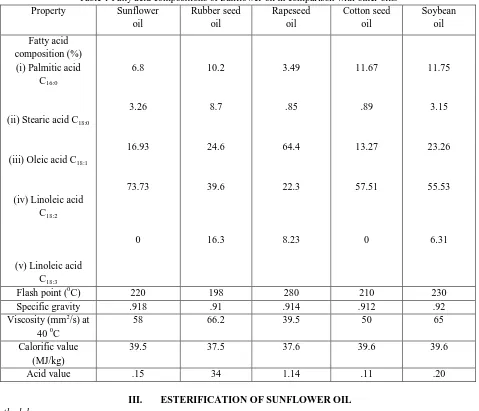
composition of the oil containsmostly oleic (44.05%), linoleic (10.72%), palmitic (38.60%), and stearic (4.65%) acids.
[image:4.612.68.547.279.690.2]Sunflower is a high oil content seed and average yields can produce 600 pounds of oil per acre, considerably more than soybeans. There is a great deal of interest from local areas for construction of small processing facilities for sunflower biodiesel production. It is most important that processing equipment be investigated very prudently for small 'press' only facilities. In most cases a major portion of the oil is left in the by-product meal thereby dropping economic efficiency. [13-16]
Table 1 Fatty acid compositions of Sunflower oil in comparison with other oils.
Property Sunflower
oil Rubber seed oil Rapeseed oil Cotton seed oil Soybean oil Fatty acid composition (%) (i) Palmitic acid
C16:0
(ii) Stearic acid C18:0
(iii) Oleic acid C18:1
(iv) Linoleic acid C18:2
(v) Linoleic acid C18:3 6.8 3.26 16.93 73.73 0 10.2 8.7 24.6 39.6 16.3 3.49 .85 64.4 22.3 8.23 11.67 .89 13.27 57.51 0 11.75 3.15 23.26 55.53 6.31
Flash point (0C) 220 198 280 210 230
Specific gravity .918 .91 .914 .912 .92
Viscosity (mm2/s) at
40 0C
58 66.2 39.5 50 65
Calorific value (MJ/kg)
39.5 37.5 37.6 39.6 39.6
Acid value .15 34 1.14 .11 .20
III. ESTERIFICATION OF SUNFLOWER OIL
A. Methodology
Technology (IJRASET)
The esterification procedure consists of the following two stages.
1) Acid-esterification: The acid-catalysed pre-treatment procedure reduces the high FFA content of the crude oil to about 2% FFA.
2) Alkaline-esterification: The products of first step are transesterified using basic catalyst. The essential parameters affecting the esterification process such as alcohol to vegetable oil molar ratio, catalyst quantity, reaction temperature and duration of reaction are analysed
B. Esterification procedure
A round bottom flask of 500 cm3 is used as laboratory scale reactor for the present analysis. The sunflower oil in the flask was
heated on a hot plate having magnetic stirrer arrangement. The mixture was rotated at the same speed for all test runs. The
temperature maintained for the whole esterification process is between 40 and 50 0C. Alcohol to vegetable oil molar ratio is one of
the significant factors that affect the alteration efficiency of the process. For the stoichiometric transesterification, 3 moles of alcohol are required for each mole of the oil. However, in exercise, the molar ratio should be greater than this theoretical ratio in order to drive the reaction towards initial completion.
The products of the principal stage are used as the feedback of the alkaline esterification process. A molar ratio of 9:1 and 3.5 gram by weight of sodium hydroxide is found to give the extreme ester yield. After the reaction is accomplished, the products are allowed to discrete into two layers. The lower layer holds impurities and glycerol. This top layer (ester) is separated and purified using distilled water. Hot distilled water (10% by volume) is squirted over the ester and stirred gradually and allowed to settle in the separating funnel. The lower layer is unsolicited and upper layer (purified biodiesel) is separated.
Chemical reaction of transesterification process
IV. BIODIESEL CHARACTERIZATION
The important properties of sunflower methyl esters are establish out and matched with that of other esters and diesel (Table 2 [13– 16]). It can be seen that the properties of sunflower methyl esters are relatively comparable to that of other esters. The outcome shows that, transesterification enhanced the important fuel properties of the oil like calorific value, density viscosity, flash point and cetane number. The comparison demonstrates that the methyl ester has relatively closer fuel properties to diesel than that of unique unrefined sunflower oil.
The viscosity was considerably got reduced from a value of 33.9 to 4.6 mm2/s (approximately one seventh of initial value). The
Technology (IJRASET)
Table 2 Properties index of sunflower oil, sunflower methyl ester, soybean methyl ester, rapeseed methyl ester and diesel.
Vegetable oil & Diesel Kinematic viscosity 38°C (cSt) Cetane number Calorific value (MJ/kg) Flash Point (°C) Density kg/lit Sunflower oil(natural)
33.9 37.1 39.6 274 .916
Sunflower oil methyl ester (Biodiesel)
4.6 49 33.5 183 .860
Soybean oil methyl ester
4.08 46 39.76 69 0.885
Rape seed oil methyl
ester
4.5 45 37.00 170 0.882
Diesel 3.18 40-55 44.8 68 0.832
V. EXPERIMENTAL SETUP
A Kirloskar make, single cylinder, water cooled, direct injection was selected for the present research work, which is primarily used for agricultural activities and household electricity generations. The detailed technical specifications of the engine are given in Table 3.
Table 3 Test engine specification of sunflower oil
Particulars Descriptions
Engine type Four stroke, single cylinder, Water cooled, Diesel
engine
Bore Diameter 87.5 mm
Stroke length 110 mm
Compression Ratio 16.7
Rated power 5 horse power
Rated speed 1500 rpm
Dynamometer Hydraulic dynamometer
Performance and emission tests are conducted on the compression ignition engine, using various blends of biodiesel and diesel as fuels. The tests are accompanied at the rated speed of 1500 rpm at different loads. The experimental data engendered are recognized and presented here using suitable graphs. These tests are intended at enhancing the concentration of ester to be used in the biodiesel–diesel blend for long-term engine operation. In each trial, engine parameters related to thermal performance of the engine such as fuel consumption and applied load are measured. In addition to that, the engine emission parameters such as carbon monoxide (CO), temperature of exhaust gas and temperature of cooling water.
VI. RESULT AND DISCUSSIONS
A. Fuel Consumption Rate v/s Load
[image:6.612.68.543.385.511.2]Technology (IJRASET)
Graph 1 Fuel Consumption Rate for blended fuels at various loads
B. Brake Specific Fuel Consumption v/s Load
The variation of brake specific fuel consumption with load for different fuels at different load is presented in graph 2. It is observed from the graph that brake specific fuel consumption for all blended fuel first decreases with increase in load i.e. up to 80 % load and after that they tends to increase with load. But the brake specific fuel consumption of each blended fuel decreases as the percentage of biodiesel i.e. sunflower methyl ester is increased in the blends. But at certain level it will increases with increases in percentage of biodiesel. It is clearly seen that out of all blended fuels the brake specific fuel consumption of the B-25 fuel at all loads is closely similar to that of the B-0 fuel or it can be said that optimum brake specific fuel consumption is observed at 80 % load by the B-25 amongst all blended fuels.
Graph 2 Brake Specific Fuel Consumptions for blended fuels at various loads
C. Brake Thermal Efficiency v/s Load
The variation of brake thermal efficiencywith load for different fuels at different load is presented in graph 3. It is observed from
Technology (IJRASET)
comparison to the B-0 fuel as the percentage of the biodiesel increases in the blended test fuels. But it is observed from the graph that initially the brake thermal efficiency of 25 fuel is more than 0 fuel up to 80 % load and then it tends to decreases below B-0 fuel at full load condition.
Graph 3 Brake Thermal Efficiency for blended fuels at various loads
D. Temperature of Exhaust Gas v/s Load
The variation of exhaust gas temperature with respect to applied load for different fuels tested is shown in graph 4. It is observed from the graph that the temperature of exhaust gas increases with increase in load for all tested fuels. The biodiesel also contains some amount of oxygen molecules in the ester form. It is also taking part in the combustion. Up to B-25 blended fuel the exhaust gas temperature is lower but further increases the percentage of biodiesel in the blends the temperature of exhaust gas increases. So we can easily said that from the graph the B-25 gives lower temperature of exhaust gas at all loading condition.
Graph 4 Temperature of Exhaust Gas for blended fuels at various loads
E. Temperature of Cooling Water v/s Load
Technology (IJRASET)
some amount of oxygen molecules in the ester form. It is also taking part in the combustion. Up to B-25 blended fuel the cooling water temperature is lower but further increases the percentage of biodiesel in the blends the temperature of cooling water increases. The oxides of nitrogen emission are directly associated to the engine combustion chamber temperatures, which in turn specified by the predominant exhaust gas temperature as well as cooling water temperature. With rise in the value of exhaust gas temperature,
NOX emission also increases. So we can easily said that from the graph the B-25 gives lower temperature of cooling water at all
loading condition so B-25 produce less amount of NOX among all blends of fuels.
Graph 5 Temperature of Cooling water for blended fuels at various loads
F. Emission of Carbon Monoxide v/s Load
The emission characteristics of biodiesel take special interest in relation to achieving the environmental norms. Graph 6 demonstrates the plots of carbon monoxide emissions of the sunflower methyl ester and various blends of biodiesel operation at the rated engine speed of 1500 rpm at various load conditions. The fuels are producing less amount of carbon monoxide emission at low loading condition and are giving more emissions at higher loading conditions. With increasing biodiesel percentage in the blends, emission of CO level decreases. Biodiesel itself has about 11% oxygen content in its constituents. This helps for the complete combustion of fuel. Hence, CO emission level decreases with increasing biodiesel percentage in the fuel.
Technology (IJRASET)
VII. CONCLUSIONS
The main objective of the present thesis work is to produce biodiesel from sunflower oil and after that perform number of test on Four stroke, single cylinder, Water cooled, Diesel engine by using the conventional diesel fuels and various blends of biodiesel fuels. After carrying out series of experiment the following conclusion were made. These conclusions are given below.
A. Out of all blended fuels the brake specific fuel consumption of B-25 fuel at all loading condition is slightly higher than that of
B-0 fuel and it can be clearly seen that the optimum brake specific fuel consumption is at 80% loading condition by B-25 and B-0 fuel.
B. It is observed that the brake the brake thermal efficiency of B-25 fuel is more than the B-0 fuels up to 60% loading condition
and then it becomes almost equivalent to that of B-0 fuel at 80% loading condition, afterwards it decreases below to the B-0 fuel at full loading condition.
C. Till 75% loading condition the fuel consumption rate of B-20 and B-25 blended fuel is very close to that of the B-0 fuels but at
full load the fuel consumption rate of B-20, B-25 and B-30 fuel increases more than B-0 fuel.
D. we can easily said that from the graph the B-25 gives lower temperature of exhaust gas at all loading condition.
E. it is clearly seen that from the graph the B-25 gives lower temperature of cooling water at all loading condition so B-25 produce
less amount of NOX among all blends of fuels.
F. It is observed that due to presence of oxygen content in the biodiesel helps in the complete combustion of fuel. Hence, CO
emission level decreases with increasing biodiesel percentage in the fuel.
VIII. RECOMMENDATION
B-25 fuel is found suitable to use as a sustainable, green, clean substitutes in the C.I engine and its fuel consumption rate, brake specific fuel consumption, brake thermal efficiency are very close to that of the conventional diesel fuel.
IX. SCOPE FOR FUTURE WORK
Due to unavailability of apparatus and equipment I was not able to measure various parameters of exhaust gas which are emitted from the engine by using pure diesel and various blends of fuels at the time of experiment. It is observed from various research papers that by using biodiesel and blends of biodiesel with diesel as a fuel in the C.I engine reduce the emission of carbon dioxide, oxides of nitrogen and hydrocarbons.
REFERENCES
[1] Agrawal AK, Das LM. Biodiesel development and characterization for use as a fuel in compression ignition engines. Trans ASME 2001;123:440–7.
[2] Fangrui Ma, Milford A. Bio-diesel production review. Bioresour Technol 1999.
[3] Canakci M, Van GJ. Biodiesel production from oils and fats with high free fatty acids. Trans ASAE 2001; 44.
[4] ] Ramadhas AS, Jayaraj S, Muraleedharan C. Use of vegetable oils as I.C. engine fuels—a review. Renewable Energy 2004;29.
[5] Ramadhas AS, Jayaraj S, Muraleedharan C. Characterization and effect of using rubber seed oil as fuel in compression ignition engines, Renewable Energy. 2005;30.
[6] Recep A, Selim C, Huseyin SY. The potential of using vegetable oil fuels as fuel for diesel engines. Energy Convers Manage 2001;42.
[7] Fernando NDS, Antonio SP, Jorge RT. Technical feasibility assessment of oleic sunflower methyl esterutilization in diesel bus engines. Energy Convers Manage 2003;44.
[8] Senatore A. A comparative analysis of combustion process in D.I. diesel engine fueled with bio-diesel and diesel fuel, SAE 2000-01-0691; 2000. [9] Peterson CL, Tood H. Carbon cycle for rapeseed oil biodiesel fuels. Biomass Bioenergy 1998;14.
[10] A. Pandey et al., Biodiesel fuel production of rice bran oil by transesterification of oils,””A review. Journal of Bioscience and Bioengineering 2001; 92:405 16. [11] Swarup Kumar Nayak et al., To Study of Vegetable Oils and Their Effects on Diesel Engine Performance, International Journal of Scientific and Research
Publications, Volume 2, Issue 10, October 2012.
[12] Salah Khan Ahmad et al., emissions and performance study with sunflower methyl ester as diesel engine fuel, vol. 3, no. 5, october 2008.
[13] Ikwuagwu OE, Ononogbu IC, Njoku OU. Production of biodiesel using rubber seed oil. Ind Crops Prod 2002;12.
[14] Antolin G, Tinaut FV, Briceno Y, Castano V, Perez C, Ramirez AI. Optimization of biodiesel production by sunflower oil transesterification. Bioresour Technol 2002;83.