“Research Work for Optimization and Effect of
WEDM Cutting Process Parameters on
Performance Measures- a Literature Review”
Sunil Kumar1, Rajender Singh2
1
Research Scholar, 2Assistant Professor, Department of Mechanical Engineering, Guru Jambheshwar University of Science and Technology, Hisar-125001, Haryana, India
Abstract: Use of traditional machining methods to machine intentionally developed new hard, tough and reinforcement materials is no longer efficient due to greater tool wear, which causes serious surface damage. Thesekinds of materials can be machined with the help of non-traditional machining methods. WEDM is one of the non-traditional methods which provide greater degree of surface finish with high MRR while cutting electrical conductive materials. WEDM performance estimation is based on MRR (Material Removal Rate), WWR (Wire Wear Rate), Kerf width and SR (Surface Roughness). Lots of work has been done by various researchers on WEDM process parameter optimization for various materials.This paper presents a literature review of work done on optimization of various cutting process parameters like: Pulse on time (Ton), Pulse off time (Toff), Wire feed rate, Peak current, Servo voltage, Spark gap set voltage etc.) and the effect of these cutting parameters on performance measures like (MRR, WWR, kerf width and SR etc.) on WEDM.
Keywords- MRR, SR, WWR, Kerf width, Process parameters, Performance measures, WEDM.
I. INTRODUCTION
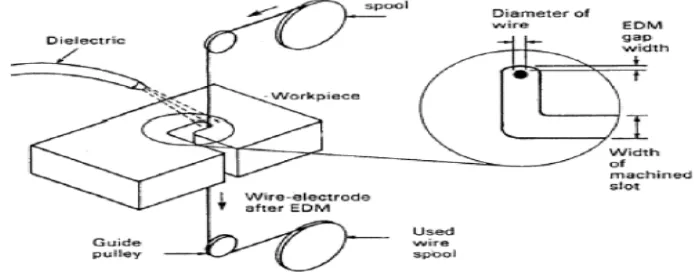
[image:2.612.122.469.582.718.2]Wire electrical discharge machining (WEDM), is a spark erosion process used to produce complex two and three-dimensional parts of electrically conductive work pieces by using wire as an electrode. WEDM is a non-traditional machining process that uses electricity to cut any conductive material precisely and accurately. During the WEDM process, the wire carries negative side of an electrical charge and the work piece carries positive side of the charge. When the wire gets close to the part, the attraction of electrical charges creates a controlled spark, which melts and vaporizes microscopic particles of material. The spark also removes a small part of the wire, so after one cut, the machine removes the used wire and automatically advances new wire with the help of wire feeding mechanism. This process takes place quickly, thousands of sparks per secondgenerated but there is a small gap between wire and work piece. Wire EDM machines use a dielectric solution of deionized water to continuously cool and flush the machining area while EDM is taking place. In many cases the entire part is submerged in the dielectric fluid, while high-pressure upper and lower flushing nozzles clear out microscopic debris from the surrounding area of the wire during the cutting process. The fluid also acts as a non-conductive barrier, preventing the formation of electrically conductive channels in the machining area. When the wire gets close to the part, the intensity of the electric field overcomes the barrier and dielectric breakdown occurs, allowing current to flow between the wire and the work piece, resulting in an electrical spark. This electric spark initiates the material removal process. Figure 1 shows the WEDM process [1].
The high degree dimensional accuracy of work piece and the surface finish makes WEDM particularly valuable for applications involving manufacturing of stamping dies, extrusion dies and prototyping parts. Without WEDM the fabrication of precision work pieces requires many hours of manual grinding and polishing. Presently WEDM is also used in the field of medicine, electronics, automotive, aerospace, defense industries etc.
Discharge current, discharge capacitance, pulse duration, pulse frequency, wire speed, wire tension, average working voltage and dielectric flushing conditions are the machining parameters which affect the performance measures like: MRR (Material Removal Rate), WWR (Wire Wear Ratio), kerf width and SR (Surface Roughness).Among the other performance measures, the kerf width which determines the dimensional accuracy of the finished part is of utmost importance. The gap between wire and work piece usually ranges from 0.025 to 0.075 mm, it is maintained by a computer controlled positioning system. In WEDM operations, material removal rate (MRR) determines the economics of machining and rate of production. In setting the machining parameters, the main goal is the maximum MRR with the accurate kerf width and minimum SR[1,2].
II. LITERATURE REVIEW
Sivaramanet. al. evaluated the effect of various control parameters on WEDM using Titanium as work piece. The input process parameters included Dielectric pressure, Pulse ON/OFF time, Wire tension, Wire feed rate, Gap voltage, and Average gap current which effect the output response parameters such as Surface roughness, Electrode wear, Material removal rate were studied through orthogonal arrays and L9 techniques of Taguchi method, and concluded in favour of Taguchi method regarding parametric optimization of WEDM on using multiple performance characteristics such as MRR and surface roughness [8]. R.M. Chaudhariet. al. in his work input process parameters affecting quality characteristics (output parameters) in WEDM process was studied. In this study, it was concluded that Surface roughness and MRR plays vital role in machining processes. Input parameters like voltage, pulse ON/OFF time, dielectric fluid pressure, wire speed, wire tension, resistance and cutting length are taken as fixed parameters for optimization of WEDM. Signal to noise ratio measuring system was used to obtain MRR and surface roughness. Optimal value for surface roughness and MRR was determined by using Multi objective optimization techniques GRA and ANOVA and by using Taguchi optimization technique, optimized value was determined for MRR and surface roughness separately which can be used to obtain minimum surface roughness and maximum MRR [9]. S. Sivanagaet. al. provided the best process parameters of WEDM in machining 18-4-1 grade speed steel (HSS) with different thickness varies from 5mm to 80mm. Experiments were executed under various conditions by varying power inputs and with stable machining and high cutting speeds. And all output performances are evaluated with different thickness of work piece material and therefore results in development of correlations with using software, these correlations and parameter evaluations were studied to choose best process parameters [10]. A. Joshi et. al. examined the control process parameters of WEDM to elaborate process limitations for tool and die steel. This research work has been done to examine the cutting and metal removal rate of tool steel EN 31. ELECTRONICA DL-25P unit 4-axis CNC WEDM with Brass wire of diameter 0.18 mm was used for experiment work. Pulse ON time, pulse OFF time, bed speed and current was input process parameters. Obtained results were examined using S/N ratios, response graph and response table in Minitab software. In this practical work results were analyzed and regression equation was developed to calculate the MRR. It was concluded that with increase in pulse ON time and bed speed, MRR increases, and low pulse OFF time results in low MRR [11]. P. Abineshet. al. studied the effect of working process parameters in WEDM using Titanium Alloys as work piece. Experiments were carried out on ELEKTRA SPRINTCUT 734 WEDM machine using Brass and Brass Coated Nickel wire of diameter 0.15-0.20 mm. Relation between the various input process parameters like Pulse ON time (Ton), Pulse OFF time (Toff), Pulse Peak Current (IP), Wire material and Work piece material and process variables was investigated to optimize output process parameters like MRR, Surface Roughness and Electrode Wear Rate. Taguchi’s L16 orthogonal array was selected to optimize values of chosen process parameters. In this work, it was concluded that with high values of pulse ON/OFF time and low value of current MRR increases. When there was an increment in pulse ON time Surface Roughness decreased and with an increment in pulse OFF time and peak current surface roughness increased. Electrode wear rate reduced when pulse OFF time and peak current increased [12].D.V. Kashidet. al. in this research investigation on effect of input process parameters on MRR in WEDM machining process of Steel Grade EN 9 was done. Experimental work was performed on SPRINTCUT ELPULS 40 A DLX CNC WEDM using a negatively charged brass wire of diameter of 0.25 mm. Three input process parameters were chosen, pulse ON time (Ton), pulse OFF time (Toff) and wire feed. Taguchi’s L9 orthogonal array was used to perform experiments and signal to noise ratio was estimated for MRR. Analysis work was performed using ANOVA and response graphs. At last it was found that MRR mostly influenced by Ton and Toff. Maximum MRR was obtained by using high value of Ton and low values of Toff and wire feed. Wire feed have minimum effect on MRR [13].N.Z. Khan et. al. studied the effect of WEDM process parameters on surface roughness average and micro hardness of HSLA (High Strength Low Alloy Steel) ASTM A572-grade 50. Taguchi’s orthogonal array and grey relational analysis (GRA) method was subsequently applied to determine an optimal WEDM parameter setting through nine experiments. Experiments were executed on a Steer Corporation DK7712 NC WEDM machine. The pulse OFF time was found to be the most important factor for both the surface roughness and the micro-hardness. This work gave results that Increased pulse ON time leads to the increase in both the surface roughness and the micro-hardness. Increase in the pulse current results in increased surface roughness. The fruitful order for the controllable input factors to the surface roughness average was in sequence, pulse OFF time, pulse ON time, and the current. However, for micro-hardness the sequence was the pulse OFF time, the current and the pulse ON time [14].P.S. Raoet.al. investigated effects of input parameters WEDM on MRR by employing Aluminum BIS-24345 alloy for work piece material. Taguchi design L18 orthogonal array was used for study of Different levels of input parameters. Pulse on time, Pulse off time, Peak
important parameters [15].L. Li. Et. al. checked on the evolution of surface integrity and machining efficiency of WEDM when machining Nickel-based Alloy (IN718). One rough cut (RC) mode and three trim cut (TC) modes were used for this study. Studied machining parameters were material removal efficiency, surface roughness, surface topography, surface alloying and micro hardness. Results explained that Surface roughness in RC mode was different than TC modes. In TC modes micro cracks absent, high toughness of IN 718 would have been the reason for this absence. Micro-cracks exists in white layer of 6-8 µm thickness in RC mode and thin white layers of 0-2 µm free from micro-cracks was observed in TC2 mode. In TC3 mode white layer was invisible [16].A. Goswamiet. al. in his research surface integrity, material removal rate (MRR) and wire wear ratio was investigated for WEDM process using Nimonic 80A as work piece material. ELECTRONICA SPRINTCUT (Electra- Elplus 40A DLX) CNC WEDM was used to perform experiments using soft brass wire of diameter 0.25 mm as tool electrode. Experiments were designed based on Taguchi’s design of experiments (DOE). Input process parameters taken was peak current, pulse ON time, pulse OFF time, wire speed, wire tension, wire offset, spark gap and pulse peak voltage, servo voltage, flushing pressure as constant process parameters. After machining, Scanned Electron Microscopy (SEM) was performed on machined work piece samples to study microstructure. It was concluded that thicker recast layer results through higher pulse ON time setting. The wire deposition on machined surface was lower when using lower pulse ON time and higher pulse OFF time settings [17]. S. Ramesh et. al. contributed an effort to obtain maximum surface finish in WEDM dealing with multi cutting passes while machining Metal Matrix Composite (MMC) work piece. 4-Axis CNC-WEDM machine by Steer Corporation was used to perform experiments using Molybdenum wire as tool electrode material of diameter 0.18mm. White layer or recast layer and heat affected zone (HAZ) on the surface of machined work piece was analyzed by using Field Emission Scanning Electron Microscopy (FESEM). After study the experimental results, it was concluded that with increment in the number of cutting passes value of surface roughness (Ra) reduced. In rough cut pass, surface cracks and craters increased because of formation of White layer, while white layer was reduced in semi-finished cutting passes due to which surface cracks and craters decreased. White layer was completely removed in finish cutting passes [18].G. Sachdevaet.al. proposed study of metal cutting rely on the features of tools, input work materials and machine parameter settings effecting process efficiency and output quality characteristics by taking vital WEDM process parameters namely current, pulse ON time, pulse OFF time, wire speed and wire tension. Work piece electrode and tool electrode were selected as H-21 die tool steel and zinc coated brass wire respectively. Taguchi’s L18 orthogonal array technique has been used to evaluate optimal parameter combination to obtain optimal cutting speed, minimum surface roughness value and minimum die width; along with S/N ratio and ANOVA for analysis of selected experiments. It was concluded from experiments that for continuous quality improvement and higher machining efficiency Taguchi’s L18 orthogonal array technique was prominent method to predict optimal parameter values [19]. M. Durairajet.al. used the Grey relational theory and Taguchi optimization technique, for optimization of the cutting parameters in Wire EDM for SS304. The aim of optimization was to attain the minimum kerf width and the best surface integrity individually. Stainless steel 304 was employed as work piece; brass wire of 0.25mm diameter was selected as tool along with distilled water which was used as dielectric fluid. Taguchi’s L16, orthogonal array technique was used for experiments. The input
MRR and SF in WEDM were determined through Taguchi method [32].A. Hasçalyket. al. investigated the machining characteristics of AISI D5 tool steel in WEDM process. Open circuit voltage, pulse duration, wire speed and dielectric fluid pressure were taken as input Parameters and were changed to determine their effect on the surface roughness and metallurgical structure of work piece. Sodick A320D/EX21 WEDM machine was elected for performing the experiments. Optical and scanning electron microscopy, surface roughness and micro hardness tests were employed to analyze the characteristics of the work piece. It was concluded that the intensity of the process energy affects the amount of recast and surface roughness as well as micro cracking, while the wire speed and dielectric fluid pressure were not having substantial effect [33].
II. CONCLUSION
Performance of WEDM process is based onthe effect of cutting process parameters on performance measures (MRR, WWR, Kerf width and SR). In WEDM, to cut complex and small parts with greater accuracy, proper selection and optimization of process parameters is required to increase the productivity.
A. From the above literature review
1) It is concluded that in most of the cases on increasing Pulse ON time & Peak current, MRR increases and with increase in pulse OFF time & servo voltage, MRR decreases. It is also revealed that diffused wire gives more MRR than simple brass or copper wires.
2) SR increases with increase in pulse OFF time & peak current while decreases with increasing pulse ON time mostly. Better surface finish occurred in trim cut as compared to rough cut.
3) It is found that kerf width decreases with increase in pulse ON time, pulse OFF time, spark gap voltage and peak current. Kerf width increases with increase in wire tension.
4) It is concluded that WWR increases with increase in peak current & pulse ON time while WWR is low when wire tension is high. Also, it is found that WWR is not much affected with pulse OFF time.
5) It is revealed that Taguchi design approach is most reliable and effective technique for the design and optimization of WEDM cutting process parameters among all techniques.
REFERENCES
[1] P. K. Mishra, “Non-Conventional Machining”, Narosa Publishing House, Edition 2005.
[2] David H. Dulebohn’sGroupin, Tracer controlled machining by electrically induced erosion, US Patent 3,614,372, filed 4 December 1969, issued 19, October 1971.
[3] H. K. Sharma, D. Gupta “Optimization of Process Parameters of Wire Cut Electronic Discharge Machining”, Global journals blog, http://blog .gjre.org/2016/02/optimization-of-process-parameters-of.html.
[4] S. Kumar, S. K. Garg, G. Chawla“Experimental Investigation of Effect of Process Parameters on Material Removal Rate during WEDM”, International Journal of Current Engineering and Technology Vol.6, Issue No.1, 2016, 40-45.
[5] V. Kumar, K. K. Jangra, V. Kumar “An experimental study on trim cutting operation using metal powder mixed dielectric in WEDM of Nimonic-90”, International Journal of Industrial Engineering Computations 7, 2016, 135–146, doi: 10.5267/j.ijiec.2015.7.002
[6] A. Goswami, J. Kumar “Trim cut machining and surface integrity analysis of Nimonic 80A alloy using wire cut EDM”, International Journal Of Engineering Science And Technology, http://dx.doi.org/10.1016/j.jestch.2016.09.016.
[7] B. Choudhuri, R. Sen, S. K. Ghosh, S. C. Saha “A Comparative Modeling and Multi- Objective Optimization in Wire EDM Process on H21 Tool Steel Using Intelligent Hybrid Approach”. International Journal of Engineering and Technology (IJET), Vol 8, Issue No. 6, 2016-17, 3102-3111, DOI: 10.21817/ijet/2016/v8i6/160806267.
[8] B. Sivaraman, C. Eswaramoorthy, E. P. Shanmugham “Optimal control parameters of machining in CNC Wire-Cut EDM for Titanium”, International Journal of Applied Sciences and Engineering Research, Vol. 4, Issue No. 1, 2015, 102-121, DOI: 10.6088/ijaser.04011.
[9] R. M. Chaudhari, V. P. Salot “A Review on Parametric Optimization on Die Steel Using Wire Cut EDM”, International Journal for Innovative Research in Science & Technology, Vol. 1, Issue No. 7, 2014, 77-79.
[10] S. Sivanaga, M. Routhor, V. S. ParameswaraRao “Optimization and Influence of Process Parameters for Machining with WEDM”, International Journal of Innovative Research in Science Engineering and Technology, Vol. 3, Issue No. 1, 2014.
[11] A. Joshi “Wire Cut EDM Process Limitations for Tool and Die Steel”, International Journal of Technical Research and Applications, www.ijtra.com Vol. 2, Special Issue 1, 2014, 65-68.
[12] P. Abinesh, K. Varatharajan, G. S. Kumar “Optimization of Process Parameters Influencing MRR, Surface Roughness and Electrode Wear During Machining of Titanium Alloys by WEDM”, International Journal of Engineering Research and General Science Vol. 2, Issue No. 4, 2014, 719-729.
[13] D. V. Kashid, S. G. Bhatwadekar, S. B. Sangale, P. R. Kubade “Investigations of Effect of Process Parameters on Material Removal Rate in Wire-cut Electrical Discharge Machining of Steel Grade EN 9”, International Journal of Emerging Engineering Research and Technology Vol. 2, Issue No. 1, 2014, 31-35. [14] N. Z. Khan, Z. A. Khan, A. N. Siddiquee, A. K. Chanda “Investigations on the effect of wire EDM process parameters on surface integrity of HSLA: a multi
performance characteristics optimization”, Production & Manufacturing Research: An Open Access Journal, Vol.2,Issue-1, 2014, 501–518,
[15] P. S. Rao, K. Ramji, B. Satyanarayana “Experimental Investigation and Optimization of Wire EDM Parameters for Surface Roughness , MRR and White Layer in Machining of Aluminum Alloy”, International Conference on Advances in Manufacturing and Materials Engineering, AMME, Vol. 5, 2014, 2197-2206,
https://doi.org/10.1016/j.mspro.2014.07.426.
[16] L. Li, X.T. Wei, Z.Y. Li “Surface Integrity Evolution and Machining Efficiency Analysis of WEDM of Nickel-based Alloy”, Applied SurfaceScience 2014,
http://dx.doi.org/10.1016/j.apsusc.2014.05.165.
[17] A. Goswami, J. Kumar “Investigation of surface integrity, material removal rate and wire wear ratio for WEDM of Nimonic 80A alloy using GRA and Taguchi method”, Engineering Science and Technology, an International Journal 17, 2014, 173-184 http://dx.doi.org/10.1016/j.jestch.2014.05.002.
[18] S. Ramesh, N. Natarajan, V. Krishnaraj “Effect of multipass cutting on surface roughness in wire electrical discharge machining of metal matrix composites”, Applied Science Innovations Pvt. Ltd., India Carbon – Sci. Tech., Vol. 6, Issue No. 3, 2014, 14 – 21.
[19] G. Sachdeva, R. Khanna, P. Yadav “Experimental study of H-21 punching dies on wire-cut electric discharge machine using Taguchi’s method”, International Journal of Scientific & Engineering Research,Vol. 4, Issue No. 5, 2013.
[20] M. Durairaj, D. Sudharsun, N. Swamynathan “Analysis of Process Parameters in Wire EDM with Stainless Steel using Single Objective Taguchi Method and Multi Objective Grey Relational Grade”, International Conference on Design And Manufacturing, Procedia Engineering 64, 2013, 868-877.
http://dx.doi.org/10.1016/j.proeng.2013.09.163.
[21] P. Gupta, R. Khanna, R. D. Gupta, N. Sharma “Effect of Process Parameters on Kerf Width in WEDM for HSLA Using Response Surface Methodology”, Journal of Engineering and Technology, Vol. 2, Issue No. 1, 2012, 1-6, doi: 10.4103/0976-8580.94230.
[22] V. Muthuraman, R. Ramakrishnan, Karthikeyan “Influence of Process variables on WEDM of Tungsten Carbide Cobalt Metal Matrix Composite”, International Journal on Design & Manufacturing Technologies, Vol. 6, Issue No. 2, 2012.
[23] V. S. Gadakh “Parametric optimization of Wire Electrical Discharge Machining using TOPSIS METHOD”, Advances in Production Engineering and Management, Vol. 7, Issue No. 3, 2012, 157-164.
[24] J. R. Mevada, C. D. Shah, B.C. Khatri “A Wear Investigation of Repeatedly Used Wire in Wire Cut Electrical Discharge Machine”, International Journal of Emerging Technology and Advanced Engineering Website, www.ijetae.com, Vol. 2, Issue No. 12, 2012, 271-274.
[25] D. S. Kumar, M. Kanthababu, Vajjiravelu, R Anburaj, H. Arul “Investigation of Wire electrical discharge machining characteristics of Al6063/SiCp composites”, International Journal for Advanced Manufacturing Technology, 56, 2011, 975-986, DOI 10.1007/s00170-011-3242-5.
[26] V. Parashar, A. Rehman, J. L. Bhagoria, Y. M. Puri “Kerf width analysis for wire cut electro discharge machining of SS 304L using design of experiments”, International Journal of Science & Technology, Vol. 3, Issue No. 4, 2010.
[27] V. M. Kumar, A. S. Babu, R. Venkatasamy, M. Raajenthiren “Optimization of the WEDM Parameters on Machining Incoloy800 Super alloy withMultiple Quality Characteristics”, International Journal of Engineering Science and Technology Vol. 2, Issue No. 6, 2010, 1538-1547.
[28] T. R. Newton, S. N. Melkote, T. R. Watkins, R. M. Trejo, L. Reister “Investigation of the effect of process parameters on the formation and characteristics of recast layer in wire-EDM of Inconel 718”, Materials Science and Engineering A 513–514, 2009, 208–215, doi:10.1016/j.msea.2009.01.061.
[29] M. A. Hassan, N. S. Mehat, S. Sharif, R. Daud, M. S. Reza “Study of Surface Integrity of AISI 4140 Steel in Wire Electrical Discharge Machining”, Proceeding of International Multi-Conference of Engineers and Computer Scientist, II, 2009.
[30] H. Singh, R. Garg “Effect of Process Parameters on Material removal rate in WEDM”, Journal of Achievement in Material and Manufacturing Engineering, Vol. 32, Issue No. 1, 2009, 71-74.
[31] F. Han, J. Jiang, D. Yu “Influence of Machining Parameters on Surface Roughness in finish cut of WEDM”, International Journal of Advanced Manufacturing Technology, Vol. 34, 2007, 538-546.
[32] S. S. Mahapatra, A. Patnaik “Parametric Optimization of Wire Electrical Discharge Machining (WEDM) Process using Taguchi Method”, Journal of the Brazilian Society of Mechanical Science & Engineering by ABCM, Vol. XXVIII, Issue No. 4, 2006, 422-429.