Technology (IJRASET)
A Method for Mobile Robot to Navigate in
Dynamic Environment using Fuzzy Approach
1
S.R.Tandan, Karishma Dewangan2, Rohit Kumar Miri3
1,3
Department of Computer Science and Engineering, Dr. C.V.Raman University Kota, Bilaspur, India
2
M.Tech Scholar, Department of Computer Science and Engineering Dr. C.V.Raman University Kota, Bilaspur, India
Abstract: In this paper, we proposed algorithm for position and path estimation of mobile Robot in dynamic environment with the help of fuzzy approach. The application of the combined soft computing approaches are best techniques because of their ability to handle imprecision and uncertainties that are often present in the many real world problem and mobile Robot navigation is one of them. Rules of a Fuzzy Logic Controller (FLC) which a Robot uses to navigate among moving obstacles. The use of a fuzzy logic controller makes the approach easier to handle the uncertainties. A mobile Robot can then use this FLC to navigate in presence of moving obstacles. Fuzzy approach can produce efficient knowledge base of a FLC for controlling the motion of a Mobile Robot among moving obstacles.
Keywords: Mobile Robot; Position and Path Estimation; Fuzzy Approach
I. INTRODUCTION
With a pressing need for increased productivity and the delivery of end products of uniform quality, industry is turning more toward computer –based automation. At the present time, most automated manufacturing tasks are carried out by special – purpose machines designed to perform predetermined function in a manufacturing process[1]. Today Robot systems are powerful elements of today’s industry. They are capable of performing many different task and operations precisely and do not require common safety and comfort elements humans need and becoming more and more significant in various aspects of human life[2], for example in industrial, commercial and scientific applications. As a result of scientific achievements and industrial development, the number of Robots currently being used in industrial projects is increasing fast. However, Robotics have been evolving in the last years and there has been an increasing interest in developing Mobile Robot systems, capable of performing robust cooperative work.
Position and path estimation is one of the fundamental problems in robotic systems. Various algorithms have been proposed and investigated to solve these problems. Path planning algorithms are traditionally classified as centralized or decentralized.
Centralized path planning algorithm can guarantee optimal path if the environment is static and the number of obstacle is small. In a dynamic environment where we cannot predict the nature of environment, decentralized path planning algorithms are more beneficial. Decentralized path planning algorithms often find the optimal paths and solve conflict problems by dynamic assignment of priorities. They allow robot to search its own path in advance without considering the nature of environment but it is difficult to handle such unknown situation because, how to locate the position of mobile robot in dynamic environment where moving obstacles present and it may also interrupt the path of mobile robot . In such case it is difficult to estimate the position and path of mobile robot. However, only centralized methods can guarantee the completeness and optimality of the results.
Control and communication methods for Mobile Robot systems have been investigated by various researchers. Problems such as positioning and path planning of mobile robot systems are generally approached with a centralized controller in mind. Moreover, most of the work in positioning and path planning has been developed on a single mobile robot interacting with its environment. This work is part of the relatively new interest in interaction between Autonomous Mobile Robots. Such systems bring in the problems of both multiple robot coordination and autonomous navigation. However, due to the complexity in developing a complete system,
In this paper will focus on a specific task: Locating the position and estimating the path of the mobile robot which takes minimum traveling time and distance to find goal position in static as well as dynamic environment. This task appears to be very difficult when an environment also affect the motion of mobile robot.
Technology (IJRASET)
The problem of positioning and path planning in dynamic environments is quite different from navigating static environments. Positioning and path planning in static environments guarantees a solution if there exists one whereas in dynamic environments in intractable. Hence, the objective of positioning and path planning in dynamic environments is to avoid collisions and minimizing motion time as much as possible [9, 10].
Robots are going to play a vital role in upcoming generation of human being. They will be having major impact on our life, Science and Technology. Robotics is the field where almost every branch of Technology has got merged like Mechanical, Electrical and Electronics & Computer Science [7].
The key difference between Mobile Robot and Human navigation is the quantum difference in perceptual capabilities. Human can detect, classify and identify the environmental features under widely varying environment condition, independent orientation and distance. Current Mobile Robots, while being able to detect stationary obstacles before they start run into them, have very limited perceptual and decision making capabilities.
Navigation in dynamic environment is most important and necessary constraint for Mobile Robot to work - well. Robot need to recognize their position and pose in known environment as well as unknown environment. In the future, the Mobile Robot will be human friendly, that are able to coexist with humans in dynamic space [4]. Positioning and path planning of mobile robot included several restrictions which arise due to dynamic nature of obstacle. It is desirable for a mobile robot to take decision in such varying environment. Set of rules of Fuzzy Logic Controller (FLC) which mobile robot use during path planning for easily navigating among moving obstacle. Fuzzy approach is important tool to handle uncertainties of environment. Uncertainty - There are a number of uncertainty factors that contribute to mobile robot navigation problem [8]. First and foremost, mobile robot environments are the factors because of their unpredictable. Navigation problem is full of uncertainties which can be easily handled by fuzzy approach.
II. LOCATINGTHEROBOTPOSITION
Mobile robot positioning is one of an extremely challenging task in robotics [1][2]. Much of researches [3, 5] on this issue have been recently studied for autonomous mobile robot system. Positioning is the problem of determining the exact location of a robot relative to a given search space of the environment. The difficult problem that has a substantial impact on the positioning mobile robot is the environment. The environments can be static or dynamics [6]. Static environments are environments where the only variable quantity state is the robot's pose. Put differently, only the robot moves in static environment. All other objects in the environments remain at the same location forever. Static environments have some nice mathematical properties that make them amenable to efficient probabilistic estimation. Dynamics environments possess objects other than the robot whose location or configuration changes over time. Specially, the changes persist over time. Because of various uncertainties and limitation of sensor information for dynamic changes, positioning in the dynamics environments is obviously more difficult than positioning in the static ones. Mobile robot work space is crucial because it defines the range of possible positions that can be achieved by its end effector relative to the environment.
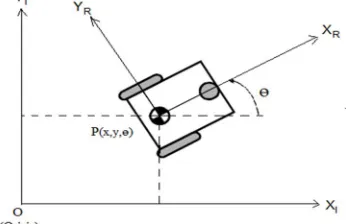
We considered to be mobile robot as single point rigid body operating on horizontal plane. The total dimensionality of this mobile robot on the plane is three, two for the position in the plane and one for the orientation along the vertical axis, which is orthogonal to the plane. In order to locate the position of mobile robot we need to establish a relationship between the global reference frame of the plane and the local reference frame of the mobile robot, as shown in fig.1
[image:3.612.220.393.576.688.2]
Technology (IJRASET)
The axes XI and YI define an arbitrary inertial basis on the plane as the global reference frame from the origin O: {XI, YI}. To specify the position of the robot, choose point p on the mobile robot as its reference point. The basis XR and YR defines two axes relative to the point p on the mobile robot and is thus local reference frame. The position of p in global reference frame is specified by coordinates of x and y, and the angular difference between the global and local reference frames is given by ө. We can describe the pose of the mobile robot as a vector with these three elements. Here we have taken subscript I to clarify the basis of this pose as the global frame:
To describe robot motion in terms of component motions, it will be necessary to map motion along the axes of the global reference frame to motion along the axes of the robot’s local reference frame. Of course, the mapping is a function of the current pose of the robot. This mapping is can represented in the form of orthogonal rotation matrix,
Let us consider the position of robot is PI as shown in figure 1, now we can map the motion of mobile robot in global reference to the local reference with the following equation
This matrix can be used to map motion in the global reference frame {XI,YI} to motion in terms of the local reference frame {XR ,YR} . This operation is denoted by R(ө)PI because the computation of this operation depends on the value of ө:
III. FUZZYAPPROACH
Problem in the real world quite often turn out to be complex owing to an element of uncertainty either in the parameter which define the problem in the situations in which the problem occur, Dynamic Mobile Robot navigation problem is one of them in which all parameter are having full of uncertainties [14].
It is in such situations that fuzzy set theory exhibits immense potential for effective solving of the uncertainty in the problem [5]. Soft computing techniques enable handling of imprecision and uncertainty often encountered in practical problems dynamic motion planning of Mobile Robot. There is natural connection between dynamic motion planning (DMP) problem of Mobile Robot and a fuzzy logic approach.
The purpose of the DMP (dynamic motion planning) problem of a Robot is to find obstacle –free path which takes a Robot from a starting point (S) to a goal point (G) with minimum time [2]. These are basically two important part of the problem.
LEARN TO FIND ANY PATH FROM POINT S TO G THAT AVOID ALL OBSTACLE; AND
LEARN TO CHOOSE THAT OBSTACLE –FREE PATH WHICH TAKES THE ROBOT IN A MINIMUM POSSIBLE TIME.
The DMP problem of Mobile Robot can be solved by many approaches but Fuzzy approach give optimum solution of the DMP problem of the Mobile Robot.
A. We State the Assumptions made about the DMP Problem 1)The Mobile Robot is considered to be single point.
Technology (IJRASET)
4)The obstacles are disjoint, that is, no two obstacles are allowed to overlap at any time.
Thus, the fuzzy logic technique helps in quickly determining imprecise yet obstacle –free paths and the use of an algorithm helps in learning an optimal set of rules that a Mobile Robot should use while navigating in presence of moving obstacle.
IV. REPRESENTATIONOFASOLUTION
A solution to the DMP problem is represented by a set of rules which a Mobile Robot will use to navigate point S to Point G. Each rule has three conditions - Distance, Angle, and Movement.
A. Distance
The distance of the nearest obstacle forward from the robot. Three fuzzy values for distance are very near (vn), near (n), and far (f).
Figure. 2 Membership function of distance used in fuzzy approach
B. Angle
The angle between the path joining the Robot and the target point and the path to the nearest obstacle forward. The corresponding five fuzzy values for the angle are Left (L), Ahead left (AL), Ahead (A), Ahead right (AR), Right (R).
Figure. 3 Membership function of angle used in fuzzy approach
C. Movement
Movement is the relative velocity vector of the nearest obstacle forward with respect to the mobile robot. Here, in each condition we assumed to take a triangular membership function.
Technology (IJRASET)
IF (distance is VN and angle is A)THEN (movement is AL)
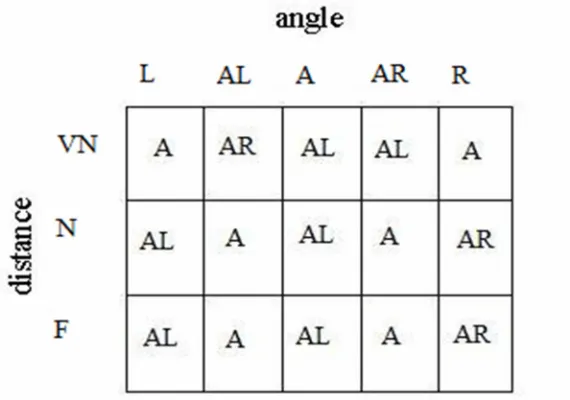
[image:6.612.153.438.204.404.2]In our solution we have three choices for distance and five choices for angle, so possible set of rule could be 3 x 5 or 15 combinations of two different conditions possible. For each of these 15 combinations, these could be one value for action variable. Thus there are total of 15 x 5 or 75 different rules possible, but an arbitrary set from these 75 rules cannot be used to constitute a valid rule base, this is because for two rules having identical combination of condition variables, there should be unique value of action variable, thus the maximum number of rules that may present in a rule base is 15, which can be used for the movement of the Mobile Robot.
Table 1.Set of rule
We have assigned a particular value of the action variable for each combination of condition variable based on intuition. An obstacle is very near and straight ahead, the robot deviated towards ahead left. However, when the obstacle is very near but on the left of the Mobile Robot, the Mobile Robot goes ahead. As the critical obstacle is away from the Mobile Robot, it has a tendency to move ahead. This set of rule is pretty good and we shall see later that an FLC with this rule base can navigate well in certain scenarios. However, currently we are also extending the –fuzzy approach to adaptively find the best action variable for a particular combination of condition variable, thereby eliminating the need for such a user –defined rule base.
It is important to note that not all 15 rules are necessary for the Mobile Robot to use during obstacle avoidance. One of the tasks in this study is to find which (and how many ) rules should be there in the rule base for the Mobile Robot to find the shortest path between two point.
V. RECOGNITIONOFOBSTACLE
In the dynamic nature of the environment we cannot predict the nature of obstacle and it becomes more difficult to handle the motion of the Mobile Robot when we do not having the knowledge of obstacle in advance. The Very near (VN), Near (N) and Far (F) obstacle avoidance behaviors use range sensor measurements to determine the preference for the possible movements. Its design is such that these behaviors become effective when an obstacle is observed in some neighborhood of the Mobile Robot. The fuzzy rules for these behaviors can be expressed as
IF (Range sensor readings) THEN (ai, 1 and ai, 2 and ai, 3)
Technology (IJRASET)
VI. FLOWCHARTOFPROPOSEDALGORITHMFORPOSITIONANDPATHESTIMATIONINDYNAMIC
ENVIRONMENT
A. Assumption
1) The speed of mobile robot and dynamic obstacle same.
Technology (IJRASET)
VII. CONCLUSION
The proposed method for position and path estimation of mobile Robot can be useful in implementation of real time humanoid Robot. Use of fuzzy logic technique makes it popular to handle an uncertainty which often comes in dynamic environment.
REFERENCES
[1] Majura F.Selekwa , Damion D.Dunlap, Dongqing Shi ,Emmanuel G. Collins Jr.,“Robot navigation in very cluttered environment by preference –based fuzzy bahaviors”, Robotics and Autonomous System, pp 1-15(2007)
[2] Dilip Kumar Pratihar ,Kalyanmoy Deb,Amitabh Ghosh - “A Genetic - Fuzzy approach for mobile Robot navigation among moving obstacles” International Journal of Approximate Reasoning, pp 145-172(1999)
[3] Roland Siegwart and lllah R. Noubakhsh “Introduction to Autonomous Mobile Robots”.
[4] Byoung – Suk Choi ,and Ju-Jang Lee Korea Advanced Institute of Science and Technology Korea(South), “The Position Estimation of Mobile Robot Under Dynamic Environment”.
[5] S. Rajsekaran, G.A. Vijayalakshmi Pai, “Neural Network, Fuzzy Logic, and Algorithm, synthesis and application”.
[6] J. Borenstein, H.R. Everett , L. Feng , and D. Wehe , “ Mobile Robot Positing Sensors and Technique”. Journal of Robotic System, Special Issue on Mobile Robot. Vol. 14 No. 4 pp. 231-249.
[7] Jaikant and Rashmi Sahay, “Algorithm for Optimizing the Path Trajectory of a Humanoid Robot for Stable Walking in Cluttered Environment Considering the Case of Static and Dynamic Obstacles”, Proceeding of National Conference on Communication Technology NCCT’08, 14-15 March 2008.
[8] Sebastian Thrun, Wolfram Burgard, and Dieter Fox, “Probabilistic Robotics”, the MIT Press, 2005. pp.191-199.
[9] Mithun Jacob, “Path Planning of and obstacle avoidance in Unknown Dynamic Environments”, University of Pennsylvania.
[10] P. Fiorini and Z. Shiller, "Heuristic Motion Planning in Dynamic Environments Using Velocity Obstacles", IEEE Robotic & Automation, San Diego, California, USA, 8-May-1994.
[11] A. Saffiotti, K. Konolige, E.H. Ruspini, “ A multivalued logic approach to integrating planning and control”, Artificial Intelligence 76(1995) 481-526. [12] A. Saffiotti, E.H. Ruspini, K. Konolige, “ Blending reactivity and goal directedness in a fuzzy controller”, in: Proceedings of the 2nd IEEE Conference on
Fuzzy System, Vol. 1, June 1993
[13] D.W. Payton, J. Rosenblatt, D.M. Keirsey, “Plan guided reaction”, IEEE Transactions on Systems, Man and Cybernetics 20 (6) (1990) 1370-1382.