M E T H O D
Open Access
f-scLVM: scalable and versatile factor
analysis for single-cell RNA-seq
Florian Buettner
1,6*, Naruemon Pratanwanich
1, Davis J. McCarthy
1,2, John C. Marioni
1,3,4*and Oliver Stegle
1,5*Abstract
Single-cell RNA-sequencing (scRNA-seq) allows studying heterogeneity in gene expression in large cell populations. Such heterogeneity can arise due to technical or biological factors, making decomposing sources of variation difficult. We here describe f-scLVM (factorial single-cell latent variable model), a method based on factor analysis that uses pathway annotations to guide the inference of interpretable factors underpinning the heterogeneity. Our model jointly estimates the relevance of individual factors, refines gene set annotations, and infers factors without annotation. In applications to multiple scRNA-seq datasets, we find that f-scLVM robustly decomposes scRNA-seq datasets into interpretable components, thereby facilitating the identification of novel subpopulations.
Keywords:Single-cell RNA-seq, Sparse factor analysis, Gene set annotations
Background
Single-cell RNA-sequencing (scRNA-seq) is an estab-lished tool for assaying variability in gene expression levels between cells drawn from a population. Cell-to-cell differences in gene expression can be driven by both observed and unmeasured factors, including technical effects such as batch, or biological drivers including cell type-specific features, such as the stage of T-cell differ-entiation [1]. Importantly, such technical and biological factors can act upon the same genes [2, 3], meaning that they need to be modelled jointly to fully understand het-erogeneity in scRNA-seq data.
Well-established approaches exist for handling ob-served factors, such as batch or experimental covariates [4, 5]. Additionally, methods based on factor analysis [6–8] and linear mixed models [9, 10] have been devel-oped to capture unwanted variability that arises from unmeasured factors, first for conventional ensemble RNA-profiling experiments and more recently for scRNA-seq [2]. Examples of unobserved factors that can explain substantial variation in scRNA-seq include the number of detected genes in the cell (cellular detection rate) [3], expression signatures that reflect the quality of the cell [11], or the cell cycle state [2, 12]. Depending on
the biological question at hand, these factors can mask other biological sources of variation, or they can them-selves be of biological interest. There exist several soft-ware implementations of methods to infer and account for observed factors and unmeasured factors, including SEURAT [13], MAST [3], and scLVM [2]. Furthermore, by using informative marker gene sets, methods based on SVD and regression have also been employed to re-construct individual cell state factors, such as the cell cycle [2, 12]. More recently, Fan et al. [14] introduced PAGODA, a PCA-based method that allows coordinated over-dispersion in specific gene sets to be identified.
However, these existing factor methods do not model errors in how gene sets are defined, and, more import-antly, they independently fit individual processes and do not explicitly account for either the presence of add-itional unannotated biological factors or confounding sources of variation. Finally, existing factor methods were motivated by relatively small single-cell RNA-seq datasets (see Additional file 1 for a comparison to alter-native factor models). Thanks to recent technological advances, it is now possible to routinely generate single-cell RNA-seq datasets containing hundreds of thousands of cells, which requires computationally effi-cient methods.
* Correspondence:[email protected];[email protected]; [email protected]
1European Molecular Biology Laboratory, European Bioinformatics Institute
(EMBL-EBI), Wellcome Genome Campus, Hinxton, Cambridge CB10 1SD, UK Full list of author information is available at the end of the article
Results and discussion
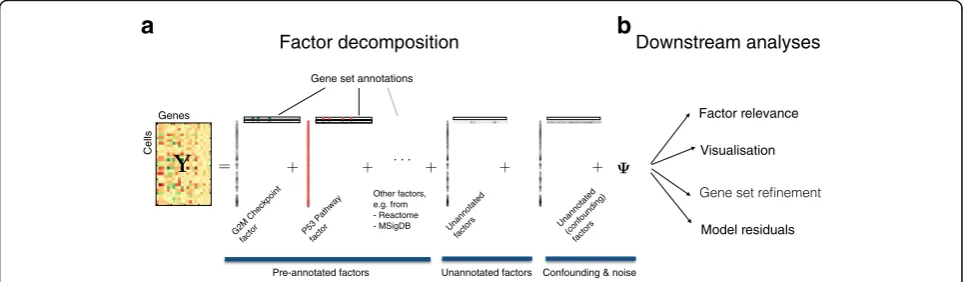
To address the aforementioned challenges, we here propose a factorial single-cell latent variable model (f-scLVM). Our model jointly infers factors that cap-ture different sources of single-cell transcriptome variation, including i) variation in expression attribut-able to pre-annotated gene sets and ii) effects due to additional sparse factors that explain putatively mean-ingful biological effects. In addition to these biological factors, our model also infers likely con-founding factors that are expected to affect the expression profile of the majority of genes (Fig. 1a).
To infer the state of these factors (i.e., whether a given factor is active in a cell), we employ similar assumptions as conventional factor analysis or principal component analysis (PCA). If a factor explains variation in the data, we assume that the expression levels of all genes assigned to it co-vary in a consistent manner. This al-lows the activity of each factor to be inferred from the data. For annotated factors, we incorporate prior annota-tion derived from publicly available resources such as MSigDB [15] or REACTOME [16], thereby assigning sets of biologically related genes to the same factor. The selected set of annotated factors depends on the specific question at hand and can include user-defined gene sets (“Methods”). The prior annotation is used to inform a sparse prior on the factor weights. Under this spike-and-slab prior, genes that are annotated to a factor have a higher probability of non-zero regulatory weights than other genes (“Methods”; Additional file 1). This ap-proach allows the assignment of genes to each factor to be refined in a data-driven manner. To ensure interpret-ability, we also assume that only a small number of changes occur (i.e., that the initial annotation is reason-ably accurate). For unannotated but biologically
meaningful factors, we assume generic sparsity such that these factors drive the variation of a small number of genes. Finally, we introduce additionaldense factors that have global effects on the expression of large numbers of genes. Similar to principles applied in population gen-omics [6, 7], we assume that these factors likely capture confounding effects.
As well as identifying new factors and updating exist-ing factor annotation, our model also infers which fac-tors explain variability in the given dataset. This factor relevance is inferred by calculating the expected variance in expression levels across cells using genes assigned to
the factor. To accurately infer these variance
components, f-scLVM can be used in conjunction with different observation models, thus accommodating both high-coverage datasets and sparse count profiles that are typically obtained from droplet-based experiments. Inference of model parameters, including gene assign-ments, factor weights, and factor states, is made using computationally efficient variational Bayesian inference, which scales linearly in the number of cells and genes. Although f-scLVM naturally builds on existing factor models, none of the existing approaches provide these features within a single model, and in particular the modelling of gene set annotations has not previously been considered (see Additional file 1 for full details and a comparison to existing factor models). The posterior distributions over model parameters facilitate a wide range of downstream analyses. These include i) the decomposition of single-cell transcriptome heterogeneity into interpretable biological drivers, ii) data visualization using factor states, iii) the refinement of gene set anno-tations, and iv) the estimation of a residual dataset, thereby selectively adjusting for biological or technical sources of variation (Fig. 1a, b).
Factor decomposition
Factor relevance
Visualisation
Downstream analyses
Genes
Cells
G2M Checkpoint factor
P53 Pathway factor
Other factors, e.g. from - Reactome - MSigDB Unannotated
factors
Gene set annotations
Model residuals
Unannotated (confounding)
factors
Pre-annotated factors Unannotated factors Confounding & noise
b
a
[image:2.595.57.540.524.665.2]Accurate identification of gene expression drivers and gene set augmentation
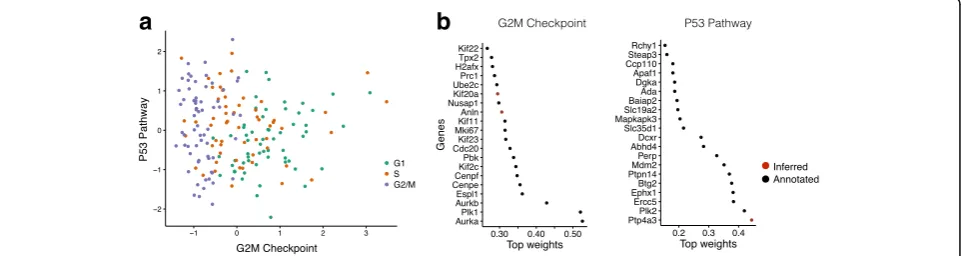
First, to validate f-scLVM we considered a dataset where the underlying sources of variation are well understood. We applied f-scLVM to 182 mouse embryonic stem cell (mESC) transcriptomes, where each cell was experimen-tally staged according to its position within the cell cycle [2]. Consequently, across the entire population, we expect that the cell cycle is the major source of variation. Indeed, when applying f-scLVM using 44 core molecular pathways derived from MSigDB [15], the method robustly identified five factors, including G2/M checkpoint and P53 pathway (Additional file 2: Figure S1). These two factors could be used to stratify the cells by their position in the cell cycle (Fig. 2a). Other methods, including PAGODA, require additional post-processing steps and infer collinear and partially redundant factors that less accurately discrimi-nated cells by cell cycle stage (Additional file 2: Figure S2), underscoring the importance of jointly modelling all an-notated and unanan-notated factors. Furthermore, unlike existing methodology, f-scLVM enabled data driven re-finement of gene set annotations (Fig. 2b). The model modified the G2/M checkpoint factor by adding two genes, Anln and Kif20a, both of which are well-characterized cell cycle regulators [17, 18]. Similarly, the model identified Ptp4a3, a known target of P53 [19], as an additional member of the P53 pathway.
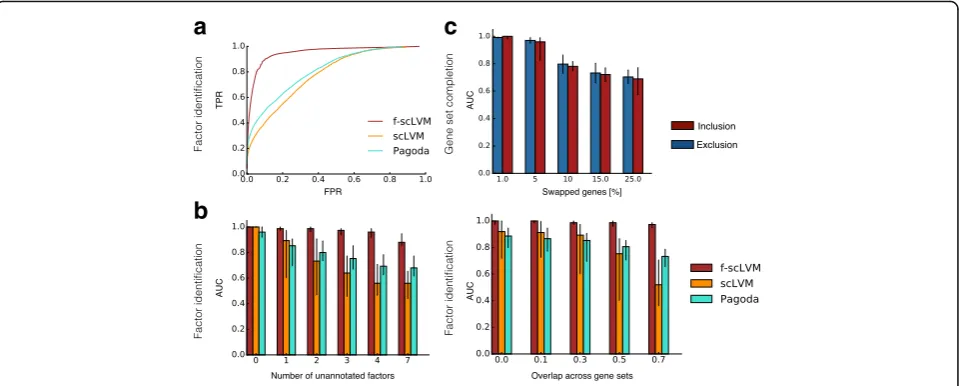
Next, we used simulations to systematically assess how robustly our model can identify relevant factors and complete gene set annotations. Over a wide range of simulations, where we varied the number of anno-tated factors and simulated confounders, the degree of overlap between gene sets, the number of cells, and the size of the annotated gene sets, we consist-ently observed that f-scLVM more accurately identi-fied the true simulated drivers than other methods based on PCA, linear mixed models, or factor analysis (Fig. 3a; Additional file 2: Figure S3a–e). Our method
showed the greatest improvement in performance over existing methods when multiple unannotated fac-tors were simulated and when the gene sets explain-ing the most variance in the data contained a substantial number of overlapping genes (Fig. 3b). We also confirmed that f-scLVM was robust to extremely sparse datasets, typical of droplet-based approaches (Additional file 2: Figures S3f–h and S11).
Additionally, we considered datasets with simulated errors in gene set annotation to assess the model’s ability to adjust these gene sets appropriately (“Methods”). We observed that the model accurately identified genes that should be excluded from and added to gene sets (Fig. 3c; Additional file 2: Figure S4). Unsurprisingly, as the frac-tion of errors in the gene set annotafrac-tion increased, the ability of the model to recover the true sets declined— -however, in the more realistic setting where only a small fraction of genes were poorly annotated (1–10%), our model performed extremely well.
Application to neuronal cells
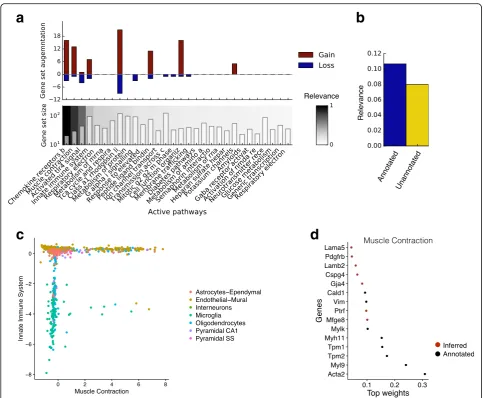
Having validated the performance of f-scLVM, we next applied it to a population of 3005 neuronal cells [20]. Using gene sets derived from REACTOME pathways as annotation, our model supported the importance of a set of factors similar to those identified by methods such as PAGODA (Fig. 4a), but with important differ-ences (e.g. innate immune system; Additional file 2: Figure S5). Additionally, our model suggested a refined annotation for some of the most relevant gene sets (Fig. 4a), with, on average, 10% of genes being added and 3% of genes being removed for the top 20 anno-tated factors. Furthermore, the model identified unan-notated factors with a high relevance score (Fig. 4b), demonstrating the importance of modelling such factors. We observed that many of these unannotated factors were sparse and captured differences between
a
b
Fig. 2Model validation using cycling mouse embryonic stem cells. Application of f-scLVM to 182 mESCs, experimentally staged for the cell cycle.
[image:3.595.58.539.556.684.2]cell types that are not readily reflected in the pathway annotations (Additional file 2: Figures S5 and 6a–c).
The top ranked annotated processes separated the cells into well-defined groups, with the endothelial-mural cells being stratified into two populations by the muscle contraction factor (Fig. 4c). Notably, our model augmented the corresponding gene set by activating several genes that have previously been implicated in muscle contraction but that were not present in the pre-defined REACTOME gene set (Fig. 4d). Among the 13 identified genes were several known markers of vascular smooth muscle cells, including Rgs4, Mtfge8, and Notch3 [21–24]. A second major driver identified by f-scLVM was the innate immune system factor, which, in particular, separated microglia (nervous sys-tem immune cells) from the remaining cell types (Fig. 4c). Moreover, similar to the muscle contraction factor, the gene set was also augmented with meaning-ful genes (Additional file 2: Figure S6d).
In addition to the populations of neurons character-ized by Zeisel et al. [20], we also applied f-scLVM to a variety of other datasets, identifying relevant factors that explained complementary axes of variation, augmenting gene sets, and observing that a consider-able proportion of the variance explained could be attributed to unannotated factors (Additional file 2: Supplementary analyses and Figures SN1–3). We also assessed the robustness of the annotated factors identi-fied by f-scLVM (Additional file 2: Figure S10).
Scalability to datasets with tens of thousands of cells
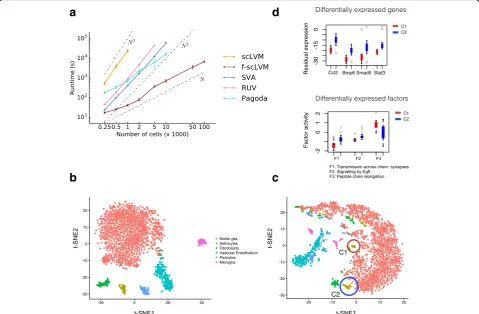
Finally, given the increasing trend to generate scRNA-seq datasets containing tens to hundreds of thousands of cells, we contrasted the computational efficiency of our model with a variety of factor analysis models (Figure 5a; Additional file 2: Figure S7). We observed that, irrespective of the number of cells, f-scLVM had a lower runtime than other approaches, with a linear scaling time in the number of cells as opposed to quadratic or even cubic relationships for other ap-proaches. Similarly, f-scLVM has a linear time-scaling in the number of genes (Additional file 2: Figure S7). As a consequence, f-scLVM can be applied to large-scale droplet-derived datasets.
To illustrate this, we applied f-scLVM to expression profiles from 49,300 retinal cells profiled using
Drop-seq [13]. Again, unannotated factors explained
substantial variation in the data, where most of this variation could be attributed to a single factor that affected a large number of genes (Additional file 2: Figure S8a), suggesting that it may correspond to con-founding effects. Indeed, this factor was correlated with the cellular detection rate (Additional file 2: Figure S8f ), a known confounding feature of scRNA-seq datasets [3]. As previously, our model identified biologically plausible processes, including GPCR signalling and transmission across chemical synapses, as explaining variability in the data (Additional file 2: Figure S8a).
a
c
b
Fig. 3Model validation using simulated data.a,bAccuracy of f-scLVM and alternative methods for recovering the set of simulated drivers of gene expression heterogeneity.aReceiver operating characteristics (ROC) pooled across different simulated datasets (Additional file 2: Table S1).
[image:4.595.59.539.88.281.2]To further explore these data, we next considered the residual dataset generated after regressing out the
effect of the unannotated, confounding, factor
(“Methods”) [25]. When focusing on a set of six re-lated and well defined cell types identified in the pri-mary analysis—Müller glia, astrocytes, fibroblasts, vascular epithelium, pericytes, and microglia—the re-sidual data revealed two subpopulations of astrocytes (Fig. 5b, c), as well as two subpopulations of micro-glia (Additional file 2: Figure S8b–d). In total, 1024 genes were differentially expressed between the two astrocyte populations (Wilcoxon rank sum test, false discovery rate (FDR) < 10%; Additional file 3). These
were enriched for processes related to immune
response and activation of astrocytes, such as inflam-matory response [26], BMP signaling pathway, and cellular response to BMP [27, 28] (Additional file 2: Table S2), and included known genes related to react-ive/inflammatory processes in astrocytes, such as Ccl2 [26]. In addition, BMP signalling is known to activate distinct downstream transcription factors, including Stat3 and Smad5, which show the expected pattern of behaviour between the two newly identified popula-tions [29] (Fig. 5d). Taken together, these results show that f-scLVM can be used to infer biological and confounding factors from large datasets.
c
a
d
b
Fig. 4Application of f-scLVM to neuronal cells.aFactor relevance and gene set augmentation for the most important 30 factors identified by f-scLVM based on REACTOME pathways.Bottom panel: Identified factors and corresponding gene set size ordered by relevance (white= low relevance;
[image:5.595.56.542.85.483.2]More broadly, we considered a range of available data-sets and investigated the nature of unannotated factors inferred by our model. We observed, as above, that these factors were often associated with technical experimental features that have previously been suggested to underpin variability in scRNA-seq data, including the number of expressed genes and sequencing depth (Additional file 2: Figure S9). However, these associations were often weak, suggesting that the inferred hidden factors help to capture additional unwanted variation that cannot be assigned to measured covariates.
Conclusions
Here, we have proposed a scalable factor analysis approach to comprehensively model the sources of single-cell transcriptome variability. Unique to our model is the ability to jointly infer both annotated and unannotated factors, including confounders, and to
augment predefined gene sets in a data driven manner. Additionally, f-scLVM is computationally efficient, allowing analysis of very large datasets containing hun-dreds of thousands of cells.
We have validated our model using simulations as well as real data where the sources of transcriptome variabil-ity are well understood. Subsequently, we have applied the model to a range of different experimental settings, demonstrating its ability to infer drivers of transcriptome variation, adjust gene sets to discover new marker genes and account for hidden confounding factors in the data.
Of course, our model is not free of limitations. A gen-eral challenge for any method is to reliably differentiate confounding factors from biological signal. f-scLVM ad-dresses this through specific assumptions on the effect of these factors (sparse versus dense) in conjunction with leveraging gene set annotation from pathway data-bases. Nevertheless, it is critical to interpret the model
a
d
b
c
Fig. 5Application of f-scLVM to large-scale scRNA-seq datasets.aThe empirical runtime when applying f-scLVM and alternative factor models (RUV, SVA, scLVM, PAGODA) to datasets with increasing size. f-scLVM scales linearly in the number of cells, enabling its use on large datasets with up to 100,000 cells. None of the existing methods could be applied to the largest dataset.Error barsdenote plus or minus one standard deviation.
[image:6.595.58.538.89.403.2]results and, in particular, the unannotated factors in the context of a given dataset.
A second potential caveat is the lack of accurate gene set annotation, which will necessarily impact the quality of the results. To mitigate this challenge, f-scLVM models possible errors in the annotation explicitly and augments gene sets in a data driven manner. However, such inferences have limitations. One important chal-lenge is collinearities between annotated factors and true biological differences. For example, if cells in different stages of the cell cycle are systematically associated with different cell types, the results from gene set refinements may be misleading and collapse two distinct biological processes into a single factor.
Other technical aspects of the model could be improved in the future. The noise model we use at present is based on a Hurdle model [3], which could be adapted to more specifically model the noise properties of different experi-mental platforms. Also, our model is intrinsically linear and in particular it assumes that the inferred factors have linear additive effects on gene expression. It would be pos-sible to model interactions between factors or different conditions, for example to assess whether a specific path-way is more active in a defined subset of cells. Extensions of f-scLVM in this direction will be an important area of future work. Finally, we note that f-scLVM could also be applied to other data modalities. In parallel to scRNA-seq, there are increasingly opportunities to model single-cell epigenome variation data, including single-cell DNA methylation profiling [30, 31], single-cell ATAC-seq [32] and multi-omic methods [33, 34].
Methods
The factorial single-cell latent variable model (f-scLVM)
f-scLVM is based on a variant of sparse factor analysis, decomposing the observed gene matrix into a sum of contributions from C measured covariates, A annotated factors, whose inference is guided by pathway gene sets, and H additional unannotated factors:
Y ¼ X
C
c¼1
ucVcT
|fflfflfflfflfflffl{zfflfflfflfflfflffl} cell covariates
þ X
A
a¼1
paRaT
|fflfflfflfflfflffl{zfflfflfflfflfflffl} annotated factors
þ X
H
h¼1
shQhT
|fflfflfflfflfflfflffl{zfflfflfflfflfflfflffl} unannotated factors
þ Ψ: ð1Þ
Here,Ydenotes the gene expression matrix where rows correspond to each of N cells and columns correspond to G genes. The vectorsuc,pa, and shcorrespond to known cell covariates, as well as cell states for annotated and un-annotated factors, andVc,Ra, andQhare the correspond-ing regulatory weights of a given factor on all genes. The matrixψdenotes residual noise, with its specific form de-pending on the noise model employed (see below). For the statistical derivation (see also Additional file 1), we express the model in Eq. 1 using matrix notation, collapsing the
factors into a factor activation matrix X= [u1,.., uC, r1,.., rA,s1,…,sH] (with the comma denoting concatenation of columns), where each factor is enumerated using an indi-cator k = 1.. K, and K denotes the total number of fitted factors K = C + A + H. The analogous matrix representa-tion is used for weightsW, resulting in:
Y¼XWTþψ:
Known covariates, annotated factors, and unannotated factors then correspond to different distributional as-sumptions on the column vectors of the matricesXand W. For brevity, we omit the cell covariates in the deriva-tions below (Additional file 1).
We place standard multivariate normal prior distribu-tions on the factor states of both annotated and unanno-tated factors. For announanno-tated factors, we employ two levels of regularization on the corresponding columns of the weight matrix W. First, gene set annotations are used to inform a regulatory sparseness prior on the rows ofW [35], thereby confining the inferred weights to the set of genes annotated in the pathway database. Second, we employ regularization of the overall variance ex-plained by individual factors (factor relevance), thus allowing the model to deactivate factors that are not needed to explain variation in a given dataset.
Regulatory sparseness prior
Gene set annotations inform a spike and slab mixture prior on the elements of W. The regulatory weight of factor kon gene gis modelled using a Normal distribu-tion (with factor-specific precision αk) if the regulatory
link is active (zg,k= 1), and a delta distribution otherwise
to force the weights of inactive regulatory link to zero:
p wg;kjzg;k
¼ (Nwg;kj0; 1=αkÞ if zg;k¼1
δ0 wg;k
otherwise:
ð2Þ
The true state of the indicator variablezg,k, which
deter-mines whether factor k regulates gene g, is unobserved. However, pathway annotations provide partial evidence which can be used to infer the most likely state ofzg,k:
p In g;kjzg;k
¼ Bernoulli I
n
g;k¼1j1−FPR
if zg:k¼1
Bernoulli In
g;k¼1jFNR
otherwise : 8 < :
Here, Ign,kis a binary variable denoting whether gene g
FPR = 0.01. Because the annotation information is mod-elled in the likelihood, the prior on the indicator vari-ables is uninformative,zg,k~ Bernoulli(0.5).
During inference, the posterior distribution of the indi-cator variables zg,k is then estimated jointly from the
observed expression data and the annotation. Once trained, the marginal posterior estimates of zg,k allow
identification of genes that are added to or removed from a particular factor, thereby augmenting the annota-tion in a data-driven manner.
Automatic relevance determination for determining factor relevance
In addition to the regulatory sparseness prior, f-scLVM uses automatic relevance determination (ARD) [36] to regularize the variance explained by individual factors. This is achieved by placing a hierarchical prior on the precision of the normal priors for active links (Eq. 2)αk
~Γ(a,b). The precision αkwill be large for factors with
low relevance, which corresponds to low prior variance, thus driving the regulatory weights to zero. The prior variance 1/αkcan also be interpreted as a measure of the
regulatory impact of a factor and corresponds to the ex-pected variance explained by the factor, for the subset of genes with a regulatory effect (see “Downstream ana-lysis”section).
Modelling unannotated factors
In addition to annotated factors, f-scLVM jointly esti-mates the effect of a fixed number of unannotated fac-tors. In the experiments, we consider two types of unannotated factors. First, to infer likely confounding factors, we assume that confounding factors have broad effects on large proportions of all genes, a principle that is widely used in population genomics [6, 7]. This prior belief is encoded using the Bernoulli prior zg,k~
Bernoulli(0.99), as a result of which the weights for these factors are effectively only regularized by the ARD prior. Second, f-scLVM allows inference of an additional set of sparse unannotated factors. These factors can, for ex-ample, be used to model additional biological variation that is not well captured by the factors in the annotation. These sparse factors are modelled using a Bernoulli prior that favours a small number of active links zg,k~
Bernoulli(0.01). The decision on how many factors of each type to consider can be guided by heuristics and diagnos-tics; see section“Diagnostics and f-scLVM parameter set-tings”for details on the selection of specific models.
Noise model
f-scLVM supports alternative noise models to accommo-date different RNA-sequencing protocols. First, the standard option is the log normal noise model, where the expression matrix Y consists of log count values
which are modelled assuming i.i.d. heteroscedastic resid-ualsψ(Additional file 1). We infer different residual var-iances for each dimension (gene), thereby accounting for varying extents of over-dispersion and enabling the model to deactivate some input dimensions, an approach widely adopted in conventional factor analysis [37].
In order to model the zero-inflation resulting from prominent dropout effects for protocols such as Drop-seq [13], f-scLVM can alternatively be run in conjunction with a zero inflation (Hurdle) noise model. A separate Bernoulli observation noise model is used, when no expression (zero count values) is observed for any specific expression value, while all remaining values are modelled using the afore-mentioned log Gaussian noise model. Formally, we define the factor analysis model on latent variables, F = XWT, and use the compound likelihood:
P yn;gjfn;g¼
1
1þexp fn;g
if yn;g¼0
N log yn;gþ1
jfn;g;σ2
g
otherwise
8 > > < > > :
where, analogous to the log normal noise model, yn,g
corresponds to log count observations. Note that in the absence of zero counts, this noise model reduces to the basic noise model.
Finally, if zero-inflation is less likely, for example in deeply sequenced datasets with larger quantities of start-ing material per cell, f-scLVM can also be used in con-junction with a classic Poisson noise model. The inference approach is analogous to the dropout model; however, assuming the following likelihood model:
P yngjfng
¼λ fng ynge −λð Þf ng
;
with link function λ fng ¼log1þefng and y n,g now
denoting raw count values.
Parameter inference
Closed-form inference in sparse factor analysis models such as f-scLVM is not tractable. In order to achieve scalability to large numbers of cells and genes, we em-ploy deterministic approximate Bayesian inference based on variational methods [38]. The core idea of variational Bayes is to approximate the true posterior distribution over all unobserved variables using a factorized form. This assumption of (partial) factorization of the poster-ior allows derivation of an iterative inference scheme, updating posterior distributions for individual parame-ters in turn, given the state of all others. An important design choice in f-scLVM is to couple the approximate posterior over the regulatory sparsity indicator zg,k and
the model weights wg,k. For full details and the update
Downstream analysis
The fitted f-scLVM model facilitates a range of different downstream analyses.
Factor relevance The relevance of different factors, in-cluding annotated pathway factors, is deduced from the ARD variance 1/αk, which corresponds to the expected
explained variance of factor k for the subset of genes with a regulatory effect (e.g. Fig. 3a, b).
Visualization The posterior distribution over the in-ferred factors X allows cell states to be visualised (e.g. Fig. 4c). This is possible for both annotated and unanno-tated factors. In the latter case, sparse unannounanno-tated fac-tors frequently tend to capture additional structure between cell types (Additional file 2: Figures S5 and S6).
Gene set refinement By comparing the posterior distri-bution on the indicator variableszg,kwith the prior gene
set annotations Ig,k, it is possible to identify individual
genes that were added to or removed from a pathway factor during inference (e.g. Fig. 4a, d). We use the pos-terior threshold of 0.5 to identify genes that were added to or removed from a gene set.
Estimation of residual expression datasets and imputation The learned factor X in combination with the corresponding regulatory weights W can also be used to calculate residual datasets where the effects of selected factors are removed, or to obtain imputed data-sets. When using the dropout noise model, expression residuals are estimated based on the latent expression values F (see “Noise model” section above). In this in-stance the model implicitly uses the dropout noise model to impute zero values prior to estimating expres-sion residuals (Additional file 1).
Relationship to other factor analysis models
Several existing factor analysis methods are related to f-scLVM. First, factor analysis with dense unannotated factors is used to adjust for unwanted variation in bulk datasets, including SVA [6], RUV [8], and PEER [7]. However, unlike f-scLVM, these methods do not model annotated factors using gene sets and hence are not designed for identifying biological drivers. Second, methods such as PAGODA [14] use gene set annotations to identify interpretable factors. However, this does not explicitly model variation outside the anno-tation, and it infers factors sequentially, which can lead to collinearities (Additional file 2: Figure S2b, e, f). Finally, there exist methods based on sparse factor analysis, in-cluding non-parametric methods and factor models that account for the specifics of single-cell transcriptome noise. f-scLVM is related to these variants of factor analysis, all
of which are based on a linear additive model. Again, these methods do not utilize gene set annotations. f-scLVM gen-eralizes many of these methods and, in particular, offers favourable computational efficiency. For further details and a detailed comparison of the features offered by different methods see Additional file 1: Section 2.
Implementation of alternative methods
We compared the performance of f-scLVM to that of existing factor models. First, we ran PAGODA using the scde R package [14]. Briefly, PAGODA infers a gene-specific residual variance by deriving cell-gene-specific error models accounting for dropout effects. This error model is then used to perform weighted PCA [39] on individual gene sets in turn, followed by a ranking of gene sets based on the explained variance of the leading PC. We also considered the single-cell latent variable model (scLVM [2]), which analogously to PAGODA infers inde-pendent low-rank factors based on predefined gene sets. The proportion of average variance explained by individ-ual factors for the set of annotated genes, as determined using the variance decomposition described in [2], was used to rank factors. A second class of methods we com-pared to are factor models that do not explicitly incorp-orate gene set annotations. Among these we used a conventional PCA fitted to the set of all expressed genes. Second, we applied the recently proposed Zero-Inflated Factor Analysis model (ZIFA) [40], a factor analysis im-plementation that explicitly models dropout events. Third, we applied a sparse factor analysis model based on the Indian buffet process (IBP), a non-parametric model that automatically infers the most appropriate number of sparse factors. None of these methods anno-tate the inferred factors and hence we implemented a post-processing step based on a gene set enrichment (using Fisher’s exact test based on the 40% of genes with the highest absolute weights; python package xstats.en-richment) to annotate the learnt factors using the same gene sets used to fit f-scLVM. We then used the enrich-mentp-value to rank the annotated individual gene sets as potential biological drivers.
Datasets and pre-processing
Choice of the gene set annotations used in the model
In principle, large numbers of annotated factors can be inferred based on large gene set annotations. Factors that correspond to inactive pathways will be deactivated during inference. However, in practice there are trade-offs such that compact gene sets can be advantageous as the model scales computationally linearly with the num-ber of factors. Empirically, we found that databases with tens to hundreds of annotated pathways result in a good trade-off between resolution and run-time. In particular, the MSigDB core processes database (hallmark gene sets H) consists of a comprehensive list of 50 pathways, allowing for a good resolution in relatively short run-times. For a more fine-grained analysis, we chose the REACTOME database consisting of 674 pathways.
Diagnostics and f-scLVM parameter settings
By default f-scLVM is fitted using annotated factors guided by gene set annotations and additional dense un-annotated factors that capture unwanted variation. How-ever, for some datasets this set of factors may not be sufficient to explain the observed heterogeneity, e.g. be-cause potential differences between cell types may not be well reflected by the provided annotations. In this case, it is advised to infer an additional set of sparse un-annotated factors. A suitable diagnostic for this decision are excessive augmentations of the annotated gene sets such that the inferred factor is unlinked to the annotated biological process. In the software implementation of f-scLVM, sparse unannotated factors are activated if the standard model changes (gains or losses) at least 100% of annotations for at least one annotated factor. For sparse and dense unannotated factors, we considered five and three factors by default, respectively. Note that because the ARD prior allows unused factors to be deac-tivated, the model is robust with respect to the number of dense unannotated factors, provided a sufficiently large number is inferred (Additional file 2: Figure S3i).
Filtering and gene selection of single-cell RNA-seq datasets
We applied f-scLVM to datasets filtered for high-quality cells and variable genes (see also individual datasets below). Analogous to commonly applied filtering steps for t-SNE and other scRNA-seq visualization ap-proaches, we recommend applying f-scLVM to genes that vary significantly across the set of cells. This set of genes can be identified based on ERCC spike-ins or a mean-CV relationship of endogenous genes. Genes in the tail of the variance distribution are dominated by technical sources of variation and hence can be discarded without loss of information.
Simulation study
We simulated gene expression matrices based on a linear additive model, an assumption that is motivated by the generative model that underlies both f-scLVM and exist-ing alternative approaches, all of which are based on vari-ants of linear factor analysis models (Additional file 1). We simulated effects from between three and ten active pathway factors with partially overlapping gene sets for each factor (see below), additional effects due to unknown confounding factors, and observation noise. We consid-ered a total of 44 simulation settings, considering variable dataset sizes (cell count), variable numbers of active path-way factors, and increasing numbers of simulated unanno-tated confounding factors. Additionally, we varied the overlap of genes annotated to individual pathways and the size of the individual gene sets and added varying degrees of noise in the annotation provided to each respective model by simulating a certain proportion of false nega-tive/false positive annotations and by swapping genes between active factors (see Additional file 2: Table S1 for full details of simulation parameters).
limit of detection where small numbers of molecules cannot be detected reliably. Second, we considered modelling the probability of dropout events as a func-tion of the true expression level, assuming an exponen-tial relationship [40]: pdrop= exp(−λfng
2
), with fng being
the latent expression level introduced above and λ the exponential decay parameter. Both dropout processes are simulated, where each setting is parameterized byλ and the threshold value, which corresponds to the lower limit of detection. For each simulation setting, 50 independent datasets were generated.
To assess the performance of f-scLVM and alternative methods, we consider the receiver operator characteristics (ROC) for identifying the true simulated drivers. For f-scLVM the factor relevance was used to rank factors. Analogous metrics were derived for all alternative methods (see“Implementation of alternative methods”section).
Additionally, we assessed the ability of f-scLVM to augment corrupted gene set annotations (Fig. 2c; Additional file 2: Figure S4). We evaluated the ability of the model to correct the false positive and false negative annotations separately.
Staged mouse embryonic stem cells
The set of 182 mESCs staged for the cell cycle have pre-viously been described in [2]. Briefly, cells were cultured in serum-free NDiff 227 medium (Stem Cells Inc.) sup-plemented with 2i inhibitors and sorted by cell cycle phases (G1, S G2/M) using FACS and Hoechst staining (Hoechst 33342; Invitrogen). Cells in all three cell cycle stages were profiled using the Fluidigm C1 system. We followed the pre-processing and normalization approach as previously described [12] and considered log-transformed and size-factor adjusted (geometric library size on endogenous genes) gene expression counts for 6635 variable genes for analysis. Additional results shown in Additional file 2: Figure S1c, d were obtained when considering a size-factor normalization based on ERCC spike-ins, which retains variation in the overall amount of mRNA per cell. f-scLVM was applied using 44 gene sets derived from MSigDB (after filtering; Additional file 1). We further applied PAGODA to the raw count data of the 182 cells using the R package scde with standard settings [14].
Zeisel et al. dataset
We analysed log-transformed gene expression values of 3005 single neurons sequenced using a protocol with unique molecular identifier [20]. We followed the pre-processing and filtering steps from the primary publication, resulting in 7097 variable genes. f-scLVM was applied using 161 annotations from the REAC-TOME database (after filtering; Additional file 1), pro-viding a high-resolution annotation. Following model
diagnostics steps (see “Diagnostics and f-scLVM par-ameter settings”), an additional five sparse unanno-tated factors were added and fitted jointly with the remaining factors (Additional file 2: Figure S5). Residual datasets were generated by regressing out the
effect of the most relevant unannotated factor
(Additional file 2: Figure S6e–h).
Retina cells
We considered the normalized, log-transformed ex-pression values of 49,300 retina cells as described in [13]. We considered all expressed genes, using the dropout noise model in f-scLVM to account for low se-quence coverage. We considered gene sets from the REACTOME database. Because of the size of the data set, we used factor pre-screening to reduce the set of factors before training, retaining 50 gene sets (Additional file 1). To generate expression values cor-rected for confounding factors, we considered residual gene expression profiles, regressing out the effect of the most relevant unannotated dense factor. These re-sidual data are available from [25]. Visualizations of corrected and raw expression values of six related cell types identified in the primary publication (Müller glia, astrocytes, fibroblasts, vascular epithelium, pericytes, and microglia) were obtained using t-SNE. The analysis of differentially expressed genes and factors was car-ried out using the Wicoxon rank sum test.
Additional files
Additional file 1:Supplementary methods. (PDF 382 kb)
Additional file 2:Supplementary figures and tables. (PDF 14372 kb) Additional file 3:Differentially expressed genes between the populations of astrocytes. Differentially expressed genes and factors between the identified astrocyte subpopulations
(using f-scLVM residuals, Fig. 4e). (XLSX 91 kb)
Acknowledgements
We thank Martin Hemberg for comments on the manuscript and Bertie Göttgens for helpful discussions.
Funding
F.B. received support from the UK Medical Research Council (MRC Career Development Award in Biostatistics). D.J.M. was supported by the National Health and Medical Research Council of Australia [APP1112681].
Availability of data and materials
f-scLVM is implemented in the slalom package for R and python, which is available under an Apache license (http://github.com/bioFAM/slalom) [42]. The software release that was used to generate the results reported in this manuscript is available at [43].
Authors’contributions
Author information
Correspondence and requests for materials should be addressed to [email protected], [email protected], [email protected].
Ethics approval and consent to participate
Ethical approval was not needed for this study.
Competing interests
The authors declare that they have no competing interests.
Publisher’s Note
Springer Nature remains neutral with regard to jurisdictional claims in published maps and institutional affiliations.
Author details
1
European Molecular Biology Laboratory, European Bioinformatics Institute (EMBL-EBI), Wellcome Genome Campus, Hinxton, Cambridge CB10 1SD, UK. 2
St Vincent’s Institute of Medical Research, 41 Victoria Parade, Fitzroy, Victoria 3065, Australia.3Cancer Research UK Cambridge Institute, Cambridge, UK. 4
Wellcome Trust Sanger Institute, Wellcome Genome Campus, Hinxton, Cambridge, UK.5European Molecular Biology Laboratory (EMBL), Genome Biology Unit, Meyerhofstr. 1, 69117 Heidelberg, Germany.6Current address: Helmholtz Zentrum München–German Research Center for Environmental Health, Institute of Computational Biology, Neuherberg, Germany.
Received: 25 August 2017 Accepted: 29 September 2017
References
1. Stegle O, Teichmann SA, Marioni JC. Computational and analytical challenges in single-cell transcriptomics. Nat Rev Genet. 2015;16:133–45. 2. Buettner F, Natarajan KN, Casale FP, Proserpio V, Scialdone A, Theis FJ,
Teichmann SA, Marioni JC, Stegle O. Computational analysis of cell-to-cell heterogeneity in single-cell RNA-sequencing data reveals hidden subpopulations of cells. Nat Biotechnol. 2015;33:155–60.
3. Finak G, McDavid A, Yajima M, Deng J, Gersuk V, Shalek AK, Slichter CK, Miller HW, McElrath MJ, Prlic M, et al. MAST: a flexible statistical framework for assessing transcriptional changes and characterizing heterogeneity in single-cell RNA sequencing data. Genome Biol. 2015;16:278.
4. Johnson WE, Li C, Rabinovic A. Adjusting batch effects in microarray expression data using empirical Bayes methods. Biostatistics. 2007;8:118–27. 5. Hicks SC, Teng M, Irizarry RA. On the widespread and critical impact of systematic
bias and batch effects in single-cell RNA-Seq data. bioRxiv. 2015:025528. 6. Leek JT, Storey JD. Capturing heterogeneity in gene expression studies by
surrogate variable analysis. PLoS Genet. 2007;3:1724–35.
7. Stegle O, Parts L, Durbin R, Winn J. A Bayesian framework to account for complex non-genetic factors in gene expression levels greatly increases power in eQTL studies. PLoS Comput Biol. 2010;6:e1000770.
8. Gagnon-Bartsch JA, Speed TP. Using control genes to correct for unwanted variation in microarray data. Biostatistics. 2012;13:539–52.
9. Listgarten J, Kadie C, Schadt EE, Heckerman D. Correction for hidden confounders in the genetic analysis of gene expression. Proc Natl Acad Sci U S A. 2010;107:16465–70.
10. Fusi N, Stegle O, Lawrence ND. Joint modelling of confounding factors and prominent genetic regulators provides increased accuracy in genetical genomics studies. PLoS Comput Biol. 2012;8:e1002330.
11. Ilicic T, Kim JK, Kolodziejczyk AA, Bagger FO, McCarthy DJ, Marioni JC, Teichmann SA. Classification of low quality cells from single-cell RNA-seq data. Genome Biol. 2016;17:29.
12. Scialdone A, Natarajan KN, Saraiva LR, Proserpio V, Teichmann SA, Stegle O, Marioni JC, Buettner F. Computational assignment Of cell-cycle stage from single-cell transcriptome data. Methods. 2015;85:54–61.
13. Macosko EZ, Basu A, Satija R, Nemesh J, Shekhar K, Goldman M, Tirosh I, Bialas AR, Kamitaki N, Martersteck EM, et al. Highly parallel genome-wide expression profiling of individual cells using nanoliter droplets. Cell. 2015; 161:1202–14.
14. Fan J, Salathia N, Liu R, Kaeser GE, Yung YC, Herman JL, Kaper F, Fan JB, Zhang K, Chun J, Kharchenko PV. Characterizing transcriptional heterogeneity through pathway and gene set overdispersion analysis. Nat Methods. 2016;13:241–44.
15. Subramanian A, Tamayo P, Mootha VK, Mukherjee S, Ebert BL, Gillette MA, Paulovich A, Pomeroy SL, Golub TR, Lander ES, Mesirov JP. Gene set enrichment analysis: a knowledge-based approach for interpreting genome-wide expression profiles. Proc Natl Acad Sci U S A. 2005;102:15545–50. 16. Croft D, Mundo AF, Haw R, Milacic M, Weiser J, Wu G, Caudy M, Garapati P,
Gillespie M, Kamdar MR, et al. The Reactome pathway knowledgebase. Nucleic Acids Res. 2014;42:D472–7.
17. Zhou W, Wang Z, Shen N, Pi W, Jiang W, Huang J, Hu Y, Li X, Sun L. Knockdown of ANLN by lentivirus inhibits cell growth and migration in human breast cancer. Mol Cell Biochem. 2015;398:11–9.
18. Gasnereau I, Boissan M, Margall-Ducos G, Couchy G, Wendum D, Bourgain-Guglielmetti F, Desdouets C, Lacombe ML, Zucman-Rossi J, Sobczak-Thepot J. KIF20A mRNA and its product MKlp2 are increased during hepatocyte proliferation and hepatocarcinogenesis. Am J Pathol. 2012;180:131–40. 19. Basak S, Jacobs SB, Krieg AJ, Pathak N, Zeng Q, Kaldis P, Giaccia AJ, Attardi
LD. The metastasis-associated gene Prl-3 is a p53 target involved in cell-cycle regulation. Mol Cell. 2008;30:303–14.
20. Zeisel A, Munoz-Manchado AB, Codeluppi S, Lonnerberg P, La Manno G, Jureus A, Marques S, Munguba H, He L, Betsholtz C, et al. Brain structure. Cell types in the mouse cortex and hippocampus revealed by single-cell RNA-seq. Science. 2015;347:1138–42.
21. Silvestre JS, Thery C, Hamard G, Boddaert J, Aguilar B, Delcayre A, Houbron C, Tamarat R, Blanc-Brude O, Heeneman S, et al. Lactadherin promotes VEGF-dependent neovascularization. Nat Med. 2005;11:499–506. 22. Liu H, Kennard S, Lilly B. NOTCH3 expression is induced in mural cells
through an autoregulatory loop that requires endothelial-expressed JAGGED1. Circ Res. 2009;104:466–75.
23. Lindskog H, Athley E, Larsson E, Lundin S, Hellstrom M, Lindahl P. New insights to vascular smooth muscle cell and pericyte differentiation of mouse embryonic stem cells in vitro. Arterioscler Thromb Vasc Biol. 2006;26:1457–64. 24. Bondjers C, Kalen M, Hellstrom M, Scheidl SJ, Abramsson A, Renner O,
Lindahl P, Cho H, Kehrl J, Betsholtz C. Transcription profiling of platelet-derived growth factor-B-deficient mouse embryos identifies RGS5 as a novel marker for pericytes and vascular smooth muscle cells. Am J Pathol. 2003;162:721–9.
25. Buettner F, Pratanwanich N, McCarthy DJ, Marioni JC, Stegle O. Additional File: retina residual dataset. 2017. https://figshare.com/articles/Additional_ File_3_retina_xlsx/5471563.
26. Farina C, Aloisi F, Meinl E. Astrocytes are active players in cerebral innate immunity. Trends Immunol. 2007;28:138–45.
27. Mabie PC, Mehler MF, Marmur R, Papavasiliou A, Song Q, Kessler JA. Bone morphogenetic proteins induce astroglial differentiation of oligodendroglial-astroglial progenitor cells. J Neurosci. 1997;17:4112–20. 28. Gomes WA, Mehler MF, Kessler JA. Transgenic overexpression of BMP4
increases astroglial and decreases oligodendroglial lineage commitment. Dev Biol. 2003;255:164–77.
29. Fukuda S, Abematsu M, Mori H, Yanagisawa M, Kagawa T, Nakashima K, Yoshimura A, Taga T. Potentiation of astrogliogenesis by STAT3-mediated activation of bone morphogenetic protein-Smad signaling in neural stem cells. Mol Cell Biol. 2007;27:4931–7.
30. Guo H, Zhu P, Wu X, Li X, Wen L, Tang F. Single-cell methylome landscapes of mouse embryonic stem cells and early embryos analyzed using reduced representation bisulfite sequencing. Genome Res. 2013; 23:2126–35.
31. Smallwood SA, Lee HJ, Angermueller C, Krueger F, Saadeh H, Peat J, Andrews SR, Stegle O, Reik W, Kelsey G. Single-cell genome-wide bisulfite sequencing for assessing epigenetic heterogeneity. Nat Methods. 2014;11:817–20. 32. Buenrostro JD, Wu B, Litzenburger UM, Ruff D, Gonzales ML, Snyder MP,
Chang HY, Greenleaf WJ. Single-cell chromatin accessibility reveals principles of regulatory variation. Nature. 2015;523:486–90.
33. Angermueller C, Clark SJ, Lee HJ, Macaulay IC, Mabel JT, Hu TX, Krueger F, Smallwood SA, Ponting CP, Voet T, et al. Parallel single–cell bisulfite and RNA–sequencing link transcriptional and epigenetic heterogeneity. Nat Methods. 2016;13:229–32.
34. Guo F, Li L, Li J, Wu X, Hu B, Zhu P, Wen L, Tang F. Single-cell multi-omics sequencing of mouse early embryos and embryonic stem cells. Cell Res.2017;27:967.
35. Parts L, Stegle O, Winn J, Durbin R. Joint genetic analysis of gene expression data with inferred cellular phenotypes. PLoS Genet. 2011;7:e1001276. 36. MacKay DJC. Bayesian nonlinear modeling for the prediction competition.
37. Bartholomew DJ, Knott M, Moustaki I. Latent variable models and factor analysis: A unified approach. Wiley; Sons; 2017.
38. Beal MJ. Variational algorithms for approximate Bayesian inference. PhD. Thesis, Gatsby Computational Neuroscience Unit, University College London 2003.
39. Bailey S. Principal component analysis with noisy and/or missing data. Publ Astron Soc Pac. 2012;124:1015–2.
40. Pierson E, Yau C. ZIFA: Dimensionality reduction for zero-inflated single-cell gene expression analysis. Genome Biol. 2015;16:241.
41. Leek JT, Johnson WE, Parker HS, Jaffe AE, Storey JD. The sva package for removing batch effects and other unwanted variation in high-throughput experiments. Bioinformatics. 2012;28:882–3.
42. Buettner F, Pratanwanich N, McCarthy DJ, Marioni JC, Stegle O. f-scLVM software. 2017. http://github.com/bioFAM/slalom.
43. Buettner F, Pratanwanich N, McCarthy DJ, Marioni JC, Stegle O. f-scLVM reference software release. 2017. https://doi.org/10.5281/zenodo.995665.
• We accept pre-submission inquiries
• Our selector tool helps you to find the most relevant journal
• We provide round the clock customer support
• Convenient online submission
• Thorough peer review
• Inclusion in PubMed and all major indexing services
• Maximum visibility for your research
Submit your manuscript at www.biomedcentral.com/submit