Artificial Neural Networks Based Oil Price
Forecasting: A Decade Review of the Literature
Mandeep Kaur1, Parminder Kaur2
1, 2
Department of Computer Science, Khalsa College for Women, Civil Lines, Ludhiana.
Abstract─ Crude oil plays an important role in the development of financial markets and the global economy. Oil price forecasts are of immediate interest and importance to central banks, various industries and international organisations. Hence proactive knowledge of its future price can lead to better decision making at various levels. A number of efforts have been made by researchers towards developing efficient methods for forecasting oil prices. The non linear, volatile and chaotic nature of international oil prices coupled with a large number of factors that affect the oil prices makes prediction of oil prices a challenging and difficult task. In the recent past Artificial Neural Networks have gained popularity as an effective tool for forecasting purposes. Artificial Neural Networks have been successfully employed to forecast oil prices by various researchers across the world. Various models have been developed for this purpose. This paper presents a comprehensive review of use of artificial neural networks for forecasting oil prices from 2005 to 2016. It reviews the various factors considered by the various researchers in these eleven years for developing various ANN models for forecasting prices of oil.
Keywords─ Artificial Neural Networks, Crude Oil price, Oil Price Forecasting, Oil price volatility.
I. INTRODUCTION
Crude oil also called black gold, is a naturally occurring, unrefined petroleum product, obtained through oil drilling alongside other resources such as natural gas. Crude oil prices are one of the key indicators of global economy. It plays a crucial role in the world economy as two-thirds of the total global energy demand is met through crude oil [1]. Oil is also the topmost traded commodity in the world. It accounts for nearly 10% of the total world trade [2]. Oil prices are basically determined by demand and supply [3][4]. But there are a large number of other factors which directly affect the oil prices, such as Gross Domestic Product growth, stock level inventories, foreign exchange rates, etc. These factors directly affect the oil market which is thus characterised by high degree of non linearity, irregularity and volatility [5]. These characteristics of oil price make prediction of oil prices a highly challenging task [6]. Since fluctuation in oil price has a great impact on various goods and services and thereby affects the whole economy [7] [8], it is therefore important to predict the oil prices. The overall demand for the oil has increased and this demand is mainly from the non OECD countries like China [9]. Since it is possible to make a near accurate guess about the future oil prices for both short term and long term, many people invest in this commodity to take advantage of market swings and obtain monetary benefits.
The present paper provides a literature review on use of artificial neural networks for forecasting the oil prices. The first section consists of basic concepts of artificial neural network. The next section contains an extensive literature survey on use of artificial neural network by the researchers for oil price forecasting.
But forecasting the oil price is a computationally complex and a very challenging task. Since oil is a volatile commodity, its volatility depends upon various factors like, Gross Domestic Product growth, stock levels inventories, foreign exchange rates, world population, and political aspects. The prices are also dependent upon the demand and supply and on various other factors such as weather, wars, etc. [10] Since fluctuation in oil price has a great impact on various goods and services and thereby affects the whole economy [11] [12], it is therefore important to predict the oil prices. The overall demand for the oil has increased and this demand is mainly from the non OECD countries like China [13]. Since it is possible to make a near accurate guess about the future oil prices for both short term and long term, many people invest in this commodity to take advantage of market swings and obtain monetary benefits.
The present paper provides the literature review on utilisation of artificial neural networks for forecasting the oil price. The first section consists of basic concepts of artificial neural network. The next section contains the literature supporting neural networks for oil price prediction and finally the conclusion.
II. ARTIFICIAL NEURAL NETWORK
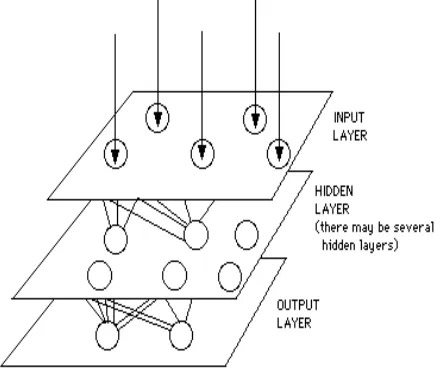
brain. It consists of neuron like processing elements with a large number of weighted connections between the elements. In general, neural networks consist of-
A. Input Layer
This layer acts as an interface with the real world and thereby receive the inputs from either input files or from electronic sensors in real- time applications.
B. Output Layer
This layer provides the output to the outside world, generally to other computer processes or devices.
C. Hidden Layers
[image:3.612.194.414.274.459.2]A neural network consists of many hidden layers between the input and output layer. Neurons in each layer receive the input from the upper layer and they process the information received and pass the result to next layer. This step is repeated till the input from the input layer reaches to the final output layer.
Fig. 1 General structure of neural networks.
An artificial neural network is generally defined by three parameters: 1) The interconnection pattern between the different layers of neurons.
2) The learning process which is used to update the weights of interconnections.
3) The activation function which converts the input to output. It is the mathematical function applied to the weighted sum (∑WX, where W is the weight and X is the input). Activation functions can be divided into three categories:
a) Linear units- the output activity is proportional to the total weighted output.
b) Threshold units- the output is set at one of two levels, depending on whether the total input is greater than or less than some threshold value.
c) Sigmoid units- the output varies continuously but not linearly as the input changes. Sigmoid units bear a greater resemblance to real neurones than do linear or threshold units, but all three must be considered rough approximations. Human brains have an important characteristic of learning, and since neural networks works similar to human brains, they model the learning process by adjusting the weights between the neurons connections. The learning process helps the neural network to map the given input into correct output. The three major learning paradigms are:
error
[image:4.612.74.547.40.226.2]
Fig. 2 Supervised Learning
ii. Unsupervised learning: In this of learning only input is given to the network. There is no external operator to supervise the learning process. The network itself decides which features, similarities and dissimilarities it will use to group the data. This is also known as self organization.
Fig. 3 Unsupervised Learning
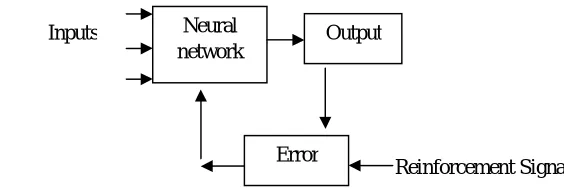
iii. Reinforcement learning: This type of learning is similar to supervised learning. The network receives the reinforcement signal from the environment and the error signal generated.
Reinforcement Signal
Fig. 4 Reinforcement Learning
III. LITERATURE SURVEY
Aladwani and Iledare used Generalized Regression Neural Network (GRNN) model where GRNN is a universal approximation for a smooth function [14]. GRNN has two layers: – Radial basis transfer function and Purelin transfer function. GRNN predictive power depends on input variables and how these variables can be grouped / normalized. The best model was chosen based on the following statistical indicators – correlation coefficients (R2), Sum of Squares Error (SSE), Standard Deviation (St. Dev.) GRNN can predict crude oil prices with a reasonable degree of accuracy, taking into account different supply and demand levels in OECD
Desired output
Desired output Operator
I n p u t s
Neural network
Inputs Output
Neural
network Output Inputs
Error Neural
[image:4.612.167.449.507.605.2]Europe, WORLD and North America. The network captured with a better accuracy the correct behaviour in comparison to the regular regression analysis. Although the data plots show good correlation between the input parameters and price data, price driven indices were used in this study to show the effect of different factors on the behaviour of crude prices.
In the study of Moshiri and Foroutan [15], three competing tools are proposed such as a feedforward neural network (FNN), ARMA (autoregressive moving average) and generalized autoregressive conditional heteroskedasticity (GARCH) models for the daily prediction of crude oil futures prices. The data used in this forecasting study are the daily crude oil futures prices covering the period between April 4th, 1983 and January 13th, 2003. Three performance metrics (MAE, MSE and RMSE) were utilized to evaluate the forecasting results of the proposed models. On the basis of these computed measures, they concluded that ANN (MAE=2.04, MSE=8.14 and RMSE=2.85) performs significantly better than ARMA (MAE=4.81, MSE=29.27 and RMSE=5.41) and also than GARCH model (MAE=2.90, MSE=15.25 and RMSE=3.90).
Further, Xie et al. [16] applied a support vector machine (SVM) model to predict crude oil price using monthly WTI spot prices over the period from January 1970 to December 2003. The proposed method was compared to ARIMA and BPNN. As results and focusing on two forecasting performance criteria (RMSE and Dstat), they found SVM forecaster performs better than the two other models. However, the BPNN surpass SVM and ARIMA for two sub-periods among four tested sub-periods.
In the next study, Shambora and Rossiter [17] used an ANN model to predict the crude oil futures prices by utilizing technical analysis crossover rules as inputs. To train the model, daily nearby crude oil futures contract prices over the period from April 16th, 1991 to December 1st, 1997 were employed. The outputs of the neural network represent the predicted prices which were considered as trading signals. Therefore, an empirical investigation of profitability was conducted using several means and statistical measures and factors. Besides, the authors compared the neural network model to three benchmark trading strategies such as buy-and-hold strategy, traditional technical trading strategy and a naïve RW strategy. According to the results of this empirical study, the profitability of ANN performed better than the other benchmark models indicating inefficiency of the crude oil futures market.
Amin-naseri and Gharacheh [18] proposed a hybrid artificial intelligence tool to forecast the monthly WTI crude oil price. The hybrid model was composed of three popular artificial intelligence (AI) techniques such as the FNN, GA and the K-means clustering. To assess effectiveness of the proposed model, the authors compared the prediction results of the hybrid model with the forecasts of four single models namely Short term energy outlook, GP, AI framework system, and ANN technique. The WTI Crude oil price time series used in their empirical study were selected from January 1983 to December 2006 for the first experiment (comparison with the first model) while from January 1974 to December 1999 for the second (comparison with GP) and running from January 1983 to December 2002 for the third experiment (comparison with the third model). Finally, the oil price data of the fourth and last experiment (comparison with ANN) was selected over the period from January 1974 to December 2001. Based on nine performance criteria (MAE, MAPE, Max AE, SSE, MSE, RMSE, Dstat, U2-Theil (RMSE of the model/ RMSE of RW process) and the squared correlation coefficient (R2)), hybrid model results outperform significantly others techniques in terms of the majority of performance measures used for empirical comparison study.
Yu et al. [19] proposed a multiscale neural network learning paradigm based on empirical mode decomposition method to predict the WTI crude oil price. The decomposition method consists on decomposing the original daily crude oil price time series, running from 01/01/1998 to 30/10/2006, into different intrinsic mode components that can be used as inputs of neural network. After training process and based on input strength indicator, only six components were retained among nine as inputs of neural network model for prediction task. To evaluate this task, the proposed model was compared to single- scale neural network learning paradigm for two different neural network architectures. According to NMSE and R2, the comparison results showed a superiority of the multiscale learning paradigm for both architectures. For the same neural network design, the multiscale neural network learning paradigm performed better than the single-scale learning paradigm and especially with (6:15:1) architecture which represented the lowest error (0.0084) and the highest R2(0.9876). The first neural network configuration used was (9:15:1) that represented 9 intrinsic mode components utilized as inputs, 15 hidden nodes and one output and the second neural network design adopted was (6:15:1).
Haidar et al. [21] developed a three layer backpropagation FNN to predict the short-term of crude oil spot price. Two groups of daily variables were considered as inputs of the forecasting model. The first represented the WTI crude oil futures prices while the second was composed of S&P 500, gold spot price, dollar index and the heating oil spot price. These features were selected over the period from 1996 to August 2007. Based on several performance criteria such as the hit rate, information coefficient (IC), RMSE, R2, MSE, MAE and SSE, Haidar and his colleagues concluded that futures contracts mainly 1 and 2 months to maturity improve the prediction results, and also outperform all other inputs for one step forecast. Moreover, they found that heating oil spot price improves the forecasting ability of the employed model for multiple steps prediction.
Moreover, Yu et al. [22] used an empirical mode decomposition (EMD) based neural network learning approach to forecast both WTI and BRENT crude oil prices. The proposed learning paradigm applies the decomposition technique with three-layer FNN and an adaptive linear neural network (ALNN) in the price forecasting task. In this research, they have utilized a daily data of crude oil price over the period between 01/01/1986 to 30/09/2006 and from 20/05/1987 to 30/09/2006 for WTI and BRENT, respectively. For the purpose of testing and verification, the authors compared the proposed model with five others techniques such as the EMD-FNN-Averaging, EMD-ARIMA-ALNN, EMD-ARIMAAveraging, standard FNN and the single ARIMA. Based on two main indicators as the RMSE and Dstat, the empirical result showed that the EMD-FNN-ALNN significantly performed the best for the two time series under study (RMSE (WTI)=0.273 and Dstat(WTI)=86.99%; RMSE(BRENT)=0.225 and Dstat(BRENT)=87.81%). Fan et al. [23] proposed a new approach called Generalized pattern matching for multi-step prediction of oil prices. This technique which was based on Genetic Algorithm predicted the oil prices based on historical observations. The results obtained proved the superiority of this technique over Elman neural networks and PMRS.
Ghaffari and Zare [24] combined the ANNs and the fuzzy logic approaches to predict the daily variation of the WTI crude oil price. Furthermore, they applied a smoothing algorithm to the daily crude oil spot prices running from January 5th, 2004 to April 30th, 2007. By comparing the smoothing procedure model (model 1) to the model without smoothing procedure (model 2), the empirical findings showed a great advantage of the smoothing algorithm to improve accuracy of the model predictions. The authors determined the percentage of the correct prediction (PCP) and found therefore that PCP of model (1) surpasses the PCP of model (2) for several arbitrary selected periods. For example, for the period (1st/5/2007-31st/5/2007), the PCP equals to 45.45% and 68.18% for model (1) and (2), respectively. These findings highlighted the reliability of the proposed model (model 1) and especially the capability of the smoothing procedure to reduce the unforeseen short term disturbances while maintaining the dynamic crude oil process.
Alternatively, Kulkarni and Haidar [25] presented a model based on multilayer feedforward neural network to forecast crude oil spot price direction in the short-term, up to three days ahead. A great deal of attention was paid on finding the optimal ANN model structure. In addition, several methods of data pre-processing were tested. Our approach is to create a benchmark based on lagged value of pre-processed spot price, then add pre-processed futures prices for 1, 2, 3,and four months to maturity, one by one and also altogether. The results on the benchmark suggest that a dynamic model of 13 lags is the optimal to forecast spot price direction for the short-term. Further, the forecast accuracy of the direction of the market was 78%, 66%, and 53% for one, two, and three days in future conclusively. For all the experiments, that include futures data as an input, the results show that on the short-term, futures prices do hold new information on the spot price direction. The results obtained will generate comprehensive understanding of the crude oil dynamic which help investors and individuals for risk managements.
Kadkhodaie - Ilkhchi et al. [26] combined gradient descent (GD), Bayesian regularization (BR), Levenberg–Marquardt (LM), and resilient back-propagation (RP) algorithms in committee machine with training algorithms (CMTA) for forecasting oil prices and concluded that the CMTA provides more accurate and reliable results than the individual neural networks with different training algorithms.
TEI@INonlinear Integration forecasting model presents the highest Dstat (95.83%) and slightly less important Dstat value (93.33%) with ANN-quantitative, however, 86.99% with EMD-FNN-ALNN model. Consequently, the high directional accuracy (93.33%) proved the effectiveness of this predicting tool.
He et al. [28] used vector error correction mechanism and a transfer function mechanism to analyse the behaviour of the WTI crude oil prices over a ten year period. They concluded that both the models displayed considerable supremacy in terms of out of sample forecasting accuracy over the Random Walk and univariate ARIMA models.
Mohammadi and Su [29] examined the forecasting abilities of several Neural Networks and ARIMA-GARCH models for forecasting and modelling the weekly crude oil spot prices in eleven different international markets over the period 2/1/1997 to 3/10/2009 period and conclude the supremacy of Neural Networks in most of the cases.
Hu et al. [30] adopted three popular neural networks methods including the multilayer perceptron, the Elman recurrent neural network (ERNN), and recurrent fuzzy neural network (RFNN). Experimental results indicated that the use of neural networks to forecast the crude oil futures prices was appropriate and consistent learning was achieved by employing different training times. Results further demonstrated that, in most situations, learning performance could be improved by increasing the training time. Moreover, the RFNN had the best predictive power and the MLP had the worst one among the three underlying neural networks. This finding showed that, under ERNNs and RFNNs, the predictive power improved when increasing the training time. The exceptional case involved BPNs, suggesting that the predictive power improved when reducing the training time. It was concluded that the RFNN outperformed the other two neural networks in forecasting crude oil futures prices.
Azadeh et al. [31] used an algorithm based on Fuzzy regression and Artificial Neural Networks to forecast long term oil prices in uncertain, noisy and complex environments. They used the Mean Absolute Percentage Error (MAPE) performance measure to conclude that the Artificial Neural Networks models considerably outperform the Fuzzy Regression Models.
Jammazi and Aloui [32] employed three variations of activation function namely bipolar sigmoid, sigmoid and hyperbolic tangent to test the accuracy of the model for oil price prediction. Several levels of input hidden are used to check the network robustness. They concluded that the HTW-MBNN network performed better than the conventional BPNN.
Mingming and Jinliang [33] proposed a multiple wavelet recurrent neural network (MWRNN) simulation model to forecast the crude oil prices. The results showed that the proposed neural network is able to predict the prices of oil with an average error of 4.06% for testing and 3.88% for training data.
Shin et al. [34] used a combination of neural network method and machine learning algorithm for predicting oil prices. The method proposed by him significantly improved the forecasting accuracy as compared to ANN, AR, SVM and other methods.
Sompui and Wongsinlatam [35] presented a prediction model for crude oil price spot price direction in the short-term. The prediction model was based on artificial neural network (ANN) for forecasting and it was compared with least square method (LSM). The results showed that on the short-term, the best prediction model for ANN of four, three, two and one hidden layers, respectively. The ANN of one - four hidden layers was found to be able to forecast better than the LSM.
Wang et al [36] combined Multilayer Perceptron and ERNN (Elman recurrent neural networks) with stochastic time effective function to forecast the prices of crude oil as well as oil stock prices. They compared the forecasting results with those obtained using BPNN and ERNN model and concluded that the predicted values of the proposed model were the closest to the actual data even during the big fluctuation periods. They used two new error measures namely complexity invariant distance (CID) and Multi CID (MCID) to prove their results.
IV. CONCLUSION
REFERENCES
[1] Alvarez-Ramirez, J., Soriano, A., Cisneros, M., Suarez, R., “Symmetry/anti-symmetry phase transitions in crude oil markets”. Phys. A 322, pp 583–596, 2003. [2] Verleger, P.K., “Adjusting to Volatile Energy Prices”, Institute for International Economics, Washington DC, 1993
[3] Hagen, R., “How is the international price of particular crude determined?”, OPEC Rev. 18, 145–158, 1994. [4] Stevens, P., “The determination of oil prices 1945–1995”, Energy Policy 23, pp 861–870, 1995.
[5] Watkins, G.C., Plourde, A., “How volatile are crude oil prices?”, OPEC Rev. 18, pp. 220–245, 1994.
[6] Wang, S.Y., Yu, L., Lai, K.K., “Crude oil price forecasting with TEI@I methodology”, J. Syst. Sci. Complex. 18, pp. 145–166, 2005.
[7] O. J. Blanchard and J. Gali, “The macroeconomic effect of oil shocks: Why are the 2000s so different from 1970s?”, NBER working paper number 13368, pp. 1-77, 2007.
[8] L. Kilian, “The Economic effects of energy price shocks”, Journal of Economic Literature vol. 46(4), pp. 871-909, 2008. [9] The International Energy Agency, “Analysis of the impact of high oil prices on the global economy,” Report, 2004.
[10] C. Aloui et al., “Further evidence on the time varying efficiency of crude oil markets”, Energy Studies Review Vol. 19(2), pp. 38-51, 2012. [11] W. L. Cheng, “Quantitative Analysis of Influencing Factors of International Oil Price,” International Petroleum Economics, Vol. 8, 2005, p. 40. [12] Y. B. Zhang, “Analysis of Influencing Factors of International Oil Price,” Chinese Petroleum Enterprise, Vol. 3 2008, p. 96.
[13] The International Energy Agency, “World Energy Trends, Excerpt from: Energy Balances from Non-OECD Countries,” Report, 2015.
[14] F. Aladwani and W. Iledare, “Predicting Crude Oil Price Trends Using Artificial Modeling Approach”, USAEE 25TH North American Conference Denver, CO, 2005.
[15] S. Moshiri, and F. Foroutan, “Forecasting nonlinear crude oil futures prices”, The Energy Journal vol. 27, pp. 81-95, 2005.
[16] W. Xie, L. Yu, S. Xu, and S. Wang,, “A new method for crude oil price forecasting based on support vector machines”, Lecture notes in computer science 3994, pp. 444-451, 2006.
[17] W. E. Shambora and R. Rossiter, “Are there exploitable inefficiencies in the futures market for oil?” Energy Economics 29, pp. 18-27, 2007.
[18] M. R. Amin-Naseri E. A. Gharacheh, “A hybrid artificial intelligence approach to monthly forecasting of crude oil price time series”, The Proceedings of the 10th International Conference on Engineering Applications of Neural Networks, pp. 160-167, 2007.
[19] L. Yu, K. K. Lai, S. Y. Wang and K. J. He, “Oil price forecasting with an EMD based multiscale neural network learning paradigm”, Lecture Notes in Computer Science. Vol 4489, pp. 925-932, 2007.
[20] F. Gori, D. Ludovisi and P. F. Cerritelli, “Forecast of oil price and consumption in the short term under three scenarios: Parabolic, linear and chaotic behaviour”, Energy Economics Vol. 32, pp. 1291-1296, 2007.
[21] Haidar, S. Kulkarni and H. Pan, “Forecasting model for crude oil prices based on artificial neural networks”, Proceedings of the International Conference on Intelligent Sensors, Sensor Networks and Information Processing, pp. 103-108, 2008.
[22] L. Yu, S. Wang and K. K. Lai, “Forecasting crude oil price with an EMD-based neural network ensemble learning paradigm”, Energy Economics vol. 30(5), pp. 2623-2635, 2008.
[23] Fan, Y., Liang, Q., Wei, Y.-M., “A generalized pattern matching approach for multistep prediction of crude oil price”, Energy Econ. 30, 889–904, 2008. [24] Ghaffari and S. Zare , “A novel algorithm for prediction of crude oil price variation based on soft computing”, Energy Economics Vol. 31, pp. 531-536, 2009. [25] S. Kulkarni and I. Haidar, “Forecasting Model for Crude Oil Price Using Artificial Neural Networks and Commodity Futures Prices”, International Journal of
Computer Science and Information Security, Vol.2, No.1, June 2009.
[26] Kadkhodaie-Ilkhchi, A., Rezaee, M., Rahimpour-Bonab, H., “A committee neural network for prediction of normalized oil content from well log data: an example from South Pars Gas Field, Persian Gulf.”, J. Pet. Sci. Eng. 65, pp 23–32, 2009.
[27] S. N. Abdullah and X. Zeng, “Machine learning approach for crude oil price prediction with Artificial Neural Networks-Quantitative (ANN-Q) model”, Proceedings of the International Joint Conference on Neural Networks, pp. 1-8, 2010.
[28] He, A., Kwok, J., Wan, T., “An empirical model of daily highs and lows of West Texas Intermediate crude oil prices”, Energy Econ. 32, pp 1499–1506, 2010. [29] Mohammadi, H., Su, L., “International evidence on crude oil price dynamics: applications of ARIMA–GARCH models”, Energy Econ. 32, pp. 1001–1008,
2010.
[30] J. W. Hu, Y. Hu, R. R. Lin, “Applying Neural Networks to Prices Prediction of Crude Oil Futures”, Mathematical Problems in Engineering, , Article ID 959040, 12 pages, 2012.
[31] Azadeh, A., Moghaddam, M., Khakzad, M., Ebrahimipour, V., “A flexible neural network-fuzzy mathematical programming algorithm for improvement of oil price estimation and forecasting”, Comput. Ind. Eng. 62, pp 421–430, 2012.
[32] Jammazi, R., Aloui, C., “Crude oil price forecasting: experimental evidence from wavelet decomposition and neural network modelling”, Energy Econ. 34, pp 828–841, 2012.
[33] Mingming, T., Jinliang, Z., “A multiple adaptive wavelet recurrent neural network model to analyze crude oil prices”, J. Econ. Bus. 64, pp 275–286, 2012. [34] Shin,H., Hou,T., Park,K., Park, C.K., Choi,S., “Prediction of movement direction in crude oil prices based on semi-supervised learning”, Decision. Support.
Systems. 55, pp.348–358, 2013.
[35] M. Sompui and W. Wongsinlatam, “Prediction Model for Crude Oil Price Using Artificial Neural Networks”, Applied Mathematical Sciences, Vol. 8, No. 80, 2014.