Opportunistic Transmission Scheduling Using
Medium Access Control Protocol
NandhiniSelvam1, Karthick Kirshnamoorthy2 1,2
Master of Computer Application, Anna University
Abstract- Mobile underwater networks with acoustic communications are confronted with several unique challenges such as long propagation delay, high transmission power utilization, and node mobility. Propose the delay-aware opportunistic transmission scheduling (DOTS) algorithm designed for underwater mobile sensor networks. It uses passively obtained local information to increase the chances of concurrent transmissions while reducing the likelihood of collisions. Propose a simple performance enhancement mechanism that permits multiple outstanding packets at the sender side enabling multiple transmission sessions significantly improves the overall throughput. Proposed a MAC protocol called DOTS that alleviates limitations caused by the long propagation latency and the severely limited bandwidth of acoustic communications. DOTS can effectively exploit temporal and spatial reuse by using local information. In DOTS, each node learns neighboring nodes’ propagation delay information and their expected transmission schedules by passively overhearing packet transmissions. DOTS aimed to achieve better channel utilization by harnessing both temporal and spatial reuse. Our simulation results document that DOTS provides fair medium access even with node mobility. A channel access protocol for ad-hoc underwater acoustic networks. The protocol saves transmission energy by avoiding collisions while maximizing throughput. This protocol achieves a throughput several times higher than that of the Slotted FAMA, while offer related savings in energy.
Key words: Underwater, Medium Access Control, Opportunistic Transmission, CSMA.
I. INTRODUCTION
Underwater Acoustic Sensor Networks (UW-ASNs) have recently been proposed as a way to explore and observe the ocean, which covers two-thirds of the Earth’s surface, to consider a SEA Swarm (Sensor Equipped Aquatic Swarm) architecture illustrated for short-term ad hoc real-time aquatic exploration such as oil and chemical spill monitoring, submarine detection, and surveillance. A swarm of traveling sensor nodes such as UCSD Drogues is deployed to the venue of interest and moves as a group with the ocean current. Each sensor monitors local underwater activities and reports critical events using acoustic multi- hop routing to a distant data collection hub, e.g., surface buoys or Autonomous Underwater Vehicles (AUVs). Despite the technological advances of acoustic communications, we are still confronted with limitations that need to be addressed in order for UW-ASNs to be put into practical use, namely severely limited bandwidth, long propagation delays (1.5km/s, five orders of magnitude slower than radio signals), and relatively high transmission energy cost. Moreover, the unreliable nature of underwater wireless channels due to complex multipath fading and surface scattering further aggravates data communications. Under these circumstances, Medium Access Control (MAC) protocols designed for terrestrial packet radio networks cannot be directly used because the propagation delay of acoustic signals is much greater than the packet transmission time (e.g., 0.5sec vs. 0.04sec to transmit a 256byte data packet with the data rate of 50kbps over a 750m range) — carrier sensing in Carrier Sense Multiple Access (CSMA) may not prevent packet collisions.
This unique situation, however, permit several packets to concurrently propagate in an underwater channel, which must be exploited in order to recover the channel throughput. While this phenomenon is also observed in transatlantic wire lines or wireless satellite relations, the main departure is that these are point-to-point links without any contention and that the large Bandwidth-Delay Product (BDP) is exploited at a upper layer, namely TCP. In common, long propagation latency in an underwater wireless network creates a unique opportunity for temporal reuse that allows for multiple concurrent packets propagating within the same contention area. Note that temporal reuse is an additional opportunity on top of well- known spatial reuse in wireless networks which allows simultaneous, non-colliding transmissions to different destinations if they are sufficiently removed from one another, solve the exposed terminal problem. In this paper, consider this idea and propose the Delay aware Opportunistic Transmission Scheduling (DOTS) algorithm designed for underwater mobile sensor networks. The follow are the key contributions of the paper. DOTS can effectively exploit temporal and spatial reuse by using local information. In DOTS, each node learns neighboring nodes’ propagation delay information and their expected transmission schedules by passively overhearing packet transmission. Hence, DOTS can compensate for the long propagation latencies by increasing the chances of concurrent transmissions while reducing the likelihood of collisions. Our extensive simulation results confirm that DOTS can significantly improve the overall throughput. We also show that such opportunistic scheduling can effectively handle spatial-unfairness caused by physical location and propagation latency (i.e., the closer the distance between a pair of nodes, the higher the chance of capturing the channel).
II. RELATED WORKS
In [1] J. Yackoski and C.-C. Shen author defined to harness this temporal reuse, proposed UW-FLASHR, a variant TDMA protocol that can achieve higher channel utilization than the maximum utilization possible in existing TDMA protocols. One potential solution for improving CSMA in UW-ASNs is to utilize temporal reuse that exploits the long propagation latencies of acoustic waves.
In [4] C. Hsu, K. Lai, C. Chou, and K. C. Lin, proposed ST-MAC, another underwater TDMA protocol that operates by constructing Spatial-Temporal Conflict Graph (STCG) to describe the conflict delays among transmission links and reduces the ST-CS model to a new vertex coloring problem. A heuristic, called the Traffic-based One-step Trial Approach (TOTA), is then proposed to solve the coloring problem. In [5] K. Kredo, P. Djukic, and P. Mohapatra,. proposed a TDMA-like protocol called STUMP that uses propagation delay information and prioritizes conflicting packet transmissions based on certain metrics (e.g., random ordering and uplink delay ordering). However, TDMA scheduling is typically performed in a centralized way which is not resilient to failure; moreover, discovering a reasonable TDMA schedule using distributed algorithms for optimized transmission scheduling requires a network-wide consensus. TDMA-like protocols are not suitable for resource constrained mobile sensor networks.
In [22] N. Chirdchoo, W. seng Soh, and K. Chua, proposed a receiver initiated reservation protocol called Receiver-Initiated Packet Train (RIPT) where after initiating packet transfers, the receiver accepts the packet transmission requests from its neighboring nodes and builds a transmission schedule for its neighboring nodes by considering the propagation delay to its neighbors. In RIPT, the receivers need to sometimes initiate packet transfer, which are very expensive, and under unreliable traffic demands, it is non-trivial to determine when to initiate packet transmissions. Unlike existing underwater CSMA solutions, DOTS neither requires an additional phase for reservation scheduling nor restricts transmission schedules to a specific order.
III. DOTS PREREQUISITE
It has been shown that observed information obtained from passively overhearing neighboring transmissions can be useful in estimating collisions at the intended receivers. DOTS uses the passively obtained information by building a delay map to achieve both temporal and spatial reuse by making intelligent transmission scheduling decisions. DOTS therefore is able to compensate for the long propagation latencies and severely limited bandwidth of the acoustic medium by using passively observed information to increase the chances of concurrent transmissions while reducing the likelihood of collisions. However, the lack of clock synchronization could make it difficult for an overhearing node of a transmission to gauge the propagation delay between itself and the transmitting node.
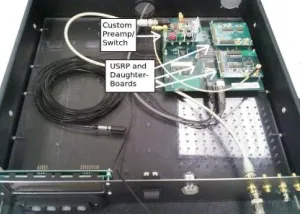
Figure 2(a). Front view of UANT system
Using this protocol a leading transmitter will send out multiple time-stamped beacons. All receiving nodes will calculate the difference between the received timestamp and the local time, compute a linear regression over all these values, and find the slope of the line. In conclusion in the second phase offset is found using the skew compensated time. Have implemented this protocol on the UANT platform, which uses a software defined radio and a mix of custom and commercially available hardware for the transmitter and receiver.
Figure 2(b). Internal view of UANT system
A. Dots Design
[image:4.612.212.403.210.359.2] [image:4.612.232.383.475.583.2]This estimate of the propagation delay between the source and the destination of the overheard frame can be performed during the clock synchronization process by examining the time of flight information during the frame exchanges and later updated through further communications between the nodes.
Moreover, the delay map database entries can expire and be removed over time with the knowledge of data size of each entry and the maximum propagation delay for each overheard frame in order to keep the number of database entries small.
B. Delay Map Management
By passively observing neighboring transmission, each node can continue a delay map, which must contain the following information:
Source: The dispatcher of the observed MAC frame
destination: the intended destination of the observed MAC frame
Timestamp: The time at which the observed MAC frame was sent
Delay: The estimated propagation delay between the source and the destination for the MAC frame.
C. Transmission Scheduling
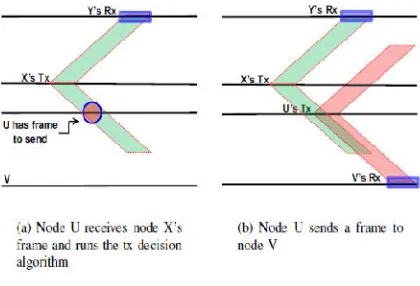
[image:5.612.202.412.385.528.2]Based on the delay chart, a node decides whether or not it can transmit without interfering with a neighbor’s reception. Fig. 4 provides an example of the transmission scheduling decision procedure. Node x sends an RTS to node y.
Figure 4. Example of a transmission decision
When node u receives this RTS and has data to send, it can begin its own transmission to node v concurrently if the following two conditions hold:
Neighboring non-interference: Its current transmission (RTS) and future transmission (DATA) must not interfere with neighbors’ ongoing and prospective receptions.
Prospective non-interference: Its prospect reception (CTS and ACK) must not be interfered with by neighbors’ prospective transmissions.
D. Schedule Recovery
recovery scheme to minimize the damage caused by a collision or a lost frame and avoid deadlocks.
E. Guard Time
A DOTS uses a guard time to support node mobility caused by the ocean currents. Every node calculates this guard time as 2 * (average movement distance/speed of sound) when it checks the transmission scheduling algorithm. The multiplier, 2, is used since both the sender and the receiver may move in opposite directions from each other. This guard time is then added to the guard time in the frame reception duration, which results in a smaller range of allowable concurrent transmissions
IV. SIMULATION RESULTS
In Fig. 5 shows the throughput of the four protocols with different data sizes in the line topology (exposed terminal).DOTS outperforms S-FAMA by a factor of two and DACAP and CS-ALOHA by around 15% for a 750m transmission range with both
It is noteworthy that DACAP outperforms S-FAMA by two times because DACAP allows for concurrent transmissions of the two sender-receiver pairs; when a sender-receiver pair (A-B) is undergoing data transmission in the line topology, the other pair (C-D) can also perform parallel data transmission because the two collision avoidance conditions of DACAP cannot suppress the transmissions of the two sender nodes (B and C). Consequently, this allows DACAP to perform concurrent transmissions possibly with collisions; however, it is the result of avoiding these minor collisions which explains the utilization gain of DOTS over that of DACAP.
A. Guard Time
Evaluating the performance of DOTS by varying the guard time intervals is important as we can show the sensitivity of guard time with respect to the speed of nodes. If the guard time is too short, the chances of packet collisions will be too high.
If it is too long, packet collisions will rarely happen, but have lesser chances of exploit temporal/spatial reuse. In Fig.8, illustrate the throughput performance based on different guard time intervals ranging from 1 to 8 ms. All intervals show positive correlation with offered load. It shows that the guard time interval of 2 ms shows the best throughput performance. The guard time intervals of 1 and 8 ms show slightly lower throughput performance due to collisions and lower utilization, respectively.
B. Fairness
V. CONCLUSION
A MAC protocol called DOTS that alleviates limitations caused by the long propagation latency and the severely limited bandwidth of acoustic communications. DOTS achieve better channel utilization by harnessing both temporal and spatial reuse. Extensive simulation results have shown that (1) DOTS outperforms S-FAMA by 2 times and DACAP by 15% times in the line topology (exposed terminal) and S-FAMA by 2 times and DACAP by 70% in the star topology (higher node density and contention), and (2) DOTS provides reliable throughput performance even with node mobility and preserves a high level of fairness for channel access. There are several directions for future work. First, DOTS can better harness spatial/temporal reuse when we allow out of order packet delivery and packet trains at the sender side; yet, this improved efficiency comes at the cost of degrading fairness. Second, will consider the capture effect as in Interference Aware (IA) MAC where a receiver can correctly decode a packet even in the presence of other concurrent transmissions. Third, when a data frame is correctly received but the corresponding ACK gets lost due to loss channel or collision, Windowed ACK can help contain the number of spurious retransmissions and increase the throughput. Fourth, the impact of mobility and random topologies on the throughput and fairness will be carefully investigated. Finally, plan to implement DOTS in a real world test bed to reexamine and verify our simulation results.
REFERENCES
[1] J. Yackoski and C.-C. Shen, “UW-FLASHR: Achieving High Channel Utilization in a Time-based Acoustic MAC Protocol,” in WUWNet, 2008. [2] A.A. Syed and J. Heidemann, “Time Synchronization for High Latency Acoustic Networks,” Proc. IEEE INFOCOM, 2006.
[3] A.A. Syed, W. Ye, and J. Heidemann, “T-Lohi: A New Class of MAC Protocols for Underwater Acoustic Sensor Networks,” Proc. IEEE INFOCOM, 2008. [4] C. Hsu, K. Lai, C. Chou, and K. C. Lin, “ST-MAC: Spatial-Temporal MAC Scheduling for Underwater Sensor Networks,” in InfoCom, 2008. [5] K. Kredo, P. Djukic, and P. Mohapatra, “STUMP: Exploiting Position Diversity in the Staggered TDMA Underwater MAC Protocol,” in Infocom, 2009. [6] D. Torres, J. Friedman, T. Schmid, and M.B. Srivastava, “Software- Defined Underwater Acoustic Networking Platform,” Proc. Fourth ACM Int’l Workshop
UnderWater Networks (WUWNet), 2009.
[7] Z. Zhou, J. Cui, and A. Bagtzoglou, “Scalable Localization with Mobility Prediction for Underwater Sensor Networks,” IEEE Trans. Mobile Computing, vol. 10, no. 3, pp. 335-348, Mar. 2011.