Technology (IJRASET)
76
Tongue Recognition System for Authentication
Amit Bade#1, Komal Chavan*2, Pradip Admane#3, Rupali Komatwar*4 #
Computer Department, Mumbai University
Abstract— The paper presents an efficient tongue recognition biometric system for authentication based on Dual Tree
Complex Wavelet Transform. A method for identifying a person based on their tongue is provided in which an image of a tongue of individual person is compared to recorded details of tongues in database. If a match is found the person is identified. Since last 10 years, various methods have been used for tongue recognition. This paper describes that how the human organ tongue can be used for biometric authentication. Here feature extraction of tongue image has been done using 2D Dual Tree Complex Wavelet Transform (2D-DT-CWT).
Keywords— Tongue images, tongue recognition, tongue biometrics, DT-CWT, complex wavelet transform, Biometrics, Image Processing.
I. INTRODUCTION
Biometrics is the automated method of identifying or verifying the identity of an individual on the basis of physiological and behavioral characters. Biometrics is considered the most effective and safe method (is very difficult to falsify). Many biometric authentication systems are available in market and used worldwide. Biometrics systems are widely used for authentication and recognition are fingerprint [1], face [2] [3], iris [4], palm-print [5], Ear [6], DNA, voice, retina etc. But all these authentication systems have some flaws at some extent and because of which they can be forged by some frauds and make the authentication system fool, and thus get succeed to claim as authorized user when they are not. Tongue Recognition System for Authentication has been developed keeping in mind all these types of flaws and frauds and tried to overcome those so as to deliver a safer authentication system. Tongue recognition has received considerably less attention than many alternative biometrics, including fingerprint, face and many other recognition systems. Tongue is unique organ rest inside the mouth and difficult to forge or affect by external environment and also it does not change by other factors such as mood, health, and/or clothing.
II. EXISTINGTONGUERECOGNITIONSYSTEMS
Major work on Tongue has been done recently in past 10 years. The first Tongue Print Recognition System was proposed in 2007 [7]. Preventing such research is the lack of an available 3D tongue image database. In that paper, they present a newly developed 3D tongue image database, they provide both tongue shape and surface textures. That was the first attempt at making a 3D tongue image database available for the research, with the ultimate goal of fostering the research on tongue biometrics. The new database can be a useful resource for tongue recognition for authentication and identification systems [7]. 3D Tongue database was used in public use system such as banking, and data protection, national security system such as defense, nuclear power station etc. Main goal of developing such a system was to avoid unauthorized access [8]. Tongue recognition for identification was done by using SIFT feature extraction algorithm [9]. Different results have been found using different recognition algorithms such as spectral analysis, Gabor filter, and wavelet transform [10].
III.PROPOSEDSYSTEM
[image:2.612.194.425.617.718.2]The block diagram of proposed system is shown in Fig 1. It consists of a capture image(s), feature extractor, feature matcher, tongue print image database, decision, DT-CWT based feature extraction and matching module.
77
A. Captured Image(s)Already captured tongue images are used for tongue recognition for authentication system. It will take given input image of tongue for recognition. It will send the selected image for feature extraction. This will provide main database for the process .The provided input image will match with this main database to find out whether the person is authenticate or not.
B. Feature extractor
In biometric system, recognition of pattern and in image processing, feature extraction starts from the set of measured data and builds various features, non redundant, facilitating the subsequent learning and generalization steps, in some cases providing better human interpretations. Feature extraction is used to reduction. When the input image to an algorithm is too large to be processed and it is suspected to be redundant, then it can be transformed into a reduced set of features also called as features vector. This process is known as feature extraction. The extracted features are expected to hold the relevant information from the input data, so that the intended task can be performed by using this reduced representation instead of the complete initial data such as tongue images. This component will analyze the given tongue image and apply the DT-CWT on it to extract the unique features (size, shape and textures) from each provided tongue image and will store the result in Tongue-print image database[9].
Fig 2. Tongue Shapes Fig.3. Tongue Textures
IV.MAIN ALGORITHM FOR FEATURE EXTRACTION
C. Dual Complex Wavelet Transform
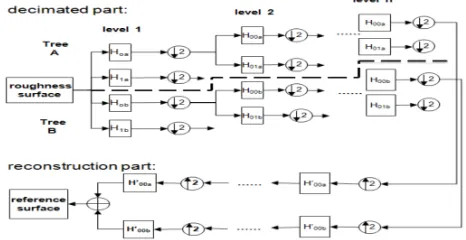
Dual tree complex wavelet transform (DT-CWT) a form of discrete wavelet transform which generates complex coefficients by
using a dual tree of wavelet filters to obtain the real and imaginary parts. The implementations of complex wavelet transform have the desirable properties as follows:
1) Approximate shift invariance
2) Good selectivity and directionality
3) Phase information
4) Perfect reconstruction
5) Limited redundancy
[image:3.612.186.419.574.694.2]DT-CWT gives better performance as compare to DWT. The disadvantages of DWT are overcome in DT-CWT.When Introduce the Dual Tree Complex Wavelet Transform; it uses two trees of real filters to generate the real and imaginary parts of the wavelet coefficients. In dual-tree, two wavelet trees are used and each capable of perfect reconstruction (PR). One tree generates the real part of the transform while the other tree is used in generating complex part. In that, two real wavelet transforms are used, and also two different sets of filters are used by the real wavelet transform, and each satisfying the perfect reconstruction conditions. DT-CWT uses two filter bands, they are: analysis and synthesis. They are used to implement the dual-tree CWT. Analysis is done for decomposition and synthesis is used for reconstruction. The two sets of filters are jointly designed so that the overall transform is approximately analytic[11].
Technology (IJRASET)
©IJRASET 2015: All Rights are Reserved
78
D. Tongue-Print Image DatabaseThis database will store all the tongue image samples for the enrollment process. It will also store all necessary information regarding particular tongue image of an individual such that, individual’s name, basic information (age, gender, id etc) along with his/her tongue image samples .This database will help to analysis the given input image by feature extraction and feature matching .There will be the different image of an individual which help in further for matching the input image.
E. Feature Matcher
As the name suggests it’s a part of a system that matches Extracted two features. If an individual wants to pass a TRSA System test he/she has to provide his/her tongue image to the system, these prints are then transferred to the feature extractor. Feature extractor gets activated and performs its function again. Furthermore these new features are matched by the feature matcher with the previously features of the stored images in Database . Feature matcher mainly use specific feature like shape , size, texture ,color of an input image provide to it for the process of image matching .
F. Decision
If match found out of above process, the person gets access further otherwise access gets denied for him/her.
NO
YES
YES
NO
FIG 5. WORK FLOW DIAGRAM
Extract static features
Search tongue database for
Matches
Is there a
Match
Decision
Reject
Capture Image(s) of tongue
Extract dynamic features
©IJRASET 2015: All Rights are Reserved
79
V. APPLICATIONS
Tongue Recognition System for Authentication is the better way to provide security at high level.
A. Identification of criminals
-
Collecting the evidence in the scene of crime. It is possible to compare with data of suspects or make a search in the database of criminals.
B. Account access
The use of TRSA for the access to the account in the bank allows to keep definitive and auditable records of account access by
employees and customers. Using TRSA the customers can access accounts and employees can log into their workstations.
C. ATMs
The use of TRSA in the ATM transaction allows more security.
D. Online banking
Internet based account access is already widely used in many places, the inclusion of TRSA will make more secure this type of transactions from home. Currently, there are many pilot programs using biometric in home banking.
E. PC/Network Access
The biometrics are used to control a secure access of the employees to the hospital network, primarily, in order to protect the patient information.
F. Access to personal information
Using biometrics, the medical patient information may be stored on smart card or secure networks, this will enable the access of the patients to their personal information.
G. Patient identification
In case of emergency, when a patient does not have identification document and is unable to communicate, biometric identification may be a good alternative to identify.
H. Air travel
In many airport are already used a biometric system in order to reduce the inspection processing time for authorized travelers.
I. Border crossing
The use of biometrics to control the travelers crossing the national or state border is increasing, especially in regions with high volume of travelers or illegal immigrants.
J. Employee access
TRSA can help airport to use biometric to control the physical access of employees to secure areas.
K. Passports
Some country already issues passports with biometric information on a barcode or smart chips. The use of TRSA can prevent the emission of multiple passports for the same person and also facilitates the identification at the airports and border controls.
VI.CONCLUSION
Technology (IJRASET)
©IJRASET 2015: All Rights are Reserved
80
VII. FUTURESCOPE
As far as our concern if Tongue Recognition System for Authentication is implemented practically with the use of sensors and some other contributive resources in real time environment, then it would be definitely a stepping stone in personal identification and authorization process by means of security. Images are often corrupted by noise due to errors generated in noisy sensors or communication channels. It is necessary to discard noise in the images before some subsequent processing. DT-CWT works on this drawback and provides the better denoising of an image in real time environment.
VIII. ACKNOWLEDGMENT
We would like to thank Mr. Nick Kingsbury from Cambridge University for providing us with a code for DT-CWT.
REFERENCES
[1] Ahmad, Fadzilah and Mohamad, Dzulkifli, ‘’A Review on Fingerprint Classification Techniques,’’ IEEE International Conference on Computer Technology and Development, Volume 2, Nov 13-15, pp.411-415, 2009.
[2] Elham Bagherian and Rahmita Wirza O.K. Rahmat, ‘’FacialFeature Extraction for Face Recognition: A Review,’’ IEEE International Symposium on Information Technology, Vol. 2, Aug 26-28, pp.1-9, 2008.
[3] Ray K. C. Lai, Jack C. K. Tang, Angus K. Y. Wong, and Philip I. S. Lei, ‘’Design and Implementation of an Online Social Network with Face Recognition,’’ Journal of Advances in Information Technology, Vol 1, No 1, pp. 38-42, 2010.
[4] Richard Yew Fatt Ng, Yong Haur Tay, and Kai Ming Mok, ‘’A Review of Iris Recognition Algorithms,’’ IEEE International Symposium on Information Technology, Vol. 2, pp.1-7, 2008.
[5] Adams Kong, David Zhang and Mohamed Kamel, ‘’A Survey of Palm print Recognition,’’ Pattern Recognition, Vol. 42, pp.1408-1418, 2009.
[6] Rajesh Bodade and Sanjay Talbar, "Iris Recognition Using Multi-Directional Wavelets: A Novel Approach" Journal of Advances in Engineering Sciences Sect. C (3), July-September 2008, (special issue on Image Processing) ISSN: 0973-9041
[7] Zhi Liu, Jing-Qi Yan, David Zhang, Qun-Lin Tang; “A Tongue-Print Image Database For Recognition”, in proceedings of the Sixth International Conference on Machine Learning and Cybernetics, Hong Kong, August 2007.
[8] Rohaila Naaz, Swati Kundra, Priti Garg, Anand Sharma; “Tongue Biometric and its Application in Public Use System”, 2011 3rd International Conference on Machine Learning and Computing (ICMLC 2011).
[9] Manoj Diwakar, Manish Maharshi, “An Extraction and Recognition of Tongue-Print Images for Biometrics Authentication System”, International Journal of Computer Applications (0975 – 8887) Volume 61– No.3, January 2013.
[10] Salim Lahmiri, “ Recognition of Tongueprint Textures for Personal Authentication: A Wavelet Approach”, JOURNAL OF ADVANCES IN INFORMATION TECHNOLOGY, VOL. 3, NO. 3, AUGUST 2012.