Machining Parameter Optimization for Cylindrical
Part in CNC Turning Centre Using Mathematical
Model and Genetic Algorithm Approach
Abhishek Agrawal1, Dr. R.S. Rajput2, Dr. Nitin Shrivastava3
PhD Scholar1, Professor & Director2, Assistant Professor3
Department of Mechanical Engineering, University Institute of Technology, Rajiv Gandhi Proudyogiki Vishwavidyalaya, Bhopal-462036(Madhya Pradesh), INDIA
Abstract: This paper presents machining parameters (turning process) optimization based on the use of artificial intelligence. To obtain greater efficiency and productivity of the machine tool, optimal cutting parameters have to be obtained. In order to find optimal cutting parameters, the genetic algorithm (GA) has been used as an optimal solution finder. Optimization has to yield minimum machining time and minimum production cost, while considering technological and material constraints.
Keywords— Multi-objective optimization, machining parameters, Genetic Algorithm, CNC turning center.
I. INTRODUCTION
Today machining process planning has to yield such results that are to give maximum productivity and to ensure economy of manufacturing. Today the market has an ever changing demand for new products, which require shorter development cycle. An important part of the product development cycle is manufacturing process planning. Shorter process planning time can lead to the use of machining parameters that are not optimal and this can lead to the greater cost of production. A human process planner selects proper machining parameters by using not only his own experience and knowledge but also from handbooks of technological requirements, machine tool, cutting tool and selected part material. This manual selection can be slow and does not have to give optimal results.
To overcome that problem, machining process planning has gone automated, by the use of Computer-Aided Process Planning (CAPP) system. In addition to operation sequence and machining parameters, the CAPP system should also be able to automatically choose machine and cutting tool while taking in consideration part material. In this paper, the focus is given to cutting parameters optimization. Cutting parameters, such as cutting depth, number of passes, feed rate and machining speed have influence on overall success of machining operation 1,2 . In order to conduct optimization, a mathematical model has to be defined. It is not always easy to define a model that can be expressed by pure analytical functions. Besides, cutting parameters optimization presents a multi-objective optimization problem, so the classical mathematical methods such as linear programming would not work with such input data. There is also a problem of finding local optimum.
In order to overcome these problems, this paper shows the use of Genetic Algorithm (GA) in machining process optimization. GA is a part of the evolutionary algorithms that copy intelligence of nature in order to find global extremities on the given function problem.
These algorithms are based on stochastic operations. In nature, only an entity that is able to adapt to its surrounding is going to survive and transfer its qualities to next generation 3,4 . Depending on measuring the quality of entity, the proposed result is kept or deleted. New combined results are then transferred to the next generation that should now consist of better results, closer to a global optimum. Whole process is terminated when stopping criteria are met and a global optimum is found. GA ensures that the calculated result is global or close to the global optimum.
Fig.1 Possible Optimization Goals
II. MODELDESIGN
In this paper a procedure for optimization of turning process parameters on CNC turning center has been applied. Optimization has been carried out by defining goal functions - minimum production time. The mathematical model that describes machining operation has been defined as a combination of those functions whose variables are necessary for cutting parameters. The mathematical model consists of three separated models:
1) Tool Life model,
where: vc – cutting speed, ap – cutting depth, f – feed, xv1,yv1– coefficient defined by material, HB – hardness of material, nt – exponent of influence of the hardness of material, m – exponent of relative tool life, Cv1 – techno-logical proportional coefficient, k1
k2k3k4k5k6k7k8k9 – influential technological coefficients (experimentally obtained), correction coefficient
2) Cutting force model,
where: CpZ – technological proportional coefficient, ap – cutting depth, f – feed, xv1, yv1 – coefficient defined by type of turning
operation, HB – hardness of material, npZ – exponent of influence of the hardness of material, kmkxkr ky kh– influential technological coefficients (experimentally obtained), correction coefficient
3) Cutting power model
where: Fz – main cutting force, vc – cutting speed
Tool life model has been integrated in goal function, while cutting force and power model represented constrain functions, as shown in Figure 2.
Maximum Quality
Optimal Machining Process
Minimum Cost
Machine
Tool Tt
Part Data
[image:4.612.127.421.80.282.2]Time Cost
Figure 2. Optimization model
Model input data is the machine and tool data information of part material and shape, as well as time and cost limit of manufacturing. Input data has been prepared on the basis of the technical data sheets of the machine manufacturer and chosen tool. Parameters referring to the type of the part material have been gathered as influence coefficients from analytical experiment data. The experiment has been performed on the CNC lathe, and a steel bar has been machined with of SANDVIK T-MAX P CNMM-190616 tool. The lathe has 30kw spindle power, maximal cutting forces Fzmax of 6300N and Fxmax of 5000N. The workpiece characteristics are as follows: diameter 80mm; workpiece length 200mm, material is low alloy steel with HB = 180. Model output is presented with cutting parameters which satisfy constrain functions at the end of optimization process and give optimal value of goal function, which is a global minimum.
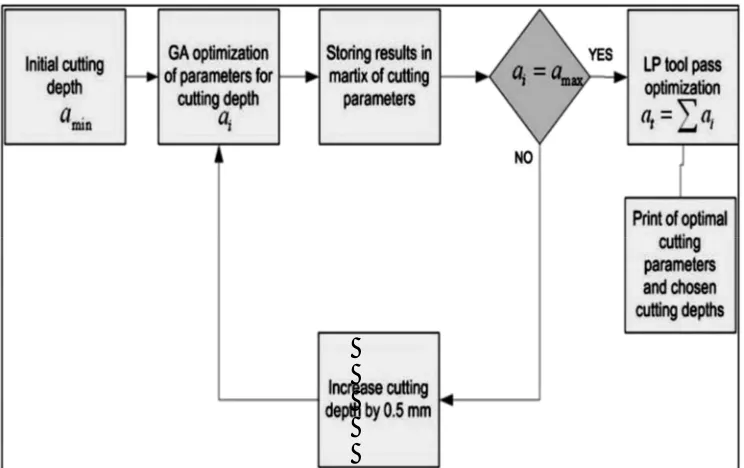
The mathematical model has been programmed in MATHLAB ™. As basis for GA we used MATLAB's GA toolbox ™. For GA, standard settings have been taken. For each depth of cutting optimization process, the optimal cutting parameters have been given. GA converges until the stopping criteria are met. In order to obtain optimal cutting parameters, a number of passes have been decided. In this case binary linear programming optimization (LP) method has been the best choice 9,10 . The whole optimization process can be represented by the block diagram, Figure 3.
Tool Life Model
Mathematical Model
Goal Function
[image:4.612.131.503.478.712.2]III. EXPERIMENTAL RESULTS
The optimization procedure is applied on the turning centers. The success of optimization depends on defining the goal function - minimum production time (4).
where: tg – main machining time, ta – tool change time, tp – time during which the tool do not cut
where: n – main spindle frequency, Lt– total length of tool path
A GA has been selected in search for the optimal solution. In the proposed GA, the advantage of multi-dimensional search scheme of GA has been used in finding a candidate for replenishment. The basic GA setup properties are the following: population size (20 individuals); coding (performed with real numbers); stochastic uniform selection has been applied (SUS); number of elite children (2); genetic operators: those individuals that survive the selection step, undergo alteration by two genetic operators -the crossover and mutation; the uniform crossover was selected; probability for crossover (0.8); mutation rate (0.1); termination conditions (two rules are used to stop this GA, the first one is a fixed number of generations (100 generations), and the second one stops the evolutionary process if the best-on-hand solution has shown no improvement in the last 50 generations. The LP has been used to give number of tool passes that meet the requirement of total roughing depth and minimum cutting time. The method outputs the binary matrix from which the row of optimization results of matrix has been selected, satisfying cutting parameters goal function.
A. Minimization of Production Time
[image:5.612.192.428.413.613.2]Using previously defined methodology, both optimization of the production time and its minimization for allowed values of cutting depth and feed rate have been performed. Table 1 shows matrix results of the obtained optimization for the minimization of the production time by GA. For each depth of the cutting optimization process, the optimal cutting parameters are given. GA converges until the stopping criteria are meet, Figure 4. Presents the diagram of GA convergence.
Figure 4. GA Convergence Graph
Table 1. Optimal Cutting Parameters for Various Depths
Feed rate Cutting speed Mach. time Cutting power Cutting force Fz
Main spindle Cutting
freq. n depth
/ m/rev / m/min / s / kW / N
/ min-1 / mm
0.90 603 4.70 16.15 1608.18 3998 1
0.90 588 4.72 23.59 2405.80 3987 1.5
0.89 566 4.81 29.99 3178.94 3919 2
0.78 518 5.62 29.96 3467.89 3669 2.5
0.72 464 6.40 29.90 3864.34 3360 3
0.68 420 7.11 29.99 4286.21 3109 3.5
0.77 327 7.80 29.99 5509.45 2476 4
0.70 320 8.44 29.99 5629.99 2483 4.5
0.40 496 9.06 29.96 3621.02 3953 5
IV. CONCLUSION
This paper deals with a novel approach to optimization of the machining parameters (turning process), by basing on the use of artificial intelligence. The proposed model is combined between GA and implementation of binary linear programming optimization (LP). This methodology has been implemented to optimize the turning simple model process. The main advantage of proposed method is ability to perform multi-objective optimization, minimum machining time and minimum production cost, while considering technological and material constrains. The results obtained from the simulation model have presented a fast and suitable solution both to the automatic definition of the machining parameters and to possible implementation in CAPP systems. The simulation results have been confirmed by the experiment.
REFERENCES
[1] M.S. Shunmugam, S.V. Bhaskara Reddy and T.T. Narendran: Selection of optimal conditions in multi-pass face-milling using GA, International Journal of Machine Tools and Manufacture, 40, (2000), 401-414
[2] V. Tandon, H. El-Mounayri and H. Kishawy, NC End Milling Optimization Using Evolutionary Computation, International Journal of Machine Tools and Manufacture, 42, (2002), 595-605.
[3] Robinson, A., Genetic Programming: Theory, implementation and evolution of unconstrained solution, Hampshire College Division III (senior) thesis, (2001). [4] Banzhaf, W., P. Nordin, R. Keller, and F. Francone, Genetic Programming: An Introduction. Morgan Kaufmann, San Francisco, CA, 1998.
[5] D. Crljenko, Bari{i}, B. and Car, Z., Optimization Of Tool Motion On A 2-Dimensional Surface By Means Of The Genetic Algorithm, Proceedings of the 5th International DAAAM Conference Advanced Technologies for Developing Countries-ATDC 2006, Croatia, Edited by Mikac, T. ; Katalini}, (2006), 159-164. [6] Cus F. and Balic J., Optimization of cutting process by GA approach, Robotics and Computer-Integrated Manufacturing, 19, (2003), 113-121.
[7] R. Al-Aomar and A. Al-Okaily, A GA-based parameter design for single machine turning process with high-volume production, Computers & Industrial Engineering, 50, (2007), 317-337.
[8] R.H. Nyström, I. Harjunkoski and A. Kroll, Production optimization for continuously operated processes with optimal operation and scheduling of multiple units, Computers & Chemical Engineering, 30, (2006), 392-406
[9] J. Matousek and B. Gärtner, Understanding and Using Linear Programming, Springer, 2006
AUTHORS’S PROFILE
Abhishek Agrawal is currently PhD Scholar from University Institute of Technology, RGPV, Bhopal, India. He received the B.E. degree in Mechanical Engineering from the Government Engineering College, Ujjain, India, in 2007, and the M.Tech degree in Computer Integrated Manufacturing from the Samrat Ashok Technical Institute (SATI) Vidisha, India, in 2010. He has 6 years teaching experience from reputed institution of Madhya Pradesh. Also, he has published few research papers in reputed national and international journal.