R E S E A R C H
Open Access
Greening emerging IT technologies:
techniques and practices
Junaid Shuja
1*†, Raja Wasim Ahmad
1†, Abdullah Gani
2, Abdelmuttlib Ibrahim Abdalla Ahmed
2,
Aisha Siddiqa
2, Kashif Nisar
3, Samee U. Khan
4and Albert Y. Zomaya
5Abstract
The tremendous increase in global industrial activity has resulted in high utilization of natural energy resources and increase in global warming over the last few decades. Meanwhile, computing has become a popular utility of modern human lifestyle. With the increased popularity of computing and IT services, the corresponding energy consumption of the IT industry has also increased rapidly. The computing community realizes the importance of green measures and provides technological solutions that lead to its energy-aware operations along with facilitating the same in other IT enabled industries. Green and sustainable computing practices review the environmental impact of the computing industry to encourage the adoption of practices and technologies for efficient operations. “Green Computing” paradigm advocates the energy-proportional and efficient usage of computing resources in all emerging technologies, such as Big Data and Internet of Things (IoT). This article presents a review of green computing techniques amidst the emerging IT technologies that are evident in our society. The best practices for green computing and the trade-off between green and high-performance policies is debated. Further, we discuss the imminent challenges facing the efficient green operations of emerging IT technologies.
Keywords: Green computing, IT services, Big data, IoT, Cloud computing, Mobile computing, Software defined networks
1 Introduction
Global industrial growth has had two demanding effects on the human environment. First, natural energy resources are being consumed at a rapid pace. Efficient operations and alternate energy resources are sought to reduce the current rate of depletion of natural energy resources. Second, global industrial growth has resulted in increased carbon emissions. The carbon emissions, known as Greenhouse Gases (GHG) in general, lead to higher disease rates, global warming, and depletion of the Ozone layer. Information Technology (IT) is both an emerging global industry and a support technology for many businesses. We seek information at increasing rates and in multiple forms to ease our lifestyle. The IT industry, or computing in general, contributes to both high energy consumption and carbon emissions. Therefore, emerging
*Correspondence: [email protected]
†Equal contributors
1COMSATS Institute of Information Technology, University Road, Abbottabad, Pakistan
Full list of author information is available at the end of the article
IT technologies, existing practices, and algorithms need to be redefined for energy efficient, energy-proportional, and sustainable operations. Additionally, IT technologies have a responsibility to limit the energy consumption and carbon footprint of other industries and organizations while facilitating green environmental practices in their daily operations [1].
Many modern aspects of our society are based on the global success of the IT industry. The problem of energy and sustainability is often associated with manufactur-ing, aviation, and petroleum industries. However, the IT sector is also accountable for high energy consumption and carbon emissions. The IT sector is currently respon-sible for 2.4-3% of global electricity consumption with aforecasted 20% increase annually. Similarly, the IT sec-tor accounts for 2-2.5% of worldwide carbon emissions equivalent to 0.86 metric gigatonnes of CO2 [2]. The
increasing energy and carbon impact of computing call for energy-proportional and “Green” computing systems.
Green Computing is a computing paradigm where:(a)
IT resource efficiencies are maximized, (b) resources
(in particular, energy) are re-used whenever possible,
(c)sustainable products and manufacturing practices are adopted, and(d)green initiatives in other industries are supported through monitoring and management tools [3]. Resource efficiency has dual context for performance and energy. Multiple resources and their alternative backups are utilized for efficient high-performance computing. In contrast, energy efficiency practices involve reduction of resources and energy proportional computing. Energy re-use in computing systems derives from the cyber-physical interactions of IT resources and cooling of large-scale IT centers [1]. Similarly, sustainability in computing is achieved by utilization of renewable energy resources while limiting the carbon footprint of IT operations. Man-ufacturing practices that increase re-use of off-the-shelf computing components and limit the e-waste also con-tribute to sustainability efforts. Other than self-conscious approaches to green computing, the IT technologies are utilized as a platform to promote the greening and sus-tainability efforts of other industries through environmen-tal monitoring and social awareness [4].
In recent years, multiple IT technologies have inte-grated into people’s lifestyles seamlessly while facilitating day-to-day tasks, such as social communications, health-care monitoring, and environmental management [5]. We present the “Green Computing” paradigm in this article from the perspective of emerging IT technologies and their green initiatives. We select(a)cloud computing,(b)
mobile computing, (c) Internet of Things (IoT), (d)big data analytics, and(d)software-based networks as emerg-ing IT technologies. This article is different from previous efforts on summarizing the green technologies in segre-gated IT technologies. The contributions of this article are(a)we provide a survey on green algorithms, circuits, architectures, and practices in emerging IT technologies of this decade,(b)we highlight the key requirements and practices for the greening of emerging IT technologies, and(c)we emphasize future research trends in the field of green computing.
Multiple computing technologies have emerged over the last decade as enablers of scientific, industrial, and social businesses. To select the emerging IT technolo-gies for a discussion on green computing, we set met-rics on popularity, social integration, and future appli-cation in smart environments [6]. We chose cloud com-puting, mobile comcom-puting, IoT, big data analytics, and software-based networks as the emerging IT technologies based on the aforementioned metrics. The integration and high correlation of these technologies create opportuni-ties that assist various organizations in performing their duties efficiently. For instance, due to high integration of the technologies, law enforcement agencies were able to detect the bomber behind the Boston marathon bomb-ing in four days. Durbomb-ing the investigation, the FBI utilized
cloud computing resources to process the large amount of data collected through edge-based devices (smartphones, cameras, and sensors) [7]. International Data Corpora-tion (IDC) annual reports also point to the increasing revenue and usage of cloud computing, mobile comput-ing, IoT, big data analytics and software-based networks technologies [8, 9].
The rest of the article is structured as follows. Sections 2, 3, 4, 5, and 6 discuss the greening of cloud computing, mobile computing, IoT, Big data analytics, and software-based networks respectively. In Section 7, research issues and challenges to the green computing paradigm and emerging IT technologies are listed. We provide concluding remarks in Section 8.
2 Green cloud computing
Cloud computing has established itself as an enabling technology for multiple IT services. The increase in the number of cloud-based IT services and applications demands establishment of data centers that house thou-sands of web servers, storage, and network devices. Cloud data centers (CDC) provide a range of services from high-performance computing to large-scale data analytics to end users. The massive scale of cloud data centers that are setup at multiple geographical locations to facilitate distributed users means that they contribute 25% to the total IT electricity share [10]. Moreover, IT services are shifting from single server operations to rack-mounted blade servers. The rack-mounted server designs result in higher electronic densities, higher energy consumption, and heat dissipation [11]. As a result, both direct energy and indirect cooling energy demands rise in cloud data centers. The techniques to “green” cloud data center oper-ations can be broadly classified into three categories:(a)
resource management with virtualization,(b) sustainabil-ity with renewable energy and waste heat utilization,(c)
and resource scheduling with state-of-the-art evolution-ary algorithms [12].
efficient operations. However, the network cost result-ing from the VM migration needs to be addressed for joint network and server resource optimization [14]. The intra-data center VM migration network cost is reduced by placing related and “talkative” VMs in optimal server proximity so that their communications are limited to a part of the network [15]. Similarly, the inter-data center VM migration cost is reduced by data deduplication and compression techniques over long-haul networks [16].
The green computing initiative also embodies sustain-ability in operations. Cloud data centers operating on renewable energy resources lead to zero GHG emis-sions. Renewable energy from sources such as the sun and the wind can be generated from on-site installations or purchased from off-site corporations [4]. The main drawbacks of renewable energy based cloud data cen-ter operations are the associated cost and unpredictable supply of the renewable resource. It is estimated that with the advances in storage capacities, the cost/Watt of renewable energy will halve in the next decade [17]. More-over, to address the unpredictability of renewable energy resources, techniques such as dynamic power-workload balancing and server power capping are exploited [1]. The integration of renewable energy resources to cloud data center power designs requires utilization of hybrid power supplies and Autonomic Transfer Switches (ATS). The ATS shift power between grid and renewable energy resources to match the dynamic data center workload with the power generation [18].
The re-use of resources is a major goal of the green computing paradigm. Modern modular data centers with blade servers of higher electronic densities are leading to increased cooling requirements. It is estimated that 40% of data center electricity is used in cooling the servers while keeping their temperatures in operational range [19]. The waste heat generated by data centers can be utilized or re-used in various waste heat recovery sce-narios. Firstly, cloud data centers provide ample oppor-tunity for waste heat re-use in the cooling process. The heat recovered from servers is captured in the vapor-absorption based cooling systems where reversible heat pumps transfer thermal energy to cooler space. Secondly, in cooler places, data centers can be co-located with res-idential buildings for district heating [20]. Thirdly, mod-ular data center designs can be migrated to cooler areas to reduce the cooling requirements while directly utiliz-ing ambient air in the coolutiliz-ing process [1]. The major concern with energy re-use in CDCs is the low quality of heat generated that is applicable to few heat recovery processes [11].
The basic objective of cloud data centers is to pro-vide IT services at an optimal pay-as-you-go model. In most software-based green cloud computing solutions, the network, processor, storage devices, and user tasks are
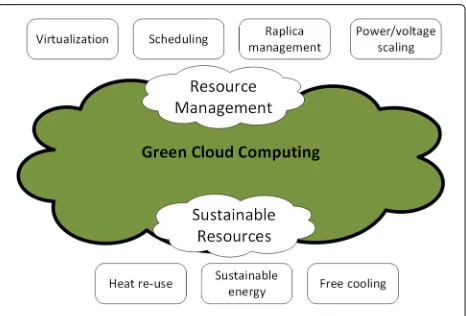
modeled as graph and tree-based structures. The resultant optimization model of the cloud services generally focuses on the task makespan and cost minimization while deter-mining which task is allocated to which resource [21]. Recently, with a shift in focus on the energy consumption, the energy costs have been included in the optimization models. However, the task makespan and energy mini-mization requirements often conflict. The task makespan minimization requires exploitation of multiple resources that leads to higher energy costs. The multi-objective modeling of the task allocation problem in cloud data cen-ters with thousands of resources and applications leads to great complexity in solution finding [22]. Evolution-ary algorithms are employed to swiftly find near-optimal solutions for the multi-objective energy efficient resource scheduling problems in cloud data centers [3]. Interested readers can refer to comprehensive surveys on the green-ing of cloud computgreen-ing [1, 21]. Figure 1 illustrates the options for greening cloud computing systems.
3 Green mobile computing
Smartphones of recent generations are equipped with high storage capacity and the computational power to per-form resource-intensive tasks. The preference of smart-phone users has lessened the dependency on desk-top servers to perform computing tasks. As a result, the resource requirements of the smartphone applica-tions have also increased [23]. Emerging media-rich smartphone applications frequently trigger sensors, such as GPS, accelerometer, and wireless radios to provide context-aware services. As a result, the computation, com-munication, and energy cost of smartphones significantly increase. To handle the energy-performance trade-off, energy-efficient system designs are necessary to meet the requirements of modern smartphone devices. More-over, energy estimation techniques help to propose the energy-efficient design of smartphone applications and
[image:3.595.307.540.558.716.2]system components. Energy estimation helps to identify the rogue applications within a smartphone [24].
Effective management of the hardware components of a smartphone device significantly improves the total energy budget. The architectural design of hardware mod-ules within the smartphone is based on Complementary Metal–Oxide–Semiconductor (CMOS). The total power consumption of CMOS based circuits (e.g. CPU, static RAM, and GPU) consists of static and dynamic power. The static power of a circuit varies from device to device depending on the insulation capabilities of transistors and represents the power consumption when the transistor is not in the switching state [25]. Dynamic power rep-resents the power consumption when a device changes logic state from on to off or vice versa. Power gat-ing embeds a high voltage threshold transistor between actual ground and circuit ground of a device to switch off the transistor during its sleep hours to reduce leak-age power. For the CPU module, dynamic frequency scaling (DFS) enables dynamic adjustment of power con-sumption for greening the smartphones at the cost of throughput [26]. The tail power represents the state of a smartphone component that remains in high power state although it has already finished its required task. The tail power state of smartphone components such as Wi-Fi, 3G, GPS, and SD-CARD, depletes battery charge quickly. Software tools, such as E-prof, empower smartphones to measure/estimate the device energy consumption at the component level. However, software-based solutions sig-nificantly impact the device’s energy consumption due to their profiling activities [27].
Software based green computing solutions such as mobile cloud computing based computational offload-ing, energy bug handloffload-ing, and energy efficient application development significantly reduce the energy budget of the smartphone. Mobile cloud computing empowers smart-phone devices to augment device lifetime by carefully offloading energy critical tasks to remote cloud servers. Computational offloading decisions consider total execu-tion time, resource consumpexecu-tion, energy requirements, and privacy issues of an application before migrating a task to resource-rich cloud servers [28]. Energy bugs within a smartphone lead to abnormal power consump-tion behavior of mobile applicaconsump-tions. Energy bugs are difficult to track, and mainly occur due to(a)faulty bat-teries,(b)damaged mobile battery chargers,(c)infected memory cards, and(d)damaged SIM cards. Alternatively, within an OS, changing OS configuration impacts the mobile battery power consumption rate. For instance, set-ting SetCPU function incorrectly for kernel overclocking results in high battery power consumption [29]. Simi-larly, infected mobile applications and frameworks also drain mobile application abnormally. For instance, a “no sleep” bug hinders a smartphone component from going
into a sleep state that consequently depletes mobile bat-tery charge. A mobile application, with no sleep bug, acquires a lock on a mobile component and does not release it for a long period of time. The ADEL framework reported energy bugs of Wi-Fi components by tracking the packet transmission rate within the mobile application using dynamic taint-tracking analysis. Handling energy bugs puts some extra burden on programmers to explic-itly manipulate power control APIs for energy-efficient operations of mobile applications [24].
Smartphone energy estimation provides the basis for green computing within smartphones. It provides feed-back to the application developers to consider energy as a metric in addition to maintainability, complexity, and understandability. Smartphone application energy esti-mation schemes are broadly classified into components power model and code analysis based estimation cat-egories. Component power model based methods use State of Charge (SOC) estimation methods to forecast the energy consumption of an application [24, 30]. Alter-natively, the code analysis based method considers base cost energy of instructions within the source code of an application to estimate energy consumption [31]. SOC estimation methods include coulomb counting and volt-age based methods. Coulomb counting estimates SOC by communicating to the smartphone’s built-in sensors to find the accumulative current drop rate over time. However, coulomb counting produces inaccurate esti-mation results due to internal factors such as battery aging, the temperature within the smartphone, and charg-ing/discharging rate. Alternatively, voltage-based SOC estimation employs fuel gauge sensors. Fuel gauge sen-sors are inaccurate owing to low charge update rate. Base cost energy methods assign base cost to the operations within an instruction to estimate energy consumption of an application based on static code analysis. The esti-mation method helps either to improve the hardware components of smartphones or software for green com-puting [31]. Figure 2 highlights the hardware and software options for green mobile computing.
Fig. 2Green Mobile Computing. The figure depicts techniques for green mobile computing
4 Green internet of things
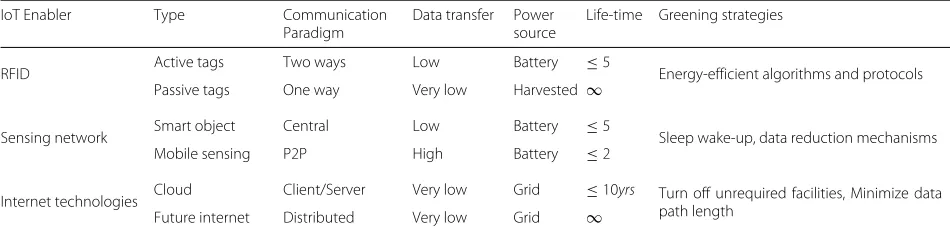
IoT is another emerging technology that facilitates data communication among multiple electronic devices with-out human and computer intervention. Green IoT is a set of procedures adopted by the IoT in the form of hard-ware or softhard-ware efficiency techniques. Green IoT aims to achieve energy efficiency through the reduction of the greenhouse effect in the current services and applications. Moreover, to reduce the impact on the environment, Green IoT focuses on the issues of green productions, green redesign, and green recycling/disposal [35]. Table 1 highlights enabling technologies and greening strategies for IoT.
Real deployment of IoT is performed through the collab-oration of enabling technologies, communication strate-gies, and protocols. This section mainly focuses on the most crucial communication strategies and technologies that lead towards green IoT.
Green Radio-Frequency IDentification (GRFID)
Radio Frequency Identification (RFID) is one of the promising IoT enablers. A RFID system comprises of RFID tags and tags readers. RFID tags are in the form of microchips attached to the radio that works as a transceiver. Every RFID tag has a unique ID and can store context data regarding the entities to which they are attached. Generally, in the elementary process, the RFID
tag reader triggers information flow through transmitting a query signal. Consequently, the responses come from the nearby RFID tags. Mostly, RFID system transmission ranges are not more than a few meters. Moreover, the transmission frequencies start at 124-135 kHz up to ultra-high at 860-960 MHz. Currently, RFID tags can be found in two types: active and passive tags. The active tag uses onboard power batteries to do its functions. The passive tags depend on harvesting energy from the signal of the readers following the principle of induction [36].
To obtain green RFID, two factors should be considered. Firstly, RFID tag sizes should be reduced since tags them-selves are difficult to recycle. Consequently, the amount of non-degradable material should be reduced in tag man-ufacturing (e.g. printable RFID tags, paper-based RFID tags, and biodegradable RFID tags). Secondly, using com-munication algorithms and protocols that support energy efficiency can lead to Green IoT. Green communica-tion protocols provide energy efficiency through dynamic adjustment of the level of transmission power, optimiza-tion of tag estimaoptimiza-tion, and avoiding of tag collision and overhearing [37].
Green Wireless Sensor Network (GWSN) A Wire-less Sensor Network (WSN) comprise of numerous sen-sor nodes that have resource-constraints, such as limited computing capability, storage capacity, and power. Com-monly, the sensor nodes are connected to a powerful base station called sink. Usually, sensor nodes are equipped with multiple on-board sensors to read the surroundings circumstances, such as humidity, temperature, accelera-tion, etc. Commercial WSN solutions are based on the IEEE 802.15.4 standard [38]. Techniques such as(a)sleep mode activation during sensor idle time, (b) wireless charging mechanisms that harvest environmental mech-anisms, (c) radio optimization, and (d) energy efficient routing and data collection are utilized for GWSN [39].
[image:5.595.57.291.86.229.2]WSN aggregate sensed data into a sink from cluster heads through event-detection and continuous monitor-ing. Cluster heads receive and send aggregated data con-tinuously, which leads to faster energy depletion around the sink [40]. There are two strategies for optimizing energy usage in WSN, namely, periodic reporting instead
Table 1IoT Enabling technologies and their greening strategies
IoT Enabler Type Communication Paradigm
Data transfer Power source
Life-time Greening strategies
RFID Active tags Two ways Low Battery ≤5 Energy-efficient algorithms and protocols Passive tags One way Very low Harvested ∞
Sensing network Smart object Central Low Battery ≤5 Sleep wake-up, data reduction mechanisms Mobile sensing P2P High Battery ≤2
Internet technologies Cloud Client/Server Very low Grid ≤10yrs Turn off unrequired facilities, Minimize data path length
[image:5.595.57.532.617.733.2]of continuous monitoring and timestamp-less synchro-nization. In a periodic reporting strategy, time periods of data reporting are set by the sensor owner to avoid energy spikes that are raised in event-driven reporting. In timestamp-less synchronization, the broadcast con-trol messages to sensors for synchronization are not put to practice. The participating sensor pairs performs REQUEST/RESPONSE until the achievement of synchro-nization process [41].
Green M2M communication(GM2MC) Machine-to-machine (M2M) communication is one of the popular paradigms in IoT. There are two communication domains in IoT: M2M and networks. In an M2M domain, multi-ple nodes are deployed to intelligently monitor and gather data. In the network domain, wireless/wired networks carry the gathered data to the desired base station (BS). The BS supports different M2M applications through the network. The challenge is that the massive nodes involved in M2M interactions consume a lot of energy. The tech-niques that can be utilized to improve energy-efficiency of M2M communications are: (a)intelligently adjusting the transmission power to the necessary level,(b) devel-oping energy-efficient routing protocols, (c) scheduling the activity in the machine domain, and(d)using energy-harvesting techniques [42]. Zhu et al. [39] provide exhaus-tive reading on Green IoT technologies.
5 Green big data analytics
Big data introduces the era of data with new challenges such as petabyte scale structured and unstructured data sets which are growing at an exponential rate and have heterogeneous formats. Fast data retrieval and accuracy of search from a pool of big data are the main chal-lenges to maximize value for decision making in big data analytics [43]. Traditional data management systems lack the capability to handle big data storage and analytics requirements and thus NoSQL technology is contribut-ing to provide suitable solutions for timely data retrieval and efficient data processing. The process of greening is crucial for big data as analytics on tremendous size of data sets requires high computing power, scalable and effi-cient storage space, high availability of main memory, and fast communication media on always-on local physical or enterprise cloud servers [44]. Consequently, green big data analytics requires efficiency in resource utilization, energy consumption, and infrastructure scalability.
Big data analytics procedures may contribute to pre-serving the usage of processing and storage resources, scalability of systems, and improved productivity. Big data analytics requirements such as high availability, reliabil-ity, and consistency are significant in the development of technological infrastructures. However, energy preserv-ing and resource optimization are the green computpreserv-ing aspects of analytics which have not being reported in the
literature frequently. Cloud computing is revealed as a big data analytics technology which offers resource out-sourcing in order to avoid physical occupation and thus multiple users with varying analytics requirements can utilize remotely accessible resources. The advancement in cloud computing for big data analytics is expected to lead to low dependency on the usage of personal computers in the new era of computing. Along with resource preserva-tion, cloud computing also offers lower energy consump-tion for executing high computaconsump-tional procedures on big data [45]. Cloud computing has great importance as being a highly available platform for big data analytics which allows minimization in resource utilization and energy consumption [46].
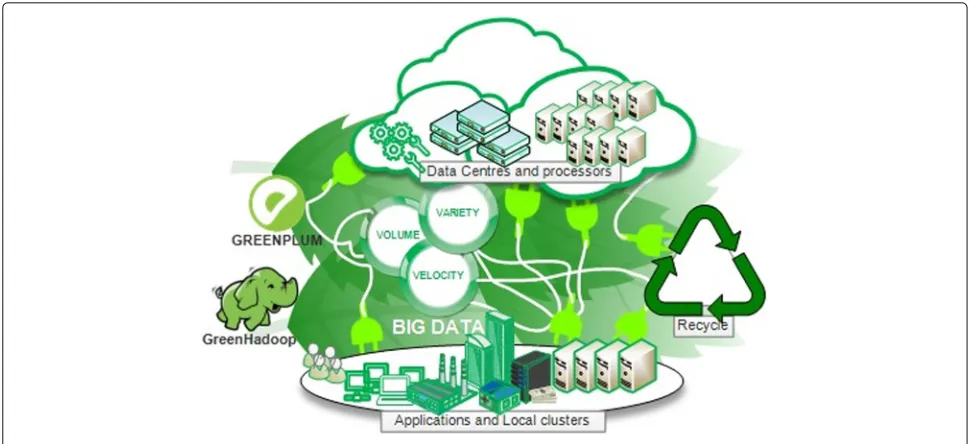
There is a visible advancement in today’s technology towards green big data analytics. For instance, Green-Plum [47] and GreenHadoop [48] are proposed in big data analytics for green computing. GreenPlum is an open source data warehouse, licensed under Apache Inc., which offers fast analytics on petabyte-scale data with efficient query processing via parallel processing and optimization. Cost-based query optimization introduced by GreenPlum ensures high analytics on large volume data sets with usage efficiency. GreenHadoop, on the other hand, brings the idea of renewable energy sources in order to bal-ance the supply and demand of energy sources associated with big data analytics. The GreenHadoop framework uses a photovoltaic solar array and electrical grid energy resources. The GreenHadoop framework for green analyt-ics achieves maximized energy consumption by estimat-ing available solar energy and schedulestimat-ing MapReduce jobs accordingly. GreenPlum provides support to both batch and interactive modes of processing. However, Green-Hadoop achieves real-time energy estimates based on prior data center workload.
Fig. 3Green Big Data Analytics. The figure depicts techniques for green big data analytics
cost, efficient green housing, and increased renewability demands which aim to achieve reduced carbon discharge, lower and stable energy costs, and access to reliable energy sources. 64% of the IT industry are meeting their targets of energy saving by using renewable energy technology [51]. Green big data analytics is significant in optimizing energy consumption and re-usability of available sources to meet extensive analytics requirements of big data. Green computing is analogous to green chemistry and allows usage minimization for enormous computing and storage resources required by big data. Green computing aligns the big data analytics technologies with the concept of sustainability i.e. reduction, reusability, and recycling. Researchers [51] suggest that the technology industry seems more concerned about analytics efficiency than environmental sustainability and computational complex-ity. However, implementation of green analytics on big data surely results in reduced memory usage and compu-tational cost. Interested readers can refer to an extensive future perspective on green big data analytics [52, 53].
6 Green networking
Networks are the basic component and enabler of the innovations that have occurred in human society in the past few decades. As more industries and business have integrated IT technologies and services, the networks have grown into complex structures connecting billions of devices worldwide. As a result, network devices con-sume a large amount of energy constituting approximately 10% of the aggregate IT energy consumption [54]. The basic techniques applied for energy efficient networks are:
(a)energy efficient protocols for routing, medium access,
hand-off and (b) Adaptive Link Rate (ALR) techniques that scale link rate and utilize sleep states for energy-proportional computing [55].
The software and virtualization techniques have led to current advancements in the energy efficiency of net-working technologies. Software Defined Networks (SDN) separate the data and control plane of network routers with the help of a central controller. SDN do not have a direct impact on the energy consumption of a network. However, the pervasive programmable interface of SDN supports energy efficient network operations indirectly through resource consolidation [56]. A minimum energy efficient subset of network resources can be calculated through a resource optimization technique and imple-mented through SDN as demonstrated in [57]. Hence, server and network resource management techniques can be utilized in parallel with the virtualization and SDN enabling technologies. SDN can help implement green computing policies at the network level based on their programmable control plane. Similarly, security policies can be implemented with the help of SDN while elim-inating the need for stand-alone security devices. Con-sequently, SDN-enabled network devices can also imple-ment security functions, lowering the total operational costs and energy bill [58].
[image:7.595.56.546.86.308.2]Similarly, network devices can offer virtual computa-tion services. As a result of virtualizacomputa-tion, network and compute devices offer agile computing and forwarding functions reducing the capital and operational costs of all IT services, especially cloud computing. The decou-pling of network functions from physical devices results in flexible and dynamic resource scheduling, hence, energy efficiency [60]. Five out of six case studies show that the NFV based networks provide energy savings compared to baseline networks. Similarly, higher performance and energy efficiency were observed as compared to com-modity servers while experimenting with a virtualized Deep Packet Inspection (DPI) application [59]. However, a balance between network function performance and energy efficiency achieved through virtualization has to be resolved.
Both SDN and NFV technologies are in early stages of deployment. Therefore, research on the development of green computing architectures based on SDN and NFV technologies has significant future prospects in terms of integration with other IT technologies. Interested read-ers can refer to [61] for a detailed survey on green networks.
7 Practices, research challenges, and issues In this section, we debate the practices, research issues, and challenges to the green initiatives in emerging IT technologies in particular and computing in general.
Green computing practices emphasize the implemen-tation of green technologies at industrial and organi-zational level. The cost of per unit energy will rise significantly owing to a considerable decrease in global energy resources. As a result, it has become necessary for both public and government sectors to propose and practice state-of-the-art strategies and plans for green computing [62]. State-of-the-art green computing prac-tices consider implementation of energy friendly IT equip-ment, lightweight resource consumption protocols, and disposal of electronic waste [63]. Green computing prac-tices emphasize turning off IT resources when not utilized for an extended period of time. Green computing prac-tices also schedule IT resources in low system power and idle states. The standby execution mode is applied for saving power if the execution power state is lower than a threshold [64]. The management of aging IT resources is another important issue in green computing. Older hardware devices have increased power consumption and require resource replacements and disposals. Hence, the practice of recycling needs to be applied to aging IT resources. Similarly, practices limiting the utilization of paper prints should be applied at organizational level [4]. The research challenges to emerging IT technologies are listed in the paragraphs below.
Green cloud computing: Green cloud computing demands divergence from conventional computing tech-niques, hence, increased operational and infrastructural costs. For example, renewable energy has a higher cost than conventional grid energy. Similarly, waste heat uti-lization measures in data centers also demand costly ther-mal heat exchange materials. Incorporating green mea-sures with cost-efficient business operations is a challeng-ing task in cloud data centers. The efficiency of renewable energy generation and storage mediums needs to be rigor-ously increased in order to provide comparable business incentives. The cost of VM migrations for resource con-solidation over long-haul networks is also a highly debated research issue [14, 65]. Moreover, government policies need to be devised that provide incentives to green cloud computing business providers and users.
Green mobile computing: Mobile application energy optimization demands precise estimation accuracy for efficient battery resource usage. Empowering applica-tion developers with a fine granular energy estimaapplica-tion tool to estimate the energy behavior of an application at earlier development stages augments device battery lifetime. Existing energy estimation tools such as power tutor, trepn profile, and Nokia energy profiler, run the application on the smartphone to record power states of power models for smartphone components to estimate energy consumption. However, because of low accuracy of fuel gauge sensors within smartphone batteries, the estimate accuracy is limited. Also, the energy estimation time and overhead is high. To challenge the aforemen-tioned issues, there is a need to develop an estimation tool that should offer high estimation accuracy and lim-ited estimation overhead. One possible solution to this problem is to estimate energy consumption based on operational cost (energy and execution time) of different functions within the software. However, due to the non-deterministic nature of smartphone applications, estima-tion accuracy is significantly affected. Moreover, software operational cost based estimation also requires accurate estimation of code storage location. The weighted prob-abilistic approach is a possible solution to resolve these issues [24].
processing resources. Consequently, big data analytics technology with minimized impact on the environment is highly desirable [43].
Green IoT: To preserve Green IoT some challenges arise and need to be addressed such as Green IoT Archi-tectures, Green Infrastructure, Green Spectrum Manage-ment, Green Communication and Green Security and Quality of Service (QoS) Provisioning [37]:
• Green IoT Architectures: IoT architecture is still under standardization. The committees of
standardization are trying to enable communication between heterogeneous networks, containing various types of devices, across various applications. The challenge is that communication protocols and devices should also consider energy-efficiency while performing their duties as anticipated by end users. • Green infrastructure: Providing energy-efficient
infrastructure for IoT is considered an important issue towards greening. Green infrastructure can be achieved through a clean-slate redesign approach. Redeploying and adapting existing infrastructure is a complex task.
• Green Communication: Communication is one of the influential factors in greening IoTs. Energy efficient communication between IoT nodes faces several challenges, such as supporting energy-efficient communication protocols along with reliable connectivity.
• Green Security and QoS Provisioning:
Implementation of reliable security and privacy algorithms puts the burden of computation on IoT devices, consequently it increases the energy consumption.
Computing architectures, circuits, protocols, and algo-rithms are advancing innovations on green challenges faced by IT. Similarly, the efficiencies of the energy sys-tems have also shown reasonable growth over the last decade. The demand and popularity for computing sys-tems, storage devices, and networks has also increased, hence, neutralizing the advances in green computing. While researchers recognize the importance of contin-ued innovations in efficient and sustainable computing and energy systems, industrial practices lag behind in the adoption of green computing. Operational costs of computing systems can significantly decrease on adop-tion of green computing practices benefiting both service consumers and managers. IT enabled businesses and industries need to comprehend the advantages of green computing in terms of customer value, operational cost sustainability, and environmental sustainability. The future of green computing lies in effective endorsement
of green computing practices by IT industries and IT empowered businesses.
8 Conclusion
In this article, a review of the Green Computing paradigm was presented with a focus on emerging IT technologies. Cloud computing, mobile computing, big data analytics, IoT, and software-based networks were identified as the emerging IT technologies driving the current popularity of the IT industry. The demand and social integration of IT technologies is increasing rapidly, hence, increas-ing the energy consumption. With a renewed focus on the global energy crisis, IT researchers and practition-ers have proposed and implemented several algorithms and protocols for the green operation of the IT industry. These algorithms and protocols implement mechanisms such as idle sleep states, energy-aware decision making, and resource scheduling. However, minimizing the energy consumption of a system significantly affects its perfor-mance parameters. The energy optimization level for a device highly depends on the use case of the applica-tion. Aggressive energy minimization policies effect sys-tem durability due to frequent power off and on syssys-tem routines.
An overall analysis of the state-of-the-art in green com-puting shows that the green algorithms and protocols are reaching a high level of maturity, and significant efficien-cies are possible. In contrast, the study has demonstrated that, in the IT industry, governance is lagging signifi-cantly behind, and hence consideration of green practices is a high priority. In particular, green computing prac-tices need to be implemented at the organizational level to complement and enforce the underlying optimization techniques and technologies proposed by researchers. The strength of green computing solutions lies in their diversity, with consideration of low-level processor, mem-ory, and network components for system optimization alongside greedy and evolutionary heuristics. However, again, this must coincide with robust and intelligent strategies that consider the overall performance energy trade-offs in terms of multi-objective optimization. The paper highlights that further research is required to ana-lyze the impact of energy optimization techniques on system performance parameters such as throughput, and response time. This analysis of system performance and energy will lead to more fine-tuned solutions for green computing that will be more acceptable to IT industry governors who prioritize performance parameters rather than energy.
Abbreviations
RFID: Radio frequency identification; SOC: State of charge; VM: Virtual machine; WSN: Wireless sensor network
Acknowledgements
The authors thank the anonymous reviewers for helpful comments that increased the quality of the article.
Funding
This work is partially funded by the Malaysian Ministry of Education under the High Impact Research Grant of University of Malaya
UM.C/625/1/HIR/MOE/FCSIT/03.
Authors’ contributions
JS contributed towards the sections of Introduction, Green Cloud Computing, and Conclusion. RW wrote the section Green Mobile Computing. AI wrote the section Green IoT. AS contributed towards section Green Big Data Analytics. KN contributed to Green Practices and Green Computing Requirements. AG, AZ, and SK revised the manuscript. In addition, all authors read and approved the work.
Competing interests
The authors declare that they have no competing interests.
Publisher’s Note
Springer Nature remains neutral with regard to jurisdictional claims in published maps and institutional affiliations.
Author details
1COMSATS Institute of Information Technology, University Road, Abbottabad,
Pakistan.2Centre for Mobile Cloud Computing Research (C4MCCR), FSKTM,
University Malaya, Kuala Lumpur, Malaysia.3Faculty of Computing and Informatics, University Malaysia Sabah, Kota Kinabalu, Malaysia.4Department
of Electrical and Computer Engineering, North Dakota State University, Fargo, ND 58108-6050, Fargo, USA.5School of Information Technologies, University
of Sydney, Sydney, Australia.
Received: 31 January 2017 Accepted: 28 June 2017
References
1. Shuja J, Gani A, Shamshirband S, Ahmad RW, Bilal K. Sustainable cloud data centers: A survey of enabling techniques and technologies. Renew Sust Energ Rev. 2016;62:195–214.
2. Wang X, Vasilakos AV, Chen M, Liu Y, Kwon TT. A survey of green mobile networks: Opportunities and challenges. Mob Netw Appl. 2012;17(1):4–20. 3. Abbasi Z, Jonas M, Banerjee A, Gupta S, Varsamopoulos G. Evolutionary
Green Computing Solutions for Distributed Cyber Physical Systems. Berlin, Heidelberg: Springer Berlin Heidelberg; 2013, pp. 1–28. 4. Deng W, Liu F, Jin H, Li B, Li D. Harnessing renewable energy in cloud
datacenters: opportunities and challenges. IEEE Netw. 2014;28(1):48–55. 5. Zhou J, Sun J, Athukorala K, Wijekoon D, Ylianttila M. Pervasive social
computing: augmenting five facets of human intelligence. J Ambient Intell Humanized Comput. 2012;3(2):153–66.
6. Ahmed E, Yaqoob I, Gani A, Imran M, Guizani M.
Internet-of-things-based smart environments: state of the art, taxonomy, and open research challenges. IEEE Wirel Commun. 2016;23(5):10–6. 7. Tapia AH, LaLone NJ, Kim HW. Run amok: group crowd participation in
identifying the bomb and bomber from the Boston marathon bombing. In: proceedings of the 11th International ISCRAM Conference. Pennsylvania; 2014.
8. Lund D, MacGillivray C, Turner V, Morales M. Worldwide and regional internet of things (iot) 2014–2020 forecast: A virtuous circle of proven value and demand. International Data Corporation (IDC), Tech Rep. 2014. 9. Gens F, Adam M, Bradshaw D, et al. Worldwide and regional public it
cloud services 2014–2018 forecast: IDC Corporate USA; 2014. 10. Shuja J, Bilal K, Madani SA, Othman M, Ranjan R, Balaji P, Khan SU.
Survey of techniques and architectures for designing energy-efficient data centers. IEEE Syst J. 2016;10(2):507–19.
11. Ebrahimi K, Jones GF, Fleischer AS. A review of data center cooling technology, operating conditions and the corresponding low-grade waste heat recovery opportunities. Renew Sust Energ Rev. 2014;31: 622–38.
12. Kołodziej J, Khan SU, Wang L, Byrski A, Min-Allah N, Madani SA. Hierarchical genetic-based grid scheduling with energy optimization. Clust Comput. 2013;16(3):591–609.
13. Xiao Z, Song W, Chen Q. Dynamic resource allocation using virtual machines for cloud computing environment. IEEE Trans Parallel Distrib Syst. 2013;24(6):1107–17.
14. Liu H, Jin H, Xu CZ, Liao X. Performance and energy modeling for live migration of virtual machines. Clust Comput. 2013;16(2):249–64. 15. Tso FP, Hamilton G, Oikonomou K, Pezaros DP. Implementing scalable,
network-aware virtual machine migration for cloud data centers. In: IEEE CLOUD; 2013. p. 557–564.
16. Kokkinos P, Kalogeras D, Levin A, Varvarigos E. Survey: Live migration and disaster recovery over long-distance networks. ACM Comput Surv (CSUR). 2016;49(2):26.
17. Goiri Í, Haque ME, Le K, Beauchea R, Nguyen TD, Guitart J, Torres J, Bianchini R. Matching renewable energy supply and demand in green datacenters. Ad Hoc Netw. 2015;25:520–34.
18. Markovic DS, Zivkovic D, Branovic I, Popovic R, Cvetkovic D. Smart power grid and cloud computing. Renew Sust Energ Rev. 2013;24:566–77. 19. Schomaker G, Janacek S, Schlitt D. The Energy Demand of Data Centers.
2015;113–124.
20. Huang F, Lu J, Zheng J, Baleynaud J. Feasibility of heat recovery for district heating based on cloud computing industrial park. In: 2015 International Conference on Renewable Energy Research and Applications (ICRERA). IEEE; 2015. p. 287–291.
21. Jing SY, Ali S, She K, Zhong Y. State-of-the-art research study for green cloud computing. J Supercomput. 2013;65(1):445–68.
22. Juarez F, Ejarque J, Badia RM. Dynamic energy-aware scheduling for parallel task-based application in cloud computing. Future Generation Computer Systems. 2016. ISSN 0167-739X. http://dx.doi.org/10.1016/j. future.2016.06.029.
23. Li X, Ortiz PJ, Browne J, Franklin D, Oliver JY, Geyer R, Zhou Y, Chong FT. Smartphone evolution and reuse: Establishing a more sustainable model. In: 2010 39th International Conference on Parallel Processing Workshops. IEEE; 2010. p. 476–84.
24. Ahmad RW, Gani A, Hamid SHA, Xia F, Shiraz M. A review on mobile application energy profiling: Taxonomy, state-of-the-art, and open research issues. J Netw Comput Appl. 2015;58:42–59.
25. Kumar BPV, Sharma NM, Kishore KL, Goel N. Leakage power recovery in spare cells by using state dependent leakage tables from library models. In: 2012 Asia Pacific Conference on Postgraduate Research in
Microelectronics and Electronics. IEEE; 2012. p. 19–24.
26. Blume H, Becker D, Rotenberg L, Botteck M, Brakensiek J, Noll TG. Hybrid functional-and instruction-level power modeling for embedded and heterogeneous processor architectures. J Syst Archit. 2007;53(10): 689–702.
27. Shuja J, Gani A, Bilal K, Khan AUR, Madani SA, Khan SU, Zomaya AY. A survey of mobile device virtualization: Taxonomy and state of the art. ACM Comput Surv (CSUR). 2016;49(1):1.
28. Fernando N, Loke SW, Rahayu W. Mobile cloud computing: A survey. Futur Gener Comput Syst. 2013;29(1):84–106.
29. Liu Y, Xu C, Cheung SC. Diagnosing energy efficiency and performance for mobile internetware applications. IEEE Soft. 2015;32(1):67–75. 30. Hoque MA, Siekkinen M, Khan KN, Xiao Y, Tarkoma S. Modeling,
profiling, and debugging the energy consumption of mobile devices. ACM Comput Surv (CSUR). 2016;48(3):39.
31. Hardy D, Puaut I. Static probabilistic worst case execution time estimation for architectures with faulty instruction caches. Real-Time Sys. 2015;51(2):128–52.
32. Pananilath I, Acharya A, Vasista V, Bondhugula U. An optimizing code generator for a class of lattice-boltzmann computations. ACM Trans Archit Code Optim (TACO). 2015;12(2):14.
33. Luporini F, Varbanescu AL, Rathgeber F, Bercea GT, Ramanujam J, Ham DA, Kelly PH. Cross-loop optimization of arithmetic intensity for finite element local assembly. ACM Trans Archit Code Optim (TACO). 2015;11(4):57.
34. Ba H, Heinzelman W, Janssen CA, Shi J. Mobile computing-a green computing resource. In: Wireless Communications and Networking Conference (WCNC) 2013 IEEE. IEEE; 2013. p. 4451–6.
36. Juels A. Rfid security and privacy: a research survey. IEEE J Sel Areas Commun. 2006;24(2):381–94.
37. Shaikh FK, Zeadally S, Exposito E. Enabling technologies for green internet of things. IEEE Syst J. 2015;PP(99):1–12.
doi:10.1109/JSYST.2015.2415194.
38. Hartung C, Han R, Seielstad C, Holbrook S. Firewxnet: A multi-tiered portable wireless system for monitoring weather conditions in wildland fire environments. In: Proceedings of the 4th international conference on Mobile systems, applications and services. ACM; 2006. p. 28–41. 39. Zhu C, Leung VC, Shu L, Ngai ECH. Green internet of things for smart
world. IEEE Access. 2015;3:2151–62.
40. Jeon SH, Lee J, Choi JK. An adaptive reporting frequency control scheme for energy saving on wireless sensor networks. In: Information and Communication Technology Convergence (ICTC), 2014 International Conference on. IEEE; 2014. p. 39–44.
41. Morreale P, Qi F, Croft P. A green wireless sensor network for environmental monitoring and risk identification. Int J Sens Netw. 2011;10(1-2):73–82.
42. Seah WK, Eu ZA, Tan HP. Wireless sensor networks powered by ambient energy harvesting (wsn-heap)-survey and challenges. In: Wireless Communication, Vehicular Technology, Information Theory and Aerospace & Electronic Systems Technology, 2009. Wireless VITAE 2009. 1st International Conference on. IEEE; 2009. p. 1–5.
43. Gani A, Siddiqa A, Shamshirband S, Hanum F. A survey on indexing techniques for big data: taxonomy and performance evaluation. Knowl Inf Syst. 2016;46(2):241–84.
44. Hashem IAT, Anuar NB, Gani A, Yaqoob I, Xia F, Khan SU. Mapreduce: Review and open challenges. Scientometrics. 20161–34.
45. Baillie R. Big data goes green. 2012. URL http://www.
renewableenergyworld.com/articles/print/volume-15/issue-3/solar-energy/big-data-goes-green.html. Accessed 11 Jan 2017.
46. Patra C, Nath A. Green computing–new paradigm of energy efficiency and e-waste minimization–a pilot study on current trends. Int J Adv Res Comput Sci Manag Stud. 2014;2(11):
47. Waas FM. Beyond conventional data warehousin - massively parallel data processing with greenplum database. In: International Workshop on Business Intelligence for the Real-Time Enterprise. Springer; 2008. p. 89–96.
48. Goiri Í, Le K, Nguyen TD, Guitart J, Torres J, Bianchini R. Greenhadoop: leveraging green energy in data-processing frameworks. In: Proceedings of the 7th ACM european conference on Computer Systems. ACM; 2012. p. 57–70.
49. “Pike-Research”. Pike research: Cloud computing energy efficiency. 2012. URL http://www.areadevelopment.com/StudiesResearchPapers/1-3-2011/pike-research-cloud-computing-energy49922.shtml. Accessed 11 Jan 2017.
50. ‘CDP’. Re100 annual report 2016 - growing market demand for renewable power. 2016;17.
51. Al-Jarrah OY, Yoo PD, Muhaidat S, Karagiannidis GK, Taha K. Efficient machine learning for big data: A review. Big Data Res. 2015;2(3):87–93. 52. Bourne PE, Lorsch JR, Green ED. Perspective: Sustaining the big-data
ecosystem. Nature. 2015;527(7576):S16—S17.
53. Asad Z, Chaudhry MAR. A two-way street: Green big data processing for a greener smart grid. IEEE Syst J. 2016;PP(99):1–11.
doi:10.1109/JSYST.2015.2498639.
54. Shuja J, Bilal K, Madani S, Khan S. Data center energy efficient resource scheduling. Clust Comput. 2014;17(4):1265–77.
doi:10.1007/s10586-014-0365-0.
55. Bilal K, Malik SUR, Khalid O, Hameed A, Alvarez E, Wijaysekara V, Irfan R, Shrestha S, Dwivedy D, Ali M, et al. A taxonomy and survey on green data center networks. Futur Gener Comput Syst. 2014;36:189–208. 56. Xia W, Wen Y, Foh CH, Niyato D, Xie H. A survey on software-defined
networking. IEEE Commun Surv Tutorials. 2015;17(1):27–51. 57. Heller B, Seetharaman S, Mahadevan P, Yiakoumis Y, Sharma P,
Banerjee S, McKeown N. Elastictree: Saving energy in data center networks. In: Nsdi, vol 10. 2010. p. 249–64.
58. Rawat DB, Reddy SR. Software defined networking architecture, security and energy efficiency: A survey. IEEE Commun Surv Tutorials. 2016;19.1: 325-346.
59. Mijumbi R, Serrat J, Gorricho JL, Bouten N, De Turck F, Boutaba R. Network function virtualization: State-of-the-art and research challenges. IEEE Commun Surv Tutorials. 2016;18(1):236–62.
60. Bolla R, Lombardo C, Bruschi R, Mangialardi S. Dropv2: energy efficiency through network function virtualization. IEEE Netw. 2014;28(2):26–32. 61. Fang C, Yu FR, Huang T, Liu J, Liu Y. A survey of green
information-centric networking: Research issues and challenges. IEEE Commun Surv Tutorials. 2015;17(3):1455–72.
62. Ahmad W, Hölzenspies PK, Stoelinga M, van de Pol J. Green computing: power optimisation of vfi-based real-time multiprocessor dataflow applications. In: Digital System Design (DSD), 2015 Euromicro Conference on. IEEE; 2015. p. 271–5.
63. Preden J, Kaugerand J, Suurjaak E, Astapov S, Motus L, Pahtma R. Data to decision: pushing situational information needs to the edge of the network. In: 2015 IEEE International Multi-Disciplinary Conference on Cognitive Methods in Situation Awareness and Decision. IEEE; 2015. p. 158–64.
64. Bolla R, Bruschi R, Davoli F, Cucchietti F. Energy efficiency in the future internet: a survey of existing approaches and trends in energy-aware fixed network infrastructures. IEEE Commun Surv Tutorials. 2011;13(2):223–44. 65. Liaqat M, Ninoriya S, Shuja J, Ahmad RW, Gani A. Virtual machine