5
VIII
August 2017
Design and Development of Three-Lift Elevator
Instructional Device utilizing PLC Controls
Romano A. Pimentel1, Marklenn C. Brandares2, John Alef T. Cordova3, Angel A. Daipan4, Aladdin F. Pomoy5, Marlon Joie D. Vallejos Jr.6, Daryn E. Villahermosa7, Arveil L. Villazorda Jr.8
1,2,3,4,5,6,7,8BS Electro-Mechanical Department, University of Science and Technology of Southern Philppines
Abstract: In response to the ASEAN 2015 integration, the adaptation of outcomes based education could be a vibrant step to achieve this goal. The study of the design and development of a Three-Lift Elevator Instructional Device utilizing PLC Controls was conducted to address the OBE system implementation in the BS Electro-Mechanical Technology course of the Mindanao University of Science and Technology. The three lift elevator was developed such that the carrier cage driven and open doors thru DC motors can maneuvered via control panel board consisting of push buttons, sensors, seven segment indicators and a Programmable Logic Controller (PLC). This teaching equipment is designed to simulate operation of a normal elevator as well as other complex sequential operations in a building serving three levels with landing door contacts, cabin detection at each floor, floor call buttons in the cabin and on each landing, together with a light indicator on every floor display controlled via PLC operation where the programs are interfaced with the input devices such pushbuttons, sensors and output devices like dc motors, seven segment displays and lights.
Keywords: Elevator, Instructional Device, Simulate, PLC, Control Board
I. INTRODUCTION
Elevator is a tool or equipment which enables easy access and mobility to different levels or floors of a multi storied building. It can also be defined as a machine, usually used in multi leveled buildings, which is capable of moving vertically up and down to carry people and goods from one floor to the other with the help of a rotating motor (which rotates both way) and a shaft or with the help of a high magnetic force. Nowadays the elevators have become very common in the world and people have really started to make a habit of not using the stairs- evolution.
The dawn of the elevator was as early as the 1820s. In the past earthquake from the middle of the 19thcentury, power elevators (steam or water driven) conveyed materials in factories and warehouses. Many elevators were also driven using leather belts and pulley systems that operated the elevator and much of the building’s machinery. Elevator equipment moved up and down through floor cavities (or “trap doors”) that opened as closed as needed. “There were no enclosures, no car enclosures, no hoist way enclosures1. In more recent years, elevator control systems have gone to solid state. “We used to drive high-speed elevators with DC; we converted the building’s AC to DC using motor-generator sets. Today, it’s all done with solid-state devices” says Donoughe, 2006.
Control systems on early elevators required human operators to regulate the speed of the lift and descent, to stop the elevator at each floor, and to open and close the doors. In the 1950s automatic pushbutton control systems replaced manual controls. In the 1970s electromechanical controls were gradually replaced with solid state electronic controls. But how does the institutions resolve the shift of technology and can they cope up with the challenge to promote competitiveness on technical education systems.
Today's technologies come and go at an alarming rate, and the length of time in any technology, either software or hardware, exists before being supplanted by a newer technology is growing ever shorter. For anyone working within the field of instructional technology, this rapid replacement rate of technologies can hold immense implications for both the development and delivery of educational systems2. The need of developing instructional trainers in replica of the essential industrial equipment such as controllers could somehow resemble those technologies found in industries and utilize them to facilitate instruction in the academic premise. Developing the required competencies of the industrial sector is a must in Colleges and Universities in order to produce competent graduates. This situation led to the development of numerous instructional trainers and equipment production enabling technology education to keep pace with the current industrial technological applications.
those people who want to learn. Since the technology now is rapidly evolving, the study complements the rapid evolution of technology.
II. DESIGNINGOFHARDWAREOFTHESYSTEM
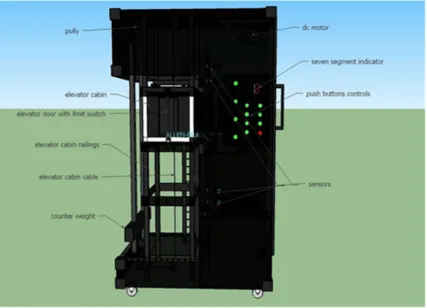
[image:3.612.99.526.179.487.2]The Three-Lift Elevator Instructional Device with PLC Application is composed of DC Motor, Eighteen-Segment Display, Fibre Optic Sensors, PLC, Printed Circuit Board, Pulley, Push Button Switch, Relay, Servo Motor, Seven- Segment Display, Tackle Pulley, and Wheel. The figure below shows the conceptual design of the prototype, It’s illustrates that the elevator has three levels, the height of the device is 60 inches and its width is 36 inches.
[image:3.612.65.530.551.719.2]Figure 1. Conceptual Design of the Prototype
Figure 2 below shows the electrical circuit wire color coding as well as the input and output of the PLC wiring connection.
Figure 3 and 4depicts the mechanical linkage of the elevator showing the cage, counterweight and the pulley linkage for the entire elevator moving motion capability.
Figure 3 Mechanical linkage of the elevator Figure 4. Pulley linkage
(Cage and Counterweight)
III. IMPLEMENTATION OF PLC BASED ELEVATOR CONTROL SYSTEM
In this system, the ladder program is downloaded to the PLC controller via software. Basic requirements are also needed:
A. PLC
B. Programming Device (personal computer)
C. Connector Cable
D. Programming Software
PLC utilized in the device is Allen Bradley and is programmed via RS Logix 500 software. Connecting cables are wired to PLC inputs such as Fibre Optic Sensor and Push buttons, while its output is connected to Relay, Servo Motor, and DC Motor.
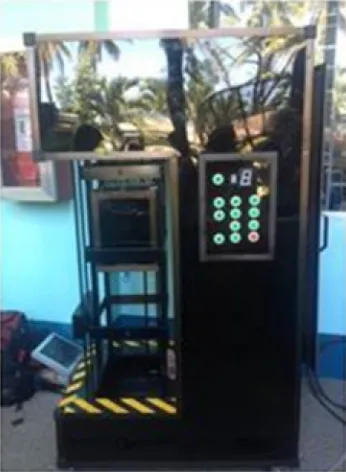
Figure 4 shows the finish prototype of Three-lift Elevator Instructional Device, the outside components of the device namely: Eighteen-Segment Display, Push Button, Seven-Segment Display, Wheel while the inside components of the device are DC Motor, Fibre Optic Sensor, Printed Circuit Board, Pulley, Relay, Servo Motor, and Tackle Pulley.
Figure 4 Completed prototype of the Three-lift Elevator Instructional Device
Pulley Cables Electric Motor linked to Pulley
Elevator Cage
[image:4.612.220.393.476.712.2]IV. PROTOTYPE MARKETABILITY
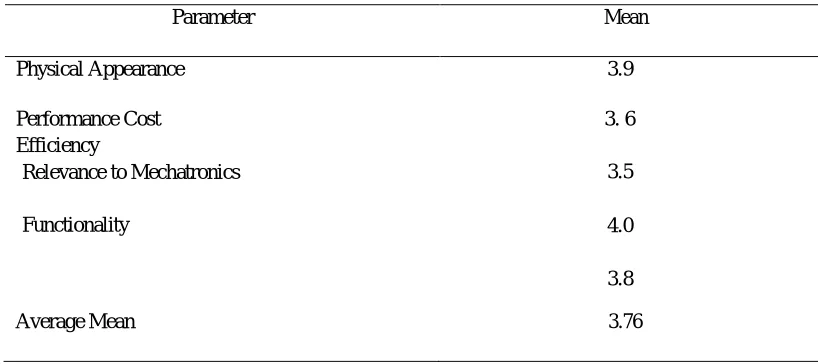
[image:5.612.100.509.169.351.2]The average mean rating of the prototype on its marketability has a good rating. The survey revealed that the Three-lift Elevator Instructional Device has a good marketability due to its physical appearance, performance, cost efficiency, usability, relevance to mechatronics, and functionality.
Table 1 Summary of Mean Responses in Terms of Marketability
Parameter Mean
Physical Appearance 3.9
Performance Cost Efficiency
Relevance to Mechatronics
Functionality
3. 6
3.5
4.0
3.8
Average Mean 3.76
Table 1 shows the physical appearance of the prototype, the mean responses rated 3.9, it means that the prototype is ready present to the market. For the performance of the prototype, the mean answer and rated 3.6, it means that the project meets or satisfied the exact performance. For cost efficiency the mean responses rated 3.5, it represents that the prototype parts is effective and available to the market. For the relevance to mechatronics, the mean responses rated 4.0 it means that the prototype is very good .The functionality of the prototype, the mean responses rated 3. 8 it means the prototype is very good.
V. CONCLUSIONS AND RECOMMENDATIONS A. Conclusions
The propose project of a Three-lift Elevator Instructional Device with PLC Application, It is important in student, not only just students , to those people, who are willing to understand the concept and operation, how an elevator really works. An application of PLC (Programmable Logic Controller) was added with the help of the researchers’ adviser. In implementing ladder diagram was challenging and it requires skills on how to create a good and functional design. However the Three-lift Elevator Instructional Device with PLC Application in functionality proved to be very reliable.
The survey results, indicates the value rated 4.1, the device is a good training for learning and enhancing skills in programming. The overall study of the researchers in their project was a suitable in their assumption in which the elevator device accomplished the equitable task made by the researchers, conjointly seeks to cultivate their research study to provide higher learning in the prototyping projects for the students of MUST.
B. Recommendations
After the conduct of survey for evaluation of the Three-lift Elevator Instructional Device with PLC Application the following recommendations are suggested:
1) Develop other PLC Programming Language aside from ladder diagram
2) Apply some safety measures on the moving parts of the device.
3) Innovate device in line with present technologies
REFERENCES [1] Edward Donoghue (2006). Past, Present and Future: Elevators