ISSN 2250-3153
Availability and Utilization of E-Learning Technologies
among Science Education Students in Tertiary
Institutions in Rivers State.
Omeodu M. Doris
Department of Science Education Rivers State University,
Port Harcourt, Nigeria E-mail: [email protected]
DOI: 10.29322/IJSRP.9.04.2019.p8881
http://dx.doi.org/10.29322/IJSRP.9.04.2019.p8881 Abstract.
The study investigated the “Availability and Utilization of E-Learning Technologies among Science Education Students in Tertiary Institutions in Rivers State’’. The study was specifically based on determining e-learning technologies available in the teaching and learning of science education in Rivers State universities, investigating how e-learning technologies are utilized in the teaching and learning of science education, identifying the challenges encountered in the utilization of e-learning technologies in the teaching and learning of science education in Rivers State Universities. The sample of the study was 15 science education teachers and 30 final year science education students selected from each of the three universities in Rivers State. The instrument used for the study was a questionnaire structured by the researcher based on each of the research questions. The instrument was titled “Availability and Utilization of E-learning Technologies in Science Education (AUETSE)”. The validity of the instrument was carried out by two research experts in the department of science education in Ignatius Ajuru University of Education. The reliability of the instrument was determined using test- retest method which yielded a reliability coefficient of 0.63. The gathered data were analyzed using percentage, mean and standard deviation. The study found that overhead projector, E-books, E-library, E-mail, microphone and mobile phone are available for use in the teaching of science education in Rivers State Universities. Whereas, Wi-fi, audio-visuals aids, educational software, computers, teleconferencing and computer laboratory are not readily available for use. Also, search for learning materials; ease access to online information, public address, enhancing student understanding, broadening students’ view of concepts amongst others. Erratic power supply, inadequacy of e-learning facilities, inadequate technical know-how, lack of ICT competence and others were identified as the challenges encountered in the utilization of e-learning technologies in the teaching and learning of science education in Rivers State Universities. The study recommends science teachers should engage the usage of information and communication technologies in the class in other to get upcoming science fit for the demands of the contemporary society.
Keywords; Availability, Utilization, E-learning, Technologies.
Introduction
The educational system of Nigeria is approaching a significant echelon which traditional norms cannot succeed
its competition. The fast approaching educational system rides on the wings of information and communication
technology. In other words the invention of various forms of communication and information technologies has
brought an innovative phase of educational system to reality. In past decades, not only was formal education
ISSN 2250-3153
denied. Invention of information and communication technologies has conked out the restrictions on formal
education system in recent times.The application of ICT in higher institutions is more critical today than ever
before since its growing power and capabilities are triggering a change the learning environments in education
(Pajo & Wallace, 2001). Teaching and learning through the implementation of information and communication
tools has revolutionized beyond the ordinary classroom, teacher, chalk and blackboard.
Education today is evolving around from the traditional system of learning due to the emergence of new
technologies in transmitting information and communication. Statistics have shown that more than eighty
percent of students in the higher institution of learning are privileged to access smart phones and more than few
own laptops which give them unrestricted access to internets, information pertaining to their various discipline
is readily available in goggle and other search engines. According to Abiodun-Oyebanji and Omotayo (2012),
information and communication technology is the combination of computer and telecommunication system to
improve the quality of teaching, learning, research and communication through its gathering, processing,
connecting, storing, analyzing data functions and dissemination of information. Information and
communication technology resources according to the Nigeria National Policy for Information Technology
(2007), includes any equipment or interconnected system or sub-system of equipment that is used in the
automatic acquisition, storage, manipulation, management control, display, switching, interchange,
transmission or reception of data or information.
E-learning could be regarded as the application of information and communication technologies and electronic
media in teaching and learning process. E- learning is the appropriate application of the computer and
electronic systems to enhance the transfer of skills and knowledge in a more comprehensive approach not
restricted to a particular courses, technologies or infrastructure (Rosenberg, 2001). In a broad sense, Wikipedia
(2010) described e-learning as type of teaching and learning which encompasses all forms of educational
technologies such as multimedia learning, Computer Based Interaction (CBL), Technology Enhanced Learning
(TEL), Virtual Education, Internet/computer Based Training e.t.c.Ajayi (2008) explained that the use of these
technological resources include various methods such as systematized feedback, computer-based operation,
world wide website (www), teleconferencing (audio and video conferencing) and computer assisted instructions
(CAI)..
Okereke (2005) noted that, in the developed countries e-learning technologies such as electronic mail, virtual
classroom, teleconferencing, and internet based learning among others has been adopted to aid education for
ISSN 2250-3153
traditional teaching and learning methods in schools that intends raising global competitive learners. ICTs are
said to help expand access to education, strengthen the relevance of education to the increasingly
digital work place, and raise educational quality helping to make teaching and learning an engaging, active
process connected to real life and many more (Ike, Iwu and Chimezie, 2006). ICT, according to Newhouse (2002b)
promote active learning as it develops an appropriate level of capability in students making it possible for them to
become more engaged with their own learning, and to achieve learning outcomes across the curriculum. He went on to
point out that it support pedagogical practices that provide learning environments that are more learner-centred,
knowledge-centred, assessment-centred, and community centred. Bozalek (2011) considered this ICT as emerging
technologies which usually will influence greatly on teaching, learning, or creative inquiry on learners or those
technologies which are on the rise, like podcasts, blogs and e-books etc, have lived up to expectation as it
appears to be very vital to education, he stressed further that because of the low cost and its ease of access and
usage, podcast is viewed as very useful in education.
Information and communication technologies represent a new paradigm in education that at onset grows on the
edge in relative obscurity and often seems to be of no threat or even of little value to users of the sustaining
technology (Sloan, 2011). As time fast approaches, information communication technologies that was once not
given proper consideration in education due to the fixation to traditional teaching method has conveyed major
advancement to the field of impacting knowledge. Omatoyo and Umoru (2015) affirmed that e-learning
technologies have the potential to innovate, accelerate, enrich and deepen skills, motivate and engage
students, help students relate school experiences to work practices, create economic viability for tomorrows
workers as well as strengthen teaching. Application of E-learning technologies in education in recent time has
enhanced the momentum of impacting knowledge and values to learners at any particular time and place.
E-learning creates an open E-learning environment for learners without restrictions to the level of available
information. Clover (2017) opined that e-learning facilities such as web based learning benefits education in
diverse ways which include;
• Efficiency in delivering courses online
• Promotes active and independent learning
• Enhances flexibility and convenience in teaching and learning
• It also enhances repeat and retention of lessons and instruction.
According to Manir (2017)The use of new multimedia technologies and the Internet in learning is seen as a
means to improve accessibility, efficiency and quality of learning by facilitating access to resources and
ISSN 2250-3153
strategies and technologies. It ranges from the way students utilize e-mails and accessing course work or materials online
while following a course on campus o programmes offered entirely online (Abbas, Alhasan, & Hamza, 2015)
However, implementation of e-learning technologies is faced with myriads of challenges in teaching and
learning especially in developing countries especially Nigeria. Due to so many negatives Nigeria political
system, she could not afford broad access to all the emerging technologies in education to enable wide usage of
e-learning facilities in universities (Manir, 2017). He further pinpointed that part of difficulties in the
implementation of e-learning facilities include difficulties with computer operations, internet access, erratic
power supply, inadequate skills, low literacy among others. Olutola and Olatoye (2015) in their study,
identified various challenges of e-learning in tertiary institutions in the developing countries they are;
• Inadequate e-learning experts or manpower to train both staff and the students
• Malfunctioning of internet facilities in tertiary institutions
• Inability to afford e-learning technologies for teaching and learning in schools
• Inadequate power supply
• Inadequate funding for tertiary institutions
• Inadequate computers and laptops for teaching and learning.
Based on the standpoint of the information revolution technologies have brought through electronic means,
education system which is committed equipping learners with skills for societal competence and survival,
should implement use of trending or emerging technologies in curriculum delivery. Most especially in science,
extensive research is highly needful for effective transfer of knowledge of learners. However, little of these
e-learning technologies are available utilized in educational systems of most developing countries to enhance
teaching and learning of science. It is in this regard this study tends to determine the availability and utilization
of E-learning technologies among science education students in tertiary institutions in Rivers State
Purpose of the study
The principal purpose of the study was to investigate the availability and utilization of E-learning technologies
among science education students in tertiary institutions in Rivers State. In definite terms, the study sought
1. To determine e-learning technologies available in the teaching and learning of science education in
rivers state universities
ISSN 2250-3153
3. Identify the challenges encountered in the utilization of e-learning technologies in the teaching and
learning of science education in Rivers State Universities.
Research questions
1. What are the e-learning technologies available in the teaching and learning of science education in
Rivers State Universities?
2. In what ways are e-learning technologies are utilized in the teaching and learning of science education?
3. What are the challenges encountered in the utilization of e-learning technologies in the teaching and
learning of science education in Rivers State Universities?
Hypotheses
• There is no significant difference between the mean response of science education teachers and students
on how e-learning technologies are utilized in the teaching and learning of science education
• There is no significant difference between the mean response of science education teachers and students
on challenges encountered in the utilization of e-learning technologies in the teaching and learning of
science education in Rivers State Universities.
Methodology.
Due to the fact that this study sought the opinion of a given population based on the research questions,
descriptive survey research design was therefore adopted for the study. The sample size for the study was
fifteen (15) science education teachers randomly selected at equal proportion from each of the three universities
in Rivers State, while thirty (30) final year science education students were also sampled from the three
Universities in Rivers State (Rivers State University, University of Port Harcourt and Ignatius Ajuru University
of Education). The instrument used for the study was a questionnaire structured by the researcher based on each
of the research questions. The instrument was titled “Availability and Utilization of E-learning Technologies in
Science Education (AUETSE)” . The instrument was structured in four point rating scale of agreement, i.e
(Strongly Agree, Agree, Disagree, Strongly Disagree) excluding research question one that was structured in
Yes or No response. The validity of the instrument was carried out by two research experts in the department of
science education in Ignatius Ajuru University of Education. The reliability of the instrument was determined
ISSN 2250-3153
teachers and students who were not included in the study on to different occasions. The result was correlated
using Pearson Product Moment Correlation, and yielded a reliability coefficient of 0.63, which indicated that
the instrument was reliable. The instrument were administered to the respondents and collected on the spot if
it’s available. The gathered data were analyzed using percentage, mean and standard deviation
Result and Discussion
[image:6.612.64.543.279.516.2]Research Question 1: What are the e-learning technologies available in the teaching and learning of science education in Rivers State Universities?
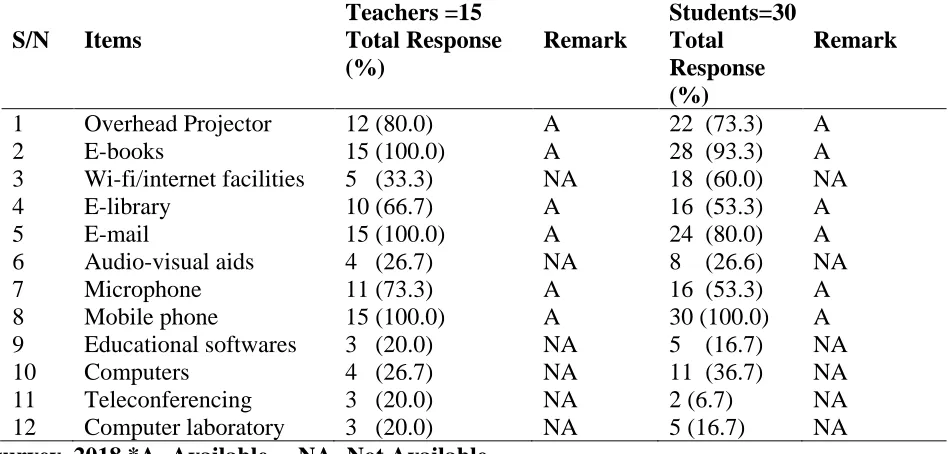
Table 1: Mean response of science education teachers and students on e-learning technologies available in the teaching and learning of science education in Rivers State Universities
Teachers =15 Students=30
S/N Items Total Response
(%)
Remark Total Response (%)
Remark
1 Overhead Projector 12 (80.0) A 22 (73.3) A
2 E-books 15 (100.0) A 28 (93.3) A
3 Wi-fi/internet facilities 5 (33.3) NA 18 (60.0) NA
4 E-library 10 (66.7) A 16 (53.3) A
5 E-mail 15 (100.0) A 24 (80.0) A
6 Audio-visual aids 4 (26.7) NA 8 (26.6) NA
7 Microphone 11 (73.3) A 16 (53.3) A
8 Mobile phone 15 (100.0) A 30 (100.0) A
9 Educational softwares 3 (20.0) NA 5 (16.7) NA
10 Computers 4 (26.7) NA 11 (36.7) NA
11 Teleconferencing 3 (20.0) NA 2 (6.7) NA
12 Computer laboratory 3 (20.0) NA 5 (16.7) NA
Field survey, 2018 *A- Available, NA- Not Available
Table 1 contains science education teachers and students’ mean response on the availability of e-learning technologies available in the teaching and learning of science education in Rivers State Universities. The study
found that overhead projector, E-books, E-library, E-mail, microphone and mobile phone are available for use
in the teaching of science education in Rivers State Universities. Whereas, Wi-Fi, audio-visuals aids,
educational software, computers, teleconferencing and computer laboratory are not readily available for use in
the teaching and learning of science education in Rivers State Universities.
[image:6.612.69.543.284.511.2]ISSN 2250-3153
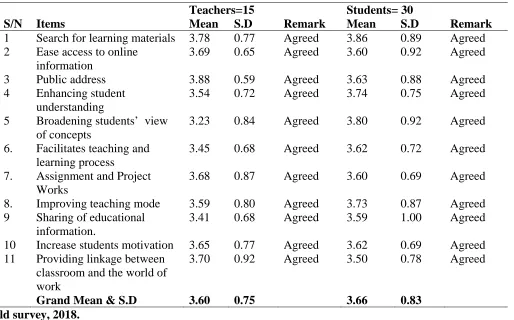
Table 2: Mean response of science education teachers and students on ways are e-learning technologies are utilized in the teaching and learning of science education
Teachers=15 Students= 30
S/N Items Mean S.D Remark Mean S.D Remark
1 Search for learning materials 3.78 0.77 Agreed 3.86 0.89 Agreed 2 Ease access to online
information
3.69 0.65 Agreed 3.60 0.92 Agreed
3 Public address 3.88 0.59 Agreed 3.63 0.88 Agreed
4 Enhancing student understanding
3.54 0.72 Agreed 3.74 0.75 Agreed
5 Broadening students’ view of concepts
3.23 0.84 Agreed 3.80 0.92 Agreed
6. Facilitates teaching and learning process
3.45 0.68 Agreed 3.62 0.72 Agreed
7. Assignment and Project Works
3.68 0.87 Agreed 3.60 0.69 Agreed
8. Improving teaching mode 3.59 0.80 Agreed 3.73 0.87 Agreed 9 Sharing of educational
information.
3.41 0.68 Agreed 3.59 1.00 Agreed
10 Increase students motivation 3.65 0.77 Agreed 3.62 0.69 Agreed 11 Providing linkage between
classroom and the world of work
3.70 0.92 Agreed 3.50 0.78 Agreed
Grand Mean & S.D 3.60 0.75 3.66 0.83
Field survey, 2018.
Table 2 shows the mean responses of science education teachers and students on ways are e-learning
technologies are utilized in the teaching and learning of science education. Based on the acceptance mean value
of 2.50, both science education teachers and students indicated that; Search for learning materials (3.78 &
3.86), ease access to online information (3.69 & 3.60), public address (3.88 & 3.63), enhancing student
understanding (3.54 & 3.74), broadening students’ view of concepts (3.23 & 3.80), facilitates teaching and
learning process (3.45 & 3.62), assignment and Project Works (3.68 & 3.60), improving teaching mode (3.59
& 3.73), sharing of educational information. (3.41 & 3.59), increase students motivation (3.65 & 3.62),
providing linkage between classroom and the world of work (3.70 & 3.50) are ways are e-learning technologies
are utilized in the teaching and learning of science education. This is confirmed by the findings of Manir (2017)
who observed that the use of new multimedia technologies and the Internet in learning is seen as a means to
improve accessibility, efficiency and quality of learning by facilitating access to resources and services as well
as remote exchanges and collaboration
ISSN 2250-3153
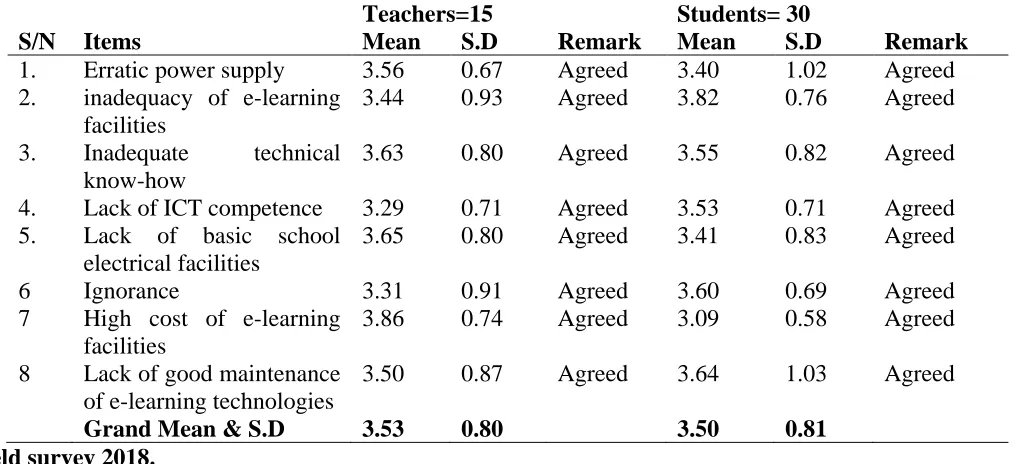
Table 3: Mean response science education teachers and students on challenges encountered in the utilization of e-learning technologies in the teaching and learning of science education
Teachers=15 Students= 30
S/N Items Mean S.D Remark Mean S.D Remark
1. Erratic power supply 3.56 0.67 Agreed 3.40 1.02 Agreed 2. inadequacy of e-learning
facilities
3.44 0.93 Agreed 3.82 0.76 Agreed
3. Inadequate technical
know-how
3.63 0.80 Agreed 3.55 0.82 Agreed
4. Lack of ICT competence 3.29 0.71 Agreed 3.53 0.71 Agreed 5. Lack of basic school
electrical facilities
3.65 0.80 Agreed 3.41 0.83 Agreed
6 Ignorance 3.31 0.91 Agreed 3.60 0.69 Agreed
7 High cost of e-learning facilities
3.86 0.74 Agreed 3.09 0.58 Agreed
8 Lack of good maintenance of e-learning technologies
3.50 0.87 Agreed 3.64 1.03 Agreed
Grand Mean & S.D 3.53 0.80 3.50 0.81
Field survey 2018.
Table 3 presents mean response science education teachers and students on challenges encountered in the
utilization of e-learning technologies in the teaching and learning of science education in Rivers State
Universities. Based on mean level of agreement, respondent showed that rratic power supply (3.56 &),
inadequacy of e-learning facilities (3.44 & 3.82), inadequate technical know-how (3.63 & 3.55), lack of ICT
competence (3.29 & 3.53), lack of basic school electrical facilities (3.65 & 3.41), ignorance (3.31 & 3.60), high
cost of e-learning facilities (3.86 & 3.09), lack of good maintenance of e-learning technologies (3.50 & 3.64),
are challenges encountered in the utilization of e-learning technologies in the teaching and learning of science
education in Rivers State Universities. This finding is in conformity with Olutola and Olatoye (2015) who
identified various challenges of e-learning in tertiary institutions in the developing countries which includes
inadequate e-learning experts or manpower to train both staff and the students, malfunctioning of internet
facilities in tertiary institutions, inadequate computers and laptops for teaching and learning and inadequate
power supply.
Hypothesis
Ho1; There is no significant difference between the mean response of science education teachers and students on how e-learning technologies are utilized in the teaching and learning of science education
ISSN 2250-3153
Groups Mean S.D N Lev. of
sig
z-crit z-cal Remark
Teachers 3.60 0.75 15
0.05 1.96 0.23 Fail to
reject
[image:9.612.68.545.55.137.2]Students 3.66 0.83 30
Table 4 present the z-test analysis on the mean response of science education teachers and students on how
e-learning technologies are utilized in the teaching and e-learning of science education. It is seen that at 0.05 level
of significance, z-critical was 1.96. The comparism of the mean and standard deviation using z-test resulted to
z-calculated value of 0.23. Therefore since the obtained z- crit is higher than the z- cal, the hypothesis failed to
reject.
Ho2; There is no significant difference between the mean response of science education teachers and students on challenges encountered in the utilization of e-learning technologies in the teaching and learning of science education in Rivers State Universities.
Table 5. Z-test analysis on the mean response of science education teachers and students on challenges encountered in the utilization of e-learning technologies in the teaching and learning of science education.
Groups Mean S.D N Lev. of
sig.
z-crit z-cal Remark
Teachers 3.53 0.80 15
0.05 1.96 0.12 Fail to
reject
Students 3.50 0.81 30
Table 4 present the z-test analysis on the mean response of science education teachers and students on
challenges encountered in the utilization of e-learning technologies in the teaching and learning of science
education. It also obvious from the table that at 0.05 level of significance, z-critical was 1.96. The comparism
between the means and standard deviations using z-test resulted to z-calculated value of 0.12. Therefore since
the obtained z-crit is higher than the z-cal, the hypothesis failed to reject.
Conclusion
The study concludes based on the findings that certain information and communication technologies that is
efficient in the teaching and learning such as computer, computer laboratory, Wi-Fi and soon are not readily
available for teaching and learning purposes for science education students. Whereas, ICT tools like
microphone, overhead projector, phones, e-library among others are available for use.
Also drawing from the findings of the study, it was concluded that various ways ICT tools are utilized in the
ISSN 2250-3153
information, public address, enhancing student understanding, broadening students’ view of concepts,
facilitates teaching and learning process, assignment and Project Works, improving teaching mode, sharing of
educational information, increase students motivation, providing linkage between classroom and the world of
work and many more
The study also found that certain factors militate against the effective utilization of ICT facilities in the teaching
and learning of science education which includes erratic power supply , inadequacy of e-learning facilities,
inadequate technical know-how , lack of ICT competence, lack of basic school electrical facilities, ignorance,
high cost of e-learning facilities, lack of good maintenance of e-learning technologies.
Recommendations
The researcher recommends the following based on the result of the study.
• Tertiary institutions should make information and communication technologies available for use in the
teaching and learning of science education as this will equip learners with updated issues in the fields of
science.
• Teachers should engage the usage of information and communication technologies in the class in other
to get upcoming science fit for the demands of the contemporary society.
• Tertiary institutions should make learning environment favourable for the usage of information and
communication technologies at any given time without any hindrance.
References
Abbas, M., Alhasan, A., & Hamza, U.M. (2015). Perceived Ease of Use and Utilization of E-learning Technologies by Academic Staff in Federal College of Education Zaria. IOSR Journal of Humanities and Social Science (IOSR-JHSS) 20(4), 41-46.
Atsumbe, B. N. Raymond, E. & Enoch, E. B. (2012). Availability and Utilization of e-Learning Infrastructures in Federal University of Technology, Minna. Journal of education and practice 3(13),56-64.
Clover, I. (2017). Advantages and Disadvantages of E-Learning. E-learning Basics. Also available https://elearningindustry.com/advantages-and-disadvantages-of-e learning
Ike, G.A, Iwu, A.O & Chimezie, O.S (2006) Perspective on educational technology. Owerri, Peace Publishers Ltd.
ISSN 2250-3153
Newhouse, C. P. (2002b). A Framework to Articulate the Impact of ICT on Learning in Schools. Australia: Specialist Educational Services.
Okereke, E.C. (2005). Strategies for Integrating Information and Communication Technology in Business Teacher Education Curriculum. Journal of Vocational and Adult Education 4(1),95-105
Olutola, A.T. & Olatoye, O.O. (2015). Challenges of E-Learning Technologies in Nigeria University Education.
Journal of Educational and Social Research 5(1) 301-306
Omotayo, D. A & Umoru, T. A. (2015). The use of information and communication technology for the enhancement of teaching and learning of business subjects in secondary schools. ABEN Conference Proceedings, 2(1), 230 – 335.
Pajo,& Wallace,(2001).Barriers to the Uptake of Web-Based Technology by University Teachers. Journal of distant education,1(6),70-84.