Facade Design Preferences of Generation Z
by Using Sorting Method
Viola Malta R.*, Muhammad Faqih**, Purwanita Setijanti**
*Post Graduate Student, Department of Architecture Faculty of Architecture, Design and Planning, Sepuluh Nopember Institute of Technology (ITS), Surabaya 60111, INDONESIA.
** Lecturer, Department of Architecture Faculty of Architecture, Design and Planning, Sepuluh Nopember Institute of Technology (ITS), Surabaya 60111, INDONESIA.
DOI: 10.29322/IJSRP.8.6.2018.p7952 http://dx.doi.org/10.29322/IJSRP.8.6.2018.p7952
Abstract - As a future market of residential property, Generation Z are an unusual target of market segmentation in the dynamic of today's property business market. Generation Z are millennial generation born in 1996-2010. Generation Z have different characteristics of behavior and personality from previous generation. People with the same background may have different preferences and behavior patterns, whereas people with different background may have similar preferences and behavior patterns. This research was conducted to find out the façade house design preferences for Generation Z visually. The sorting method was used to conduct survey on respondents. The population in this research was Generation Z in Indonesia. Based on the survey results, it can be concluded that the sampling technique used in this research was Accidental/Incidental Sampling. The design of a suitable house facade was needed to be developed in the future, i.e. the façade design that looked like a house in general and many were found in everyday life.
Index Terms- Preferences, Housing Facade Design, Generation Z, Sorting Method
I. INTRODUCTION
uman is motivated to meet the needs of his life, one of which is residential house as a place to live in. However, the development of residential architecture designs today appear as a commodity of human consumption, resulting in changes in the meaning of house. The beauty of residential house becomes an important consideration besides its function as a residence. The beauty of residential house can be seen one of which by its facade.
As a future market of residential property, Generation Z are an unusual target of market segmentation in the dynamic of today's property business market. Segmentation is a set of markets (consumers) classified in groups based on a certain criterion [1]. Generation Z have different characteristics of behavior and personality from previous generation. Generation Z are millennial generation born in 1996-2010. The millennial generation have a very clear passion. They highly appreciate brands using right technology to interact with them via smartphones, e-mail, social media, and more. Compared to other market segments, they are more convinced that most brands do not use the right technology to interact with them. Therefore,
they assume that there is a gap between their expectation of product and reality.
Global web index also states it through its review and survey results of 2018 in "Trends 18 - The Trends to Know for 2018". It is described, though Generation Z are included in the millennial generation, they have some different characteristics with those of generation Y that are also considered as a millennial generation. The following is 6 aspects of differences: a. Generation mobile
Generation Z spend more time with smartphones than any other electronic devices. While the millennial generation are still using a wide range of them, such as television, radio, and others. Generation Z also prefer streaming on their smartphones than through the radio if they want to listen to music.
b. Social, social, social
Generation Z use much more social media than the older millennial generation do, approximately 3 hours a day. While the older millennial generation only take 2 hours 39 minutes. c. Time rich
Generation Z are more fond of social life than any other generation are. Really, they use social media not only to spend their spare times, but also to search for content. This is the reason why Generation Z spend more time for it than the older millennial generation do.
d. Social research
Generation Z more believe in the results of product reviews conducted through social media than from search engines. This is very much paradoxical with the older millennial generation. They use more search engines than social media reviews.
e. Status matters
In choosing a product, Generation Z do not just look from the brand. They prefer products that they think are impressive regardless of what brands they are. It is in contrast with the older millennial generation. They really consider that brand is status. For example to choose gadgets, older millennial generation tend to choose I-phone. While Generation Z have more variety of brands, as long as the products they think are impressive.
f. Enthusiasm Trumps Ownership
effort and enthusiasm to get them. They tend to prefer something that is promos, discounts, and others. Unlike the older millennial generation who are better able to buy premium goods and they are considered to be more prosperous than Generation Z.
In a study on environmental behavior, there is a 'filter' generated from what so-called 'cohort effect', i.e. the similarity between group of individual because for example they are born on a certain time (in the same generation).[2] They are starting from Traditionalist Generation, Baby Boomer, to Generation X, Y, Z. Therefore, further research and analysis are needed. People with the same background may have different preferences and behavior patterns, whereas people with different background may have similar preferences and behavior patterns.[3] Consumer preferences can be measured with a measurement model that analyses relationship between product knowledge owned by the consumer and the attitude of the product according to the characteristics and attributes of the products[4]. Consumer preferences are defined as the likes or dislikes by a person for the product (goods or services). People's preferences show person's fondness for various product choices[5].
This research was conducted to find out the façade house design preferences for Generation Z visually. By knowing these preferences, this research was expected to be a guide to property business that can provide suitable residential property product and can be absorbed by Generation Z market in the future. The sorting method was used to conduct survey on respondents. According to Nielsen (1995), this method was used to help design or evaluate information by making respondents organize or sequence the topics into categories that had previously been labeled respectively. This method used tools like cards, either actual cards, paper pieces, and even used sorting software.
II. RESEARCH ELABORATIONS
Architecture is the sciences and arts of established environment. Architecture can influence the way a person feels, helps (accommodates) what is done everyday, and also influence a person's habits of doing something. Furthermore, architecture is part of the art of life.[7] An architecture is considered to be successful when it is able to give expression of the life that inhabits it because one's feelings can be influenced by an architectural form.
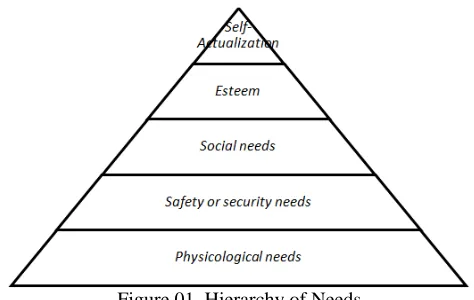
[image:2.612.325.562.59.209.2]House is one form of architecture that becomes one of the basic needs of human life. The Hierarchy of Needs Theory can be used to determine the level of human needs for his house. From the theory, it can be seen that if the most basic needs are fulfilled, people will increasingly strive to meet other needs.[8]
Figure 01. Hierarchy of Needs
The first level is physiological or basic needs. This is the most important need, such as food to eat, air for breathing, space to move, and the need to rest or sleep. In the context of the need for space, human requires the space to rest.
The second level is the need for safety (safety needs). When the basic needs are met, they increase to the need for security. In the dwelling, for example, human needs for a safe house. These can be accommodated through simple houses.
The third level is the need to be loved and belonging (love / belonging needs). At this level, a house is considered as a means to represent social needs. The house serves as a means of interacting and doing social activities, because human wants other human beings.
The fourth level is the need to be rewarded (esteem needs). In terms of the dwelling, human assumes that the existence of a house can improve self-image of the owner. This happens because human requires rewards for himself, such as self-confidence, success, competition, and independence.
The last or fifth level is self-actualization. It is the peak of human needs. After meeting all the needs, then human needs a means for self-actualization. House can be one of them as realization, reflection, or status symbol of someone to represent self expression. Possessing the first house is included in the needs of levels 2 and 3, which can increase to level 4, depending on individual. As for upper-middle-level economic consumers, houses are of level 4 and level 5. These needs are influenced by lifestyles which are defined as the way of life they followed, including social rules and characteristics setting. In this case, behavioral factors have an effect on preferences.
In general, to get actual knowledge about the design preferences of Generation Z house facades, this study focused on the theory of preferences within the scope of environmental behavior studies. This theory was used to analyze the level of customer satisfaction of a product. Every consumer aimed at maximizing the level of satisfaction obtained from a certain amount of money he spent.[9] For this purpose, each consumer unit was considered to be able to rank all of the existing commodities. In other words, each consumer unit had to be able to determine the order of preference of the existing commodities.
it offered. Segmentation was a set of markets (consumers) classified in groups based on a certain criterion.[1] The consumer segmentation referred to in this research was Generation Z. What so-called Generation Z was millennial generation born in 1996 - 2010. Generation Z was chosen as the object of research because there were studies and articles saying that millennial generation (including Generation Z) were threatened to have house in the future.
In identifying market segments, three stages of procedure could be performed, namely:
a. Survey Stage
At this stage interviews were conducted to target market segments to gain an understanding of attitudes, motivations, and consumer behavior. Interviews could be in the form of questionnaires, in which the data of collected questionnaires could be used as information on the required attributes. b. Stage Analysis
At this stage, data containing highly correlated variables were discarded, then group analysis was performed to produce the maximum number of different segments.
c. Formation Stage
At this stage a group was formed based on different attitudes, behaviors, demographics, psychological, psychographics, and media patterns. From the dominant characters found in the group, a profile name was given to the segmented group.
In the market segmentation procurement, division was divided by the following categories:
a. Market Segmentation based on Geography. b. Market Segmentation based on Demographics. c. Market Segmentation based on Psychographics. d. Market Segmentation based on Sociocultural.
e. Market Segmentation based on extreme relationships. It was associated with loyalty to manufacturers and brands.
f. Segmentation based on usage situation. g. Segmentation based on benefits.
h. Hybrid segmentation. This segment was formed based on a combination of several segment variables that made up a single segment.
i. Market Segmentation based on Behavior. Segmentation was grouped based on buyer’s knowledge, attitude, use, or reaction to a product.
By knowing the intended market segmentation, the producers would be easier to know the preferences of consumers because they had been grouped homogeneously by certain criteria, in this case was Generation Z. This aspect of research was related to Generation Z preference and the design of suitable residential facades developed in the future.
The survey method used the sorting method. This method was used to help design or evaluate information by making respondents set or sequence the topic into categories that had previously been labeled respectively. The results of the research would be examined quantitatively to find the residential facade design that was in accordance with the Generation Z preference. Furthermore, qualitative analysis was conducted by interviewing several respondents to get complete information.
The population in this research was Generation Z in Indonesia. Within the next 10 years (in 2027) when the demographic bonus was predicted to occur, the age of the population ranged from 25 to 29 years and was possible to have a private dwelling. However, this study did not take Generation Z across Indonesia, but only those who were currently studying in senior high schools or equivalent in Surabaya. The sampling technique used in this research was Accidental / Incidental Sampling. This technique was included in the category of non-probability sampling, which did not provide equal opportunities for each element or member of the population to be selected as a sample.[10] Therefore, criteria were needed to determine the appropriate sample. They were:
a. Aged between 15 - 19 years.
b. Being in senior high school or equivalent in Surabaya.
III. RESULT AND FINDINGS
[image:3.612.311.582.350.421.2]To observe Generation Z residential preference visually, questionnaire surveys and sorting method were applied. Respondents were asked to sequence 5 (five) images of the house facade from the most preferred to the least favored. The drawings were chosen based on the representation of house facade design styles commonly seen by Indonesian people.
Figure 02. The houses’ facade for questionnaire
The following were general overview of the design images of the house façade:
a. Figure A represents a house with a classic style. b. Figure B represents a house with asymmetrical force. c. Figure C represents a house with a modern-traditional style. d. Figure D represents a modern full-style house.
e. Figure E represents a minimalist style house.
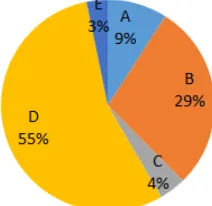
After sorting and quantitative analysis of the survey results were undertaken, respondents mostly liked the Figures of E (33%), A (25%), and C (25%) as the first choice (33%). As for the fifth option (least liked), respondents chose D (55%) and B (29%) respectively. Hence, respondents preferred a house that looked like a house in general and it could be found in their everyday lives. What they used to see was recorded in their memories and experiences that became a habit. When the way a person did something was really embedded in him, it became a habit and was called as 'common sense'. There was an individual 'filter' reflected in personal experience of living environment image, experience, something more memorable, and so on.[2]
encountered in Indonesia. Many respondents placed Figure D and B as their fifth (least preferred) option. What was interesting was that there were 12% of respondents chose Figure D as their first choice, even the percentage was bigger than the one who chose Figure B as their first choice (5%).
Figure 03. Respondents’ First Choice
[image:4.612.392.498.60.163.2]Figure 04. Respondents’ Second Choice
Figure 05. Respondents’ Third Choice
Figure 06. Respondents’ Forth Choice
Figure 07. Respondents’ Fifth Choice
This was because the behavior of Generation Z liked using technology for social activities and reviewing things through the virtual world and social media. Figure D was a unique and futuristic house representation that was loaded in cyberspace and social media. However, more respondents chose Figure A, C, and E. This proved that there were still more respondents who prioritized usual choices they saw and felt real.
This is in line with what Blakley, a special Generation Z consultant, said in his interview with Forbes Magazine. He said that the producers should have specific strategies to deal with Generation Z consumer, one of which was 'relatability'. Generation Z demanded something original, real, and close to their daily lives. In fact, it also appeared from their choices of who promoted a product. They were more confident in the existing product reviews in social media because the use of products was more real than ads which were too superior to the product. That's why endorsement phenomena, influencers, and so forth arose even popularity could beat the 'ordinary' celebrities in promoting the product. By definition, Lifestyle Expert type influencers were the first real people, while celebrities were the second. Based on the nature of their media and content, Lifestyle Expert category was one of the most reliable and relatable brand ambassadors because they actually used the products they reviewed / promoted in their daily lives.
Architecture was relatively complex with many fields involved in it. It was not only related to engineering, but also related to experience, tradition, and precedent.[7] This was in line with qualitative analysis results of interviews with some respondents to get the selection reasons of the sequence of their sorting method results of 5 drawings of the house. Respondents said that they liked the drawing of house facades A, C, and E because they looked comfortable and what they were for them. This is because they felt that the house looked like house in general. They preferred the traditional minimalist, classical, and modern style house that were often encountered in their everyday lives. Hence, their impressions were more comfortable than the modern and futuristic houses. They were considered too unique and strange, so that less reflected the comfort for the dwelling.
[image:4.612.110.225.132.241.2]IV. CONCLUSIONS
Based on the visual design preference of Generation Z house façade, the design of a suitable house facade was needed to be developed in the future, i.e. the façade design that looked like a house in general and many were found in everyday life. They were less fond of 'futuristic' house designs and looked different from what they saw and lived all along. When the way a person did something was really embedded in him, it became a habit and was called 'common sense'. There was an individual 'filter' reflected in the personal experience of the image of living environment, experience, something more memorable, and so on. Architecture was relatively complex as many fields involved in it. It was not only related to technique, but also related to experience, tradition, and precedent.
ACKNOWLEDGMENT
This publication based on Master Program Thesis which conducted in 2018, entitled “Preferences Based on the Z-Generation Lifestyle as the Future Market of Residential Property.”
REFERENCES
[1] Andersen, Bob. and Luke, Residential Real Estate Development : A Practical Guide For Beginners to Experts., 2006, Australia : Lulu Publisher.
[2] Rapoport, A., Culture, Architecture, dan Design., 2005, United States of America : Locke Science.
[3] Pinkster, F., & van Kempen, R., Leefstijlen en Woonmilieuvoorkeuren, 2002, Utrecht: Urban and Regional Research Centre, Universiteit Utrecht. [4] Tambunan, Damelina B, Atribut yang Menjadi Pertimbangan Konsumen
dalam Membeli Produk Perumahan : Studi Kasus Di Kota Surabaya, 2009,
Surabaya : Journal Integritas Manajemen Bisnis, Vol 2 No. 2. Terakreditasi Nasional Berdasarkan SK DIK.
[5] Kotler, Philip, Manajemen Pemasaran, 1997, Surakarta: PT Pabelan Surakarta.
[6] Nielsen, Jakob. Card Sorting to Discover the Users’ Model of the Information Space, 1995, Nielsen Norman Group.
[7] Ballantyne, A., What is Architecture, 2002, London : Routledge.
[8] Maslow, Abraham, A Theory of Human Motivation, 2013, London : Createspace Independent Publishing Platform.
[9] Sudarman, Ari. Teori Ekonomi Mikro Edisi 4, 2004, Yogyakarta : BPFE UGM.
[10] Sugiyono, Metode Penelitian Kuantitatif, Kualitatif, dan R&D, 2011, Bandung: Alfabeta, cv.
AUTHORS
First Author – Viola Malta Ramadhani, Post Graduate Student,
Department of Architecture, Faculty of Architecture Design, and Planning, Sepuluh Nopember Institute of Technology (ITS), Surabaya 60111 INDONESIA, [email protected].
Second Author – Muhammad Faqih, Lecturer, Department of
Architecture Faculty of Architecture, Design and Planning, Sepuluh Nopember Institute of Technology (ITS), Surabaya 60111, INDONESIA, [email protected].
Third Author – Purwanita Setijanti, Lecturer, Department of
Architecture Faculty of Architecture, Design and Planning, Sepuluh Nopember Institute of Technology (ITS), Surabaya 60111, INDONESIA, [email protected].
Correspondence Author – Viola Malta Ramadhani,