LI-FI: Use of Visible Light Communication to Increase
Performance of Data Transmission
Author - K.Shayether, S.A.Asmina, M.J.E.Fernando, K.J.Sheshadari, H.A.T.Rangari, Dhishan Dhammearatchi
Sri Lanka Institute of Information Technology Computing Pvt (Ltd).
Abstract- The aim of this paper shows the prospective routine of Li-Fi technology and its features to increase the performance of data transmission and various applications where Li-Fi has been placed to use. The modern society is highly affected by modern communication technology. Almost all the level of peoples are using web to complete the chore through wireless network. As amount of users are increases in using wireless network, this has unfortunately led to an increase in network complexity, speed decreases, shortage of wireless radio bandwidth and an increased risk of interference of radio frequencies. Moreover efficiency and safety of the internet are dominating issues now. Though Wi-Fi gives us speed up to 150mbps, which is not sufficient to accommodate number of anticipated users. To Resolving this limitation of Wi-Fi, a new technology always is desirable and, there are enormous new technologies participating to make sophisticated environment for an end user. As a result, Li-Fi has been introduced that could provide a connection that's 100 times faster than traditional Wi-Fi, Li-Fi provides better effectiveness, handiness and safety than Wi-Fi. It has gained a huge popularity in short range of year. Such technology has brought not only speed but harmless and inexpensive future of communication. The immense usage of Li-Fi may solve some tailback of Wi-Fi technology. In the present; this paper made an exhaustive study on Li-Fi technology, working techniques, and related researches which used Li-Fi technology.
Key Words— Li- Fi, Wi-Fi, LED, Gi-Fi
I. INTRODUCTION
Modern society have gradually become hooked to the internet some way or the other in this 21st century. When there is no internet connection, it is difficult to think of a single day in human life. The internet that is using for a variety of purposes, topmost among them being sharing of data. In circumstances where people want to exchange data quickly and efficiently, low internet speeds can be quite maddening when numerous devices are connected.
In 2011, Scientist Harold Haas from UK showcased new technology and devised a best solution over these all problems called Li-Fi. It has been designed in such a way that it overcomes the disadvantages that occurs during the usage of Wi-Fi. Li-Fi stands for Light Fidelity. Li-Fi is a high speed and fully networked wireless communication.
Same as Wi-Fi and which uses light source called Light emitting diode for transmission and communication as well instead of
radio waves. Li-Fi is perfect for huge wireless data coverage in limited area and for releasing radio intrusion problems. The basic idea of Li-Fi technology is that the data can be transmitted through Light emitting diode (LED), which takes very less power when compared to other bulbs. Li-Fi is more proficient than Wi-Fi. Which means it can reach speeds of up to 1Gbps.
The Li-Fi light flicker at higher rates which is hazardous to the human eye. These challenges can be sorted out someday this paper is ordered as follows. The Background and Related Works are in section II. Our Approach and Solution has been discussed in section III. In Section IV and V Conclusion and Future Work of this technology have been discussed. Finally, references are given.
II. BACKGROUND AND RELATED WORKS
Li-Fi is a revolution of twenty first century data communication. Li-Fi is a technology which is very similar to the fiber optics communication where the data is transmitted through a LED at a higher intensity. Li-Fi technology can be applied to many different field navigation, undersea communication and etc. Li-Fi can also be used to improve security system in many different fields.
system uses Quadrature Amplitude Modulation (QAM). Users are allocated into separate color clusters created by Light Emitting Diodes and the user data is transmitted through allocated color beams achieved by a color sensor. The signal is modulated by QAM. This modulated signal is then transmitted through a RGB LED.As the transmitters at both ends are using different colors for data transmission, because of this Bi-directional link less interference is realized in this system. Since each users are allocated with different color clusters multi user access is very easy here. The drawback of the system is it only suits for indoor environments [3].Christain B.D.et.all (2014) has proposed a system called Online Web Server Management based on Li-Fi technology. This system uses visible light communication to transfer data and used multiple hoping technologies as well. It uses two modules for data transmission user module and destination module here Li-FI is connected to computer system connected to a sensor and a GPS/GSM device. The basic idea behind this technology is transfer data via illumination. Intensity of the LED light varies by changing the current passed through them at very high speeds. By using multi-hop technology the reliability and speed of the connection is increased [4]. López R.D has designed a Li-Fi system. The project has built a complete communication system, In order to enable wireless data communication visual light will be used instead of radio frequencies. Intention of the system is to achieve a steady system where we can send data in a controlled environment from 1 to 100 MHz System has implemented piece by piece starting from scratch. In carrying out this task Li-Fi technology is being used. It is a high speed and fully networked wireless communication mechanism, like Wi-Fi, but the system uses light. Li-Fi is a subset of Optical Wireless Communication and can be a correlative to Radio Frequency communication, or a replacement in contexts of data broadcasting. Using Li-Fi is a less costly and effective. But The Transmitter used in the system has a limited range because of the power intensity of its LEDs and also some weaknesses were there in giving directivity [5]. Waje S. has introduced a new system named Information Transmission System Indoor positioning and navigation which is mainly dealt with light sensors. System uses lighting sensors regarding information transmission. System for indoor positioning and navigation. In this system fluorescent light is used as the way to transmit information, which is cipher by using a pulse frequency modulation way. An efficient transmitter circuit has being designed here by adding a few components to a commercial electronic ballast circuit for fluorescent lamps with a low price. Communication will be able to go parallel with light freely as light reaches all around the area easily. This system can provide indoor tracking very less cost manner with an accuracy on the similar way as outdoor wearable GPS sensors and can be used in very wide indoor areas. It does not have any complex installations and is thus highly practical. The system can be mostly beneficial for mobile and wearable computers [6]. K.S.Kerps (2015) has designed a system called Road management and safety based on Li-Fi technology.one can make use of head lights and lights of vehicles. When the vehicle is passes though the mall, the code is send to the pc at mall. Complete on the personal computer. Police can make use of this information if needed. Person then pays the road service cab and move forward. Therefore, information about each and every
III. OUR APPROACH AND SOLUTIONS
A. Working Processes
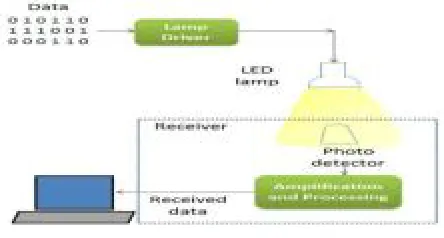
[image:3.612.37.259.348.467.2]This technology based on the Visible Light Communication (VLC) which uses the visible light for data communication. Therefore, LED is the significant component of the Li-Fi technology. Li-Fi is designed using light-emitting diodes (LED) at downlink transmitter. Li-Fi principle is very simple. LED light set along with a microchip used to identify the changes in the light flickering, and help in converting light into data in its digital form. If the LED is turn on, it sent digital pulse 1. If the LED is turnoff, a digital pulse 0 is transmitted. The LED can be switched on and off very quickly which provides an opportunities for transmitting data through light. The multiple LED in the lamp, the more data to deal with it. There are certain opportunities to make improvements to alter the light’s frequency using mixture of red, green and blue LEDs and for parallel data transmission, array of LEDs can be used. The figure 01 illustrate the working process of Li-Fi.
Figure 01: Li-Fi working Process
(Source: technichedu.in/journals/index.php/ijaecs/article)
B. Problem and the solutions
Now a day, Wi-Fi is the most commonly used technology in each and every field such as Hospitals, Security Services, Undersea Communication, Navigation, Petrochemical Industries and power plant and etc. For instance in Health technologies such as medical field operating rooms did not allow Wi-Fi over concern of radiation which used 2.4 GHz frequency Band, and if Wi-Fi implemented in hospitals, interference from phones and computers can block signals from nursing equipment. In power plant Wi-Fi and many other radiation or radio waves are bad for sensitive areas especially the atomic power plants and the range that Wi-Fi works between 20 to 100 meters. There is a serious necessity for a new technology hence the Wi-Fi has some major backdrops. In order to deal with these problems, several solutions have been proposed, Light Fidelity is a best solution in 21st
century. Li-Fi can be active well and used securely in airliners and healthcare field that are disposed to snooping from radio waves. This can be used in underwater where Wi-Fi fail to do, therefore throwing open limitless opportunities for military operations. Li-Fi technology cannot hack which lead to high security. LED can be used in vehicles head lights and back lights and traffic signals are also moving to LED. This can be developed an intelligent transport system and traffic management where vehicle-to-vehicle and vehicle-to-roadside communications. Li-Fi can be applied to highly accurate location-based information services such as advertising and navigation that permits the user to receive appropriate information in a timely manner and location. Li-Fi is an outline for all of these providing new competences to current and future services.
IV. CONCLUSION
Li-Fi is still in its developing stages and thus offers remarkable scope for future research and revolution. It has massive potential. A large number of research projects have focused on this new technology to support the higher data transmission. This paper presents a summarized overview of the recent research works being conducted in this technology. Li-Fi provides promising features to improve the data communication. As the amount of available bandwidth is limited, the airwaves are becoming gradually blocked, difficult to used wire-less technology with accurate. The LI-FI technology can give solution to this problem. Also it will shape the better future for next generation and can offer candid and very effective alterations to radio waves communications. This technology will be going to change the scenario of wireless communication in many harmless ways near in future.
V. FUTURE WORK
transceiver integrated on a single chip that functioned at 60 GHz on the CMOS process. It will allow wireless transfer of audio and video data at up to less than 10 gigabits per second, ten times the current maximize the wireless transfer rate, at one-tenth the cost. Some reports called as GI-FI [11].
ACKNOWLEDGMENT
The authors are very much grateful to Sri Lanka Institute of Information Technology for doing research work in Computer Networking as well as all the authors whom we have referred in this research paper. Authors are also grateful to Dhishan Dhammearatchi for his constant support and encouragement for conducting research work in Computer Networks Design and Implementation.
.
REFERENCES
[1] P.Tupe (2015), “Voice Activated Li-Fi Operated Surveillance System”, International Journal of Emerging
Trends in Engineering and Development, vol.6, no.5, [online], Available: www.rspublication.com/ijeted/ijeted_index.html
[2] M.D.Reddy and S.Sonali (2015),"Li-Fi Based Patient Monitoring System", International Journal of Scientific and Technology Research, vol. 04, no. 37, pp. 7972-7975,[online], Available: www.ijsetr.com
[3]A.Sewaiwar and Y.H. Chung (2014), “Color Clustered Bi-Directional Full Duplex Li-Fi using QAM-DCO-OFDMA”, Research Gate, vol.14, [online], Available: http://www.ftrai.org/ucawsn2014
[4] B.D.Christian et.all (2014), “Online Web Server Management System Using Li-Fi Technology”, International Journal of Scientific & Engineering Research, vol.4, no.10, [online], Available: http://www.ijser.org
[5]Lopez R.D. and Bosch A.G. , “Design and implementation of a Li-Fi system” , July-2015
[6] S.Waje (2014), “Information Transmission System for Indoor Positioning and Navigation based on Novel Light Sensor”, International Journal of Application or Innovation in Engineering & Management, Vol.3, no. 5,
[7]K.S.Kapre (2015), “Road Traffic Management and Safety Using Li Fi Technology”, International Journal of Advanced Research in Science Engineering & Technology, vol.2, no. 12.
[8] A.Patni et.all (2015), “Highway Navigation using Light Fidelity Technology”.
[9]Q. Huang et.all (2014) “Li-Fi Wireless Communication and Energy Harvesting Wireless Sensor for Next Generation
Building Management” [online], Available: http://www.docs.lib.purdue.edu/ihpbc/120/ International High Performance Building Conference.
[10]M.D. Renzo et.all (2013),” Spatial Modulation for MIMO Wireless Systems” [online], Available:
https://www.eng.ed.ac.uk/postgraduate/research/projects/lifi-li-fi-spatial-modulation.
[11] S.Chatterjee et.all (2015), “Scope and Challenges in Light Fidelity Technology in Wireless Data Communication”, International Journal of Innovative Research in Advanced Engineering, vol.2, no.2, [online], Available: http://
www.ijirae.com
First Author – K.Shayether, Undergraduate BSc IT Sliit computing,[email protected].
Second Author – S.A.Asmina, Undergraduate BSc IT Sliit computing,[email protected].
Third Author - M.J.E.Fernando, Undergraduate BSc IT Sliit computing,
Fourth Author – K.J.Sheshadari, Undergraduate BSc IT Sliit computing,[email protected]
Fiftht Author – H.A.T.Rangari Undergraduate BSc IT Sliit computing.
Sixth Author – Dhishan Dhammearatchi ,Lecturer Sliit computing