www.ijsrp.org
Face Recognition Using Neural Networks
M.Nandini
#1, P.Bhargavi
#2, G.Raja Sekhar
#3Department of EConE, Sree Vidyanikethan Engineering College Tirupathi
1
2
3
Abstract— Face recognition from the images is challenging due to the wide variability of face appearances and the complexity of the image background. This paper proposes a novel approach for recognizing the human faces. The recognition is done by comparing the characteristics of the new face to that of known individuals. It has Face localization part, where mouth end point and eyeballs will be obtained. In feature Extraction, Distance between eyeballs and mouth end point will be calculated. The recognition is performed by Neural Network (NN) using Back Propagation Networks (BPN) and Radial Basis Function (RBF) networks. The recognition performance of the proposed method is tabulated based on the experiments performed on a number of images.
Index Terms— Face Detection, Face Localization, Feature Extraction, Neural Networks, Back propagation Network, Radial Basis
I. INTRODUCTION
ace recognition is an interesting and successful application of Pattern recognition and Image analysis. Facial images are essential for intelligent vision-based human computer interaction. Face processing is based on the fact that the information about a user’s identity can be extracted from the images and the computers can act accordingly. Face detection has many applications, ranging from entertainment, Information security, and Biometrics [1]. Numerous techniques have been proposed to detect faces in a single image.
To build fully automated systems, robust and efficient face detection algorithms are required. The face is detected once a person’s face comes into a view [2]. Once a face is detected, the face region is cropped from the image to be used as “Probe” into the knowledge to check for possible matches. The face image is pre- processed for factors such as image size and illumination and to detect particular features [3]. The data from the image is then matched against the knowledge [4]. The matching algorithm will produce a similarity measure for the match of the probe face into the knowledge.
This paper proposes a new face recognition method where local features are given as the input to the neural network. First, the face region is extracted from the image by applying various pre-processing activities. The method of locating the face region is known as face localization. The local features such as eyes and mouth
are extracted from the face region. The distance between the eye balls and the distance between the mouth end points are calculated using the distance calculation algorithm. Then the distance values between the left eye and the left mouth end point, the right eye and the right mouth end point, the left eye and the right mouth end point, the right eye and the left mouth end point are calculated. These values are given as the inputs to the neural network. Back propagation algorithm is used for training the values. Then the network is simulated using the features taken from the test set of images. The simulated result is given as the input to the Radial Basis Network for the function approximation. The output from the Radial Basis Network is considered as the recognition result.
II.
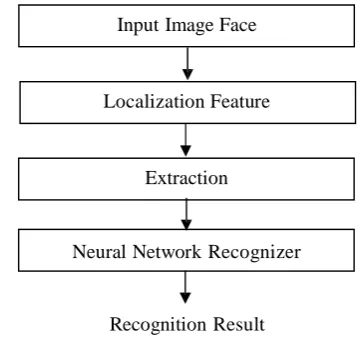
FACE RECOGNITION SYSTEM The proposed system consists of a face localizer, a feature extractor and a neural network classifier. The block diagram is shown in Figure 1.Input Image Face
Localization Feature
Extraction
Neural Network Recognizer
[image:1.595.326.507.454.630.2]Recognition Result
Fig 1: Block Diagram of Face Recognition System
Input image is acquired by taking photographs using the digital camera. These images are taken in color mode and saved in JPG format. However, the proposed method is suitable for working with any file format.
A. Face Localization Face localization aims to determine the image
position of a single face. This is a simplified detection problem with the assumption than an input image consists only one face [5]. Various pre-processing activities are done in this phase to make the raw data into usable format. The procedure below explains the proposed face localization technique.
www.ijsrp.org
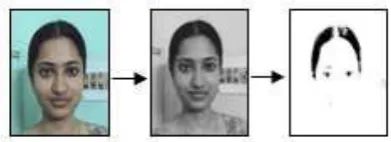
1) Image Conversion: The input image is first
converted into the scale image. The gray-scale image i s then converted into its binary form. The execution sequence of this step is shown in Figure 2.
2) Dilation: The dilation process removes the noise encountered in the binary image. Hence, the dilation operation is performed on the binary image obtained. The gray-scale image is then converted into its binary form. Then, the dilated image is mapped on to the gray scale image using intensity calculation formula below.
Let Im denotes the intensity of mapped image Id denotes the intensity of the dilated image and Ig denotes the intensity of the gray scale image.
Ig ( i, j ) if Id ( i , j ) = 1
Im ( i, j ) = 0 otherwise
The execution sequence of this step is shown in Figure 3.
[image:2.595.326.532.75.149.2]3) Image Cropping: The mapped image is converted into binary image and the required face region is cropped from the binary image. The execution sequence of image cropping is shown in Figure 4.
Figure 2: Image Conversion in Face localization phase
[image:2.595.69.265.448.519.2]
Figure 3: Image Cropping in Face localization phase
Figure 2: Dilation in Face localization phase
B. Feature Extraction
The Feature Extraction is carried out by taking the features such as eyes, mouth, nose, ears etc. Generally, there are two methods of representation about facial features: One is the local facial features such as eyes, nose and mouth are located; the other is about the whole facial features as expressing with a rectangle area containing eyes, nose and mouth. In this paper, the two features, eyes and mouth are taken into consideration. The proposed feature extraction algorithm is explained below.
1. Divide the localized face column wise into two equal parts.
2. For each row ‘r’ do steps 3 and 4.
3. The first black pixels encountered on either side are taken as (x1, y1) and (x2, y2) respectively.
4. Calculate the distance between those points using the formula:
Distance = Sqrt ( ( x2 – x1 )2 )+ ( ( y2 – y1 )2 )
5. From step 4, two sets of non-zero distance vales corresponding to eyes and mouth are obtained.
6. Find the maximum of the distances for each non-zero set. They represent the distance between the eyeballs and the distance between the mouth end points.
7. Using the pixels corresponding to that maximum distance, calculate the following:
i. Distance from the left eyeball to the right eyeball.
ii. Distance from the left mouth end point to the right mouth end point.
iii. Distance from the left eyeball to the left mouth end point.
[image:2.595.84.264.558.622.2]www.ijsrp.org v. Distance from the left eyeball to the right mouth end point.
vi. Distance from the right eyeball to the left mouth end point.
8. The six values calculated above are given as the inputs to the neural network recognizer.
C. Neural Network as a Recogniser
After extracting the features from the given face image, a recognizer is needed to recognize the face image from the stored database. Neural network can be applied for such problems [7, 8, 9]. This paper proposes a recognition method, which uses two networks: Back Propagation Network (BPN) and Radial Basis Function Network (RBF) [10]. Back propagation can train multilayer feed-forward networks with differentiable transfer functions to perform function approximation, pattern association, and pattern classification. The BPN is designed with one input layer, one hidden layer and one output layer. The input layer consists of six neurons the the inputs to this network are feature vectors derived from the feature extraction method in the previous section. The network is trained using the
samples.
The Back propagation training takes place in three stages:
1. Feed forward of input training pattern
2. Back propagation of the associated error and
3. Weight adjustment.
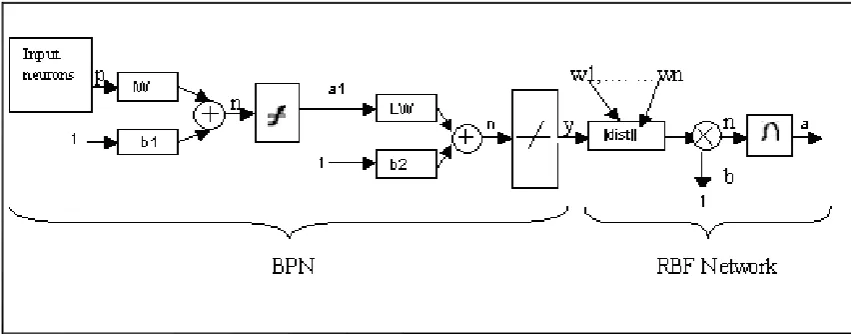
[image:3.595.87.513.414.581.2]During feed forward, each input neuron (p1) receives an input value and broadcasts it to each hidden neuron, which in turn computes the activation and passes it on to each output unit, which again computes the activation to obtain the net output. During training, the net output is compared with the target value and the appropriate error is calculated. From this, the error factor is obtained which is used to distribute the error back to the hidden layer. The weights are updated accordingly. In a similar manner, the error factor is calculated for units. After the error factors are obtained, the weights are updated simultaneously. The output layer contains one neuron. The result obtained from the output layer is given as the input to the RBF.
Figure 5: Combined Framework of BPN and RBF
RBF uses the gaussian function for approximation. For approximating the output of BPN, it is connected with RBF. The Radial Basis Function neural network [11, 12] is found to be very attractive for the engineering problems They have a very compact topology
• They are universal approximators
• Their learning speed is very fast because of their locally tuned neurons [6].
The RBF neural network has a feed forward architecture with an input layer, a hidden layer and an output layer.
www.ijsrp.org recognizer in face recognition system and the inputs to this
network are the results obtained from the BPN. Following are the explanations of the notations used in Figure 5.
p – Set of input neurons
b – bias
b1, b2 – bias
IW – Weight between Input and hidden layers
LW – Weight between hidden and Output
layers
Y – Output of BPN
Wi – Weight vector to RBF
III. RESULTS
The effectiveness of the proposed face localization method and the distance calculation algorithm are demonstrated using MATLAB. The face database consists of 90 images. Out of 90 images, 64 images are taken for training the networks. The number of epochs versus the squared error graph is shown in Figure 6.
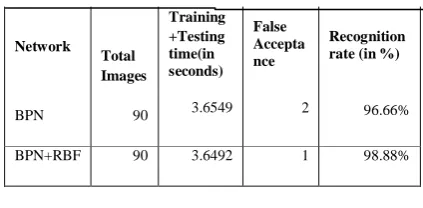
Then the neural networks are tested with the remaining images. The BPN network accepts 2 unknown faces and it recognizes all the known faces. The combined model of BPN+RBF recognizes all known faces and accepts 1 unknown face (false acceptance). The time consumption and the recognition rate are tabulated in Table I
.
[image:4.595.349.561.104.208.2]Figure 6: Error rate versus number of Epochs TABLE I
COMPARISON OF BPN+RBF FRAMEWORK OVER BPN
IV. CONCLUSIONS
In this paper, a new face localization technique is proposed and a new feature extraction algorithm is developed for human face recognition. The neural network model is used for recognizing the frontal or nearly frontal faces and the results are tabulated. A new neural network model combined with BPN and RBF
networks is developed and the network is trained and tested. From these results, it can be concluded that, recognition accuracy achieved by this method is very high. This method can be suitably extended for moving images and the images with varying background.
REFERENCES
[1] W.Zhao, R.Chellapa, P.J.Phillips, and A.Rosenfeld, “Face Recognition: A Literature Survey,” Technical Report CART-TR-948. University of Maryland, Aug.2002
[2] Sanjay Kr.Singh, D.S. Chauhn, Maynk Vatsa, and Richa Singh, “Robust Skin Color Based Face Detection Algorithm “, Tamkang Journal of Science and Engineering, Vol.6, No.4, pp.227-234, 2003. [3] K. Sobotta and I. Pitas, Face Localization and Facial Feature
Extraction Based On Shape and Color Information, IEEE Int. Conf. on Image Processing, 3, 483-486, Switzerland, 16-19 September 1996.
[4] Raphaël Féraud, Oliver J.Bernier, Jean-Emmanuel Viallet, and Michel Collobert, “A Fast and Accurate Face Detector Based on Neural Networks”, IEEE Trans. On Pattern Analysis and Machine Intelligence, Vol.23, No.1, pp.42-53, January 2001
[5] Ming-Hsuan Yang, D. Kriegman, and N.Ahuja, “Detecting Faces in Images: A Survey ”, IEEE Trans On Pattern Analysis and Machine Intelligence,Vol.24, No.1, pp. 34-58, January 2002
[6] Lin-Lin Hunag, Akinobu Shimizu, Yoshihoro Hagihara, and Hidefumi Kobatake, ”Gradient feature extraction fro classification-based face detection”, A journal of pattern recognition
society, Pattern Recognition 36,pp.2501-2511, 2003
[7] H. A. Rowley, S. Baluja and T. Kanade, “Neural Network based Face detection”, IEEE Trans. On Pattern Recognition and Machine Intelligence, 20(1),23-28, 1998.
[8] S. Lawrence, C. L. Giles, A. C. Tsoi and A. D. Back, “Face Recognition: A Convolutional Neural Networks Approach”, IEEE Trans. on Neural Networks, Special Issue on Neural Networks and Pattern Recognition, 8(1), 98-113, 1997.
[9] J. Haddadnia, K. Faez, Neural network human face recognition based on moment invariants, Proceeding of IEEE International Conference on Image Processing, Thessaloniki, Greece, 1018-1021, 7-10 October 2001.
[10] Haddadnia, K. Faez, "Human Face Recognition Using Radial Basis Function Neural Network", Third Int. Conf. On Human and Computer, pp. 137-142, Aizu, Japan, Sep. 6-9, 2000.
[11] J. Haddadnia, M. Ahmadi, K. Faez,” A Hybrid Learning RBF Neura Network for Human Face Recognition with Pseudo Zernike Moment
Network
BPN
Total Images
90
Training +Testing time(in seconds)
3.6549
False Accepta nce
2
Recognition rate (in %)
96.66%
www.ijsrp.org Invariant”, IEEE International Joint conference on Neural Network,
Honolulu, HI, May 12-17, 2002.