Citation:
Baker, T and Asim, M and Tawfik, H and Aldawsari, B and Buyya, R (2017) An
energy-aware service composition algorithm for multiple cloud-based IoT applications.
JOURNAL
OF NETWORK AND COMPUTER APPLICATIONS, 89.
pp.
96-108.
ISSN 1084-8045 DOI:
https://doi.org/10.1016/j.jnca.2017.03.008
Link to Leeds Beckett Repository record:
http://eprints.leedsbeckett.ac.uk/4149/
Document Version:
Article
The aim of the Leeds Beckett Repository is to provide open access to our research, as required by
funder policies and permitted by publishers and copyright law.
The Leeds Beckett repository holds a wide range of publications, each of which has been
checked for copyright and the relevant embargo period has been applied by the Research Services
team.
We operate on a standard take-down policy.
If you are the author or publisher of an output
and you would like it removed from the repository, please
contact us
and we will investigate on a
case-by-case basis.
An Energy-aware Service Composition Algorithm for Multiple
Cloud-based IoT Applications
T. Baker1, M. Asim2, H. Tawfik3, B. Aldawsari1, and R. Buyya4 1Department of Computer Science, Liverpool John Moores University, UK
2Department of Computer Science, National University of Computer and Emerging Sciences, Pakistan 3School of Computing, Creative Technologies and Engineering, Leeds Beckett University, UK 4Department of Computing and Information Systems, The University of Melbourne, Australia
{t.baker,b.aldawsari}@ljmu.ac.uk;[email protected]; [email protected];[email protected]
Abstract
This paper develops a novel multi-cloud IoT service composition algorithm called (E2C2) that aims at creating an energy-aware composition plan by searching for and integrating the least possible number of IoT services, in order to fulfil user requirements. A formal user requirements translation and transformation modelling and analysis is adopted for the proposed algorithm. The algorithm was evaluated against four established service composition algorithms in multiple cloud environments (All clouds, Base cloud, Smart cloud, and COM2), with the results demonstrating the superior performance of our approach.
Keywords: IoT; Multi-cloud; Service composition; Energy efficiency
1. Introduction
The Internet of Things (IoT) paradigm has rapidly evolved in the last few years and envisions the internet as a set of intelligent, self-configuring and interconnected objects in a dynamic and global infrastructure. Objects refer to uniquely addressable smart devices that are generally distributed endowed with sensing and actuation capabilities and equipped with limited computing resources such as CPU, memory, and network capabilities. IoT can be defined as the integration of several technologies and communication solutions such as Radio Frequency Identification (RFID) technology, sensors and actuators. The basic idea behind it is the pervasive presence of smart objects around people, able to understand, monitor, and even control the environment. IoT has the potential to play a key role in both home and work scenarios, such as assisted living, smart home and office, e-health, and smart transportation [1–5]. For instance, in healthcare applications, small wearable devices are deployed to capture patients health data such as blood pressure and heart rate. The collected data are then sent to doctors for healthcare advice and could also be made available remotely to medical experts for research. Smart Cities is another revolutionary development of IoT applications that aims to establish an efficient communication and collaboration platform exploiting various information sources to make the cities smarter [6–8]. Despite the recent advances towards making IoT a reality, there exist several open issues that require further research and development efforts in order to exploit its full potential [9–14]. One of these challenges refer to the huge amount of energy consumed at streaming information produced by a large number of resource constrained interconnected devices, which have to be stored, processed, and presented in an efficient, and easily interpretable form.
service provider interaction. Cloud computing has taken computing from desktop to the world of internet, offering virtually unlimited capabilities in terms of storage, and processing power. During the last decade, the use of cloud computing to run businesses has increased noticeably due to the cloud on-demand utility pricing model. This unprecedented proliferation of the cloud service industry is justified by the simple and promising cloud computing services provision model: providers offer services to end users on services pool, end-users search for and subscribe to use the services they need, and a high-speed network connection is established between users and providers to formulate the model. In general, IoT can take advantage of the virtually unlimited capabilities and resources of the cloud paradigm to compensate for its technological con-straints (i.e., storage, processing and communication) [5, 6]. A report published by the International Data Corporation (IDC) predicts that the installed service provider datacenter capacity consumed by IoT work-loads will increase nearly by 750% between 2014 and 2019 [16] and more than 90% of the data generated by IoT devices will be hosted on the cloud. The report also suggests that IoT will become the top driver of IT expansion in larger datacenters, speeding the transition to cloud-oriented infrastructure and data platform architectures.
the end results to the user.
Generally, users focus on the speed of the service, response time and service cost with little or no consid-eration for the service location and number of composite services needed to meet the requirements or energy efficiency. The rapidly growing levels of energy consumption and carbon emission associated with using the cloud computing has become a key environmental concern. The increasing density in IoT applications users, providers, and datacenters will automatically lead to significant increases in network traffic and the associated energy consumed by the huge infrastructure (e.g., extra servers, switches) required to respond quickly and effectively to users requests. This power consumption issue is particularly significant when transferring data into a datacenter located somewhere in the world relatively far from the user geographical location; for example where the user is based in the UK and the datacenter is in Hong Kong. In addition, given the large number of service providers offering things and the huge amount of data generated, a higher bandwidth and network speed is required to cope with the cloud network traffic across the globe and to speed up data transformation process [18]. This results in an significant energy usage. Thus, a key challenge is to integrate fewer services from cross-continental and scattered providers in order to fulfil user demands, which means less data exchange and in return reduces the carbon footprint in the multi-cloud IoT environ-ment. The movement of mass data between services influences the whole application process in terms of energy consumption. This paper presents and evaluates a novel Energy-aware multi-Cloud IoT service com-position algorithm that generates energy efficient composition plans by integrating the least possible number of services from service providers that are scattered globally. Thus, this work aims at addressing a key and emerging IoT issue that is of adopting energy efficient approaches for cloud-based services and applications. The rest of the paper is organised as follows: the next section defines the problem to be tackled. In section 3 we provide the main aim and objectives. The related works have been summarised in section 4. A detailed discussion of the proposed model and how it works is presented in section 5. The evaluation of the proposed model is detailed in section 6. Finally, the paper concludes the results and proposes future work in section 7.
2. Problem definition
user needs, broker aims, and the environmental target presents the main challenging task for the multi-cloud IoT brokers for the following two reasons:
1. how can the broker compose multiple services to serve the request, when there is no one service that can match the request.
2. how can the broker compose the least possible number of services from a minimum number of providers to ensure that the energy efficiency target is met.
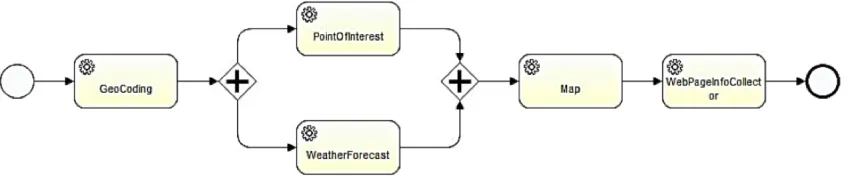
To further illustrate the above issues, consider the example of having the following five separate web services with the WSDL code along with a potential composition shown in Fig. 1 and Fig. 2 respectively:
• Given the street address/name as input,geoCodingtype service, returns the associated geographical coordinates. This service denoted to in this paper as servicea.
• Given the geographical coordinates,pointOfInteresttype service returns the places that end users might be interested in. This service denoted to in this paper as serviceb.
• Given the geographical coordinates,weatherForecastreturns the information about the weather observations at the station closest to the end user. This service denoted to in this paper as servicec.
• Given the geographical coordinates,maptype service returns a map showing the position of the end user. This service denoted to in this paper as serviced.
• awebPageInfoCollectortype service takes a set of information related to a location as input and returns a web page that shows it. This service denoted to in this paper as servicee.
Next, consider the following requests received by the broker:
• Request 1: find the Geographical Coordinates of Byrom Street in Liverpool.
• Request 2: find the weather forecast near Big Ben in central London and show the directions from the current location to Big Ben on the map
Figure 1: Five separate web services
[image:7.612.100.525.486.579.2]will be created. Each service in the IS composition is bound to a real remote Web Service running in the background and registered with a Marketplace. After providing the street address of the user as input the composite service returns a Web page with some information related to the users location. Hence, the second request can be achieved in one of the following two ways:
(i) invoking the pointOfInterestservice, pass the geoCoordinates and the pointOfInterest as an input, to get Big Ben and directions to it; then invoke theweatherForecastto get the temperature and the other weather elements.
(ii) Compose theweatherForecastandmapweb services to fulfil the same request.
2.1. Problem statement
The aforementioned example illustrates the composition problem in a simple way so-called “web ser-vices composition”. However, as the number of service providers and serser-vices increases, the composition of many services from different providers becomes more complicated in a real multi-cloud environment, and requires a massive amount of data interchange among all service participants, which consequently leads to high levels of energy consumption.
As stated above, typically the cloud user submits a job, in the form of a set of a functional and non-functional requirements, to a cloud service provider (datacenter) via a web interface of a cloud services broker. The broker, in turn, is responsible for finding the best-fit service to the user request based on the requirements submitted to satisfy the user Service Level Agreement (SLA). There have already been vast amount of research works in the area of cloud service discovery and composition, along with the resulting techniques and tools that are powerful enough for cloud service consumers to rely on to discover and use the services such as [20–23]. However, these research efforts are limited in the following ways:
(i) they assume that the requested services for composition are all contained within a single cloud; (ii) they do not compare the energy required to compute and execute the similar services that can fulfil the
user request, to choose the most energy efficient one.
(iii) they do not consider the number of services involved in the composition, which has a direct impact on the energy consumption.
consuming. Hence, what continues to be a challenging and an under-investigated issue is finding a compo-sition plan with the least possible number of composite services that fulfils the user request from minimum number of cloud service providers. This implies arriving at the most energy efficient service composition plan, which becomes more complicated as the number of the cloud service providers increase.
3. Aim of the proposed algorithm
Generally, there are three main pillars for energy consumption in multi-cloud computing environment that should be dealt with equally to achieve the full green cloud computing model:
(i) the amount of energy consumed by the datacenter equipments (e.g., computer air conditioning unit (CRAC)),
(ii) the amount of energy consumed on transporting the data between the user and the cloud datacenter. (iii) the overall amount of energy required by the appropriate composite services.
The current state-of-the-art solutions focus primarily on points (i and ii) above, as is detailed in the section 4, whereas the primary aim of this paper is to propose and evaluate a high-end energy efficient service composition algorithm to address the overall amount of energy required by the appropriate composite services.
The new algorithm acts as an intermediary bridge between the user and the subscribed datacenters. It creates an energy efficient composition plan that contains the least possible number of services, from minimum possible number of cloud services’ providers in a multi-cloud environment; while making sure the user’s needs are met. To accomplish this aim, we first formalise the user-broker model to illustrate how a user submits a service request to the broker, and what the user request is composed of. This will then be followed by formalising the datacenter-broker communication model, which shows the kind of data that each datacenter is required to send to the broker to facilitate how the broker/algorithm finds the best-fit energy efficient composition at a later step. A formalised optimal service composition plan algorithm is presented thereafter, along with its experimentation and evaluation.
4. Related Work
Things in terms of the convergence of cloud and IoT was established in [30], which proposed a set of methods to access smart devices through existing web based technologies such as web services and RESTful interfaces. It offered a solution to manage and use IoT resources in a service-oriented paradigm. The authors in [31] proposed a sensor-cloud infrastructure to virtualize and manage physical sensors on the cloud. The work in [32, 33] focused mainly on integrating IoT devices with enterprise applications, by taking advantage of the cloud and service-oriented paradigm. Nastic et al. [29] presented an approach that encapsulates fine-grained IoT resources and IoT capabilities in software-defined APIs in order to create IoT cloud system. In [34] authors addressed the problem of integrating sensor-based services with traditional IT systems by adopting the concepts of service orchestration and choreography. The orchestration process facilitates the integration of results obtained from several sensors or smart devices while the choreography is used to invoke several other services in order to extend the cooperation between virtual and physical worlds. TinySOA [35] is a service-oriented architecture that can be used for the development of Wireless Sensor Networks (WSN) applications and its integration with the Internet application in order to collect information from the remote sensors using APIs. In addition, it has mechanisms for WSN infrastructure registry and node discovery. Li et al. [26] proposed a framework that provides essential platform services for IoT solution providers to deliver and continuously extend their services. It enables IoT solution providers to efficiently deliver new resources by leveraging computing resources and platform services.
Automating service composition aims to overcome the problem where no single service can satisfy the functionality required by the user; it allows multiple services to be combined in to a large application in order to fulfil the request. A number of different approaches have been proposed such as, Matchmaking-based [36], Logic-based [37], Graph-Theory-based [38], Petri net-based [39], and AI-Planning based [40]. There are several other open source tools for service composition and execution, for example SWORD [41], ZenFlow [42], and Flow Editor [43]. SWORD offers a set of tools for building composite web services using rule-based plan generation. In SWORD, a service is modelled by a rule that expresses that for a given inputs, the service is capable of producing particular outputs. ZenFlow is a visual composition builder for web services written in BPEL4WS. It provides a number of visual tools to ease the definition of a business process such as multiple views of process, filtering, logical zooming capabilities and hierarchical representations. FlowEditor is a visual semantic web service composition tool based on OWL-S specification. It helps users solve business problems by creating and exporting new on-demand services. FlowEditor offers several advantages, such as visual service composition by drag-and-drop and visual control construct supports.
cloud-IoT resources, only a few approaches have addressed the optimization of the resulting compositions. Optimization of service composition aims at selecting appropriate services and service components to op-timize the overall quality of the composition according to a set of predefined metrics, such as cost, perfor-mance, trust, energy efficiency and security [25, 44–48]. Energy efficiency has been receiving relatively less attention when it comes to the optimization of service composition. Several approaches exist in the literature, which focuses on the IoT devices energy conserving issues at the hardware level [49–52]. For example, sensor nodes can switch their radios offto save power when not in use and can wake up only when they are required to operate. These techniques are not useful when the IoT devices are exposed as software components and are deployed in the cloud environment for its users to access them. The work presented in [53] discusses the challenges and problems of measuring the power consumption of an individual web service. Park et al. [54] presented a SOA-based middleware to support quality-of-service control of mobile applications and to configure an energy-efficient service composition graph. Luo at el. [55] proposed a technique to select a composite service by using the path with the best QoS and lowest cost. The technique is based on the Dijkstras search path, which assumes that QoS attributes such as duration and throughput are additive. Elshaaf et al. [46] presented an approach to collaboratively infer the trustworthiness of shared component services of a service composition in distributed services environment. The service composition trustworthiness is based on consumers feedback on the reliability and their satisfaction with the services.
The construction of the optimal QoS aware service composition using the optimal set of service com-ponents often leads to inefficient compositions with redundant services or functionalities. The number of services involved in a composition has a direct impact on a number of QoA measures. For example, the work in [56, 57] suggest that by minimizing the number of services in a composition will help minimizing the total response time and maximize the throughput. Wang et al. [58] proposed a greedy algorithm to minimize the number of required service composition during a persistent querys life time such that the involved routing update cost and transmission cost is minimized. In [59, 60] the authors extended greedy algorithm by search-ing for and integratsearch-ing the most energy efficient service composition route to the datacenter. According to [57], the main drawback of existing service composition approaches is their low performance such as, when the requirement of minimizing the number of services is not a priority, that is, when the selected number of services and the input/output interaction among them is high. There exist a number of approaches in the Literature [61–64], which addressed the optimization of the resulting compositions according to a set of QoS parameters. However, these approaches do not find optimal compositions in terms of number of services.
research on energy efficient composition of IoT resources is an emerging IoT area that is still relatively under-explored. To the best of our knowledge, there exists no previous work, which focuses on the opti-mization of the resulting composition by taking into account the energy efficiency as the primary metric for IoT resources. Given the large number of cloud IoT resources available, we achieve energy efficiency by integrating least possible services to satisfy the user requirements.
5. Formal Model Design
[image:12.612.187.425.343.569.2]In order to formulate the problem and the proposed solution in this paper, we need to identify the main parties of the multi-cloud environment as: users, a broker, and services providers. The next subsections formalise the interrelationship among those parties, and show how the new Energy Efficient multiple Cloud Computing service composition algorithm works (named E2C2) to identify and select the most energy effi -cient service composition plan.
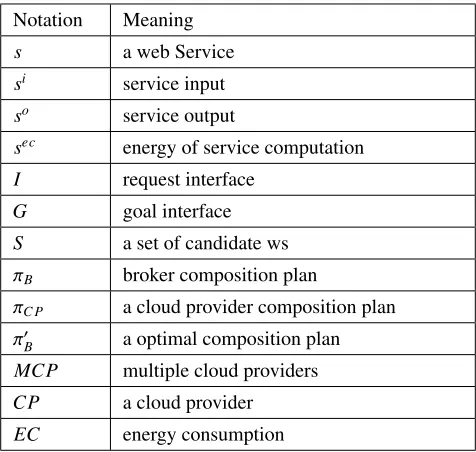
Table 1: Summary of notations used
Notation Meaning
s a web Service
si service input
so service output
sec energy of service computation
I request interface
G goal interface
S a set of candidate ws
πB broker composition plan
πC P a cloud provider composition plan
π′
B a optimal composition plan
MCP multiple cloud providers
CP a cloud provider
EC energy consumption
5.1. Formal user-broker model
in Figure 1: si ={I
1,I2, ...}as input gained from the service request, andso ={O1,O2, ...}as output for the service response; as such, the user should submit a service request in a 2-tuple format⟨I,G⟩where,Iis the initial interface indicating the request such thatI⊇si; andGis a goal interface, which indicates the ultimate
response the user wants to get, such thatG ⊆ so. This makes it simple to find a single web service that
match the user needs, if and only ifI =siandG=so. However, in a complex user request where there is
not a single web service that satisfies the request, a composition plan must be in place. Therefore, we will focus in this paper on building up a composition plan for multiple web services in a multi-cloud providers environment. Upon receiving the user request, the service composition will be defined by the broker using four-tuple model⟨I,G,S, πB⟩, whereIandGalready defined by the user as mentioned above,S is a set of
candidate web services that will be identified by the broker to match the outcome based onG; andπBis a
composition plan that is a sequence of ordered web services such thatπB ⊆S. By applying each service in
πB, the resulting interface is a superset of G.
5.2. Formal datacenter-broker model
In a multi-cloud environment, the requested services may come from different commercial cloud providers so they can be integrated and used together via mutual communication protocols to satisfy a complex ser-vice request. The Multiple Cloud serser-vice Providers (MCP) is a set of cloud providers, such that MCP =
{CPi.m,CPi+1.m, ...,CPn.m}. It can be seen that eachCPin MCP is identified by 2 numbersiandmsuch that
(1 ≤ i ≤ n) represents a CP unique identification number; andmis the number of pre-defined/developed composition plan provided by each specific CP. For illustration purposes, theCP3.6denotes to the Cloud Provider 3 that provides 6 composition plans, in addition to the atomic services. Moreover,πj(CPn.m)
de-notes to the pre-defined composition plan (j) by (CPn.m).
Since the energy required for service computation is a significant factor in our proposed algorithm, it is deemed essential that services’ providers provide the broker with the energy consumption variable of each service to enable the broker to decide the most energy efficient one. As such, a servicesis described by its provider in a 3-tuple format⟨si,so,sec⟩, wheresecis the energy required for the service computation at the
hosting datacenter. In order to ensure that our aims (section 3) are met, the proposed algorithm makes the following assumptions:
1. The broker will create a composition plan, denoted to as (πB) that includes services from either the
2. Each service provider will essentially send the number of its pre-defined composition plans (m), the actual composition plansπ(CP), and a list of atomic services in the form of⟨si,so,sec⟩.
3. The proposed algorithm lists the cloud providers in a descending order based on (m). Such that, the cloud provider that has the largest number of composition plans will be listed first. This procedure will help in creating a final composition plan containing the minimum possible number of services and service providers.
4. The broker starts examining the pre-defined composition plans of all providers first to try and find a one that matches the user request, as shown in (Algorithm 1).
[image:14.612.158.458.284.604.2]5. If none is found to be matching the user request, then individual services, which might be a subset of a pre-defined composition plan, will be checked then as shown in (Algorithm 2).
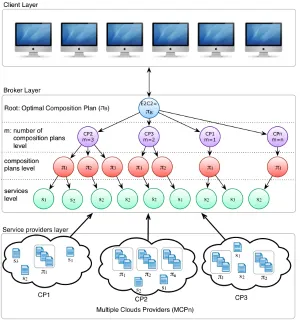
Figure 3: A conceptual representation of the proposed approach
the root of Broker Layer (πB) is the final, optimal, web service composition plan. IfπB =πj(CPn.m), thenπB
is the optimal composition plan that contains services that all come from the same provider, which should also be the most energy efficient one amongst all available composition plans. Otherwise, a composition plan will be created by the broker as per the following section.
5.2.1. Optimal service composition plan
As stated above,S is a set of candidate web services that will initially be identified and named by the broker to satisfy the user needs. Therefore,S can be seen asS = {⟨si,CPp⟩,⟨sj,CPq⟩, ...,⟨sk,CPr⟩}such
that applying the sequence of web services results in an interface R, whereG⊆R. The desired outputoof each servicesinS together will result in (so1∪so2∪...∪sok)=R⊇G. By taking into account the minimum energy efficiency condition of the proposed algorithm, the broker optimal composition will be a sequence of:⟨s′,CP′,EC(s′)⟩, such that:
π′
B=
min{⟨s′i,CP′p,EC(s′i)⟩,⟨s′j,CP′q,EC(s′j)⟩, ...,⟨s′k,CP′r,EC(s′k)⟩} ⊆S, subject to (1) below: πj(CPn.m)
minCons|∑ki=1{EC(s′i)} |s′∈π′B| (1)
[image:15.612.114.498.556.624.2]Thus, the optimal π′B composition plan must be either a pre-defined composition plan by one of the subscribed cloud providers, or a set of atomic services from the same or different cloud providers that guarantee the minimum possible number of services involved with the least energy required to compute each service selected. Back to the example in Section 2, consider a multi-cloud environment where a broker deals with four cloud providers{CP1,CP2,CP3,CP4}. Each of these providers provides a set of atomic services, which is a subset of the services{a,b,c,d,e}, and a set of pre-defied composition plansπ(CP), as shown in Table 2 below.
Table 2: Multiple-cloud providers and services
Cloud providers CP4.4 CP1.3 CP2.1 CP3.1
Atomic services a, b, c, e a, b, c c, d, e c, d
EC (kW) 0.52, 0.8, 0.721, 0.56 0.65, 0.5, 1.2 0.72, 0.32 1.2, 0.45
π(CP) {a,e},{b,c,e},{c,e},{b,e} {a,b},{a,c},{b,c} {d,e} {c,d}
four subscribed service providers. It starts first with the one that has the largest number of composition plans, which isCP4.4in Table 2 above. For instance, if the user asks for servicesb,c,e, then the providers will be checked in this order:CP4.4,CP1.3,CP2.1,CP3.1.
Hence, given thatCP4.4has the requested composition plan already defined, then this satisfies the mini-mum possible number of providers involved in the composition. The broker will continue checking the other compositions of the other cloud providers to find out if there is any other pre-defined composition plan that satisfies USR, with a lower energy consumption. The proposed E2C2 algorithm structures the multi-cloud environment, the services and the available pre-defined composition plans as a four-level tree format, as shown in Fig. 3, such that:
(i) Level 1: the Root, which is the optimal service composition plan by E2C2.
(ii) Level 2: lists thenumberof the pre-defined composition plans by each subscribed CP.
(iii) Level 3: lists the actual services composition plan(s) by each subscribed provider, along with the total energy consumed by each composition plan.
(iv) Level 4: is the atomic web services, in each composition plan (e.g., a, b, etc.)
In this case, E2C2 algorithm starts (USR=⟨I,G⟩) in line 2 of Algorithm 1. The algorithm then selects (in line 3) and checks (in line 6-24) the first CP that contains the largest number of (m) pre-defined composition plans. This kind of sorting helps to quickly identify the cloud provider with the greater number of compo-sition plans, which can possibly have a compocompo-sition plan that fulfils the received request, as demonstrated in (line 14-22). However, it should be noted that clouds are not necessarily organised in such an order in real-life scenarios. When all clouds are listed and arranged, all composition plans are then examined. If a composition plan is found, then the energy required by that plan will be stored in the (minCons) buffer. The value stored insideminConswill be used every time a matching composition plan is found, to compare the consumption of the new composition plan with the one saved in theminCons. Alternatively, if no composi-tion plan is identified from the first provider, the next provider will be checked (as shown in line 35), until an appropriate cloud provider is obtained.
input : user service requestUS R, multiple cloud providersMCP, largest number of composition planm
output : Optimal Composition Planπ′B
assumption: Cloud providers are sorted in decreasing order based on the number of composition plans
1 beginalgorithmic[1]USR←Ø, π′B←NU LL,minCons←NU LL,m←largest number of
composition plan; ▷Initialise
2 GetUSR⟨I,G⟩
3 Select(CPm) ▷CP that contains the largest number of composition plans m
4 i←m
5 if(i is True)then
6 foreach j←1to j≤istep1do 7 if(πj(CPi)∩USR)==Øthen 8 if(j=i)then
9 go to 35
10 else
11 go to 6
12 end
13 else
14 if(j=1)then
15 minCons←EC(πj(CPi))
16 else
17 if(EC(πj(CPi))<minCons)then
18 minCons←EC(πj(CPi))
19 else
20 go to 6
21 end
22 end
23 end
24 end
25 returnminCons 26 if(i=m)then 27 π′B←minCons 28 else
29 if(minCons< π′B)then 30 π′B ←minCons 31 end
32 end
33 returnπ′B ▷Optimal composition plan
34 end 35 i=i-1 36 if(i≥1)then 37 Select(CPi)
38 go to 5 ▷So that other CPs will be checked in a decreasing order 39 else
40 Invoke Algorithm 2 41 end
42
The alternative scenario our algorithm handles is where there is not a single pre-defined composition plan that can satisfy the user need, Algorithm 2 starts checking the services in the available composition plans in case that any of them can match a subset of the user’s requested services defined in USR, as shown in line 6 of Algorithm 2. In addition, it checks all atomic services from available providers and combines the ones that fulfil the user request, as demonstrated in line 16. It also counts the number of providers collaborated in the final composition (line 15), and calculates the total energy consumption of the final composition, as shown in line 14.
1 GetUSR⟨I,G⟩
2 Select(CPm) ▷that contains the largest number of composition plans m
3 i←m
4 if(i is True)then
5 foreach j←1to j≤istep1do 6 if(πj(CPi)
∩
USR)⊂USRthen
7 if(i=m)then
8 eneCons←EC(πj(CPi))
9 else
10 if(EC(πj(CPi))<eneCons)then 11 eneCons←EC(πj(CPi))
12 end
13 end
14 minCons=minCons+eneCons 15 proList=proList+CPi
16 serList=serList∪((πj(CPi)
∩
USR))
17 else
18 if(πj(CPi)∩USR)==Øthen 19 if(j=i)then
20 go to 27
21 else
22 go to 5
23 end
24 end
25 end
26 end
27 else 28 i=i-1
29 if(i≥1)then 30 Select(CPi)
31 go to 4
32 else 33 exit 34 end
35 end
The IoT service registry describes and publishes the offered functionality of the IoT resources, which are wrapped up as web services, to potential consumers. A service broker can use our proposed algorithm to create an optimal composition plan by searching and locating the most energy efficient services from the service registry. Service discovery is not only based on matching user functional requirements but also takes into account the energy efficiency. A cloud carrier [15] ensure seamless provisioning by providing connec-tivity among cloud entities. In our case, Internet is the major way to access and use cloud services. The role of a cloud auditor [15] can be incorporated in our proposed framework to conduct a design time verification of the generated energy efficient composition and assess its adaptability towards runtime changes. At this stage, the role of the cloud auditor is considered beyond the scope of this paper.
6. Evaluation
6.1. Experimental Settings
In order to evaluate the performance and efficiency of the proposed algorithm, it is important to compare the results against well established benchmark algorithms. Four different algorithms for selecting the cloud services combination were adopted for our comparative evaluation purposes: (All Clouds, Base Cloud, Smart Cloud [65], and COM2 [66]). The first algorithm, All Clouds, considers all clouds as inputs for the compo-sition and determines all possible solutions. The algorithm helps to locate a service compocompo-sition sequence with a minimal execution time, but does not to minimize the number of clouds in the final composition. The Base Cloud algorithm recursively enumerates all cloud combination possibilities in increasing order until an optimal solution is identified. It begins by analyzing all singleton sets of clouds and stop searching if the required combination can be found utilizing a single cloud, otherwise, it extends its search to cloud sets of size two, then three until the required combination is found. It generates an optimal composition solution with a small number of clouds. The Smart Cloud algorithm is designed to locate a near optimal composition plan based on an approximation algorithm. It considers a multiple cloud environment as a tree and then identifies a minimum demand set from searching the tree. The Smart Cloud locates a sub-optimal solution at a reduced cost while using a reduced cloud set. Heba kurdi et al [66] proposed a novel combinatorial opti-mization algorithm that considers multiple clouds and performs service composition with a short execution time and a minimal number of clouds, thereby reducing communication costs.
provided in the OWL-S XPlan package [67, 68], along with high-level semantic and syntactic declarative description of properties of the services [69] in terms of⟨I,G⟩to determine whether desired services are composable. The experiments were conducted on an Apple iMac (Retina 5K display, 3.2 GHz Intel Core i5, and 8 GB 1867 MHz DDR3). We have used NetBeans 8.1 as the prototype development platform and the simulation running environment, and Java EE 8 as the programming language to implement the proposed algorithm.
[image:20.612.194.416.283.373.2]The broker in our simulation deals with four cloud providers {CP1,CP2,CP3,CP4}. Each of these providers provides a set of pre-defined composition plans, which are subset of{π1, π2, π3, π4, π5}, and are based on the Multi-cloud providers (MCP) environment as shown in Table 3.
Table 3: Cloud providers composition set per multiple-cloud providers environment
MCPs CP1 CP2 CP3 CP4
MCP1 π1,π2,π3 π4,π5 π3,π4 π1,π2,π3,π5
MCP2 π1,π2 π3 π2,π5 π1,π4,π5
MCP3 π1,π3,π5 π5 π1,π2 π3,π4
MCP4 π2,π3,π5 π3,π4 π1,π2,π3 π4,π5
MCP5 π1,π2 π2,π3 π3 π1,π4,π5
In addition,{2,3,8,3,3}represents the number of web services involved in each of the aforementioned composition plan respectively, as shown in Table 4.
Table 4: Number of services per composition plans
Composition plan π1 π2 π3 π4 π5
Number of services 2 3 8 3 3
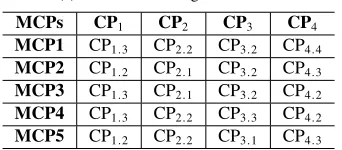
[image:20.612.213.401.448.481.2]Table 5: CPs and number of (π) composition plans per MCPs
(a) Before descending order of CPs
MCPs CP1 CP2 CP3 CP4
MCP1 CP1.3 CP2.2 CP3.2 CP4.4
MCP2 CP1.2 CP2.1 CP3.2 CP4.3
MCP3 CP1.3 CP2.1 CP3.2 CP4.2
MCP4 CP1.3 CP2.2 CP3.3 CP4.2
MCP5 CP1.2 CP2.2 CP3.1 CP4.3
(b) After descending order based on number ofπ
MCPs Sorting order of CPs
MCP1 CP4.4 CP1.3 CP2.2 CP3.2
MCP2 CP4.3 CP1.2 CP3.2 CP2.1
MCP3 CP1.3 CP3.2 CP4.2 CP2.1
MCP4 CP1.3 CP3.3 CP2.2 CP4.2
MCP5 CP4.3 CP1.2 CP2.2 CP3.1
6.2. Experimental results and analysis
The results for the four benchmark algorithms, the All Clouds in Table 6.a, the Base Cloud in Table 6.b, the Smart Cloud in Table 6.c and COM2 in Table 6.d have all confirmed previously published results in [65, 66]. We list the results of the E2C2 performance in Table 6.e such that it can be compared against the aforementioned approaches. We adopt the same cloud simulation environment and simulation parameters used by previous work. The three performance measures we considered in the conducted experiments are:
(i) The number of cloud providers that are involved in the final composition|CP|. (ii) The number of services checked before reaching into the final composition|S|.
(iii) The running time, measured in seconds, for running the algorithm until an appropriate composition is reached.
Table 6: CPs and number of (π) composition plans per MCPs
(a) All Clouds Algorithm
Performance CP involved |CP| |S|
MCP1 CP1 CP2 CP4 3 46
MCP2 CP1 CP2 CP3 CP4 4 27
MCP3 CP1 CP3 CP4 3 32
MCP4 CP1 CP2 CP3 CP4 4 44
MCP5 CP1 CP2 CP3 CP4 4 32
Total 18 181
(b) Based Cloud Algorithm
Performance CP involved |CP| |S|
MCP1 CP1 CP2 2 65
MCP2 CP1 CP2 CP4 3 148
MCP3 CP3 CP4 2 128
MCP4 CP2 CP3 2 68
MCP5 CP2 CP4 2 112
Total 11 521
(c) Smart Cloud Algorithm
Performance CP involved |CP| |S|
MCP1 CP1 CP3 2 70
MCP2 CP1 CP2 CP4 3 48
MCP3 CP3 CP4 2 48
MCP4 CP2 CP3 2 140
MCP5 CP1 CP2 CP4 3 56
Total 12 362
(d) COM2 Algorithm
Performance CP involved |CP| |S|
MCP1 CP4 CP2 2 35
MCP2 CP4 CP2 CP3 3 45
MCP3 CP1 CP4 CP3 3 50
MCP4 CP1 CP3 CP2 3 49
MCP5 CP2 CP4 2 30
Total 13 209
(e) E2C2 Algorithm
Performance CP involved |CP| |S|
MCP1 CP4 CP2 2 35
MCP2 CP4 CP1 CP2 3 26
MCP3 CP1 CP3 CP4 3 29
MCP4 CP1 CP3 CP2 3 38
MCP5 CP4 CP2 2 24
[image:22.612.137.475.462.621.2]Total 12 152
Figure 5: The average number of examined services
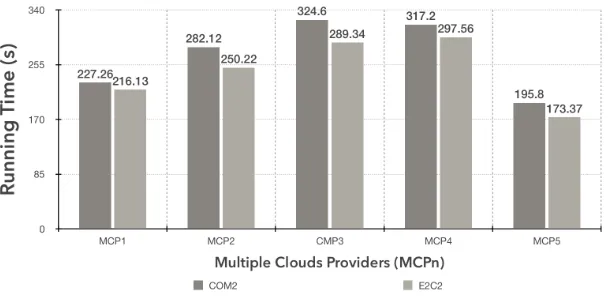
The number of combined clouds in the case of our E2C2 algorithm was as low as two clouds in some cases and never exceeded three in the worst, as shown in Fig. 6. Although Table 6.b shows that Base Cloud algorithm is the best in regards to the number of combined clouds, its weakness is associated with the high cost in execution time and number of examined services, which reaches more than 3 times the number of services in proposed E2C2 algorithm. The results are obtained from a pre-sorted list of cloud providers in a decreasing order based on the number of composition plans. Fig. 7 shows substantial performance improvement in E2C2 execution time compared to COM2, which is the best of the four examined algorithms, in each MCP. The results in Fig. 7 show that the execution time of E2C2 did not exceed 298 second in the worst scenario (MCP4), and 173 second in the best scenario.
[image:23.612.144.471.459.620.2]Figure 7: Running Time to achieve service composition planπ
7. Conclusions and Future Work
A novel multi-cloud IoT service composition algorithm, named E2C2, has been developed to emphasise energy awareness when searching for optimum composition plans to meet specified user requirements. Our algorithm searches for and integrates the minimum number of IoT services that satisfies the user request in an energy efficient manner. Evaluation of our algorithm was based on the systematic performance comparison with existing alternative algorithmic solutions, namely All Cloud, Base Cloud, Smart Cloud and COM2, using a benchmark example. The simulation results demonstrated a favourable performance of our algorithm in terms of achieving the least number of services searched to arrive at an optimum and energy efficient composition. Our work endeavours to contribute to the emerging IoT issue of energy efficient approaches, services and systems for cloud-based applications, by focusing on the energy implications of composite services.
References
[1] O. Vermesan, P. Friess, P. Guillemin, S. Gusmeroli, H. Sundmaeker, A. Bassi, I. S. Jubert, M. Mazura, M. Harrison, M. Eisenhauer, P. Doody, Internet of things strategic research roadmap, in: Cluster of European Research Projects on the Internet of Things, CERP-IoT, European Commission - Information Society and Media DG, 2011.
[2] S. Chen, S. Member, H. Xu, D. Liu, B. Hu, H. Wang, A vision of iot: Applications, challenges, and opportunities with china perspective, IEEE Internet of Things Journal 1 (4) (2014) 349–259.
[3] A. Whitmore, A. Agarwal, L. D. Xu, The internet of things—a survey of topics and trends, Information Systems Frontiers 17 (2) (2015) 261.
[4] L. D. Xu, W. He, S. Li, Internet of things in industries: A survey, IEEE Transactions on Industrial Informatics 10 (4) (2014) 2233–2243.
[5] A. Botta, W. de Donato, V. Persico, A. Pescap´e, On the integration of cloud computing and internet of things, in: 2014 International Conference on Future Internet of Things and Cloud (FiCloud), IEEE, 2014, pp. 23–30.
[6] H. Yue, L. Guo, R. Li, H. Asaeda, Y. Fang, Dataclouds: Enabling community-based data-centric ser-vices over internet of things, IEEE Internet of Things Journal 1 (5) (2014) 472–482.
[7] K. Tei, L. Gurgen, Clout : Cloud of things for empowering the citizen clout in smart cities, in: 2014 IEEE World Forum on Internet of Things (WF-IoT), 2014, pp. 369–370.
[8] M. Victoria, F. Terroso-S´aenz, A. Gonz´alez-Vidal, M. Vald´es-Vela, A. F. Skarmeta, M. A. Zamora, V. Chang, Applicability of big data techniques to smart cities deployments, IEEE Transactions on Industrial Informatics PP (99) (2016) 1–10.
[9] E. Cavalcante, J. Pereiraa, M. P. Alvesc, P. Maiaa, R. Mouraa, T. Batistaa, F. C. Delicatoc, P. F. Piresc, On the interplay of internet of things and cloud computing: A systematic mapping study, Computer Communications 89 (90) (2016) 17–33.
[11] E. Borgia, The internet of things vision: Key features, applications and open issues, Computer Com-munications 54 (2014) 1–31.
[12] R. Romana, J. Zhoua, J. Lopezb, On the features and challenges of security and privacy in distributed internet of things, Computer Networks 57 (10) (2013) 2266–2279.
[13] M. Mital, V. Chang, P. Choudhary, A. Pani, Z. Sun, Adoption of cloud based internet of things in india: A multiple theory perspective., International Journal of Information Management.
[14] A. M. Alberti, E. S. dos Reis, R. da R. Righi, V. M. Munoz, V. Chang, Converging future internet, “things”, and big data: A specification following novagenesis model, in: The first international confer-ence on Internet of Things and Big Data,, 2016.
[15] P. Mell, T. Grance, The nist definition of cloud computing, National Institute of Standards and Tech-nology (NIST).
[16] R. L. Villars, J. Cooke, C. MacGillivray, Impact of internet of things on datacenter demand and opera-tions, Special Study 255397, IDC Analyze the Future (2015).
[17] B. Aldawsari, T. Baker, D. England, Trusted energy efficient cloud-based services brokerage platform, International Journal of Intelligent Computing Research (IJICR) 6 (3) (2016) 630–639.
[18] K. Rose, S. Eldridge, L. Chapin, The internet of things: An overview understanding the issues and challenges of a more connected world, Report report-InternetofThings-20151015-en, Internet Society (2015).
[19] Object management group, business process model and notation (bpmn) version 2.0 [online] (May 2016) [cited March 2017].
[20] S. Nair, S. Porwal, T. Dimitrakos, A. Ferrer, J. Tordsson, T. Sharif, C. Sheridan, M. Rajarajan, A. Khan, Towards secure cloud bursting, brokerage and aggregation, in: IEEE 8th European Conference on Web Services (ECOWS), IEEE, 2010, pp. 189–196.
[22] K. Gouda, T. Radhika, M. Akshatha, Priority based resource allocation model for cloud computing, International Journal of Scientific Engineering and Technology (IJSET) 2 (1) (2013) 215–219.
[23] K. Dinesh, G. Poornima, K. Kiruthika, Efficient resources allocation for different jobs in cloud, Inter-national Journal of Computer Applications 56 (10) (2012) 30–35.
[24] V. Chang, Y.-H. Kuo, M. Ramachandrana, Cloud computing adoption framework: A security frame-work for business clouds, Future Generation Compter Systems 57 (2016) 24–41.
[25] V. Chang, M. Ramachandran, Towards achieving data security with the cloud computing adoption framework, IEEE Transactions on Services Computing 9 (1) (2015) 138–151.
[26] F. Li, M. Vogler, M. Claeßens, S. Dustdar, Efficient and scalable iot service delivery on cloud, in: IEEE Sixth International Conference on Cloud Computing (CLOUD), 2013, pp. 740–747.
[27] Y. Jararweh, M. Al-Ayyoub, A. Darabseh, E. Benkhelifa, M. Vouk, A. Rindos, Sdiot: a software defined based internet of things framework, Journal of Ambient Intelligence and Humanized Computing 6 (4) (2015) 453–461.
[28] D. Yazar, A. Dunkels, Efficient application integration in ip-based sensor networks, in: In Proceed-ings of the First ACM Workshop on Embedded Sensing Systems for Energy-Efficiency in Buildings, BuildSys ’09, 2009, pp. 43–48.
[29] S. Nastic, S. Sehic, D.-H. Le, H.-L. Truong, S. Dustdar, Provisioning software-defined iot cloud sys-tems, in: International conference on future internet of things and cloud (FiCloud), 2014, pp. 288–295.
[30] D. Guinard, V. Trifa, S. Karnouskos, P. Spiess, D. Savio, Interacting with the soa-based internet of things: Discovery, query, selection, and on-demand provisioning of web services, IEEE Transactions on Services Computing 3 (3) (2010) 223–235.
[31] M. Yuriyama, T. Kushida, Sensor-cloud infrastructure—physical sensor management with virtualized sensors on cloud computing, in: Proceedings of the 13th International Conference on Network-Based Information Systems (NBiS ’10), Takayama, Japan, 2010, pp. 1–8.
[33] J. Soldatos, M. Serrano, M. Hauswirth, Convergence of utility computing with the internet-of-things, in: 2012 Sixth International Conference on Innovative Mobile and Internet Services in Ubiquitous Computing (IMIS), IEEE, 2012, pp. 874 – 879.
[34] K. Dar, A. Taherkordi, R. V. R. Rouvoy, F. Eliassen, Adaptable service composition for very-large-scale internet of things systems, in: Proceedings of the Workshop on Posters and Demos Track PDT’11, ACM, 2011, pp. 1–11.
[35] E. Avil´es-L´opez, J. Garc´ıa-Mac´ıas, Tinysoa: a service-oriented architecture for wireless sensor net-works, Service Oriented Computing and Applications, Springer 3 (2) (2009) 99–108.
[36] O. Lassila, S. Dixit, Interleaving discovery and composition for simple workflows, in: Proc. Semantic Web Services, AAAI Spring Symp. Series, 2004, pp. 22–26.
[37] J. Rao, P. Kungas, M. Matskin, Composition of semantic web services using linear logic theorem proving, Information Systems 31 (4/5) (2006) 340–360.
[38] R. Zhang, I. Arpinar, B. Aleman-Meza, Automatic composition of semantic web services, in: Proceed-ings of International Connference of Web Services, 2003, pp. 38–41.
[39] J. Luo, J. Zhou, Z. Wu, An adaptive algorithm for qosaware service composition in grid environments, Service Oriented Computing and Applications 3 (3) (2009) 217–226.
[40] D. Wu, B. Parsia, E. Sirin, J. Hendler, D. Nau, Automating daml-s web services composition using shop2, in: Proceedings International Semantic Web Conference, 2003, pp. 195–210.
[41] S. R. Ponnekanti, A. Fox., Sword: A developer toolkit for web service composition, in: In Proceedings of The Eleventh World Wide Conference, 2012.
[42] A. Martinez, M. Patino-Matinez, R. Jimenez-Peris, Zenflow: a visual web service composition tool for bpel4ws, in: Proceedings of the IEEE Symposium on Visual Languages and Human-Centric Comput-ing, 2005, pp. 181–188.
[43] B.Pi, G. Zou, C. Zhong, J. Zhang, H. Yu, A. Matsuo, Flow editor: Semantic web service composition tool, in: IEEE Ninth International conference on Service Computing (SCC), 2012, pp. 666–667.
[45] L. F, M. N., Seeking quality of web service composition in a semantic dimension, IEEE Transactions on Knowledge and Data Engineering (TKDE) 23 (6) (2010) 942–959.
[46] H. Elshaaf, D. Botvich, Trustworthiness inference of multi-tenant component services in service com-positions, Journal of Convergence 4 (1) (2013) 31–37.
[47] M. Alrifai, T. Risse, W. Nejdl, A hybrid approach for efficient web service composition with end-to-end qos constraints, ACM Transactions on the Web (TWEB) 6 (2) (2012) 111–130.
[48] E. Constante, F. Paci, N. Zannone, Privacy-aware web service composition and ranking, in: 2013 IEEE 20th International Conference on Web Services (ICWS),, 2013, pp. 131–138.
[49] H. Jun, Y. Meng, X. Gong, Y. Liu, Q. Duan, A novel deployment scheme for green internet of things., IEEE Internet of Things Journal 1 (2) (2014) 196–205.
[50] T. Mukesh, A framework for power saving in iot networks, in: In 2014 International Conference on Advances in Computing, Communications and Informatics (ICACCI), 2014, pp. 369–375.
[51] A. Zeeshan, W. Yoon, A survey on energy conserving mechanisms for the internet of things: Wireless networking aspects, Sensors 15 (10) (2015) 24818–24847.
[52] J. Liang, J. Chen, H. Cheng, Y. Tseng, An energy-efficient sleep scheduling with qos consideration in 3gpp lte-advanced networks for internet of things, IEEE Journal on Emerging and Selected Topics in Circuits and Systems 3 (1) (2013) 13–22.
[53] P. Bartalos, M. B. Blake, Engineering energy-aware web services toward dynamically-green comput-ing, in: Proceedings of the Service-Oriented Computing-ICSOC 2011 Workshops, Springer, 2012, pp. 87–96.
[54] E. Park, H. Shin, Reconfigurable service composition and categorization for power-aware mobile com-puting, Parallel and Distributed Systems 19 (11) (2008) 1553–1564.
[55] Z. Luo, J. Zhou, Z. Wu, An adaptive algorithm for qosaware service composition in grid environments, Service Oriented Computing and Applications 3 (3) (2009) 217–226.
[57] P. Rodriguez-Mier, M. Mucientes, M. Lama, A dynamic qosaware semantic web service composition algorithm, in: in International Conference on Service-Oriented Computing, 2012.
[58] X. Wang, J. Wang, Z. Zheng, Y. Xu, M. Yang, Service composition in service-oriented wireless sen-sor networks with persistent queries, in: 2009 6th IEEE Consumer Communications and Networking Conference, IEEE, 2009, pp. 1–5.
[59] T. Baker, B. Al-Dawsari, H. Tawfik, Y. Ngoko, Greedi: An energy efficient routing algorithm for big data on cloud, Ad Hok Networks 35 (2015) 83–96.
[60] T. Baker, Y. Ngoko, R. Tolosana-Calasanz, O. F. Rana, M. Randles, Energy efficient cloud computing environment via meta-director framework, in: 6th IEEE international Conference on Developments in E-Systems Engineering (DeSE 2013), IEEE, 2013, pp. 130–136.
[61] Y. Yan, B. Xu, Z. Gu, S. Luo, A qos-driven approach for semantic service composition, in: IEEE International Conference on Commerce and Enterprise Computing, 2009, pp. 523–526.
[62] M. Aiello, E. E. Khoury, A. Lazovik, P. Ratelband, Optimal qos aware web service composition, in: IEEE International Conference on Commerce and Enterprise Computing, 2009, pp. 491–494.
[63] W. Jiang, S. Hu, Z. Huang, Z. Liu, Q. D. Handler, Two-phase graph search algorithm for qos-aware automatic service composition, in: International Conference on Service-Oriented Computing and Ap-plications, 2010.
[64] P. J. Antonio, S. S. P. Fernandez, A. Ruiz-Cort´es, Qos-aware web services composition using grasp with path relinking, Expert Systems with Applications 41 (9) (2014) 4211–4223.
[65] G. Zou, Y. Chen, Y. Xiang, R. Huang, Y. Xu, Ai planning and combinatorial optimization for web service composition in cloud computing, in: Annual International Conference on Cloud Computing and Virtualization (CCV 2010), 2010, p. 28.
[66] H. Kurdi, A. Al-Anazi, C. Campbell, A. A. Faries, A combinatorial optimization algorithm for multiple cloud service composition, Computers and Electrical Engineering 42 (C) (2015) 107–113.
[68] R. Karunamurthy, F. Khendek, R. H. Glitho, A novel architecture for web service composition, Journal of Network and Computer Applications 35 (2011) 787–802.