after stroke. Neuropsychological rehabilitation, 24 (2). 172 - 201. ISSN 0960-2011 DOI: https://doi.org/10.1080/09602011.2013.875925
Link to Leeds Beckett Repository record:
http://eprints.leedsbeckett.ac.uk/2454/
Document Version: Article
The aim of the Leeds Beckett Repository is to provide open access to our research, as required by funder policies and permitted by publishers and copyright law.
The Leeds Beckett repository holds a wide range of publications, each of which has been checked for copyright and the relevant embargo period has been applied by the Research Services team.
We operate on a standard take-down policy. If you are the author or publisher of an output and you would like it removed from the repository, please contact us and we will investigate on a case-by-case basis.
A Comparison of Errorless and Errorful
Therapies for Dysgraphia after Stroke
Submitted to Neuropsychological Rehabilitation
Lindsey Thiel, Paul Conroy
Neuroscience and Aphasia Research Unit (NARU),
School of Psychological Sciences,
University of Manchester,
Manchester, UK
Short title: Errorless & errorful dysgraphia therapy
Name and address for correspondence:
Dr Paul Conroy,Neuroscience and Aphasia Research Unit (NARU), School of
Psychological Sciences (Zochonis Building), The University of Manchester, Oxford Road, Manchester M13 9PL. [email protected]
Tel: 0161 275 2581, Fax: 0161 275 2873.
Abstract
Background: Despite the increasing significance of written communication, there is limited research into spelling therapy for adults with acquired dysgraphia. Existing studies have typically measured spelling accuracy as an outcome although speed may also be important for functional writing. As spelling is relatively slow, effortful and prone to errors in people with dysgraphia, minimising errors within therapy could be a factor in therapy success.
Method: This within-participant case-series study investigated whether errorless and errorful therapies would differ in their effects on spelling speed and accuracy for four participants with acquired dysgraphia. Matched sets of words were treated with errorless or errorful therapy or left untreated. Results were collated one week and five weeks after therapy.
Results: Both therapy approaches were successful in improving spelling accuracy. For three participants, equivalent gains were demonstrated following errorless and errorful therapy. One participant made significantly greater improvements in spelling accuracy following errorless therapy. The effects were maintained five weeks later. There was no significant difference in post-therapy spelling speed between the two therapy conditions.
Introduction
The skills required for effective writing and spelling are extremely sensitive to brain damage and are nearly always disrupted in instances of generalised neurological damage (Kaplan, Gallagher & Glosser, 1998). This reflects the inherent complexity of writing and spelling, requiring the active integration of linguistic, motor, perceptual and spatial processes (Rapp, 2002). Acquired dysgraphia refers to an impairment to the linguistic and cognitive aspects of writing and spelling and typically co-occurs with other symptoms of language impairment, often to several linguistic modalities (e.g., spoken word retrieval, auditory comprehension, reading etc.) in individuals with aphasia (Damasio, 1998). Aphasia is a multi-modal language disorder resulting from acquired brain injury, infection, surgical removal of brain tissue, brain tumour, or most commonly, stroke affecting the left hemisphere (Hallowell & Chapey, 2008).
The literature shows that acquired spelling impairments can to some extent be treated, and that treatment benefits can be maintained. However, anecdotal evidence strongly suggests that therapy for acquired spelling disorders is a neglected aspect of clinical care, which may in part reflect the limited research evidence base. Given the dominance of oral communication in everyday interactions (Nickels, 2002), the treatment of spoken language is often prioritised over written language. However, some authors have contended that writing may be easier to improve (at least for some participants) and more beneficial for communicating or supporting communication in many cases (Beeson & Rapcsak, 2002). A less controversial but also important observation is that written communication, e.g. via the internet and mobile phones, has become increasingly important in vocational, educational and social spheres. In so far as intervention for acquired communication disorders should be guided by the actual communicative needs of adult brain injury survivors, there is a strong need for further basic and clinical research into writing and spelling disorders. In particular, it may be helpful to evaluate the utility of rehabilitation methods with a strong evidence base in related clinical disorders, such as memory impairment. One approach to spelling therapy research which has, until now, been largely unexplored, is the application of the principles of errorless learning (EL).
Errorless Learning
minimised or eliminated from the task, can be equally or more effective in rehabilitation after brain injury, particularly for treating memory impairments. It is important to note, however, that it is difficult to construct a completely errorless task; therefore the term “errorless” is usually used to describe tasks with relatively few errors (Clare & Jones, 2008). Page, Wilson, Shiel, Carter and Norris (2006) define errorless learning as “a teaching technique whereby people are prevented, as far as possible, from making mistakes” (p. 90).
distinguish correct from incorrect responses, can be used (Page et al., 2006). In contrast, if errors are made, they are as likely to be remembered as correct responses by the implicit memory system (Page et al., 2006).
Further support for errorless learning has been provided in the neuroscience literature (McCandliss, Fiez, Protopapas, Conway, & McClelland, 2002; McClelland, Thomas, McCandliss, & Fiez, 1999). According to McClelland et al. (1999) a difficulty in learning through errorful tasks could be explained through the Hebbian learning rule: the principle that if a neuron fires another, there will be a strengthened connection between them. Therefore, a pattern of neural activity elicited by an input will reoccur with subsequent occurrences of the same input, regardless of whether it is useful. Errors would, thus, be reinforced in an errorful task, whereas correct responses would be reinforced in an errorless task. In a study combining data from a computational model and Japanese adults, McClelland et al. (1999) showed through computer simulations of a Hebbian learning model why it might be that Japanese adults have difficulty distinguishing [r] and [l] in English: namely, that Hebbian learning reinforced the perception of sounds they had acquired when younger and prevented them from learning this distinction as an adult. They also taught Japanese adults to discriminate between [r] and [l] in an errorless task, which resulted in successful learning.
rewarding. They also found that cognitive abilities (memory, executive/ problem-solving skills and monitoring skills) predicted therapy success overall, and that participants who did better in the errorful condition had better working and recall memory.
In a recent review of errorless learning studies by Middleton & Schwartz (2012), it was concluded that errorless and errorful approaches have generally resulted in equal gains when applied to picture naming therapies for people with aphasia (Conroy, Sage & Lambon Ralph, 2009a, 2009b; Fillingham, Sage and Lambon Ralph, 2005a, 2005b, 2006; McKissock & Ward, 2007). However, they pointed out that EF performs as well as EL despite more feedback usually being provided in EL tasks, and suggested that EF may have an advantage over EL in that it provides more retrieval practice. Tasks with more retrieval practice (i.e. those with more testing) have been shown to be more successful for improving memory than those with more study time and less testing (Cull, 2000; Karpicke & Roediger, 2008; Thompson, Winger & Bartlin, 1978; Wheeler, Ewers & Buonanno, 2003). EF has also been shown to be more successful than EL after long intervals (Fillingham et al., 2006).
shown before the participant attempts to spell it, errors are less likely to be produced; therefore, it could be viewed as more errorless than ACT.
There has been one published study which has previously compared errorless and errorful spelling therapy in participants with stroke-induced dysgraphia. Raymer, Strobel, Prokup, Thomason & Reff (2010) carried out a cross-over designed study with four participants. These authors noted that “spelling is inherently error-prone, especially in patients with acquired dysgraphia, who often struggle and self-correct misspellings when they use more preserved reading abilities to recognise a spelling error and reattempt the spelling” (p.3, 2010). For the errorless condition a CART task with systematic vanishing cues was employed. The errorful condition consisted of spelling to dictation with increasing cues. They hypothesised that errorless training would be more beneficial than errorful training for these participants. The study found large effect sizes for trained items across both approaches, but against expectations, there was some advantage of errorful over errorless for three of the four participants. The participants preferred the errorless therapy as they found it less frustrating.
response times were added into the equation, it was found that processing speed was still substantially lower than that for control participants after therapy, despite accuracy scores being close to those for controls. Therefore, Crerar (2004) argued that accuracy only tells part of the story and that by including speed, clinicians and researchers can gain more insight into participants’ comprehension abilities.
Study Aims
This study aimed to answer the following questions:
Research Question 1: Will errorless and errorful training methods differ in their effects on spelling accuracy?
Research Question 2: Will treatment effects be maintained after a period of no training?
Research Question 3: Will errorless training result in speedier production of the correct spelling of target words, compared with errorful training?
Method
A within-participant case series design was used to compare the effects of errorless and errorful learning for acquired dysgraphia in terms of spelling accuracy and speed. Four participants with severe dysgraphia took part in this within-subject case series study. They were recruited from two stroke support groups in South Manchester in the North West region of England. To be included in the study, participants had to have an acquired spelling impairment following a stroke as well as sufficient visual acuity and motor ability for writing. Exclusion criteria included a severe impairment in word retrieval (written or verbal), reading or auditory comprehension, as participants needed to be able to follow verbal instructions and monitor their own writing.
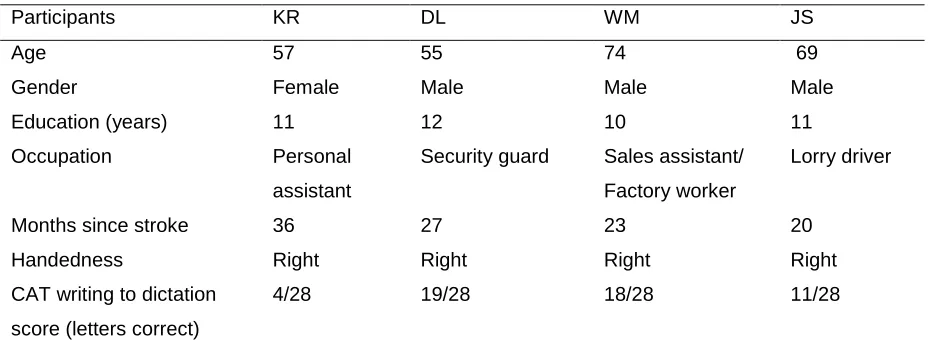
(25/28) of letters correct was required for entry into the study. Table 1 shows the scores of the participants who were included as well as their demographic information.
Table 1 about here
Background Assessment
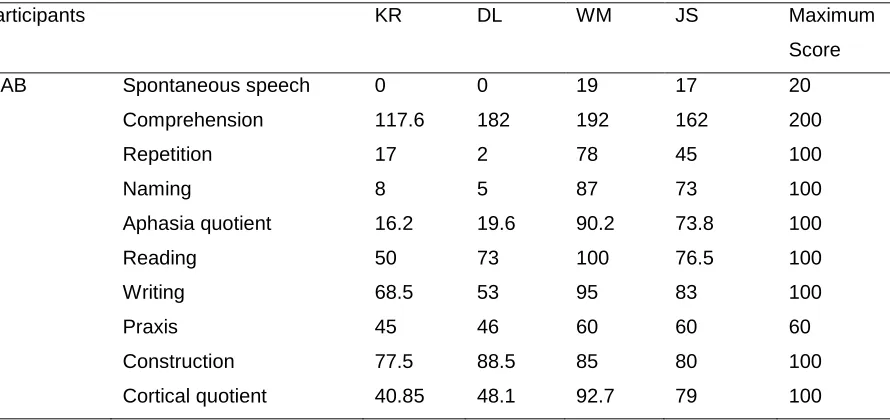
Assessment took place once weekly for 60-90 minutes over 8 weeks in each participant’s home. Participants underwent comprehensive assessment of their aphasic symptoms with the Western Aphasia Battery (WAB; Kertesz, 2006), the results of which are presented in Table 2. Additionally, a screen of semantic association skills, the Pyramids and Palm Trees Test (PPT; Howard & Patterson, 1992), was implemented, as well as spelling sub-tests 39, 40, 44 and 45 from the Psycholinguistic Assessments of Language Processing in Aphasia (PALPA; Kay, Lesser, & Coltheart, 1992), the results of which are displayed in Table 3. An error analysis of participants’ incorrect responses on the PALPA sub-tests (39, 40 and 44) was conducted. Table 4 shows each participant’s percentage of each error or response type.
Summary of Assessment Results
KR presented with severe non-fluent aphasia. She communicated by producing a few single spoken words, writing single words and short sentences, and drawing. She was therefore very motivated to improve her writing so that she could communicate more effectively. Assessment of KR’s writing on the WAB confirmed that she had difficulty writing in full sentences. Her written picture description was generally agrammatic, with mainly verbs being omitted. KR’s spelling scores were low on all of the PALPA spelling to dictation subtests. She did not have significantly different scores for high and low imageability words (X2 = 3.57, df = 1, p = .06) nor high frequency and low frequency words (X2 = 0.89, df = 1, p = .35) on the PALPA 40 (Imageability and Frequency Spelling), nor between regular and exception words (X2 = 0.00, df = 1, p = 1.00) on the PALPA 44 (Regularity and Spelling). She failed on each attempt at writing non-words (PALPA 45). KR was often aware of her incorrect responses, but could usually not correct them.
SCHOOH; fact → FAT; giraffe → GIFFARE) were characteristic of graphemic buffer disorder (Miceli, Silveri & Caramazza, 1985; Sage & Ellis, 2006; Shallice, Glasspool & Houghton, 1995), a peripheral spelling impairment that has been described as being caused by a deficit in the short-term holding mechanism for the orthographic representations of words while writing is planned and executed. Symptoms include inconsistency, length effects (where more errors occur in longer words) and the following error types: letter additions (carpet → CARPERTS), substitutions (carpet →CARPEN), omissions (carpet→ CARPE) and transpositions (carpet → CARPTE) (Rapp, 2005).
DL presented with severe expressive difficulties due to apraxia of speech and aphasia. He communicated through writing single words and gesturing. Like KR, he was keen to improve his writing so that he could communicate more easily. His written picture description on the WAB demonstrated that DL had a profound difficulty with writing. He only managed to write five words, one of which was spelled incorrectly. He did not have significantly different scores for high frequency and low frequency words (X2 = 2.54, df = 1, p = .11) on the PALPA 40 (Imageability and Frequency Spelling), nor on regular and exception words (X2 = 0.42, df = 1, p = .52) on the PALPA 44 (Regularity and Spelling). On the PALPA 39 (Letter Length Spelling), his scores on longer words were not significantly different when compared statistically with his scores on shorter words (X2 = 3.87, df = 1, p = .05). However, a marked length effect was observed when DL’s spelling
The imageability effect and the fact that he only wrote one non-word in a phonologically plausible manner on the PALPA 45 (Non-word Spelling) suggested that he had phonological dysgraphia (Jefferies, Sage & Lambon Ralph, 2007; Rapcsak, Beeson, Henry, Leyden, Kim, Rising, Andersen & Cho, 2009; Shallice, 1981), a dysgraphia sub-type that has been used to describe people with impaired non-word spelling, lexicality effects (where a non-word such as PEB is spelt as a phonologically similar stored word such as PUB) (Rapcsak, et al., 2009), imageability effects (Whitworth, Webster & Howard, 2005), and word class effects (where content words such as INN are more likely to be spelt correctly than grammatical function words like IN) (Patterson & Lambon Ralph, 1999). However, his most marked impairment seemed to be at the level of the graphemic buffer, due to length effects, inconsistency in spelling, and the fact that the majority of his errors were additions (aunt → AUNST), omissions (banana → BANAN), substitutions (gravity → GRAVITE), and movement errors (tongue → TONGEU).
imageability words (X2 = 0.91, df = 1, p = .34) nor high frequency and low frequency words (X2 = 2.54, df = 1, p = .11) on the PALPA 40 (Imageability and Frequency Spelling), nor between regular and exception words (X2 = 1.60, df = 1, p = .21) on the PALPA 44 (Regularity and Spelling). When asked whether he was happy with erroneous responses, he often said yes; however, when errors were pointed out to him he could sometimes correct them.
Inconsistency in spelling and predominantly addition (ghost → GHOUST), substitution (hotel → HOTOL), omission (potato → POTA) and movement errors (tongue → TOUNGE) pointed to a graphemic buffer disorder (Miceli et al., 1985; Sage & Ellis, 2006). His low score (4/24) on the PALPA 45 (Non-word Spelling), compared to his higher scores for word spelling on other tests also suggests that WM also had phonological dysgraphia (Rapcsak et al., 2009).
Spelling), nor between regular and exception words (X2 = 0.00, df = 1, p = 1.00) on the PALPA 44 (Regularity and Spelling). His scores on the PALPA 39 (Letter Length Spelling) were not significantly different for longer words (5 and 6 letters) compared to shorter words (3 and 4 letters) (X2 = 0.01, df = 1, p = .94), which suggested that his spelling was not significantly affected by length. However, he only managed to spell one non-word plausibly to dictation (PALPA 45: Non-word Spelling), which implied that he had a difficulty converting phonemes to graphemes (although, the deficit in speech perception may have been a contributory factor here also). JS rarely detected that there were errors in his incorrect responses when asked.
On the PALPA sub-tests, the majority of his errors were due to the substitution, omission or movement of letters (ghost → GHOSE; spring → SPING; aeroplane → EAROPLANE), which suggested a graphemic buffer disorder. However, on more difficult spelling tests (i.e. those with low imageability and low frequency words) such as the Baxter and Warrington Spelling Test he made occasional semantic errors (e.g. plait → HAIR and cruise → WORLD). Together with his impaired ability to write non-words, these semantic errors indicated a deep dysgraphia (Bub & Kertesz, 1982; Kumar & Humphreys, 2008), albeit a milder form than that of KR.
Target Words for Therapy
Therapy
For each participant, 120 words that were spelt incorrectly to dictation on two attempts were selected for 3 word lists (40 in each) for errorless (EL), errorful (EF), and control (untreated) conditions. Word lists were matched for phoneme and letter length, frequency, regularity and imageability.
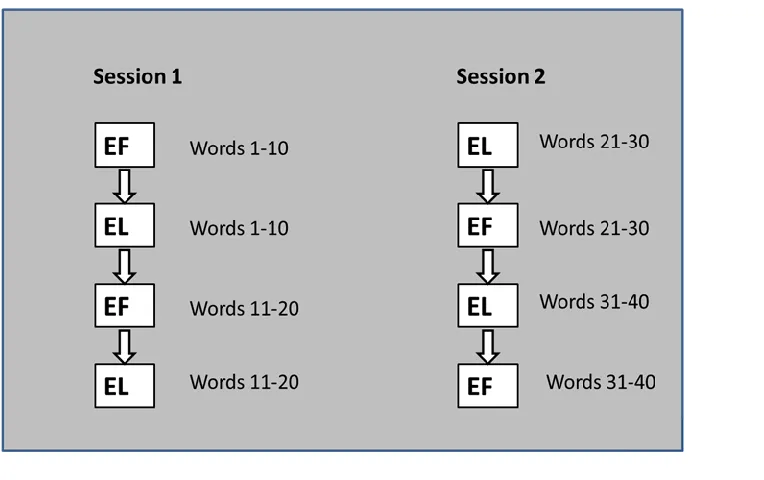
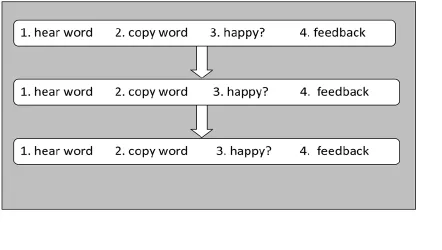
Treatment was administered in 8 90-minute sessions over 4 weeks in participants’ homes. Each session was divided into 4 blocks of 10 target items and errorless and errorful conditions were alternated (see Figure 1). So session 1 had the following structure: 10 errorless, 10 errorful, 10 errorless, 10 errorful. The order of therapy type was reversed in the second session of each week to control for any order effects such as tiredness. The EL and EF word lists were each divided and a sub-set of 20 words from each set were targeted in each session. Therefore, in sessions 1, 3, 5 and 7, words 1-20 from the EL and EF sets were treated, and in sessions 2, 4, 6 and 8, words 21-40 from each of the EL and EF sets were treated. There was just one ‘run-though’ of each sub-set per session.
Figure 1 about here
Errorless Therapy
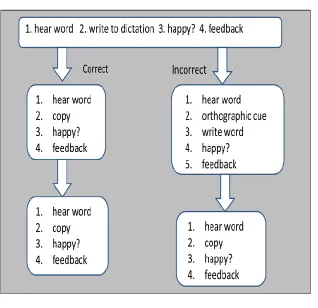
responses. After the first and second attempts, the therapist pointed out any errors that were not immediately recognised by the participant by comparing the participant’s response to the word on the card. This allowed the participant to correct these errors on the next attempt. If an error was made on the third attempt, the therapist pointed it out if it had not been noticed by the participant; however, the participant was instructed not to correct it, whether it had been recognised or not. Responses were recorded and errors were counted to ensure that minimal errors were produced. The number of incorrect responses per session for each participant is displayed in Table 5. The highest number of incorrect responses in a session was 4 (by WM); however, the mean number per session was 1.3.
Figure 2 about here
Table 5 about here
Errorful Training
orthographic cue that constituted around 50% of the help needed to write the word correctly. For example, if the word elephant was initially spelt as ELEFET then ‘eleph’ was
provided. If only one letter was incorrect, for example, KAT for ‘cat’, then the therapist wrote the word, leaving a blank space for the incorrect letter and a choice of two letters. Whether the second attempt was spelt correctly or incorrectly, the full card was then shown and the participant was asked to copy the word, which the therapist produced verbally once more. After each attempt, participants were asked whether they were happy with their response. They were then told by the therapist whether or not the word was written correctly, but not the location of errors, except after the third attempt. Again, responses were recorded and errors were counted to confirm that this task was errorful. As expected, error rates were much higher than those in errorless therapy, with the number of incorrect responses per session ranging from 10 to 33 (see Table 6). The mean number of incorrect responses per session was 19.8.
Figure 3 about here
Table 6 about here
Post-therapy Assessments and Scoring
Participants were assessed on spelling accuracy of all 120 items from errorful, errorless and control lists one week post therapy to measure immediate therapy effects, and five weeks post-therapy to establish whether any therapy effects had been maintained. Words from each condition were randomised within the list to control for any order effects.
Two different scoring systems were used. Firstly, words were scored on whole word accuracy. A score of 1 was given for each correctly spelt word and a score of 0 for each incorrectly spelt word (whole word score). Secondly, a more fine-grained analysis of number of correct letters per target word was conducted. The scoring system described in the writing subtests of the Comprehensive Aphasia Test (Swinburn, Porter & Howard, 2004) was used. Letters scored 1 point if they were correct and in the correct position relevant to adjacent letters. A score of 0 was given for letter omissions, substitutions, and transpositions (only one of the transposed letters scored 0). 1 point was subtracted from the total score for any additional letters, regardless of the number of additional letters that were included in the response. Finally, semantic paraphasias scored 0. The number of correct letters per set was then calculated and divided by the total number of letters in the target words for each set to obtain a percentage of correct letters per set (letter level score).
scores given by the second author were divided by the scores given by the first author and multiplied by 100 to obtain a reliability percentage. This was 99.4%.
During assessment a digital voice recorder was used to record spelling speed. The therapist said the word ‘done’ as soon as the participant had finished writing the word (if correct) or as soon as the participant signalled that he/she had finished writing or wanted to move on (in the case of no responses or incomplete/ incorrect attempts). Goldwave software was then used to measure the response times of correctly spelt items. The response time was defined as the time between the end of the therapist’s production of the target word and the beginning of the word ‘done.’
Results
The results will be set out in order to directly answer the research questions proposed at the end of the introduction. The results have, therefore, been set out as follows:
1. Accuracy Immediately Post-therapy
Research Question 1: Will errorless and errorful training methods differ in their effects on spelling accuracy?
Whole word scores
Whole word accuracy scores for each participant are displayed in Figure 4. Participants have been ordered according to total baseline spelling scores on the PALPA subtests, with the most impaired to the left and the least impaired to the right.
Figure 4 about here
To establish whether therapy was effective, these scores were compared to baseline. For all sets, the baseline score was 0/40, as items included into therapy and control sets had to be failed at baseline on two occasions. The mean scores on both errorless (23.25/40) and errorful sets (20/40) were significantly higher post therapy (EL: X2= 29.64, df = 1, p< .001; EF: X2= 23.77, df = 1, p< .001). All participants improved significantly following both therapy conditions (McNemar 1-tailed, p < .003 for all participants). Furthermore, the mean control score (8/40) was significantly higher than baseline (X2= 10.19, df = 1, p = .001), and each participant’s control score improved significantly (KR: McNemar 1-tailed,
p = .01; DL: McNemar 1-tailed, p = .02; WM: McNemar 1-tailed, p = .001 and JS: McNemar 1-tailed, p = .002).
= 1, p = .66). This was the case for three of the participants (KR, WM & JS). However, DL performed significantly better on errorless therapy target words (X2= 4.17, df = 1, p = .04). The mean control score across the participants was significantly lower than both the mean errorless score (X2= 10.19, df = 1, p = .001) and the mean errorful score (X2= 6.57,
df = 1, p = .01). Individual analyses showed that this pattern was consistent across three of the four participants (KR, DL and JS). One participant, WM, did not perform significantly better on items targeted in either errorless (X2 = 0.06, df = 1, p = .80) or errorful therapy (X2= 0.00, df = 1, p = 1.00) compared to controls.
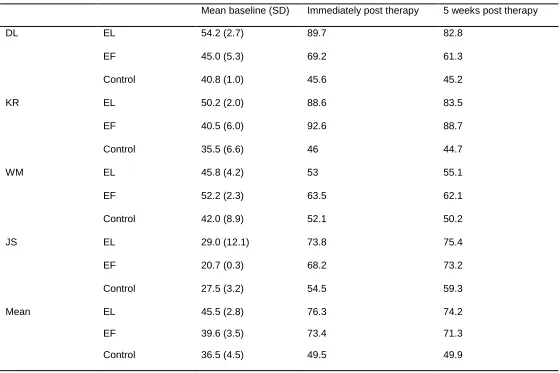
Letter level scores
Letter level scores (percentage of letters correct per set) are displayed in Table 7. Scores were compared to baseline (a mean of the two baseline scores). The mean letter level score improved significantly for both therapy conditions (Errorless: X2= 18.5, df = 1, p < .001; Errorful: X2= 21.78, df = 1, p < .001). This reflected the results of DL, KR and JS (Errorless: DL: X2= 29.34, df = 1, p < .001; KR: X2= 32.77, df = 1, p < .001; JS: X2= 38.21, df = 1, p < .001; Errorful: DL: X2= 10.93, df = 1, p < .001; KR: X2= 58.36, df = 1, p < .001; JS: X2= 43.47, df = 1, p < .001). However, WM did not have significantly higher scores for either of the conditions. In contrast to the whole word scores, the mean letter level score for control sets was not higher than baseline. The only participant who had a significantly higher score was JS (X2= 13.9, df = 1, p < .001).
X2 = 12.64, df = 1, p < .001; Errorful: X2= 11.01, df = 1, p = .001) DL and KR had significantly better scores on errorless (DL: X2= 42.23, df = 1, p < .001; KR: X2= 39.21, df = 1, p < .001) and errorful sets (DL: X2= 45.6, df = 1, p =.001; KR: X2= 48.62, df = 1, p < .001) compared to control sets. JS’s errorless score was significantly higher than his control score (X2 = 7.24, df = 1, p = .007); however, his errorful score was not. WM’s errorful and errorless scores were not higher than his control scores.
Table 7 about here.
2. Accuracy at Follow-up Assessment
Research Question 2: Will treatment effects be maintained after a period of no training?
Whole word scores
improved from 9/40 at immediate assessment to 14/40 at follow-up. This was not statistically significant, however.
Similar to immediate post-therapy scores, mean whole word follow-up scores for the errorless and errorful conditions were not significantly different to each other (X2= 0.08, df = 1, p = .78). This reflects the results of three participants, KR, WM and JS, whose individual scores were not significantly different across these conditions. However, as was the case for the immediate assessments, DL scored significantly higher on words trained through the errorless therapy (X2= 7.15, df = 1, p = .01).
Figure 5 about here
Letter level scores
When letter level scores from immediate and follow-up post-therapy assessments were compared, there were also no significant differences for any of the conditions, which provided further confirmation that effects had been maintained.
A comparison of follow-up errorless and errorful scores showed no significant difference between the mean scores. Only DL’s scores showed any differences, with his errorless score being significantly higher than his errorful score (X2= 10.38, df = 1, p = .001). The mean errorless and errorful scores were significantly higher than the mean control score (Errorless: X2= 11.47, df = 1, p = .001; Errorful: X2= 8.67, df = 1, p = .003). This was true for DL and KR (Errorless: DL: X2= 28.92, df = 1, p < .001; KR: X2= 30.89, df = 1, p < .001; Errorful: DL: X2= 4.56, df = 1, p = .03; KR: X2= 41.42, df = 1, p < .001). However, JS only scored significantly higher on his errorless set compared to control (JS: X2= 5.16,
df = 1, p = .02) and neither of WM’s therapy sets had a significantly higher letter level
score when compared to his control set.
3. Speed of Spelling
Research Question 3: Will errorless training result in speedier production of the correct spelling of target words, compared with errorful training?
writing or failures to retrieve the word. However, by only including correctly spelt words in the analysis, errorless and errorful lists were no longer matched for psycholinguistic variables (e.g. length and frequency). Therefore, an ANCOVA was used to compare the mean response time of each therapy condition while controlling for the variables that have an effect on spelling speed. A Pearson correlation coefficient was computed and a significant positive correlation was found between spelling speed and word length in letters (r = 0.43, n = 173, p <.001) and word length in phonemes (r = .445, n = 173, p
<.001) (i.e. longer words had higher response times, so the longer the word, the slower the spelling speed). There was a significant negative correlation between spelling speed and word frequency (r = -.157, n = 173, p = .04) (i.e. words with higher frequency values had lower response times, so the more frequent the word, the faster the spelling speed). These were therefore entered into the ANCOVA as covariates. The ANCOVA showed no effect of therapy type on spelling speed (F (1, 168) = 0.80, p = .37). Individual mean response times for each therapy are displayed in Table 8.
Table 8 about here
Discussion
accuracy and speed. It was predicted that errorless and errorful learning would result in similar spelling accuracy, but that errorless learning would lead to speedier spelling of target words.
The results showed that both therapies led to significant improvements in spelling accuracy following therapy, which were largely maintained five weeks later. This pattern was consistent across three participants, KR, DL and JS. WM, on the other hand, performed similarly on therapy and control conditions, suggesting that effects were not due to therapy but rather variability in spelling skill. Furthermore, a more fine-grained letter level analysis of his spelling showed no significant improvements to his spelling following therapy. It was unlikely that any improvements could be attributed to spontaneous recovery because all participants had had their stroke at least one year prior to commencement of the study. Furthermore, KR, DL and JS performed significantly better on treated items than control items suggesting that improvements to spelling were due to therapy.
Two participants, KR and JS, performed equally well on relearning spelling following errorless and errorful learning. Therefore, it seems that it was the commonalities of the two approaches that were responsible for their success rather than the differences. Both therapy approaches aimed at strengthening orthographic representations of specific words through repeated exposure to the target word. Furthermore, the tasks in each therapy were matched very closely in order to control for differences that were not associated with ‘errorfulness’ or ‘errorlessness’. In both therapies, participants were presented with the phonological form of the word for each attempt with the aim of strengthening the link between phonology and orthography. The therapies were also similar in that the participant was given three attempts at writing the word and was encouraged to monitor after each attempt. In all cases after the initial sessions, participants started to monitor errors themselves without instruction. This could be a factor that influenced therapy success in these participants and might also partly account for improved control scores. In both therapies feedback was given directly after the response had been written. It seems that therapy success for KR and JS was not dependent on the presence or absence of errors.
self-correct errors would give errorless therapy an advantage for these participants. Perhaps because monitoring was encouraged, feedback was given and the correct word was copied, the errors made in errorful therapy did not have a detrimental effect.
trial-and-error process might explain why it was a less effective method for DL, who generally had to rely on an unsuccessful trial-and-error approach to spelling.
WM obtained low scores and non-significant differences between therapy and control conditions despite having a relatively high level of linguistic and spelling ability (within the group) prior to therapy. It is difficult to explain these erratic results in terms of his dysgraphia sub-type as his spelling had similar characteristics to the other participants. However, it seems likely that other cognitive abilities might have affected his performance. Throughout the course of the study there was some evidence suggestive of memory impairment, for example, he often forgot therapy sessions. Lambon Ralph, Snell, Fillingham, Conroy & Sage (2010) investigated the relationship between cognitive-linguistic abilities and anomia therapy outcomes in 33 people with aphasia, in order to determine whether therapy effects could be predicted based on background assessments. They found that pre-treatment picture naming ability, phonological ability, but also cognitive abilities (reasoning, problem-solving, attention and visual recall) predicted therapy outcome at immediate and follow-up assessment. Additionally, in their picture naming therapy studies comparing errorless and errorful learning, Fillingham et al. (2005a, 2005b, 2006) found that language abilities did not predict therapy outcome, but that cognitive abilities (recognition memory, executive/ problem-solving skills and monitoring ability) did.
Shiel, Carter & Norris, 2006). The disadvantage of errorful learning has been attributed to impaired explicit memory and a reliance on implicit memory, which cannot distinguish between correct and incorrect responses (Baddeley & Wilson, 1994; Page et al., 2006). The similarity in effects of errorless and errorful learning in people with aphasia could therefore be due to intact explicit memory. However, DL, who performed better following errorless learning, did not have any apparent memory difficulties, whereas WM, who performed similarly following both therapies, did. Unfortunately, as cognitive skills were not assessed in this study, the relationship between cognitive abilities and therapy outcomes cannot be explored.
at control items may have reflected improved attention or increased motivation and effort through having therapy, as well as improved self-monitoring.
be an association between dysgraphia subtype and success in a certain type of therapy and that more research is needed into other factors that might contribute to spelling performance, such as reading abilities, memory and executive functions.
A possible reason for the better performance following errorful therapy in Raymer et al.’s (2010) study could be retrieval practice (Middleton & Schwartz, 2012). Errorful therapies require the participant to retrieve the phonological or orthographic representation in contrast to errorless therapies in which the word is often repeated or copied. In their errorless condition, Raymer et al.’s participants first copied the word and then gradually had to retrieve parts of the word as they were covered. In their errorful condition, they first had to retrieve the entire word and then parts of it as orthographic cues were provided. The errorful task in the present study also provided more opportunities for retrieval than the errorless task; however, no advantage was found for EF in the short or the long-term, despite otherwise carefully matched tasks.
goals, for example training phonological skills (e.g. phoneme-grapheme conversion) or self-monitoring skills as this study has focused on methods for retraining lexical orthography. A limitation of this study was that the two therapies were administered concurrently, which, firstly, meant that it was possible that the therapies could have affected one another, and secondly, that it was not possible to compare their generalisation effects. Therefore, there is a need to explore alternative study designs which separate the two therapies being compared and thus reduce any risk of between-therapy interaction.
with milder naming impairments found the errorful therapy more challenging and less intrusive.
References:
Baddeley, A. D., & Wilson, B. A. (1994). When implicit learning fails: Amnesia and the problem of error elimination. Neuropsychologia, 32, 53–68.
Baxter D. M., Warrington E.K. (1994). Measuring dysgraphia: A graded difficulty spelling test. Behavioural Neurology, 7, 107–116
Beeson, P. M. (1999). Treating acquired writing impairment: Strengthening graphemic representations. Aphasiology, 13, 367-386.
Beeson, P.M., Hirsch, F., & Rewega, M. (2002). Successful single-word writing treatment: Experimental analysis of four cases. Aphasiology, 16, 473–491.
Beeson, P. M., & Rapcsak, S. Z. (2002). Clinical diagnosis and treatment of
spelling disorders. In A. E. Hillis (Ed.), Handbook on adult language disorders: Integrating cognitive neuropsychology, neurology, and rehabilitation (pp. 101-120). Philadelphia: Psychology Press.
Behrns, I., Ahlsén, E. & Wengelin, A. (2010). Aphasia and text writing,
International Journal of Language and Communication Disorders, 45, 230-243. Bertsch, S., Pesta, B. J., Wiscott, R., & McDaniel, M. A. (2007). The generation
effect: A meta-analytic review. Memory & Cognition, 35, 201-210.
Bub, D., & Kertesz, A. (1982). Evidence forlexicographic processing in a patient with Preserved written over oral single word naming. Brain, 105, 697–717.
Clare, L., Wilson, B. A., Breen, K., & Hodges, J. R. (1999). Errorless learning of face–name associations in early Alzheimer’s disease. Neurocase, 5, 37–46.
Clare, L., Wilson, B. A., Carter, G., Gosses, A., Breen, K., & Hodges, J. R.
(2000). Intervening with everyday memory problems in early Alzheimer’s disease: An errorless learning approach. Journal of Clinical and Experimental Neuropsychology, 22, 132–146.
Clare, L., Wilson, B. A., Carter, G., & Hodges, J. R. (2003). Cognitive
rehabilitation as a component of early intervention in dementia: A single case study.
Aging and Mental Health, 7, 15–21.
Clare, L., Wilson, B. A., Carter, G., Hodges, J. R., & Adams, M. (2001). Long-
term maintenance of treatment gains following a cognitive rehabilitation intervention in early dementia of Alzheimer type: A single case study. Cognitive Rehabilitation in Dementia: A Special Issue of Neuropsychological Rehabilitation, 11, 477–494.
Clare, L., Wilson, B. A., Carter, G., Roth, I., & Hodges, J. (2002). Relearning of
face–name associations in early-stage Alzheimer’s disease. Neuropsychology, 16, 538–547.
Conroy, P., Sage, K., & Lambon Ralph, M. A. (2009a). Errorless and errorful therapy for verb and noun naming in aphasia. Aphasiology, 23, 1311-1337.
Conroy, P., Sage, K., & Lambon Ralph, M. A. (2009b). The effects of decreasing and increasing cues for verb and noun naming in aphasia. Aphasiology, 23, 707-730. Crerar, M. A., Ellis, A. W., & Dean, E. C. (1996). Remediation of sentence
processing deficits in aphasia using a computer-based microworld. Brain and Language, 5211, 229-275.
Crerar, M. A. (2004). Aphasia rehabilitation and the strange neglect of speed.
Crisp J. & Lambon Ralph M.A. (2006). Unlocking the nature of the
phonological-deep dyslexia continuum: the keys to reading aloud are in phonology and semantics. Journal of Cognitive Neuroscience, 18, 348–362.
Cull, W. L. (2000). Untangling the benefits of multiple study opportunities and repeated testing for cued recall. Applied Cognitive Psychology, 14, 215–235.
Damasio, A. (1998). Signs of Aphasia. In M. J. Sarno (Ed.) Acquired Aphasia (3rd ed.) (pp. 25-42). San Diego: Academic Press.
DePartz, M.P., Seron, X., & Van der Linden, M. V. (1992). Re-education of
surface dysgraphia with a visual imagery strategy. Cognitive Neuropsychology, 9, 369-401.
Druks, J., & Masterson, J. (2000). The Object Action Naming Battery. London: Psychology Press.
Evans, J. J., Wilson, B. A., Schuri, U., Andrade, J., Baddeley, A., Bruna, O.,
Canavan, T., Della Sala, S., Green, R., Laaksonen, R., Lorenzi, L., & Taussik, I. (2000). A comparison of "errorless" and "trial-and-error" learning methods for teaching individuals with acquired memory deficits. Neuropsychological Rehabilitation, 10, 67-101
Fillingham, J. K., Sage, K., & Lambon Ralph, M. A. (2005a). Further
explorations and an overview of errorless and errorful therapy for aphasic word-finding difficulties: The number of naming attempts during therapy affects outcome.
Aphasiology, 19, 597–614.
Fillingham, J. K., Sage, K., & Lambon Ralph, M. A. (2005b). Treatment of
Fillingham, J. K., Sage, K., & Lambon Ralph, M. A. (2006). The treatment of
anomia using errorless learning. Neuropsychological Rehabilitation, 16, 129–154.
Hallowell, B. & Chapey, R. (2008). Introduction to Language Intervention
Strategies in Adult Aphasia. In R. Chapey (Ed.) Language Intervention Strategies in Aphasia and Related Neurogenic Communication Disorders (5th ed.) (pp. 3-19). Philadelphia: Lippincott Williams & Wilkins.
Howard, D., & Patterson, K. (1992). The Pyramids and Palm Trees Test: a test of semantic access from words and pictures. Bury St. Edmunds: Thames Valley Test Company.
Hunkin, N. M., Squires, E. J., Parkin, A. J., & Tidy, J. A. (1998). Are
the benefits of errorless learning dependent on implicit memory? Neuropsychologia, 36, 25–36.
Jefferies, E., Sage, K., and Lambon Ralph, M.A. (2007). Do deep dyslexia,
dysphasia and dysgraphia share a common phonological impairment?
Neuropsychologia, 45, 1553–1570.
Kaplan, E., Gallagher, R. & Glosser, G. (1998). Aphasia-Related Disorders. In
M. J. Sarno (Ed.) Acquired Aphasia (3rd ed.) (pp. 309-339). San Diego: Academic Press.
Kaplan, E., Goodglass, H., & Weintraub, S. (2001). Boston Naming Test. Philadelphia, PA: Lea and Febiger.
Karpicke, J. D., & Roediger, H. L. (2008). The critical importance of retrieval for learning. Science, 319, 966–968.
Kay, J., Lesser, R., and Coltheart, M. (1992). Psycholinguistic Assessments of
Kertesz A. (2006). Western Aphasia Battery. New York: Grune & Stratton,
Kumar, V.P. & Humphries, G.W. (2008). The role of semantic knowledge in relearning spellings: Evidence from deep dysgraphia. Aphasiology, 22, 489-504.
Lambon Ralph, M.A., Snell, C., Fillingham, J., Conroy, P. & Sage, K. (2010).
Predicting the outcome of anomia therapy for people with aphasia post CVA: Both language and cognitive status are key predictors. Neuropsychological Rehabilitation, 20, 289-305.
McCandliss, B., Fiez, J., Protopapas, A., Conway, M., & McClelland, J. (2002).
Success and failure in teaching the /r/ - /l/ contrast to Japanese Adults: Tests of a Hebbian model of plasticity and stabilization in spoken language perception.
Cognitive, Affective, and BehaviouralNeuroscience, 2, 89–108.
McClelland, J., Thomas, A. G., McCandliss, B., & Fiez, J. (1999). Understanding
failures of learning: Hebbian learning, competition for representational space, and some preliminary data. Progress in Brain Research, 121, 75–80.
McKissock, S., & Ward, J. (2007). Do errors matter? Errorless and errorful learning in Anomic picture naming. Neuropsychological Rehabilitation, 17, 355–373.
Miceli, G., Silveri, M. C., & Caramazza, A. (1985). Cognitive analysis of a case of pure agraphia. Brain and Language, 25, 187-212.
Middleton, E. & Schwartz, M. (2012). Errorless Learning in Cognitive Rehabilitation: A Critical Review. Neuropsychological Rehabilitation, 22, 138-168.
Nickels, L. (2002). Theoretical and methodological issues in the cognitive neuropsychology of spoken word production. Aphasiology, 16(1/2), 3-19. Page, M., Wilson, B. A., Shiel, A., Carter, G., & Norris, D. (2006). What is the
locus of the errorless-learning advantage? Neuropsychologia, 44, 90–100.
Current Opinion in Neurobiology, 9, 235–239.
Rapp, B. (2002). Uncovering the Cognitive Architecture of Spelling. In A. Hillis (Ed.)
The Handbook of Adult Language Disorders: Integrating Cognitive Neuropsychology, Neurology, and Rehabilitation (pp. 47-69). Philadelphia: Psychology Press.
Rapp, B., & Kane, A. (2002). Remediation of deficits affecting different components of the spelling process. Aphasiology, 16, 439–454.
Rapp, B. (2005). The relationship between treatment outcomes and the underlying cognitive deficit: Evidence from the remediation of acquired dysgraphia.
Aphasiology, 19, 994–1008.
Rapcsak, S.Z. & Beeson, P.M. (2002). Neuroanatomical correlates of spelling and writing. In A. Hillis (Ed.) The Handbook of Adult Language Disorders: Integrating Cognitive Neuropsychology, Neurology, and Rehabilitation (pp. 47-69). Philadelphia: Psychology Press.
Rapcsak, S.Z., Beeson, P.M., Henry, M.L., Leyden, A., Kim, E., Rising, K., Andersen, S. Cho, H. (2009). Phonological dyslexia and dysgraphia: cognitive mechanisms and neural substrates. Cortex,45, 575-591.
Raymer, A. M., Cudworth, C., & Haley, M. A. (2003). Spelling treatment for an
individual with dysgraphia: Analysis of generalization to untrained words.
Aphasiology, 17, 607–624.
Raymer, A., Strobel, J., Prokup, T., Thomason, B., & Reff, K. L. (2010).
Errorless versus errorful training of spelling in individuals with acquired dysgraphia.
Sage, K., & Ellis, A. (2006). Using orthographic neighbours to treat a case of graphemic buffer disorder. Aphasiology, 20, 851–870.
Schmalzl, L., & Nickels, L. (2006). Treatment of irregular word spelling in
acquired dysgraphia: Selective benefit from visual mnemonics. Neuropsychological Rehabilitation,16, 1–37.
Squires, E. J., Hunkin, N. M., & Parkin, A. J. (1997). Errorless learning of novel associations in amnesia. Neuropsychologia, 35, 1103–1111.
Shallice, T. (1981). Phonological agraphia and the lexical route in writing. Brain, 104, 413-429.
Shallice, T., Glasspool, D. W., & Houghton, G. (1995). Can neuropsychological evidence inform connectionist modelling? Analyses of spelling. Language and Cognitive Processes, 10, 195–225.
Swinburn, K., Porter, G. and Howard D. (2004). Comprehensive Aphasia Test. Psychology Press.
Thompson, C. P., Wenger, S. K., & Bartling, C. A. (1978). How recall facilitates subsequent recall: A reappraisal. Journal of Experimental Psychology: Human Learning and Memory, 4, 210–221
Wheeler, M., Ewers, M., & Buonanno, J. (2003). Different rates of forgetting following study versus test trials. Memory, 11, 571–580.
Table 1. Demographic Data and Screen Scores
Participants KR DL WM JS
Age 57 55 74 69
Gender Female Male Male Male
Education (years) 11 12 10 11
Occupation Personal assistant
Security guard Sales assistant/ Factory worker
Lorry driver
Months since stroke 36 27 23 20
Handedness Right Right Right Right CAT writing to dictation
score (letters correct)
4/28 19/28 18/28 11/28
Table 2. WAB Scores
Participants KR DL WM JS Maximum
Score WAB Spontaneous speech 0 0 19 17 20
Comprehension 117.6 182 192 162 200
Repetition 17 2 78 45 100
Naming 8 5 87 73 100
Aphasia quotient 16.2 19.6 90.2 73.8 100 Reading 50 73 100 76.5 100
Writing 68.5 53 95 83 100
Praxis 45 46 60 60 60
Table 3. PALPA and PPT Scores
Participants KR DL WM JS Cut-Off
PALPA 39 3-Letter 6/6 6/6 6/6 6/6 - 4-Letter 5/6 6/6 5/6 6/6 - 5-Letter 3/6 5/6 5/6 5/6 - 6-Letter 2/6 2/6 2/6 5/6 - PALPA 40 High Imageability, High Frequency 4/10 7/10 8/10 9/10 9.0
High Imageability, Low Frequency 1/10 5/10 6/10 6/10 8.5 Low Imageability, High Frequency 0/10 4/10 7/10 4/10 7.7 Low Imageability, Low Frequency 0/10 0/10 3/10 4/10 6.4 PALPA 44 Regular Words 9/20 14/20 14/20 14/20 -
Exception Words 8/20 11/20 9/20 15/20 - PALPA 45 Non-word Spelling 0/24 1/24 4/24 1/24 -
PPT 52/52 52/52 48/52 48/52 49/52
Table 4. Percentage of error types in PALPA 39, 40 & 44
Participant KR DL WM JS
Semantic 12.1 - - -
Phonological* Word 1.5 - 5.3 -
Non-word - - - -
Total 1.5 - 5.3 -
Peripheral (buffer-type**) Addition - 2.2 7.9 -
Substitution 4.5 22.2 26.3 37.9
Omission 1.5 13.3 10.5 3.4
Movement 1.5 4.4 2.6 3.4
Mixed 16.7 22.2 26.3 17.2
Total 24.3 64.4 73.7 62.1
<50% of target letters*** Word 6.1 2.2 2.6 10.3
Non-word 30.3 31.1 18.4 10.3
Total 36.4 33.3 21.1 20.7
Morphological 19.7 - - -
No response 6.1 2.2 - 17.2
Table 5. Number of incorrect responses per session in EL therapy*
Session 1 2 3 4 5 6 7 8
DL 2 3 0 0 1 1 1 2
KR 1 2 1 1 0 1 0 1
WM 2 3 2 3 2 4 1 3
JS 0 0 1 1 0 1 1 0
*Two or more incorrect responses to the same target word were counted as separate errors.
Table 6. Number of incorrect responses per session in EF therapy*
Session 1 2 3 4 5 6 7 8
DL 33 29 27 22 19 18 19 23
KR 31 33 25 20 23 13 21 10
WM 18 21 19 22 14 14 11 20
JS 19 23 13 19 13 17 10 14
[image:52.842.58.790.321.441.2]Table 7. Letter level analysis scores (%)
Mean baseline (SD) Immediately post therapy 5 weeks post therapy
DL EL 54.2 (2.7) 89.7 82.8
EF 45.0 (5.3) 69.2 61.3
Control 40.8 (1.0) 45.6 45.2
KR EL 50.2 (2.0) 88.6 83.5
EF 40.5 (6.0) 92.6 88.7
Control 35.5 (6.6) 46 44.7
WM EL 45.8 (4.2) 53 55.1
EF 52.2 (2.3) 63.5 62.1
Control 42.0 (8.9) 52.1 50.2
JS EL 29.0 (12.1) 73.8 75.4
EF 20.7 (0.3) 68.2 73.2
Control 27.5 (3.2) 54.5 59.3
Mean EL 45.5 (2.8) 76.3 74.2
EF 39.6 (3.5) 73.4 71.3
Table 8. Participants' mean response times (seconds) for accurately spelt words following therapy
Participant Errorless Errorful
Mean SD Mean SD
KR 11.17 3.25 15.33 12.57
DL 22.64 8.30 27.26 12.77
WM 6.07 0.97 4.74 0.89
JS 7.3 6.63 6.35 4.16
0 5 10 15 20 25 30 35 40
KR DL WM JS Mean
Nu
mbe
r of w
ords
c
orre
c
t
[image:58.842.143.698.127.426.2]Participants
Figure 4. Spelling accuracy scores 1 week post therapy
Errorless Therapy Errorful Therapy Control
*
*
*
*
0 5 10 15 20 25 30 35 40
KR DL WM JS Mean
[image:59.842.175.718.206.480.2]N um ber of w ords c orr e c t Participants
Figure 5. Spelling accuracy scores 5 weeks post therapy
Errorless Therapy
Errorful Therapy
Control