ESTIMATION OF STRUCTURAL EQUATION MODELS THROUGH
K- MEANS CLUSTER APPROACH - AN APPLICATION FOR
ASSESSING SOCIO - ECONOMIC DEVELOPMENT IN HARYANA
.O.P. Sheoran, Lajpat Rai and K.K.Saxena* Department of Mathematics and Statistics
CCS Haryana Agricultural University, Hisar -125 004 (India)
*Department of Statistics, P.O.Box 338, UDOM, Tanzania
ABSTRACT
Structural equation models have been estimated with maximum likelihood technique
assuming three dimensions for socio-economic sectors. Scores for latent variables
from the best fitted model were computed by principal component analysis and
K-means cluster analysis. These models have been fitted for the purpose of studying
levels of socio economic development in Haryana State.
Keywords: Structural equation models, Maximum Likelihood Estimation, Cluster Analysis, Factor Analysis, Latent variables
Introduction
Socio-economic development in a region is related to the facilities of
education, transport, communication, electricity, financial institutions and medical
facilities etc. The pace of socio-economic development among various regions in a
State can never be uniform over the years owing to historic, geographic, ecological
and climatic conditions and some other unknown factors. Wide disparities may exist in
the level of development in different regions of the state.
The motivation to research workers has always been concerned to find out the
extent of these disparities with regard to agricultural, infrastructural, socio-economic
and industrial development parameters. Policy makers for the development of a State
need such systematic information to frame schemes, policies and programmes.
Statistically the problem is to identify the factors (latent variables) of
component analysis and k-means cluster analysis.
In the present paper, Principal component analysis has been employed to identify the
factors responsible for the development. Structural Equation Modelling (SEM) technique has
been used to develop the model of socio-economic development in the state of Haryana and
classify the tehsils according to their levels of socio-economic development. The assessment
of the overall fit of the model to data has been judged by Chi-square test statistic, Goodness
of fit index (GFI), Adjusted goodness of fit index (AGFI), Root mean square residual (RMR)
and Model modification Index.
Various authors have studied Multivariate techniques to distinguish regional
disparities for future planning in socio- economic aspects. Narain et al.(1991) used
multivariate technique for the first time to evaluate the economic development in Orissa .
Then in a series of papers, Narain et al. (1994,2001,2007 ,2012) studied the evaluation and
identification of development in various states of India. Lipshitz and Raveh,(1994,1998) used
the co-plot technique and Multi-dimentional scaling method for the socio economic
differences among various localities. Upadhyay (2001) used spatial and temporal analysis to
assess the development in Rajasthan. Soares et al., 2003, used factor and cluster analysis to
uncover regional disparities in the European Union. Sheoran et. al. (2012) estimated the
parameters of structural equation model with latent variables and used them for the
assessment of the development of Haryana State.
2. Methodology
The measurement model for each dimension in the form of standard factor analytical model is
given by
ε η Λ
y y (1)
for latent endogenous variables with E(εε)Θε and
δ
ξ
Λ
x
x
(2)for latent exogenous variables with E(δδ)Θδ
We also defineE(εδ)Θδεand E(ξξ)Φ, where
y is a p x 1 vector of observed indicators of the dependent (endogenous) latent variable
x is a q x 1 vector of observed indicators of the independent (exogenous) latent
variablesξ
η is a m x 1 random vector of latent dependent or endogenous variables
ξ is a n x 1 random vector of latent independent or exogenous variables
ε is a p x 1 vector of measurement error in y
δ is a q x 1 vector of measurement error in x
y
Λ is a p x m matrix of coefficients of regression of y onη and
x
Λ is a q x n matrix of coefficients of regression of x on ξ
The implied covariance/correlation matrix Σ(θ) is given by
δ x
xΦΛ Θ
Λ (θ
Σ )
(3)
with the assumptions E(x) = E(δ) = 0 and E(ξδ’) = E(δξ’) = 0,
Then the structural part of the model is given by
ζ Γξ Βη
η (4)
We also defineE(ζζ)Ψ, where
Β is a m x m coefficient matrix that relates endogenous variables to each other
Γ is a m x n coefficient matrix that relates endogenous variables to exogenous variables
and
ζ
is a m x 1 vector of errors (residuals)The correlation matrix implied by the model is comprised of three separate correlation
matrices, i.e. correlation matrix of the observed indicators of the latent endogenous variables
yy
Σ ,the correlations between the indicators of latent endogenous and indicators of latent
exogenous variables isΣyxand the correlation matrix of the indicators of the latent exogenous
variablesΣxx.Arranging the above three matrices together, we get the joint covariance matrix
implied by the model, ie.
xx xy
yx yy
Σ
Σ
Σ
Σ
Σ(θ)
. δ x x δε 1 δε x 1 y ε y 1 1 y Θ Λ Φ Λ Θ Λ B) (I Γ Φ Λ Θ Λ ΓΦ B) (I Λ Θ Λ ] B) Ψ)[(I Γ (Γ B) (I Λ Σ(θ) y
x [ ]
(5)
After estimating an econometric model by maximum likelihood estimation procedure,
testing of the specific model (structural) formation, the latent scores for each of the modelled
latent variables for each unit (tehsil) were computed using the approach of Jöreskog (2000).
Consider the equations (1) and (2) for measurement models and writing these equations in a
system as given below
δ
ε
ξ
η
Λ
0
0
Λ
x
y
x yand using the following notation
x y Λ 0 0 Λ
Λ ,
ξ η
ξa ,
δ
ε
δ
a ,
x
y
x
a ,The latent scores for the latent variables in the model can be computed with formula
a 1 a UD VL VD UΛΘ x
ξ 2
1 2 1 2
1
i
ˆ (6)
Where UDUis singular value decomposition of ΦE[ξaξa]and VLVis the value
of singular value decomposition of the matrix 2 1 2
1
UTBUVD
D , while Θais the error
covariance/correlation matrix of the observed variables. The latent scores ξaiwere computed
for each observation xijin the [(pq)N] sample matrix whose rows are observations on
each of observed variables and N is number of tehsils. These latent scores (ξai) were used as
an input for cluster analysis for the purpose of grouping the tehsils into several groups with
similar characteristics. At the first step, Ward (1963) hierarchical procedure has been used to
define the number of clusters and the group centroids. At second step, K-means method has
been applied by taking the centroids from the Ward (hierarchical) method as initial
seed-points. These steps were repeated until any re-assignment of cases does not make the clusters
more internally cohesive (homogeneous) and more clearly separated from each other.
For the purpose of developing structural equation models, we identified 9 indicators
for the year 2007-08, which have been included in the study. The codes and description of the
variables have been presented in Table 1.
Table1: Codes and description of the variables in socio-economic sector
Code Description Symbol
LITERACY Percentage literacy y1
LIT_MALE Male literacy rate y2
LIT_FEMALE Female literacy rate y3
BANK Average population per bank (in '000) y4
POP_DEN Density of population per square km of area x1
URBAN_POP Percentage of urban population x2
VEH_REG Different type of vehicles registered x3
M_WORKER Percentage of main workers to total population x4
COOP_SOC Number of co-operative societies per lakh of
population x5
The factor (latent variables) responsible for socio-economic development in the State
have been extracted by using Principal component analysis. The suitability of the factor
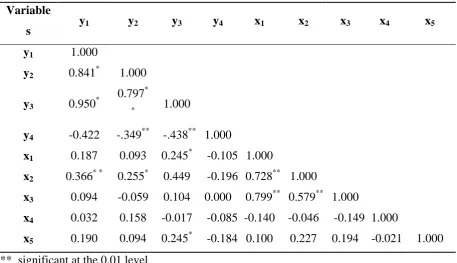
analysis has been tested by visual inspection of the correlation matrices (Table 2) , by the
Bartlett test of sphericity and by Keiser-Meyeer-Olkin (KMO) measure of sampling
adequacy. The Bartlett test produced the Chi-square values as 385.42 (P < 0.001) which
suggested that the original variables are significantly inter-correlated. The KMO statistic has
been obtained as 0.68 which suggests that there are sufficient numbers of indicators for each
factor. The Cattell’s scree plots (Fig 1) level out after third eigen value and the variance
contribution diminish after third component for all the periods, hence factor analysis has been
Fig 1: Scree plot for the number of factors to be retained
Table 2: Correlation matrix of indicators variables for socio-economic sector.
Variable
s y1 y2 y3 y4 x1 x2 x3 x4 x5
y1 1.000
y2 0.841* 1.000
y3 0.950*
0.797*
* 1.000
y4 -0.422 -.349** -.438** 1.000
x1 0.187 0.093 0.245* -0.105 1.000
x2 0.366* * 0.255* 0.449 -0.196 0.728** 1.000
x3 0.094 -0.059 0.104 0.000 0.799** 0.579** 1.000
x4 0.032 0.158 -0.017 -0.085 -0.140 -0.046 -0.149 1.000
x5 0.190 0.094 0.245* -0.184 0.100 0.227 0.194 -0.021 1.000
** significant at the 0.01 level * significant at the 0.05 level
The normal varimax rotated solution for 9 selected indicators of socio-economic
sector have been given in Table 3. The Table 3 reveals that three components have eigen
values above one contributing 73.19 per cent of the total variance.
0.0 1.0 2.0 3.0 4.0
0 1 2 3 4 5 6 7 8 9 10
Ei
gen
Va
lue
The factor analysis suggested three factors have been found crucial for
socio-economic development. The first factor has significantly high loading on the variables
namely LITERACY, LIT_MALE, LIT_FEMALE and BANK. This factor could be taken as
dimension of “Literacy and Banking”. This factor explains 38.73 per cent of the total
variance. The second factor has been identified as “Population Distribution and Vehicles” as
it loads very heavily on the variables like POP_DEN, URBAN_POP and VEH_REG. This
factor explains 23.69 per cent of the total variance. The third factor “Work Force” loads high
on M_WORKER only. This factor explained 10.76 per cent of the total variance.
A perusal of communality values indicates that for 7 variables, the communalities
exceed 70 per cent. Thus there is a fair degree of representation of all the 9 considered
variables by the three factors i.e. “Literacy and Banking”, “Population distribution and
vehicles” and “Work Force” identified crucial for socio-economic development.
In order to normalize these variables using monotonic transformation technique ,
these variables have been transformed to Normal distribution by normal score technique
(Jöreskoget al. 2000).
Table3: Normal varimax solution for variables of socio-economic Sector
Variables Factor 1 Factor 2 Factor 3 h2
LITERACY 0.95 0.13 -0.04 0.92 LIT_MALE 0.90 -0.01 0.10 0.81 LIT_FEMALE 0.94 0.19 -0.09 0.93 BANK -0.57 -0.07 -0.15 0.35 POP_DEN 0.07 0.93 -0.05 0.87 URBAN_POP 0.31 0.81 0.02 0.77 VEH_REG -0.08 0.91 -0.08 0.83 M_WORKER 0.07 -0.09 0.98 0.98 COOP_SOC 0.24 0.25 -0.05 0.13
Eigen Value 3.49 2.13 1.17
Percentage variance 38.73 23.69 10.77 Cumulative
The structural equation model of socio-economic sector of Haryana has been
hypothesized on the basis of the three latent variables as suggested by the preliminary
exploratory factor analysis and then further improved by freeing the elements of residual
matrices and adding or deleting the indicator variables to the latent variables as suggested by
the largest modification indices. The model parameters have been re-estimated after every
improvement. Finally, the model which converged to the optimum solution with acceptable
fit statistics has been obtained. The exogenous measurement models using (2) of socio
-economic sector have been given in matrix equation (7) as given below:
5 4 3 2 1 2 1 ) ( 52 ) ( 41 ) ( 32 ) ( 31 ) ( 22 ) ( 11 5 4 3 2 1 0 0 0 0 x x x x x x x x x x x (7)
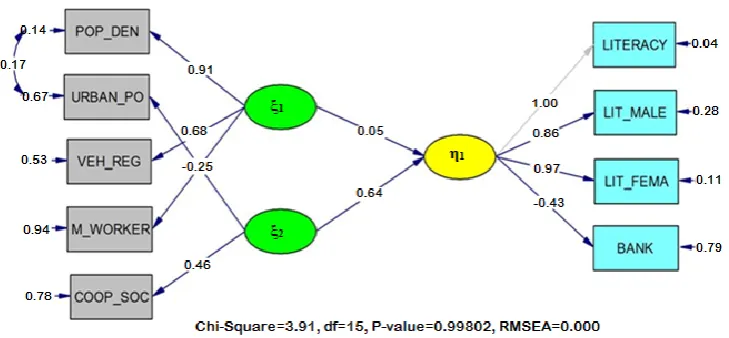
From the equations (7), it can be revealed that the exogenous latent variable ξ1 has
been measured by POP_DEN, VEH_REG with positive factor loadings and M_WORKER
with negative non-significant loading. The second latent dimension ξ2has positive significant
loadings on indicator variables like URBAN_POP, VEH_REG and COOP_SOC.The
endogenous measurement model using (2), has been formulated as
4 3 2 1 1 ) ( 41 ) ( 31 ) ( 21 ) ( 11 4 3 2 1 y y y y y y y y (8)The endogenous measurement model presented in (10) depict that the latent variable
η1 has been measured by the indicator variables namely LITERACY,LIT_MALE,
LIT_FEMALE and BANK.The structural equation model with latent variables using (3), has
been given by following equation
1 2 12 1 11
1
(9)The restricted model has been estimated by setting the off-diagonal elements of
and to zero. The restricted model has a Chi-square value of 30.90 (d.f = 24) with GFI =
0.90 and SRMR = 0.07 showing that it does not fit well to the data. The restricted models
matrices. The residual matrix of endogenous variables remained as diagonal matrix as given
below in (10).
44 33 22 11 0 0 0 0 0 0 (10)
In order to obtain the improved model which fit well to the data, certain elements of
Θδ and Θδϵ have been kept free as given below in (11) and (12).The improved model has
Chi-square value as 3.91 (d.f.=15), GFI as 0.99 and SRMR as 0.03 showing that model implied
correlation matrix is equal to population correlation matrix.
55 44 33 22 21 11 0 0 0 0 0 0 0 0 0 (11) and 0 0 0 0 0 0 0 0 0 0 0 0 52 51 43 42 32 23 13 12 (12)
The path diagram of final models which fit well to data for socio-economic sector
[image:9.595.117.482.553.722.2]with estimated coefficients has been presented in Fig 2.
Table4: Maximum likelihood estimates of structural equation model for socio-economic
sector
Parameter Estimate (S.E) Standardize
d Estimates Parameter Estimate (S.E)
Standardized Estimates
) ( 11
x
0.91 (0.16) 0.92 44 0.94 (0.17) 0.94
) ( 22
x
0.57 (0.16) 0.57 55 0.78 (0.18) 0.79 )
( 31
x
0.68 (0.15) 0.68 21 0.17 (0.10) 0.18
) ( 41
x
-0.25 (0.13) -0.25 11 0.04 (0.03) 0.04
) ( 52
x
0.46 (0.17) 0.46 22 0.28 (0.05) 0.29
) ( 11
y
1.00 0.98 33 0.11 (0.03) 0.11 )
( 21
y
0.86 (0.07) 0.84 44 0.79 (0.14) 0.79
) ( 31
y
0.97 (0.05) 0.94 12 -0.12 (0.06) -0.12
) ( 41
y
-0.46 (0.11) -0.45 13 0.06 (0.04) 0.06
21
0.46 (0.19) 0.46 23 0.14 (0.05) 0.1411
0.05 (0.21) 0.05 32 -0.15 (0.07) -0.1512
0.64 (0.24) 0.66 42 0.14 (0.07) 0.14 var(ζ1) 0.51 (0.21) 0.53
43 -0.07 (0.04) -0.07
11 0.14 (0.24) 0.15 51 -0.08 (0.05) -0.08
22 0.67 (0.17) 0.68
52 -0.20 (0.07) -0.20
33 0.53 (0.16) 0.53
χ2
(df=15) 3.91
GFI 0.99
SRMR 0.03
The un-standardized and standardized maximum likelihood estimates of the free
parameters of models have been presented in Table 4. The estimates in Table 4 indicated that
the exogenous variable ξ1 has a positive non-significant influence on the endogenous latent
variable η1 whereas exogenous latent variables ξ2 indicates a positive significant influence on
η1. Also the exogenous latent variables ξ1 and ξ2 have significant correlation. The estimates in
the Table 4 also revealed that the off-diagonal elements 21 of the residual matrix have
Using (6), the latent scores ξaiwere computed for each observation xij in the
] )
[(pq N sample matrix whose rows are observations on each of observed variables and
N is number of tehsils.These latent scores (ξai) were used for classifying the tehsils with
cluster analysis. In order to search for the number of groups which shows similar
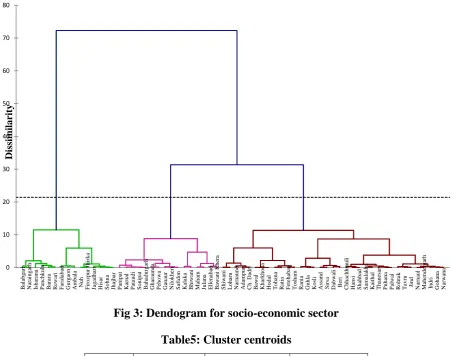
socio-economic characteristics, Ward’s hierarchical clustering method has been used on the latent
scores of three socio-economic dimensions. The Ward’s method based on squared Euclidean
distances has been used to form the dendogram (Fig 3). From the analysis the dendogram, it
has been concluded that 3-clusters solutions are appropriate for grouping of tehsils on the
basis of socio-economic characteristics. The average scores on the latent variables η1, ξ1 and
[image:11.595.71.525.304.660.2]ξ2 for the resulting three clusters are presented in Table 5.
Fig 3: Dendogram for socio-economic sector
Table5: Cluster centroids
Cluster η1 ξ1 ξ2
1 1.209 -0.179 -0.742
2 0.682 0.223 -1.127
B alabg arh Na ra ing arh Ishar ana P anc hkula B ara ra R ewa ri F arida ba d Gur g aon Amba la
Nuh Firoz
pur Jhirka Ja g adha ri
Hisar Sohna Jha
jhar
P
anipat Karna
l
P
ataudi
S
onipat Baha
durg arh Gha ra unda P ehowa Ga na ur Nilokher i S afidon Ka laka B hiwa ni Maha m Julana Ellena ba d B awa ni Khe ra S hiwa ni L oha ru Na rna und Ada mpur C h. Da dr i B awa l Kha rkhod a Hoda l Toha na R ati a F eteha ba d Tosha m R ania
Guhla Kosli Assa
nd S irsa Da bwa li B eri C hha chhra uli Ha nsi S ha hba d S amala kha Ka it ha l Tha ne sa r P nha na P alwa l R ohtak Ta vr u
Jind Narna
3 1.340 -0.129 -0.975
The non-hierarchical clustering procedure (K-means), using the cluster centres
presented in Table 5 of hierarchical solution as the initial seed points has then been used to
improve the results of best cluster solution derived by the Ward’s method. The improved
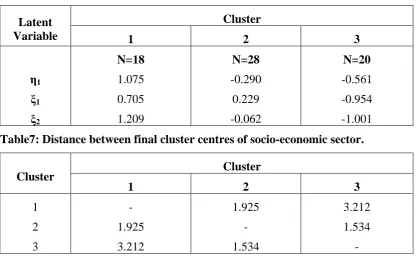
cluster solutions by K-mean procedure for the socio-economic sector have been presented in
Table 6. The perusal of the Table 6 indicated that cluster 1 comprising of 18 tehsils as
mentioned in Table 8 has been characterised by high scores on all the latent variables. The
Cluster 2 has moderately higher scores on all the latent variables compared to cluster 3 and
consisting of 28 tehsils as mentioned in Table 8. The remaining 20 tehsils form cluster 3
which has lower scores on all the latent dimensions. The largest distance of 3.212 between
the cluster 1 and 3 has also supported this fact that these clusters differ significantly with
respect to socio-economic characteristics. Further, the distance between cluster 1 and 2 as
well as cluster 2 and 3 indicates that these clusters are also dissimilar in socio-economic
characteristics.
Table6 : Final cluster centres of socio-economic sector
Latent Variable
Cluster
1 2 3
N=18 N=28 N=20
η1 1.075 -0.290 -0.561
ξ1 0.705 0.229 -0.954
[image:12.595.72.493.405.668.2]ξ2 1.209 -0.062 -1.001
Table7: Distance between final cluster centres of socio-economic sector.
Cluster Cluster
1 2 3
1 - 1.925 3.212
2 1.925 - 1.534
Table8 : Classification of tehsils for socio-economic development in Haryana State.
Cluster Tehsils
1 Hisar, Panchkula, Asandh, Isharana, Gurgaon, Sohna, Nuh, FirozpurJhirka, Faridabad, Balabgarh, Jagadhari, Kaithal, Sirsa,
Ambala, Barara, Narayangarh, Jhajhar, Rewari
2
Adampur, Hansi, Narnaund, Gohana, Fatehabad, Ratia, Narnaul,
Mahendergarh, Indri, Smalakha, Taoru, Punhana, Palwal, Rohtak,
Chhachhrauli, Jind, Narwana, Guhla, Thanesar, Shahbad, Dabwali,
Rania, Tosham, Siwani, Loharu, CharkhiDadri, Beri, Kosli
3 Sonipat, Kharkhoda, Ganaur, Tohana, Kalaka, Karnal, Gharaunda, Nilokheri, Panipat, Pataudi, Hodal, Meham, Julana, Safidon, Pehowa,
Ellenabad, BawaniKhera, Bhiwani, Bahadurgarh, Bawal
References
Joreskog, K.G. (2000). Latent variable scores and their uses. Scientific Software International, http://www.ssicentral.com/lisrel.
Joreskog, K.G., D. Sorbom, S.duToit and M. du Toit (2000).LISREL 8: New Statistical Features. Chicago: Scientific Software International.
Lipshitz, G. and A. Raveh (1994). Application the Co-Plot Method in the Study of Socio-economic differences among Cities: A Basis for a Differential Development Policy.
Urban Studies, 31: 123-135.
Lipshitz, G. and A. Raveh (1998). Socio-economic differences among localities: A new method of multivariate analysis. Regional Studies, 32: 747–757.
Narain, P., S.C. Rai, and P. Sarup (1991).Statistical evaluation of development on socio-economic front.Jour. Ind. Soc. Agric. Stat.43(3): 329-345.
Narain, P., S.D. Sharma, S.C. Rai and V.K. Bhatia (2001).Regional dimensions of disparities in crop productivity in Uttar Pradesh.Jour. Ind. Soc. Agric. Stat.54: 62-79.
Narain, P., S.D. Sharma, S.C. Rai and V.K. Bhatia (2007).Statistical evaluation of social development at district level.Jour. Ind. Soc. Agric. Stat.61(2): 216-226.
Soares, J.O.; M.M.L Marqus and C.M.F. Monteiro.(2003). A multivariate methodology to uncover regional disparities: A contribution to improve European Union and governmental decisions. European Journal of Operational Research, 145: 121–135.
Upadhyay, B. 2001.Statistical Assessment of Development in Rajasthan – A Spatial and Temporal Analysis. Unpublished Ph.D. Thesis, M.P.U.A.T, Udaipur.