Volume 2009, Article ID 941920,11pages doi:10.1155/2009/941920
Research Article
Probabilities as Values of Modular
Forms and Continued Fractions
Riad Masri and Ken Ono
Department of Mathematics, University of Wisconsin, Madison, WI 53706, USA
Correspondence should be addressed to Ken Ono,[email protected]
Received 12 May 2009; Accepted 26 August 2009
Recommended by Pentti Haukkanen
We consider certain probability problems which are naturally related to integer partitions. We show that the corresponding probabilities are values of classical modular forms. Thanks to this connection, we then show that certain ratios of probabilities are specializations of the Rogers-Ramanujan and Rogers-Ramanujan- Selberg- Gordon-G ¨ollnitz continued fractions. One particular eval-uation depends on a result from Ramanujan’s famous first letter to Hardy.
Copyrightq2009 R. Masri and K. Ono. This is an open access article distributed under the Creative Commons Attribution License, which permits unrestricted use, distribution, and reproduction in any medium, provided the original work is properly cited.
1. Introduction and Statement of Results
In a recent paper1, Holroyd et al. defined probability models whose properties are linked to the number theoretic functionspkn, which count the number of integer partitions ofn
which do not containkconsecutive integers among its summands. Their asymptotic results for eachklead to a nice application: the calculation of thresholds of certain two dimensional cellular automatasee1, Theorem 4.
In a subsequent paper 2, Andrews explained the deep relationship between the generating functions for pkn and mock theta functions and nonholomorphic modular
forms. Already in the special case of p2n, one finds an exotic generating function whose
unusual description requires both a modular form and a Maass form. This description plays a key role in the recent work of Bringmann and Mahlburg3, who make great use of the rich properties of modular forms and harmonic Maass forms to obtain asymptotic results which improve on1, Theorem 3in the special case ofp2n.
These problems are relatives of the following standard undergraduate problem. Toss a fair coin repeatedly until it lands heads up. If one flipsntails before the first head, what is the probability thatnis even? Since the probability of flippingntails before the first head is 1/2n1, the solution is
1 2
1 23
1 25 · · ·
1 1−1/2−
1 1−1/4
2
3. 1.1
Instead of continuing until the first head, consider the situation where a coin is repeatedly flipped: once, then twice, then three times, and so on. What is the probability of the outcome that eachnth turn, wherenis odd, has at least one head?
More generally, let 0< p <1, and let{C1, C2, . . .}be a sequence of independent events
where the probability ofCnis given by
PpCn:1−pn. 1.2
For each pair of integers 0≤r < t, we let
Ar, t:set of sequences whereCn occurs ifn /≡ ±r mod t. 1.3
In the case wherep 1/2, one can think of Cn as the event where at least one ofntosses
of a coin is a head. Therefore, ifp 1/2, the problem above asks for the probability of the outcomeA0,2.
Remark 1.1. Without loss of generality, we shall always assume that 0≤r≤t/2. In most cases
Ar, tis defined by two arithmetic progressions modulot. The only exceptions are forr0, and for eventwhenrt/2.
It is not difficult to show that the problem of computing
PpAr, t:“probability of Ar,t” 1.4
involves partitions. Indeed, if pr, t;n denotes the number of partitions of n whose summands are congruent to ±r modt, then we shall easily see that the probabilities are computed using the generating functions
Pr, t;q:
∞
n0
pr, t;nqn
⎧ ⎪ ⎪ ⎪ ⎪ ⎪ ⎪ ⎪ ⎪ ⎪ ⎨ ⎪ ⎪ ⎪ ⎪ ⎪ ⎪ ⎪ ⎪ ⎪ ⎩
∞
n0
1
1−qtnr1−qtnt−r, if 0< r <
t
2,
∞
n1
1
1−qtn, ifr0,
∞
n0
1
1−qtnt/2, ifr
t
2.
1.5
so it is natural to investigate the number theoretic properties of the probabilitiesPrAr, t
from this perspective.
Here we explain some elegant examples of results which can be obtained in this way. Throughout, we letτ ∈H, the upper-half of the complex plane, and we letqτ : e2πiτ. The Dedekind eta-function is the weight 1/2 modular formsee5defined by the infinite product
ητ:q1τ/24
∞
n1
1−qnτ. 1.6
We also require some further modular forms, the so-called Siegel functions. Foruandvreal numbers, letB2u:u2−u1/6 be the second Bernoulli polynomial, letz:u−vτ, and let
qz:e2πiz. Then the Siegel function gu,vτis defined by the infinite product
gu,vτ:−qτB2u/2e2πivu−1/2
∞
n1
1−qzqτn
1−qz−1qnτ. 1.7
These functions are weight 0 modular formse.g., see5.
For fixed integers 0≤r ≤t/2, we first establish thatPpAr, tis essentially a value of
a single quotient of modular forms.
Theorem 1.2. If 0< p <1 andτp:−logp·i/2π,then
PpAr, t ⎧ ⎪ ⎪ ⎪ ⎪ ⎪ ⎪ ⎪ ⎪ ⎪ ⎪ ⎪ ⎪ ⎪ ⎨ ⎪ ⎪ ⎪ ⎪ ⎪ ⎪ ⎪ ⎪ ⎪ ⎪ ⎪ ⎪ ⎪ ⎩
qt−1/24 τp ·
ητp
ηtτp, ifr 0,
q−t2/48 τp
1−qt/τp2
·η
τpηtτp
ηt/2τp , ifr
t
2,
−q
−2t1/24 τp e−πir/t
1−qrτp
· η
τp
g0,−r/ttτp, otherwise.
1.8
One of the main results in the work of Holroyd et al.see1, Theorem 2was the asymptotic behavior of their probabilities asp → 1. In Section 4we obtain the analogous results for logPpAr, t.
Theorem 1.3. Asp → 1, one has
−logPpAr, t∼ ⎧ ⎪ ⎪ ⎪ ⎪ ⎨ ⎪ ⎪ ⎪ ⎪ ⎩
π2
61−p
1−1
t
, ifr0, t
2,
π2
61−p
1−2
t
, otherwise.
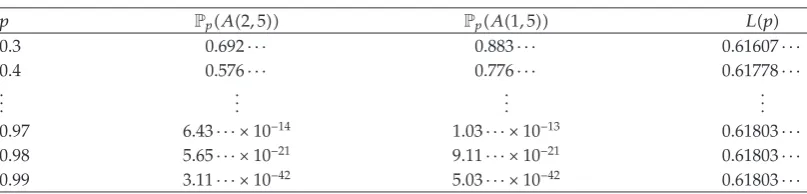
Table 1: Values ofLp.
p PpA2,5 PpA1,5 Lp
0.3 0.692· · · 0.883· · · 0.61607· · ·
0.4 0.576· · · 0.776· · · 0.61778· · ·
..
. ... ... ...
0.97 6.43· · · ×10−14 1.03· · · ×10−13 0.61803· · · 0.98 5.65· · · ×10−21 9.11· · · ×10−21 0.61803· · · 0.99 3.11· · · ×10−42 5.03· · · ×10−42 0.61803· · ·
To fully appreciate the utility ofTheorem 1.2, it is important to note that the relevant values of Dedekind’s eta-function and the Siegel functions can be reformulated in terms of the real-analytic Eisenstein seriessee5
Eu,vτ, s:
m,n∈Z2
m,n/ 0,0
e2πimunv ys
|mτn|2s, τxiy∈H, Res>1. 1.10
One merely makes use of the Kronecker Limit Formulas e.g., see 5, Part 4. These limit formulas are prominent in algebraic number theory for they explicitly relate such values of modular forms to values of zeta-functions of number fields.
We give two situations where one plainly sees the utility of these observations. Firstly, one can ask for a more precise limiting behavior than is dictated byTheorem 1.3. For example, consider the limiting behavior of the quotient Lp : PpA2,5/PpA1,5, asp → 1.
Table 1is very suggestive.
Theorem 1.4. The following limits are true:
lim
p→1
PpA2,5
PpA1,5
−1√5
2 ,
lim
p→1
PpA3,8
PpA1,8 −1 √
2.
1.11
Remark 1.5. Notice that1/2−1√5 −1φ, whereφis the golden ratio
φ: 1
2
1√51.61803. . . . 1.12
Theorem 1.4is a consequence of our second application which concerns the problem of obtaining algebraic formulas for all of these ratios, not just the limiting values. As a function ofp, one may compute the ratios of these probabilities in terms of continued fractions. To ease notation, we let
a1
b1
a2
b2
a3
denote the continued fraction
a1
b1
a2
b2
a3
b3· · ·
.
1.14
The following continued fractions are well known:
1 1
1 1
1 1···
1
1 1
1 1
1· · ·
−1
√
5
2 ,
1 2
1 2
1 2···
1
2 1
2 1
2· · ·
−1√2.
1.15
Theorem 1.4is the limit of the following exact formulas.
Theorem 1.6. If 0< p <1 andτp:−logp·i/2π, then one has that
PpA2,5
PpA1,5
1 1
qτp 1
q2 τp 1
q3 τp 1 ···
,
PpA3,8
PpA1,8
1 1qτp
q2 τp 1q3
τp q4
τp 1q5
τp q6
τp 1q7
τp···
.
1.16
Theorem 1.6can also be used to obtain many further beautiful expressions, not just those pertaining to the limit asp → 1. For example, we obtain the following simple corollary.
Corollary 1.7. Forp11/e2πandp2 1/eπ, one has that
Pp1A2,5
Pp1A1,5
e−2π/5
−φ
1 2
5√5,
Pp2A3,8
Pp2A1,8
e−π/242√2−32√2.
1.17
Remark 1.8. The evaluation ofPpA2,5/PpA,1,5whenp1/e2πfollows from a formula
in Ramanujan’s famous first letter to Hardy dated January 16, 1913.
We chose to focus on two particularly simple examples of ratios, namely,
PpA2,5
PpA1,5,
PpA3,8
PpA1,8. 1.18
One can more generally consider ratios of the form
PpAr1, t
PpAr2, t
. 1.19
It is not the case that all such probabilities, for fixedr1 andr2, can be described by a single
continued fraction. However, one may generalize these two cases, thanks toTheorem 1.2, by making use of the so-called Selberg relations6 see also7which extend the notion of a continued fraction. Arguing in this way, one may obtainTheorem 1.6in its greatest generality. Although we presentedTheorem 1.4as the limiting behavior of the continued fractions in Theorem 1.6, we stress that its conclusion also follows from the calculation of the explicit Fourier expansions at cusps of the modular forms inTheorem 1.2. In this way one may also obtainTheorem 1.4in generality. Turning to the problem of obtaining explicit formulas such as those in Corollary 1.7, we have the theory of complex multiplication at our disposal. In general, one expects to obtain beautiful evaluations as algebraic numbers wheneverτpis an
algebraic integer in an imaginary quadratic extension of the field of rational numbers. We leave these generalizations to the reader.
2. Combinatorial Considerations
Here we give a lemma which expresses the probability PpAr, t in terms of the infinite
products in1.5.
Lemma 2.1. If 0< p <1 andτp:−logp·i/2π,then
PpAr, t P
r, t;qτp
·∞
n1
1−qnτp· 2.1
Proof. By the Borel-Cantelli lemma, with probability 1 at most finitely many of theCn’s will
fail to occur. Now, for each pair of integers 0 ≤ r ≤ t/2, letSr, tbe the countable set of binary strings a1a2a3a4· · · ∈ {0,1}N in which an 1 ifn /≡ ±r mod t, and an 0 for at
most finitely manynsatisfyingn ≡ ±r mod twith the appropriate modifications on the arithmetic progressions modulo tfor r 0, and fort even with r t/2. Then the event
Ar, tcan be written as the countable disjoint union
Ar, t
a1a2a3···∈Sr,t
n:an1
Cn∩
n:an0 Cc
Using this, we find that
PpAr, t
a1a2a3···∈Sr,t
Pp
n:an1
Cn∩
n:an0 Cc
n
a1a2a3···∈Sr,t
n:an1
1−qnτp
n:an0
qn τp
∞
i1
1−qnτp
a1a2a3···∈Sr,t
n:an0
qn τp 1−qnτp
∞
n1
1−qnτp·
a1a2a3···∈Sr,t
n:an0
qn τpq
2n τp q
3n τp · · ·
∞
n1
1−qnτp· Pr, t;qτp
.
2.3
3. Proof of
Theorem 1.2
We first note thatqτp e2πiτp p, and by1.6we have
∞
n1
1−qnτp q−1/24 τp η
τp. 3.1
Now we prove each of the three relevant cases in turn. First, suppose thatr 0. By Lemma 2.1we need to show
q−1/24 τp η
τp
∞
n1
1−qtnτp−1qτtp−1/24 ητp
ηtτp. 3.2
This follows from the identity
∞
n1
1−qtnτp−1
∞
n1
1−qtτnp−1q1tτ/p24ηtτp−1. 3.3
Next, suppose thattis even andr t/2. ByLemma 2.1we need to show
q−1/24 τp η
τp
∞
n0
1−qtnτpt/2
−1
q
−t2/48 τp
1−qτt/p2
ητpηtτp
Observe that
∞
n1
1−qtnτpt/2
−1
∞
n1
1−q2t/n21τp−1
∞
n1
1−q2t/n2τp1−qnt/2τp−1
∞
n1
1−qntτp1−qnt/2τp−1.
3.5
Then3.4follows from the identities
∞
n1
1−qntτpqtτ−1p/24ηtτp,
∞
n1
1−qnt/2τp−1q1t//242τpη
t
2τp
−1
. 3.6
Finally, suppose that 0< r < t/2. ByLemma 2.1we need to show
q−1/24 τp η
τp
∞
n0
1−qτtnpr−11−qtnτpt−r−1−q
−2t1/24 τp e−πir/t
1−qrτp
ητp
g0,−r/ttτp.
3.7
Observe that
∞
n0
1−qτtnpr
1−qtnτpt−r
1−qτrp
1−qτt−pr
∞
n1
1−qτtnpr
1−qtnτpt−r
1−qτrp1−qτt−pr
∞
n1
1−qrτpqtnτp
1−q−1 rτpq
tn1
τp
1−qrτp1−q−1 rτpqtτp
1−q−rτ1pqtτp
∞
n1
1−qrτpqntτp
1−q−rτ1pqntτp
1−qτrp
∞
n1
1−qrτpqtτnp
1−q−rτ1pqntτp
3.8
It follows from the definition of the Siegel functiongu,vτthat
∞
n1
1−qrτpqntτp
from which we obtain
∞
n0
1−qtnτpr−11−qτtnpt−r−1−qτ−pt/12e−πir/t1−qrτp−1g0,−r/ttτp−1. 3.10
Substitute the preceding identity into the left-hand side of3.7to obtain the result.
4. Proof of
Theorem 1.3
Recall that the partition generating function is defined by
Gx:
∞
n1
1−xn−1, 0< x <1. 4.1
We now prove each of the relevant cases in turn. First, suppose thatr 0. ThenP0, t;qτp Gqt
τp, and byLemma 2.1,
−logPpA0, t logG
qτp
−logGqtτp. 4.2
Make the change of variablesxe−w. Then a straightforward modification of the analysis in
8, pages 19–21shows that, for each integerα≥1,
logGe−αw π
2
6αw 1 2log
1−e−αwCαOw asw−→0 4.3
for some constantCα. It follows from4.3that
logGqτp
−logGqtτp∼ π
2
61−p
1−1
t
asp−→1. 4.4
Next, suppose thattis even andr t/2. Then
P t
2, t;qτp
1
1−qτt/p2 ∞
n1
1−qnt/2τp−11−qtτnp
Gqt/2 τp
Gqt τp
−1
1−qt/τp2
, 4.5
and byLemma 2.1and4.3,
−logPp
A
t
2, t
log1−qτt/p2logGqτp
−logGqt/τp2logGqτtp
∼ π2
61−p
1−2
t
1
t
asp−→1.
Finally, suppose that 0< r < t/2. Then byLemma 2.1,
logPpAr, t logG
qτp
−log
∞
n0
1−qtnτpr−1
−log
∞
n0
1−qτtnpt−r−1
. 4.7
One can show in a manner similar to4.3that for each integerβ≥1,
log
∞
n0
1−e−αnβw−1
−log1−e−βw
∞
k1
e−βwk
αwk2
1
2log
1−e−αβwCα,βOw asw−→0
4.8
for some constantCα,β. It follows from4.3and4.8that
logGqτp
−log
∞
n0
1−qtnτpr
−1 −log
∞
n0
1−qtnτpt−r
−1
∼ π2
61−p
1−2
t
asp−→1.
4.9
5. Proof of
Theorem 1.6
and
Corollary 1.7
Here we proveTheorem 1.6and Corollary 1.7. These results will follow from well-known identities of Rogers-Ramanujan, Selberg, and Gordon-G ¨ollnitze.g., see9. We require the celebrated Rogers-Ramanujan continued fraction
Rqq1/5
1 1
q
1
q2
1
q3
1 ···
, 5.1
and the Ramanujan-Selberg-Gordon-G ¨ollnitz continued fraction
Hqq1/2
1 1q
q2
1q3
q4
1q5
q6
1q7···
. 5.2
It turns out that theseq-continued fractions satisfy the following identitiese.g., see10:
Rqq1/5∞ n1
1−q5n−11−q5n−4
1−q5n−21−q5n−3 q 1/5P
2,5;q
P1,5;q,
Hqq1/2∞ n1
1−q8n−11−q8n−7
1−q8n−31−q8n−5 q 1/2P
3,8;q
P1,8;q.
5.3
To proveCorollary 1.7, notice that ifp 1/e2π resp.,p 1/eπ, thenτp iresp.,
τp i/2. In particular, we have thatqτp e−2π resp.,qτp e−π.Corollary 1.7now follows from the famous evaluationse.g., see11and12, page xxviiwhich is Ramanujan’s first letter to Hardy
Re−2π−φ
1 2
5√5,
He−π42√2−32√2.
5.4
Acknowledgment
Ken Ono thanks the support of the NSF, the Hilldale Foundation and the Manasse family.
References
1 A. E. Holroyd, T. M. Liggett, and D. Romik, “Integrals, partitions, and cellular automata,” Transactions of the American Mathematical Society, vol. 356, no. 8, pp. 3349–3368, 2004.
2 G. E. Andrews, “Partitions with short sequences and mock theta functions,” Proceedings of the National Academy of Sciences of the United States of America, vol. 102, no. 13, pp. 4666–4671, 2005.
3 K. Bringmann and K. Mahlburg, “Asymptotics for partitions without sequences,” preprint.
4 G. E. Andrews, H. Eriksson, F. Petrov, and D. Romik, “Integrals, partitions and MacMahon’s theorem,” Journal of Combinatorial Theory. Series A, vol. 114, no. 3, pp. 545–554, 2007.
5 S. Lang, Elliptic Functions, vol. 112 of Graduate Texts in Mathematics, Springer, New York, NY, USA, 2nd edition, 1987.
6 A. Selberg, “ ¨Uber einge arithmetische Identit¨aten,” Avh. Norske Vidensk. Akad, vol. 23, no. 8, 1936.
7 A. Folsom, Modular units, Ph.D. thesis, University of California, Los Angeles, Calif, USA, 2006.
8 D. J. Newman, Analytic Number Theory, vol. 177 of Graduate Texts in Mathematics, Springer, New York, NY, USA, 1998.
9 K. Ono, The Web of Modularity: Arithmetic of the Coefficients of Modular Forms and q-Series, vol. 102 of CBMS Regional Conference Series in Mathematics, American Mathematical Society, Providence, RI, USA, 2004.
10 G. E. Andrews, B. C. Berndt, L. Jacobsen, and R. L. Lamphere, “The continued fractions found in the unorganized portions of Ramanujan’s notebooks,” in Memoirs of the American Mathematical Society, vol. 99, American Mathematical Society, Providence, RI, USA, 1992.
11 H. G ¨ollnitz, “Partitionen mit Differenzenbedingungen,” Journal f ¨ur die Reine und Angewandte Mathematik, vol. 225, pp. 154–190, 1967.