
Design of Modified Maiden Power System Stabilizer
Using Cuckoo Search Algorithm
D. K. Sambariya
Department of Electrical Engineering, Rajasthan Technical University, Kota, 324010, India
Copyright c2016 by authors, all rights reserved. Authors agree that this article remains permanently open access under the terms of the Creative Commons Attribution License 4.0 International License
Abstract
This article presents an improved maiden power system stabilizer (PSS) for enhancement of small signal stability of a power system. The free coefficients of proposed PSS are determined using optimization technique with the cuckoo search algorithms (CS-PSS). The performance of the CS-PSS is validated on single-machine infinite-bus power and extended to a multi-machine power system. These results are compared to the newly introduced maiden PSS structure and found superior in terms of settling time and performance indices.Keywords
Power System Stabilizer, Single-machine infinite-bus power system, Two-area Four-machine Ten-bus Power System, Cuckoo Search Algorithm, Maiden PSS1
Introduction
The energy issue is one of the important challenges in modern scenario. It consists of the power generation, trans-mission and distribution of the energy to the end users. The resulting network is a large and complex in sense of analysis and operation. On occurrence of sudden load changes and faults on the system, results to small signal oscillations in the range of 0.2 Hz to 3.0 Hz. These oscillations tend to die-out automatically, but some of these may persist for a longer time causing power transfer impossible over the weak trans-mission lines [1].
In early phase of 1960s, the fast acting, high-gain auto-matic voltage regulators (AVR) were applied to the generator excitation system which in-turn invites the problem of low frequency electromechanical oscillations in the power sys-tem. The device connected to generator excitation to control the oscillations were termed as power system stabilizer. It adds a stabilizing signal to AVR for modulating the genera-tor excitation such as to create an electric genera-torque component in phase with rotor speed deviation, which increases the gen-erator damping [2].
These stabilizers were designed to make system oscilla-tion free with different structural designs and/or control
tech-niques. The early development of PSS were lead-lag and were called as conventional power system stabilizer. Sim-ilar to CPSS; a Proportional-Integral-Derivative (PID) con-troller may be connected to modulate the signal of the AVR to damp-out the small signal oscillations. The conventional tun-ing method of the PID gains is based on as Zeigler/Nichol’s method, gain-phase margin method, Cohen/Coon pole place-ment, gain scheduling and minimum variance methods. Re-cently, a new PSS structure is proposed in [3], as similar to CPSS and PID based PSS. However, these methods suffer from some limitations as (a) extensive methods to set gains, (b) difficulty to deal with gains for a large, complex and non-linear power system, and (c) poor performance in a closed loop because of changing conditions [4, 5].
The design of power system stabilizer is explored using fuzzy logic controller [6, 7]. It have been considered for multi-machine models of power system in [8, 9]. The role of membership function in the design of PSS is examined in [10] and with different de-fuzzification methods in [11]. The robust fuzzy PSS is presented in [12]. The role of mem-bership funtion based on linguistic variables are examined in [13].
To mitigate the shortcomings of these conventional meth-ods much optimization based algorithms have been pro-posed. The methods available in literature are as Tabu search [14], Evolutionary algorithm [15], the Differential Evolu-tion (DE) algorithm [16], Simulated Annealing [17], Genetic Algorithm [18], particle swarm optimization [19], an iter-ative linear matrix inequalities algorithm [20], Combinato-rial Discrete and Continuous Action Reinforcement Learn-ing Automata (CDCARLA) [21], Bacteria ForagLearn-ing Opti-mization (BFO) Algorithm [22], Bat Algorith (BA) as in [23, 24, 25, 26, 27], Harmony Search algorithm (HSA) as in [28, 29, 5], Fire fly algorithm (FFA) [30] and other than the optimization, some artificial intelligence based, techniques such as type-1 Fuzzy logic based PSS [31, 29, 28, 32, 33], In-terval type-2 Fuzzy logic based PSS [34, 35, 36], ANN [37] etc. are ready for use in the design of PSS.
may give degraded results with a large computational burden. Meta-heuristic algorithms possess two important charac-teristics like intensification (or exploitation) and diversifica-tion (or exploradiversifica-tion) is considered as upper-level methods for the optimization. Genetic algorithm [38, 39] and parti-cle swarm optimization [40, 19, 41] are the typical types of meta-heuristic algorithms for global optimization in the de-sign of a power system stabilizer.
Yang and Deb in 2009 [42], have introduced a promising nature -inspired metaheuristic algorithm called as Cuckoo search (CS) and extended to engineering optimization in [43] and multi-objective optimization in [44, 45, 46]. Civi-cioglu and Besdok (2013) [47], have introduced a concep-tual comparison of cuckoo search with differential evolu-tion (DE), particle swarm optimizaevolu-tion (PSO), artificial bee colony (ABC) and suggested that differential evolution and cuckoo search algorithms provide more improved results than ABC and PSO. Gandomi et al. (2013) [48], provided a more extensive comparison study for solving various sets of structural optimization problems and concluded that cuckoo search obtained improved results than other algorithms such as PSO and genetic algorithms (GA). Among the diverse ap-plications, an interesting performance enhancement has been obtained by using cuckoo search in reliability optimization problems in [49].
The main concern of this article is to evaluate and modify the maiden PSS structure proposed in [3]. The maiden PSS structure is modified with the knowledge of modern control theory as required for system to be stable resulting addition of non-zero in the numerator part of the compensator. The free elements of such modified maiden PSS are optimized using CSA (PSS: Proposed) and compared to the maiden PSS (PSS: Falehi) by connecting both controllers to SMIB and multi-machine power system.
In the organization of paper, the problem is formulated in section 2. The Cuckoo search algorithm which is used to op-timize the PSS controller parameters is introduced in section 3. The performance analysis is carried out in section 4, for single-machine infinite-bus power system and multi-machine power system model. Lastly the analysis is concluded in sec-tion 5, followed by appendix and references.
2
Problem Formulation
The general representation of a power system using non-linear differential equations can be given by
˙
X=f(X, U) (1) Where,X andU represents the vector of state variables and the vector of input variables. As in [29], the power system stabilizers can be designed by use of the linearized incremental models of power system around an operating point. The system representation based on differential equa-tions and used data is given in [23]. The state equaequa-tions of a power system can be written as
∆ ˙X =A∆X+BU (2)
2.1
SMIB power system [image:2.595.305.533.212.380.2]The schematic diagram of the single-machine connected to an infinite-bus (SMIB) through a transmission line is shown in Fig 1. It includes the generator, AVR and excitation system, PSS, transmission line and the infinite-bus. The infinite-bus system is the representation of a large intercon-nected power system which is generally represented by the Thevenins equivalent.
Figure 1.The schematic representation of SMIB system
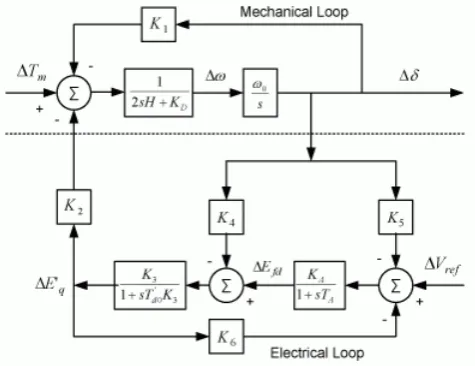
[image:2.595.301.539.428.611.2]Heffron-Phillip linearized model and the connection to FPSS with scaling factors is shown in Fig. 2 [16].
2.2
Two-area four-machine power system [image:3.595.58.308.355.503.2]The schematic diagram of the four-machine ten-bus power system is shown as in Fig. 3. The analysis of the sys-tem can be carried out by simultaneous solution of equations consisting of synchronous machines with excitation systems, prime movers, dynamic and static loads, transmission line network, and other devices like static VAR and HVDC con-verters based compensators. The dynamics of generator ro-tors, prime movers, excitation, and other related devices are being represented by differential equations. Thus, the com-plete multi-machine model consists of large numbers of or-dinary differential equations (ODE) and algebraic equations [28, 29]. These are linearized about an operating point (nom-inal) to derive a linear model for the small signal oscillatory behaviour of power systems. The range of variation in oper-ating point can generate a set of linear models corresponding to each operating point/condition.
Figure 3. Representation of line diagram for fou-machine ten-bus power system
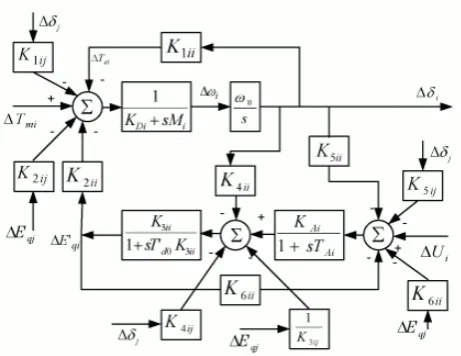
Figure 4. Representation of Heffron-Phillip model for multi-machine con-figuration of power system
The state equations of a power system, consistingN num-ber of generators andNpssnumber of power system
stabiliz-ers can be written as in Eqn. 2. Where,Ais the system ma-trix with order as4N×4N (16×16)&is given byδf /δX,
whileBis the input matrix with order4N ×Npss (16×4)
and is given byδf /δU. The order of state vector is4N×1
(16×1), the order of isNpss ×1 (4×1). Here, the well
known Heffron-Phillip linearized model is used to represent the large multimachine power system as in Fig. 4 [29].
2.3
PSS proposed in Falehi [3] and ProposedThe general requirement of a power system stabilizer to compensate the developed phase lag in between excitation in-put and air-gap torque, therefore, a phase compensator block is needed. In 2013 [3], Falehi have proposed a new struc-ture of PSS as in Fig. 5, but it lakes with the provision of proper phase compensation in compensation block. There-fore, in Fig. 6, proper phase compensation is introduced by non-zero in the phase compensation block. Derivative and integral blocks are kept same as in Falehi PSS [3]. In case of Falehi PSS, there are four parameters (Tc,Ac,Ki,Kd) to be
optimized by cuckoo search algorithm, while these are five (Tp,Tc,Ac,Ki,Kd)in the proposed new PSS structure as in
Fig. 6.
[image:3.595.61.292.557.735.2]Figure 5.PSS structure as in [3]
Figure 6.Proposed PSS structure
2.4
Objective functionTo increase the system damping to electromechanical modes, of the power system model five different objective functions are considered. The problem constraints are as the parameters of the controllers connected to the power system. The unknown parameter bounds are considered as in Eqn. 3 - 7.
Tpmin≤Tp≤Tpmax (3)
Tcmin≤Tc≤Tcmax (4)
Aminc ≤Ac≤Amaxc (5)
Kimin≤Ki≤Kimax (6)
Kdmin≤Kd≤Kdmax (7)
Typical ranges of the optimized parameters are 0.1 ≤
Tp ≤1.5,10≤Tc ≤30,10≤Ac ≤20,0.01≤Ki≤0.5,
the controller are determined by HS algorithm under the one objective function as describe following.
J|SM IB=
t=Tsim
Z
t=0
|∆ω(t)|2dt (8)
J|M M =
t=Tsim
Z
t=0 4
X
i=1
|∆ωi(t)|
2
dt (9)
3
Cuckoo Search Algorithm
The application of CS algorithm in the field of optimiza-tion has received appreciable attenoptimiza-tion. It has been modified time to time according to problem requirements. It have been modified to deal with mult-objective problems by Yang and Deb [44] and proposed a modified CS algorithm by Walton et al. in [51].
As the Cuckoos lay their eggs in the nest of other birds and respective host birds take care of the cuckoos chicks [52]. It is mainly inspired by the obligate brood parasitism of cuck-oos by laying their eggs in the nests of other host birds. The infringing cuckoos are in direct contest with the host birds. The host bird discovers the eggs of other birds and may throw these out of nest or may construct another nest elsewhere. The Parasitic cuckoos generally selects a nest in which the host bird just laid its own eggs [52]. The Cuckoo eggs gen-erally hatch somewhat earlier than their host eggs [53]. As soon as, cuckoo chick is hatched starts to evict y blindly pro-pelling the eggs out of the nest to reduce the share of food. Cuckoo chick starts to mimic the voice call of host chicks to gain more opportunity of feeding [52, 54].
An algorithm provides a set of output variables on appli-cation of input variables. An optimization algorithm gener-ates/produces a new set of solutionxt+1to a given problem from a given solutionxtat timetor iteration.
xt+1=A{xt, p(t)} (10) Where, the new solution vector xt+1 is nonlinearly
mapped through A to given d-dimensional vector xt. Let
the variables of the problem are k and are represented as
p(t) = p1, p2, ..., pk which may be time dependent and can
be tuned byA. Let an optimization problem is S with states as ψ then according to pre-define criterion D, the optimal solutionxosselects the desired states asφas in Eqn. 11.
S(ψ)−→A(t)S{φ(xos)} (11)
Thus, the final found/converged stateφrepresents to an op-timal solution of the problem of interest. Here, the system states are selected in the design space by running the opti-mization algorithmA. Thus, the performance of the algo-rithm is depended /controlled by the initial solutionxt=0, the
parametersp, and stopping criterion.
3.1
Procedural stepsThe Cuckoo search algorithm is based on the brood par-asitism of some cuckoos such as theani andGuira and is
enhanced by use of Levy flights [55], not just by simple isotropic random walks. The Cuckoos are special birds not only because of the beautiful sounds but also because of their aggressive reproduction strategy. Cuckoos engage the obli-gate brood parasitism by laying their eggs in the nests of other host birds. TheaniandGuiraas the species of cuckoos used to lay their eggs in other birds nests and they may remove others eggs to increase thehatching probabilityof their own eggs. It is necessary to make assumptions as followings:
Assumptions
• At a time each cuckoo lays one egg and dumps it in a randomly selected nest
• The nests with high-quality eggs are selected and being carried over to the next generations
• The available number of nests (of hosts) is kept fixed (as n), and the probability of cuckoo egg detection by the host bird is fixed asPa ∈[1,0]. As above, the host
bird may get rid of the egg or may even abandon the nest to build a new nest i.e a fractionPa of thenhost nests
that are replaced by new nests [52].
Further, as an implementation, it should be assumed that the solution refers to an egg in a nest, and each cuckoo can lay only one egg. Thus, there is no distinction between cuckoo, egg or nest because as each nest consists one egg which cor-responds to one cuckoo. CS algorithm uses a combination of a local random walk (for local search) and the global ran-dom walk (for global search) and is controlled by a switching parameterPa.
Local random walk: Let two different solutions selected by random permutation are asxtjandxtk, Heaviside function asH(Pa− ∈), random number drawn from a uniform
distri-bution as∈, and with step size ass. Then, the local random walk can be represented as.
xti+1=xti+αs⊗H(Pa− ∈)⊗(xtj−x t
k) (12)
Here, α > 0 is the step size related to the scales of the problem of interests. It is generally selected asα = 0.The product⊗means entry-wise walk during multiplications.
Global random walk: The global random walk is carried out by using Levy flights in which the step-lengths are dis-tributed according to a heavy-tailed probability distribution [52]. On completion of large number of steps the random walk tends to a stable distribution as compared to its origin. The final solution can be represented by Eqn. 13 as follow-ing.
xti+1=xti+αL(s, λ) (13)
L(s, λ) = λΓ(λ) sin(πλ/2)
π
1
s1+λ (14)
The Eqn. 13 is the stochastic representation for a random walk. The random walk is a Markov chain; whose next loca-tion directly depends on the current localoca-tion and the tran-sition probability. An appropriate value of new solutions generated by randomization and their locations should be far enough from the best solution (current) to make sure not be trapped in a local optimum [53, 42]. The local search exists about to 1/4 of the search time (withPa= 0.25), while global
L´evy distribution:Levy flights are characterized by infinite mean and variance therefore, CS can explore the search space more efficiently as compared to standard Gaussian process. Thus, CS guaranteed global convergence and highly efficient [53, 56, 57].
In L´evy flight the step-lengths are distributed according to the probability distribution as in Eqn. 15, which provides a random walk while the random step length is drawn from a Levy distribution for1≤λ≤3[53].
Levy(u) =t−λ (15) Improved cuckoo search:As above theαintroduced in the CS is to find locally improved solutions, whilePa andλto
find global solution. In tuning of solution vectors; the param-etersPa andαplays a vital role. In original CS,Pa andα
are kept fixed and cannot be altered during new generations, therefore, the number of iterations kept large to get optimal solutions. With large value ofPa and small value ofα, the
convergence speed is high but unable to find required solu-tions. To mitigate the problem of adjusting the value ofPa
andα, these are considered as variables in improved CS. The values ofPaandαmust be large enough to make capable the
algorithm to increase the diversity of solution vectors during early generations and decreased in final generations to result in a better fine-tuning of solution vectors. Thus,Pa andα
are dynamically changed with the number of generation and expressed in Eqn. 16 - Eqn. 18, whereN I andgnare the number of total iterations and the current iteration, respec-tively [52].
Pagn=Pa,max−
Pa,max−Pa,min
N I gn (16) α(gn) =αmax×e(c.gn) (17)
c=Ln(αmin/αmax)
N I (18)
The performance of the algorithm may deteriorate by an increase in the maximum value of αas in [52], therefore, the suitable values are0.005 ≤Pa ≤1.0and0.05≤ α≤
0.5. The considered values ofPa andαare 0.25 and 0.25,
respectively. The Cuckoo Search is shown in Algorithm 1.
4
System response and discussion
4.1
SMIB power system4.1.1 Controller parameter optimization
In order to assess effectiveness, the proposed CS-PSS al-gorithm is programmed in MATLAB R2011b environment and executed on Intel (R) Core (TM) - 2 Duo CPU T6400 2.00 GHz with 3 GB RAM, 32-bit operating system. The pa-rameters of the algorithm used for simulation are: n = 25,
Pa= 0.25and Iteration as 200 as in Algorithm 1. The plant
(SMIB power system) operating at nominal operating con-dition (where in Xe = 0.4p.u. and P = 1.0p.u.) is
con-sidered for optimal tuning of PSS parameters as proposed in [28]; subjected to the ISE minimization based objective func-tion with the parametric bounds such as 0.1 ≤ Tp ≤ 1.5,
Algorithm 1Cuckoo search algorithm for tuning parameters of conventional power system stabilizer
1: procedure OBJECTIVE FUNCTION F(X), X = (X1, X2, ..., Xd)T(minimization of objective function;
whereXdis the number of free Coefficients of CPSS)
2: Initialize a population of a host nest,xi,(i= 1,2, ..., n);
selected asn=25, lower and upper bound are defined in vector
3: for i = 1 : n, nest(i,:)=Lb+(Ub − Lb). ∗
rand(size(Lb))do
4: end for
5: whileiter < M aximumgenerationsdo
6: Get a cuckoo (sayi) randomly&generate a new solution by levy flights as in Eqn. 15. Evaluate its quality / fitness
Fi,Choose a nest amongn(sayj) randomly.
7: ifFi< Fjthen
8: Replacingjby the new solution i.e. replacing with min-imum function value.
9: end if
10: Abandon a fraction (Pa) of worse nests and generate
(Pa ∈ [0,1], as 0.25 in Eqns. 16 - 18 new solutions
at new location by Levy flights (as in Eqn. 15)
11: keep the best solutions(bestnest) i.e. nests with qual-ity solutions rank the solutions and find the current best (fmin);
12: iter=iter+ 1; (update iteration counter)
13: F cs(iter,:) = fmin; save Fcs.mat{to plot fitness
func-tion or value at each iterafunc-tion[200×1] as in Fig. 8 - Fig. 9}
14: P cs(iter,:) = bestnest; save Pcs.mat {Parameters or value at each iteration}
15: end while
16: post process results(fmin, bestnest) and visualization
17: end procedure
10 ≤ Tc ≤ 30, 10 ≤ Ac ≤ 20, 0.01 ≤ Ki ≤ 0.5 and
200 ≤ Kd ≤ 300. The scheme of optimization is shown
in Fig. 7 and the performance of cuckoo search in terms of fitness function variation is shown in Figs. 8 - 9. The op-timized parameters for both PSSs (Falehi PSS and Proposed PSS) at nominal operating condition are enlisted in Table 1. The fitness function value at200thiteration for Falehi PSS
and proposed PSS are as8.352×10−4 and7.053×10−4,
respectively.
Table 1.Optimized parameters using cuckoo search algorithm for PSS (Proposed) and PSS (Falehi) [3]
Structure Tp Tc Ac Ki Kd
PSS: Proposed 0.3991 22.9353 16.0501 0.0027 300
[image:6.595.306.530.117.342.2]PSS: Falehi [3] - 14.5637 10 0.0187 200
Figure 8. Performance of cuckoo search algorithm in parameter optimiza-tion for Falehi PSS Structure [3] in SMIB system
Figure 9. Performance of cuckoo search algorithm in parameter optimiza-tion for proposed PSS Structure in SMIB system
4.1.2 Performance analysis
[image:6.595.59.267.389.546.2]The considered power system is subjected to fault at 5 sec-onds (persists up to 0.1 second i.e. cleared at 5.1 secsec-onds) and the performance of both PSS structures in terms of gen-erator speed, control voltage, voltage behind transient reac-tance, air-gap electric torque, power angle and terminal volt-age is compared fin Fig. 10 - 15. It is clear that the system behaviour without PSS is unstable, while it is being stabi-lized using either PSS structure. The recorded settling time with PSS [3] is 15.1 seconds and with PSS (Proposed is 8.2 seconds) as shown in Fig. 10, results heavy performance im-provement with proposed PSS. The other signal variations with proposed PSS structure, such as control voltage, volt-age behind transient reactance, air-gap electric torque, power angle and terminal voltage shown in Fig. 11 - Fig. 15, re-spectively are also settled to steady state appreciably earlier than that with PSS structure as in [3].
[image:6.595.313.521.392.548.2]Figure 10.Plot of SMIB response with PSS structure proposed as in [3] and proposed PSS structure for speed deviation
Figure 11.Plot of SMIB response with PSS structure proposed as in [3] and proposed PSS structure for control signal
[image:6.595.314.521.603.758.2]Figure 13.Plot of SMIB response with PSS structure proposed as in [3] and proposed PSS structure for electric torque
Figure 14.Plot of SMIB response with PSS structure proposed as in [3] and proposed PSS structure for change in angle
Figure 15.Plot of SMIB response with PSS structure proposed as in [3] and proposed PSS structure for terminal voltage
4.2
Two-area four-machine ten-bus power system4.2.1 Controller parameter optimization
Considering same parameters of CS algorithm as in pre-ceding section and the actuating data for line diagram in Fig. 3 as in [29, 28] equipped with four controllers to four gen-erators are optimized. The performance of CSA in terms of fitness function (J for multi-machine) variation is recorded as in Fig. 16 and Fig. 17. The fitness function value at the 200th iteration with PSS structure as in [3] is 0.2271 and with the PSS (proposed) is 0.0511.
The higher value of fitness function with PSS [3] rep-resents its premature optimization at 20th iteration and on
[image:7.595.336.525.279.420.2]wards. The optimized parameters with both controllers are
[image:7.595.86.272.281.418.2]Figure 16.Performance of cuckoo search algorithm in parameter optimiza-tion for Falehi PSS Structure [3] in Two-Area System
Figure 17.Performance of cuckoo search algorithm in parameter optimiza-tion for proposed PSS Structure in Two-Area System
enlisted in Table 2. The speed signal for all four generators (Gen-1 to 4) without PSS, with PSS [3] and with PSS (Pro-posed) is recorded in Fig. 18 - Fig. 21, respectively. It is clear from these figures that all generators without PSS show unstable behaviour and response with both PSSs as stable. As a comparison the settling time with both PSS structure is recorded in Table 3 and is clear that the performance with proposed PSS is very encouraging because settling to steady state quite earlier. The5thcolumn of Table 3 represents the
percentage improvement (about 86 to 88).
Figure 18.Speed response of two-area power system without PSS, with PSS structure as in [3] and with PSS (Proposed) for Generator-1
[image:7.595.84.271.466.602.2] [image:7.595.339.526.605.748.2]Table 2.Cuckoo search based optimized parameters for (a) PSS: Falehi [3] and (b) PSS: Proposed
Controller Genrs Controller Parameters
Tp Tc Ac Ki Kd
PSS: Proposed
Gen-1 0.10 10.00 10.71 0.28 295.82
Gen-2 0.31 10.01 10.24 0.06 296.44
Gen-3 0.11 12.28 19.76 0.50 200.00
Gen-4 1.01 10.00 10.25 0.50 289.79
PSS: Falehi
Gen-1 - 30.00 10.00 0.49 200.00
Gen-2 - 20.40 10.00 0.50 299.99
Gen-3 - 30.00 10.00 0.50 200.01
[image:8.595.45.537.278.517.2]Gen-4 - 30.00 10.00 0.50 200.07
Table 3.Settling time in seconds for speed response of system without PSS, with PSS: Falehi [3] and with PSS: Proposed
Generator Without PSS PSS:Falehi [3] PSS: Proposed Improved (%)
Gen-1 Unstable 84.83 10.92 87.13
Gen-2 Unstable 95.32 11.32 88.12
Gen-3 Unstable 71.88 8.461 88.23
Gen-4 Unstable 71.60 9.407 86.86
[image:8.595.68.256.583.726.2]Figure 19.Speed response of two-area power system without PSS, with PSS structure as in [3] and with PSS (Proposed) for Generator-2
Figure 20.Speed response of two-area power system without PSS, with PSS structure as in [3] and with PSS (Proposed) for Generator-3
[image:8.595.307.541.585.766.2]types of performance indices (PIs) are introduced as in Eqn. 19 - Eqn. 21 and evaluated as in Table 4.
Figure 21.Speed response of two-area power system without PSS, with PSS structure as in [3] and with PSS (Proposed) for Generator-4
• ITAE: Integral of the Time-Weighted Absolute Error
IT AE=
Tsim
Z
0
t|∆ω(t)|dt (19)
• ISE: Integral Square Error
ISE=
Tsim
Z
0
|∆ω(t)|2dt (20)
• IAE: Integral of the Absolute Error
IAE=
Tsim
Z
0
|∆ω(t)|dt (21)
where,Tsim is the simulation time of the system
Table 4.Performance indices (ITAE, IAE and ISE) for speed response with (a) PSS: Falehi [3] and (b) PSS: Proposed
Genr. ITAE IAE ISE
Falehi Prop. Falehi Prop. Falehi Prop.
G-1 0.7128 0.0092 0.0326 0.0034 3.0848E-05 4.1870E-06
G-2 0.7221 0.0088 0.0326 0.0032 3.0204E-05 3.8272E-06
G-3 0.7018 0.0112 0.034 0.0053 4.5987E-05 1.9542E-05
G-4 0.5384 0.0120 0.0272 0.0047 3.0717E-05 1.4110E-05
5
Conclusion
In this paper a new structure of power system stabilizer to improve small signal stability is introduced. The appli-cation of this PSS is applied to single-machine infinite-bus power system and two-area four-machine ten-bus power sys-tem and, moreover, the performance is compared to the newly introduced PSS structure in [3] and without PSS. It is estab-lished that the performance with proposed PSS is highly en-couraging and found better as compared to PSS by Falehi. The results are incorporated in terms of settling time and per-formance indices (ITAE, IAE and ISE) found as least with proposed PSS as compared to PSS structure in [3].
REFERENCES
[1] D. K. Sambariya and R. Gupta, “Fuzzy applications in a multi-machine power system stabilizer,” Journal of Electrical Engineering and Technology, vol. 5, no. 3, pp. 503–510, 2010. [Online]. Available: http://www. jeet.or.kr/ltkpsweb/pub/pubfpfile.aspx?ppseq=100 [2] H. M. Soliman, “Resilient observer-based power
system stabilizers,” Transactions of the Institute of Measurement and Control, 2015. [Online]. Avail-able: http://tim.sagepub.com/content/early/2015/03/06/ 0142331215572418.abstract
[3] A. D. Falehi, “Design and scrutiny of maiden pss for alleviation of power system oscillations using rcga and pso techniques,”Journal of Electrical Engineering & Technology, vol. 8, no. 3, pp. 402 – 410, 2013. [Online]. Available: http://dx.doi.org/10.5370/JEET. 2013.8.3.402
[4] H. M. Soliman, E. H. E. Bayoumi, and M. F. Hassan, “Power system stabilizer design for minimal overshoot and control constraint using swarm optimization,” Electric Power Components and Systems, vol. 37, no. 1, pp. 111–126, 2008. [Online]. Available: http://dx.doi.org/10.1080/15325000802322053 [5] D. K. Sambariya and R. Prasad, “Design of robust
PID power system stabilizer for multimachine power system using HS algorithm,” American Journal of Electrical and Electronic Engineering, vol. 3, no. 3, pp. 75–82, 2015. [Online]. Available: http: //dx.doi.org/10.12691/ajeee-3-3-3
[6] D. K. Sambariya and R. Gupta, “Fuzzy logic based power systems stabilizer for kota thermal power
station,” in International Conference on Computers, Controls and Communication (INCON-CCC-2004), 2004, pp. 307–316. [Online]. Available: http://dx.doi. org/10.13140/RG.2.1.2280.5523
[7] D. K. Sambariya, R. Gupta, and A. K. Sharma, “Simulation of fuzzy logic power system stabi-lizer,” in IEE Sponsored National Conference on Power Engineering Practices & Energy Management, (PEPEM-2005), 2005, pp. 32–35. [Online]. Available: http//dx.doi.org/10.13140/RG.2.1.2539.2402
[8] D. K. Sambariya and R. Gupta, “Fuzzy logic based power system stabilizer for multi-machine system,” in Thirteenth, National Power Systems Conference (NPSC-2004), 2004, pp. 257–261. [Online]. Available: http://dx.doi.org/10.13140/RG.2.1.1412.2007
[9] D. K. Sambariya and R. Gupta, “Fuzzy logic based ro-bust multi-machine power system stabilizer,” in Inter-national Conference on Computer Applications in Elec-trical Engineering Recent Advances, (CERA-2005), 2005, pp. 436–442.
[10] D. K. Sambariya, R. Gupta, V. Vishnoi, and M. K. Meena, “Fuzzy logic based power systems stabilizer for single machine with different membership func-tions,” in National Seminar on Engineering Compu-tational Techniques and their Applications, (ECTTA-2005), 2005, pp. 1–6.
[11] D. K. Sambariya, R. gupta, O. P. Dudi, and V. Vish-noi, “Fuzzy logic based multi-machine power system stabilizer with different deffuzification methods,” in In-ternational Conference On Power, Energy & It Sector, (Peitsicon-2005), 2005, pp. 142–146. [Online]. Avail-able: http://dx.doi.org/10.13140/RG.2.1.2801.3841 [12] D. K. Sambariya, R. Gupta, and V. Vishnoi, “Robust
fuzzy logic based power system stabilizer,” inNational Conference on Communication, Control and Bioinfor-matics, (NCCB 2006), 2006, pp. FZ–09 (1–6).
[13] D. K. Sambariya and R. Prasad, “Selection of membership functions based on fuzzy rules to design an efficient power system stabilizer,”International Journal of Fuzzy Systems, pp. 1–16, 2016. [Online]. Available: http://dx.doi.org/10.1007/s40815-016-0197-6
[15] S. Panda, “Multi-objective evolutionary algorithm for sssc-based controller design,” Electric Power Systems Research, vol. 79, no. 6, pp. 937 – 944, 2009. [Online]. Available: http://www.sciencedirect.com/ science/article/pii/S0378779608003222
[16] M. Abido, “Robust design of power system sta-bilizers for multimachine power systems using dif-ferential evolution,” in Computational Intelligence in Power Engineering, ser. Studies in Compu-tational Intelligence, B. Panigrahi, A. Abraham, and S. Das, Eds. Springer Berlin Heidelberg, 2010, vol. 302, pp. 1–18. [Online]. Available: http://dx.doi.org/10.1007/978-3-642-14013-6 1 [17] M. Abido, “Simulated annealing based approach to
PSS and FACTS based stabilizer tuning,” Interna-tional Journal of Electrical Power&Energy Systems, vol. 22, no. 4, pp. 247–258, 2000. [Online]. Avail-able: http://www.sciencedirect.com/science/article/pii/ S0142061599000551
[18] H. Alkhatib and J. Duveau, “Dynamic genetic algorithms for robust design of multimachine power system stabilizers,”International Journal of Electrical Power & Energy Systems, vol. 45, no. 1, pp. 242–251, 2013. [Online]. Available: http://www.sciencedirect. com/science/article/pii/S0142061512005315
[19] M. Eslami, H. Shareef, A. Mohamed, and S. Ghoshal, “Tuning of power system stabilizers using particle swarm optimization with passive congregation,” In-ternational Journal of the Physical Sciences, vol. 5, no. 17, pp. 2574–2589, 2010. [Online]. Available: http://www.academicjournals.org
[20] H. Bevrani, T. Hiyama, and H. Bevrani, “Robust PID based power system stabiliser: Design and real-time implementation,” International Journal of Electrical Power & Energy Systems, vol. 33, no. 2, pp. 179–188, 2011. [Online]. Available: http://www.sciencedirect. com/science/article/pii/S0142061510001493
[21] M. Kashki, Y. Abdel-Magid, and M. A. Abido, “Pa-rameter optimization of multimachine power system conventional stabilizers using cdcarla method,” Inter-national Journal of Electrical Power & Energy Systems, vol. 32, no. 5, pp. 498–506, 2010. [Online]. Available: http://dx.doi.org/10.1016/j.ijepes.2009.09.014
[22] S. Abd-Elazim and E. Ali, “Power system stability enhancement via bacteria foraging optimization algo-rithm,”Arabian Journal for Science and Engineering, vol. 38, no. 3, pp. 599–611, 2013. [Online]. Available: http://dx.doi.org/10.1007/s13369-012-0423-y
[23] D. K. Sambariya and R. Prasad, “Robust tuning of power system stabilizer for small signal stability enhancement using metaheuristic bat algorithm,” Inter-national Journal of Electrical Power & Energy Systems, vol. 61, no. 0, pp. 229–238, 2014. [Online]. Available: http://dx.doi.org/10.1016/j.ijepes.2014.03.050
[24] D. K. Sambariya and R. Prasad, “Application of bat algorithm to optimize scaling factors of fuzzy logic-based power system stabilizer for multimachine power system,” International Journal of Nonlinear Sciences and Numerical Simulation, vol. 17, no. 1, pp. 41–53, 2016. [Online]. Available: http://dx.doi.org/10.1515/ ijnsns-2015-0025
[25] D. K. Sambariya and R. Gupta, “Effective PID-PSS de-sign using bat algorithm for SMIB power system,” in 6th IEEE International Conference on Power Systems, (ICPS-2016), 2016, pp. 1–6.
[26] D. Sambariya, R. Gupta, and R. Prasad, “De-sign of optimal input-output scaling factors based fuzzy PSS using bat algorithm,” Engineering Science and Technology, an International Journal, vol. 19, no. 2, pp. 991 – 1002, 2016. [Online]. Avail-able: http://www.sciencedirect.com/science/article/pii/ S2215098615301142
[27] D. K. Sambariya and R. Prasad, “Design of optimal proportional integral derivative based power system stabilizer using bat algorithm,”Applied Computational Intelligence and Soft Computing, vol. 2016, p. 22, 2016. [Online]. Available: http://dx.doi.org/10.1155/ 2016/8546108
[28] D. K. Sambariya and R. Prasad, “Design of harmony search algorithm based tuned fuzzy logic power system stabilizer,” International Review of Electrical Engineering (IREE), vol. 8, no. 5, pp. 1594–1607, 2013. [Online]. Available: http://dx.doi.org/10.15866/ iree.v8i5.2117
[29] D. K. Sambariya and R. Prasad, “Optimal tuning of fuzzy logic power system stabilizer using harmony search algorithm,”International Journal of Fuzzy Sys-tems, vol. 17, no. 3, pp. 457–470, 2015. [Online]. Avail-able: http://dx.doi.org/10.1007/s40815-015-0041-4 [30] D. K. Sambariya, R. Prasad, and D. Birla, “Design
and performance analysis of PID based controller for SMIB power system using firefly algorithm,” inIEEE Proceedings of 2015 RAECS UIET Panjab University Chandigarh21−22ndDecember 2015, 2015, pp. 1–8.
[Online]. Available: http://dx.doi.org/10.1109/RAECS. 2015.7453394
[31] D. K. Sambariya, R. Gupta, and A. Sharma, “Fuzzy applications to single machine power sys-tem stabilizers,” Journal of Theoretical and Applied Information Technology, vol. 5, no. 3, pp. 317– 324, 2009. [Online]. Available: http://www.jatit.org/ volumes/research-papers/Vol5No3/9Vol5No3.pdf [32] D. K. Sambariya and R. Prasad, “Robust power
[33] D. K. Sambariya, “Power system stabilizer design using compressed rule base of fuzzy logic controller,” Journal of Electrical and Electronic Engineering, vol. 3, no. 3, pp. 52–64, 2015. [Online]. Available: http://dx.doi.org/10.11648/j.jeee.20150303.16
[34] D. K. Sambariya and R. Prasad, “Evaluation of interval type-2 fuzzy membership function & robust design of power system stabilizer for smib power system,” Sylwan Journal, vol. 158, no. 5, pp. 289–307, 2014. [Online]. Available: http://sylwan.ibles.org
[35] D. K. Sambariya and R. Prasad, “Power system stabilizer design for multimachine power system using interval type-2 fuzzy logic controller,” International Review of Electrical Engineering (IREE), vol. 8, no. 5, pp. 1556–1565, 2013. [Online]. Available: http://dx.doi.org/10.15866/iree.v8i5.2113
[36] D. K. Sambariya and R. Prasad, “Design and small signal stability enhancement of power system using interval type-2 fuzzy PSS,” Journal of Intelligent & Fuzzy Systems, vol. 30, no. 1, pp. 597–612, 2015. [Online]. Available: http://dx.doi.org/10.3233/ IFS-151825
[37] Y. Zhang, G. Chen, O. Malik, and G. Hope, “An artificial neural network based adaptive power system stabilizer,”Energy Conversion, IEEE Transactions on, vol. 8, no. 1, pp. 71–77, Mar 1993. [Online]. Available: http://dx.doi.org/10.1109/60.207408
[38] M. Linda and N. Nair, “A new-fangled adap-tive mutation breeder genetic optimization of global multi-machine power system stabilizer,” International Journal of Electrical Power & Energy Systems, vol. 44, no. 1, pp. 249–258, 2013. [Online]. Available: http://dx.doi.org/10.1016/j.ijepes.2012.06.005
[39] Y. Abdel-magid and M. Abido, “Optimal multiobjective design of robust power system stabilizers using genetic algorithms,” IEEE Transactions on Power Systems, vol. 18, no. 3, pp. 1125–1132, Aug 2003. [Online]. Available: http://dx.doi.org/10.1109/TPWRS. 2003.814848
[40] M. Abido, “Optimal design of power-system stabilizers using particle swarm optimization,”IEEE Transactions on Energy Conversion, vol. 17, no. 3, pp. 406–413, Sep 2002. [Online]. Available: http://dx.doi.org/10.1109/ TEC.2002.801992
[41] M. Eslami, H. Shareef, and A. Mohamed, “Power system stabilizer design using hybrid multi-objective particle swarm optimization with chaos,” Journal of Central South University of Technology, vol. 18, no. 5, pp. 1579–1588, 2011. [Online]. Available: http://dx.doi.org/10.1007/s11771-011-0875-3
[42] X.-S. Yang and S. Deb, “Cuckoo search via levy flights,” in Nature Biologically Inspired Computing, 2009. NaBIC 2009. World Congress on, Dec 2009, pp. 210–214. [Online]. Available: http://dx.doi.org/10. 1109/NABIC.2009.5393690
[43] X. S. Yang, A New Metaheuristic Bat-Inspired Algorithm. Springer Berlin Heidelberg, 2010, vol. 284, pp. 65–74. [Online]. Available: http://dx.doi.org/ 10.1007/978-3-642-12538-6 6
[44] X.-S. Yang and S. Deb, “Multiobjective cuckoo search for design optimization,” Computers & Op-erations Research, vol. 40, no. 6, pp. 1616 – 1624, 2013, emergent Nature Inspired Algorithms for Multi-Objective Optimization. [Online]. Avail-able: http://www.sciencedirect.com/science/article/pii/ S0305054811002905
[45] X.-S. Yang and S. Deb, “Cuckoo search: re-cent advances and applications,” Neural Computing and Applications, vol. 24, no. 1, pp. 169–174, 2014. [Online]. Available: http://dx.doi.org/10.1007/ s00521-013-1367-1
[46] J. Fister, Iztok, X.-S. Yang, D. Fister, and I. Fister, “Cuckoo search: A brief literature review,” in Cuckoo Search and Firefly Algorithm, ser. Studies in Computational Intelligence, X.-S. Yang, Ed. Springer International Publishing, 2014, vol. 516, pp. 49– 62. [Online]. Available: http://dx.doi.org/10.1007/ 978-3-319-02141-6 3
[47] P. Civicioglu and E. Besdok, “A conceptual compari-son of the cuckoo-search, particle swarm optimization, differential evolution and artificial bee colony al-gorithms,” Artificial Intelligence Review, vol. 39, no. 4, pp. 315–346, 2013. [Online]. Available: http://dx.doi.org/10.1007/s10462-011-9276-0
[48] A. Gandomi, X.-S. Yang, and A. Alavi, “Cuckoo search algorithm: a metaheuristic approach to solve structural optimization problems,”Engineering with Computers, vol. 29, no. 1, pp. 17–35, 2013. [Online]. Available: http://dx.doi.org/10.1007/s00366-011-0241-y
[49] E. Valian, S. Tavakoli, S. Mohanna, and A. Haghi, “Improved cuckoo search for reliability optimiza-tion problems,” Computers & Industrial Engineering, vol. 64, no. 1, pp. 459 – 468, 2013. [Online]. Avail-able: http://www.sciencedirect.com/science/article/pii/ S036083521200188X
[50] F. Demello and C. Concordia, “Concepts of syn-chronous machine stability as affected by excita-tion control,” IEEE Transactions on Power Ap-paratus and Systems, vol. P AS −88, no. 4, pp. 316–329, April 1969. [Online]. Available: http://dx.doi.org/10.1109/TPAS.1969.292452
[51] S. Walton, O. Hassan, K. Morgan, and M. Brown, “Modified cuckoo search: A new gradient free op-timisation algorithm,” Chaos, Solitons & Fractals, vol. 44, no. 9, pp. 710 – 718, 2011. [Online]. Avail-able: http://www.sciencedirect.com/science/article/pii/ S096007791100107X
vol. 64, no. 1, pp. 459 – 468, 2013. [Online]. Avail-able: http://www.sciencedirect.com/science/article/pii/ S036083521200188X
[53] X.-S. Yang and S. Deb, “Engineering optimisation by cuckoo search,” Int. J. Mathematical Modelling and Numerical Optimisation, vol. 1, no. 4, pp. 330–343, 2010. [Online]. Available: arXiv:1005.2908
[54] D. K. Sambariya and O. Sharma, “Model order reduction using routh approximation and cuckoo search algorithm,”Journal of Automation and Control, vol. 4, no. 1, pp. 1–9, 2016. [Online]. Available: http://pubs.sciepub.com/automation/4/1/1
[55] I. Pavlyukevich, “Levy flights, non-local search and simulated annealing,” Journal of Computational Physics, vol. 226, no. 2, pp. 1830–1844, 2007.
[Online]. Available: http://www.sciencedirect.com/ science/article/pii/S002199910700263X
[56] P. Civicioglu and E. Besdok, “A conceptual compari-son of the cuckoo-search, particle swarm optimization, differential evolution and artificial bee colony al-gorithms,” Artificial Intelligence Review, vol. 39, no. 4, pp. 315–346, 2013. [Online]. Available: http://dx.doi.org/10.1007/s10462-011-9276-0
![Figure 7. Scheme of parameter optimization using cuckoo search algorithmfor PSS: Falehi [3] and PSS: Proposed](https://thumb-us.123doks.com/thumbv2/123dok_us/8790918.909222/5.595.319.547.681.769/figure-scheme-parameter-optimization-cuckoo-algorithmfor-falehi-proposed.webp)
![Figure 11. Plot of SMIB response with PSS structure proposed as in [3] andproposed PSS structure for control signal](https://thumb-us.123doks.com/thumbv2/123dok_us/8790918.909222/6.595.314.521.603.758/figure-response-structure-proposed-andproposed-structure-control-signal.webp)
![Figure 13. Plot of SMIB response with PSS structure proposed as in [3] andproposed PSS structure for electric torque](https://thumb-us.123doks.com/thumbv2/123dok_us/8790918.909222/7.595.339.526.605.748/figure-response-structure-proposed-andproposed-structure-electric-torque.webp)
![Figure 21. Speed response of two-area power system without PSS, with PSSstructure as in [3] and with PSS (Proposed) for Generator-4](https://thumb-us.123doks.com/thumbv2/123dok_us/8790918.909222/8.595.307.541.585.766/figure-speed-response-area-power-pssstructure-proposed-generator.webp)
![Table 4. Performance indices (ITAE, IAE and ISE) for speed response with (a) PSS: Falehi [3] and (b) PSS: Proposed](https://thumb-us.123doks.com/thumbv2/123dok_us/8790918.909222/9.595.59.553.113.194/table-performance-indices-itae-speed-response-falehi-proposed.webp)
