Building Safety and Health Modelling Framework for Polytechnic
Buildings in Malaysia
Azuin Binti Ramli
1,a, Zainal Abidin Bin Akasah
2,b, Mohd Idrus Bin Hj. Mohd Masirin
3,c 1,2,3Faculty of Civil and Environmental Engineering
Universiti Tun Hussein Onn Malaysia (UTHM), 86400 Parit Raja, Batu Pahat,
Johor, Malaysia.
: [email protected]
b: [email protected]
: [email protected]
Abstract
The implementation of safety and health measures on building should be addressed during their life cycles to improve the occupants’ quality of life. Review of literatures shows that the design and management systems of building safety and health should be an integral part of all building systems. Otherwise, they may pose safety and health hazards to the occupants and affected the performance of polytechnic buildings in Malaysia. The objective of this paper is to propose a Building Safety and Health Modelling (BSHM) framework for polytechnic buildings in Malaysia focusing on the factors affecting the safety and health performance of a building. A through literature reviews of current safety and health practices related to buildings and facilities are briefly reviewed from journals, thesis and articles books in order to interpret the BSHM from a global perspective. A comprehensive BSHM framework consisting of two categories and six main variables was developed to address the variables for theory and implementation. Hopefully, the findings of this study can leads a basis for evaluating BSHM effectiveness and the development of practical assessment scheme to evaluate the safety and health of polytechnic buildings.
Keywords: Safety and health, framework, polytechnics buildings.
Introduction
More effort is necessary to boost this application especially towards the safety of buildings. The safety of new and existing buildings must be well planned to ensure that its occupants can live in it safely. Comprehensive ways, tools and concept must be develop to determine performance indicators and criteria for safety and health building, focusing in general on the prevention of safety and health problems. The development of frameworks will intend to guide research efforts consolidate past research and to construct a relevant concepts and theory of the systems that can serve as a common point of reference and integrate them into descriptive or predictive models [1]. It is hoped that such a structured approach will enhance better communication with shared understanding in which effectiveness research can build in specific areas.
Concept Of Safety And Health
Health is an important aspects for the wellbeing of individuals and society, which may contribute for economic productivity and prosperity. The Constitution of the World Health Organization (WHO) defines health as "A state of complete physical, mental, and social well-being not merely the absence of disease " [8]. The WHO concept of health, became significant for measuring building health quality involving the complete state of physical, mental, and social well-being. The definition of healthy building, based on the relevant literature, be summarized as one that protects occupants from hazardous material, building-related physical and mental illnesses and capable of protected occupants and public from death and physical injury during its entire life cycle [9,10]. Wong et. al [10] developed a tool to measure health and safety of residential buildings and defined indoor air quality, thermal comfort, lighting quality, space, water supply, sanitation handling, sound and space as components of health. This model divided health into six areas, allowing it to be used as an assessment scheme to quantify the health and hygiene performance of residential buildings.
A more comprehensive research and practice have been developed and used to address all relevant health and comfort issues. Bluyssen [11] developed a framework of health and comfort with the goal of creating healthy and comfortable conditions for the people living and working. He proposed a measurement framework divided into four models includes human being, border indoor-outdoor, control and total life-cycle management (Figure 1). The framework classifies indoor environment factors into indoor air quality, thermal comfort, acoustical quality and visual or lighting quality
Human being
Border indoor–
outdoor
Control
Total life-cycle
management
Performance indices
Integrating (conscious
and unconscious)
health and comfort
aspects
A sustainable
envelope that
guarantees a high
basic level of health
and comfort
Performance on
demand,
anticipating
wishes and needs
during different
activities and over
time
[image:2.595.108.530.378.565.2]End-user
focused system
engineering of
the indoor
environment
Figure 1: Framework for health and comfort [11]
Building Safety and Health Framework and Variables
The implementation of safety measures should be addressed in the design stage process.
Therefore, much literature [15,16,17] pointed out building design and management play an important role in building safety. Al-Hamoud and Khan [15] also highlighted the unnecessary hazards in buildings design can be reduce much more easily at the drawing board than would be the case after the fact corrective action. They identified that the designers will be aware of such safety requirements in the design process if clear rules exist and are enforced.
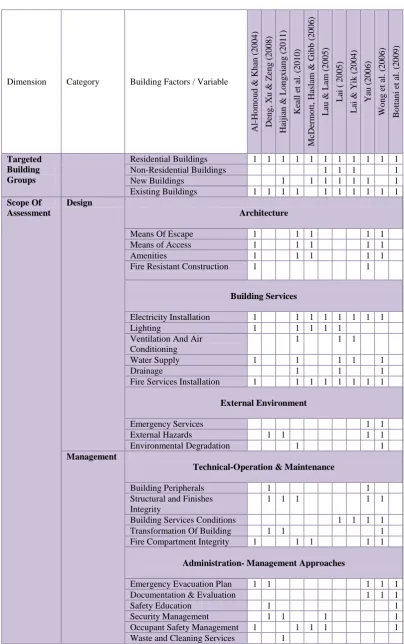
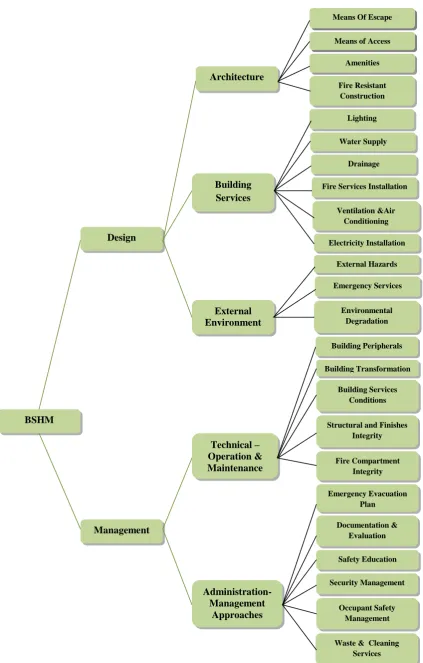
In Malaysia, numerous intelligent buildings have been built over the years since the Multimedia Super Corridor (MSC) was introduced by the government in 1996. Intelligent building is considered as one that incorporates the best available concepts, materials, systems and technologies [18]. The demand for safe, healthy and comfort living environment and requirement has increased dramatically, thus sustainable development and management must have engineering, managerial, financial and intelligent features and capability to respond to the rapid changing pace of technology in design and management [19]. The management system of building safety could be divided into technical management and administration management [20]. The quality of operation and management approaches appears to be the most critical factor should consider in order to improve the health and safety conditions across buildings [19]. In this regard, building factors are grouped into two main categories, namely design and management
Table 1: Literatures of Building Safety and Health Framework
(Source: Summary from literature)
Dimension Category Building Factors / Variable
Al -Ho m o u d & Kh an ( 2 0 0 4 ) De n g , Xu & Zen g (2 0 0 8 ) Ha ij ian & Lo n g x ian g (2 0 1 1 ) Ke all e t al. (2 0 1 0 ) M cDe rm o tt , Ha sla m & Gib b (2 0 0 6 ) Lau & Lam (2 0 0 5 ) Lai ( 2 0 0 5 ) Lai & Yik (2 0 0 4 ) Ya u (2 0 0 6 ) Wo n g e t al. ( 2 0 0 6 ) Bo tt an i et a l. (2 0 0 9 ) Targeted Building Groups
Residential Buildings 1 1 1 1 1 1 1 1 1 1 1 Non-Residential Buildings 1 1 1 1 New Buildings 1 1 1 1 1 1 1 Existing Buildings 1 1 1 1 1 1 1 1 1 1 Scope Of
Assessment
Design
Architecture
Means Of Escape 1 1 1 1 1
Means of Access 1 1 1 1 1
Amenities 1 1 1 1 1
Fire Resistant Construction 1 1
Building Services
Electricity Installation 1 1 1 1 1 1 1 1
Lighting 1 1 1 1 1
Ventilation And Air Conditioning
1 1 1
Water Supply 1 1 1 1 1
Drainage 1 1 1
Fire Services Installation 1 1 1 1 1 1 1 1
External Environment
Emergency Services 1 1
External Hazards 1 1 1 1
Environmental Degradation 1 1
Management
Technical-Operation & Maintenance
Building Peripherals 1 1
Structural and Finishes Integrity
1 1 1 1 1
Building Services Conditions 1 1 1 1 Transformation Of Building 1 1 1 Fire Compartment Integrity 1 1 1 1 1
Administration- Management Approaches
Emergency Evacuation Plan 1 1 1 1 1 Documentation & Evaluation 1 1 1
Safety Education 1 1
Security Management 1 1 1 1
Figure 2: Variables of building safety and health framework
Administration-Management Approaches Design
Technical – Operation & Maintenance Architecture
Building Services
External Environment
Management
Fire Resistant Construction
Lighting
Water Supply
Drainage
Fire Services Installation
Ventilation &Air Conditioning
Electricity Installation
External Hazards
Emergency Services
Environmental Degradation
Building Peripherals
Building Transformation
Building Services Conditions
Structural and Finishes Integrity
Fire Compartment Integrity
Emergency Evacuation Plan
Documentation & Evaluation
Safety Education
Security Management
Occupant Safety Management
Waste & Cleaning Services Means Of Escape
Means of Access
Amenities
Architecture. Issues of architecture have long been and widely addressed by many researchers. In 1984, Banham emphasize human needs and environmental concerns must be considered an integral part of architecture, systematically explored the impact of health and comfort engineering on the design of buildings and the minds of architects [11]. Bokalders and Block [21] highlighted building sustainability must take a broader changes in architecture, construction and spatial planning to reduce environmental, safety and health impacts of a buildings. Therefore, the focus of architecture is not only on the aesthetic aspects, should be in combination with a certain structural solution or style and it must enclose space in which certain activities can take place, safely, comfortably and efficiently.
Variables within the architecture category consists of means of escape, means of access, amenities and fire resistant construction. For the purpose of effectively architecture process, Al-Hamoud and Khan [15] proposed systematic safety compliance checklist with the safety requirements includes the design of fire extinguishing systems, smoke detectors, stairways and handrails, minimum width of courts, exterior finishes and number of exists and exit access distances and dimensions.
Building Services. Evaluation studies have shown that indoor environment of building is the importance factor that affect the safety, health and comfort of occupants. Thus, health and comfort improvements for managing the indoor environment quality has been emphasized such as thermal comfort, lighting quality, indoor air quality and acoustical quality [11]. For example, good indoor air quality always related to ventilation and air-conditioning system components and emission of certain products, such as construction and furnishing products and heating. Lai [22] suggested the building services installations for safety, health and comfort should work together with the operation and maintenance parties to ensure the designed conditions of the installations be properly delivered and maintained in its life cycle. He suggested, the installations of building services includes electricity system, lighting, ventilation, air conditioning, water supply, drainage, fire services installation, gas supply, lifts and escalators.
Lai and Yik [23] highlighted, an assessment of building services conditions are important in the context of safeguarding the safety, health and well being of people, and protecting the environment. Systems of building services which are electricity, fire service, lifts and escalators, gas supply, water supply and ventilating systems tend to be maintained in serviceable condition if they are regularly inspected according to the legal requirements [23]. Further evidence in connection to the relationship between overall health and safety and development scale has illustrated by Wong et al. [10] in connection with building services. They identified large developments performed better in terms of buildings services because the flexibility in adopting better building services design and adequate funding in building maintenance and management.
External Environment. The term environmental hazard refers to all the potential threats facing human society by events that originate in, and are transmitted through, the environment [13]. They identified the major categories of environmental hazard are natural hazards (floods and landslide), technological hazards (hazardous materials, Industrial failures, unsafe public buildings and facilities) and context hazards (environmental degradation and air pollution). In this manner, safety and health measures introduced to protect occupiers from external environment which can introduce additional hazards within the home.
Three perspectives in this framework include Emergency Services, external hazards and environmental degradation. Wong et al. [10] proposed an assessment method that identified a building factor of influence the health and safety performance. BQI assessment method are concerned with external environmental change, consists of density, adjacent use, air quality, aural quality, visual obstruction, thermal comfort, proximity to special hazards and proximity to fire station.
amendments in regulatory controls. They identified damages could arise due to negligent of their legal responsibilities and liabilities. For ensuring compliance with relevant acts, maintenance work shall be referred by a competent person, a competent worker [7], a competent examiner, a registered specialist engineer and a registered specialist contractor.
Many authors agree that the assessment of structural conditions as major security factor to improve the health, safety and sustainability of building [5,6,12,14,23,25]. Furthermore, the major security factors in use of buildings includes ageing of building structure, hidden dangers brought in use of buildings by design and construction, new constructions impact on surrounding existing buildings, security risks brought by the building peripherals, decoration and transformation of buildings [23]. Moreover, because of historical changes and development of economy, few users made destructive decoration and transformation of buildings. These behaviours lead few buildings appeared structure crack, tilt and collapse [5]. In this regard, regional department of building management play an important role to strengthen the security management of buildings [26].
Administration - Management Approaches. Besides design quality, the quality of management approaches in buildings is influential to the health and safety of residents. It is known that the government of Malaysia and private asset owners have created numerous infrastructure and building assets over the years. The government of Malaysia has started to take holistic approaches to creates the effective engagement of Total Asset Management in the 10th Malaysia Plan (2011-2015) that leads to asset development and management plan proposal to improve the service, comfort and safety to the public [27]. According to Lai and Yik [28] who conducted the study to evaluate the quality of facilities management services in residential buildings in Hong Kong found the functionally quality of the facilities is dependent on the quality of their operation and management. They analysed five aspects of facilities management services include security, cleaning, repair and maintenance [7], landscape and leisure and general management.
Today, the implementation of safety management systems (SMS) has become popular to tackling occupational safety and health challenges continuously and improving control on factors influencing health and safety [29]. The empirical investigation performed by Bottani et al. [29] attempted to prove whether the performance of safety management systems adopting and non-adopting companies statically differs and found that the implementation of SMS can bring substantial benefit to a company. They defined the criteria encompass company’s attitude to define safety and security goals and communicate them to employees, update risk data and performing risk analysis, identify risks and define corrective actions and developing employees training programs.
Conclusion
Building safety and health literature was intensively reviewed and analysed in this paper in order to address building safety and health variables for theory and implementation. Finally for the conclusion, hopefully at the end of this study a safety and health framework affecting the safety and health performance of polytechnic buildings will be used by researcher, contractor, building owners, maintenance and management services providers. A quantitative evaluation methodology based on the proposed framework is under development by the writers. The methodology will be able to predict and understand the role and formation of individual variable and their relationships among each other. For further study, the development of safety and health model can be used as an assessment framework, process and benchmarking tool for building performance evaluation in terms of safety and health.
Acknowledgements
References
[1]
Kirs, P.J., Sanders, G.L., Cerveny, R.P & Robey, D. (1989). An experimental validation of the Gorry and Scott Morton framework. MIS Quarterly, 13 (2), 183-197.[2] Lai, I. (2011, February 1). JKR to probe Serdang Hospital ceiling collapse.The Star Online.Retrieved from http://thestar.com.my/news/story.asp?sec=nation& file=/2011/2/1/ nation/7911518.
[3] Murali, R. S. N. (2010, March 11). All-round flaws caused stadium roof collapse. The Star Online, Retrieved from http://thestar.com.my/news/story.asp?file=/2010/3/11 /nation/5841338&sec=nation.
[4] Bernama. (2010, May 17). Uniform Building By-Laws review to promote Green Technology.The Star
Online.Retrieved from http://thestar.com.my/news/story.asp?file= /2010/5/17/nation/20100517144644&sec=nation
[5] Akasah, Z. A, Abdul, R. M. A and Zuraidi, S. N. F. (2011). Maintenance Management Success Factors for Heritage Building: A Framework. Structural Studies, Repairs and Maintenance of Heritage Architecture XII. WIT Transaction on The Built Environment, Vol. 118 @ 2011. ISBN: 978-1-84564-526-7; ISSN: 1743-3509 (0n-line).
[6] Akasah, Z. A. and Alias, M. (2009). Application of The Generic Process Modelling in The Preservation of Heritage School Building. Structural Studies, Repairs and Maintenance of Heritage Architecture XI. WIT Transaction on The Built Environment, Vol. 109 @ 2009; ISSN: 1743-3509 (0n-line), doi: 10.2495/STR090291.
[7] Mohammad Ashraf, Zainal Abidin and Siti Nor Fatimah (2012), The Importance of On-going Maintenance in Preserving the Heritage Listed Buildings. International Journal on Advanced Science, Engineering and Information Technology, Volume 2 (2012) No 2, page 83 -85.
[8] World Health Organization, WHOQOL. (1997). Measuring quality of life. WHO/MSA/MNH/PSF/97.4.Retrieved from: http://www.who.int/mental_health/ media/68.pdf
[9] Bluyssen, P.M. (2010). Towards new methods and ways to create healthy and comfortable buildings. Building and Environment 45(2010), 808-818. doi:10.1016/j.buildenv.2009.08.020.
[10] Wong, S.K., Cheung, A.K.C., Yau, Y., Ho, D.C.W. (2006). Are our residential buildings healthy and safe.A survey in Hong Kong. Structural Survey, 24 (1), 77-86. doi:10.1108/02630800610654432
[11] Bluyssen, P.M. (2010). The indoor environment handbook: How to make buildings healthy and comfortable. London, UK: Earthscan.
[12] Yau,Y. (2006). The Safety Performance Of Apartment Buildings: Empirical Evidence From Hong Kong. (Doctoral dissertation), Retrieve from: http://hub.hku.hk/handle/ 10722/52586
[13] Smith, K. and Petley, D.N.( 2008). Environmental hazards.5th Edition, Taylor & Francis e-Library, New York.
[14] Keall, M., Baker, M.G., Howden-Chapman, P., Cunningham, M and Ormandy, D.(2010). Assessing housing quality and its impact on health, safety and sustainability.J Epidemiol Community Health 2010.64. pp.765-771.
Available:http://dx.doi.org/ 10.1136/jech.2009.100701
[15] Al-Homoud, M.S. and Khan, M.M. (2004). Assessing safety measures in residential buildings in Saudi Arabia.Building
Research and Information, 32(4), 300-305.
[16] McDermott, H., Haslam, R. and Gibb, A. (2006). The Interaction between design and occupier behaviour in the safety of new homes. Accident Analysis and Prevention, 39 (2007), pp. 258-266.
[17] Reese, C. D. (2004). Office building safety and health. United States of America: CRC Press.
[18] Salleh, H., Ali, A.S., Kamaruzzaman, S.N. & Chuing, L.S.(2009). A case studies of intelligent buildings in Malaysia.
Malaysia Construction Research Journal. Vol 4, No 1, 44-55.
[19] Lau, P.C. & Lam, Y.M. (2005). Property management facing paradigm changes with intelligent building dimension at heart. CII-HK Conf., Hong Kong,129-133.
[20] Deng, H., Xu, J. & Zeng, H.(2008). Study on measures and strategies of use safety management of buildings in Longgang district of Shenzhen. IEEE Computer Society, 490-493. doi:10.1109/ICIII.2008.58.
[22] Lai, R.S.H. (2005). Care of building services installation for safety health and comfort. CII-HK Conf., Hong Kong, 129-133.
[23] Lai, J.H.K. and Yik, F.W.H. (2004). Law and building services maintenance in Hong Kong. Transactions, 11(1), 7-14
[24] Isa, A.F.M., Abidin, Z.Z. & Hashim, A.E. (2011). Built Heritage Maintenance: A Malaysian Perspectives. Science
Direct. 20, 213-221, doi:10.1016/j.proeng.2011.11.158
[25] Haijian, H. & Longxiang, M. (2011). Safety Risk Evaluation of Buildings and Structures Influenced by Construction of Adjacent Underground Engineering. IEEE Conference, 646-650.
[26] Wang, P., Tang, P., Wang, Y. and Dou, J. (2011). Investigation and analysis of existing building use and maintenance.
IEEE Conference, 2275-2278. doi:10.1109/MACE.2011.5987433.
[27] Idris, M. S. M. (2010). Total asset management – enhancing value in the 10th Malaysia Plan. Journal of Facilities Management, Vol. 8 Iss: 1.
[28] Lai, J.H.K. & Yik, F.W.H. (2011). An analytical method to evaluate facility management services for residential buildings. Building and Environment, 46, 165-175. doi:10.1016/j.buildenv.2010.07.012.
![Figure 1: Framework for health and comfort [11]](https://thumb-us.123doks.com/thumbv2/123dok_us/8789382.908556/2.595.108.530.378.565/figure-framework-health-comfort.webp)