On a Special Quaternionic Sequence
S¸ule C
¸ ¨ur ¨uk
,
Serpıl Halici
∗Department of Math., Science and Arts Faculty, Pamukkale University, Pamukkale Denizli, Turkey
Copyright c2018 by authors, all rights reserved. Authors agree that this article remains permanently open access under the terms of the Creative Commons Attribution License 4.0 International License
Abstract
In this study, we investigate Fibonacci quaternions and their some important properties. Then, we define a special sequence using the elements of the Fibonacci quaternion sequence. Furthermore, we calculate the autocorrelation, right and left periodic autocorrelation values by using the elements of the newly defined sequence.Keywords
Recurrence Relation, Special Sequences, Quaternions1
INTRODUCTION
Quaternions are defined by W. R. Hamilton as a generalization of complex numbers[3]. The author discovered quaternions in his work that begin by asking the question ”If there is a turn in2-dimensional spaces, it also exists in3-dimensional spaces” during the19thcentury. In the literature, the set of this numbers is denoted by the letterHin the memory of Hamilton.
Any real quaternion numberqis written in the form below.
q=a0+a1i+a2j+a3k; a0, a1, a2, a3∈R (1.1)
Herei, j, kare imaginary units.His a vector space and the set of{1, i, j, k}is a base of this space. While the addition onHis
the component to component, the multiplication is performed taking into account the following equalities[10].
ij=−ji=k, jk=−kj=i, ki=−ik=j (1.2)
and
i2=j2=k2=ijk=−1. (1.3)
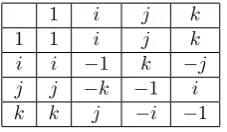
Taking the rules (1.2) and (1.3) into consideration, the following table can be construct.
1 i j k
[image:1.595.242.356.602.668.2]1 1 i j k i i −1 k −j j j −k −1 i k k j −i −1
Table 1. The multiplication of bases elements
The setHis a skew-field and an associative division algebra according to this multiplication. The elementqcan be written as vector and scalar parts[4, 10];
q=a0+v
wherev =a1i+a2j+a3kis the vector part ofqanda0, a1, a2, a3are real components. His a vector space onR. Moreover, His a algebra generated by the elements iandj on the real field. Involution process is also commonly known as conjugate
operation[2, 3, 4, 9].
For any quaternionq, the conjugate operation is defined asq=a0−a1i−a2j−a3k. For the quaternionspandq, the properties of this operation can be given as
q=q, q+p=q+p, qp=p q. (1.5)
The norm of quaternionqis defined as follows;
|q|=pqq=pqq=pa02+a12+a22+a32. (1.6) According to the function in(1.4),q6= 0,qcan be reversed in the setH, that is
q−1= q
kqk. (1.7)
Different quaternion sequences which are their coefficients were taken from some special sequences were studied in the literature. The first of these studies belongs to A. F. Horadam. Horadam studied different quaternion sequences taken from some special sequences. He defined the Fibonacci and Lucas quaternions as shown in the equation(1.8)and(1.9)below, respectively[4].
Qn=Fn+Fn+1i+Fn+2j+Fn+3k (1.8)
and
Kn=Ln+Ln+1i+Ln+2j+Ln+3k. (1.9)
And he called as Fibonacci and Lucas quaternions. In addition, the author also defined the conjugate and norm of quaternionQn as
Qn=Fn−Fn+1i−Fn+2j−Fn+3k (1.10)
and
|Qn|= q
QnQn= q
QnQn= p
Fn2+Fn+12+Fn+22+Fn+32 (1.11)
respectively. The formulas (1.8) and (1.9) give thenthterm of Fibonacci and Lucas quaternions, respectively. It should be noted that every Fibonacci numberFn, except the first two, is the sum of its two immediate predecessors,Fn−1andFn−2. Accordingly,
forn∈Z,n≥2and the initial conditionsF0= 0, F1= 1this sequence is written as follows[6, 12]
Fn=Fn−1+Fn−2. (1.12)
Now, let’s define a new set of elements consisting of Fibonacci quaternions: if we denote the sequence which itsnterms isQn like
{Qn}n≥0={Q0, Q1, Q2, ..., Qn, ...}, (1.13) then the general term of this sequence is given by the following formula.
Qn=
1
√
5(αα
n−ββn). (1.14)
Note that the formula (1.14) is obtained by Halici in[2]. Here,αandβare the roots of the characteristic equation of the sequence
{Fn}n≥0and the valuesαandβare follows
α= 1 +iα+jα2+kα3, β= 1 +iβ+jβ2+kβ3. (1.15)
2
A PERIODIC SEQUENCE WITH FIBONACCI COEFFICIENTS
In this section, we first introduce some concepts and notations. By using the definition of norm of a quaternion, let us define the norm of sequence{Qn}as
k{Qn}n≥0k=kQ0, Q1, Q2, . . . , Qn, . . .k= n−1 X
t=0
kQtk. (2.1)
Now, let’s display the following sequence asPab,
Pab={a, b,
b+ 1
a ,
a+b+ 1
ab , a+ 1
whereaandbare real numbers. Then, using the sequence (2.2), let’s define also a new sequenceUnas follows.
Un+1=
1 +Un
Un−1
, U0=a, U1=b n≥1. (2.3)
So, let’s define a new quaternion sequence using the elements of the Fibonacci quaternion sequence and denote it with{Qn}n≥0 . Forn≥2, thenthterm of the sequence{Qn}n≥0is
Qn=
1 +Qn−1
Qn−2
. (2.4)
If we calculate the initial values, then we haveQ0=i+j+ 2k, Q1= 1 +i+ 2j+ 3k. Thus, the elements of{Qn}n≥0are
{Qn}n≥0={Q0, Q1,
Q1+ 1
Q0
,Q0+Q1+ 1 Q0Q1
,Q0+ 1 Q1
, . . .}. (2.5)
Thus, we getQt=Qt+5, that is the sequence{Qn}n≥0is a periodic sequence. Hence, if we want to write several elements of this sequences, we have
1
2(3−i−j−k), − 1
30(1 + 9i+ 7j+ 17k), 1
15(10 +i−2k).
Therefore, one can use the elements of this new sequences to find the autocorrelation function. The autocorrelation function of a sequence is a measure of how different from the transformation of the given sequence[5]. The autocorrelation function has many important applications in engineering such as optical, coded diagramming.
Since the set of complex numbers is a special case of real quaternions, the special sequences defined on real quaternions can be thought of as a generalization of the sequences defined on complex numbers. So, one can use the elements of this new se-quence as autocorrelation coefficients.
Now, let us consider a periodic autocorrelation functionCof the sequence{Qn}n≥0[7].
C(m) =
n−1 X
t=0
QtQt+m, f or m6= 0 and1≤m≤n−1 (2.6)
Since the quaternion multiplication is not commutative, two alternative definitions of the autocorrelation function are possible. LetC be the right periodic autocorrelation function of the sequence{Qn}n≥0 , form 6= 0and for all 1 ≤m ≤n−1, and define as
CR(m) = 1
kQk
n−1 X
t=0
QtQt+m. (2.7)
Then, letCbe the left periodic autocorrelation function of the sequence{Qn}n≥0, form6= 0and∀ 1≤m≤n−1, and define
as
CL(m) = 1
kQk
n−1 X
t=0
QtQt+m. (2.8)
An alternative definition of the left autocorrelation function is given by the following formula;
AltCL(m) = 1
kQk
n−1 X
t=0
Qt+mQt. (2.9)
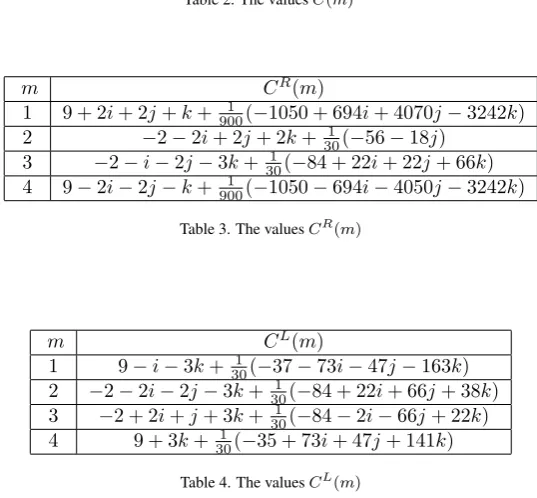
SinceAltCL(m) =CL(m), these definitions are equal to each other. In the following tables, for{Q
n}n≥0andm= 1,2,3,4 we calculate the autocorrelation, right and left periodic autocorrelation values.
m C(m)
Table 2. The valuesC(m)
m CR(m)
1 9 + 2i+ 2j+k+9001 (−1050 + 694i+ 4070j−3242k) 2 −2−2i+ 2j+ 2k+301(−56−18j)
3 −2−i−2j−3k+ 1
30(−84 + 22i+ 22j+ 66k)
4 9−2i−2j−k+9001 (−1050−694i−4050j−3242k)
Table 3. The valuesCR(m)
m CL(m)
1 9−i−3k+301(−37−73i−47j−163k) 2 −2−2i−2j−3k+301(−84 + 22i+ 66j+ 38k) 3 −2 + 2i+j+ 3k+ 1
30(−84−2i−66j+ 22k)
4 9 + 3k+301(−35 + 73i+ 47j+ 141k)
Table 4. The valuesCL(m)
Some elements of the above tables2,3,4 can be calculate as below; by using the initial values,Q0 = i+j + 2k,Q1 =
1 +i+ 2j+ 3k, the valuesQ2, Q3, Q4, Q5, Q6are as follows;
Q2=
1
2(3−i−j−k), Q3=− 1
30(1 + 9i+ 7j+ 17k), Q4= 1
15(10 +i−2k) (2.10)
and
Q5=i+j+ 2k, Q6= 1 +i+ 2j+ 3k. (2.11)
Thus,forn= 5, this is a periodic sequence . Hence, we can write as
{i+j+ 2k,1 +i+ 2j+ 3k,1
2(3−i−j−k),− 1
30(1 + 9i+ 7j+ 17k), 1
15(10 +i−2k)}.
By the aid of the autocorrelation function, for the sequence{Qn}n≥0, we have the following sum.
C(2) =
4 X
t=0
QtQt+2= 3 + 3i+ 2j+ 5k+
1
30(152−53i−5j−28k) (2.12)
Also, under favor of the right periodic autocorrelation function definition, form= 4, we have
CR(4) =
4 X
t=0
QtQt+4=Q0Q4+Q1Q0+Q2Q1+Q3Q2+Q4Q3,
CR(4) = 9−2i−2j−k+ 1
900(−1050−694i−4050j−3242k). (2.13)
By using the definition of left periodic autocorrelation function, we can get the following formula.
CL(3) =
4 X
t=0
QtQt+3=Q0Q3+Q1Q4+Q2Q0+Q3Q1+Q4Q2,
CL(3) =−2 + 2i+j+ 3k+ 1
Now, we give the following theorem without proof.
THEOREM 1.For the Fibonacci quaternion sequence{Qn}n≥0, the set of right autocorrelation values is different from the set
of left autocorrelation values.
THEOREM 2.For the Fibonacci quaternion sequence{Qn}n≥0the following equalities are satisfied. n−1
X
m=0
kCL(m)k= 1
kQk
n−1 X
t1=0
n−1 X
t2=0
Qt1(C
R(t
2−t1))Qt2 (2.15)
and
n−1 X
m=0
kCR(m)k= 1
kQk
n−1 X
t1=0
n−1 X
t2=0
Qt1(C
L(t
2−t1))Qt2. (2.16)
WhereCR(m)andCL(m)right and left periodic autocorrelation functions of the sequence{Q
n}n≥0, respectively.
PROOF.From the definitions right and left autocorrelation function, we have
n−1 X
m=0
kCL(m)k=
n−1 X
m=0
k 1
kQk
n−1 X
t=0
QtQt+mk
n−1 X
m=0
kCL(m)k= ( 1
kQk)
2 n−1 X
m=0
((
n−1 X
t1=0
Qt1Qt1+m)(
n−1 X
t1=0
Qt2Qt2+m))
n−1 X
m=0
kCL(m)k= 1
kQk2
n−1 X
m=0 n−1 X
t1=0
n−1 X
t2=0
Qt1Qt1+mQt2+mQt2
n−1 X
m=0
kCL(m)k= 1
kQk2
n−1 X
t1=0
n−1 X
t2=0
n−1 X
m=0
Qt1Qt1+mQt2+mQt2
n−1 X
m=0
kCL(m)k= 1
kQk2
n−1 X
t1=0
n−1 X
t2=0
Qt1(
n−1 X
m=0
Qt1+mQt2+mQt2
n−1 X
m=0
kCL(m)k= 1
kQk2
n−1 X
t1=0
n−1 X
t2=0
Qt1(kQkC
R(t
2−t1))Qt2
n−1 X
m=0
kCL(m)k= 1
kQk
n−1 X
t1=0
n−1 X
t2=0
Qt1(C
R(t
2−t1))Qt2).
Thus, the equation (2.15) is true. Similarly, the equation (2.16) can be obtained. So, the proof is completed.
quaternion sequence with the help of the periodic sequence definition. And then, the autocorrelation values, right and left pe-riodic autocorrelation values were calculated with the elements of the newly defined sequence. We would like to mention that autocorrelation functions for the Fibonacci quaternion sequences can be also calculated according to different conjugates.
REFERENCES
[1]Beth, T., Jungnickel D., and Lenz H. Design theory. Vol. 69. Cambridge University Press, 1999.
[2]Halici, S. On Fibonacci quaternions. Advances in Applied Clifford Algebras 22.2 (2012): 321-327.
[3]Hamilton, W.R. Ii on quaternions; or on a new system of imaginaries in algebra, Philosophical Magazine Series, Taylor & Francis,25:163, 10–13(1844).
[4]Horadam, A. F. Complex Fibonacci numbers and Fibonacci quaternions. The American Mathematical Monthly 70.3 (1963): 289-291.
[5]Jungnickel, D. and Pott, A. Perfect and almost perfect sequences. Discrete Applied Mathematics 95.1-3 (1999): 331-359.
[6]Koshy, T. Fibonacci and Lucas Numbers with Applications. Wiley-Interscience, New York (2001).
[7]Kuznetsov, O. Perfect sequences over the real quaternions. Signal Design and its Applications in Communications, 2009. IWSDA’09. Fourth International Workshop on. IEEE, 2009.
[8]Luke, HD. Sequences and arrays with perfect periodic correlation. IEEE Transactions on Aerospace and Electronic Sy-stems 24.3 (1988): 287-294.
[9]Iyer, M. R. A Note On Fibonacci Quaternions, The Fib. Quarterly, 3(1969), 225-229.
[10]Morais, JP., Georgiev, S. and Sprig, W. An Introduction to Quaternions. Real Quaternionic Calculus Handbook. Sprin-ger Basel, 1-34, 2014.
[11]Rouse Ball, W. W., and Coxeter, H. S. M. Mathematics recreation and essay. (1987).