
Computer mediated communication as a tool for improving the english language among adult learners in TVET programme
16
0
0
Full text
(2) Journal of Technical Education and Training. BACKGROUND OF STUDY In Malaysia, the government sees education as an industry and it recognizes the importance of English as the language in international communication. English language is promoted as essential lifelong component in education and is taught at all phases and forms of learning from pre-school to post-retirement as well as the whole spectrum of formal, non-formal and informal learning. At colleges and universities all undergraduates are required to learn the subject for duration of between one to three academic semesters depending on their entry level of the English language. The emphasis given for crucial mastery of the target language among undergraduates is justified by the very nature of research and academic work they have to complete which involve great amount of referencing using the target language. As such there is a great need for the effective use of the target language among students throughout their daily academic life. This is especially true since English is still largely used in many academic settings (class lectures, workshops, labs, seminars and projects). Despite having formally learned the language for at least eleven years of schooling many undergraduates are still weak in the command of the English language. It is a known fact that a worrying number of Malaysian ESL learners are shy, reluctant and afraid to use the language both in and outside the language classroom (Bahiyah, 1991; The Star, 1994; Anuar Zaini cited from Utusan Malaysia, 2000; Ungku Abdul Aziz cited from The Star, 2000; Mahathir cited from New Straits Times, 2000; Musa cited from New Straits Times, 2000; Wong cited from New Straits Times, 2001). In addition, the nature of the exam-oriented educational system in Malaysia also contributes to the poor performance in the English language among students. The “mad scramble” for “As” among students, teachers and parents especially at school level contributes to the poor performance of our students in their actual use of the English language and has to a significant extent resulted in a lack of opportunity to practice and use the target language in everyday setting. Incidentally, one wonders as to the quality of the numerous “As” collected by the so many students in public school examinations (New Straits Times, 2009) RATIONALE Learning a language requires maximum use of the target language in both transactional and interaction forms of communication (Bygate, 1987:7). Considerable amount of research has suggested that learners of a second language need more opportunities than they are usually provided for both spoken and written interactions without which learners' L2 language development may actually reach a "plateau" proficiency level and not move beyond it (Swain & Lapkin, 1986; Swain, 1985; Swain & Wong Fillmore, 1984). Interaction: The abundance of online forums available in the Internet has revolutionized education and communication. They provide authentic interactive communication opportunities for students which are very crucial to language acquisition. According to Hughes (1999), "Language use and language learning are social activities; they occur best in situations which encourage negotiation of meaning and learner collaboration with other learners, instructors and community members." Because language use is meant for human communication it is therefore crucial that they be learned in a setting that involves abundance 34.
(3) Journal of Technical Education and Training. interaction among users of the language. The desire to communicate when interacting results in the need to use the language freely and in abundance. Confidence: Computer-Mediated Communication (CMC) tools have been widely used by language learners and language teaching professionals and by researchers investigating the potentials of such tools to support (reflective) language learning strategies (Goodfellow & Lamy, 1999). The effect on learner confidence and spoken production of both synchronous and asynchronous text exchanges to support language learning has also been investigated on several occasions; Chun (1994 cited from Sheild, 1999) found that language learners who used synchronous text-chat between scheduled face-to-face sessions became more confident about speaking the target language and Stevens and Hewer (1998) claim that confidence in spoken production L2 was improved by providing groups of distance language learners with access to email between scheduled telephone conferences. It has also been shown that shy learners tend to make greater contributions to discussions and learning events in the anonymous environment of text-based CMC than in face-to-face situations (Turbee 1996, 1997; Turner, 1996; Warschauer et al, 2000) and that they report increased confidence in using the target language in such environments (Healy Beauvois, 1998 cited from Sheild, 1999). Spontaneity: Based on the analysis of MOOtalk and on the interviews with participants in her PennMoo class, Wan Fara in her study on the use of MOO with her samples concluded that the virtual platform presented an opportunity for the participants to practice "speaking" in the target language. Whether it is called "written conversation" or interactive writing" or "visible conversation" (Colomb & Simutis, 1996 cited from Wan Fara, 1998:169) the opportunity for students to actively and spontaneously interact in the target language was evident (1998:169). Clearly, then, CMC can be of benefit to language learners in several ways; asynchronous tools promote meta-cognitive learning strategies and synchronous tools cognitive learning strategies, while learner confidence, participation and usage in L2 production appears to increase with the use of both synchronous and asynchronous CMC tools AIM OF THE STUDY It was therefore the aim of this study to identify the effectiveness of using an online forum to promote use of English among undergraduates. Would the use of the online forum help promote the use of the English language among the participants? What aspect of the language learning process would the online forum have an impact most? How would participants perceive use of the online forum in their learning process? These were some of the research questions postulated. RESEARCH DESIGN This research was conducted qualitatively. By "qualitative research” means "any kind of research that produces findings not arrived at by means of statistical procedures or other means of quantification" (Strauss and Corbin, 1990:17 cited in Hoepfl, M.C. 1997:2). Due to the nature of the research that involves in-depth and descriptive understanding of CMC related phenomena in context-specific settings that are unique and which are at times 35.
(4) Journal of Technical Education and Training. idiosyncratic and pervasive in nature (Hoepfl, 1997:3), qualitative approach was deemed most appropriate for the purpose. Qualitative data was thus collected using participant observation (Jorgensen, 1989), interview (Paton, 1990) and content analysis (Paton, 1990). Sampling: In this study, a non-randomized purposeful sampling as opposed to randomized was adopted. This kind of sampling allowed for the purposeful and small selection of samples since a small sample that has been systematically selected for typicality and relative homogeneity provides far more confidence than does a sample of the same size that incorporates substantial random or accidental variations (Maxwell, 1996:70). Participants: To begin with, the researcher first defined the dimensions of variation in the population that were deemed most relevant to the study and systematically selected individuals, times or settings that represented the most important possible variations on these dimensions Maxwell (1996:72). The sample size proposed for this study was 191 people including the lead researchers. The students comprised third-year adult undergraduates comprising of primary school headmasters pursuing Bachelor in Education Management in TVET at the Faculty of Technical Education Universiti Tun Hussein Onn Malaysia. A total of 38 respondents (100 percent sampling) consisted of a balanced male-female ratio and a mixed diversity of racial, religious, and academic performances backgrounds. At the time this study was conducted the students were learning Effective Communication subject a compulsory English language paper for all undergraduates. Instrument of Research: For this research, the educational CMC or ICT tool used for both treatment and data collection was Nicenet's Internet Classroom Assistant or simply called Nicenet (Appendix 1). Nicenet is the name of a non‐profit organization of Internet professionals who give their time to provide services to the Internet community. Everything in Nicenet is offered free for public use, and Nicenet makes no profits from your participation. Nicenet is actually a free asynchronous online computer‐mediated learning environment that supports a collaborative learning process totally conducted online via the Internet. It provides learners and instructors with a conferencing platform whereby they can actively participate in learning activities together virtually.. The conferencing presentation of Nicenet adapts well for lifelong learning by providing the facility for participants to express their opinions on matters of common interest for others to share and respond. On clicking the Conference button participants can see a list of discussion topics (Appendix 2) each consisting of messages posted by others in respond to the issue. The other features of Nicenet other than Conferencing are Link Sharing, Documents, Class Schedule and Personal Messages (Appendix 2). Using Link Sharing, participants are able to submit web links for others to share by typing the link address and words of description about the link in the boxes provided. For example, if a participant wishes to suggest a web site of common interest like Readers Digest” to other participants s/he only needs to key in www.readersdigest.com and click the submit button. Documents enable participants to submit 36.
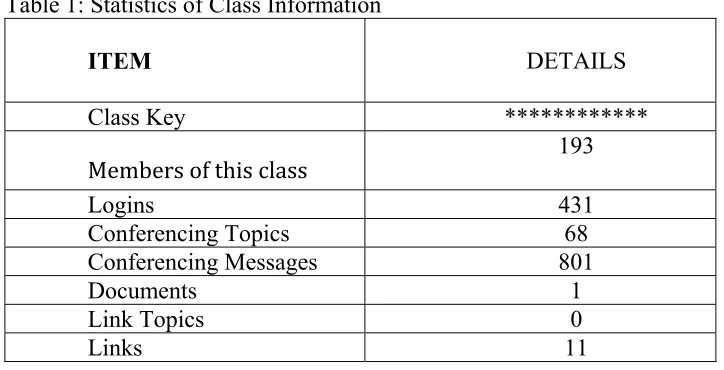
(5) Journal of Technical Education and Training. notices or in the case of assignments answers to questions asked. The Class Schedule functions as a timetable. Procedure: For the study, all the participants were asked to register in the one class created by the researcher. Having registered, students were asked to participate in the forum either using home computers, cyber cafes or through computers available at the university. The first topic for discussion was initiated by the researcher and later on decided upon and posted by students themselves. All contributions in the form of responses to topics or new ones form an electronic transcript available to all participants almost immediately once they have been posted by students themselves. These were stored in the system server for perusal by others who might want to respond to anyone or more of the messages posted. Throughout the 15week study students were constantly encouraged (as opposed to use of threat!) to log on and participate in the ongoing discussion as often as they possibly could. Data collection and analysis were conducted simultaneously using participant observation (virtually in the class created), informal conversation (in face-to-face class meetings) and content analysis (the participant’s postings) done throughout the duration of the 15-week study. FINDINGS This study generated numerous findings of great benefit to the researchers. However, for the purpose of this paper, the findings shall only be limited to the main objective of the study as stated in the beginning. To begin with, the findings shall start with the basic information on class features and participation. Table 1: Statistics of Class Information ITEM. DETAILS. Class Key. ************ 193. Members of this class Logins Conferencing Topics Conferencing Messages Documents Link Topics Links. 431 68 801 1 0 11. PARTICIPATION With reference to Table 1, ever since the Nicenet class was first created in the first week of semester, there were 431 logins including those of the researcher. The students created and discussed about 68 different topics of common interest (Appendix 2) under which a total of 37.
(6) Journal of Technical Education and Training. 801 messages were generated for discussion. On average this came to about 50 messages per week which we considered very significant considering the fact that our ESL students do not “speak” that much in ordinary face-to-face (F2F) classroom environment. In terms of frequency of participation, about half of the students participated between 5-10 times. Quite a significant number participated up to more than 15 times throughout the duration of this study. It is also very interesting to note that participation on the part of the students was done voluntarily. The main factors that drove them to participate in Nicenet were to improve on their English language, to exchange ideas with other participants, to “meet” new people in the forum and to a rather significant extent to “hang around”. There were no elements of threat from the lecturer or fear of being penalised for non-participation. In fact when asked many of the participants even recommended their on-going Nicenet class to friends from other classes within UTHM and other institutions of higher learning. These encouraging phenomena did not only occur during the duration of this study but also in every other earlier and current semesters with new batch of students. Participation among the participants was thus very encouraging. In terms of accessibility to the online forum about 70 % of the participants logged in from private cyber cafes other than using university and home computers. This is quite surprising though encouraging considering the cost incurred on the part of the participants. It also leads to show that given the right platform and means Malaysian ESL learners are determined to learn and use the target language extensively. TOPICS OF DISCUSSION Throughout the semester, participants talked about various topics of common interest. On almost every day of the week there were new topics of discussion created by the participants including weekends. Except for three or four topics that were created by the researchers the rest were initiated by the students themselves. On the part of the researchers the topics were created with the sole purpose of initiating new areas of discussion and to induce students to delve into particular pertinent current issues that they would have ignored or overlooked. Throughout the 15-week period, students discussed about various topics. These ranged from “My Family to “K-economy”. Among the most talked about topics were “Ban of Bollywood Movies” (55 messages), “Sex Education” (56 messages), “The best Malaysians” (57 messages), “Smoking” (44 messages), and “Use of English in Engineering” (35 messages). Surprisingly, philosophical topics like “What is the life” also managed to get a significantly high number of response among these teenagers that totalled 44 messages altogether. Campus related topics like “Prom Night” (29 messages), “The Comparison between UTHM and another University” (24 messages) and “Night Class” (22 messages) were also popular among participants of the online conference.. 38.
(7) Journal of Technical Education and Training. For analysis purpose, the list of 68 topics created were classified into 15 different categories (Appendix 1); Sexuality, Language Games, Academic, Entertainment, Economy, Philosophy, Patriotism, Social Greetings And Relationship, Health, Information Technology, Students’ and Campus Life, Personal Assessment, Politics, Nicenet Feedback and Others. Among them the category on “Social Greetings and Relationship” seemed to top the list with a total of 104 messages. BENEFITS From the survey, almost all the participants identified themselves as being initially shy and afraid to use the English language especially in F2F spoken form. This is common of Asian students including Malaysian ESL learners. These problems of shyness and fear of using the target language is faced not only by the Malay undergraduates but also by the non-Malays; Chinese, Indians and others. As a result most Malaysian ESL learners including those in colleges and universities prefer to 'hide' in silence (Bahiyah, 1991) rather than participate in on-going F2F oral interaction among friends, between students, lecturers and what more strangers. This scenario is also true for adults undergraduates in UTHM especially the participants of this study. Below are some of their opinions as regards benefit of learning the language online. Overcoming Fear and Lack of Confidence FROM: A Female Malay student SUBJECT: About nicenet... For me, nicenet is a good place to express my feelings and opinions coz I am not a person who like to voice out (orally) my personal view especially in public. Maybe I afraid of making mistake, lack of confidence and sometimes afraid to hurt people feelings undeliberately. I prefer to express myself in written form like in nicenet, Fear and lack of confidence is most common among foreign language learners including ESL learners in Malaysia. Due to the intrinsic nature of Malaysians who are shy and less explicit the availability of online forums like Nicenet is surely a boon towards their extensive use of the English language. Overcoming Nervousness FROM: A male Malay student SUBJECT: I like to give my opinion in nicenet than in class Maybe because when I have to answer in face to face with my lecturer it made me nervous and my idea was hard to come out. Usually after my lecture finishing the questioning session with me, then I had something to say.....Poor of me.... It is common for anybody to feel insecure and nervous having to respond perfectly when the lecturer is around. However, with Nicenet those are not problems anymore since the virtual 39.
(8) Journal of Technical Education and Training. platform allows for spontaneity and free flow of ideas without having to worry about grammar and accuracy. Overcoming Embarrassment FROM: A female Malay student SUBJECT: it's good for us... Assalamualaikum.... Hi everyone! about the nicenet feedback...from my experience with nicenet. I think, it is one easy way for some student to improve their language, the way to give some ideas, to share experience about anything such as life, love, movie, opinions and much more topics that we can share. In the class, I feel embarrassed because I scare when I make a mistake, my classmate will laugh at me but by this way I didn't feel that and more enjoying...nicenet is easy to use. However, having been introduced to Nicenet all the participants admitted that "speaking" in the English language had never been easier. The "virtualness" of the platform has helped them to overcome the shyness in them and the fear of making mistakes. They gradually became confident and found it so much more comfortable to think about what they wanted to 'say' in the online forum and not worried about whether others will laugh at or look down on their views and command of the English language (grammar, 'pronunciation', sentence structure, etc.). Improve Writing Skill FROM: A Female Chinese Student SUBJECT: About nicenet. For me, nicenet is a good place to express my feelings and opinions coz I am not a person who like to voice out (orally) my personal view especially in public. Maybe I afraid of making mistake, lack of confidence and sometimes afraid to hurt people feelings undeliberately. I prefer to express myself in written form like in nicenet, we can talk about many things without limit: time limit & space limit. During the class, it’s more difficult for me to speak and give immediate response to Mr. Berhan so suddenly. Because I need more time to think. Yes, undeniably, nicenet did improve my English in writing no matter when I compose a message or read other people message. But it still could not build up my courage to take initiative to talk a lot. Sometimes, I also feel boring when using nicenet, the background is so dull and too formal. I think it should be more colourful, better put more attractive pictures. However, nicenet is a good attempt as another form of learning and communicating. Keep it up! 40.
(9) Journal of Technical Education and Training. Develop Thinking Ability FROM: A Male Chinese Student SUBJECT: A nice 'nicenet' I want to say that 'nicenet' is a nice 'net'. I can share my opinions & view of lot of different topics. My language is not well. Each time I entry this class, I save a copy so that I can read trough the messages details. I spent a lot of time to read & post the messages. But, I enjoy doing so. I can improve my English & widen my way of thinking. Sometimes, I have the problems to express my views in normal class my English is not good. But in nicenet, I have times to think & than I can express my views slowly. However, I don't have phone-line in my house, each time I want to use internet, I have to go to the computer labs. Time to Think and Say FROM: A female Malay student SUBJECT: nice but way to approach......? Like its name nicenet is a nice place where we can view out our opinion, exchange ideas with others and learn something new-by analyzing what people have said….. Sometimes, they want to voice out their point of view but they just find it hard to approach….. However, I find it fun coz I can voice out my ideas and doesn’t care what people would criticize it. Sometimes, I just keep quiet in class because the ideas did not come out at the right time. However, by using nicenet, I have longer time to think. Does U think so? This is from another student who was already an experienced user of Nicenet. According to her she was first introduced to the forum in the previous semester by the same researcher/lecturer and still found using the virtual platform convenient and interesting. Freedom of Expression: Discuss about “Anything under the Sky” FROM: A female Indian student SUBJECT: nicenet Hello!! Well, this is my second time using nicenet. I find it interesting using it because that not everyone got a chance to talk in the class or they may feel shy to talk in the class. Therefore, with nicenet they can talk anything that they like. Moreover, lecturer also can know their student through nicenet. And this one is from a female Chinese student who was a very proactive student both in Nicenet and in the normal F2F class. Her praise for Nicenet was so enthusiastically conveyed and she regarded the virtual platform as a great avenue or “space” for her to express her opinions on anything she wanted and ignoring the criticism by others or the fact that she was weak in her English.. 41.
(10) Journal of Technical Education and Training. “Space of Life” FROM: A female Chinese student SUBJECT: The 'Space' of life! Nice Net is the 'space' of our life. This is the space for us to share all views, opinions & ………all the people can 'communicate' in this sky without shy, afraid, embarrass &…….In this space, no people can see your face. Don't worry that u will make mistake in grammars, sentence &……..don't worry that the people will laughing u. we can explain our opinion, unsatisfied&…………..Nice Net is the sky to collect all the voice from our heart. Besides, we can learn how to analysis, respect & receiving the opinion from other people. Are u enjoys it? Do u still remember the first time when u heard the word of 'nice net'? Nice net is the good place for the people who can't communicate with fluency in English. Likes me, I can't communicate with fluency in English. So, I will feel afraid to explain my opinion in the class for every discussion. Sometimes I will keep quiet in the class however I got the good idea & opinion. Because I afraid that another people will not understand what with what I mean that & what I want to explain. For me, this is the good way to exceed my obstruction. For improving our nice net, I think we must active in this class. Every people can put the new title which is interesting, not just the discussion title in the class. We also can adding some pictures or voice to make our nine net funny, interesting & etc. so, why u still waiting? Now, please open your computer, go to the nine net & flying in our communication's sky'. One participant was so overwhelmed with the new experience that she considered Nicenet as something of a miracle for her to improve on her English language. In her very own words this is what she had to say: In my opinion, Nicenet is definitely a haven for discussion … Who bothers the grammar! Sounding out by typing on the keyboard is already a satisfaction!!! (At least at this stage) -. A female Chinese student The most common reason given by the participants in support of confidence and ease of use was the “virtualness” of the setting. When participating in the forum participants were able to “hide” their weaknesses, shyness and their physical self for fear of making mistakes only to be rebuked or ideas rejected by friends and lecturers hence avoid embarrassments and dejection. As voiced by many participants that “everything is done behind the computer screen” thus provides comfort and ease of use when participating in virtual discussions. This is especially true even among working professionals of the IT industry which is rather surprising actually. It was reported that many working professionals working in Silicon Valley found it more comfortable to work with machines than people for the simple reason that they could hide [their emotional distress] behind them [computers] (National Geographic, 2001:52-75).. 42.
(11) Journal of Technical Education and Training. SUMMARY The main contention of discussion in this section is OPPORTUNITY. All the students irrespective of their backgrounds had equal opportunity to practice using the English language as frequent and as how they wished. For those who were good and brave enough discussed in great length and as frequent as possible sometimes delving in to one particular issue more than once as in “Prom Night”, “Sex Education” and many other topics. Also many participants used the Personal Messages, Documents and Link Sharing facilities as well other than the main Conferencing facility to communicate with each other. In conclusion, the results of this study demonstrated that use of CMC tool such as conferencing in Nicenet can indeed encourage extensive use of the English language among ESL learners. All the learners irrespective of their backgrounds have been proven to have benefited from their use of Nicenet both in terms of language development and socio-cultural awareness. Because of the uniqueness of Nicenet which is virtual, asynchronous (delayed) and have very user-friendly conferencing interface it made it easier and attractive for learners to communicate using the English language both with friends, strangers and even lecturers. The study also demonstrated that given the opportunity and the right tool almost ANY ESL learner can and WANT to use the English language in their daily communication. In this case, Nicenet has proven to be an effective tool highlighting the importance of providing learners with ample opportunities and the right kind of learning tool (in this case Nicenet) if learning of the target language is to be made successful. Finally, since the class is virtual it therefore, never sleeps and opens 7-days-7-nights enabling learning to take place from any location at anytime hence supporting and re-affirming the need for life-long learning.. 43.
(12) Journal of Technical Education and Training. APPENDIX 1 TOPICS ACCORDING TO CATEGORY OF DISCUSSION CATEGORY 1 2. 3. Sexuality (57) Language Games (49). Academic (94). 4. Entertainment (86). 5. Economy (13) Philosophy (59). 6. QUANTITY TOPICS* Sex education free #sex# 6 Things You Can Do in a Lift Interview Question for Bill Gates What can you do in 30 seconds? After "click ME first" ...click me..!!! Projek Sarjana Muda (PSM) Night Class A Matter About Brochure Assignment Computer skill presentation Extended length of study Use of English in Engineering What is a good varsity education? Ban of Bollywood Movies??????? Pearl Harbour good movies what is your favourite artist The Matrix Computer games Saw the movie’ Unbreakable'? 2 thumbs up! K-Economy What is the "life"?. Death penalty Fortune of our youngsters today! 21 years old. its independent day The best Malaysians National Unity 8 Social Greetings and "Colour up your LIFE!!!" Relationship YOUR BIRTHDAY..... (104) Friends??? My Family Number in brackets: Total Messages within Category 7. Patriotism (69). 44. 56 1 5 19 23 2 1 22 2 4 14 15 35 55 7 2 3 9 6 4 13 44 15 1 7 57 4 2 7 21 20.
(13) Journal of Technical Education and Training. APPENDIX 2 SAMPLE TOPICS OF DISCUSSION IN NICENET. comm. Conferencing Topics. Home. [ Add New Topic | Post New Message ] View All Topics. All Topics :. Conferencing Link Sharing. Go. Pearl Harbour - ( 7 messages posted ) [post | edit | delete]. Documents Class Schedule Class Members. Sex Educations??? - ( 56 messages posted ) [post | edit | delete] "Colour up your LIFE!!!" - ( 2 messages posted ) [post | edit | delete]. Personal Messages : View | Send Classes : Join | Create | Drop | Delete Class Administration. Please loving & appreciate the people around u! – ( 1 message posted ) [post | edit | delete] good movies - ( 2 messages posted ) [post | edit | delete]. Edit User Profile ICA FAQ. Fortune of our youngsters today! - ( 1 message posted ) [post | edit | delete]. 45.
(14) Journal of Technical Education and Training. PROTECT YOUR PRIVACY: LOG OUT. Where u all? \ (? 0?)/ - ( 7 messages posted ) [post | edit | delete] what is your favourite artist - ( 3 messages posted ) [post | edit | delete] Interview Question for Bill Gates - ( 19 messages posted ) [post | edit | delete]. 46.
(15) Journal of Technical Education and Training. REFERENCES Bahiyah, A. H. (1992). "Malu" - Shyness and Shyness Behaviors in the English Language Classroom" in MELTA. Vol. 21 Oct. p.97-107. Gumperz, J. (1962) “Types of Linguistic Communities” in Anthropological Linguistics. Vol. 4. No. 1. p.28-40 Hoepfl, M.C. (1997) "Choosing Qualitative Research: A Primer for Technology Education Researchers." In Journal of Technology Education. [On-line]. Retrieved on 20 Sep 2000 at http://scholar.lib.vt.edu/ejournals/JTE/v9n1/hoepfl.html Jorgensen, D.L. (1989) Participant Observation. California. SAGE Publication Inc. Maxwell, J.A. (1996) Qualitative Research Design: An Interactive Approach. California. SAGE Publications. National Geographic (2002) “Silicon Valley: Dream Incubator”. December 9. p.52-75. New Straits Times (2009) Chasing As: Look Again at all the As We Collect. Retrieved on 28 Jan at www.nst.com.my/Current_News/NST/Wednesday/Letters/2463807/Article/index_html New Straits Times (2000) Innovative Computer Systems All The Way. (16 Sept 2000:16) Paton, M.Q. (1990) Qualitative Evaluation and Research Methods (2nd Ed.). Newbury Park, CA. Sage Publications Inc. Sheild, L. et al (1999) MOOing in L2: Constructivism and developing Learner Autonomy for Technology-Enhanced Language Learning. Retrieved on 20 Sep 2000 at http://jaltcall.org/cjo/10_99 Stevens, A. & Hewer, S. (1998). From policy to practice and back. Proceedings of 1st LEVERAGE conference, Cambridge 7-8 January. Retrieved on 20 Sep 2000 at http://greco.dit.upm.es/~leverage/conf1/hewer.htm Swain, M & Lapkin, S (1986) Immersion French in Secondary Schools: The Goods and The Bads. In Contact. Vol 5(30. P.2-9 The Star (1994) "Master English, PM Tells Envoys". 9th August p.1 The Star (2000) "Ungku Aziz on Poor Malay Performance: Need to Improve Command of English. Sept 2000. Turbee, L. (1996). MOOing in a foreign language: How, why, and who? Paper written for the Information Technology Education Connection's International Virtual Conference/Exhibition on Schooling and the Information Superhighway, 1996. Retrieved on 20 Sep 2000 at http://home.twcny.rr.com/lonnieturbee/itechtm.html. 47.
(16) Journal of Technical Education and Training. Utusan Malaysia (2000) "Bahasa Inggeris: Penggunaan di UM Mulai Tahun Tiga. 22 Nov. p.5 Wan Fara Adlina Mansor (1998) Interaction on the Network: A Case of PENMOO among ESL Learners. A dissertation presented for the award of PhD at the University of Pennsylvania (Unpublished. Pennsylvania. United States.. 48.
(17)
Figure
Related documents
To maintain the favourable conservation condition of Arctic Tern in South Dublin Bay and River Tolka Estuary SPA, which is defined by the following list of attributes and
The hCRF-LVP test was performed in 12 normal subjects and 15 tests were performed on 12 autoimmune, renal, and sarcoidosis patients (mean age±SD, 35.4±14.4 yr; range, 15-49 yr),
Since the overall rate of clustering may not always be informative, we also examined whether certain Harare districts and rural home districts were associated with a higher frequency
This age-related divergent effect of cell cycle kinetics on initial response to therapy was confined to the less favorable subgroup of patients with karyotypic abnormalities,
To determine if secretion of the Sm-like peptide by cultured smooth muscle cells is linked to cell replication as well as DNA synthesis, smooth muscle cell cultures were exposed to
Above all, our data here showed that Andrographolide can inhibit OVA-induced asthma with a possible mechanism of ROS elimination, thus negatively regulate NF-κB and
A phylogenetic tree was constructed by using the deduced amino acid sequences of the VP7 genes of the G2 strains isolated from various African countries in 1999 (Fig.. Two
Of 20 serum specimens that tested negative for hMPV F-specific antibodies (using the re- combinant VSV-hMPV F antigen ELISA), all tested negative in the hMPV-infected cell ELISA,
