Journal of Technical Education and Training Volume 2 Number 2 (2010)
1
LEARNING WITH WORKED-OUT PROBLEMS:
THE IMPACTS OF INSTRUCTIONAL EXPLANATION AND
SELF-EXPLANATION PROMPTS ON TRANSFER
PERFORMANCE
Lai Chee Sern
Institute of Technology and Education, University of Bremen, Germany
Email: [email protected]
____________________________________________________________________
ABSTRACT
In the present research, two different explanatory approaches – namely, instructional explanation and self-explanation prompts – were applied in worked-out-problem-based learning (or learning from worked-out problems) in the domain of manufacturing technology. The main purpose of this investigation was to compare the effects of both explanatory approaches on topic knowledge acquisition, near-transfer performance, and far-transfer performance. Additionally, the mental efforts invested by the participants during the learning process were also recorded to examine its relation with learning performance. A pre- and post-tests were used to assess topic knowledge acquisition, near- and far-transfer performance, whereas mental effort was measured by means of NASA Task Load Index. The analysis outcomes revealed that the self-explanation prompts approach was significantly superior to the instructional-explanation approach in terms of topic knowledge acquisition and near-transfer performance. There was no significant difference found between both approaches in far transfer performance. Apart from the above, the findings also demonstrated that a high mental effort investment did not guarantee a fruitful learning performance.
Key words: Worked-out problem, instructional explanation, self-explanation, near and far transfer performance, cognitive load, and mental effort
Journal of Technical Education and Training Volume 2 Number 2 (2010)
2
1 Introduction
Emerging technologies and management practices have altered the skill requirements for manufacturing workforce. To account for this, Gale, Wojan, and Olmsted (2002) have conducted a national survey of over 3,000 USA manufacturing establishments to explore the associations between worker skill requirements and the use of manufacturing and telecommunication technologies, work organisation, and other management practise. The employers in the survey reported an increasing demand on worker’s problem solving skills in addition to computer and interpersonal skills in manufacturing sector. Although the detail might differ, similar trends have been observed in Malaysia. For instance, Mohamed Rashid and Mohd Nasir (2003) reported that the problem solving skill, along with teamwork and communication skills, are listed at the top of the list of competencies needed for employment in manufacturing sector.
The above examples show the significance of problem solving skills for the manufacturing workforce. Given that the technical workers in the manufacturing sectors are often asked to solve problems, there is an obvious need for instructional designers to develop methods to help students become more effective problem solvers. This issue has drawn attention from educational institutions. Their attentions have largely been focused on the questions of how to foster problem solving skills and, subsequently, how problem solving skills can be transferred from one context to another, especially from school to workplace. To this end, a number of researchers (e.g., Bransford, Brown & Cocking, 2000; Savery, 2006; Wang, Fong, & Alwis, 2005; Wee, 2004) have suggested that learning through real life problems might be an effective way of acquiring problem solving skills. Instructionally, this can be accomplished through problem-based learning (PBL), which promotes problem solving skill acquisition through the development of self-learning strategies, while requiring students to apply knowledge and solution strategies to new situations (Blumberg, 2000; Mergendoller, Maxwell, & Bellisimo, 2001).
2 The Weaknesses of PBL
Over the past few decades, substantial research has been conducted to evaluate the effectiveness of PBL. For example, McParland, Noble and Livingston (2004) conducted a study to evaluate the performances of PBL and lecture-based learning in psychiatry. They reported that students performed significantly better on examination when PBL was employed, in comparison to lecture-based learning. Similarly, Hmelo (1998) has also conducted a study to compare the effects of PBL and non-PBL methods on the development of clinical reasoning and learning strategies by using path physiological explanation tasks. The research showed that students exposed to PBL demonstrated better outcomes than those exposed to non-PBL strategies.
Journal of Technical Education and Training Volume 2 Number 2 (2010)
3 conclusion is consistent with several studies that have reported no significant differences between problem-based and lecture-based learning in terms of students’ learning performance (see Antepohl & Herzig, 1999; Cruickshank & Olander, 2002; Dyke, Jamrozik, & Plant, 2001).
To date, empirical evidence from the PBL research does not come up to a decisive conclusion about the effectiveness of applying PBL in various learning disciplines, contexts, and settings. On top of this unfavourable condition, Barrows and Tamblyn (1980) pointed out that the application of PBL presents some weaknesses:
PBL method puts the emphasis on problem solving skill acquisition, and ignores the acquisition of domain knowledge. Acquisition of domain knowledge is, to a certain extent, important because any learning activity is not likely to be realisable without interacting with relevant learning information (Straka & Macke, 2009). The imbalance between skill and knowledge acquisition becomes very obvious when problem-based learning is not correctly implemented and properly guided by the facilitator.
The process of PBL is enormously time consuming. The students need considerable time and effort to comprehend the unfamiliar concepts and terminology presented in an unresolved problem. This makes PBL appears to be an inefficient way of learning.
The use of problems as a stimulus for learning has also received several negative critics. Paas, Renkl, and Sweller (2003), and Van Gog, Paas, and van Merriënboer (2008) argue that learning by solving problem is not effective for problem solving skill acquisition, especially when learners are in the initial stage of skill acquisition. At this early stage, learners will try to understand the domain knowledge without yet trying to apply it, and the process is usually dominated by reading and discussion activities (VanLehn, 1996). Novice learners with low prior knowledge commonly lack the experience and effective schema for problem solving and, therefore, instruction that consists mainly of problem-solving elements is believed to be ineffective because novices always attempt to solve the problem using weak strategies, such as means-ends strategy, which involves interaction with many pieces of information. Such strategy induces high extraneous cognitive load (a type of harmful cognitive load) because processing too many interacting elements imposes a high demands on a novice’s cognitive system. Since extraneous cognitive load is detrimental to learning, it should be avoided during the process of learning (Kirschner, Sweller, & Clark, 2006; Renkl, Stark, Gruber, & Mandl, 1998). This is the reason Paas, Renkl, and Sweller (2003) suggest offering worked-out problems as an instructional support to diminish the harmful extraneous cognitive load, which in turn might improve learning.
3 Learning with Worked-out Problems
Journal of Technical Education and Training Volume 2 Number 2 (2010)
4 solutions by themselves; conversely, they are fully provided with solution procedures. By doing so, more working memory space is freed up, which may permit the learners to interact with more pieces of information without causing working memory overload.
The positive effects of worked-out problem can be explained by cognitive load theory (Sweller, van Merriënboer, & Paas, 1998). The cognitive load theory describes three different cognitive loads during the learning process, namely, intrinsic, extraneous, and germane cognitive loads. Intrinsic cognitive load refers to the demands on working memory capacity caused by the complexity of a learning material or an instructional task. Extraneous cognitive load is induced by the format of the instruction, rather than by the intrinsic characteristics of a material or learning task. Extraneous cognitive load is commonly conceived of as ineffective load because it is not directly related to learning and interferes with schema acquisition. For example, having text and a diagram that are difficult to relate to each other might induce unnecessary cognitive load that does not positively contribute to the acquisition of schemas. Similar to extraneous cognitive load, germane cognitive load is also influenced by the format of instruction or the external learning activities. The crucial distinction between these two types of cognitive loads is that germane cognitive load is attributed to the instructional activities that facilitate the acquisition of schema and new knowledge. This is to say that germane cognitive load is an effective type of cognitive load (Paas, Renkl, & Sweller, 2003). It is important to note that cognitive load theory assumes that the intrinsic, extraneous, and germane cognitive loads are additive, which means the total load from these three different cognitive loads should not surpass the working memory capacity in order to facilitate learning. The main point is that it is vital not to induce high extraneous cognitive load since it may hamper learning; meanwhile, it is also very important to increase the germane cognitive load as it contributes directly to learning.
Journal of Technical Education and Training Volume 2 Number 2 (2010)
5 because either providing or generating explanations may directly contribute to learning (Chi, 2000; Gerjets, Scheiter, & Catrambone, 2006).
Basically, instructional explanation is designed to communicate a particular aspect of subject matter knowledge. This type of explanation is contributed by teachers or teaching materials (e.g., courseware, text books) during the process of learning and it is regarded as a powerful instrument to help learners understand the concepts, ideas, events, and procedures of a specific topic (Leinhardt, 1993). Self-explanation, on the other hand, is generally understood as a learning activity in which the learner generates explanations or rationales for the solution procedures of a worked-out problem for her/himself (Chi, 2000). These explanatory activities play an important role in out problem learning because most, if not all, of the worked-out problems typically contain unexplained solution procedures. This is problematic because knowing a problem’s solution does not mean understand it, and understanding plays a major role in attaining transfer of learning (Ohlsson & Rees, 1991). Due to the incompleteness of the worked-out problem solution, the learners might not be able to fully understand the solution procedures, thereby failing to generalise from the worked-out problem. In other words, the learners fail to construct problem-solving schema. This is among the reasons to explicate why learners who have studied the worked-out problems are often incapable of solving problems that differ from the ones they have studied (Gick & Holyoak, 1983; Sweller & Cooper, 1985). Moreover, when the solution of a problem is presented in an incomplete way, it is very likely to induce extraneous cognitive load in the students who lack the requisite prior domain knowledge. This, in turn, might not bring positive contribution to learning in general and transfer performance in particular (Paas & van Gog, 2006). In order to enhance transfer performance, some authors (e.g., Chi, 2000; Renkl, 1997) suggest that learners should overcome the incompleteness of worked-out solutions by engaging in explanatory activities, such as receiving instructional explanations or generating explanations.
4 Objectives of Research
In general, the present research aimed at comparing two explanatory procedures – namely, providing instructional explanations and self-explanation prompts – within the context of worked-out-problem-based learning for manufacturing technology. Specifically, the present research attempted to investigate (i) the difference between instructional explanation and self-explanation prompts on topic knowledge acquisition, near-transfer performance and far-transfer performance; and (ii) the relationship between mental effort and learning performance.
5 Method
5.1 Research Design
Journal of Technical Education and Training Volume 2 Number 2 (2010)
6
5.2 Sample
In this study, a total of 76 second year students (50 female and 26 Male; mean age 20.99 years) from the Faculty of Technical Education, University Tun Hussein Onn Malaysia (UTHM), were randomly assigned to the experimental conditions: self-explanation prompt (n=25), instructional self-explanation (n=25), and control group (n=26).
5.3 Instruments
The self-developed pre-test (λ6=0.63) and post-test (λ6=0.65) were used to collect the
data concerning topic knowledge acquisition, near- and far-transfer performance. The topic knowledge in the context of this research refers to the concepts, principles, schemas, and theories within the domain of manufacturing technology. For the purpose of this research, the scope of manufacturing technology was narrowed to four subtopics of moulding technology, namely, plastics injection moulding, rotational moulding, blow moulding, and extrusion process. Topic knowledge was assessed by 10 multiple-choice items.
Near-transfer means transfer between worked-out problems and tasks that share similarities (e.g., similar solution procedures). Near-transfer performance is realised with the tasks that have the same underlying structures as the worked-out example problems presented during the learning phase but different surface characteristics. This means that the worked-out problems and the test problems have the same pattern of questioning but with different surface story. The near-transfer performance was measured by five short answer items.
Far-transfer means the transfer between two different contexts. Far-transfer performance is measured by far-transfer problems in which the problem contexts have different underlying structures and surface features as compared to the worked-out problems presented in the learning phase. In general, far-transfer problems require students to apply the same basic topic knowledge as in the worked-out example, but the knowledge is applied in a more complex situation. Five short answer items were created to gauge far-transfer performance.
NASA Task Load Index (NASA-TLX), developed by Hart and Staveland (1988), will be used to assess the participant’s intensity of mental effort throughout the experiments. NASA-TLX, which is composed of six items, was modified to 6-point scale ranging from ‘very low demand’ to ‘very high demand’. With regard to the reliability of NASA-TLX, the present study had obtained a reliability coefficient (alpha) of 0.80.
5.4 Experiment Procedures
Journal of Technical Education and Training Volume 2 Number 2 (2010)
7 carried out a week after the first learning phase and the subsequent pre-test. In worked-out problems learning phase, six worked-out problems were presented to the participants. The participants were first presented with two low-complexity worked-out problems, followed by two medium-complexity worked-worked-out problems, and lastly, two high-complexity worked-out problems.
For the self-explanation prompts (SE) group, the participants would have to try to understand the solutions of every worked-out problem. Then, the participants would be asked to justify and explain why or how the solutions were done in a particular way. The participants had to write down their explanations on the provided papers. Then, participants were required to fill out the NASA-TLX. At the end, the participants worked on a post-test. After the post-test, the participants were asked again to fill out the NASA-TLX
For the instructional explanation (IE) group, the worked-out problems and solutions were presented to the participants. The instructor explained the problems and the complete solutions to the participants. Then, the participants were required to fill out the NASA-TLX. At the end, the participants were required to sit for the post-test. After the post-test, the participants were asked again to fill out the NASA-TLX
For the control group, the participants were required to study from the learning contents but were not presented with any worked-out problems.
6 Results and Discussion
The results and discussion are divided into four parts, namely topic knowledge acquisition, near-transfer performance, far-transfer performance, and mental effort.
6.1 Topic Knowledge Acquisition
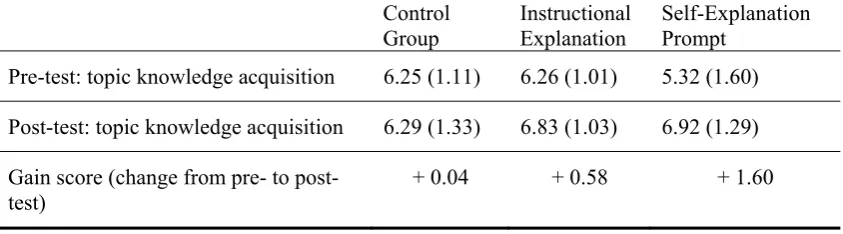
[image:7.595.88.510.613.730.2]The pre- and post-tests scores are illustrated in Table 1. At first glance, one could draw a broad conclusion that the learners benefited from learning with worked-out problems, as the learners who were exposed to the worked-out problems and either provided with instructional explanations or prompted to self-explain outperformed their counterparts who did not have the same learning experience. Both the instructional explanation and self-explanation prompts groups did better than the control group (IE: M = 6.83, SD = 1.03; SE: M = 6.92 (1.29); control group: M = 6.29, SD = 1.33).
Table 1: Topic knowledge acquisition [Mean (standard deviation)
Control Group
Instructional Explanation
Self-Explanation Prompt
Pre-test: topic knowledge acquisition 6.25 (1.11) 6.26 (1.01) 5.32 (1.60)
Post-test: topic knowledge acquisition 6.29 (1.33) 6.83 (1.03) 6.92 (1.29)
Gain score (change from pre- to post-test)
Journal of Technical Education and Training Volume 2 Number 2 (2010)
8 The ANOVA demonstrates that there was a significant difference between the experimental groups in which the F was significant beyond the 0.05 level with a strong effect. (F (2, 69) = 8.04, p=0.001, η2 = 0.17). The pos hoc analysis (Bonferroni test) indicates that the performance of those in the self-explanation prompts group has significantly surpassed the participants in the instructional explanation and control groups. Meanwhile, the test results also show that the difference between the instructional explanation group and the control group was not statistically significant. This analysis output has apparently shown that the self-explanation prompts strategy is an effective way to foster topic knowledge acquisition within the context of the present research.
This finding is in line with the previous studies in which self-explanation prompts have a facilitative effect on topic knowledge acquisition. For instance, the recent study conducted by Rau, Aleven, and Rummel (2009) showed that the self-explanation prompt method was able to positively impact on a learner’s ability to reproduce conceptual knowledge in the domain of fraction. In specific, the authors attempted to incorporate self-explanation prompts into multiple graphical representations (textual description plus graphic) and they found out that learning with multiple graphical representations alone might be confusing rather than fruitful to learning of fraction. However, when they coupled these multiple graphical representations with self-explanation prompts, they found a positive effective on reproduction of conceptual knowledge.
6.2 Near-Transfer Performance
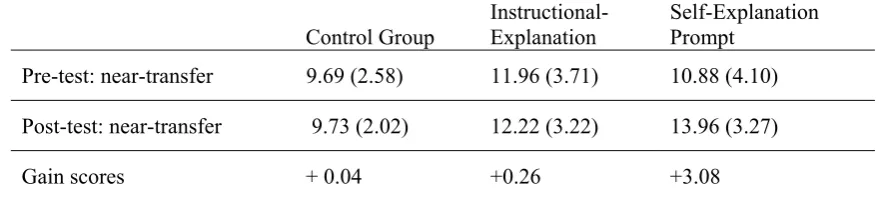
[image:8.595.76.516.571.671.2]Similar to the above case of topic knowledge acquisition, the learners in the self-explanation prompts group obtained the highest post-test scores as far as near-transfer performance is concerned. The data (Table 2) reveals that the learners in self-explanation prompts group achieved the highest near transfer mean score and gain score (M = 13.96, SD = 3.27; gain score = 3.08) in the post-test, whereas the learners in the control group had the lowest mean and gain scores (M = 9.73, SD = 2.02; gain score = 0.04), and those in the instructional explanation group yielded intermediate mean and gain scores (M = 12.22, SD = 3.22; gain score = 0.26).
Table 2: Near-transfer performance [Mean (standard deviation)
Control Group
Instructional-Explanation
Self-Explanation Prompt
Pre-test: near-transfer 9.69 (2.58) 11.96 (3.71) 10.88 (4.10)
Post-test: near-transfer 9.73 (2.02) 12.22 (3.22) 13.96 (3.27)
Gain scores + 0.04 +0.26 +3.08
Journal of Technical Education and Training Volume 2 Number 2 (2010)
9 reveals that there were significant mean differences in gain scores between the self-explanation prompts group and the instructional self-explanation group as well as between the self-explanation prompts group and the control group. In other words, the learners in self-explanation prompts group gained significant higher performance compared to the learners in both the instructional explanation and control groups. In contrast, the mean gain scores of the instructional explanation and the control groups did not differ significantly. Based on these outcomes, it can be asserted that learning from worked-out examples with self-explanation prompts positively contributes to near-transfer performance.
The possible explanation for the present outcome could be that when a learner is prompted to generate explanations, the learner’s entry knowledge will be activated as s/he begins to construct an interpretation of the worked-out solution procedures based on her/his existing entry knowledge and understanding. If the learner has sufficient existing knowledge to self-explain, then a new mental model, which is based on the worked-out problem model, can be constructed. This newly constructed mental model can then be integrated into the existing incomplete or erroneous knowledge base to form a more complete mental model (Renkl, 2002). Since the new mental model is constructed corresponding to the worked-out problem model, the difficulty of solving isomorphic or near-transfer problems can be substantially reduced. As a consequence, the near-transfer performance can be enhanced.
6.3 Far-Transfer Performance
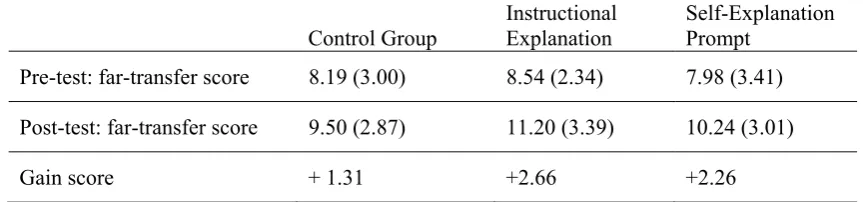
[image:9.595.81.513.544.645.2]As far as far-transfer performance is concerned, the learners in the instructional explanation group attained the highest post-test as well as gain scores (M=11.20, SD=3.39; gain score=2.66). In contrast, the learners in the control group scored the lowest as they had only an average post-test score of 9.50 (SD=2.87) and an average gain score of 1.31; while those in the self-explanation prompts group yielded an intermediate score of post-test mean score and gain score (M = 10.24, SD = 3.01; gain score 2.26).
Table 3: Far-transfer performance [Mean (standard deviation)
Control Group
Instructional Explanation
Self-Explanation Prompt
Pre-test: far-transfer score 8.19 (3.00) 8.54 (2.34) 7.98 (3.41)
Post-test: far-transfer score 9.50 (2.87) 11.20 (3.39) 10.24 (3.01)
Gain score + 1.31 +2.66 +2.26
Journal of Technical Education and Training Volume 2 Number 2 (2010)
10 2002), it is quite surprising that the favourable effect of self-explanation prompts or instructional explanation was not visible on far-transfer performance in this study.
From a cognitive load perspective, using higher complexity worked-out examples in the learning process would probably have introduced a great amount of intrinsic cognitive load. This high intrinsic cognitive load may have decreased the working memory capacity, and thereby leaving insufficient cognitive resources for solving far-transfer problems and performing constructive cognitive activities, such as understanding the solution procedures, integrating fragmented information, repairing and modifying an existing faulty mental model, or constructing new knowledge representations. Theoretically speaking, learning materials with lower intrinsic cognitive loads allow learners to have more working memory capacity to spare and, thus, enable them to cope with extraneous cognitive demands (Paas, Renkl, & Sweller, 2004; Van Merriënboer & Sweller, 2005). Therefore, for a novice, learning with low intrinsic cognitive load inducing instructional materials may enhance transfer performance, while high intrinsic cognitive load inducing instructional materials can interfere with transfer performance, especially far-transfer performance.
6.4 Mental Effort and Learning Performance
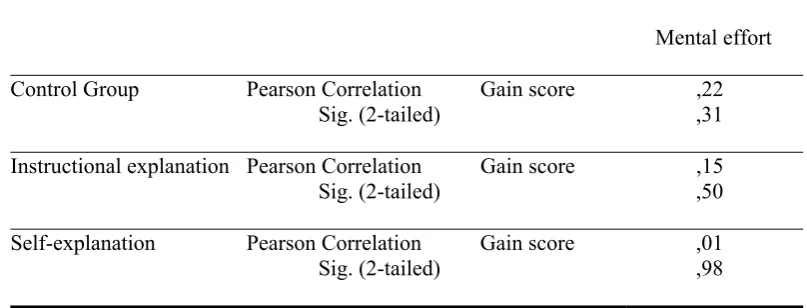
[image:10.595.94.498.434.588.2]It is interesting to find out that the amount of mental effort investment is positively but not significantly correlated with the test performance. Control group: r (24) = 0.22, ns; Instructional explanation group: r (23) = 0.15, ns; Self-explanation prompts group: r (25) = 0.01, ns. Refer Table 4.
Table 4: Correlations between mental effort and performance gain score
Mental effort
Control Group Pearson Correlation Gain score ,22
Sig. (2-tailed) ,31
Instructional explanation Pearson Correlation Gain score ,15
Sig. (2-tailed) ,50
Self-explanation Pearson Correlation Gain score ,01
Sig. (2-tailed) ,98
Journal of Technical Education and Training Volume 2 Number 2 (2010)
11 well, might tend to do their best on a test without considering the rewards offered. Second, students only put mental effort in a task when there are sufficient rewards. Although the authors did not conduct direct measurement of mental effort invested by the research participants, their findings seems to suggest that test performance might be dependent on the cognitive (e.g., problem solving skills) and non-cognitive factors (e.g., interest) but not directly influenced by the level of mental effort investment.
7 Conclusion
In conclusion, the current results suggest that the stimulation of cognitive processes by self-explanation prompts might result in a better topic knowledge acquisition and near-transfer performance for novice learners. In terms of far-transfer performance, both the provision of instructional explanations and self-explanation prompts produce similar results. Meanwhile, it has also been found that the learning performance is not dependent upon the quantity of mental effort invested to a learning task. That is to say, a high mental effort investment does not guarantee a fruitful learning performance.
References
Antepohl, W., & Herzig, S. (1999). Problem-based learning versus lecture-based learning in a course of basic pharmacology: a controlled, randomized study. Medical Education. Vol: 33(2), pp.106-113.
Atkinson, R.K., Renkl, A., & Merill, M.M. (2003). Transitioning From Studying Examples to Solving Problems: Effects of Self-Explanation Prompts and Fading Worked-Out Steps. Journal of Educational Psychology. Vol: 95(4), pp.774-783
Barrows H.S., & Tamblyn R.M. (1980) Problem-Based Learning: An Approach to Medical Education. New York: Springer Publishing Company.
Blumberg, B. (2000). Evaluating the Evidence That Problem-based learners are self-directed learners: A review of the literature. In D.H. Evensen and C.E. Hmelo (Eds). Problem-based learning: A research perspective on learning
interactions. Mahwah, NJ: Erlbaum
Borghans, L., Meijers, H, & ter Week, B. (2008).The Role of Noncognitive Skills in Explaining Cognitive Test Scores. Economic Inquiry. Vol: 46(1), pp.2-12
Bransford, J.D., Brown, A.L., & Cocking, R.R. (2000). How people learn: Brain, mind, experience, and school. Washington: National Academic press.
Chi, M.T.H. (2000). Self-Explanation expository texts: The dual processes of
Journal of Technical Education and Training Volume 2 Number 2 (2010)
12 Chi, M.T.H., & Glaser, R. (1985). Problem Solving Ability. In R. Sternberg (Ed).
Human Ability: an information-processing approach (pp. 227-257). San Francisco: W.H. Freeman & Co.
Cruickshank, B.J., & Olander, J. (2002). Can Problem-based Instruction stimulate higher order thinking? Journal of College Science Teaching. Vol: 31(6), pp.374-377
Dyke, P., Jamrozik, K., & Plant, A.J. (2001). A randomized Trial of a problem-based learning approach for teaching epidemiology. Academic Medicine. Vol: 76(4), pp.373-379
Gale, JR. H.F., Wojan, T.R., & Olmsted, J.C. (2002). Skills, Flexible Manufacturing Technology, and Work Organization. Industrial Relations. Vol: 41(1), pp.48-79
Gerjets, P., Scheiter, K., & Catrambone, R. (2006). Can learning from molar and modular worked examples be enhanced by providing instructional explanations and prompting self-explanation?. Learning and Instruction.Vol:16(2), pp.104-121
Gick, M.L., & Holyoak, K.J. (1983). Schema induction and analogical transfer. Cognitve. Psychology. Vol: 15, pp.1-38
Hart, S.G., & Staveland, L.E. (1988). Development of NASA-TLX (Task Load Index): Results of experimental and theoretical research. In P.A. Hancock, & N. Meshkati (Eds), Human Mental Workload. (pp.139-183). Amsterdam: North Holland
Hmelo, C.E. (1998). Congenital Consequences of Problem Based Learning for the Early Development of Medical Expertise. Teaching and Learning in Medicine. Vol: 10, pp.92-100.
Kirschner, P.A., Sweller, J., & Clark, R.E. (2006). Why Minimal Guidance During Instruction Does Not Work: An analysis of the failure of Constructivist, Discovery, Problem-based, Experiential, and Inquiry-based Teaching. Educational psychologist. Vol: 41(2), pp.75-86.
Leinhardt, G. (1993). Instructional explanations in history and mathematics. In W. Kintsch (Ed.), Proceedings of the Fifteenth Annual Conference of the Cognitive Science Society (pp. 5-16). Hillsdale, NJ: Lawrence Erlbaum Associates
McParland, M., Noble, L.M., & Livingston, G. (2004). The effectiveness of problem-based learning compared to traditional teaching in undergraduate psychiatry. Medical Education. Vol: 38. Pp.859-867
Journal of Technical Education and Training Volume 2 Number 2 (2010)
13 Michel, M.C., Bischof, A., & Jakobs, K.H. (2002). Comparison of Problem- and
Lecture-Based Pharmacology Teaching. Trends in Pharmacological Sciences. Vol: 23(4), pp.168-170.
Mohamed Rashid, N.B., & Mohd Nasir, A.H. (2003). Lifelong Learning in Malaysia. Paper presented at the International Policy Seminar Co-Organised by
IIEP/UNESCO and KRIVET on Making Lifelong Learning a Reality, 24-26th
June 2003, Seoul
Ohlsson, S., & Rees, E. (1991). The function of conceptual understanding in the learning of arithmetic procedures. Cognition and Instruction. Vol: 8(2), pp.103-179
Paas, F., & van Gog, T. (2006). Optimising worked example instruction: Different ways to increase germane cognitive load. Learning and Instruction. Vol: 16(2), pp.87-91.
Paas, F., Renkl, A., & Sweller, J. (2003). Cognitive Load Theory and Instructional Design: Recent developments. Educational Psychologist. Vol: 38(1), pp.1-4
Paas, F., Renkl, A., Sweller, J. (2004). Cognitive load theory: instructional
implications of the interaction between information structures and cognitive architecture. Instructional Science. Vol: 32(1), pp.1-8
Rau, M.A., Aleven, V., & Rummel, N. (2009). Intelligent Tutoring System with Multiple Representations and Self-Explanations Prompts Support Learning of Fractions. In V. Dimitrova, R. Mizoguchi, & B. du Boulay (Eds), Proceedings of the 14th International Conference on Artificial Intelligence in
Education.(pp.441-448). Amsterdam, the Netherlands: IOS Press.
Renkl, A. (1997). Learning from worked-out examples: A study on individual differences. Cognitive Science. Vol: 21, pp.1-29
Renkl, A. (2002). Worked out examples: Instructional explanations support learning by self-explanation. Learning and Instruction. Vol: 12(5), pp.529-556
Renkl, A., Stark, R., Gruber, H., & Mandl, H. (1998). Learning from worked-out examples: The effects of example variability and elicited self-explanations. Contemporary Educational Psychology. Vol: 23, pp.90-108
Savery, J.R. (2006). Overview of Problem-based Learning: Definitions and
Distinctions. The Interdisciplinary Journal of Problem-based Learning. Vol: 1(1), pp.9-20
Journal of Technical Education and Training Volume 2 Number 2 (2010)
14 Sweller, J., & Cooper, G.A. (1985). The Use of Worked Examples as a Substitute for
Problem Solving in Learning Algebra. Cognition and Instruction. Vol: 2, pp.59-89
Sweller, J., van Merriënboer, J.J.G., & Paas, F. (1998). Cognitive Architecture and Instruction Design. Educational Psychology Review. Vol: 10, pp.251-296
Van Gog, T., Paas, F., & van Merriënboer, J.J.G. (2008). Effects of studying sequences of process-oriented and product-oriented worked-examples on troubleshooting transfer efficiency. Learning and Instruction. Vol: 18(3), pp.211-222
Van Merriënboer, J.J.G., & Sweller, J. (2005). Cognitive Load Theory and Complex Learning: Recent development and future directions. Educational Psychology Review. Vol: 17, pp.147-177
Van Lehn, K. (1996). Cognitive skill acquisition. Annual Review of Psychology. Vol: 47, pp.513-539.
Wang, J.G., Fong, Y.C., & Alwis, W.A.M. (2005). Developing Professionalism in Engineering Students Using Problem-based Learning. Proceedings of the Regional Conference on Engineering Education. On 12-13 Dec 2005, Johor Malaysia.
Wee, K.N.L. (2004). Jump Start Authentic Problem-based Learning. Singapore: Prentice-Hall.