© 2016, IRJET | Impact Factor value: 4.45 | ISO 9001:2008 Certified Journal
| Page 161
Effects of Confinement on Structural Stability and Electronic Structure
of Sodium Clusters
Balasaheb J. Nagare
1, Sunil P. Chavan
21,2
Department of Physics, University of Mumbai, Santacruz (E), Mumbai 400 098, India.
---***---Abstract -
We have investigated structural stability and electronic properties of sodium clusters in the size range of 2-20 atoms as a function of confinement using real space density functional theory (DFT). We have selected lowest energy structures by examining lowest five isomers as a function of volume for six different compressions. The minimum volume considered is about 10% of the free box volume. We analyze energetics, eigenvalue spectra, molecular orbitals and charge density to examine the stability and electronic properties of the sodium clusters. Our calculations show the insignificant changes in the total energies until the volume gets reduced beyond the one third of the original volume. Once the critical volume is reached, the changes in the total energies are significant. This is accompained by the breaking of degeneracy of electronic levels, the increase in spacing between the energy states. The molecular orbital analysis shows the hybridization of s-p-d orbitals, rotations, splitting, overlap of π-electrons and squeezing of molecular orbitals. It further shows the spill of electron density into the interstics region of clusters.Key Words: Structural stabilty, Electronic properties,
confinement, DFT method, Sodium clusters.
1.INTRODUCTION
It is well established that geometrical confinement modifies the properties of materials. Confinement could be due to a surface, an interface, an adsorbate layer or encapsulation in nanotubes. Such materials often display unusual structure[1,2] and new physiochemical properties.[3–5] Therefore considerable efforts have been directed towards elucidating properties of such systems under confinement. Confinement may change the geometric arrangement of atoms accompanied by significant changes in the electronic energy levels leading to very different properties.
Recently, a real space density functional theory have been used to study the effect of compression on the structural and electronic properties. It is observed that sodium clusters do not show significant change unless the volume is reduced to about 70% of free space box volume. Thereafter the change in total energy, kinetic energy and other components show highly nonlinear behaviour. The change in the kinetic energy has most dominated. The geometries tend to become more spherical. In most of the cases, the HOMO-LUMO gap reduces mainly due to the change in the ground state
geometries. However, In few cases Na2, Na5, Na7 and Na8, where the ground state geometries remain unchanged, HOMO-LUMO gap increases as expected from the simple particle in a box model. Further, it is observed that the strong confinement leads to significant isomeric transitions.[6,7] However, the structural stability and electronic structure have not been discussed. Then question arise whether the clusters would be stable under high confinement. If so, then what would be its limiting value. To gain some insight into the stability of clusters and electronic structure under confinement, we have carried out systematic DFT calculations on a series of sodium clusters.
It should be mentioned that the present work has been carried out within the framework of DFT at the level of generalised gradient approximation (GGA) given by Perdew– Burke–Ernzerhof (PBE)[8] functional. Previously, GGA approach has been successfully used to get valuable insight of structural and electronic properties of sodium clusters.[9,10] Further, It has been extended to understand the electronic properties of sodium metal at different pressure.[11,12] Even though DFT based methods are successful to explain the ground state properties in a wide range of materials, it failed to give accurate calculation of quasiparticle energies. This mainly occurs due to underestimation of Kohn-Sham energy eigenvalues in local and semilocal functionals which may ultimately be attributed to their inherent lack of derivative discontinuity[13], self-interaction error[14] and delocalization error.[15] Therefore, the DFT method needs to be used with caution.
© 2016, IRJET | Impact Factor value: 4.45 | ISO 9001:2008 Certified Journal
| Page 162
clusters with the help of energetics and electronic properties using eigenvalue spectra, molecular orbital analysis and charge density.
The organization of the present paper is as follows. In the next section, we will describe the model and technical details of our simulations. In section III, we present and discuss the results. In section IV, we will summarize our results along with some important concluding remarks.
2. COMPUTATIONAL METHOD AND DETAILS
The calculations have been performed using OCTOPUS code[18] with GGA method given by PBE approximation[8].
The norm conserving Troullier–Martins
pseudopotentials[19] have been used in all calculations. The initial structures of sodium used in this study have been obtained by a simulated annealing method. The optimized geometries of the first five low lying isomers are comparable with the reported results.[20,21]
In each of the cases, the five isomers are subjected to various compressions by a hard-walled three dimensional cubic boxes whose volume (V) was reduced from V0 to V/V0 = 0.05, where, V0 is the volume of a cubic box corresponding to free space. For large clusters, we have reduced the volume of a cubic cell up to V/V0 = 0.125. We denote the smallest volume by Vh. All optimized geometries were considered to be converge when the change in energy was of the order of 10−5 hartrees and the absolute maximum force was less than 0.002 hartrees/Å. A grid spacing of 0.18 Å for the real space grid have been used for all calculations. The validity of the grid-spacing have been verified by reference calculations for the test structure Na2 using grid-spacings of 0.09 to 0.30 Å. All five grid-spacings 0.16 to 0.20 Å have reproduced similar absorption spectra up to an accuracy of about 0.1 eV in the relevant low-energy region of about 0-6 eV. Among the lowest five isomers of each of sodium clusters, we have selected the ground state geometry for the property calculations.
The binding per atom is calculated as;
(1) n being the size of the cluster. The total energy difference for each of the clusters can be calculated as;
(2)
where Ef ree and Econfine are the total energy of free and compressed geometries respectively.
3. RESULTS AND DISCUSSION
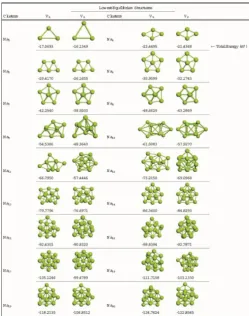
For all the clusters considered (Nan, n = 2 − 20), we have investigated the effect of compression on the stability and electronic structure of the ground state geometries. These are shown in Figure 1. The ground state geometries have been selected among the lowest five energy structures. These geometries are subjected to five to seven different
volumes depending on the size of the cluster. As we shall see in many of the cases, it is most convenient to bring out the effect of compression by comparing the results for free space volume (V0)[22] with highest compression volume (Vh). We will first present the results on structural stability using total energy per atom, total energy difference and binding energy of clusters. This is followed by a discussion on electronic structure with the help of eigenvalue spectra, molecular orbital analysis and charge density.
Fig -1: The geometries of the lowest equilibrium structures of sodium clusters with n=3-20. In each of cases, the first row presents free state geometries and second row show the compressed geometries for the same isomers.
[image:2.595.307.557.214.531.2]© 2016, IRJET | Impact Factor value: 4.45 | ISO 9001:2008 Certified Journal
| Page 163
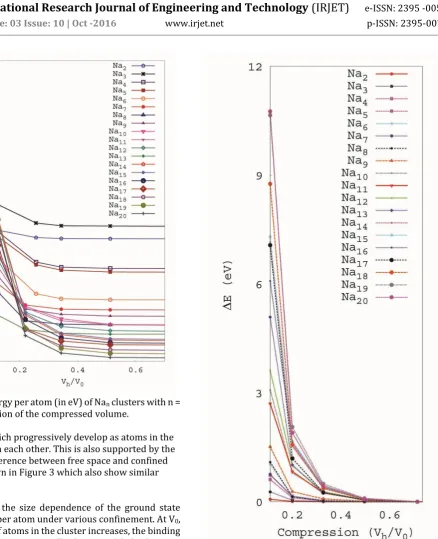
Fig -2: Total energy per atom (in eV) of Nan clusters with n = 2 − 20 as a function of the compressed volume.
interactions, which progressively develop as atoms in the cluster approach each other. This is also supported by the total energy difference between free space and confined systems as shown in Figure 3 which also show similar trends.
Figure 4 shows the size dependence of the ground state binding energy per atom under various confinement. At V0, as the number of atoms in the cluster increases, the binding energy increases monotonically due to p-d hybridization. However, In case of Na3, where equilateral triangle is John-Teller unstable with the flat potential energy surface. It also depicts even-odd oscillations in the dependence of binding energy per atom. These results are comparable to reported by Solov et. al.[23] The analogous behaviour in the binding energy curve is also observed under high compression. In this case, even cluster have higher binding energies as compared with their odd neighbours. Note that this phenomenon occurs simultaneously with the slight monotonous growth of the binding energies per atom with increasing cluster size. Indeed, the lowering of binding energies per atom under high compression is expected due to strong electrostatic repulsion between the nuclei and electrons.
Fig -3: Total energy difference between free and confined space of sodium clusters as a function of confining volume.
[image:3.595.106.545.48.588.2] [image:3.595.37.292.70.437.2] [image:3.595.309.550.84.588.2]© 2016, IRJET | Impact Factor value: 4.45 | ISO 9001:2008 Certified Journal
| Page 164
Fig -4: Binding energy per atom for lowest energy sodium clusters as a function of cluster size (n) at V0 and Vh. Geometries of the corresponding clusters one can find in Figure 1.
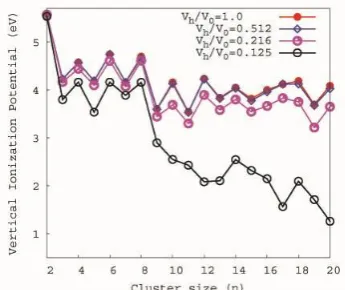
which means their higher stability as compared to the neighbouring odd-N-clusters. Interestingly enough, the ionization potentials of sodium clusters show a large decrease under high confinement. The lowering of IP values is attributed to the overlap of electronic orbitals and confinement-induced strong coulombic repulsion when the atoms in the cluster approaches to each other under confinement. As a result, lesser amount of energy is required to remove the electron from its valence orbital. It is further noted that even in confined systems, the odd-even oscillation in the ionization potential are observed in all sodium clusters.
Fig -5: Ionization potentials of lowest energy sodium clusters as a function of cluster size (n) under various compressions.
The eigenvalue spectra for five representative clusters are shown in Figure 6 for the two extreme cases. The degeneracy is explicitly indicated by the label. A number of interesting features can be noted from the eigenvalue spectra: (i) the formation of the spectra across the series reveals that all
energy levels are raised with respect to free-cluster systems; (ii) an increase in spacing between the energy levels and
Fig -6: Eigenvalue spectra of Na, Na2, Na3, Na8 and Na20 clusters in the low and high confinement regimes. The number near the level shows degeneracy. The red and blue represent occupied and unoccupied levels, respectively. The V0 and Vh denote the free and highest compressed state.
this effect is more prominent in the conduction band; (iii) re-ordering of molecular orbitals (splitting, rotations and squeezing) and is more prominent for high confinement i.e. higher energy levels in the conduction band; (iv) breaking of degeneracy of energy levels. The energy levels with same principal quantum number (‘n’) and different ‘l’ quantum numbers crossover, while those with same ‘l’ never cross; (v) exhibit very strong HOMO–LUMO transitions. As expected, all the energy levels are raised relative to their free-cluster values. The extent by which a level is raised increases as V decreases, and it increases with n, for a given V0 and l. Let us recall that for particle in a box, total energy is proportional to n2/L2 (En ∝ n2/L2), where n is the principal quantum number and L is the length of confining box. As L decreases, En increases. However, for higher values of n, the higher eigenvalues increase is more. As a consequence upon compression, HOMO-LUMO gap increases. The simple picture is modified by a change in the symmetry of the ground state upon compression. Na13, Na18 and Na20 clusters represent such cases. As a consequence, there is reduction in Eg. Thus, the simple picture of confinement gets considerably modified because of the detailed arrangementof ions. Figure 6 also shows the variation in the LUMO and HOMO energy along with Eg for Na8, Na13, Na18 and Na20. Na8 shows the increase in Eg as expected from the simple particle in a box model. For the other cases, the rise in HOMO, sharper than that of LUMO.
[image:4.595.38.277.84.300.2] [image:4.595.311.555.130.293.2] [image:4.595.77.250.515.660.2]© 2016, IRJET | Impact Factor value: 4.45 | ISO 9001:2008 Certified Journal
| Page 165
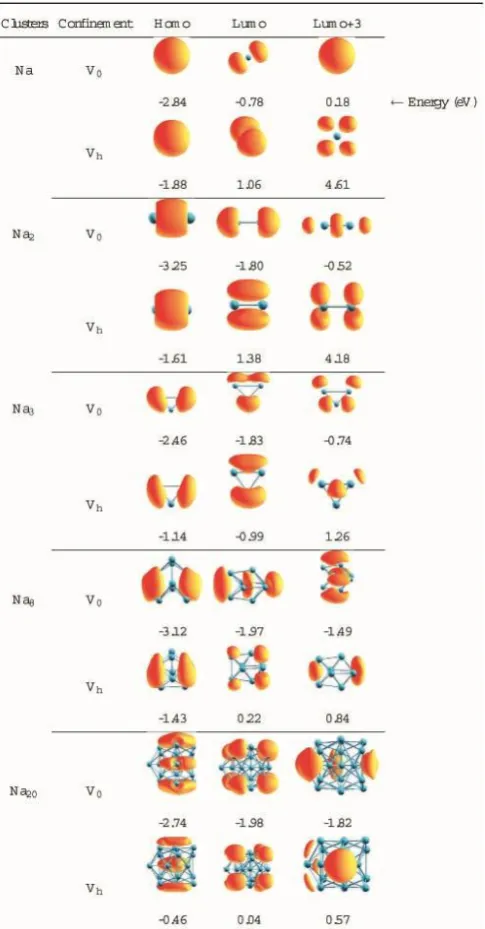
Fig -7: The molecular orbitals of some of the sodium clusters. Only molecular orbitals are shown in the figure. The symbols V0 and Vh have same meaning as mentioned above.
an isolated Na atom, the unoccupied states next to -2.84 eV are triply degenerate. These states become unbound at Vh, next to -1.88 eV (HOMO). The isosurface of molecular orbitals shows that the HOMO which has ‘s’ character are weakly destabilized under the confinement. For Na2, the state (HOMO) at -3.25 eV is doubly occupied and it is of s-type. The next to -1.80 eV, LUMO is also doubly degenerate. All unoccupied states are of p-type. However, at Vh, the state next to HOMO (-1.62 eV), is doubly degenerate (LUMO, LUMO+1) at 1.38 eV and having ‘p’ character. At Vh, only lowest state is bound. Thus, the unoccupied energy levels are highly destabilized at Vh. However, the delocalization of MOs is actually depends on value of V. It is effective when V
exceeds the critical volume. The critical volume is generally reached when the confinement reduces to 50 % of the free cluster volume. Even it becomes unbound at Vh. The eigenvalue spectra also shows the crossing of ‘s’ and ‘p’ states. In Na8 − 4D system at V0, the unoccupied levels are bundled into two groups, whereas at Vh, it got split into more four groups and the gap is widened. This also indicates that molecular orbital for each of that group, most likely similar, i.e. it would be either p or d or f type. On the other hand in free space (Vh), the some orbitals in the second bunch have ‘s’, some have ‘p’ and ‘d’ character, but unlike at the higher compression, Vh, they show mixed character. The p-d hybridization has been also observed in sodium metal when subjected to high pressure at 200 GPa.[11,12]
Lastly, we analyse the electron density of the constrained geometries and compare it with counterpart. Figure 8 shows the contour plot on a isosurfaces of charge density for Na20 cluster. It clearly depicts the drop of electron density from its maximum (atom) to minimum value (vacuum) below critical volume. However, the amount of overspill may extend upto few angstroms, which depends on the confining volume. The spill of the electron density plays a decisive role in the appearance of the floating state. These extra states are also seen in the unoccupied band of the eigenvalue spectra as shown in Figure 6.
Fig -8: The contour plot (in the x-plane) on a isosurfaces of charge density of Na20 cluster depict the flow of electron maximum (inside the electron) to minimum (outside the electron) concentration under isotropic confinement.
4. SUMMARY AND CONCLUDING REMARKS
We have used real space DFT method to study the effect of confinement on the structural stability and electronic structure of sodium clusters in the size range of 2-20 atoms as a function various degrees of confinement. The stability of clusters has been examined with the help of total energy per atom, differencein the total energy and binding energy per atom. It is found that the clusters remain stable till its confining volume reduces to 50% (critical limit) of free cluster box volume. It is further observed that the clusters do not show significant change in their geometries unless the volume exceeds its critical limit. Thereafter, the clusters become highly unstable and shows non-linear behaviour at highest confinement.
[image:5.595.39.282.98.563.2] [image:5.595.306.553.415.490.2]© 2016, IRJET | Impact Factor value: 4.45 | ISO 9001:2008 Certified Journal
| Page 166
lowering of ionization potential, breaking of degeneracy of energy levels, overlap of π-electrons, delocalization and squeezing of molecular orbitals and strong HOMO-LUMO transitions. The charge density analysis shows the overspill of electron density from maximum to minimum value which results in the addition of the extra levels in the unoccupied band.
ACKNOWLEDGEMENT
This research was supported in part by the Department of Science and Technology (DST), through computing resources provided by the high performance computing facility at the Inter University Accelerator Center (IUAC), New Delhi.
REFERENCES
[1] I. Tamblyn, J.-Y. Raty, and S. A. Bonev. Tetrahedral
clustering in molten lithium under pressure. Phys. Rev. Lett., 101:075703, 2008.
[2] M. I. Eremets, I. A. Trojan, S. A. Medvedev, J. S. Tse, and Y.
Yao. Superconductivity in hydrogen dominant materials: Silane. Science, 319:1506, 2008.
[3] L. F. Lundegaard, G. Weck, McMahon M. I., S.
Desgreniers, and P Loubeyre. Observation of an O8 molecular lattice in the epsilon phase of solid oxygen. Nature, 443:201, 2006.
[4] L. Gao, Y. Y. Xue, F. Chen, Q. Xong, R. L. Meng, D. Ramirez,
C. W. Chu, J. H. Eggert, and H. K. Mao. Superconductivity up to 164 k in HgBa2Cam − 1CumO2m+2+δ (m=1, 2, and 3) under quasihydrostatic pressures. Phys. Rev. B, 50:4260, 1994.
[5] J. S. Tse, Y. Yao, and K. Tanaka. Novel superconductivity
in metallic SnH4 under high pressure. Phys. Rev. Lett., 98:117004, 2007.
[6] Balasaheb J. Nagare, Dilip G. Kanhere, and Sajeev
Chacko. Structural and electronic properties of sodium clusters under confinement. Phys. Rev. B, 91:054112, 2015.
[7] Balasaheb J. Nagare. The optical response of
nanoclusters under confinement. RSC Advances., 5(94):77478, 2015.8
[8] J. P. Perdew, K. Burke, and M. Emzerhof. Generalized
gradient approximation made simple. Phys. Rev. Lett., 77:3865, 1996.
[9] Oleg Kostko, Bernd Huber, Michael Moseler, and Bernd
von Issendorff. Structure determination of medium-sized sodium clusters. Phys. Rev. Lett., 98:043401, 2007.
[10] Masahiro Itoh, Vijay Kumar, Tadafumi Adschiri, and
Yoshiyuki Kawazoe. Comprehensive study of sodium, copper, and silver clusters over a wide range of sizes 2 to 75. J. Chem. Phys., 131:174510, 2009.
[11] E. Gregoryanz, O. Degtyareva, M. Somayazulu, R. J.
Hemley, and H. K. Mao. Melting of dense sodium. Phys. Rev. Lett., 94:185502, 2005.
[12] Y. Ma, M. Ermets, A. R. Organov, Y. Xie, I. Trojan, and S.
Medvedev. Transparent dense sodium. Nature, 458:182, 2009.
[13] L. J.Sham and M.Schluter. Density-functional theory of
the energy gap. Phys. Rev. Lett., 51:1888, 1983.
[14] J. P. Perdew and Alex Zunger. Self-interaction correction
to density-functional approximations for many-electron systems. Phys. Rev. B, 23:5048, 1981.
[15] A. J. Cohen, P. Mori-Sanchez, and W. Yang. Fractional
charge perspective on the band gap in density-functional theory. Phys. Rev. B, 77:115123, 2008.
[16] M. F. Bertino, F. Hofmann, and J. P. Toennies. The effect
of dissociative chemisorption on the diffraction of D2 from Ni(110). J. Chem. Phys., 106:4327, 1997.
[17] M. F. Bertino, A. P. Graham, L. Y. Rusin, and J. P. Toennies.
Diffraction and rotational transitions in the scattering of D2 from Cu(001) at energies up to 250. J. Chem. Phys., 109:8036, 1998.
[18] M. A. L. Marques, A. Castro, G.F. Bertsch, and A. Rubio.
Octopus: A first-principles tool for excited electron-ion dynamics. Comp. Phys. Comm., 151:60, 2003. http://www.tddft.org/programs/octopus.
[19] N. Troullier and J. L. Martins. Efficient pseudopotentials
for plane-wave calculations. Phys. Rev. B, 43:1993, 1991.
[20] Ursula Rothlisberger and Wanda Andreoni. Structural
and electronic properties of sodium microclusters (n=2-20) at low and high temperatures: New insights from ab initio molecular dynamics. J. Chem. Phys., 94(12):8129, 1991.
[21] Seyed Mohammad Ghazi, Shahab Zorriasatein, and D. G.
Kanhere. Building clusters atom-by-atom: From local order to global order. J. Phys. Chem. A, 113:2659–2662, 2009.
[22] This is the minimum volume which we reproduces the
free cluster results.
[23] IIia A. Solov’yov, Andrey V. Solov’yov, and Walter
Greiner. Structure and properties of small sodium clusters. Phys. Rev. A, 65:053203, 2002.
[24] W. A. de Heer. The physics of simple metal clusters:
experimental aspects and simple models. Rev. Mod. Phys., 65:611, 1993.
[25] H. Akeby, I. Panas, L. G. M. Petterson, P. Siegbahn, and U.
Wahlgreen. Electronic and geometric structure of the copper (Cun) cluster anions (n ≤ 10). J. Phys. Chem., 94:5471, 1990.