© 2016, IRJET | Impact Factor value: 4.45 | ISO 9001:2008 Certified Journal | Page 40
EAACK: A Novel Technique to resolve security issues in WSN
Mr. Sachin Acharya T
1, Mr. Nithin Kumar
21
M.Tech Scholar, Dept. of Computer Science & Engineering, P.E.S College of Engineering,Karnataka,India
2M.Tech Scholar, Dept. of Computer Science & Engineering, P.E.S College of Engineering,Karnataka,India
---***---Abstract -
WSNs are the temporary networks which aredynamic and self-maintainable. As being dynamic in nature and without any fixed infrastructure security becomes a great concern in WSNs. In WSN we have different types of security attacks like black hole, worm hole and grey hole but in this paper we are only focusing on the detection of malicious nodes and false reporting. In this paper, we propose and implement a new intrusion-detection system named Enhanced Adaptive Acknowledgment (EAACK) specially designed for MANETs. Compared to contemporary approaches, EAACK demonstrates higher malicious- behavior-detection rates in certain circumstances while does not greatly affect the network performances.
Key Words: WSN, Security attacks in WSN , Enhanced
Adaptive Acknowledgement , EAACK , False Misbehaviour Reporting , Misbehaviour Report Authentication
1. INTRODUCTION
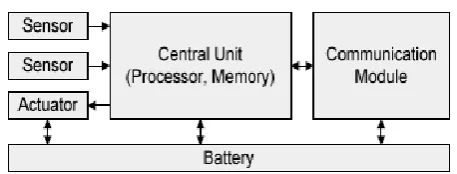
[image:1.595.325.554.203.290.2]Wireless sensor network is a group of specialized transducers that are deployed in particular environment to gather information. Wireless sensor network is an advanced technology with their limited energy, processing and transmission capabilities. WSN have gained popularity due to their usage in various applications in impractical environments. A typical WSN consists of battery-powered sensor nodes with data acquisition, processing and transmitting components. The main challenge for sensor networks consists of two aspects. First, sensor nodes have some resource constraints. Second, in several applications sensor nodes are randomly deployed to monitor particular environment [3]. An application that uses sensor networks are distributed in nature and basically route messages using wireless communication medium. Wireless communication medium is inherently insecure and sensor nodes have low computational power processors, low memory, and runs on battery. In addition, sensor nodes are likely be deployed in open, physically impractical, or hostile environments where sensor nodes can be easily compromised by the attackers.
Fig 1: Structure of a typical sensor node
As shown in Fig 1, a typical sensor node consists of three subsystems. Sensing subsystem for data acquisition, Processing subsystem for processing gathered information, and Communication subsystem for the transmission of gathered information. Finally, the three subsystems of sensor nodes run on the energy provided by underlying battery. Though sensor nodes are deployed in impractical environments, security requirements is to be provided such as integrity, confidentiality, and availability so on.
1.1 Security Requirement
The security requirements [1] for a wireless sensor network can be classified into following ways:
Integrity: The data in transmission between sensor nodes can be altered by the adversaries. Data integrity should be provided to ensure that information is not altered in transmission.
Authentication: As WSN communicates sensed data, the sender/receiver needs to authenticate each other while exchanging the control information.
Confidentiality: Applications like military, secret
applications and key exchanges need the confidentiality of data. Confidentiality can be provided through the use of cryptographic techniques on the data.
© 2016, IRJET | Impact Factor value: 4.45 | ISO 9001:2008 Certified Journal | Page 41 sensor nodes through some energy conservation
schemes.
Data Freshness: In addition to data confidentiality, data integrity and availability, we also need to ensure the freshness of each transmitted message that no old messages are replayed by adding time stamp to the packet
1.2 Security attacks
Attacks on the sensor networks can be classified [2] as following ways:
Interruption is a class of attack on WSN where the availability of the sensor nodes is damaged. It includes problems such as malicious content insertion, capturing the nodes, corrupting messages etc.
Interception is a class of attack on WSN where the confidentiality of data that’s being transmitted over the network is disclosed. It includes unauthorized access to sensor node or data within it.
Modification is a class of attack on WSN where the integrity of data that’s being transmitted over the network is modified. It includes the modification of the data packets or causing denial of service attack. Fabrication is a class of attack on WSN where the
authentication for the transfer of control information is altered. In this sort of attacks an intruder injects false data and gains the trustworthiness.
These are all the different classes of attacks that may occur in sensor network. This classes of attacks can be rectified by using some acknowledgement schemes that ensure about the attacks on which preventive actions can be taken. But traditional acknowledgement schemes are volatile for the attacks that are explained below such as black hole and grey hole attacks.
A. Black Hole Attack: A black hole attack is a kind of attack in WSN where a malicious node in the sensor network makes use of the routing information and represents itself has the shortest path to the destination node in the sensor network. After representing itself has a shortest path to destination node, the malicious node receives routing packets and does not forward packets to its neighbor nodes. This kind of malicious node is
called black hole [4]. After the creation of this black hole
in sensor networkthe source node sends out its data
packets to the black hole believing that it’s the shortest
path to destination node. Thus the black hole receives all sent packets from the source node and behalf of forwarding those data packets to the destination it will simply discard those packets. So the data packets obtained by the black hole node will not arrive at the destination node.
B. Grey Hole Attack: The grey hole attack was first described by Karlof and Wagner [5]. This attack is sometimes also called as selective forwarding. The grey hole attack is a kind of attack in WSN where a malicious node in the sensor network tries to stop the data packets that are passing through it in a sensor network by refusing to forward the data packets or dropping the data packets passing through them. In this grey hole attack, the malicious node can selectively drops the data packets coming from particular sensor node. This selective dropping may create DoS attack in the sensor network. In this sort of attacks the malicious nodes may also behave like black hole and refuses to forward the data packets passing through them.
As explained above the black hole and grey hole attacks are two severe attacks on WSN with passive nature. Due to their passive nature the present acknowledgements schemes are vulnerable to this kind of attacks on WSN. The present acknowledgement schemes are explained in next section with their related work in field of WSN.
2. RELATED WORKS
The nodes in WSNs assume that other nodes always cooperate with each other in data transmission. This assumption leaves the attackers to cause significant impact on the network with just one or two compromised nodes. To address this problem, IDS should be added to enhance the security level of WSNs. If WSN can detect the attackers as soon as they enter the network, we will be able to completely eliminate the potential damages caused by compromised nodes.
In this paper, we discuss some of the security schemes which are being used so far.
2.1 Watchdog
Marti et al. [6] proposed the Watchdog scheme. It improves the throughput of network with the presence of malicious nodes. The Watchdog scheme consists of two parts i.e ‘Watchdog’ and ‘Pathrater’.
© 2016, IRJET | Impact Factor value: 4.45 | ISO 9001:2008 Certified Journal | Page 42 to its next hop’s transmission. If a Watchdog node overhears
that its next node fails to forward the packet within a certain period of time, it increases its failure counter. Whenever a node’s failure counter exceeds a predefined threshold, the Watchdog node reports it as misbehaving. In this case, the Pathrater cooperates with the routing protocols to avoid the reported nodes in future transmission.
The Watchdog scheme fails to detect malicious misbehaviors with the presence of the following: 1) ambiguous collisions; 2) receiver collisions; 3) limited transmission power; 4) false misbehavior report; 5) collusion; 6) partial dropping.
2.2 TWOACK
To overcome the weaknesses of the Watchdog scheme, a new scheme named TWOACK was proposed by Liu et al. [7] Aiming to resolve the receiver collision and limited transmission power problems of Watchdog, TWOACK detects misbehaving links by acknowledging every data packet transmitted over every three consecutive nodes along the path from the source to the destination.
Upon retrieval of a packet, each node along the route is required to send back an acknowledgment packet to the node that is two hops away from it down the route. TWOACK is required to work on routing protocols such as Dynamic Source Routing (DSR) [9].
[image:3.595.314.544.252.367.2]The receiver collision and limited transmission power problems posed by Watchdog are solved by this scheme. But the acknowledgment process required in every packet transmission process increased the network traffic. Due to the limited battery power nature of WSNs, such redundant transmission process can degrade the life span of the entire network.
Fig 2: TWOACK Scheme
2.3 AACK
Sheltami et al. [10] proposed a new scheme called AACK. Similar to TWOACK, AACK is an acknowledgment-based network layer scheme which is a combination of a scheme called TWOACK and an end-to-end acknowledgment scheme called ACKnowledge (ACK). Compared to TWOACK,
AACK significantly reduced network overhead while still capable of maintaining or even surpassing the same network throughput.
[image:3.595.46.266.552.647.2]Within a predefined time period, if the source node S receives this ACK acknowledgment packet, then the packet transmission from source node S to destination node D is successful. Otherwise, the source node S will switch to TWOACK scheme by sending out a ACK packet. This scheme reduces the network overhead, but both TWOACK and AACK fails to detect the malicious nodes and false misbehavior reporting.
Fig 3: AACK Scheme
2.4 Digital Signature
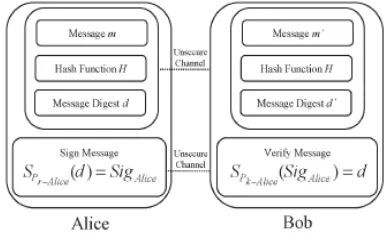
Cryptography is the study of mathematical techniques related to aspects of information security such as confidentiality, data integrity, entity authentication, and data origin authentication [8]. Digital signature is a widely adopted approach to ensure the authentication, integrity, and nonrepudiation of WSNs. It can be defined as a data string, which associates a message in digital form with some originating entity. Digital signature schemes can be mainly divided into the following two categories.
1) Digital signature with appendix: The original message is required in the signature verification algorithm. Examples include a digital signature algorithm (DSA) [12].
2) Digital signature with message recovery: This type of scheme does not require any other information besides the signature itself in the verification process. Examples include RSA [11].
[image:3.595.328.522.614.732.2]© 2016, IRJET | Impact Factor value: 4.45 | ISO 9001:2008 Certified Journal | Page 43
3. PROPOSED SCHEME
In order to overcome the drawbacks of the above
discussed scheme, the Enhanced Adaptive
Acknowledgement scheme (EAACK) was introduced. EAACK is consisted of three major parts, namely, ACK, Secure ACK (S-ACK), and misbehavior report authentication (MRA)[13].
A. ACK
ACK is basically an end-to-end acknowledgment scheme. It acts as a part of the hybrid scheme in EAACK, aiming to reduce network overhead when no network misbehavior is detected. If the ACK packet doesn’t reach the source in predefined period of time then ACK scheme will be adopted for the network.
B. S-ACK
The S-ACK scheme is an improved version of the TWOACK. Here every three consecutive nodes work in a group to detect misbehaving nodes. For every three consecutive nodes in the route, the third node is required to send an S-ACK acknowledgment packet to the first node. The intention of introducing S-ACK mode is to detect misbehaving nodes in the presence of receiver collision or limited transmission power.
C. MRA
The false misbehavior report can be generated by malicious attackers to falsely report innocent nodes as malicious. The Misbehavior Report Authentication scheme (MRA) is designed to detect misbehaving nodes with the presence of false misbehavior report. This scheme authenticates whether the destination node has received the reported missing packet through a different route.
To initiate the MRA mode, the source node first searches its local cache and finds out an alternative route to the destination node. Then using the new route, the source sends out a MRA packet to the destination. If the MRA packet is matches with the data packet at the destination then false misbehavior is reported and the malicious node responsible for it is ignored in the further transmission.
3. CONCLUSIONS
In this research paper, we have proposed a novel technique named EAACK protocol to overcome the network security issues in WSN. This scheme has positive results against the drawbacks of Watchdog, TWOACK, and AACK in the cases of receiver collision, limited transmission power and false misbehavior reporting. The MRA protocol also helps to overcome false misbehavior reporting and helps in
the detection of malicious nodes within the WSN. These nodes can be avoided in further transmission in order to maintain the network performance.
ACKNOWLEDGEMENT
We are very thankful to the Dept. of Computer Science & Engineering, P.E.S College of Engineering, Mandya and the faculty section for the immense support, guidance and resources.
REFERENCES
[1] Zoran S.Bojkovic, Bojan M. Bakmaz, and Miodrag R.
Bakmaz, “Security Issues in Wireless Sensor Networks”, International Journal Of Communication, Issue 1, Volume 2, 2008
[2] Romer, K., Mattern, F. & Zurich, E.,”The Design Space of
Wireless Sensor Networks,”IEEE Wireless Communication.2004
[3] Shio Kumar, M P Singh , and D K Singh, “ Routing
Protocols In Wireless Sensor Networks- A Survey”
[4] M. Al-Shurman, S. M. Woo, S. Park, “Black Hole Attack in
Mobile Ad-Hoc Networks”, ACMSE’04, Huntville, AL, USA, April 2-3,2004. International Journal of Computer Science & Engineering Survey (IJCSES) Volume 1,November 2010
[5] ] C. Karlof, D.Wagner, “Secure routing in wireless sensor
networks: Attacks and countermeasures,Special Issue on Sensor Network Applications and Protocols”, vol 1 (2-3), 2003,pp.1293 –1303
[6] S. Marti, T. J. Giuli, K. Lai, and M. Baker, “Mitigating
routing misbehaviour in mobile ad hoc networks,” in Proc. 6th Annu. Int. Conf. MobileComput. Netw., Boston, MA, 2000, pp. 255–265.
[7] K. Liu, J. Deng, P. K. Varshney, and K. Balakrishnan, “An
acknowledgment-based approach for the detection of routing misbehaviour in MANETs,” IEEE Trans. Mobile Comput., vol. 6, no. 5,pp. 536–550, May 2007.
[8] A. Menezes, P. van Oorschot, and S. Vanstone, Handbook
of Applied Cryptography. Boca Raton, FL: CRC, 1996, T-37.
[9] D. Johnson and D. Maltz, “Dynamic Source Routing in ad
hoc wireless networks,” in Mobile Computing. Norwell, MA: Kluwer, 1996, ch. 5,pp. 153–181.
[10] T. Sheltami, A. Al-Roubaiey, E. Shakshuki, and A.
Mahmoud, “Video transmission enhancement in presence ofmisbehaving nodes inMANETs,” Int. J. Multimedia Syst., vol. 15, no. 5, pp. 273–282, Oct. 2009.
[11] R. Rivest, A. Shamir, and L. Adleman, “A method for
obtaining digital signatures and public-key cryptosystems,” Commun. ACM, vol. 21, no. 2, pp. 120– 126, Feb. 1983.
[12] Nat. Inst. Std. Technol., Digital Signature Standard (DSS)
Federal Information Processing Standards Publication, Gaithersburg, MD, 2009, Digital Signature Standard (DSS).
[13] EAACK—A Secure Intrusion-Detection System for
© 2016, IRJET | Impact Factor value: 4.45 | ISO 9001:2008 Certified Journal | Page 44 TRANSACTIONS ON INDUSTRIAL ELECTRONICS, VOL.
60, NO. 3, MARCH 2013
BIOGRAPHIES
Mr. Sachin Acharya T, Teaching Assistant under TEQIP, AICTE New Delhi has completed Bachelor of Engineering in Computer science and Engineering at P.E.S College of Engineering, Mandya. in the academic year 2014 and is perusing Masters in Technology in Computer Science Engineering at P.E.S College of Engineering, Mandya.