EFFICIENT SCHEDULER AND MULTI THREADING FOR
RESOURCE AWARE EMBEDDED SYSTEM
1KARTHIKEYAN.V, 2Dr.S.RAVI
Asst.Professor, ECE Department, Dr.M.G.R.Educational & Research Institute, Chennai Prof&Head, ECE Department, Dr.M.G.R.Educational & Research Institute, Chennai
ABSTRACT
In embedded system applications the processor is connected to different segments of the hardware and each hardware is associated with software called task. The scheduler is the part of the software that determines which task will run next and its implementation is a difficult process in RTOS. Existing scheduling methods fail to suit real time system requirements. The purpose of this research work is to design a efficient scheduler in real time. In the proposed method a new round robin scheduling algorithm approach is presented in µC/OS-II operating system and LPC 1768 environment. µC/OS-II provides two API's that lets user to enable and disable scheduler within a task. Although it is not advised to use this API's as it is against the concept of Real time priority scheduling, it may be required in certain situations. The scheduler designed handles scheduling of multiple tasks efficiently and an analysis of scheduler performance using threading and non threading approach is made. The experimental result shows improved performance over the existing methods in terms of various performance criteria. The implication of this research work is that the scheduler designed can execute tasks based on priorities within the allotted time.
Keywords:Scheduler, multi threading, Alphabet and number sorting, LPC 1768
1. INTRODUCTION
Real time operating systems are a segment or a part of the whole program that decides the next task, task priority, handles the task messages and coordinates all of the tasks. The scheduler, also called the dispatcher, is the part of the kernel responsible for determining which task will run next. Most real-time kernels are priority based. Each task is assigned a priority based on its importance. The priority for each task is application specific. In a priority based kernel, control of the CPU will always be given to the highest priority task ready-to-run. When the highest-priority task gets the CPU, its execution is determined by the type of kernel used. There are two types of priority-based kernels: non-preemptive and preemptive. When a task starts and runs until termination or giving control willingly are called non preemptive scheduling and those tasks which are forced to give
the resource are called preemptive scheduling. The
scheduler needs to save the status of the tasks and after going through the list of tasks having different priority levels, it switches control to the task having
highest priority. In general the tasks have three
states .The state before running state is called ready to run state, when the task is in execution is called Running state and when the task doesn’t have
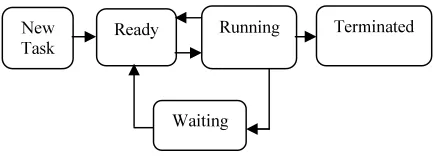
resources to run then it is sent to a blocked state. The scheduler function is affected when the task switches from running to waiting state, switches from running to ready state ,switches from waiting to ready state or when the task terminates as illustrated in fig.1. In sections III & IV different performance criteria and various algorithms for Scheduler is discussed. In section V a presentation is made on the various RTOS functions used and
about development cycle. The obtained
[image:1.595.304.521.597.677.2]experimental results are shown in section VI and a detailed discussion on the comparison of performance of scheduler designed with the existing methods is presented in chapter VII.
Figure 1: Various states of a task
2. RELATED WORKS
Task scheduling for multiprocessor system is presented in [12] .In this scheduling algorithm is
New Task
Ready Running Terminated
task scheduling based and it is queue based approach to schedule parallel tasks. High energy consumption is a biggest problem in cloud computing and it can be minimized by energy aware task scheduling by considering resource usage of different nodes [4]. Depending on the service reliability of grid system an effective resource scheduling method having fault tolerant feature is presented in [14]. In the systems that consists of both critical and non critical sections the scheduling algorithm needs to minimize average waiting time of the non critical tasks in the queue and also it should avoid context switching of critical tasks [7].In [13] a novel CPU scheduling algorithm for both pre emptive and non pre emptive is presented and the results are compared with existing algorithms and an effort is made to improve the CPU efficiency in multi programming operating system. A detailed survey of different CPU scheduling algorithms and their merits and demerits are presented in [9].In order to improve the efficiency of CPU there is a need to manage all the processes properly and a new round robin scheduling algorithm for CPU scheduling is presented in [11].
An efficient memory management using buddy allocator algorithm in the LPC 1768 and µC/OS-II environment is presented in [6].Here the author highlights advanced features of µC/OS-II and LPC 1768 and a effective memory management algorithm is designed using them. In [3] the author presented a priority based round robin algorithm. The method integrates the features of round robin and priority scheduling algorithm thereby reducing various performance parameters. A new scheduling algorithm based on the integration of round robin and shortest job first is presented in [8].In this priority is calculated by SJF and starvation is reduced by round robin algorithm.
3. PERFORMANCE EVALUATION OF
SCHEDULER ALGORITHMS
The following parameters are the
performance indicators of scheduler.
Utilization : The term describes the fraction
of time a device is in use.
Throughput : It is the number of jobs
completed per second
Service time : It is the time taken by the device
to complete the execution of a request.
Queuing Time : It is the amount of time a
request waits on a queue to get service from the device. Residence Time : It is equal to the sum of service
time and queuing time
Response time : It is the time used by a system to
respond to a submission of request
Think Time : It is the time taken for figuring
out the next request.
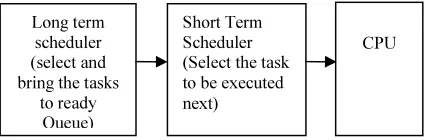
[image:2.595.304.517.421.491.2]The function of the scheduler is to allocate CPU to a specific task for a period of time. Schedulers are basically classified into two basic types Long term and short term schedulers [1]. The functionality of schedulers is shown in fig.2. Long term scheduler selects the required tasks and bring them into the ready queue. It consumes much time for the creation of task and eventually slow in nature. Whereas short term scheduler selects particular task among the tasks that are ready to execute and allocate CPU or core to that particular task. Short term scheduler decides the task that is going to be executed next and it is fast compared to long term scheduler.
Figure 2: Functionality of Schedulers
4. TYPES OF SCHEDULING
ALGORITHMS
The different types of scheduling
algorithms are explained below
4.1 First Come First Served
This method is same as that of FIFO and it is a very simple algorithm. The main drawback in this is average queuing time is long and residence time depend on ordering of processes in queue.
4.2 Shortest Job First
It is suitable for situations where minimizing queuing time is of prime importance.
Here scheduling is based on logged history and is hard to implement.
Long term scheduler (select and bring the tasks
to ready Queue)
Short Term Scheduler (Select the task to be executed next)
4.3 Preemptive Algorithms
When a Higher priority task is ready for execution, the execution of current task is stopped and execution of higher priority task starts. The algorithm gives first priority to short jobs.
4.4 Priority Based Scheduling
Here priority is assigned for each and every task to be executed and highest priority task is scheduled first. Tasks with same priority are scheduled using FCFS.
4.5 Round Robin Scheduling
The task need to complete its execution within the fixed time slot otherwise the task may lose its flow, and data generated or it has to wait for its next turn. In this algorithm choosing the time quantum is very important.
4.6 Multilevel Queues
In this each queue has a scheduling algorithm and a priority based algorithm is used to arbitrate between the queues..A feedback method is used to move between queues. The method is complex but flexible.
4.7 Real Time Scheduling
This type of scheduling is used when a critical task is to be executed within a fixed time in hard real time systems and where critical processes need higher priority over lower priority tasks in soft real time systems [10].
5. PROPOSED METHOD
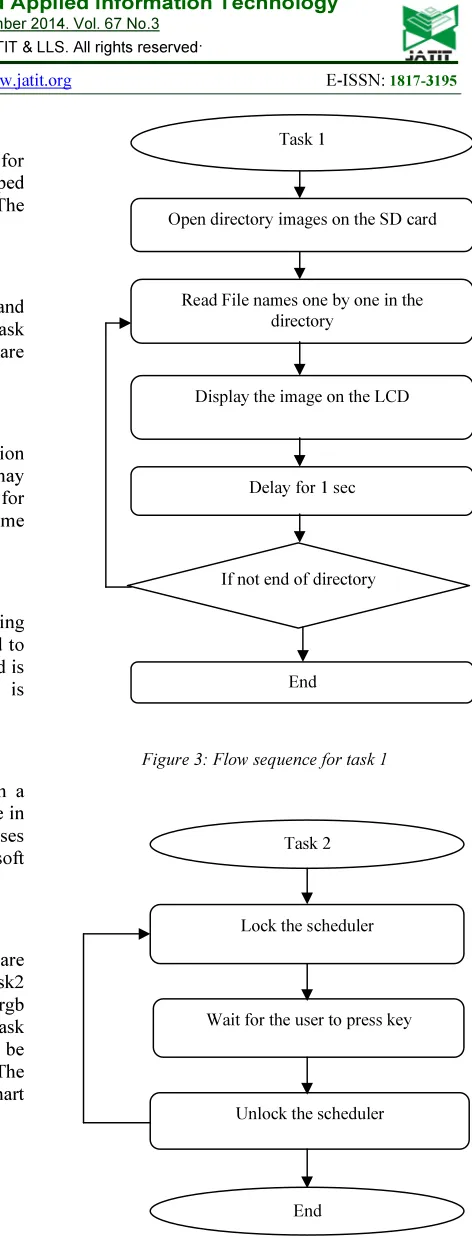
[image:3.595.279.515.75.694.2]In the proposed method two tasks are created task 1 with priority 57(high) and Task2 with priority of 58(low).Task1 will read raw rgb file from the sd card and display it on the lcd. Task 2 will lock the scheduler and wait for key to be pressed and then unlocks the scheduler. The flowchart for task1 is shown in fig.3 and flow chart for task 2 is shown in fig. 4.
Figure 3: Flow sequence for task 1
Figure 4: Flow sequence for Task 2 Task 2
Lock the scheduler
Wait for the user to press key
Unlock the scheduler
End Task 1
Open directory images on the SD card
Read File names one by one in the directory
Display the image on the LCD
Delay for 1 sec
If not end of directory
5.1 µCOS API’s and its functions
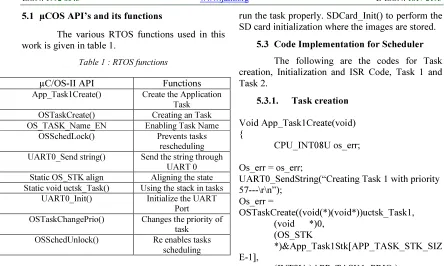
[image:4.595.66.510.117.383.2]The various RTOS functions used in this work is given in table 1.
Table 1 : RTOS functions
µC/OS-II API Functions
App_Task1Create() Create the Application Task OSTaskCreate() Creating an Task OS_TASK_Name_EN Enabling Task Name
OSSchedLock() Prevents tasks rescheduling UART0_Send string() Send the string through
UART 0 Static OS_STK align Aligning the state Static void uctsk_Task() Using the stack in tasks
UART0_Init() Initialize the UART Port OSTaskChangePrio() Changes the priority of
task OSSchedUnlock() Re enables tasks
scheduling
5.2 Development Cycle
The main objective of task scheduler is to meet the deadline of execution of tasks and also the real time constraints [5]. The following algorithms are used for the scheduler design. Two tasks are chosen to be scheduled. Task 1 consists of opening different stored images and displaying them sequentially with a delay of 1 sec. Task 2 is to lock the scheduler and release the scheduler upon a key press.
Task 1
1. Open different images one by one in the
directory
2. Display the image on the LCD
3. Delay for 1 sec
4. Go back to step2
5. End
Task 2
1. Lock the scheduler
2. Wait for the user to press a key
3. Unlock the scheduler
4. Go back to step 1
5. End
In order to implement the above two algorithms RTOS functions App_Task1Create() and App_Task2Create are used. Stack of sufficient size is created using OSTaskCreate API in order to
run the task properly. SDCard_Init() to perform the SD card initialization where the images are stored.
5.3 Code Implementation for Scheduler
The following are the codes for Task creation, Initialization and ISR Code, Task 1 and Task 2.
5.3.1. Task creation
Void App_Task1Create(void) {
CPU_INT08U os_err;
Os_err = os_err;
UART0_SendString(“Creating Task 1 with priority 57---\r\n”);
Os_err =
OSTaskCreate((void(*)(void*))uctsk_Task1,
(void *)0,
(OS_STK
*)&App_Task1Stk[APP_TASK_STK_SIZ E-1],
(INT8U )APP_TASK1_PRIO );
#if OS_TASK_NAME_EN>0
5.3.2. Initialization and ISR code
Void BUTTON_init(void) {
LPC_GPIO2->FIODIR &= -(1<<10);
LPC_GPIOINT->IO2intEnf l = (1<<10);
NVIC_EnablelRQ(EINT3_IRQn); }
5.3.3. Task 1
Static void uctsk_Task1(void*pdata) {
Pdata = pdata;
res = f_opendir(&Dir,”0/images”);
if(res! = FR_OK)
{UART0_SendString(“Unable to open dir\r\n”); While(1);
}
5.3.4. Task 2
{
UART0_SendString(“Task2 is Running\r\n”);
OSSchedLOCK();
While(UserStatus! = 1) {
Delay(); }
5.4.Experimental setup
In this work an LPC 1768 board and µC/OS-II operating system are used. The
LandTiger V2.0 NXP LPC1768 ARM
development board is a 32 bit Microprocessor and it has the features of 512KB on chip flash
program memory,64KB SRAM for high
performance CPU, Standard JTAG test/debug interface, Two RS 232 serial interfaces, Two CAN
bus communication interfaces, RS 485
communication interface,RJ45-10/100M Ethernet network interface, DAC o/p interface and ADC i/p interface, USB 2.0 interface, SD/MMC card (SPI) interface, Color LCD display interface etc.
[image:5.595.307.516.343.480.2]µC/OS-II is a real time multi tasking operating system kernel version 2. It is used for inter task communication and synchronization. It has the features like Portabability, preemptive, multitasking kernel, can handle 64 tasks, supports processors up to 64 bit and has deterministic execution times. µC/OS-II is simple to use and simple to implement KERNEL. The experimental setup is shown in fig. 5.
Figure 5: Experimental Setup (1) USB cable of the board connected to USB port of PC (2) Serial port of the RTOS board connected to Serial port of the PC
6. IMPLEMENTATION RESULTS
The implementation of multithreading consists of two case studies
i) Sorting of large set of numbers using
threading and normal approach
ii) Dictionary sorting of alphabetical
words using threading and normal approach
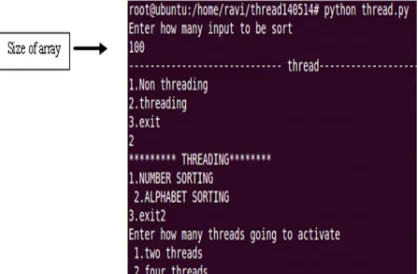
In both the applications, the number of threads is varied and time metric is evaluated. It is established that thread based implementation is fast particularly in sorting of alphabets. The thread is implemented in python and openMP platform. In case (i) multithread implementation of sorting of numbers is presented and menu to perform selection of threading or non threading for sorting application is shown in fig. 6.In fig. 7 two threads are selected to sort the input numbers in ascending order. The time taken by the merged output is also computed and displayed as a metric.
Figure 6: Menu to perform selection of threading or non threading for sorting application
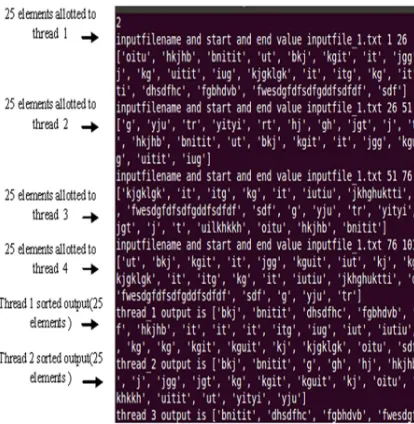
[image:5.595.249.560.505.710.2]In case (ii) Dictionary sorting of alphabetical words using threading is presented .In figure. 8 & 9 sorting of alphabets for dictionary is implemented using four threads.
Figure 8: Sorted Alphabet in progress for four threads
Figure 9: Continued output of Fig.8(Four thread case)
7. DISCUSSION
In [2] the author presented a optimized round robin scheduling algorithm for CPU scheduling to solve the problem encountered in simple round robin scheduler(i.e., giving equal priority to all tasks) by decreasing the performance parameters to a maximum possible extent. The results of designed scheduler performance shows improvement in
reducing average waiting time and the time taken for completing the task execution is very small.
[image:6.595.318.514.198.331.2]The scheduler performance in sorting of numbers using normal approach and threading is presented in fig. 10.
[image:6.595.310.514.375.689.2]Figure 10a: Non-Threading ( Non Multitasking ) based implementation ( sorting of numbers)
Figure 10b: Threading based implementation - Two threads (sorting of numbers)
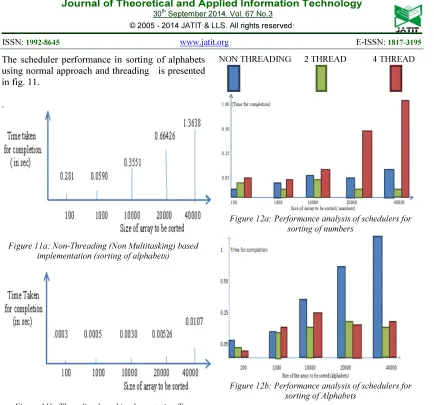
[image:6.595.88.292.420.599.2] [image:6.595.307.511.557.699.2]The scheduler performance in sorting of alphabets using normal approach and threading is presented in fig. 11.
.
[image:7.595.86.520.73.478.2]Figure 11a: Non-Threading (Non Multitasking) based implementation (sorting of alphabets)
[image:7.595.90.291.521.654.2]Figure 11b: Threading based implementation-Two Threads ( sorting of Alphabets)
Figure 11c : Threading based implementation-Four Threads (Sorting of Alphabets)
The performance analysis of scheduler for non threading, two threads and four threads for the two cases is shown in fig. 12.
NON THREADING 2 THREAD 4 THREAD
Figure 12a: Performance analysis of schedulers for sorting of numbers
Figure 12b: Performance analysis of schedulers for sorting of Alphabets
8. CONCLUSION
REFERENCES
[1] Abbas noon, Ali kalakech,and Seifedine kadry, “A new round robin based scheduling algorithm for operating systems:Dynamic
quantum using the mean
average”,International Journal of Computer
Science Issues,Vol. 8,No. 3, 2011, pp. 224-229.
[2] Ajit singh, Priyanka goyal and Sahil batra, “An optimized round robin scheduling
algorithm for CPU Scheduling”,International
Journal on Computer Science and
Engineering,Vol. 2,No. 7, 2010, pp.
2383-2385.
[3] Ishwari singh rajput and Deepa gupta, “A Priority based round robin CPU scheduling
algorithm for real time systems”,International
Journal of Innovations in Engineering and
Technology, Vol. 1,No. 3, 2012, pp. 01-11.
[4] Jie song, Xuebing Liu,Zhiliang zhu,Dazhe Zhao and Ge Yu, “A novel task scheduling approach for reducing energy consumption of
Map reduce cluster”,IET Technical review,Vol.
3,No. 1, 2014, pp. 65-74.
[5] M.Kaladevi and Dr.S.Sathiyabama, “A comparative study of scheduling algorithms for
real time task”, International journal of
advances in science and technology, Vol. 1,
No. 4, 2010, pp. 8-14.
[6] Karthikeyan.V and Dr.S.Ravi, “Robust
memory management using real time
concepts”,Journal of computer science, Vol.
10,No. 9, 2014, pp. 1480-1487.
[7] G.Muneeswari and K.L.Shunmuganathan, “A
novel hard soft processor affinity scheduling
for multicore architecture using
multiagents”,European journal of scientific
research, Vol. 55, No. 3, 2011, pp. 419-429.
[8] Neeraj kumar and Nirvikar, “Performance
improvement using CPU Scheduling
Algorithm”,International Journal of Emerging
Trends of Technology in Computer
Science,Vol. 2,No. 2, 2013, pp. 110-113.
[9] Neetu goel and Dr.R.B.Garg, “A comparative
study of CPU scheduling
algorithms”,International journal of graphics
& image processing, Vol. 2, No. 4, 2012, pp.
245-251.
[10]Rajkamal, “Embedded system
architecture,programming and design”,Tata
Mcgraw hill publishing company limited,2003.
[11) Rakesh kumar yadav,Abhishek k
mishra,Navin prakash and Himanshu Sharma,
“An improved round robin scheduling
algorithm for cpu scheduling”,International
journal on computer science and engineering,
Vol. 02, No. 04, 2010, pp. 1064-1066.
[12] Ranjit Rajak, “A novel approach for task
scheduling in multiprocessor system”,
International journal of computer
applications,Vol. 44,No. 11,2013,pp. 12-16.
[13] Sukumar babu bandarupalli and Neelima priyanka nutulapati, “A novel CPU scheduling algorithm preemptive & non preemptive”,
International journal of modern engineering
research (IJMER), Vol. 2, No. 6, 2012, pp.
4484-4490.
[14] U.Syed Abudhagir and Dr.S.Shanmugavel, “A novel dynamic reliability optimized resource scheduling algorithm with fault tolerant approach for grid computing system”,
Journal of Theoretical and applied information