S T U D Y P R O T O C O L
Open Access
The Risk of Paradoxical Embolism (RoPE) Study:
Developing risk models for application to
ongoing randomized trials of percutaneous
patent foramen ovale closure for cryptogenic
stroke
David M Kent
1*and David E Thaler
2, for RoPE Study Investigators
1Abstract
Background:Despite the diffusion into practice of percutaneous closure of a patent foramen ovale (PFO) in patients with cryptogenic stroke (CS), the benefits have not been demonstrated, and remain unclear. For any individual presenting with a PFO in the setting of CS, it is not clear whether the PFO is pathogenically-related to the index event or an incidental finding. Further, the overall rate of stroke recurrence is low in patients with CS and PFO. How patient-specific factors affect the likelihood that a discovered PFO is related to an index stroke or affect the risk of recurrence is not well understood. These probabilities are likely to be important determinants of the benefits of PFO closure in CS.
Design/Methods:The goal of the Risk of Paradoxical Embolism (RoPE) Study is to develop and test a set of predictive models that can identify those patients most likely to benefit from preventive treatments for PFO-related stroke recurrence, such as PFO closure. To do this, we will construct a database of patients with CS, both with and without PFO, by combining existing cohort studies. We will use this pooled database to identify patient
characteristics associated with the presence (versus the absence) of a PFO, and to use this“PFO propensity”to estimate the patient-specific probability that a PFO was pathogenically related to the index stroke (Model #1). We will also develop, among patients with both a CS and a PFO, a predictive model to estimate patient-specific stroke recurrence risk based on clinical, radiographic and echocardiographic characteristics. (Model #2). We will then combine Models #1 and #2 into a composite index that can rank patients with CS and PFO by their conditional probability that their PFO was pathogenically related to the index strokeandthe risk of stroke recurrence. Finally, we will apply this composite index to completed clinical trials (currently on-going) testing endovascular PFO closure against medical therapy, to stratify patients from low-expected-benefit to high-expected-benefit.
Background
Approximately 40% of all strokes are classified as cryp-togenic, meaning that the cause is unknown despite an extensive work up [1]. While patent foramen ovale (PFO) is a common and generally benign condition found on autopsy in about 25% of the population [2-4], approximately 40% to 50% of patients younger than age
55 with cryptogenic stroke (CS) have PFO on transeso-phageal echocardiography (TEE) [4-7]. Furthermore, a PFO is found more frequently in patients with CS than in patients with a known cause of stroke, even in the elderly patient[7-9], These association suggest that PFO has an etiological role in CS, presumably via paradoxical emboli (PE) (i.e. venous emboli that gain access to the arterial circulation through a PFO) [7]. Thus, many phy-sicians will recommend PFO closure in patients, espe-cially younger patients, who have had CS.
* Correspondence: [email protected]
1
Institute for Clinical Research and Health Policy Studies, Tufts Medical Center/Tufts University School of Medicine, Boston, MA, 02111, USA Full list of author information is available at the end of the article
However, the benefit of PFO closure in patients with CS has not been demonstrated, and remains unclear. First, for a patient presenting with a PFO and a CS, it is not clear for that individual whether the PFO is causally related to the index event or whether it is an incidental finding, since PFOs are so common in the general popu-lation. Second, the overall rate of stroke recurrence is relatively low in patients with CS and PFO, ranging in studies from 0% to 12% per year, with an average annualized risk across studies of approximately 2% [4,5,10]. Thus, even rare but serious procedure- and device-related complications may be sufficient to nullify the benefit of percutaneous closure, especially if many who receive the device have index strokes unrelated to their PFO. A method is needed to identify patients with CS and pathogenic PFOs, especially those with a high risk of recurrence from patients with CS and incidental PFOs.
The theoretical rationale for the RoPE study has been described in prior work [7,11]. Briefly, the RoPE Study builds on prior work demonstrating the potential impor-tance of risk modeling in the interpretation of clinical trials, where overall results may not reflect the benefits
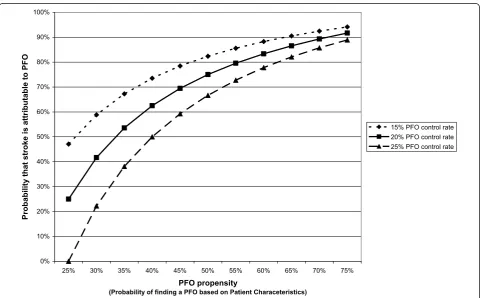
to individual patients [12-17]. In the setting of CS speci-fically, we have shown that the probability that an indi-vidual will have a PFO can be predicted (i.e. prior to TEE) based on the presence or absence of conventional stroke risk factors (e.g. age, presence of hypertension, diabetes, hypercholesterolemia, etc.) and other charac-teristics. We call the patient-specific probability of find-ing a PFO in the settfind-ing of CS the “PFO propensity”. Using simple assumptions and Bayes’ theorem, PFO propensity can be shown to be directly but not linearly related to the patient-specific PFO-attributable fraction (i.e. the probability that the PFO is pathogenic rather than incidental)– as shown in the Figure 1. Thus, although it is not possible in the individual patient to determine with certainty whether a discovered PFO is incidental or pathogenic, it is nonetheless possible to construct mathematical models that can stratify patients by their likelihood that their stroke is PFO-related.
Additionally, while prior studies have had limited sta-tistical power to develop predictive models that can pre-dict stroke recurrence given the low frequency of this outcome, the RoPE Study aims to overcome this barrier by combining multiple large multicentered studies to
0% 10% 20% 30% 40% 50% 60% 70% 80% 90% 100%
25% 30% 35% 40% 45% 50% 55% 60% 65% 70% 75%
PFO propensity
(Probability of finding a PFO based on Patient Characeteristics)
Probability that stroke is att
ributable to PFO
[image:2.595.58.539.385.683.2]15% PFO control rate 20% PFO control rate 25% PFO control rate
Figure 1PFO Propensity and the Probability that a Stroke is PFO-attributable. We define PFO propensity as the probability of finding a PFO in a patient, based on patient-specific characteristics (such as age and the presence or absence of hypertension, diabetes and
yield a pooled database with a sufficient number of cere-brovascular outcome events to model recurrence risk.
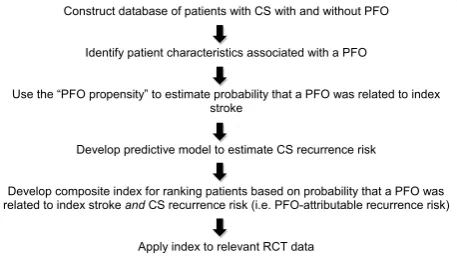
The aim of the RoPE Study is to develop mathemati-cal models that can be used to stratify patients by the joint probability that an index stroke is “PFO-related” and that the stroke will recur and to use these models to stratify patients in on-going clinical trials testing per-cutaneous closure, with the goal of informing patient-selection for PFO closure in clinical practice. The steps by which this will be accomplished are summarized in Figure 2, as well as in the specific aims below.
Design/Methods
The specific aims of the RoPE Study are:
1. To construct from existing cohort studies of patients with CS studied with TEE, both with and without PFO, the largest extant CS database, suffi-ciently robust to support predictive risk modeling. 2. To identify patient characteristics associated with the presence (versus the absence) of a PFO, and to use this “PFO propensity” to estimate the patient-specific probability that a PFO was pathogenically related to the index stroke. (Model #1)
3. To develop a predictive model to estimate patient-specific stroke recurrence risk based on clinical, radiographic and echocardiographic characteristics in patients with PFO and CS. (Model #2)
4. To develop a composite index based on Models #1 & #2 that can rank patients with CS and PFO by their conditional probability that the PFO was pathogenically related to the index stroke (Model #1) andthe risk of stroke recurrence (Model #2). 5. To apply this composite index to patients in com-pleted clinical trials (currently on-going) testing endovascular PFO closure against medical therapy, to stratify them from low-expected-benefit to high-expected-benefit.
Aim 1: To construct the largest extant CS database from existing cohort studies of patients with CS studied with TEE for the presence/absence of PFO
Methods for pooling multiple independent studies have been previously described [18,19]. Steps include: 1) selection of participating clinical trials and databases; 2) development of a collaborative investigative team including clinicians, statisticians and programmers; 3) preliminary determination of the availability and charac-teristics of data in each of the component databases; 4) complete specification of the dependent (outcome) vari-able used in each study and in the pooled analyses; 5) determination and specification of the independent (explanatory) variables; 6) specification of the inclusion/ exclusion criteria for the studies; 7) verification of vari-able definitions; 8) acquisition of new data if required; 9) checking for consistency of effects across study databases.
Based on our own literature search, a published litera-ture review [4], and then subsequently on a published meta-analysis [10], we contacted all investigators with relevant data examining the rate of recurrent stroke in patients CS and PFO. This also yielded data examining the presence/absence of PFO in patients with CS. We obtained agreements to include 13 databases with over 2500 subjects, as shown in Table 1. This provides the basis of our power calculations for subsequent aims.
Precise determination of inclusion/exclusion criteria, specification of the independent variables and specifica-tion of the dependent variable for each of the models are dependent on careful examination of each of the component databases for details of variable definition and missingness. s Consensus on the variables will be reached among RoPE Investigators for the final models. Provisional variable descriptions are provided below.
The RoPE Study will include patients with CS who have been examined for the presence of a PFO with either TEE or Transcranial Doppler (TCD) and the injection of bubbles. The preliminary definition of CS for the RoPE Study conforms to the Trial of ORG 10172 in Acute Stroke Treatment (TOAST) classifica-tion,[20] and requires a “complete work-up” (defined below) for the cause of the stroke. Cardioembolic stroke in this classification was considered “probable” if there was a high-risk source of embolism and “possible” for medium risk sources. This latter category includes PFO and atrial septal aneurysms (ASA). For the purposes of the RoPE Study, subjects with medium risk sources will be considered cryptogenic. The definition of stroke for the RoPE Study is“a sudden onset neurological deficit in a vascular territory presumed to be due to focal ische-mia.” If the deficit lasts for less than 24 hours, it must be accompanied by acute magnetic resonance imaging
Construct database of patients with CS with and without PFO
Identify patient characteristics associated with a PFO
Use the “PFO propensity” to estimate probability that a PFO was related to index stroke
Develop predictive model to estimate CS recurrence risk
Develop composite index for ranking patients based on probability that a PFO was related to index stroke and CS recurrence risk (i.e. PFO-attributable recurrence risk)
[image:3.595.61.290.563.693.2]Apply index to relevant RCT data
(MRI) or computer tomography (CT) changes in appro-priate locations. If the deficit is greater than 24 hours, MRI or CT changes are not required.A“complete work-up” must include: 1) MRIor CT; 2) Vascular imaging -catheter angiography or angiography by MRI or CT; 3) Cardiac rhythm study: at least one electrocardiography (ECG), or documented Holter or telemetry.
In addition to excluding patients with stroke of known cause, patients included in the RoPE study must be worked up for the presence of a PFO with a TEE using intravenous injection of bubbles. Patients can be included in model #1 without a TEE, if they have had both transthoracic echocardiography [to rule out other potential cardioembolic sources] and TCD with bubbles (to establish the presence/absence of right-to-left shunt-ing). Only patients with a TEE will be included in Model #2, since this model will require assessment of the presence/absence of ASA and PFO grading.
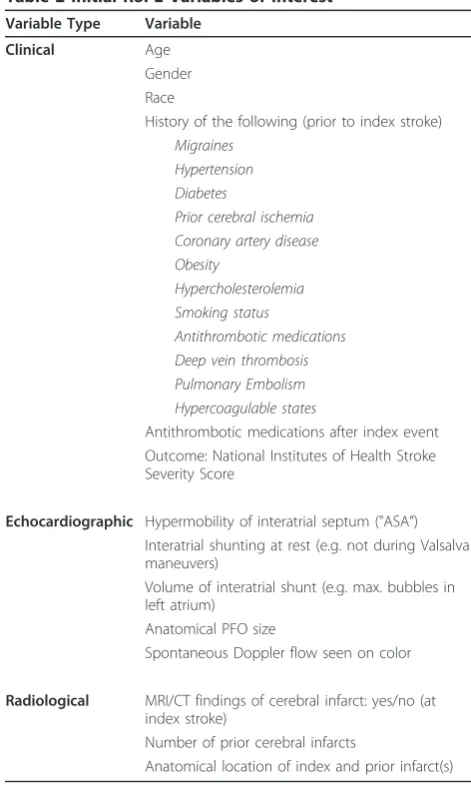
[image:4.595.57.539.100.284.2]Table 2 shows provisional independent (predictor) variables that we anticipate will be important in both the prediction of the presence/absence of PFO, and also the risk of the outcome (recurrent ischemic stroke, as defined above). Of note, we anticipate that harmoniza-tion of databases may require the acquisiharmoniza-tion of new pri-mary data, potentially from the following sources: 1) medical record review 2) rereading of TEE tapes; 3) rereading of neuroimages; 4) obtaining follow-up for recurrent events. In general, the reasons for needing additional primary data from a particular database may include: 1) missing data on a portion of patients; 2) dif-fering variable definitions between databases; and 3) new data (variables) required not previously collected in a given database. Medical record review would be possi-ble for clinical registries and TEE tapes and neuroi-mages are potentially available for most of the Table 1 RoPE Database
Database # of subjects # w/PFO # w/o PFO RoPE Investigator
APRIS [6] 83 17 66 Marco DiTullio
Bern (published) [30] 159 159 - Krassen Nedeltchev
Bern (unpublished) 249 249 - Heinrich Mattle
CODICIA [31] 486 266 240 Joaquin Serena
PFO-ASA Study [5] 581 267 314 Jean-Louis Mas
German Study [24] 1126 389 737 Christian Weimar
Lausanne 172 93 79 Patrik Michel
NOMASS [32] 60 23 37 Mitchell Elkind
PICSS [33] 250 98 152 Shunichi Homma
Sapienza (unpublished) 343 133 210 Emanuele Di Angelantonio
Federica Papetti
Toronto [34] 114 114 - Cheryl Jaigobin
Tufts 140 140 - David Thaler
[image:4.595.302.538.319.722.2]Total Estimates* 2546 1484 1062
Table 2 Initial RoPE Variables of Interest Variable Type Variable
Clinical Age
Gender Race
History of the following (prior to index stroke) Migraines
Hypertension Diabetes
Prior cerebral ischemia Coronary artery disease Obesity
Hypercholesterolemia Smoking status
Antithrombotic medications Deep vein thrombosis Pulmonary Embolism Hypercoagulable states
Antithrombotic medications after index event Outcome: National Institutes of Health Stroke Severity Score
Echocardiographic Hypermobility of interatrial septum ("ASA”) Interatrial shunting at rest (e.g. not during Valsalva maneuvers)
Volume of interatrial shunt (e.g. max. bubbles in left atrium)
Anatomical PFO size
Spontaneous Doppler flow seen on color
Radiological MRI/CT findings of cerebral infarct: yes/no (at index stroke)
Number of prior cerebral infarcts
component databases. Based on the characteristics of any observed missing data we will investigate the use of imputation and replacement algorithms, or whether a component database needs to be excluded–although sta-tistical methods to preserve data and power will be fully employed (such as imputation for independent vari-ables). Because missingness of the dependent (outcome) variable poses more potential problems due to informa-tive censoring, we intend to exclude any datasets for which less than 90% of patients have follow-up at one year. Re-adjudication of all stroke outcomes is planned as part of the RoPE study. Methods ensuring database quality during database construction will be comple-mented by steps taken during the predictive modeling process to check for consistency of effects across databases.
Aim 2: To identify patient characteristics associated with the presence (versus the absence) of a PFO, and to use this“PFO propensity”to estimate the patient-specific probability that a PFO was pathogenically related to the index stroke. (Model #1)
Since PFOs discovered in patients with CS may be pathogenically related to the stroke or not, in Aim 2, we will use logistic regression models to identify patient characteristics that are associated with the presence of a PFO among patients with CS ("PFO propensity”). In previous work [7,11,21], we have shown that this “PFO propensity” can be related to the probability that a PFO is pathogenic (i.e. non-incidental) using Bayes’theorem and 2 simple assumptions: 1) if not for those strokes that are PFO-attributable, the probability of a PFO in a CS patient would be the same as in the general popula-tion (controls); and 2) the rate of PFO-attributable strokes in PFO-negative CS patients is near-zero. Under these conditions:
Probability that PFO is incidental in a CS case =
PFO probability in controls∗(1−Probability of PFO in CS case) Probability of PFO in CS case∗(1−PFO probability in controls)
Since the patient-specific probability of PFO in CS is given by the PFO propensity (i.e. the prevalence of PFO in CS patients otherwise similar to the patient), the only additional term needed to estimate the probability that a PFO is incidental for a particular patient is the general rate of PFO in the population (PFO probability in controls).
To develop a predictive model for PFO propensity, we will explore crude associations (overall and within each database) between the presence of a PFO and clinical variables including the subject’s age, gender, race, hyper-tension, diabetes, hyperlipidemia, history of prior epi-sodes of cerebral ischemia, obesity, antithrombotic
medications, concurrent deep venous thrombosis, and neuroradiologic variables (i.e. prior stroke on MRI or CT, small [< 1.5 cm] versus large infarct, location of infarct). Multivariable associations between predictors and the presence of a PFO will be examined using logis-tic regression models. Selection of candidate variables for these models will be based on clinical rationale and the published literature. Variables with statistically mar-ginal associations in the preliminary analyses (p > 0.15) will be removed. Non-linear associations between inde-pendent risk variables and the outcome will be investi-gated using generalized additive spline models[22]. As indicated, appropriate parametric logistic regression models will be developed to capture these non-linear relationships.
Statistical significance of individual variables in the final model will be assessed with the Score statistic. Based on clinical reasoning, a limited number of interac-tion terms between risk factors may also be tested for inclusion in the model. The models will be analyzed by conventional criteria, such as goodness-of-fit tests, and receiver operator characteristics (ROC) curve areas [23]. “Calibration” of predicted probabilities of outcome throughout the range of their predictions will be evalu-ated with plots. The final multivariable regression mod-els will be run separately on each of the component datasets to assess the consistency of the results and model performance. Based on these results, interaction terms between indicator variables representing study and model predictors of PFO will be used to investigate significant variation in associations across study datasets. Predictors found to be inconsistent across studies may be removed from the model. We will reanalyze the data using a generalized linear mixed model that includes a random effect term for study to get final parameter esti-mates with their corresponding standard errors.
of 0.50 and 0.20, respectively. Since outcome data is not needed for this analysis, loss of this amount of data is unlikely and the database would anyway still have ample power, permitting full exploration of multiple variables.
Aim 3. To develop a predictive model to estimate patient-specific recurrence risk based on clinical, radiographic and echocardiographic characteristics in patients with PFO and CS. (Model #2)
For Aim 3 we will use Cox proportional hazard models to develop a predictive model to estimate patient-speci-fic recurrence risk. Because patients with CS with higher PFO-related recurrence risk generally have a lower pre-valence of conventional stroke risk factors[25], failure to adjust for general (non-PFO-related) recurrent risk can lead to paradoxical results. This has been a major chal-lenge for prior studies, since the low rate of outcomes limits the statistical power to control for conventional stroke risk factors and model PFO-related risk. While in the RoPE study we will have many-fold the number of outcomes compared to any prior study, statistical power for this analysis remains an issue.
To address this, depending in part on the number of outcomes, we will consider a two-step approach, that takes advantage of the outcomes in the component of the RoPE database of CS patientswithoutPFO. First, we will construct a model for recurrence risk on the com-ponent of the study of CS patientswithoutPFO. Next, we will construct a model for recurrence risk on the component of the study of CS patients withPFO, using the derived risk variable from the first step to control for the confounding background risk of stroke from PFO-unrelated causes. This will permit background stroke risk to be controlled for in a statistically efficient fashion. For step two, using the study subjects with known PFO, we will pay particular attention to echocar-diographic information (e.g. hypermobility of the intera-trial septum, interaintera-trial shunting at rest, severity of interatrial shunt, anatomical PFO size, presence/absence of spontaneous flow on color Doppler)–to identify fea-tures of“high-risk”PFOs.
Preliminary analyses for both phases of this two step process (i.e. modeling recurrence risk in patients with-out PFO and modeling recurrence risk in patients with PFO) will investigate associations between established risk factors and recurrent strokes. Kaplan-Meier survival curves and logrank tests will be used to assess statistical significance. For each phase, a multivariable prediction model for recurrent stroke will be developed using a Cox proportional hazard model, using an approach otherwise similar to that described for Aim 2. Predictive discrimination will be assessed using the overall C index [26]. Model calibration is assessed by comparing pre-dicted survival probabilities against Kaplan-Meier
(observed) probabilities across equal-sized risk quantiles (based on predicted recurrence probabilities). Differ-ences between predicted and observed probabilities will be compared using a modified Hosmer-Lemeshow c2 statistic [27]. The Cox models be re-run including the study as a stratification factor to control for potential between-study differences in baseline survival functions when estimating hazard ratios of potential risk factors.
Adequacy of the data for Aim 3: Power was calculated on extreme optimistic and extreme pessimistic calcula-tions. To obtain outcome rates for our sample we used databases with patients who had PFOs. We optimisti-cally estimate available follow-up data for up to 1,752 patients with PFO; 1,332 from databases with both PFO and non-PFO patients and an additional 420 from data-bases that only have data on patients with PFOs. Based on the average outcome rates on the observed data, the estimated stroke rate for these patients is 6%. The sam-ple size of 1,752 will provide 80% power to detect a clinically relevant hazard ratio of 1.77 for a risk factor with a prevalence of 50% and an overall stroke rate of 6%. Most pessimistically, we excluded 100% of our lar-gest study (the German study [24]) and estimated fol-low-up will only be available for 70% of the remaining subjects which would result in a total sample size of 944. With this extremely conservative estimate of the sample size the study will have 80% power to detect a hazard ratio of 2.22 assuming an overall stroke rate of 6% and a risk factor prevalence of 50%.
While having a sample size toward this lower estimate would still be adequate to detect these moderate to large effects, it would require us to be parsimonious in testing variables to avoid over-fitting (only about 60 stroke outcomes in PFO patients). After final database construction, we will consider whether to model the risk of the composite outcome stroke and transient ischemic attack (TIA). This has an outcome rate of 11.2% on the sample of our database with completed follow-up, vir-tually doubling the number of outcomes.
Aim 4. To develop a composite index that can rank patients with CS and PFO by their conditional probability that the PFO was pathogenically-related to the index stroke (Model #1)andthe risk of stroke recurrence (Model #2)
expected-benefit. In performing Aim 5, it is important to recognize that subgroup analyses are prone to false posi-tive results due to multiple comparisons. Indeed, an advantage of multivariable risk-based analysis is that it allows the influence of multiple variables to be summar-ized along a single dimension and thus minimize the risks of this Type I error. However, this is only the case if the stratification isfullyspecified, before the outcomes are examined, since even with a single risk model minor differences in stratification can influence results; when two risk models are combined, the potential for analytic flexibility-and therefore bias–is increased. While this Aim needs to be informed by the results of Aims 2 and 3, and the observed risk distributions in the RoPE popula-tions, to emphasize the importance offull pre -specifica-tion of the stratifica-specifica-tion strategy, process and analysis before the outcome data of the randomized controlled trials (RCTs) are examined, we have partitioned this into a separate specific aim, to be completed before Aim 5.
A challenge of this step is that transformation of PFO propensity into a probability that a PFO is pathogenic versus incidental requires an estimate of the rate of PFO in a control population. The control rates of TEE-detected PFOs vary somewhat from study to study, pre-sumably due to variation in TEE technique (since the presence of a PFO rates have been shown to be largely independent of patient characteristics in unselected [screened] populations[25,28]. Figure 1 shows the rela-tionship of PFO propensity to the probability that a PFO is pathogenic under the assumptions that the con-trol PFO rate is 15%, 20% and 25%. While the ranking of patients according to their probability that their PFO is pathogenically related to their index event is insensi-tive to the exact control rate selected, to converge on a control rate that would allow us to combine models #1 and #2, we will: 1) perform meta-analysis of control groups in prior case-control studies (CS versus non-cryptogenic stroke patients); 2) analyze the PFO-rate in TEE-studied non-cryptogenic stroke patients in compo-nent RoPE studies that included such patients (such as PICSS, which has 365 TEE-studied non-cryptogenic stroke patients). We will explore the distribution of the patient-specific probability that the discovered PFO is pathogenic across the different strata of the RoPE population.
Once the models are combined to produce the prob-ability of stroke recurrence conditional on the probabil-ity that the index event was related (i.e. PFO-attributable recurrence risk), and based on a thorough understanding of the risk profile of the patients in the RoPE population and the randomized clinical trial popu-lation (but prior to any analysis of outcomes in the RCTs), the full stratification plan will be specified, as provisionally outlined in Aim 5.
Aim 5: To apply this score to patients in completed clinical trials (currently on-going) testing percutaneous PFO closure against medical therapy, from low-expected-benefit to high-expected-low-expected-benefit
The primary hypothesis of Aim 5 is that there will be a treatment-by-index interaction, when patients enrolled in RCTs testing PFO closure are ranked by their risk of stroke recurrence, conditioned on the probability that the PFO was pathogenically-related to the index event (using the composite index as a continuous variable). A p-value of 0.05 will be the threshold for significance. Depending on results, a clinically usable model will be developed. This step comprises external validation of the combined model. In addition, model 2 (the CS recurrence risk model) will be externally validated on the pooled medical arms of the RCTs by conventional criteria, including goodness-of-fit tests, ROC curve areas and calibration plots as described in the prior aims.
For Aim 5, we have, as of this writing, received agree-ment to test the risk models on two RCT databases, which will be pooled. Additional RCTs will be sought. The two RCTs to be pooled are:
Randomized Evaluation of Recurrent Stroke compar-ing PFO Closure to Established Current Standard of Care Treatment (RESPECT) Trial: (http://ClinicalTrials. gov identifier: NCT00465270) This is a prospective, ran-domized, multi-center trial, enrolling at 60 North
Amer-ican centers, designed to investigate whether
percutaneous PFO closure with the Amplatzer PFO Occluder is superior to current standard of care medical treatment in the prevention of recurrent stroke. Inclu-sion criteria include age of 18-60 years old, cryptogenic stroke (not TIA) within 270 days, and TEE demonstra-tion of a PFO. The recruitment target is 1000 subjects who will be randomized 1:1 to endovascular PFO clo-sure or medical management. The primary endpoints are recurrence of non-fatal stroke, post-randomization death, and fatal ischemic stroke.
PC-Trial: Patent Foramen Ovale and Cryptogenic Embolism: (ClinicalTrials.gov identifier: NCT00166257). The PC-Trial is very similar in design to the RESPECT Trial comparing the efficacy of percutaneous PFO clo-sure with medical treatment in 26 European centers. An additional inclusion criterion is cryptogenic peripheral embolism. Subjects are being stratified according to age and presence or absence of an atrial septal aneurysm. The recruitment target is 410 and the primary outcome is death, non-fatal stroke and peripheral embolism[29].
parameter configurations. For example, the proposed study sample of 700 subjects in each study arm, with an overall recurrence rate of 5% (stroke only), will provide approximately 80% power to detect a difference in the hazard ratio for a change of 10% in predicted risk of 1.00 and 1.33 for the two study groups, assuming a uni-form distribution of risk scores. Additional RCTs will also be sought.
List of Abbreviations
ASA: atrial septal aneurysm; CS: cryptogenic stroke; CT: computer tomography; ECG: electrocardiogram; MRI: magnetic resonance imaging; PE: paradoxical emboli; PFO: patent foramen ovale; RCT: randomized controlled trial; RESPECT Trial: Randomized Evaluation of Recurrent Stroke comparing PFO Closure to Established, Current Standard of Care Treatment Trial; ROC: receiver operator characteristics; RoPE: Risk of Paradoxical Embolism; TCD: transcranial Doppler; TEE: transesophageal echocardiography; TIA: transient ischemic attack; TOAST: Trial of ORG 10172 in Acute Stroke Treatment
Acknowledgements and Funding
The RoPE Study is supported by the National Institute of Neurological Disorders and Stroke (R01 NS062153).
The RoPE Study Investigators include:
Emanuele Di Angelantonio, MD, MSc, is University Lecturer, Department of Public Health and Primary Care,CambridgeUniversity.
Marco DiTullio, MD, is a Professor of Medicine at Columbia University. Mitchell S. V. Elkind, MD, MS, is an Associate Professor of Neurology and Epidemiology at Columbia University.
John Griffith, PhD, is an Associate Professor of Medicine at Tufts University School of Medicine.
Shunichi Homma, MD, FACC, is a Professor of Medicine at the Columbia University.
Cheryl Jaigobin, MD, FRCP, MSc, is an Assistant Professor of Medicine at the University of Toronto.
David Kent, MD, CM, MSc, is an Associate Professor of Medicine at Tufts University School of Medicine.
Jean-Louis Mas, MD, is a Professor of Neurology at Hôpital Sainte-Anne, Paris-Descartes University.
Heinrich Mattle, MD, is a Professor of Neurology at the University of Bern. Patrik Michel, MD, is Head of Stroke Unit at the Centre Hospitalier Universitaire Vaudois.
Marie-Luise Mono, MD, is affiliated with the Department of Neurology at University of Bern.
Krassen Nedeltchev, MD, FESC, is Head of the Division of Neurology at the Triemli Municipal Hospital, Zurich.
Federica Papetti, MD, is a Practicing Clinician at the Department of Cardiology at the University of Rome.
Robin Ruthazer, MPH, is an Assistant Professor of Medicine at Tufts University School of Medicine.
Joaquín Serena, MD, PhD, is Head of the Neurology Department at the Hospital Universitari Doctor Josep Trueta Institut d’Investigació Biomèdica de Girona, Spain.
David Thaler, MD, PhD, FAHA, is an Associate Professor of Neurology at the Tufts University School of Medicine.
Christian Weimar, MD, is Professor of Neurology at the University of Duisburg-Essen.
Author details
1
Institute for Clinical Research and Health Policy Studies, Tufts Medical Center/Tufts University School of Medicine, Boston, MA, 02111, USA.
2Department of Neurology, Tufts Medical Center/Tufts University School of
Medicine, Boston, MA, 02111, USA.
Authors’contributions
Drs K and T co-developed the ideas for the RoPE Study and the RoPE protocol. Dr. K wrote the initial draft of this manuscript. Dr T revised the manuscript for important content. JG and RR provided statistical
consultation. The RoPE Study Investigators (all authors) reviewed and approved the manuscript.
Competing interests
Drs. Kent and Thaler have no conflict of interests to report.
Received: 4 April 2011 Accepted: 27 July 2011 Published: 27 July 2011
References
1. Sacco RL, Ellenberg JH, Mohr JP, Tatemichi TK, Hier DB, Price TR, Wolf PA: Infarcts of undetermined cause: the NINCDS Stroke Data Bank.Ann Neurol1989,25:382-390.
2. Patten BM:The closure of the foramen ovale.Am J Anat1931,48:19-44. 3. Hagen PT, Scholz DG, Edwards WD:Incidence and size of patent foramen
ovale during the first 10 decades of life: an autopsy study of 965 normal hearts.Mayo Clin Proc1984,59:17-20.
4. Homma S, Sacco RL:Patent foramen ovale and stroke.Circulation2005, 112:1063-1072.
5. Mas JL, Arquizan C, Lamy C, Zuber M, Cabanes L, Derumeaux G, Coste J, Patent Foramen Ovale and Atrial Septal Aneurysm Study Group:Recurrent cerebrovascular events associated with patent foramen ovale, atrial septal aneurysm, or both.New England Journal of Medicine2001, 345:1740-1746.
6. DiTullio M, Sacco RL, Gopal A, Mohr JP, Homma S:Patent foramen ovale as a risk factor for cryptogenic stroke.Ann Intern Med1992,117:461-465. 7. Alsheikh-Ali AA, Thaler DE, Kent DM:Patent Foramen Ovale in
Cryptogenic Stroke. Incidental or Pathogenic?Stroke2009. 8. Handke M, Harloff A, Olschewski M, Hetzel A, Geibel A:Patent foramen
ovale and cryptogenic stroke in older patients.N Engl J Med2007, 357:2262-2268.
9. Overell JR, Bone I, Lees KR:Interatrial septal abnormalities and stroke: a meta-analysis of case-control studies.Neurology2000,55:1172-1179. 10. Almekhlafi MA, Wilton SB, Rabi DM, Ghali WA, Lorenzetti DL, Hill MD:
Recurrent cerebral ischemia in medically treated patent foramen ovale: a meta-analysis.Neurology2009,73:89-97.
11. Kent DM, Thaler DE:Is patent foramen ovale a modifiable risk factor for stroke recurrence?Stroke2010,41:S26-S30.
12. Kent DM, Rothwell PM, Ioannidis JP, Altman DG, Hayward RA:Assessing and reporting heterogeneity in treatment effects in clinical trials: a proposal.Trials2010,11:85.
13. Kent DM, Hayward RA:When averages hide individual differences in clinical trials.American Scientist2007,95:60-68.
14. Rothwell PM, Warlow CP:Prediction of benefit from carotid
endarterectomy in individual patients: a risk-modelling study. European Carotid Surgery Trialists’Collaborative Group.Lancet1999,353:2105-2110. 15. Thaler DE, Kent DM:Rethinking trial strategies for stroke and patent
foramen ovale.Curr Opin Neurol2010,23:73-78.
16. Kent DM, Hayward RA:Limitations of applying summary results of clinical trials to individual patients: the need for risk stratification.JAMA2007, 298:1209-1212.
17. Rothwell PM, Mehta Z, Howard SC, Gutnikov SA, Warlow CP:Treating individuals 3: from subgroups to individuals: general principles and the example of carotid endarterectomy.Lancet2005,365:256-265. 18. Schmid CH, Landa M, Jafar TH, Giatras I, Karim T, Reddy M, Stark PC,
Levey AS:Constructing a database of individual clinical trials for longitudinal analysis.Control Clin Trials2003,24:324-340.
19. Selker H, Griffith J, Beshansky J, Califf RM, D’Agostino RB, Laks MM, Lee K, Maynard C, Wagner GS, Weaver WD:The thrombolytic predictive instrument (TPI) project: combining clinical study databases to take medical effectiveness to the streets.DHHS1992, 9-31.
20. Adams HP Jr, Bendixen BH, Kappelle LJ, Biller J, Love BB, Gordon DL, Marsh EE:Classification of subtype of acute ischemic stroke. Definitions for use in a multicenter clinical trial. TOAST. Trial of Org 10172 in Acute Stroke Treatment.Stroke1993,24:35-41.
21. Kent DM, Trikalinos TA, Thaler DE:Patent foramen ovale and cryptogenic stroke.N Engl J Med2008,358:1519-1520.
22. Hastie T, Tibshirani R:Generalized additive models.Statistical Science1986, 1:297-318.
24. Weimar C, Holle DN, Benemann J, Schmid E, Schminke U, Haberl RL, Diener HC, Goertler M:Current management and risk of recurrent stroke in cerebrovascular patients with right-to-left cardiac shunt.Cerebrovasc Dis2009,28:349-356.
25. Dahabreh IJ, Kent DM:Index event bias as an explanation for the paradoxes of recurrence risk research.JAMA2011,305:822-823. 26. Pencina MJ, D’Agostino RB:Overall C as a measure of discrimination in
survival analysis: model specific population value and confidence interval estimation.Stat Med2004,23:2109-2123.
27. Harrell FE Jr, Lee KL, Mark DB:Multivariable prognostic models: issues in developing models, evaluating assumptions and adequacy, and measuring and reducing errors.Stat Med1996,15:361-387. 28. Krasuski RA, Hart SA, Allen D, Qureshi A, Pettersson G, Houghtaling PL,
Batizy LH, Blackstone E:Prevalence and repair of intraoperatively diagnosed patent foramen ovale and association with perioperative outcomes and long-term survival.JAMA2009,302:290-297.
29. Khattab AA, Windecker S, Juni P, Hildick-Smith D, Dudek D, Andersen HR, Ibrahim R, Schuler G, Walton AS, Wahl A, Mattle HP, Meier B:Randomized clinical trial comparing percutaneous closure of patent foramen ovale (PFO) using the Amplatzer PFO Occluder with medical treatment in patients with cryptogenic embolism (PC-Trial): rationale and design. Trials2011,12:56.
30. Nedeltchev K, Arnold M, Wahl A, Sturzenegger M, Vella EE, Windecker S, Meier B, Mattle HP:Outcome of patients with cryptogenic stroke and patent foramen ovale.J Neurol Neurosurg Psychiatry2002,72:347-350. 31. Serena J, Marti-Fabregas J, Santamarina E, Rodriguez JJ, Perez-Ayuso MJ,
Masjuan J, Segura T, Gallego J, Davalos A:Recurrent stroke and massive right-to-left shunt: results from the prospective Spanish multicenter (CODICIA) study.Stroke2008,39:3131-3136.
32. Steiner MM, Di Tullio MR, Rundek T, Gan R, Chen X, Liguori C, Brainin M, Homma S, Sacco RL:Patent foramen ovale size and embolic brain imaging findings among patients with ischemic stroke.Stroke1998, 29:944-948.
33. Homma S, Sacco RL, Di Tullio MR, Sciacca RR, Mohr JP:Effect of medical treatment in stroke patients with patent foramen ovale: patent foramen ovale in Cryptogenic Stroke Study.Circulation2002,105:2625-2631. 34. Casaubon L, McLaughlin P, Webb G, Yeo E, Merker D, Jaigobin C:Recurrent
stroke/TIA in cryptogenic stroke patients with patent foramen ovale.Can J Neurol Sci2007,34:74-80.
doi:10.1186/1745-6215-12-185
Cite this article as:Kentet al.:The Risk of Paradoxical Embolism (RoPE) Study: Developing risk models for application to ongoing randomized trials of percutaneous patent foramen ovale closure for cryptogenic stroke.Trials201112:185.
Submit your next manuscript to BioMed Central and take full advantage of:
• Convenient online submission
• Thorough peer review
• No space constraints or color figure charges
• Immediate publication on acceptance
• Inclusion in PubMed, CAS, Scopus and Google Scholar
• Research which is freely available for redistribution